华润啤酒

Search documents
寻觅“举杯”新场景 啤酒企业双重压力下的销量困局
Bei Jing Shang Bao· 2025-05-08 11:19
Core Viewpoint - The Chinese beer industry faces significant challenges in 2024, with a notable decline in sales and a shift in consumer behavior impacting revenue and profit margins [1][4][5]. Revenue and Profit Summary - In 2024, seven listed beer companies achieved a total revenue of approximately 152.13 billion yuan and a net profit of about 17.44 billion yuan [1]. - The revenue distribution among these companies shows three main tiers: over 30 billion yuan, between 10 billion and 30 billion yuan, and below 10 billion yuan [1]. - Budweiser APAC leads with a revenue of 62.46 billion yuan, followed by China Resources Beer and Tsingtao Brewery with revenues of 38.64 billion yuan and 32.14 billion yuan, respectively [1]. Performance Disparity - 57% of the beer companies experienced a decline in sales volume, attributed to a decrease in on-the-go consumption and high-end product sales [1][4]. - Among the seven companies, four reported a decrease in revenue, with Budweiser APAC, China Resources Beer, Tsingtao Brewery, and Chongqing Beer showing declines of 8.9%, 0.76%, 5.3%, and 1.15%, respectively [2][3]. - Conversely, Yanjing Beer, Zhujiang Beer, and Huichuan Beer saw revenue increases of 3.2%, 6.56%, and 5.44%, respectively [2]. Market Challenges - The decline in on-the-go consumption channels, such as restaurants and bars, has significantly impacted beer sales [4][5]. - The average per capita consumption in the restaurant sector dropped to 39.8 yuan, a decrease of 6.6% year-on-year, with the beverage segment experiencing the most significant decline [4]. - High-end product sales are also under pressure, with Budweiser APAC's market share in the high-end segment falling from approximately 50% to 42% [5]. Strategic Shifts - Beer companies are shifting focus from traditional on-premise sales to new consumption scenarios, particularly instant retail, which is gaining traction [6][7]. - Instant retail for beer has seen significant growth, with a reported 83% increase in market size from 2020 to 2022 [6]. - Companies like China Resources Snow Beer and Tsingtao Brewery are exploring customized products and services to meet evolving consumer demands [6]. Future Trends - The competition in the beer industry is transitioning from channel acquisition to the exploration of consumer scenarios, especially in the high-end segment [7]. - The future development of the beer market is expected to focus on technology-driven high-end products and the capture of instant consumption scenarios [7].




上市啤酒企业减员数量曝光:百威亚太减员4000人,燕京、华润减员上千人
Sou Hu Cai Jing· 2025-05-08 09:54
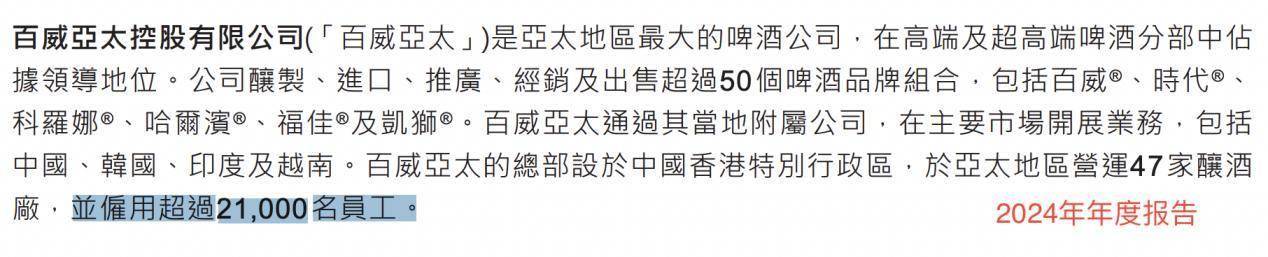
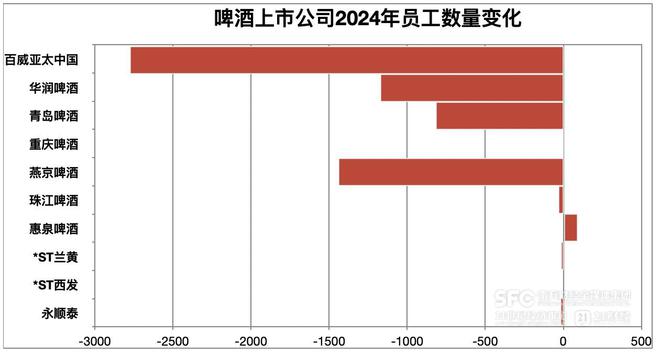
Employment Changes - Budweiser APAC reduced its workforce from approximately 25,000 employees in 2023 to over 21,000 in 2024, resulting in a decrease of about 4,000 employees, which is a reduction rate of approximately 16% [1] - Yanjing Beer reduced its workforce by 1,440 employees, with total employees dropping from 21,405 in 2023 to 19,965 in 2024 [2][5] - China Resources Beer employed around 26,000 people in 2024, down from about 27,000 in 2023, a decrease of 1,000 employees [6] - Qingdao Beer saw a reduction of 817 employees, with total employees decreasing from 30,687 in 2023 to 29,870 in 2024, a reduction rate of 2.66% [8] Financial Performance - Budweiser APAC's beer sales in 2024 were 8.481 million kiloliters, a year-on-year decline of 8.8%, with revenue of $6.246 billion, down 7%, and normalized EBITDA of $1.807 billion, down 6.3% [2] - Yanjing Beer achieved beer sales of 4.0044 million kiloliters in 2024, a year-on-year increase of 1.57%, with revenue of 14.667 billion yuan, up 3.20%, and net profit attributable to shareholders of 1.056 billion yuan, up 63.74% [6] - China Resources Beer reported a total revenue of 38.635 billion yuan in 2024, a slight decline of 0.76%, with net profit attributable to shareholders of 4.739 billion yuan, down 8.03%, and a gross margin of 42.6%, which is an increase of 1.2 percentage points [8] - Qingdao Beer reported revenue of 32.138 billion yuan in 2024, a decrease of 5.3%, while net profit attributable to shareholders was 4.345 billion yuan, an increase of 1.81%, and net profit excluding non-recurring items was 3.951 billion yuan, up 6.19% [10]

东吴证券:一季度啤酒行业恢复性增长 期待旺季量价提速
Zhi Tong Cai Jing· 2025-05-08 08:14
Core Viewpoint - The beer sector is experiencing a recovery in Q1 2025, with revenue of 20.043 billion yuan, a year-on-year increase of 3.68%, and a net profit of 2.519 billion yuan, up 10.62% year-on-year, indicating a positive trend after a challenging 2024 [1][2]. Group 1: Revenue and Profit Trends - In 2024, the beer sector faced pressure with a revenue of 68.038 billion yuan, down 1.67% year-on-year, while net profit reached 7.290 billion yuan, up 6.05% year-on-year [2]. - Q1 2025 shows a recovery with revenue at 20.043 billion yuan, a 3.68% increase, and net profit at 2.519 billion yuan, a 10.62% increase year-on-year [1][2]. Group 2: Volume and Price Dynamics - The beer market has faced challenges in volume and price since 2024, attributed to weak consumer recovery and proactive inventory management by leading companies [3]. - Despite a weak price performance in Q1 2025, sales have shown signs of recovery, indicating potential for improved volume and price dynamics moving forward [3][4]. Group 3: Cost and Margin Analysis - Cost elasticity has been steadily realized since 2024, with gross margin levels improving throughout the year [3]. - In Q1 2025, while the price per ton has decreased, cost elasticity has continued, leading to sustained improvements in gross margin [3][4]. Group 4: Future Outlook and Investment Opportunities - The operational rhythm is expected to support a recovery in volume and price, particularly as Q2 and Q3 2025 enter a low base period [4]. - The current low inventory levels in distribution channels, combined with the approaching peak beer consumption season, present investment opportunities in companies like Qingdao Beer and Yanjing Beer [5].

白酒公司高管集体降薪,有人一年少了四百万
21世纪经济报道· 2025-05-08 03:52
Core Viewpoint - The article discusses the contrasting employment trends in the beer and liquor industries during the current adjustment period, highlighting that while beer companies have reduced their workforce significantly, liquor companies, particularly leading brands, have increased their employee numbers despite facing revenue declines [2][11]. Employment Trends in Beer Industry - Over the past year, the beer industry has seen a reduction of over 6,000 employees across 10 listed companies, with major players like Budweiser APAC and China Resources Beer each reducing their workforce by over 1,000 [5][8]. - The overall employment in the beer sector has decreased to below 300,000, primarily due to declining sales and revenue in the industry [2][5]. - The reduction in workforce is attributed to decreased demand for production and sales roles, particularly for temporary workers during peak seasons [8][9]. Employment Trends in Liquor Industry - In contrast, the liquor industry has experienced an increase of over 3,900 employees, with only 7 out of 22 listed liquor companies reporting reductions [9][12]. - Leading liquor companies such as Kweichow Moutai and Yanghe Brewery have added over 1,000 employees each, indicating a robust demand for production roles [9][12]. - The increase in employment is partly driven by the need to meet production demands and the social responsibility of state-owned enterprises to maintain employment levels [12][13]. Salary Adjustments - While the overall employment levels in liquor companies have increased, there has been a notable reduction in executive compensation, with many high-ranking officials seeing salary cuts of hundreds of thousands [16][17]. - In contrast, the average salary for non-executive employees has remained stable or even increased in some companies, such as Water Well and Kweichow Moutai, which reported a rise in average non-executive salaries [20][21]. Future Outlook - The article suggests that the current adjustment period for the liquor industry is not yet over, and further developments in cost-cutting measures and employee compensation will need to be monitored [21].






酒业迈入降本增效周期:三大啤酒企业去年减员超千人,白酒公司高管集体降薪|酒业财报观察
2 1 Shi Ji Jing Ji Bao Dao· 2025-05-08 00:19
Core Viewpoint - The current adjustment period in the liquor industry shows contrasting trends between beer and liquor companies, with beer companies reducing staff significantly while liquor companies are expanding their workforce despite a general slowdown in performance [1][2][3]. Beer Industry - In the past year, beer companies have collectively reduced their workforce by over 6,000 employees, with major companies like Budweiser APAC and China Resources Beer leading the cuts [5][6]. - Budweiser APAC saw the largest reduction, decreasing from 21,181 employees at the end of 2023 to 18,401 by the end of 2024 [1]. - The overall decline in the beer industry is attributed to a drop in sales and revenue, leading to decreased demand for production and sales staff [8][9]. Liquor Industry - In contrast, the liquor industry has seen an increase in employee numbers, with 22 listed liquor companies collectively adding over 3,900 employees, bringing the total to over 174,000 [11][12]. - Major liquor companies like Kweichow Moutai and Yanghe Distillery increased their workforce by over 1,000 employees each [11]. - The increase in staffing is driven by production needs and a commitment to social responsibility, as many liquor companies are state-owned and are responding to government calls for job stability [12][13]. Salary Trends - While the overall workforce in the liquor industry is expanding, executive salaries have seen significant reductions, with many high-ranking officials experiencing pay cuts of hundreds of thousands of yuan [17][20]. - For instance, the chairman of Kuaizhou Moutai saw a drop in salary from 364.4 million yuan to 264.4 million yuan [17]. - In contrast, the average salary for non-executive employees in the liquor sector has remained relatively stable, with only a few companies reporting slight declines [22][24]. Future Outlook - The current adjustment phase in the liquor industry is ongoing, with expectations for further changes in cost management and employee compensation [24]. - Industry experts suggest that the liquor sector may face a turning point, indicated by market dynamics such as inventory control and pricing strategies [24].
啤酒2024年报及2025年一季报总结:25Q1恢复性增长,期待旺季量价提速
Soochow Securities· 2025-05-07 13:20
Investment Rating - The report maintains an "Accumulate" rating for the beer industry, indicating a positive outlook for investment opportunities in this sector [1]. Core Insights - The beer industry experienced a recovery in Q1 2025 after a challenging 2024, with revenue and profit showing signs of growth. Specifically, the beer sector's revenue for 2024 was CNY 68.038 billion, down 1.67% year-on-year, while net profit increased by 6.05% to CNY 7.290 billion. In Q1 2025, revenue reached CNY 20.043 billion, up 3.68% year-on-year, and net profit rose by 10.62% to CNY 2.519 billion [11][22][24]. Summary by Sections 1. Q1 Performance and Cost Elasticity - The beer sector faced pressure in 2024, but Q1 2025 showed recovery with revenue and profit growth. The revenue for 2024 was CNY 68.038 billion, with a net profit of CNY 7.290 billion. In Q1 2025, revenue was CNY 20.043 billion, and net profit was CNY 2.519 billion, indicating a recovery trend [11][22]. - Cost elasticity has been a key factor in maintaining profit margins, with a steady increase in gross profit margins throughout 2024 and into Q1 2025 [19][20][55]. 2. Future Growth Potential - The report anticipates a positive trend in volume and price in the upcoming quarters, particularly as the industry enters a low base period in Q2 and Q3 2025. The recovery in the restaurant sector is expected to support beer sales [48][50]. - The focus on mid-to-high-end beer products continues to drive growth, with brands like Qingdao Beer and Yanjing Beer expected to perform well due to their strong market positions and product upgrades [53][54]. 3. Investment Recommendations - The report suggests increasing exposure to quality leaders such as Qingdao Beer and Yanjing Beer, which are positioned well for growth in the upcoming consumption peak season. The recommendation is based on their strong cash flow and dividend yield potential [6][24]. - The report highlights the importance of monitoring the recovery of the restaurant sector and the impact of consumption stimulus policies on beer sales [50][52].

青岛啤酒收购即墨老酒100%股权 多元化能否打开增长空间?
Xin Lang Cai Jing· 2025-05-07 12:13
面对每天上千份上市公司公告该看哪些?重大事项公告动辄几十页几百页重点是啥?公告里 一堆专业术语不知道算利好还是利空?请看智通财经公司新闻部《速读公告》栏目,我们派 驻全国的记者们将于公告当晚为您带来准确、快速、专业的解读。 公告数据显示,即墨黄酒厂总资产为约9亿元,净资产为约2亿元。2024年,即墨黄酒实现主营业务收入 约1.66亿元,同比增长13.5%; 实现净利润3047万元,同比增长38.0%。"消费行业3倍PB,20倍PE,在一 级半市场来说,略高一点,不过即墨黄酒厂拥有的'即墨老酒'品牌在当地知名度很高,给出一个略高的 溢价,比较合理。" 青岛啤酒表示,即墨黄酒与青岛啤酒同属发酵酒类行业,随着即墨黄酒的加入,将进一步丰富青岛啤酒 产品线,拓宽市场渠道,为广大消费者提供更加多元化的选择。在品牌及产品宣传推广、销售网络与渠 道等方面与公司现有优势市场和资源进行协同,进一步扩大市场影响力。 从市场销售淡旺季上,"即墨老酒"与啤酒产品可以形成市场销售的互补效应,构建更具市场竞争力的跨 品类产品组合,在巩固传统产品市场地位的同时开辟新的增长点。 有观察人士表示,随着整个啤酒市场的萎缩和高端化进入尾声,头部啤酒 ...
双轮驱动下的行业变革,食品饮料企业ESG实践如何领跑新周期?
Sou Hu Cai Jing· 2025-05-06 17:09
值得注意的是,企业的社会责任实践正进一步向供应链上游延伸。食品饮料行业的碳排放多数与供应链息息相关,这使得协同减排成为破局关键。飞鹤通过 绿色采购标准、供应商碳管理考核等方式,将减排压力传导至上下游。例如,要求包材供应商通过环保认证,推动其采用低碳工艺;创新"厂中厂"模式减少 物流环节排放。此外,产业集群效应带动区域就业与农民增收,实现经济效益与社会效益的双重提升。 当前,ESG实践已从单点突破迈向系统化深耕。董事会主导的治理架构、清晰的碳中和路径、产学研协同创新,成为企业构建可持续竞争力的基石。有学者 认为,行业未来需进一步强化数据披露透明度,探索碳普惠、碳金融等市场化机制,同时加快中小企业的ESG能力建设,推动全行业向绿色、包容、高效的 高质量发展模式迈进。在这场关乎未来的转型中,中国食品饮料企业正以行动证明,践行ESG不是成本负担,而是开启新增长曲线的钥匙。 (资讯图文来源品牌方) 绿色转型的深入推进,离不开科技创新的有力支撑。在食品安全与品质这一行业生命线上,科技正成为破解难题的核心力量。从源头到终端,全产业链数字 化管理体系的构建,确保了产品可追溯性与质量稳定性。飞鹤依托自建牧场与专属农场,实现奶源 ...

啤酒厂商忙活一年却“增利难增收”,饮料化能否成为“第二增长曲线”?
Mei Ri Jing Ji Xin Wen· 2025-05-06 10:00
Core Insights - The beer market is experiencing intensified competition as it enters a phase of stock competition, with contrasting performance driven by events like the European Cup and the Paris Olympics, alongside adverse weather and weak recovery in dining demand [1][3] - The overall beer industry remains highly fragmented, with major players like Budweiser APAC, China Resources Beer, Tsingtao Brewery, and Yanjing Beer generating over 150 billion yuan in total revenue, while smaller companies struggle with revenues below 1.3 billion yuan [1][3] Industry Performance - In 2024, the beer industry in China saw a 0.6% decline in production among large-scale enterprises, with industry revenue decreasing by 5.7%, marking it as the only category in the food and beverage sector to experience a revenue drop [3][8] - Major companies such as Budweiser APAC, Tsingtao Brewery, and China Resources Beer reported revenue declines of 8.8%, 5.3%, and 2.45% respectively, while Yanjing Beer and Zhujiang Beer managed to achieve revenue growth [3][10] Financial Results - Among the six major beer companies, Budweiser APAC, China Resources Beer, and Chongqing Beer all faced declines in both revenue and net profit, while Tsingtao Brewery saw a slight increase in net profit despite a revenue drop [5][6] - Yanjing Beer and Zhujiang Beer reported significant growth in both revenue and net profit, with Yanjing's net profit increasing by 63% [5][6] Q1 2025 Performance - In Q1 2025, major beer companies showed resilience with revenue and net profit growth, particularly Yanjing Beer, which achieved a net profit increase of over 60% [13][14] - Qingdao Beer led in revenue with approximately 10.446 billion yuan, while Zhujiang Beer had the highest revenue growth rate at 10.69% [14][16] Market Trends - The beer market is shifting towards high-end products, with companies focusing on premium offerings to attract consumers [15][17] - Yanjing Beer has launched new beverage products, indicating a strategic move towards diversification and tapping into the beverage market [17][18] - Qingdao Beer is also exploring beverage integration through its strategic merger with Qingdao Beverage Group, enhancing its product offerings and market reach [19]
大众品综述:24年承压,25年改善可期
HTSC· 2025-05-06 04:00
Investment Rating - The report maintains an "Overweight" rating for the food and beverage industry [9]. Core Insights - The food and beverage sector is expected to see improvements in 2025 after a challenging 2024, with various sub-sectors showing signs of recovery and growth potential [1][16]. Dairy Products - The dairy sector experienced a revenue decline of 7.2% in 2024, with a significant drop in net profit by 27% and 43.3% for attributable and non-recurring net profit respectively. However, Q1 2025 showed a slight revenue increase of 0.4% and a notable recovery in non-recurring net profit by 24.4% [2][16]. - Major dairy companies are expected to stabilize operations after channel adjustments, with recommendations for Yili and Mengniu [2][24]. Snack Foods - The snack food sector saw a revenue increase of 2.8% in 2024, but faced challenges in Q1 2025 with a revenue decline of 4.8%. The sector is benefiting from channel innovations and the growth of the konjac category [3][29]. - Companies like Yanjinpuzi and Ganyuan Foods are recommended due to their adaptability to market changes [3][33]. Beer - The beer sector faced a revenue decline of 1.5% in 2024, but Q1 2025 showed a recovery with a 3.7% revenue increase. The sector is expected to improve due to low inventory levels and a stabilizing restaurant demand [4][24]. - Recommended stocks include Yanjing Beer and Zhujiang Beer [4][24]. Soft Drinks - The soft drink sector demonstrated resilience with a revenue growth of 15.7% in 2024, and a stable performance in Q1 2025 with a 5.5% increase. The sector is benefiting from strong travel demand and new product launches [5][24]. - Key recommendations include Nongfu Spring and attention to Kangshifu and Uni-President [5][24]. Condiments - The condiment sector saw a revenue increase of 7.7% in 2024, but growth has been modest in 2025. Major players are adjusting to improve market share [6][24]. - Companies like Haitian Flavoring and Zhongju Gaoxin are highlighted for their ongoing transformations [6][24]. Frozen Foods - The frozen food sector has been under pressure with a revenue increase of only 1.6% in 2024 and a decline of 5.1% in Q1 2025. Intense price competition is affecting profitability [7][24]. - The sector is expected to improve as restaurant demand recovers [7][24].