
中国人民银行

Search documents
央行:“十四五”以来共降准9次,累计下调法定存款准备金率3.5个百分点
Sou Hu Cai Jing· 2025-10-14 09:12
Core Viewpoint - The People's Bank of China has implemented a total of 9 reserve requirement ratio cuts since the beginning of the 14th Five-Year Plan, reducing the statutory deposit reserve ratio by 3.5 percentage points, which has provided approximately 7 trillion yuan in long-term liquidity [1] Monetary Policy Tools - The central bank has employed various monetary policy tools to flexibly adjust short- and medium-term liquidity [1] - The toolbox for monetary policy has been enriched, including operations such as open market transactions of government bonds and reverse repos [1] Credit Growth Management - There is an emphasis on strengthening the understanding and grasp of the supply and demand patterns and new characteristics of monetary credit to promote reasonable growth in monetary credit [1]
央行:10月15日将开展6000亿元买断式逆回购操作 期限为6个月
Zheng Quan Shi Bao Wang· 2025-10-14 09:08
Core Viewpoint - To maintain ample liquidity in the banking system, the People's Bank of China will conduct a 600 billion yuan reverse repurchase operation on October 15, 2025, with a term of 6 months (182 days) using a fixed quantity, interest rate bidding, and multiple price level bidding method [1] Group 1 - The operation will involve a total of 600 billion yuan [1] - The reverse repurchase operation is aimed at ensuring liquidity in the banking system [1] - The term for this operation is set at 6 months (182 days) [1]
个人存取款5万元登记再调整,意味着什么?银行员工透露详情
Sou Hu Cai Jing· 2025-10-13 18:05
Core Viewpoint - The recent fluctuations in the economy and the ongoing pandemic have led to increased public anxiety regarding personal income stability and employment prospects, resulting in a significant rise in personal savings in China, which now totals 227.21 trillion yuan, making China the leader in global deposit scale [1] Group 1: Regulatory Changes - The People's Bank of China (PBOC) has introduced a new regulation requiring commercial banks to inquire about the source and purpose of personal deposits exceeding 50,000 yuan, with detailed customer information to be recorded [4] - The regulation aims to combat money laundering, telecom fraud, illegal fundraising, and tax evasion, thereby maintaining the overall stability and security of the financial system [6] Group 2: Public Reaction - The new regulation has sparked discussions and dissatisfaction among depositors, who feel that their financial privacy is being infringed upon by the banks' inquiries into the purpose of large withdrawals [3] Group 3: Adjustments to the Regulation - Following the implementation of the regulation, the PBOC has adjusted the threshold for reporting large transactions, with some regions increasing the limit to 100,000 yuan or more, to balance regulatory effectiveness and operational efficiency [8] - The adjustments also reflect a consideration for depositor privacy, acknowledging that large cash withdrawals may involve sensitive personal matters [8] - The initial 50,000 yuan threshold was deemed to potentially overwhelm bank staff with excessive workload, prompting the need for a more manageable standard [8] Group 4: Future Regulatory Strategies - The PBOC is advancing its digital currency strategy as a means to enhance financial regulation, with digital yuan transactions being traceable, thus providing a robust tool for preventing financial crimes [9] - Digital yuan can facilitate transactions even in areas lacking traditional network coverage, expanding its application and offering more flexible regulatory options [9]

货币市场日报:10月13日
Xin Hua Cai Jing· 2025-10-13 14:30
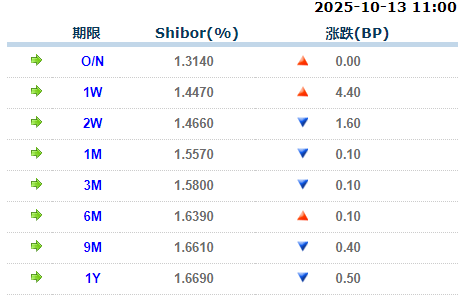
Core Viewpoint - The People's Bank of China conducted a 137.8 billion yuan reverse repurchase operation with a rate of 1.40%, resulting in a net injection of 137.8 billion yuan into the market on October 13, 2025 [1]. Market Rates Summary - The Shanghai Interbank Offered Rate (Shibor) for the 7-day term increased by 4.40 basis points to 1.4470%, while the overnight Shibor remained unchanged at 1.3140% [1][2]. - The 14-day Shibor decreased by 1.60 basis points to 1.4660% [2]. Interbank Repo Market - In the interbank pledged repo market, most rates increased slightly, with DR001 and R001 weighted average rates rising by 0.3 basis points and 4.0 basis points to 1.3131% and 1.357%, respectively [6]. - The transaction volumes for DR001 and R001 increased significantly, with DR001 seeing a rise of 2.652 billion yuan and R001 increasing by 43.681 billion yuan [6]. Funding Conditions - The overall funding environment was described as balanced and slightly loose, with overnight rates for collateralized loans ranging from 1.35% to 1.5% [10]. - By the end of the trading day, the overnight rates dropped to around 1.28%, indicating a continued loose funding condition [10]. Interbank Certificates of Deposit - On October 13, 66 interbank certificates of deposit were issued, totaling 48.59 billion yuan [11]. - The trading sentiment for secondary market certificates was described as subdued, with yields for various maturities showing slight increases compared to the previous trading day [11].
央行发文!金融机构加强客户受益所有人识别
Zhong Guo Jing Ying Bao· 2025-10-13 07:33
一是基于风险原则。金融机构应当按照基于风险的原则,采取与风险程度相匹配的差异化措施识别核实 客户的受益所有人。 中经记者 郝亚娟 夏欣 上海、北京报道 近日,中国人民银行研究起草了《金融机构客户受益所有人识别管理办法(征求意见稿)》。 上述文件要求,金融机构应当按照以下原则开展受益所有人识别核实工作: 金融机构不得仅通过查询中国人民银行受益所有人信息查询管理系统的方式获取受益所有人信息,或者 直接通过批量化、自动化等辅助手段代替必要的风险判断和受益所有人识别核实。 (编辑:朱紫云 审核:何莎莎 校对:颜京宁) 二是合理性原则。金融机构应当勤勉尽责,通过合理的手段了解客户的所有权和控制权结构,识别并采 取合理措施核实受益所有人,从而确信其了解客户的受益所有人身份信息和权利状况信息。 三是可靠性原则。金融机构应当通过来源可靠的佐证材料、数据或信息识别核实受益所有人,并综合考 虑这些不同来源的佐证材料、数据或信息相互印证以后的整体可靠性。 ...
节后买断式逆回购操作释放积极信号,资金利率或低位运行
Xin Hua Cai Jing· 2025-10-13 02:03
Group 1 - The People's Bank of China (PBOC) conducted a 1.378 trillion yuan 7-day reverse repurchase operation at an interest rate of 1.40%, maintaining the previous rate, resulting in a net injection of 1.378 trillion yuan due to no reverse repos maturing on that day [1] - From September 28 to October 11, the central bank's reverse repo net withdrawal reached 1.3304 trillion yuan, with a significant operation of 1.1 trillion yuan 3-month reverse repos announced on October 9, contrasting with a net injection of 300 billion yuan for the month [1] - Despite the large-scale reverse repos maturing after the holiday, funding prices gradually returned to pre-quarter-end levels, with overnight funding rates dropping to 1.33%, down 21 basis points from before the holiday [1] Group 2 - The upcoming week (October 13-17) will see a decrease in reverse repo maturities to 1.021 trillion yuan, with significant amounts maturing on Thursday and Friday, and a total of 8 billion yuan 3-month reverse repos maturing on Tuesday [2] - Analysts expect the funding environment to remain loose, as the central bank's proactive measures and limited government bond net payments will help mitigate external disturbances [2] - The liquidity test in October is anticipated to be concentrated at the end of the month, with tax payment deadlines delayed to October 27, coinciding with the month-end liquidity pressure [3] Group 3 - The PBOC's liquidity injection tools have shifted towards longer-term MLF and reverse repos since the third quarter, reducing the necessity for frequent short-term operations [4] - Despite the increase in reverse repo maturities post-holiday, the central bank's consistent stance on liquidity provision suggests limited impact on the funding environment [4] - Analysts from Citic Securities believe that the liquidity gap in October may be weaker than seasonal trends, with the central bank's monetary policy remaining accommodative [3][4]
中国人民银行已与三十二个国家和地区签署协议 本币互换对我国经济有何作用(政策解读·问答)
Ren Min Ri Bao· 2025-10-12 21:57
Core Viewpoint - The People's Bank of China (PBOC) has been actively deepening foreign currency financial cooperation by signing bilateral currency swap agreements with various central banks, enhancing the international use of the Renminbi and promoting economic stability [1][3]. Group 1: Currency Swap Agreements - In 2023, the PBOC has signed or renewed bilateral currency swap agreements with eight foreign central banks, including the European Central Bank and the Bank of Thailand [1]. - As of September 30, 2023, the PBOC has established effective bilateral currency swap agreements with 32 countries and regions, covering major economies across Asia, Europe, Africa, the Americas, and Oceania [3]. Group 2: Benefits of Currency Swaps - Currency swaps facilitate cross-border trade and investment, significantly promoting international economic development [4]. - For instance, the renewed currency swap agreement between China and Brazil, which began in 2013 with a scale of 190 billion RMB, has strengthened trade relations and market confidence, maintaining Brazil as China's largest trading partner in Latin America [4]. Group 3: Impact on Enterprises - Companies engaged in overseas operations can apply for local currency funding under the swap agreements, allowing them to quote and settle transactions in Renminbi or the local currency, thus stabilizing costs and profits against USD exchange rate fluctuations [5]. - This mechanism enables enterprises to achieve more precise pricing and enhances their competitiveness in international markets [5]. Group 4: Implications for the Renminbi - The expanding scale and scope of currency swaps indicate a growing willingness among countries to hold and use the Renminbi, reflecting an increase in its international recognition [6]. - Currency swaps have become a crucial part of the global financial safety net, enhancing financial autonomy and stability for participating countries [6].
中美关税摩擦再升级,警惕对风险资产冲击
Hua Tai Qi Huo· 2025-10-12 11:59
Report Industry Investment Rating No relevant content provided. Core Viewpoints - Domestic economic situation shows a gap between strong expectations and weak reality, with economic pressure increasing marginally in August, featuring "slow industry, weak investment, and dull consumption," and external tariff pressure rising. The government has introduced policies such as new policy - based financial tools worth 500 billion yuan and 1.1 trillion yuan of repurchase operations to address these issues. Attention should be paid to post - holiday policy expectations and the possible correction of the current off - peak season situation [2]. - Sino - US tariff friction has intensified. With the expiration of the tariff delay on November 10 approaching, the market's concern about the risks brought by tariff friction has risen rapidly. Before the South Korea APEC Summit from October 28 to November 1, the risk impact of tariff escalation on the market should be vigilant [3]. - The US government shutdown has entered its second week, and the market has under - priced the severity of the shutdown. Attention should be paid to the follow - up development of the event. In the commodity market, focus on sectors such as gold and non - ferrous metals, and also pay attention to the "anti - involution" space of some chemical products and the impact of Sino - US negotiations on agricultural products [4]. - In terms of strategy, it is recommended to allocate long positions in industrial products and precious metals in the commodity and stock index futures markets [5]. Summary by Directory Market Analysis - Domestic economic data in August showed signs of weakness, with external tariff pressure increasing from the US, Mexico, India, etc. The government has introduced policies to stabilize growth, including new policy - based financial tools and large - scale repurchase operations. Attention should be paid to post - holiday policy expectations and the possible correction of the off - peak season situation [2]. - Sino - US tariff friction has escalated. The US has taken measures such as adding Chinese enterprises to the entity list and increasing tariffs on imported products. China has responded with export controls on rare earths. Before the South Korea APEC Summit, the risk impact of tariff escalation on the market should be vigilant [3]. - The US government shutdown has entered its second week, affecting economic data release. The market has under - priced the severity of the shutdown. In the commodity market, different sectors have different trends, and gold is expected to strengthen [4]. Strategy - In the commodity and stock index futures markets, it is recommended to allocate long positions in industrial products and precious metals [5]. To - do List - On October 6, Trump announced a 25% tariff on imported medium and heavy - duty trucks starting from November 1, 2025. On September 25, he had announced a 25% tariff on all imported heavy - duty trucks starting from October 1 [6]. - The Fed's attitude towards the economy and inflation is complex. Some officials believe that continued easing may be appropriate this year, but inflation has upward risks, and employment has downward risks [6]. - China's central bank increased its gold reserves for the 11th consecutive month in September, and on October 9, it carried out 1.1 trillion yuan of repurchase operations [6]. - The first - stage Gaza cease - fire agreement came into effect on October 9, and Israel approved the agreement on October 10 [6]. - The US will impose additional port service fees on Chinese - owned or - operated ships starting from October 14, which seriously violates international trade principles and the Sino - US shipping agreement [6]. Macroeconomic Indicators - **US Economic Heat Map**: In September 2025, the GDP growth rate was 2.08%, the Markit manufacturing PMI was 52.00, and the service PMI was 54.20. Investment, employment, inflation, consumption, finance, and net exports all had corresponding data changes [8]. - **European Economic Heat Map**: In September 2025, the GDP growth rate was 1.30%, the manufacturing PMI was 49.80, and the service PMI was 51.30. There were also changes in investment, employment, consumption, inflation, trade, credit, and finance [9]. - **Chinese Economic Heat Map**: In the third quarter of 2025, the GDP growth rate was 5.2%. Trade, investment, consumption, inflation, finance, and other aspects had different trends, such as a 5.9% cumulative year - on - year increase in export volume and a 0.5% cumulative year - on - year increase in fixed - asset investment [10]. Interest Rates - The report provides data on the 10 - year and 2 - year Sino - US Treasury bond spreads [21]. Foreign Exchange - It includes data on the week - on - week change of the US dollar against major currencies and the trend of the US dollar index [24][26].
锁定受益人!事关反洗钱央行再放大招,这次有哪些亮点
Bei Jing Shang Bao· 2025-10-12 10:12
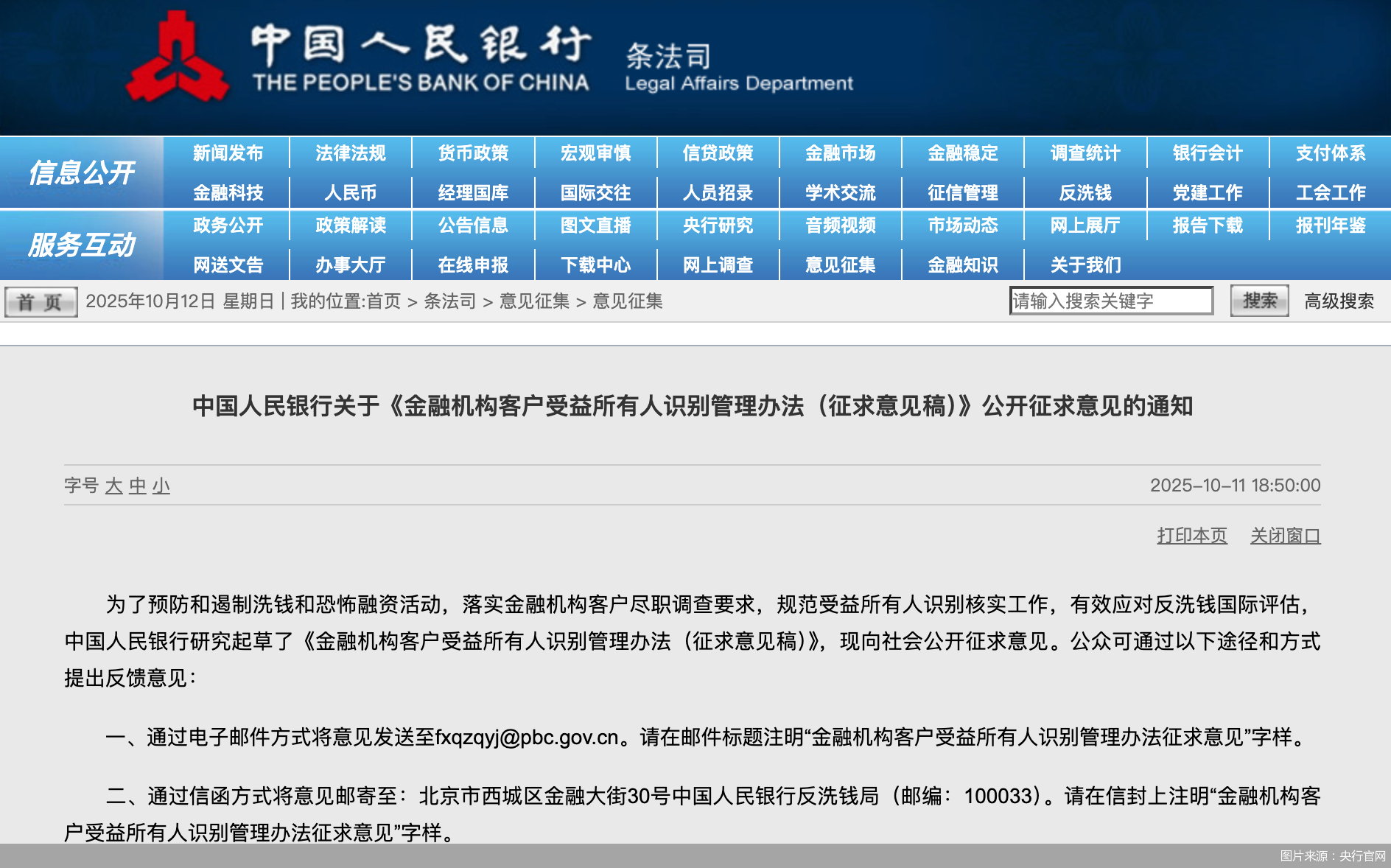
Core Viewpoint - The People's Bank of China is drafting new regulations to enhance the identification and verification of beneficial owners by financial institutions, in line with the revised Anti-Money Laundering Law, aiming to improve the effectiveness of anti-money laundering efforts and comply with international assessments [1][4]. Summary by Relevant Sections Regulatory Framework - The new regulation, titled "Management Measures for the Identification of Beneficial Owners of Financial Institutions," is open for public consultation as of October 11 [1]. - The regulation aims to standardize the identification and verification processes for beneficial owners, addressing the shortcomings identified in current practices [4]. Risk-Based Approach - Financial institutions are required to adopt a risk-based approach in their customer due diligence, differentiating measures based on the risk profile of clients [4]. - The regulation specifies that beneficial owners are identified as individuals or entities holding more than 25% of shares, rights, or control over a company [4]. Differentiated Measures - The regulation introduces differentiated measures for low-risk and high-risk clients, moving away from a "one-size-fits-all" approach, which previously led to inefficiencies and resource wastage [5]. - For low-risk situations, simplified processes can be applied, while high-risk cases will receive more thorough scrutiny [5]. Feedback Mechanism - A differential feedback mechanism is established, requiring financial institutions to report discrepancies found during the verification of beneficial owner information [6]. - Institutions must communicate with clients to resolve any inconsistencies and correct any inaccuracies in their identification of beneficial owners [6]. Implementation and Training - Financial institutions are encouraged to enhance internal training to ensure staff understand and can effectively implement the new measures [6]. - Regulatory bodies are expected to strengthen oversight and international cooperation to combat cross-border money laundering [6].
人民银行就《金融机构客户受益所有人识别管理办法(征求意见稿)》公开征求意见
Xin Hua Cai Jing· 2025-10-11 11:56
《办法》贯彻基于风险原则,明确金融机构对于低风险客户可以适用豁免、简化识别标准。 《办法》一是明确受益所有人识别核实整体流程及要求;二是明确了应识别、保存的受益所有人身份信 息和权利状况信息要素;三是规定金融机构应基于风险采取差异化的识别核实措施。 (文章来源:新华财经) 《办法》规定了法人与非法人组织、信托、资产管理产品的受益所有人定义与识别标准,其中法人与非 法人组织的识别标准与《受益所有人信息管理办法》一致。 新华财经北京10月11日电中国人民银行就《金融机构客户受益所有人识别管理办法(征求意见稿)》 (以下简称《办法》)公开征求意见。 《办法》参考反洗钱国际标准,强调金融机构应在开展客户尽职调查时,识别并采取合理措施核实客户 受益所有人,要求金融机构遵循基于风险原则、合理性原则和可靠性原则开展受益所有人识别核实工 作。 ...