三星电子

Search documents
物理AI专利竞争力:中企包揽前三
日经中文网· 2026-01-16 08:00
Core Viewpoint - The article discusses the competitive landscape of patents in the field of "physical AI," which integrates humanoid robots and artificial intelligence, highlighting China's leading position in this sector [2][4]. Group 1: Patent Competitiveness - China ranks first globally in the comprehensive strength of patents related to physical AI, followed closely by the United States [2]. - The analysis was conducted with the assistance of LexisNexis, focusing on the integration of robotics and AI technologies [2]. Group 2: Leading Companies - The top three companies in terms of comprehensive patent strength in the physical AI sector are Baidu (4126 points), Huawei (3645 points), and Tencent (3043 points), all from China [5][6]. - Samsung Electronics from South Korea ranks fourth with 2734 points, followed by NVIDIA from the United States with 2154 points [5]. Group 3: Comparative Analysis - Chinese companies, while leading in quantity, still face challenges in patent quality compared to American firms like Intel, NVIDIA, and Alphabet, although Huawei is reportedly nearing their level [6]. - Japan's highest-ranked company in this field is Fanuc, which is positioned at 13th place [6].






涨价潮不止,存储芯片继续爆发!
Ge Long Hui· 2026-01-16 07:25
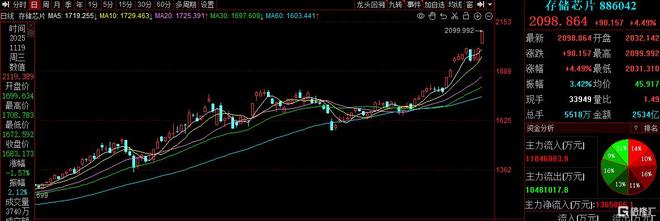
Core Viewpoint - The memory and storage prices are experiencing significant increases, with prices rising three to four times compared to last year, driven by high demand from AI servers and a "super bull market" in the storage sector [1][6]. Group 1: Market Performance - The A-share storage chip sector index surged over 4% today, with a cumulative increase of over 18% this year [2]. - Individual stocks such as Jintaiyang and Baiwei Storage reached their daily limit, with Baiwei Storage and Jingce Electronics rising over 16% [4][5]. Group 2: Price Trends - DDR5 memory prices have increased by over 300% since September 2025, while DDR4 memory prices have risen by over 150% [6]. - AI servers are consuming 53% of global memory monthly production capacity, significantly impacting consumer-grade memory supply [6]. Group 3: Company Performance - Baiwei Storage forecasts a revenue of 10 billion to 12 billion yuan for 2025, representing a year-on-year growth of 49.36% to 79.23%, with net profit expected to increase by 427.19% to 520.22% [8]. - Other companies in the market are also expected to see significant profit increases, with predictions of over 100% growth for several storage-related stocks [8]. Group 4: Analyst Predictions - Bernstein raised SanDisk's target price from $300 to $580, citing an unprecedented storage super cycle driven by AI [9]. - Wells Fargo also increased target prices for several storage companies, including Western Digital and Micron Technology, reflecting the bullish outlook on the storage market [9].

台积电业绩狂飙引爆AI行情,阿斯麦市值一举突破5000亿美元
Jin Rong Jie· 2026-01-16 06:21
Group 1 - TSMC reported Q4 2025 revenue of $33.73 billion, a year-on-year increase of 25.5%, and a net profit of approximately $16 billion, up 35%, with a gross margin of 62.3%, marking the eighth consecutive quarter of profit growth [1] - Advanced processes contributed significantly, with 3nm technology accounting for 28% of Q4 wafer revenue, and 77% of revenue coming from 7nm and below advanced processes, an increase of 5 percentage points compared to the full year of 2024 [1] - TSMC's 2026 guidance includes expected Q1 revenue between $34.6 billion and $35.8 billion, with a gross margin maintained at 63% to 65%, and a capital expenditure plan raised to $52 billion to $56 billion, significantly higher than $40.9 billion in 2025 [1] Group 2 - ASML, TSMC's largest single equipment customer, saw its stock price rise significantly, with a market capitalization exceeding $500 billion, making it the third European company to reach this scale [2] - ASML's stock increased by 7.6% during trading in Amsterdam, with a year-to-date gain of 24%, currently valued at approximately $527 billion [2] - Morgan Stanley's report indicates that ASML's Q4 2025 order volume is expected to reach €7 billion, exceeding market consensus by about 4%, maintaining an "overweight" rating on ASML's stock with a target price of $1,518 [2]
美光1000亿美元芯片工厂动工!
国芯网· 2026-01-16 04:41
国芯网[原:中国半导体论坛] 振兴国产半导体产业! 不拘中国、 放眼世界 ! 关注 世界半导体论坛 ↓ ↓ ↓ 1月16日消息,美光科技于纽约州奥农达加县的超级晶圆厂举行破土动工仪式。 这一项目不仅是纽约州有史以来规模最大的私人投资,更是美国历史上最大的半导体制造项目,总投资 达 1000亿美元。 据了解,美光最初于2022年10月公布建厂计划,原定2024年中开工。然而,由于长达上万页的环境评估 报告审查流程,工期推迟了约一年半。 根据最新安排,美光计划在3月31日前完成场地清理,随后进行铁路支线与湿地平整工作。预计首座工 厂将于2030年投产,第二座工厂将在三年后启用。至2045年第四座工厂建成时,该项目将创造约9000个 就业岗位。 若美光能按计划将其市场份额提升至40%,则有望超越竞争对手,跃升为全球第一大存储公司。 ***************END*************** 半导体公众号推荐 半导体论坛百万微信群 市场研究机构Counterpoint Research的数据显示,在2025年第三季度全球HBM市场中,美光以21%的营 收份额位列第三,落后于SK海力士(57%)和三星电子(22 ...

台积电利润狂飙! 市值已超三星两倍!
国芯网· 2026-01-16 04:41
国芯网[原:中国半导体论坛] 振兴国产半导体产业! 不拘中国、 放眼世界 ! 关注 世界半导体论坛 ↓ ↓ ↓ 尽管特朗普的贸易政策以及对半导体加征关税的威胁给全球芯片行业带来了诸多不确定性,但这种不确定性尚未严重影响人工智能热潮推动下的芯片制造 商利润飙升的势头。 1月16日消息,台积电公布第四季度财报,显示利润飙升35%,达到约160亿美元,创历史新高! 与此同时,台积电也在加大对美国芯片制造的投资。去年3月,台积电宣布计划在美国投资1000亿美元,此前该公司已承诺在亚利桑那州投资650亿美元建 设三家工厂,其中一家已投入运营。 ***************END*************** 半导体公众号推荐 半导体论坛百万微信群 加群步骤: 第一步:扫描下方二维码,关注国芯网微信公众号。 台积电预测今年将实现更强劲的增长。该公司称,得益于全球人工智能行业的蓬勃发展,预计今年第一季度营收将同比增长40%,达到358亿美元,并预 计2026年资本支出将增长高达37%,达到560亿美元。 台积电还称,客户发出了强烈的"需求信号",并直接联系公司寻求产能。 台积电是亚洲市值最高的上市公司,截至当天发稿,台积 ...

各地公布最低时薪|首席资讯日报
首席商业评论· 2026-01-16 04:10
Group 1 - The Ministry of Human Resources and Social Security has released the minimum wage standards for various provinces, with Guangdong's monthly minimum wage set at 2500 yuan for the highest tier and 1750 yuan for the lowest tier, while hourly wages range from 23.7 yuan to 17.4 yuan [2] - Two films, including "Boonie Bears: Year of the Bear" and "Fast and Furious 3," have been officially scheduled for release during the 2026 Spring Festival [3] - CK Hutchison is seeking a valuation of approximately $30 billion for its retail subsidiary, Watsons, in an upcoming IPO, aiming for a dual listing in Hong Kong and London by mid-year [4] Group 2 - Xibei's founder confirmed the closure of 102 stores, representing 30% of its total outlets, while ensuring that customer prepaid cards can be used at other locations or refunded [5][6] - The U.S. plans to suspend visa processing for 75 countries, including Somalia, Russia, and Nigeria, to combat potential public burden applicants [7] - Elon Musk's social platform X announced measures to restrict its AI chatbot Grok from generating explicit images, following widespread criticism for misuse [8] Group 3 - Sun Yinan, former CEO of Wei Long, has joined Dayao as CEO, bringing significant experience from the fast-moving consumer goods sector [9] - Nvidia has raised the supply standards for HBM4 chips from Samsung and SK Hynix, prompting Samsung to adjust its chip designs to enhance performance [10] - Tesla's lithium refining plant has commenced operations, marking it as the largest lithium refining facility in the U.S. [11] Group 4 - Daiwa Capital forecasts strong growth in the South Korean robotics market, predicting installations will surge from 31,000 units in 2024 to 99,000 units by 2030, driven by AI advancements [12] - SF Express and Jitu Express have signed a subscription agreement for mutual share recognition, involving nearly 8.3 billion Hong Kong dollars [13] - EDG esports club's affiliated company has been penalized for tax evasion, resulting in a fine of 53,890.93 yuan for underreported tax [14]
前方高能! AI燃爆存储芯片超级周期,这位业绩跑赢97%同行的基金经理押注“存储”为最佳主题
Zhi Tong Cai Jing· 2026-01-16 02:56
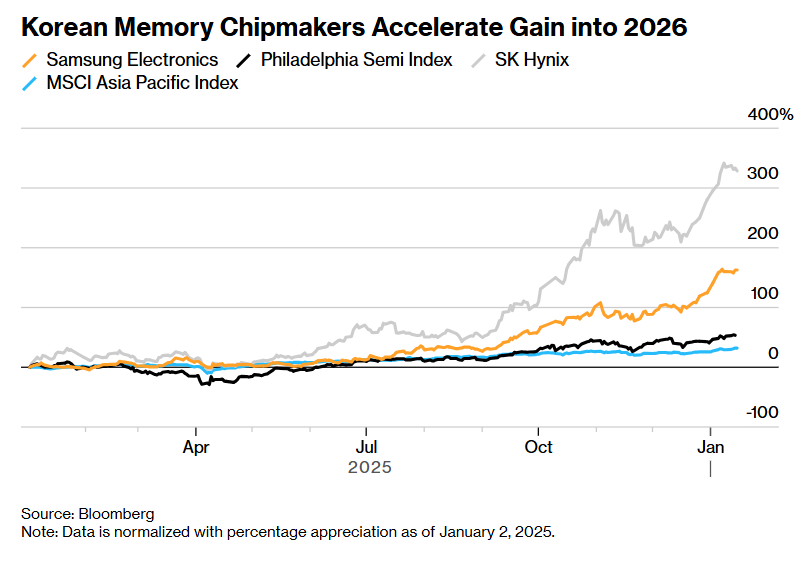
Core Viewpoint - The unprecedented global wave of artificial intelligence (AI) is expected to drive a significant increase in demand for chips, particularly AI chips and storage chips, over the next decade, with storage chip stocks being highlighted as the most promising investment area by industry experts [1][4]. Group 1: Market Trends and Performance - The Korean stock market, driven by major storage chip companies SK Hynix and Samsung Electronics, is projected to surge by 76% in 2025, marking it as one of the most dynamic markets globally [2]. - Micron Technology (MU.US), the only major U.S. storage chip manufacturer, is expected to see its stock price increase by 240% in 2025, with an 18% rise already noted in 2026 [2]. - The demand for DRAM/NAND storage chips remains robust, with prices experiencing significant increases due to the heightened importance of storage chips in AI training and inference systems [2][11]. Group 2: Company Performance and Projections - TSMC reported a record gross margin exceeding 60% and significantly raised its revenue growth forecast for 2026 to nearly 30%, indicating strong performance in the chip manufacturing sector [3]. - ClearBridge Investments' fund manager Divya Mathur has seen his fund outperform 97% of peers, heavily investing in Samsung Electronics and SK Hynix, which are expected to see substantial stock price increases [4]. - The storage chip sector is anticipated to enter a "super cycle" that could last until at least 2027, with meaningful supply increases not expected until early 2028 [13][14]. Group 3: Price Dynamics and Supply Constraints - Analysts predict that the prices of DRAM and NAND storage chips will experience steep increases, with forecasts for 2026 showing a potential rise of 88% for DRAM and 74% for NAND [15]. - The supply of storage products is constrained as manufacturers focus on advanced HBM storage systems, leading to shortages in traditional storage products [11]. - The ongoing construction of large AI data centers is driving demand for storage components, which is expected to exceed supply, benefiting companies like Micron, SK Hynix, and Samsung [11][12].
前方高能! AI燃爆存储芯片超级周期 这位业绩跑赢97%同行的基金经理押注“存储”为最佳主题
智通财经网· 2026-01-16 02:30
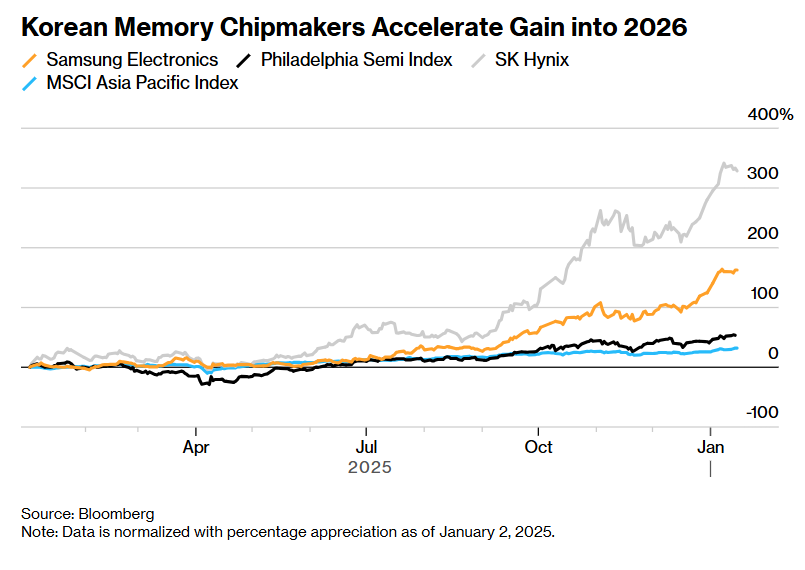
Core Viewpoint - The unprecedented global wave of artificial intelligence (AI) is expected to drive a significant increase in chip demand, particularly for AI chips and storage chips, over the next decade, making storage chip stocks a highly attractive investment opportunity [1][3]. Group 1: Market Trends - The Korean stock market, driven by major storage chip manufacturers SK Hynix and Samsung Electronics, is projected to surge by 76% in 2025, marking it as one of the most dynamic markets globally [2]. - Micron Technology's stock is expected to rise by 240% in 2025, with a strong 18% increase already noted in 2026 [2]. - The demand for DRAM/NAND storage chips is experiencing robust growth, with prices for products like DDR4/DDR5 and enterprise SSDs showing significant increases due to the rising importance of storage chips in AI training and inference systems [2][11]. Group 2: Company Performance - TSMC reported a record gross margin exceeding 60% in Q4, with a projected revenue growth rate of nearly 30% for 2026, significantly surpassing market expectations [3]. - ClearBridge Investments' emerging market fund manager, Divya Mathur, has seen performance exceed 97% of peers, heavily investing in Samsung Electronics and SK Hynix, which are expected to see their stock prices double and quadruple, respectively, by 2025 [3][4]. - The stock prices of Western Digital, Seagate, and SanDisk have also shown remarkable growth, with all three companies experiencing over 200% price increases in 2025 [12]. Group 3: Future Projections - Analysts predict that the "storage chip supercycle" will last at least until 2027, with meaningful supply increases not expected until early 2028 [13][14]. - Citigroup analysts have raised their price forecasts for DRAM and NAND chips significantly, anticipating an 88% increase in DRAM prices and a 74% increase in NAND prices in 2026 [15]. - The ongoing construction of large AI data centers is expected to create a strong demand for storage components, which is currently outpacing supply, benefiting companies like Micron, Samsung, and SK Hynix [11].
韩媒:三星2nm,还差点
半导体行业观察· 2026-01-16 01:48
Core Viewpoint - TSMC is expanding its leading position in the advanced wafer foundry market, significantly increasing its 3nm process sales share in Q4 last year and planning to start mass production of its 2nm process this year [1][2]. Group 1: TSMC Developments - TSMC's 3nm process accounted for 28% of its total sales as of Q4 last year, marking a historical high [2]. - TSMC's N2 (2nm) process successfully entered mass production in the second half of last year, with expectations for rapid full-scale production this year [1]. - The N2P process, a follow-up to the N2 process, is also set to begin mass production in the second half of this year, offering improvements in performance and energy efficiency [1]. - TSMC's 2nm process has reportedly maintained a stable yield since mass production began, with local sources claiming yields exceed 80% [1]. Group 2: Samsung Electronics Developments - Samsung began mass production of its first-generation 2nm (SF2) process-based mobile application processor Exynos 2600 in Q4 last year, targeting deployment alongside Qualcomm's latest chipsets [2]. - The yield for the Exynos 2600 is estimated at around 50%, a significant improvement from approximately 30% mid-last year, with no major defects reported during initial mass production [2]. - The success of Samsung's second-generation 2nm process (SF2P) is deemed crucial for the recovery of its advanced wafer foundry business, with performance improvements of 12%, energy efficiency improvements of 25%, and an 8% reduction in chip size compared to SF2 [2][3]. Group 3: Strategic Partnerships and Future Prospects - Samsung has signed a semiconductor foundry production contract worth 22 trillion Korean Won with Tesla, aiming to mass-produce the AI6 chip using the SF2P process [3]. - The AI6 chip is intended for Tesla's next-generation Full Self-Driving (FSD), robotics, and data center applications, with initial samples produced in domestic facilities before full-scale production at a new fab in Taylor [3]. - SF2P is the first 2nm process from Samsung to receive formal confirmation for large-scale production from external customers, which could encourage other clients to request mass production [4].
巨头们竞逐玻璃基板
半导体行业观察· 2026-01-16 01:48
Core Viewpoint - The commercialization of glass substrates, a key technology for next-generation semiconductor packaging, is accelerating, with companies like SK, LG, and Samsung rapidly expanding partnerships with material and process suppliers [1] Group 1: Industry Trends - The competitive landscape has shifted from pure technology research to a value chain battle aimed at large-scale production [1] - Glass substrates are viewed as an ideal alternative for next-generation packaging due to their advantages such as low thermal expansion coefficient, high surface flatness, low signal loss, and high energy efficiency [1] - The increasing prevalence of high-performance, high-integration chips, particularly in artificial intelligence semiconductors, has heightened the importance of precision and stability during the packaging phase [1] Group 2: Company Strategies - SKC, through its subsidiary Absolics, is accelerating preparations for mass production of glass substrates, viewing it as a high-value packaging material that can grow alongside AI semiconductor business [1][2] - Absolics is diversifying its supply sources for photoresists by introducing domestic suppliers and is seeking more partners for glass through-hole (TGV) and electroplating processes [2] - Samsung is actively developing key components for glass substrates through a joint venture with Sumitomo Chemical and has invested in JWMT to support factory expansion and capacity enhancement [2] - LG Innotek is evaluating the glass substrate business as an extension of its existing substrate and packaging operations, collaborating with UTI to develop technology for enhancing glass substrate strength [2] Group 3: Production Challenges - The complexity of glass substrate processes, which include photoresists, glass core materials, hot pressing, electroplating, and tempered glass processing, makes it difficult for a single company to complete all processes independently within a limited timeframe [3] - As mass production plans become clearer, the demand for establishing partnerships to stabilize output and yield is increasing [3] - The competition in the glass substrate field is not about who masters the technology first, but rather who completes the mass-producible structural design first [3]