英维克

Search documents
液冷板块反复活跃 多股涨超7%
Mei Ri Jing Ji Xin Wen· 2025-08-11 02:07
Group 1 - The liquid cooling concept stocks are experiencing significant activity, with companies like Eurocontinental approaching the daily limit increase [1] - Other companies in the sector, such as Aikesaibo, Fangsheng Co., Invec, Chuanhuan Technology, and Sixuan New Materials, have seen their stock prices rise by over 7% [1]




10个行业获融资净买入 20股获融资净买入额超1亿元
Zheng Quan Shi Bao Wang· 2025-08-11 01:45
Group 1 - On August 8, among the 31 first-level industries, 10 industries received net financing inflows, with the non-ferrous metals industry leading at a net inflow of 359 million yuan [1] - Other industries with significant net financing inflows included computer, automotive, defense and military, social services, and comprehensive sectors, with net inflows of 334 million yuan, 121 million yuan, 81.19 million yuan, 75.19 million yuan, and 73.91 million yuan respectively [1] - A total of 1552 individual stocks received net financing inflows on August 8, with 131 stocks having inflows exceeding 30 million yuan [1] Group 2 - Among the stocks, Yangguang Electric Power had the highest net financing inflow of 245 million yuan [1] - Other notable stocks with significant net inflows included Dongxin Technology, Shenghe Resources, Huayou Cobalt, Yangjie Technology, Tianqi Lithium, Yingwei Ke, Jiejia Weichuang, and Chutianlong, with net inflows of 219 million yuan, 212 million yuan, 191 million yuan, 156 million yuan, 152 million yuan, 137 million yuan, 129 million yuan, and 129 million yuan respectively [1]



AI&半导体电话会:液冷渗透率提升,FAB稳健成长
2025-08-11 01:21
AI&半导体电话会:液冷渗透率提升,FAB 稳健成长 20250810 摘要 海外云厂商如微软、亚马逊和 Meta 持续增加对 AI 的投入,资本开支显 著上调,形成正向循环,微软 AI 云计算业务同比增长 27%,亚马逊全 年资本开支预计达 1,100 亿至 1,200 亿美元,Meta 将 2025 年资本开 支上调至 660 亿到 720 亿美元。 液冷技术市场前景乐观,维谛公司二季度营收同比增长 35%,订单收入 达 85 亿美元。英伟达发布 GV300 GPU,微软明确要求数据中心支持 液冷,中国台湾供应商奇宏等营收显著增长,数据中心冷却系统供不应 求。 数据中心采用液冷技术主要由功耗驱动,传统风冷接近极限,液冷能效 比更高。全球数据中心液冷渗透率预计从 2024 年的 14%提高到 2025 年的 20%以上,国内市场增长空间巨大。 2024 年全球液冷服务器市场中,浪潮信息、超聚变和宁畅占据前三位, 合计市场份额超过 70%。这些公司在液冷技术方面积累了较强的技术和 服务能力,产业生态协同完善。 Q&A 这些公司凭借其强大的研发能力和广泛的市场覆盖,在激烈竞争中保持领先地 位。 液冷技术在数据中 ...


当前AI机柜内,液冷趋势与空间
2025-08-11 01:21
Summary of Conference Call Records Industry Overview - The conference call discusses advancements in liquid cooling technology within the server cabinet industry, particularly focusing on the Blackwell and Rubin series of products [1][2][6]. Key Points and Arguments 1. **Blackwell 300 Improvements**: The Blackwell 300 has undergone significant enhancements over the Blackwell 200, including a full cold plate covering that increases the number of liquid cooling plates and connectors, resulting in a 16% increase in infrastructure value and a 30% overall value increase [1][4]. 2. **Liquid Cooling System Value Distribution**: In the liquid cooling system, quick connectors hold a substantial value due to their high quantity, while the material cost of cold plates is relatively low. Major ODM manufacturers like Foxconn capture most of the core value by sourcing and assembling components [5]. 3. **Rubin Architecture Changes**: The Rubin architecture introduces a substantial technological upgrade, moving away from simple iterations to a new cooling solution, which may significantly alter supplier dynamics and market shares [6][7]. 4. **Strategic Collaboration**: Vertu and NV's strategic partnership focuses on developing next-generation cooling systems for the Rubin series, with initial tests using B100. Future cabinet power densities may reach 200-500 watts, necessitating advanced cooling methods [8]. 5. **Cost Implications of Cooling Solutions**: The coupling silent solution may double the cost per kilowatt compared to the existing Blackwell 200 solution, while the all-in-one plate attachment model could reduce costs to 1.5-1.6 times [9][10]. 6. **Future Trends in Liquid Cooling**: As server power densities increase, the adoption of comprehensive liquid cooling solutions is expected to rise, with competition among components intensifying due to declining material costs [7]. 7. **Market Entry Barriers**: New entrants into the Rubin ecosystem will depend more on supply chain relationships, capacity, and pricing rather than technical capabilities [19]. 8. **Material Compatibility Testing**: Liquid materials entering the NV ecosystem must undergo rigorous compatibility testing to prevent corrosion and ensure system integrity, typically starting 3-6 months before product release [17][18]. Additional Important Content - **Electronic Cooling Fluids**: Electronic cooling fluids are more expensive than traditional water-based coolants, with costs averaging 200-300 RMB per liter compared to less than 20 RMB per kilogram for water-based solutions. Despite better cooling performance, the long-term costs may be higher due to the need for continuous replenishment [16]. - **Domestic Supplier Landscape**: Domestic manufacturers like Invec and Bihai have entered the NV supply chain, indicating a shift towards local sourcing despite the historical reliance on foreign suppliers [14][15]. - **Impact of ASIC Shipments**: The anticipated increase in ASIC shipments in 2026 is expected to stabilize the demand for liquid cooling solutions, with no significant decline expected due to the introduction of Rubin [12]. This summary encapsulates the critical insights from the conference call, highlighting the advancements in liquid cooling technology and the strategic movements within the industry.

中原证券晨会聚焦-20250811
Zhongyuan Securities· 2025-08-11 01:14
Core Insights - The report highlights a moderate recovery in the Chinese economy, with consumption and investment as key drivers, and suggests a focus on technology growth and cyclical manufacturing as main investment themes [7][8][9] Domestic Market Performance - The Shanghai Composite Index closed at 3,635.13, down 0.12%, while the Shenzhen Component Index closed at 11,128.67, down 0.26% [3] - The average P/E ratios for the Shanghai Composite and ChiNext are 14.93 and 41.75, respectively, indicating a suitable environment for medium to long-term investments [7][8] International Market Performance - Major international indices such as the Dow Jones and S&P 500 experienced declines of 0.67% and 0.45%, respectively, while the Nikkei 225 saw a slight increase of 0.62% [4] Economic Indicators - In July, the national CPI remained flat year-on-year, with a month-on-month increase of 0.4%, while the PPI decreased by 3.6% year-on-year and 0.2% month-on-month [4][7] - The report notes that the People's Court has issued guidelines to address challenges faced by the private economy, including payment delays and financing difficulties [4][7] Industry Analysis - The report discusses the photovoltaic industry, noting a significant rebound in the index, which rose by 9.73% in July, outperforming the CSI 300 index [17] - The report emphasizes the importance of addressing low-price competition in the photovoltaic sector, with policies expected to drive industry consolidation and improve product quality [17][20] New Energy Vehicle Industry - The report outlines the rapid growth of the new energy vehicle (NEV) market, with global sales projected to exceed 20 million units by 2025, and China maintaining a leading position with a market share of 65% in global electric vehicle sales [22][23] - The NEV industry in Henan province is highlighted for its comprehensive supply chain, including raw materials, key components, and vehicle manufacturing [21][23] Storage Industry - The new energy storage sector is experiencing rapid growth, with a significant increase in installed capacity expected, driven by advancements in lithium-ion battery technology [25][26] - The report indicates that Henan province is focusing on developing a diverse new energy storage technology landscape, including lithium-ion and flow batteries [29][30] Machinery and Robotics - The machinery sector showed a 7.35% increase in July, with strong performance in engineering machinery and industrial robots, suggesting a positive outlook for these industries [31][32] - The report recommends focusing on companies with stable earnings and high dividend yields in the engineering machinery sector [31][32]

万联晨会-20250811
Wanlian Securities· 2025-08-11 00:34
Core Insights - The A-share market experienced a narrow consolidation last Friday, with the Shanghai Composite Index falling by 0.12% to 3635.13 points, and the Shenzhen Component Index down by 0.26% [2][7] - The total trading volume in the A-share market was approximately 1.71 trillion RMB, with around 2300 stocks rising [2][7] - In the Shenwan industry sector, the comprehensive and building materials industries led the gains, while the computer industry lagged [2][7] - The Hang Seng Index closed down by 0.89%, and the Hang Seng Technology Index fell by 1.56% [2][7] - The US stock indices all rose, with the Dow Jones up by 0.47%, the S&P 500 up by 0.78%, and the Nasdaq up by 0.98% [2][7] Economic Indicators - The National Bureau of Statistics released July CPI and PPI data, showing that the Consumer Price Index (CPI) rose by 0.4% month-on-month, while the core CPI, excluding food and energy, increased by 0.8% year-on-year [8] - The Producer Price Index (PPI) fell by 0.2% month-on-month and decreased by 3.6% year-on-year, indicating a narrowing decline compared to the previous month [8] - The State Administration of Foreign Exchange reported a current account surplus of 971.5 billion RMB for Q2 2025, with a goods trade surplus of 1.5751 trillion RMB [3][8] Industry Analysis Machinery Equipment Sector - In Q2 2025, the fund's heavy allocation in the machinery equipment sector decreased, with a total market value of 72.996 billion RMB, down by 14.84% quarter-on-quarter [9][10] - The concentration of holdings in the top five, ten, and twenty stocks in the machinery equipment sector showed a decline, with the top five stocks accounting for 42.51% of the total market value [10][12] - The top ten heavy stocks included companies primarily in automation equipment and engineering machinery, with mixed performance among them [10][12] Consumer Sector - The heavy allocation in the consumer sector continued to decline, with the overall heavy allocation ratio dropping to 5.85%, significantly below the historical average of 11.37% [13][14] - The agricultural, forestry, animal husbandry, and beauty care sectors saw a slight increase in heavy allocation ratios, while other sectors experienced declines [13][14] - The top twenty stocks in the market included three from the consumer sector, with notable declines in heavy allocation for major liquor brands [14][19] Food and Beverage Sector - The heavy allocation in the food and beverage sector decreased significantly, with a total market value of 243.716 billion RMB, down by 49.483 billion RMB quarter-on-quarter [17][18] - The liquor sector's heavy allocation ratio fell to 2.90%, while the allocation for other consumer goods, excluding snacks, also declined [18][19] - Investment opportunities exist in the beverage, snack, and health product sectors, with a focus on companies that adapt to consumer trends and preferences [20][21]
国盛证券:“Scale-up“战略正在重塑光通信产业格局 继续看好算力板块
Zhi Tong Cai Jing· 2025-08-10 12:49
Core Insights - The global optical communication industry is experiencing significant changes driven by AI computing demand, highlighted by Corning's strong Q2 earnings and Amphenol's record acquisition of CommScope's CCS business [1][2] Group 1: Corning's Q2 Performance - Corning reported Q2 optical communication revenue of $1.57 billion, a 42% year-over-year increase, with a net profit of $247 million, up 73% [1] - The company emphasized its "Scale-up" strategy, which is expected to create 2-3 times the market space for its existing $2 billion enterprise network business [1] - Corning is collaborating with partners like Broadcom to advance CPO technology to address bottlenecks in optical-electrical conversion [1] Group 2: Amphenol's Acquisition - Amphenol announced a $10.5 billion cash acquisition of CommScope's CCS business, enhancing its full-link layout in the optical fiber interconnection field [2] - This acquisition follows Amphenol's previous purchase of CommScope's wireless network and distributed antenna system business, further intensifying competition with Corning in the optical communication sector [2] Group 3: Transition to Scale-up Architecture - The transition from Scale-out to Scale-up architecture is driven by the need for higher efficiency in AI computing [3] - Scale-up architecture focuses on increasing the computing density of individual nodes, requiring new optical communication technologies [3] - Performance demands for Scale-up networks include high bandwidth and low latency, pushing optical communication technology towards higher energy efficiency and integration [3] Group 4: Industry Restructuring - As bandwidth demands increase, traditional electrical interconnections are nearing physical limits, making chip-level optical interconnections (like CPO) a necessity [4] - Scale-up architecture may involve interconnection lines several kilometers long, challenging traditional copper cable connections due to power consumption and heat dissipation issues [4] Group 5: Impact on the Supply Chain - The optical communication supply chain will benefit in stages from the Scale-up trend, with upstream optical chips/components seeing the first surge in demand [5] - High-density optical interconnections will drive the need for high-speed VCSEL/EML laser chips and optical connectors [5] - Multi-mode optical fibers are expected to experience significant growth due to their cost advantages in short-distance high-density scenarios [5]





从康宁到安费诺,Scale-up持续强化
GOLDEN SUN SECURITIES· 2025-08-10 09:32
Investment Rating - The report maintains a rating of "Buy" for the industry, specifically highlighting companies such as Zhongji Xuchuang, Xinyi Sheng, and Tianfu Communication as key investment targets [3][10][14]. Core Insights - The global optical communication industry is undergoing a significant transformation driven by AI computing demand, as evidenced by Corning's Q2 financial report showing a 42% year-on-year increase in optical communication revenue and Amphenol's $10.5 billion acquisition of CommScope's CCS business, marking the largest acquisition in the company's history [1][22]. - The transition from Scale-out to Scale-up architecture is fundamentally reshaping the optical communication landscape, emphasizing higher computational density per node rather than merely increasing the number of server nodes [2][23]. Summary by Sections Financial Performance - Corning reported Q2 2025 optical communication revenue of $1.57 billion, a 42% increase year-on-year, with a net profit of $247 million, up 73% year-on-year [4][23]. Industry Trends - The Scale-up strategy is expected to create 2-3 times the market space for Corning's existing $2 billion enterprise network business, with ongoing collaborations with partners like Broadcom to advance CPO technology [4][23]. - Amphenol's acquisition of CommScope's CCS business enhances its vertical competition with Corning, establishing a comprehensive product chain from high-speed fiber connectors to data center cabling [4][23]. Technical Requirements - The Scale-up architecture demands stricter performance requirements for bandwidth and latency, necessitating support for high-frequency data transmission between GPUs and fine-grained memory semantic communication [24][25]. - The transition to Scale-up architecture is pushing optical communication technology towards higher energy efficiency and integration levels, as traditional copper interconnects face physical limits [24][25]. Market Opportunities - The demand for high-density optical interconnects is driving the need for high-speed VCSEL/EML laser chips and silicon photonic engines, with multimode fibers expected to see significant growth due to their cost advantages in short-distance high-density scenarios [11][24]. - The integration capabilities of optical communication equipment vendors are becoming increasingly important, with leading companies leveraging mergers and acquisitions to enhance their comprehensive solution offerings [11][25]. Recommended Stocks - The report recommends focusing on companies within the computing power sector, particularly in optical communication, such as Zhongji Xuchuang, Xinyi Sheng, and Tianfu Communication, as well as companies involved in liquid cooling and edge computing platforms [7][14].

广东一年猛增9家千亿企业,PCB、液冷赛道领跑
Huan Qiu Wang· 2025-08-10 02:22
Group 1 - Guangdong has 26 companies with a market value exceeding 100 billion yuan, with 9 new additions in the past year, driven by sectors like PCB and liquid cooling technology in the AI infrastructure space [1][3] - The top three companies by market value in Guangdong are China Merchants Bank (1126.66 billion yuan), Ping An Insurance (985.22 billion yuan), and BYD (964.72 billion yuan) [3] - Shenzhen leads with 18 companies, followed by Guangzhou and Foshan with 2 each, and Dongguan, Huizhou, Yunfu, and Zhuhai each having 1 [3] Group 2 - The PCB sector has seen significant growth, with companies like Shenghong Technology, Pengding Holdings, and Shennan Circuit achieving record market values, and Shenghong Technology's market value skyrocketing from 33.06 billion yuan to 165.08 billion yuan, a 398.38% increase [3] - Other notable companies include Dongpeng Beverage, which grew its market value by 61.54% to 148.2 billion yuan, and Guangqi Technology, which surpassed 86.8 billion yuan due to its unique advantages in aerospace and low-altitude economy [3][4] - The AI technology revolution is reshaping the industry chain, with the PCB industry entering a new growth cycle driven by demand from computing power, high-speed communication, and new energy vehicles [3][4] Group 3 - The AI infrastructure sector is expected to continue nurturing companies with market values exceeding 100 billion yuan, with Shengyi Electronics and Invec being strong contenders in the PCB and liquid cooling technology fields, respectively [4] - Shengyi Electronics, a leading PCB company, anticipates a net profit increase of 461.8% to 503.43% year-on-year in the first half of 2025, currently valued at 43.74 billion yuan [4] - Invec, a leader in liquid cooling technology with a 30% global market share, is expected to see revenue and profit growth in 2024, currently valued at 39.75 billion yuan, as the liquid cooling market for data centers grows at a compound annual growth rate of 48% [4]






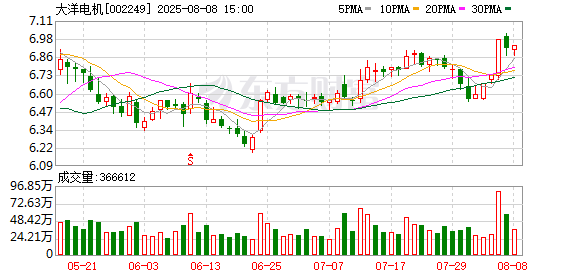
大洋电机:公司子公司中山宜必思科技有限公司温控散热风机产品目前已成功应用于IDC领域
Mei Ri Jing Ji Xin Wen· 2025-08-09 09:41
Group 1 - The core viewpoint is that Dayang Electric has successfully applied its temperature control and cooling fan products in the IDC (Internet Data Center) sector, indicating potential for future growth in this area [2] - The company’s subsidiary, Zhongshan Yibisi Technology Co., Ltd., has established partnerships with major clients such as China Mobile, Invec, and Haiwu in the IDC field [2] - Although the current scale of products used in the IDC sector is relatively small, there is an expectation for rapid growth in business volume as the industry develops, which will contribute to new revenue growth for the company [2]