联发科

Search documents
闪德资讯存储市场洞察报告 2025年4月
闪德资讯· 2026-01-20 08:45
Investment Rating - The report indicates a cautious outlook for the storage industry due to tariff impacts and market uncertainties, suggesting a "Hold" rating for investments in this sector [7][20][36]. Core Insights - Tariffs have become a dominant variable affecting the entire storage industry chain, with the U.S. imposing tariffs as high as 125%, impacting prices of DRAM modules and SSDs [7]. - Major manufacturers like Micron and SK Hynix are adjusting strategies by raising prices and shifting focus towards high-end products such as HBM and DDR5, anticipating a significant increase in HBM demand [7][36]. - The market is experiencing short-term price volatility due to tariffs and supply-demand tensions, with SSD and DRAM prices fluctuating as demand remains uncertain [7][36]. - The rise of AI applications is driving demand for high-performance memory, despite an overall weak smartphone market [7][36]. - Various semiconductor policies are being implemented across the U.S., South Korea, and China, affecting the industry's operational landscape [7]. Summary by Sections Macroeconomic Overview - In April, China's manufacturing PMI index was at 49%, indicating a decline in manufacturing activity, while the U.S. PMI was at 48.7%, reflecting ongoing contraction in the manufacturing sector [8][9][11]. Upstream Market Dynamics - Morgan Stanley predicts a three-phase impact from tariffs on the storage industry, with the first phase leading to price increases due to stockpiling [20][22]. - The current phase is characterized by short-term price increases that are not sustainable, with economic recession risks looming [20][22]. - Major manufacturers are reducing production of older process technologies, focusing on advanced products to enhance profitability [26][30]. Passive Components - Major passive component manufacturers are raising prices due to strong demand and rising costs, with expectations of double-digit percentage increases [38]. Module Manufacturer Dynamics - Companies like Nanya and Adata are seeing revenue growth driven by AI applications, with expectations of improving DRAM contract prices in the upcoming quarters [39][40]. - The overall market is experiencing a price increase trend as supply-demand dynamics stabilize [43]. Domestic Spot Market - The storage market in April was characterized by tariffs, price increases, stockpiling, and a cautious market outlook, with significant fluctuations in SSD and DRAM prices [49][51]. - The market is expected to stabilize once tariff policies are fully established, allowing for a return to normal supply-demand dynamics [66].


闪德资讯存储市场洞察报告 2025年2月
闪德资讯· 2026-01-20 08:45
Investment Rating - The report does not explicitly state an investment rating for the industry Core Insights - The storage market is experiencing a gradual recovery, with manufacturing PMI in China rising to 50.2%, indicating expansion in the manufacturing sector [8][10] - The semiconductor industry is facing challenges due to geopolitical tensions and trade restrictions, impacting investor confidence [23] - AI and generative AI are driving significant demand for advanced semiconductor solutions, with expectations for growth in AI-related chip demand [23][25] - The report highlights a shift in production focus among major manufacturers towards high-end products like DDR5 and HBM due to declining prices in traditional DRAM products [36] Summary by Sections Macroeconomic Overview - China's manufacturing PMI increased by 1.1% to 50.2%, indicating a recovery in manufacturing activities [8][10] - The U.S. manufacturing PMI was reported at 50.9% in January, showing a positive trend since October [8][11] - Global economic expansion is expected to be supported by lower interest rates and growth-promoting policies, particularly in the U.S. [8] Upstream Market - Omdia forecasts a 6% increase in DRAM wafer production capacity for Samsung Electronics, with a target of 789 million wafers in 2025 [19] - SK Hynix plans to increase DRAM wafer input by 15%, with a focus on maximizing production at its facilities [19] - SEMI predicts a 6.6% annual increase in semiconductor capacity, reaching 33.6 million 8-inch wafers by 2025 [20] Company Dynamics - Samsung Electronics reported a sales figure of 30.1 trillion KRW for its semiconductor division in Q4 [29] - SK Hynix is set to begin mass production of HBM3E products in the first quarter of 2025 [34] - Micron plans to increase its HBM market share to 20% by 2025, with significant expansions in production capacity [34] Application Market - Intel's upcoming Panther Lake processors will support AI operations, expected to launch in 2025 [85] - AMD's Ryzen AI Max series processors, featuring advanced AI capabilities, are set to be released in the first quarter of 2025 [86] - Qualcomm's Snapdragon X series PC processors will support AI applications and are expected to launch in the first quarter [87] Domestic Spot Market - The domestic storage spot market remains stable, with prices showing a slight decline [44] - NAND inventory levels are nearing completion, with some manufacturers transitioning from sellers to buyers, providing price support [45] - DDR5 memory prices have seen a significant increase, with costs rising from $4.70 to $4.90-$5.00 [47]



英特尔最大晶圆厂,复活?
半导体行业观察· 2026-01-20 02:02
Group 1 - Intel's Ohio One project, initially touted as the largest wafer factory in the U.S., has faced delays and scale reductions but remains active, with recent contractor job postings indicating acceleration in progress [1] - The Ohio One facility is designed to host up to eight wafer fabs, with the first two expected to begin production by 2030-2031, significantly delayed from the original 2025 target [1] - The first wafer fab will be the 1st fab, followed by the 2nd fab expected to start production a year later, coinciding with Intel's development of its next-generation 14A process [1] Group 2 - Intel's latest Panther Lake mobile CPUs are produced in Arizona and Oregon using the new 18A process, marking a significant advancement for domestic chip manufacturing, although there are no large external customers for this process [2] - CEO Pat Gelsinger has shifted from a pessimistic view of the 18A process to a more optimistic stance recently, despite the 14A process now expected to reach mass production in 2027 [2] - The Ohio One site was initially predicted to be the birthplace of the 14A process, but this timeline has shifted, with derivative products already occupying a significant portion of Intel's lineup before the site's official opening [2] Group 3 - The U.S. government allocated $8.9 billion from the CHIPS Act to Intel in exchange for a 10% equity stake, alongside a $5 billion collaboration with NVIDIA, signaling a resurgence in Intel's competitiveness, particularly in the foundry business [3] - Intel is accelerating the construction of the Ohio One facility after years of stagnation, but the timeline for its completion remains uncertain [3] Group 4 - TSMC is facing a "happy dilemma" with its 3nm process capacity fully booked until 2027, prompting significant increases in capital expenditure plans [5] - This capacity constraint is reshaping the market dynamics, leading TSMC's top clients to consider alternatives like Samsung and Intel [5] - TSMC's capital expenditure for 2026 is projected to be between $52 billion and $56 billion, exceeding previous expectations due to the overwhelming demand for advanced nodes [5] Group 5 - The supply-demand imbalance is causing market oversupply, with major clients like Apple, NVIDIA, AMD, Broadcom, Qualcomm, and MediaTek seeking alternative capacities as TSMC's advanced process node market share is expected to drop from 95% to 90% [6] - TSMC's 3nm monthly production capacity is planned to expand to 190,000 wafers by the end of 2026, but this will still fall short of client demand [6] - TSMC is adopting a more aggressive strategy by delaying new 3nm process development and encouraging clients to shift products originally slated for 2027/2028 to the 2nm GAA process [6] Group 6 - Samsung's Taylor wafer fab is seen as a more likely alternative for clients seeking supply options compared to Intel, with Qualcomm and AMD being the most likely to consider Samsung [7] - Discussions have indicated that Apple and Broadcom are evaluating Intel, but significant work remains for Intel's 14A process to be competitive [7]


电子行业周报:台积电25Q4单季度业绩创历史新高
Shanghai Aijian Securities· 2026-01-19 10:20
Investment Rating - The electronic industry is rated as "Outperform" compared to the market [1] Core Insights - The SW electronic industry index increased by 3.77%, ranking 2nd out of 31, while the CSI 300 index decreased by 0.57% [2][5] - TSMC reported a record high quarterly revenue of $33.73 billion for Q4 2025, benefiting from strong demand for AI chips, with a year-on-year growth of 25.5% [22][29] - The approval of NVIDIA's H200 chip export to China is expected to alleviate the high-end computing power supply gap in key sectors such as research and medical imaging [31][33] Market Performance - The top-performing sectors in the SW electronic industry include integrated circuit packaging and testing (+14.47%), semiconductor equipment (+9.31%), and integrated circuit manufacturing (+8.68%) [9] - The best-performing stocks in the electronic sector this week were Zhenlei Technology (+48.18%), Kema Technology (+42.68%), and Kecuan Technology (+41.14%) [12] TSMC Financial Performance - TSMC's Q4 2025 net profit was approximately NT$505.74 billion, with a gross margin of 62.3% and a net profit margin of 48.3% [22][23] - The revenue structure shows that high-performance computing (HPC) and smartphones contribute 55% and 32% of TSMC's total revenue, respectively [27] Future Outlook - TSMC's management expects Q1 2026 revenue to be between $34.6 billion and $35.8 billion, with gross margins projected to remain between 63% and 65% [29] - The introduction of the H200 chip is anticipated to support the acceleration of AI technology commercialization in China [33]

3nm产能告急,台积电大客户被迫分流,三星、英特尔机会来了?
Hua Er Jie Jian Wen· 2026-01-19 02:21
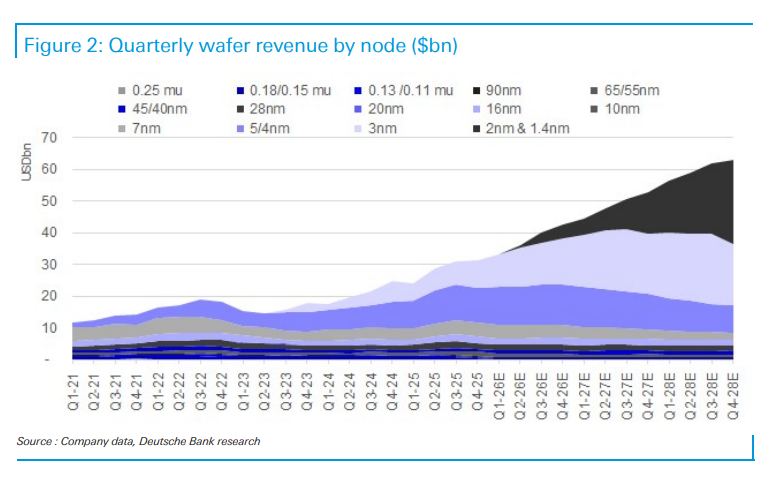
Core Viewpoint - The demand for chips is surging due to the AI wave, leading TSMC to face capacity constraints until 2027, prompting major clients like Apple and Nvidia to consider shifting some orders to Samsung and Intel [1][2]. Group 1: TSMC's Capacity and Capital Expenditure - TSMC is experiencing a "happy trouble" as its 3nm process capacity is extremely tight, with orders booked through 2026 and into 2027, necessitating a significant increase in capital expenditure plans [1]. - TSMC's capital expenditure guidance for 2026 is projected to be between $52 billion and $56 billion, exceeding Deutsche Bank's expectation of $50 billion and market consensus of $46 billion [1][3]. - The current situation reflects a severe shortage in core wafer manufacturing capacity, particularly for the 3nm process, rather than just CoWoS packaging capacity [1][3]. Group 2: Market Share and Client Dynamics - The supply-demand imbalance is causing a direct market spillover effect, with TSMC's market share in advanced process foundry expected to decline from 95% to 90% as clients seek alternative capacity [2]. - Major clients including Apple, Nvidia, AMD, Broadcom, Qualcomm, and MediaTek are left with no choice but to explore alternative suppliers due to the extreme capacity constraints [2][5]. Group 3: Client Shifts and Competitive Landscape - TSMC is delaying new 3nm development projects and encouraging clients to shift their product plans towards 2nm GAA processes for 2027/28 [5]. - Samsung's Taylor factory is likely to be the preferred alternative for clients seeking to diversify their supply sources, with Qualcomm and AMD being the most likely to consider Samsung [5]. - Apple and Broadcom are reportedly looking into Intel as an alternative, although Intel still has significant work to do despite its potential with the 14A process [5]. Group 4: Long-term Growth and Profitability - Despite short-term capacity challenges, the long-term growth potential driven by AI is highly certain, with TSMC raising its expected CAGR for AI-related growth from the mid-40s to the mid-to-high 50s for 2024-2029 [6]. - TSMC's long-term overall growth forecast has been adjusted to a 25% CAGR, with long-term gross margin targets raised to 56% [6][7]. - The focus remains on TSMC's core profitability, despite potential margin dilution from overseas expansion and challenges related to talent and infrastructure [6][7]. Group 5: Valuation Adjustments - Deutsche Bank has raised TSMC's target price by 10% to NT$2,200, reflecting a 20x P/E ratio based on expected EPS for 2027, consistent with industry peers [9]. - This valuation indicates TSMC's solid position and strong growth rate until 2028, although potential risks such as geopolitical tensions and competition from Intel are noted [9].
A股投资策略周报:近期资本市场资金面异动分析-20260118
CMS· 2026-01-18 11:33
Core Insights - The report indicates that the recent acceleration in net financing inflow has provided incremental capital to the market, driving individual stock performance while significantly increasing overall market leverage and potential volatility risks [5][30]. - To mitigate the rapid rise in leverage, regulatory measures have been intensified, including raising the margin requirement for financing from 80% to 100%, which aims to control new leverage without impacting existing contracts [7][17]. - The report anticipates that the A-share market is likely to shift to a volatile trend after reaching previous highs, with a focus on performance disclosures expected to intensify as the earnings forecast disclosure peak approaches on January 15 [2][30]. Market Analysis - The report highlights that the A-share market experienced a high trading volume, with total market turnover exceeding 3.9 trillion yuan in the first half of the week, followed by a drop below 3 trillion yuan after the margin policy announcement [32]. - The technology sector, particularly AI computing and semiconductor equipment, is identified as a key battleground for January, alongside resource products represented by industrial metals [5][30]. - The report notes that the net outflow from ETFs, amounting to 129.6 billion yuan, has contributed to cooling market enthusiasm, with significant withdrawals from major ETFs such as the CSI 300 ETF [12][15]. Sector Performance - The report indicates that sectors such as computing, electronics, and non-ferrous metals have seen positive valuation trends, while sectors like defense, real estate, and steel have experienced declines [30][33]. - The report emphasizes the importance of cyclical and technology sectors for investment strategies, recommending a focus on industries such as electric equipment, machinery, non-bank financials, electronics, and basic chemicals [6][31]. - The report also highlights the improvement in the semiconductor industry, with December exports of integrated circuits showing a year-on-year increase of 47.72%, indicating a positive trend in the tech sector [38][41]. Investment Strategy - The report suggests a preference for large-cap growth stocks in the current market environment, recommending index combinations including CSI 300, STAR Market 50, and quality indices [6][31]. - It advises that industry allocation should focus on spring market dynamics and forward-looking clues from annual reports, particularly in cyclical and technology sectors [6][31]. - The report underscores the significance of monitoring performance disclosures, especially for small-cap and thematic stocks, as they may face pressure from earnings forecasts [5][30].
招商策略:A股在创出前期新高后,有望转为震荡走势
Xin Lang Cai Jing· 2026-01-18 11:25
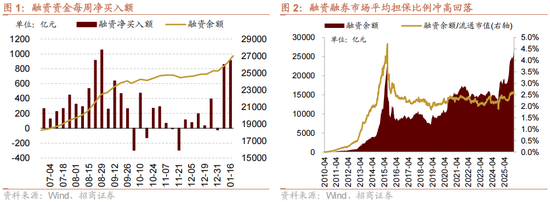
Core Viewpoint - Recent regulatory measures have been implemented to prevent rapid increases in leverage, including raising the margin requirement for financing, which has led to a cooling of market sentiment and a rational return of investor emotions [1][2][7][24]. Market Analysis - The A-share market has shown signs of volatility after reaching new highs, with a shift towards a more oscillatory trend expected as earnings disclosures approach [1][2][24]. - The market experienced a significant drop in trading volume from over 3.9 trillion to below 3 trillion after the margin requirement was raised to 100% [3][26]. - The technology sector, particularly AI applications and semiconductor equipment, remains a key focus for investment in January, alongside resource products represented by industrial metals [2][24]. Fund Flow - There was a net inflow of 913 billion in financing funds over the first four trading days, with a total financing balance reaching 2.7 trillion, marking a historical high [9][41]. - The stock market saw a net outflow of 1.296 trillion from ETFs, with the CSI 300 ETF accounting for a significant portion of this outflow [11][20][41]. Industry Performance - The semiconductor industry showed a notable increase in exports, with December exports rising by 47.72% year-on-year, indicating a strong demand for integrated circuits [29][30]. - The industrial metals sector has seen price increases, with copper, nickel, and tin prices rising, while aluminum and cobalt prices have decreased [39]. Investment Recommendations - The investment strategy for January emphasizes large-cap growth stocks, with recommended index combinations including CSI 300 and STAR Market 50 [8][25]. - Key sectors for investment include technology, industrial equipment, non-bank financials, and cyclical industries, with a focus on sectors that are expected to benefit from upcoming earnings reports [2][24][25]. Emerging Trends - The GEO (Generative Engine Optimization) concept is gaining traction in the market, with several stocks experiencing significant price increases as companies explore this new marketing paradigm [53][54]. - Companies involved in GEO are primarily focused on digital marketing and content services, with many still in the early stages of developing related business models [54][56].
小米玄戒O2被曝继续用台积电3nm
Guan Cha Zhe Wang· 2026-01-16 09:07
Core Viewpoint - Xiaomi is planning to adopt TSMC's N3P process for its second-generation self-developed SoC, the Xuanjie O2, instead of the latest 2nm process, and aims to expand the application of its self-developed chips beyond smartphones [1][2] Group 1: Product Development and Strategy - The Xuanjie O2 is expected to be applied in "non-smartphone" products, indicating Xiaomi's intention to broaden its chip usage [1] - The first-generation SoC, Xuanjie O1, was launched last year but was only used in a limited number of products, such as the Xiaomi 15S Pro and Xiaomi Pad 7 series [1] - Industry insiders suggest that the Xuanjie O1 served primarily to test Xiaomi's technical capabilities and market acceptance rather than to replace existing SoC suppliers like Qualcomm and MediaTek [1] Group 2: Market Competition and Challenges - Qualcomm and MediaTek are transitioning to more advanced 2nm processes for their flagship SoCs, which could weaken the market competitiveness of Xiaomi's Xuanjie O2 if it uses the N3P process [2] - TSMC's 2nm process has limited initial capacity, already allocated to major clients like Apple and Nvidia, making it difficult for Xiaomi to secure early production capacity [2] - The cost of 2nm processes is significantly higher than that of 3nm, which, combined with rising memory chip prices, has increased the overall material costs for smartphones by over 25% [2] Group 3: Pricing and Financial Implications - The launch price of the Xiaomi 17 Ultra has increased by around 500 yuan compared to its predecessor, indicating a trend of rising product prices [3] - Xiaomi's president has indicated that significant price increases are expected across the industry in the coming year, which may further pressure profit margins if higher-cost processes are adopted [3] - Xiaomi is likely to use its self-developed processors in mid-range and sub-flagship products, potentially exerting pressure on MediaTek, which primarily supplies non-flagship models [3] Group 4: Future Innovations and Investments - Xiaomi's founder has stated that by 2026, the company aims to achieve a "triple integration" of self-developed chips, operating systems, and AI models in a single product, marking a significant technological milestone [4] - Over the past five years, Xiaomi has committed approximately 105 billion yuan to core technology research and plans to invest 200 billion yuan over the next five years [4] - The company is targeting comprehensive chip coverage across its entire product line, including tablets, PCs, and automobiles, with the Xuanjie O2 leading this initiative [3][4]


友商降本增效,天玑9500s 良心拉满!高容量缓存满配背后的用户体验战
Jin Tou Wang· 2026-01-16 07:11
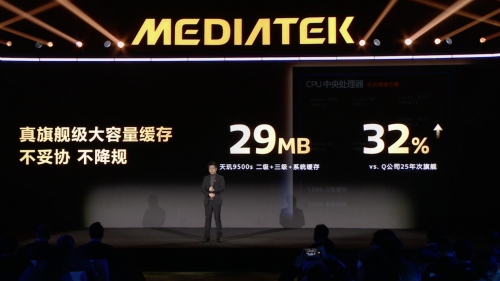
Core Insights - MediaTek's newly released Dimensity 9500s features a comprehensive cache configuration, including 7MB of L2 cache, 12MB of L3 cache, and 10MB of system cache, totaling 29MB, positioning it as a true flagship chip [1][3] - The importance of cache in mobile chips is emphasized, as it acts as a temporary storage for data, significantly impacting performance [3] - The Dimensity 9500s utilizes a flagship-level architecture with a 3nm process and approximately 30 billion transistors, showcasing a competitive configuration in its class [3] Performance Analysis - The GPU, G925, is expected to outperform competitors, with real-world tests showing the Dimensity 9500s achieving nearly full frame rates in demanding games like "Honkai: Star Rail" [5] - In various gaming tests, the Dimensity 9500s demonstrated strong performance, achieving an average frame rate of 119.9 in "Honor of Kings" and maintaining high frame rates in "Genshin Impact" under maximum settings [8] - Overall, the gaming capabilities of the Dimensity 9500s are highlighted as exceptionally strong, with its full cache configuration contributing to a superior user experience [10]
昨夜今晨:美团入局线上卖车 迅雷起诉前CEO陈磊索赔2亿元
Sou Hu Cai Jing· 2026-01-16 02:52
Group 1 - ZhiMi Technology plans to enter the online travel market by establishing a ticket and hotel division, aiming to compete with Ctrip and reduce its market dominance [2] - The move aligns with national calls for market competition, following an investigation into Ctrip's alleged abuse of market dominance by the State Administration for Market Regulation [2] - ZhiMi has previously focused on smart cleaning devices but has been diversifying into various consumer electronics and service sectors in recent years [2] Group 2 - Shenzhen Xunlei Network Technology Co., Ltd. has filed a civil lawsuit against former CEO Chen Lei, seeking to recover 200 million RMB for damages to the company [3] - The lawsuit centers on allegations that Chen Lei controlled a company that transferred assets from Xunlei without board approval through related-party transactions [3] - A previous criminal investigation into the same matter was terminated in late 2022 due to insufficient evidence [3] Group 3 - Meituan has signed a strategic cooperation agreement with Shanghai Xiche Future Intelligent Technology Co., Ltd. to enter the car sales market [4] - The partnership aims to integrate local life service platform resources with automotive industry capabilities, creating a one-stop solution for car purchasing and services [4] - Initial focus will be on online display, test drive appointments, and transaction closure, leveraging Meituan's existing traffic system to enhance user engagement [4] Group 4 - MediaTek has launched two new system-on-chip (SoC) products for the smartphone market: Dimensity 9500s and Dimensity 8500 [5] - The Dimensity 9500s is manufactured using TSMC's 3nm process, featuring a full big-core CPU architecture and Immortalis-G925 GPU, with a benchmark score exceeding 3.61 million on AnTuTu [5] - The Dimensity 8500 is based on a 4nm process and also utilizes a full big-core design with an octa-core Mali-G720 GPU [5] Group 5 - Apple has expanded the cross-border payment capabilities of Apple Pay for Visa cardholders in mainland China, allowing them to make contactless payments abroad [6] - Initial participating banks include Industrial and Commercial Bank of China and Bank of China, with plans to add more issuers and Mastercard support in the future [6] - This update enhances the usability of digital wallets for individuals traveling abroad or studying overseas [6]