巨子生物

Search documents
消费医疗行业周报(八):我国重组胶原蛋白新材料实现溶液、凝胶、固体的剂型全覆盖-20250414
CMS· 2025-04-14 09:35
Investment Rating - The industry is rated as "Recommended" based on favorable fundamentals and expectations for the industry index to outperform the benchmark index [2][27]. Core Insights - The report highlights the approval of "Recombinant Type III Humanized Collagen Gel" by Jinbo Biotech, marking a significant advancement in the domestic market for recombinant collagen materials, which now covers various formulations including solutions, gels, and solids [1][22]. - The collagen industry is expected to experience a peak in product approvals between 2025 and 2026, with companies like Juzhi Biotech and Chuangjian Medical making significant progress in their product registrations [24]. - The report emphasizes the high market demand for collagen products, particularly in aesthetic applications, driven by the increasing awareness and acceptance of various filler materials [5][11]. Summary by Sections 1. Collagen Filling Products - Various types of facial injectables are categorized into biodegradable and non-biodegradable fillers, with biodegradable fillers further divided into short-acting and long-acting types [8]. - Collagen is a natural protein found in animal tissues, constituting one-third of total body protein, with a significant presence in the skin [10]. 2. Clinical Research on Collagen - Clinical studies on collagen primarily focus on periorbital rejuvenation and skin revitalization, with a growing need for expanded application areas due to increasing aesthetic demands [11]. - The report notes that the use of collagen for periorbital rejuvenation effectively addresses issues like dark circles and fine lines, showcasing its advantages over other materials [11]. 3. Evaluation of Collagen Injection Fillers - The report evaluates the characteristics of collagen fillers, highlighting their immunogenicity, biodegradability, and biocompatibility, which contribute to their safety and effectiveness in clinical applications [14]. - The report also discusses the regulatory landscape, noting that there are currently nine approved collagen injection products in China, with Jinbo Biotech being the sole domestic producer of recombinant collagen [21]. 4. Market Trends and Future Outlook - The report anticipates a surge in collagen product approvals, particularly for recombinant types, as companies navigate the regulatory landscape and enhance their product offerings [24]. - The introduction of innovative technologies, such as self-assembling collagen, is expected to improve product safety and efficacy, further driving market growth [22].
社会服务行业周报:外部局势多变,重视刚需、内需
Ping An Securities· 2025-04-14 02:05
Investment Rating - The industry investment rating is "Outperform the Market" [1][30][35] Core Insights - The report highlights the impact of the escalating US-China "tariff war" on the market, with China responding with equivalent measures [3][6] - Recent policies aimed at promoting consumption, such as the "Special Action Plan for Promoting Healthy Consumption," are expected to boost domestic demand [7][8] - The retail sector is actively assisting foreign trade enterprises in expanding domestic sales channels, with major players like JD.com and Alibaba launching initiatives to support this transition [11][13] Summary by Sections Macro and Industry Dynamics - The US has increased tariffs on Chinese imports, with rates reaching up to 145% [6] - China has implemented measures to promote healthy consumption and enhance the shopping experience for foreign tourists [7][8] - The domestic travel market is showing growth, with significant increases in tourist numbers during the Qingming holiday [9][10] Company Dynamics - Jinbo Biotech has received approval for a new collagen product, marking a significant innovation in the medical aesthetics field [16] - Proya has announced the recruitment of several high-profile R&D experts to enhance its global research capabilities [16] - Xiaogoods City reported a revenue increase of 17.93% year-on-year for Q1 2025, indicating strong performance in essential consumer goods [17] Investment Recommendations - The report notes that the social service sector has shown resilience, with key companies trading at a PE ratio of 20-30 times for 2025, indicating stable operations [30] - The report emphasizes the strong performance of domestic retail companies amidst the tariff disruptions, with notable stock price increases for companies like China Duty Free and Yonghui Supermarket [28][30]



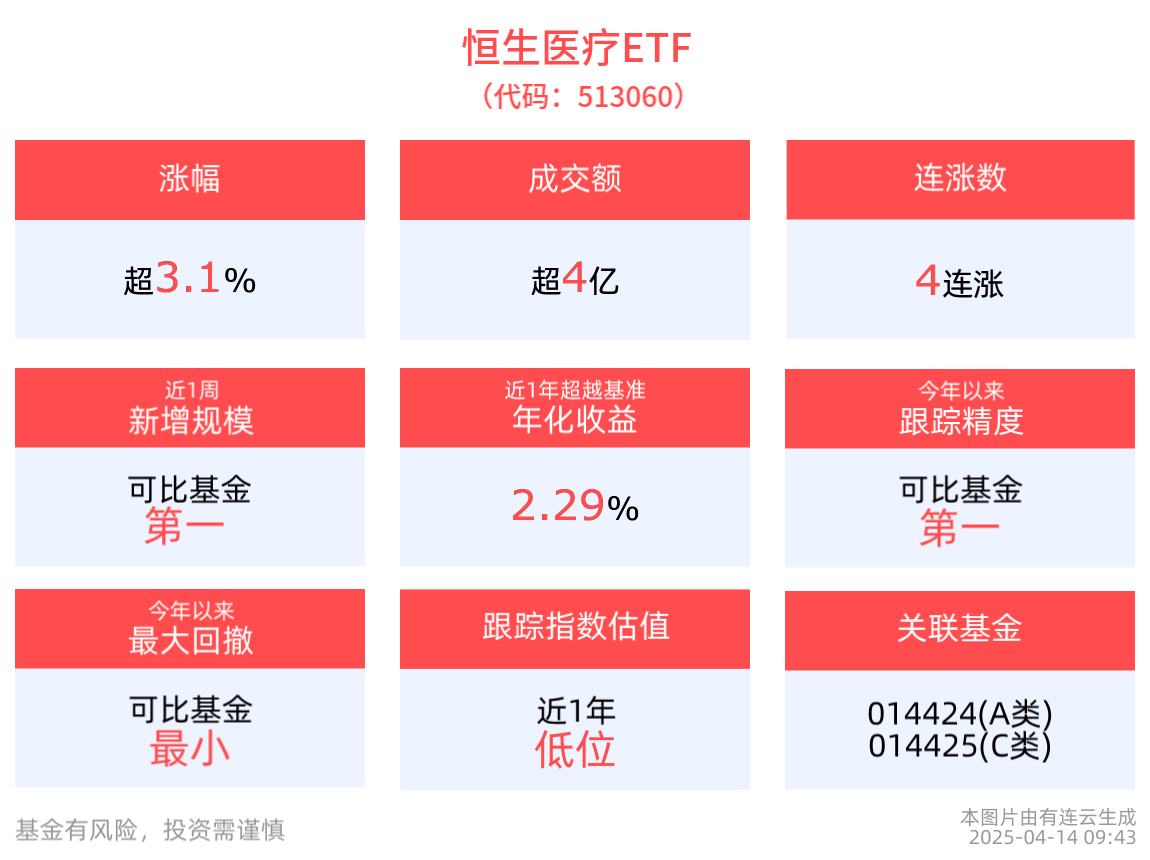
机构:医疗消费板块值得重点布局,恒生医疗ETF(513060)上涨3.15%,再鼎医药涨超12%
Sou Hu Cai Jing· 2025-04-14 01:57
Group 1 - The Hang Seng Healthcare Index (HSHCI) has seen a strong increase of 2.95%, with notable gains from companies such as Zai Lab (09688) up 12.39% and Dongyangguang Changjiang Pharmaceutical (01558) up 9.04% [3] - The Hang Seng Healthcare ETF (513060) has risen by 3.15%, marking its fourth consecutive increase, with a recent price of 0.46 yuan [3] - Over the past three months, the Hang Seng Healthcare ETF has accumulated a total increase of 21.98% [3] Group 2 - The Hang Seng Healthcare ETF has experienced a net value increase of 26.66% over the past year, with the highest single-month return reaching 28.34% since its inception [4] - The ETF's Sharpe ratio stands at 1.27, indicating strong risk-adjusted returns [4] - The ETF's management fee is 0.50%, and the custody fee is 0.15% [4] Group 3 - The top ten weighted stocks in the Hang Seng Healthcare Index account for 56.37% of the index, with companies like BeiGene (06160) and WuXi Biologics (02269) leading the list [5] - The performance of these stocks varies, with BeiGene showing a gain of 5.34% and WuXi Biologics up by 2.81% [7] Group 4 - The current market environment emphasizes the importance of domestic consumption growth due to pressures from U.S.-China tariffs, highlighting healthcare consumption as a key investment area [8] - The market sentiment is recovering, with a focus on undervalued blue-chip stocks and companies with solid fundamentals, particularly in the healthcare sector [8]




化妆品医美行业周报:提振内需消费,预计国货美妆竞争格局进一步优化-20250413
Shenwan Hongyuan Securities· 2025-04-13 13:45
Investment Rating - The report maintains a "Buy" rating for the cosmetics and medical beauty industry, highlighting the potential for domestic brands to gain market share and improve competitive dynamics [4]. Core Insights - The domestic beauty market is expected to see an optimization in competitive dynamics, driven by a rise in domestic consumption and a retreat of international brands due to increasing geopolitical uncertainties [9][10]. - The cosmetics and medical beauty sector outperformed the market during the period from April 3 to April 11, 2025, with the Shenwan Beauty Care Index declining by 2.5%, which is better than the Shenwan A Index's decline of 1.9 percentage points [5][6]. Summary by Sections Industry Performance - The cosmetics and medical beauty sector showed resilience, with key indices performing better than the overall market, indicating a positive trend for domestic brands [5][6]. - The report notes that the retail sales growth for cosmetics in January and February 2025 was 4.4%, outperforming the overall retail sales growth of 4.0% [23]. Market Trends - According to Euromonitor data, the market for domestic skincare and makeup brands is on the rise, with significant improvements in market share for brands like Proya and Natural Hall, which have entered the top ten in market share [9][35]. - The report anticipates that domestic brands will continue to benefit from the trend of rising domestic consumption, especially as international brands face challenges [10][35]. Company Performance Forecasts - For Q1 2025, several companies are expected to report positive growth: - Up Beauty Co. is projected to see a revenue and net profit increase of 10% year-on-year [11]. - Marubi is expected to achieve a revenue increase of 40% and a net profit increase of 35% [11]. - Proya is forecasted to have a revenue increase of 8% and a net profit increase of 10% [11]. - The report highlights that companies like Giant Biological and Mao Geping are also expected to see significant growth, with revenue and net profit both projected to increase by 40% and 25% respectively [11]. Investment Recommendations - The report recommends focusing on companies with strong brand matrices and high growth potential, such as Up Beauty Co., Proya, and Marubi, which are well-positioned to leverage the e-commerce boom [14]. - It also suggests keeping an eye on companies like Shanghai Jahwa and Betaini, which are expected to perform well in the upcoming quarters [14]. Industry Dynamics - The report discusses the entry of four prominent researchers into Proya, indicating a strong focus on technological innovation and talent development within the company [26]. - The competitive landscape in the medical beauty sector is evolving, with new products and innovations expected to drive growth and market share for companies like Jinbo Biological and Huaxi Biological [29][30].




商贸零售行业周报:关税冲击持续,关注内需优质渠道和产品龙头-20250413
KAIYUAN SECURITIES· 2025-04-13 11:11
Investment Rating - The industry investment rating is "Positive" (maintained) [1] Core Viewpoints - The report emphasizes the ongoing impact of tariff shocks and suggests focusing on high-quality retail channels and differentiated consumer brands that cater to domestic demand [4][22] - The report highlights the transformation of traditional retail, with Yonghui Supermarket leading the way in adapting to a consumer-centric retail era [4][22] - The rise of domestic brands and the recovery of consumer demand are seen as inevitable trends, with recommendations to focus on quality retail channels and differentiated brands [4][22] Summary by Sections Retail Market Review - The retail industry index rose by 2.88% during the week of April 7 to April 11, outperforming the Shanghai Composite Index, which fell by 3.11% [6][13] - The supermarket sector showed the largest increase, with a weekly rise of 13.54% [14][17] - Notable individual stock performances included Guofang Group (+61.1%), Eurasia Group (+26.3%), and Nanning Department Store (+22.4%) [19][20] Industry Dynamics - Yonghui Supermarket has opened a "green channel" for domestic manufacturers affected by export restrictions, receiving over 100 cooperation requests from various sectors [4][22] - The report discusses the approval of a new collagen product by Jinbo Bio, which is expected to strengthen its leading position in the medical beauty sector [4][23] Investment Recommendations - Investment focus areas include: - Traditional retail: Highlighting companies like Yonghui Supermarket and Aiyingshi that are adapting to consumer trends [7][27] - Gold and jewelry: Recommendations for brands like Laopu Gold and Chaohongji that possess differentiated product capabilities [7][28] - Cosmetics: Emphasizing domestic brands such as Maogeping and Shangmei that are expanding into high-potential segments [7][28] - Medical aesthetics: Focusing on companies like Aimeike and Kedi that are positioned to benefit from the recovery in medical beauty consumption [7][28] Company-Specific Insights - Laopu Gold reported a revenue of 8.506 billion yuan (+167.5%) and a net profit of 1.473 billion yuan (+253.9%) for FY2024, indicating strong growth potential [29] - Yonghui Supermarket's revenue for the first three quarters of 2024 was 54.549 billion yuan (-12.1%), with a net loss of 78 million yuan, but it is undergoing significant transformation [32] - Jinbo Bio's new collagen product is expected to provide both immediate filling effects and stimulate collagen regeneration, enhancing its competitive edge in the market [23][24]


一位女CEO出任大学校长
投资界· 2025-04-13 07:55
高校&产业,双向奔赴。 作者 I 杨文静 报道 I 投资界PEdaily 20 22年11月4日,距离西北大学化工学院实验室14 0 0多公里外,港交所敲响钟声。 这一天,来自西安的护肤界新秀巨子生物登陆港交所,成为港股胶原蛋白第一股。而在现场,17位并排而立的敲钟人里站着 唯一一位女士,也是这家公司的灵魂人物—— 范代娣。 时至今日,范代娣和巨子生物依然留给创投圈深刻印象。当年在巨子生物IPO前的唯一一轮融资里,十多家知名投资机构云 集,公司估值高达20 0亿人民币。一家TOP级别VC机构向投资界透露, "当时的投资份额要靠抢"。 日前,陕西省政府官网发布人事任免通知, 任命范代娣为西北大学副校长。 回溯创业历程,她的身上有着太多故事,作为 一个从高校实验室里走出的上市公司,巨子生物至今依然常常出现在VC朋友的闲谈里。 从实验室走出的女创始人 时间回到1 96 6年,范代娣出生在陕西蒲城一个村子里,父亲是当地的赤脚医生。多年后回忆幼时的生活,范代娣仍然记得父 亲半夜出诊的场景,这也让她日后逐渐和医疗结缘。直到1 9 9 4年博士毕业后,范代娣回到母校西北大学,开始从事生物医药 类研发。 一次偶然,范代娣和实 ...
美妆巨头抢滩医美:欧莱雅科技转型背后的行业变局
3 6 Ke· 2025-04-13 05:05
Core Insights - The beauty and medical aesthetics sectors are increasingly merging, with significant interest from both international giants and local startups, indicating a strong growth trend in this area [1][5][31] - L'Oréal is a leading player in this trend, having made substantial investments and strategic moves to integrate beauty and medical aesthetics [2][10][17] Group 1: Industry Trends - Since 2024, there has been an unusual enthusiasm among beauty companies to enter the medical aesthetics business, with both high-end and budget brands participating [1] - The merger of beauty and medical aesthetics is not a new concept, but it is gaining momentum, with companies like L'Oréal leading the charge [1][5] - The retail sales of cosmetics in China fell by 1.1% in 2024, while the total retail sales of consumer goods grew by 3.5%, highlighting the need for beauty brands to innovate and find new growth avenues [5] Group 2: Company Developments - In 2023, L'Oréal rebranded its active health cosmetics division to the skin science beauty division and launched its core brand, SkinCeuticals, in 2024 [2] - Estee Lauder's Clinique launched a series of medical device products, while Shiseido is set to introduce its first medical beauty brand in China [3] - Domestic brands like Shiseido and Up Beauty are also making strides in the medical aesthetics space, with new product launches and business developments [4] Group 3: Strategic Initiatives - L'Oréal's beauty tech transformation strategy, initiated in 2018, focuses on integrating technology into beauty and medical aesthetics, with significant investments in digital R&D [6][8] - The company has established a comprehensive network for integrating beauty and medical aesthetics, including investments in high-end medical beauty chains and partnerships with biotech firms [17][18] - L'Oréal's SkinCeuticals brand has seen a 9.8% year-on-year growth, reaching €7.03 billion in revenue, making it the fastest-growing segment of the group [10] Group 4: Market Dynamics - The merging of beauty and medical aesthetics allows brands to create a closed-loop product offering, enhancing customer loyalty and repeat purchases [22] - The shift towards medical aesthetics is seen as a necessary strategy to avoid intense competition in traditional beauty markets [19][20] - However, the differing operational models and regulatory requirements between beauty and medical aesthetics present new challenges for companies [24][30]

国货替代逻辑兑现!基金经理看好本土增长驱动
券商中国· 2025-04-12 13:12
Core Viewpoint - The article discusses the strong rebound of domestic brands in sectors such as consumer goods, pharmaceuticals, and technology, driven by the logic of domestic brand substitution and independent performance growth, leading to increased market share and revenue opportunities for these brands [2][3]. Group 1: Domestic Brand Substitution Logic - Public funds have heavily invested in domestic brands, particularly in the cosmetics sector, benefiting from the domestic brand substitution logic, as foreign competitors like Estée Lauder face challenges in the Chinese market [3]. - The stock of Estée Lauder has seen a cumulative decline of over 25% in the last four trading days, while domestic brands like Mao Geping and Shangmei have shown strong resilience, with increases of 6.30% and 3.89% respectively [3]. - In the infant formula sector, domestic brand China Feihe has surged over 10% in the Hong Kong market, supported by significant investments from Ping An Fund and GF Fund [3]. Group 2: Independent Performance Growth - The article emphasizes the importance of independent performance, highlighting that many domestic brands achieve stable growth by relying on the vast domestic market, with companies like Bosideng generating approximately 94% of their revenue from China [6]. - The motorcycle sector has seen a surge in interest for domestic brand Chunfeng Power, with 70 public funds including it in their top ten holdings, reflecting confidence in the brand's growth potential [7]. - The article notes that many companies, including internet and consumer goods firms, have achieved consistent performance growth without international operations, indicating a strong domestic market drive [7]. Group 3: Market Opportunities and External Factors - The article points out that the strong manufacturing capabilities and demand in the domestic market provide public funds with opportunities to capitalize on undervalued stocks that have been unfairly punished by market sentiment [8]. - The pharmaceutical sector is expected to remain resilient against external factors, with domestic innovative drug companies benefiting from supportive policies and technological advancements [9][10]. - The article mentions that the introduction of zero tariffs on certain cancer and rare disease drugs in early 2024 may further mitigate external impacts on the pharmaceutical sector [10].

申万宏源关键假设表调整与交流精粹(2025年4月):AI产业链突破不止,关税冲击难挡前行
Shenwan Hongyuan Securities· 2025-04-11 06:41
Group 1: Macro and Strategy Insights - The manufacturing PMI recorded a slight increase to 50.5% in March, with production and new orders indices rising marginally [8] - The report emphasizes the importance of pricing long-term positive factors during market adjustments, suggesting that the market is transitioning to a more pragmatic stance [9] - The bond market is expected to perform well due to the unexpected tariffs, with a shift towards a steeper yield curve anticipated [16] Group 2: Financial and Real Estate Sector - The banking sector is expected to maintain stable performance with better-than-expected interest margins, focusing on high-dividend stocks [19] - The real estate sector is under pressure but is expected to show signs of bottoming out, with the importance of stabilizing the sector increasing amid trade tensions [23] - Construction investment is anticipated to recover, driven by improvements in manufacturing PMI and external shocks [25] Group 3: Materials and Energy Sector - Oil prices have declined due to OPEC's production increase and tariff impacts, but shale oil costs provide strong support for prices [26] - The chemical sector is responding to U.S. tariffs with a focus on self-sufficiency, highlighting the importance of domestic production trends [31] - The coal market is expected to stabilize as demand increases with the arrival of the peak season, supported by fiscal policies [36] Group 4: Consumer and Healthcare Sector - The pharmaceutical industry remains optimistic despite potential tariff impacts, particularly in the innovative drug supply chain [24] - The agricultural sector is under scrutiny due to unexpected tariff policies, with a focus on investment opportunities in various sub-sectors [11] Group 5: Technology and AI Sector - The AI industry is experiencing significant breakthroughs, with a focus on domestic computing power and the emergence of physical AI as a new frontier [4] - The report highlights the potential for AI applications in low-digital penetration sectors such as finance, education, and healthcare [4]
“AI+医美”进行时!投资逻辑重构?
券商中国· 2025-04-07 07:36
Core Viewpoint - The integration of AI into the medical beauty industry is reshaping the sector, with significant implications for material research, clinical practices, and consumer services, leading to a transformation from "experience science" to "computational science" [1][2][6]. Group 1: AI Integration in Medical Beauty - Major companies in the medical beauty and cosmetics sectors, such as L'Oréal, Betaini, and Jinbo Biotechnology, have begun deploying AI technologies to enhance their operations [2][7]. - AI is expected to accelerate breakthroughs in material research, replace traditional consultation methods with effect simulation technology, and enable personalized services [2][6]. - The 2024 annual reports indicate that institutional investors are prioritizing "AI empowerment" as a core valuation metric for medical beauty companies [2][6]. Group 2: Investment Trends - Jinbo Biotechnology and Juzhi Biotechnology, which focus on recombinant collagen, have seen significant increases in fund holdings, with Jinbo Biotechnology receiving 35 fund investments, up from single digits a year ago [3][5]. - Jinbo Biotechnology's sales of its recombinant collagen product reached a milestone of one million units, with its stock price increasing by 74.8% over the past year [3][4]. - Meitu, a well-known photo editing company, has also entered the medical beauty space, with its stock price rising by 73.44% in the past year [5]. Group 3: AI's Impact on Industry Practices - AI is revolutionizing various aspects of the medical beauty industry, including clinical diagnosis, consumer services, and material research [6][12]. - AI's application in clinical diagnosis allows for pre-surgical simulations that reduce reliance on physician experience and enhance patient trust [6][12]. - The use of AI in consumer services enables personalized solutions through skin diagnostics and tailored treatment plans, shifting the focus from selling individual products to providing comprehensive solutions [6][12]. Group 4: Future Valuation and Business Models - The competitive landscape and valuation logic of publicly listed medical beauty companies are undergoing significant changes due to AI's pervasive influence [14][16]. - Companies are expected to transition from a focus on individual product sales to a model that emphasizes platform capabilities, data accumulation, and algorithm iteration speed [16]. - The long-term outlook suggests that as AI improves treatment predictions and risk mitigation, the medical beauty industry's business model will evolve towards bundled offerings of "AI solutions + products + services" [16][19]. Group 5: Caution and Challenges - Some companies, like Aimeike, are cautious about AI adoption, focusing instead on upgrading existing product technologies [19]. - The high costs associated with AI development and the potential for regulatory challenges related to AI diagnostics are significant considerations for companies in the sector [19][20]. - The reliance on high-quality data for AI model training poses challenges due to the privacy and fragmentation of medical beauty data [19].