泸州老窖

Search documents
零售、白酒等大消费板块盘初冲高,东百集团6天4板
Mei Ri Jing Ji Xin Wen· 2025-11-12 01:56
Group 1 - The retail and consumer sectors, including liquor, experienced a surge at the beginning of trading on November 12, with notable increases in stock prices [1] - Dongbai Group achieved its fourth consecutive trading limit increase within six days [1] - Zhejiang Dongri reached its trading limit, while China Duty Free Group, Gujing Gongjiu, and Luzhou Laojiao also saw significant stock price increases [1]





酒价内参11.12价格发布 贵州茅台飞天终端售价微涨
Xin Lang Cai Jing· 2025-11-12 00:30
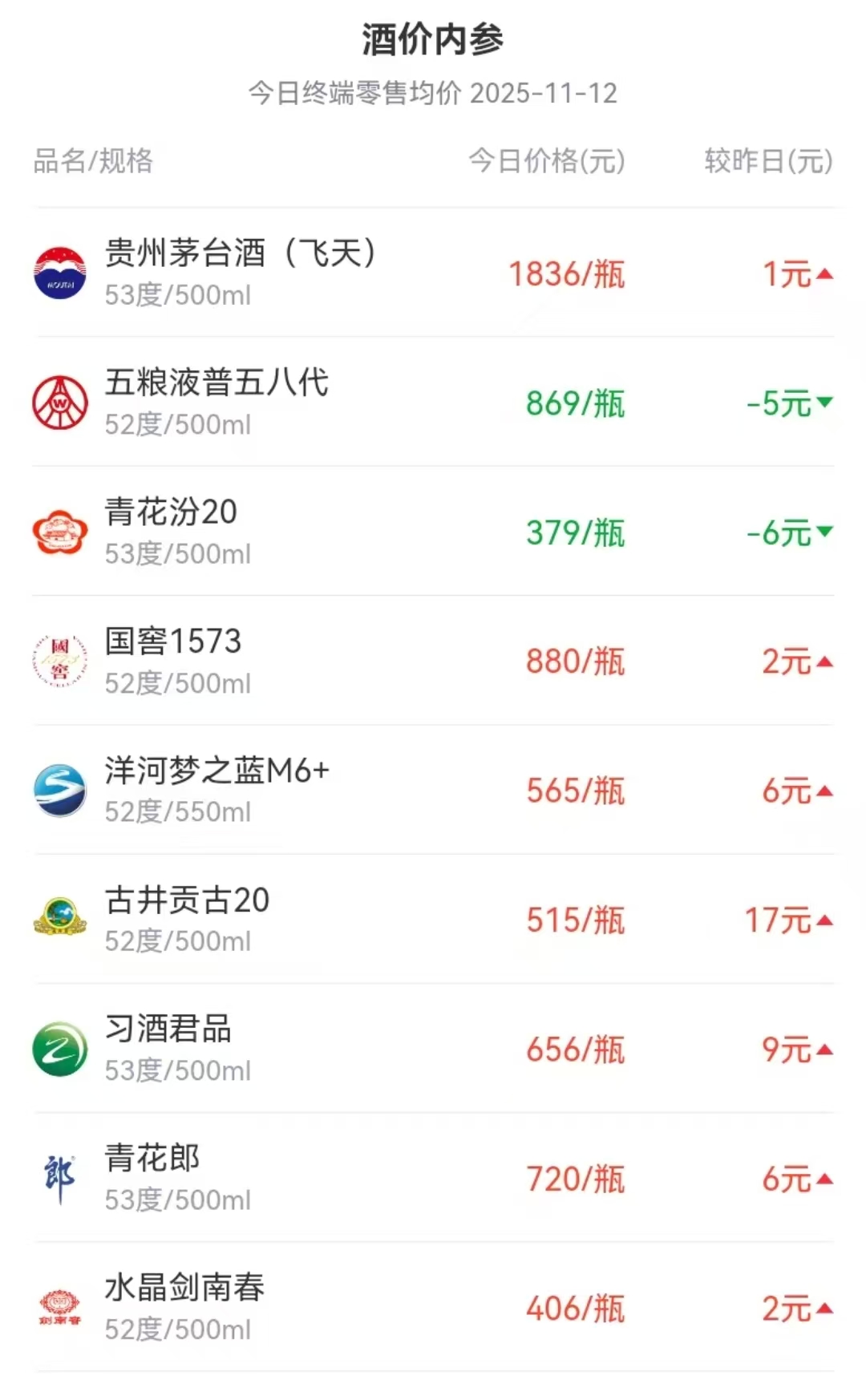
Core Insights - On Double Eleven, the retail prices of major Chinese liquor brands showed an overall increase, indicating a stabilization trend in the market [1][3] Price Changes - Guizhou Moutai (Feitian) saw a slight increase of 1 yuan per bottle, with a current average price of 1836 yuan [3] - The price of Gujing Gongjiu (20 years) rose significantly by 17 yuan per bottle, reaching 515 yuan [3] - Other brands such as Guojiao 1573, Yanghe Dream Blue M6+, Xijiu Junpin, Qinghualang, and Shuijing Jianan Chun experienced minor price increases ranging from a few yuan [1][3] - Conversely, Wuliangye (Pu Wuliang 58th generation) and Qinghualang (20 years) saw a slight decrease in price, dropping by approximately 5 yuan per bottle [1][3]


2025年第45周:酒行业周度市场观察
艾瑞咨询· 2025-11-12 00:06
Group 1: Industry Environment - The white liquor industry is experiencing a slowdown in performance and increasing differentiation, with 19 listed companies reporting a 7% year-on-year decline in total revenue by Q3 2025, while only Moutai and Fenjiu maintained growth [2] - The industry is entering a phase of volume competition, with intensified price wars and channel battles increasing cost pressures, particularly for small and medium-sized enterprises [2] - Future competitiveness will favor companies that actively transform and focus on long-term value, as the industry shifts towards rational development [2] Group 2: Consumer Trends - Young consumers are driving a trend towards mixed drinks, such as white liquor with cola, leading to a demand for lower alcohol content products [3] - Companies are responding with innovative products, including cross-industry collaborations like the "yellow wine + beer" from Guyue Longshan and Carlsberg's low-sugar sparkling fruit wine [3] - The industry is debating the definition of low-alcohol liquor, with a push towards maximizing flavor rather than adhering to strict alcohol content classifications [3] Group 3: Regional Enterprises - Regional liquor companies face significant challenges, including high inventory pressure and price inversions, as national brands dominate the market [4] - Strategies for regional companies include becoming provincial leaders, focusing on core markets, or considering exit strategies [4] - Key pathways for success involve brand premiumization, product structure optimization, and deepening distribution channels [4] Group 4: Policy and Development - The Ministry of Industry and Information Technology has included liquor production in the "historical classic industries," promoting cultural heritage and high-quality development [5] - Goals include cultivating over 50 billion-level leading enterprises and creating trillion-level industry clusters by 2028 [5] - The focus is on integrating culture, technology, and ecology to facilitate the transformation and upgrading of the liquor industry [5] Group 5: Brand Dynamics - Yanjing Beer reported a net profit of 1.77 billion yuan for Q3 2025, a 37.45% increase year-on-year, driven by a high-end strategy and cross-industry collaborations [15] - Luzhou Laojiao achieved revenue of 23.127 billion yuan and net profit of 10.762 billion yuan in the first three quarters of 2025, demonstrating resilience amid industry challenges [16] - Wuliangye's revenue reached 60.945 billion yuan with a net profit of 21.511 billion yuan, as the company adjusted its strategy to meet changing consumer demands [18] Group 6: Innovation and Sustainability - The first sustainable development report for the core sauce-flavored liquor production area was released, focusing on ecological protection and circular economy [9] - Moutai introduced a "date selection" service for consumers, enhancing personalization and emotional value in product offerings [23] - Niulanshan Chenxiang achieved significant sales milestones, selling 6 billion bottles over ten years, supported by strong brand recognition and market positioning [24]


2025双11高端白酒价格“大跳水”
Guan Cha Zhe Wang· 2025-11-11 23:49
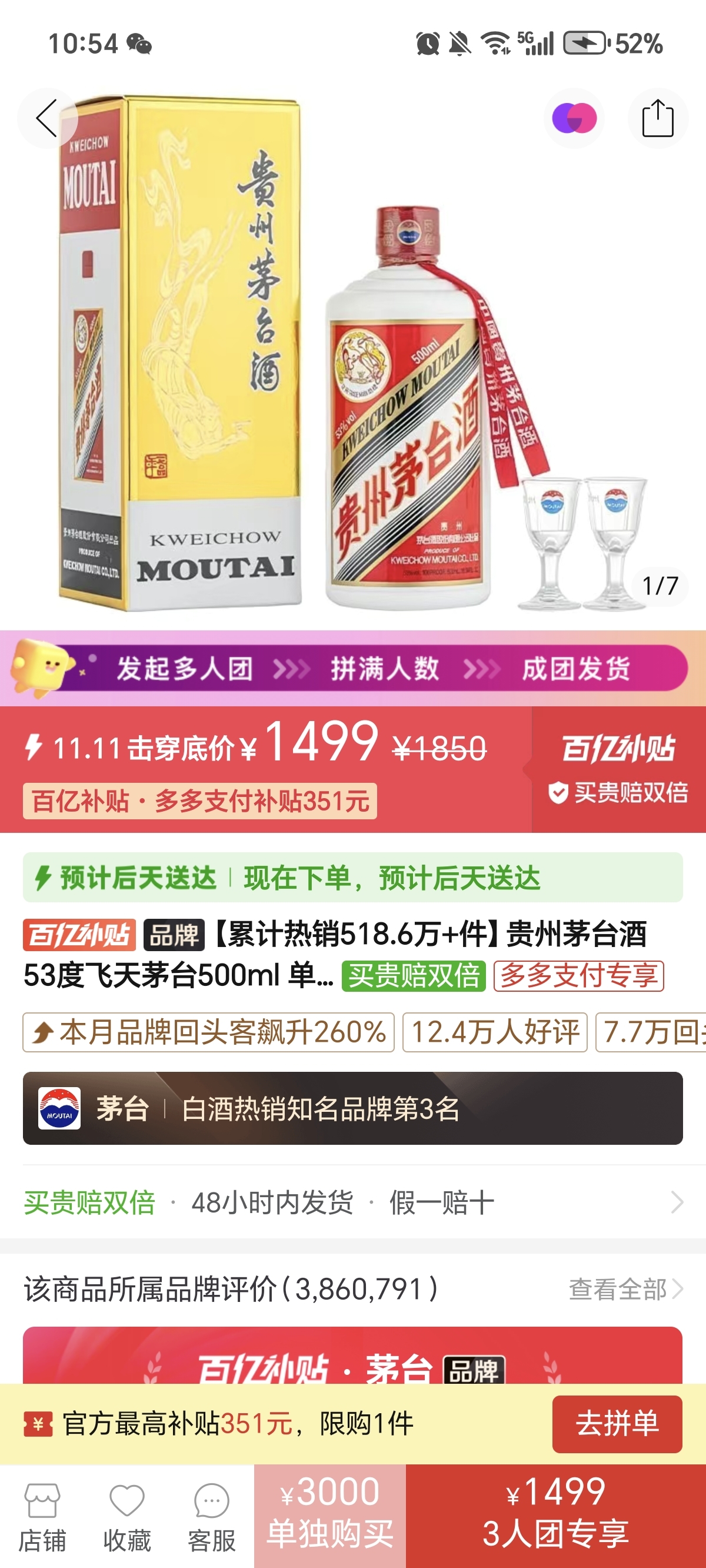
Core Viewpoint - The price of Feitian Moutai has significantly dropped during the 2025 Double Eleven shopping festival, with prices reaching as low as 1499 yuan per bottle, indicating a major shift in the high-end liquor market and consumer behavior [2][4][12]. Price Trends - In 2024, the price of Feitian Moutai was around 2000 yuan, but by 2025, it fell to 1499 yuan due to aggressive discounting strategies by e-commerce platforms [2][10]. - The price of Feitian Moutai on various platforms during the 2025 Double Eleven included 1640 yuan on Taobao, 1664.9 yuan on JD, and 1499 yuan on Pinduoduo, with some reports of prices as low as 1399 yuan [3][6][10]. Market Dynamics - The prolonged promotional period leading up to Double Eleven has resulted in a continuous decline in prices, with reports of daily price changes and significant drops in wholesale prices [4][5][8]. - The price of Feitian Moutai has been on a downward trend for over a year and a half, with a notable decline starting in April 2024, influenced by various market factors including increased supply and changing consumer preferences [9][10]. Consumer Behavior - The perception of Moutai as a luxury item has diminished, with consumers expressing dissatisfaction over the price drops, indicating a shift in the market dynamics and consumer sentiment [4][11]. - Younger consumers are moving away from traditional drinking cultures, impacting the demand for high-end liquors like Moutai [11][15]. Industry Impact - The decline in Moutai prices is reflective of broader challenges in the liquor industry, with other brands like Wuliangye and Guojiao 1573 also experiencing significant price drops [13][14]. - The traditional inventory management practices in the liquor industry, characterized by "stock pressure-control price-repressure," are being challenged as prices continue to fall, leading to potential long-term implications for the market [14][15].
消费龙头稳健前行新兴产业强势突围
Si Chuan Ri Bao· 2025-11-11 20:18
Core Insights - The overall performance of Sichuan-listed companies in the third quarter of 2025 shows significant revenue and profit figures, with total operating revenue reaching 823.1 billion and net profit at 82.15 billion [1] Revenue and Profit Distribution - Sichuan companies exhibit a tiered revenue distribution, with 14 companies entering the "100 billion revenue club" [2] - Sichuan Changhong, New Hope, and Sichuan Road and Bridge lead the revenue rankings with 81.889 billion, 80.504 billion, and 73.281 billion respectively [2] - In terms of profit, 15 companies reported net profits exceeding 1 billion, with Wuliangye leading at 21.511 billion [2] - A total of 31 companies saw net profit growth exceeding 100%, with Olin Bio achieving over 10 times growth [2] Industry Performance - Traditional consumer industries are stable, while some cyclical industries face significant pressure, as seen with Sichuan Changhong's 5.94% revenue growth and Tongwei's 5.38% revenue decline [3] - Emerging industries, particularly in communication and military sectors, are becoming new growth engines, exemplified by New Yisheng's revenue growth of 221.70% [4] Traditional Industry Adaptation - Traditional leaders in the liquor and photovoltaic sectors are actively seeking breakthroughs despite facing challenges, with Wuliangye and Luzhou Laojiao both experiencing revenue declines [5][6] - Both companies are pursuing transformation strategies, including product innovation and targeting younger consumer demographics [6] - Tongwei is leveraging its full industry chain advantage to navigate the cyclical challenges in the photovoltaic sector [6] Institutional Confidence - Institutional investments in Sichuan companies indicate long-term confidence, with many companies favored by institutional capital reflecting their solid industrial foundation and innovative potential [5][6]
抖音整顿茅台销售背后
Sou Hu Cai Jing· 2025-11-11 18:20
Core Viewpoint - The recent rumors regarding Douyin's punishment for selling Moutai below market price have been clarified as a misunderstanding, with the platform focusing on combating false advertising and suspiciously low prices in the liquor category, particularly for Moutai [2] Group 1: Douyin's Actions - Douyin has initiated a special action to combat false advertising and suspiciously low prices in the liquor category, specifically targeting two behaviors: misleading low prices for traffic and sales of potentially counterfeit products [2] - The platform has already banned over 100 abnormal low-priced products and restricted 52 merchants from operating [2] Group 2: Industry Response - Major liquor companies have launched a concentrated effort to clean up their sales channels, announcing official authorized sales channels and naming non-authorized stores [3][4] - Companies like Guizhou Moutai and Wuliangye have publicly listed non-authorized stores, including well-known platforms like Meituan and 1919 [4] Group 3: Market Dynamics - The liquor industry is facing a unique market environment with offline sales under pressure while online sales are experiencing explosive growth [5] - During the recent Mid-Autumn and National Day holidays, liquor sales saw a year-on-year decline of approximately 20%, despite some price recovery [5] - In contrast, online platforms reported significant sales increases, with Moutai sales up nearly 10 times and Wuliangye sales up nearly 3 times during the holiday period [5] Group 4: E-commerce Challenges - The rapid growth of liquor e-commerce has led to aggressive price cuts during promotional events like Double Eleven, with Moutai's subsidized price dropping to 1499 yuan per bottle [6] - The shift in supply chain dynamics, moving from direct manufacturer supply to distributor supply, has resulted in significant price discrepancies across platforms [6] - A notable percentage of products purchased from e-commerce platforms have been identified as counterfeit, with Wuliangye reporting that 16.65% of tested products were fake [6] Group 5: Strategic Shifts - Liquor companies are not only focusing on channel cleanup but are also restructuring their channel models to regain control over their brand presence in e-commerce [7] - Collaborations with e-commerce platforms are being explored to enhance brand integrity and sales efficiency [9] - The rapid development of e-commerce presents both opportunities for growth and challenges related to unauthorized sales and price control [9]

地方政府与城投企业债务风险研究报告:四川篇
Lian He Zi Xin· 2025-11-11 11:15
Report Summary - The investment rating of the industry is not mentioned in the report [4] - The report focuses on the economic, fiscal, and debt situations of Sichuan Province and its prefecture - level cities, as well as the conditions of local urban investment enterprises. It points out that Sichuan has obvious location and resource advantages, with its economy growing steadily and the government actively addressing debt issues. However, there are still challenges such as uneven regional development and debt pressure [4][5][6] Group 1: Sichuan Province's Economic and Fiscal Strength Economic Development - Sichuan has significant location and resource advantages, with well - developed land and air transportation. Its economic aggregate ranks high in China, but the urbanization level is relatively low, and the per - capita GDP is in the middle - lower range. The tertiary industry is the main driving force for economic growth [7][10][11] - The construction of the Chengdu - Chongqing Economic Circle is advancing, with major projects having a total investment of over 12 trillion yuan. In 2025, the planned investment is about 3.7 trillion yuan, and as of August 2025, the investment completion rate is 75.29% [12][14] - Sichuan has introduced a series of policies in 2025 to boost consumption, promote industrial transformation and upgrading, and improve economic recovery [14][15] Fiscal Strength and Debt - Sichuan's general public budget revenue ranks 7th in China, but the fiscal self - sufficiency rate is low. The government - funded revenue has decreased due to the real estate market, while the superior subsidy revenue ranks first in the country, supporting the comprehensive fiscal strength. The comprehensive fiscal strength ranks 4th in China [17][18][21] - By the end of 2024, Sichuan's government debt balance was 2.40289 trillion yuan, with a debt ratio of 143.87% and a debt - to - GDP ratio of 37.14%. The government has been actively reducing debt through measures such as obtaining replacement bonds, introducing incentive mechanisms, and strengthening debt management since 2024 [24][26][27] Group 2: Economic and Fiscal Strength of Sichuan's Prefecture - level Cities Economic Development - The economic development of Sichuan's prefecture - level cities is uneven. The Chengdu Plain Economic Zone and the Southern Sichuan Economic Zone have better industrial bases. Chengdu has far stronger economic strength than other cities, and Panzhihua has the highest per - capita GDP in the province [28][29][33] Fiscal Revenue - In 2024, most prefecture - level cities' general public budget revenues increased, with growth rates concentrated between 2% - 10%. The government - funded revenues of most cities decreased, and the superior subsidy revenue contributed significantly to the comprehensive fiscal strength [37][38][39] Debt - The government debt balances of all prefecture - level cities have increased, and the debt ratios have generally risen. Zigong, Suining, Bazhong, and Neijiang have relatively high debt ratios. All cities are following Sichuan's overall debt - reduction strategy [48][49] Group 3: Sichuan's Urban Investment Enterprises Overview - As of October 22, 2025, there are 218 urban investment enterprises with outstanding bonds in Sichuan. Most of them are at the district - county level, and the credit ratings are mainly AA. Chengdu has the largest number of such enterprises [52] Bond Issuance - In 2024, the number and scale of bond issuances by Sichuan's urban investment enterprises decreased slightly. From 2024 to September 2025, most cities' urban investment enterprises had a net outflow of bond financing, and the outstanding bond balances decreased [54][55][57] Debt - paying Ability - The total debt of most urban investment enterprises has increased, with the debt structure mainly composed of bank financing and bond financing. The overall debt - to - capital ratio has slightly increased, and the cash - to - short - term debt ratio has decreased. Suining's urban investment enterprises face significant short - term debt - paying pressure [60][61][65] Support from Fiscal Revenue - Except for Liangshan and Ya'an, the ratio of "total debt of bond - issuing urban investment enterprises + local government debt" to comprehensive fiscal revenue in other cities exceeds 200%, with Chengdu exceeding 500% [73]
食品饮料行业第三季报总结报告:酒类渠道包袱加速去化,大众品类表现分化
Guoxin Securities· 2025-11-11 11:13
Core Insights - The leading companies in the mass-market segment are stabilizing, while the liquor industry is experiencing accelerated pressure release, reinforcing market share logic [4][19][39] - The food and beverage sector is expected to show stable overall growth with structural differentiation by 2025, with Q1/Q2/Q3 revenues growing by +2.5%/+2.4%/-4.77% year-on-year, and net profits declining by +0.3%/-2.1%/-14.6% [4][12] - The liquor sector is entering a phase of adjustment, with a consensus on deceleration in 2024, as many companies are adjusting their strategies amid increasing channel pressures [4][19][39] Liquor Sector - In Q3 2025, the liquor sector's revenue and net profit declines have widened, with total revenue of 3,202 billion yuan, down 5.8% year-on-year, and net profit of 1,126 billion yuan, down 6.9% year-on-year [19][35] - Major liquor companies are experiencing significant revenue drops, with only a few, such as Moutai and Fenjiu, showing positive growth [20][21] - The sector is facing increased competition, leading companies to prioritize market share over profitability, resulting in a decrease in gross profit margins [33][39] Mass-Market Segment - The mass-market segment is benefiting from proactive inventory reduction and macroeconomic policy support, leading to improved operations for leading companies in 2025 [4][12] - Specific categories such as sugar-free tea, functional beverages, and snacks are showing high growth rates, with companies like Nongfu Spring and Dongpeng leading the charge [4][12] - The snack segment reported a revenue increase of 22.4% year-on-year in Q3 2025, despite rising costs in certain product categories [4][12] Investment Recommendations - The report suggests focusing on liquor and restaurant supply chains, particularly companies like Moutai, Luzhou Laojiao, and Fenjiu, which are expected to benefit from policy sensitivity [4][12] - Stronger companies in the mass-market segment, such as Nongfu Spring and Yanjing Beer, are recommended for investment due to their robust performance [4][12] Financial Performance - The liquor sector's cash flow is under pressure, with many companies reporting negative operating cash flows, indicating a slowdown in business activity [40] - The overall net profit margin for the liquor sector has decreased, with only Moutai showing an improvement in gross profit margin due to better product mix [39][40]


微醺情绪价值“稀释” 百润股份的威士忌梦能否“救场”
Bei Jing Shang Bao· 2025-11-11 11:01
Core Viewpoint - RIO's market position has weakened significantly, with its products being replaced by competitors in the low-alcohol beverage segment, leading to declining sales and financial performance for its parent company, Bairun Co. [1][5] Group 1: Market Position and Sales Performance - RIO's products, once dominating low-alcohol beverage shelves, now occupy less than one-third of the space, with many products nearing expiration dates [3][4] - Bairun Co. reported a revenue decline of approximately 5% and a net profit decrease of about 4% in the first three quarters of the year [4][5] - The company's inventory turnover days have increased significantly, indicating slower sales, with the latest figure reaching 468.66 days [4] Group 2: Competitive Landscape - The low-alcohol beverage market is becoming increasingly competitive, with brands like Suntory's Holo and 196°C gaining popularity among consumers [7][8] - The market is shifting from a blue ocean to a red ocean, with various brands, including traditional liquor companies, entering the low-alcohol segment, further squeezing RIO's market share [8][9] Group 3: Future Growth Strategies - Bairun Co. is exploring whiskey as a second growth curve, having initiated its whiskey business in 2016 and launching brands like "Laizhou" and "Bailide" [9][10] - The domestic whiskey market is expanding, with a projected capacity of 5 to 8 billion yuan and an annual growth rate of at least 15% [10][11] - However, Bairun Co. faces challenges in brand recognition and sales performance in the whiskey segment, as its products are less known compared to established brands [10][11]

1499元买飞天茅台,2025双11高端白酒价格“大跳水”
Guan Cha Zhe Wang· 2025-11-11 10:43
Core Viewpoint - The price of Feitian Moutai has experienced a significant decline, with prices dropping below 2000 yuan during the 2025 "Double 11" shopping festival, marking a dramatic shift in consumer sentiment and market dynamics [1][20]. Price Trends - During the 2024 "Double 11," Feitian Moutai was priced at approximately 2036 yuan on Taobao, 2061 yuan on Pinduoduo, and 2499 yuan on JD [1][18]. - In 2025, prices fell further, with Taobao listing it at 1640 yuan, Pinduoduo at 1499 yuan, and JD at 1664.9 yuan [2][7]. - The price of loose Feitian Moutai continued to decline, reaching 1590 yuan on Pinduoduo and 1499 yuan during promotional events [7][12]. Market Dynamics - The prolonged promotional period leading up to "Double 11" has resulted in a continuous price drop, with prices fluctuating daily [6][17]. - The price drop is attributed to various factors, including increased supply, changes in consumer behavior, and aggressive discounting strategies by e-commerce platforms [24][41]. Consumer Sentiment - Consumers have expressed mixed feelings, with some stating that the "Moutai myth" has fallen as prices drop significantly [2][12]. - The decline in prices has led to a shift in purchasing behavior, with consumers focusing more on value rather than brand prestige [24][41]. Industry Impact - The price decline of Feitian Moutai is part of a broader trend affecting the high-end liquor market, with other brands like Wuliangye and Guojiao 1573 also experiencing significant price drops [25][30]. - The industry is facing deep adjustments, with traditional sales strategies being challenged by changing consumer preferences and economic conditions [24][41].