航锦科技

Search documents
化学原料板块9月30日涨1.16%,*ST亚太领涨,主力资金净流出7896.85万元


Zheng Xing Xing Ye Ri Bao· 2025-09-30 08:42
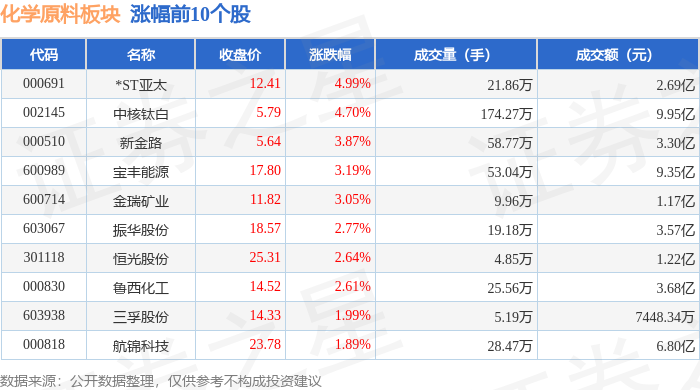
Market Overview - On September 30, the chemical raw materials sector rose by 1.16%, with *ST Asia leading the gains [1] - The Shanghai Composite Index closed at 3882.78, up 0.52%, while the Shenzhen Component Index closed at 13526.51, up 0.35% [1] Stock Performance - The top-performing stocks in the chemical raw materials sector included: - *ST Asia: Closed at 12.41, up 4.99% with a trading volume of 218,600 shares and a turnover of 269 million [1] - Zhongke Titanium White: Closed at 5.79, up 4.70% with a trading volume of 1,742,700 shares [1] - New Jinlu: Closed at 5.64, up 3.87% with a trading volume of 587,700 shares and a turnover of 330 million [1] - Baofeng Energy: Closed at 17.80, up 3.19% with a trading volume of 530,400 shares and a turnover of 935 million [1] Capital Flow - The chemical raw materials sector experienced a net outflow of 78.97 million from institutional investors, while retail investors saw a net inflow of 132 million [2] - The capital flow for specific stocks showed: - Zhongke Titanium White had a net inflow of 64.77 million from institutional investors [3] - Huayuan Titanium Industry experienced a net outflow of 14.35% from retail investors [3]

继续猛攻!化工ETF(516020)盘中上探1.32%!机构:预计行业供需有望持续改善
Xin Lang Ji Jin· 2025-09-30 02:50
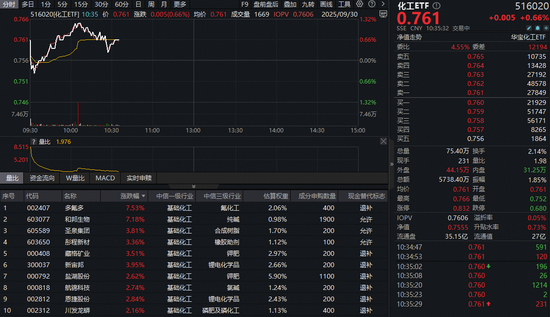
Group 1 - The chemical sector continues to show strong performance, with the chemical ETF (516020) experiencing a price increase of 0.66% as of the latest update, reflecting a peak intraday gain of 1.32% [1][2] - Key stocks in the sector, including fluorine chemicals, soda ash, lithium batteries, and synthetic resins, have seen significant gains, with companies like Duofu Duo and Hebang Biological rising over 7% [1][3] - The Ministry of Industry and Information Technology has proposed measures to expand market consumption, including optimizing tax incentives for the automotive industry and promoting electric vehicles in public sectors [1][4] Group 2 - According to CITIC Construction Investment, investment in China's lithium battery industry chain has rapidly increased, with solid-state batteries emerging as a hot investment area, indicating a significant acceleration in the industrialization process [3] - The chemical ETF (516020) is currently at a low valuation point, with a price-to-book ratio of 2.31, suggesting a favorable long-term investment opportunity [3] - Donghai Securities highlights that China's chemical industry has a competitive advantage due to cost efficiency and technological advancements, positioning it to fill gaps in the international supply chain [4] Group 3 - The chemical ETF (516020) tracks the CSI segmented chemical industry index, with nearly 50% of its holdings in large-cap leading stocks, providing investors with a diversified exposure to the chemical sector [5] - The ETF allows investors to efficiently capitalize on the rebound opportunities in the chemical sector, with a balanced approach to various sub-sectors [5]


烧碱周报:价格偏弱运行,关注节后变化-20250929
Zhong Yuan Qi Huo· 2025-09-29 09:13
1. Report Industry Investment Rating - No information provided in the report. 2. Core Viewpoints of the Report - The market continues to trade on the Fed's interest rate cut path, and attention should be paid to the latest US non - farm payroll data. During the National Day holiday, the market is shipping based on previous orders, and enterprises may face some pressure. The price of liquid caustic soda in the East China region is expected to remain stable, while in the Shandong market, due to the approaching holiday, there is no obvious positive news on the demand side, and the inventory of local alkali plants is likely to increase, with the possibility of price cuts in the near future. The spot trend in Shandong is weak, demand is lower than expected, and the futures price is running weakly. Attention should be paid to whether it can stop falling and stabilize after the holiday. The recommended trading strategy is to set the upper reference pressure level for the caustic soda 2601 contract at 2700 yuan/ton and the lower support level at 2400 yuan/ton [4]. 3. Summary According to the Directory 3.1 Market Review - **Spot Market**: The report presents multiple charts showing the price trends of caustic soda in different regions (Shandong, Jiangsu, Zhejiang), the price differences between different types of caustic soda (32% and 50% ion - membrane caustic soda, flake caustic soda), and the price relationships between caustic soda and related products (such as raw salt, liquid chlorine). The data is sourced from Wind and Mysteel. In the week from 20250919 - 20250925, the price of 32% ion - membrane caustic soda in Shandong remained at 800 yuan/ton, the price of 50% ion - membrane caustic soda decreased by 2.36% to 1270 yuan/ton, the price of 98% flake caustic soda in the Northwest remained at 3230 yuan/ton, and the price of liquid chlorine in Shandong remained at - 150 yuan/ton. The price of alumina in Shandong decreased by 1.86% to 2950 yuan/ton [10][13][18]. - **Futures Market**: The report shows the price trends of caustic soda futures and its comparison with other related futures (soda ash, alumina, PVC), as well as the relationship between the caustic soda futures price and the number of warehouse receipts. The data is sourced from Wind and Mysteel [16]. 3.2 Market Analysis - **Supply Side: Production and Operating Rate**: In the week of 20250919 - 0925, the average capacity utilization rate of Chinese caustic soda sample enterprises with a capacity of 200,000 tons and above was 82.5%, a week - on - week increase of 0.6%. The load in the Northwest decreased due to new device maintenance, while the load in North and East China increased after device maintenance. It is estimated that the weekly capacity utilization rate of caustic soda this week will be around 85.9%, and the weekly output will be around 845,700 tons. The report also lists the maintenance plans of multiple enterprises [22][23]. - **Downstream Demand**: For alumina, the current spot supply in northern China is relatively loose, while the market - available spot in Henan and Southwest China is still tight. The supply of domestic ore remains tight, and some enterprises continue to purchase imported ore. The production is relatively stable, but the narrowing profit due to falling prices makes enterprises more willing to negotiate lower prices for raw materials. It is expected that the domestic alumina price will continue to adjust weakly in the short term, with a price range of 2850 - 3100 yuan/ton. In the week of 20250919 - 20250925, the capacity utilization rate of the viscose staple fiber industry was 89.82%, a week - on - week increase of 0.3% [27]. - **Inventory**: As of September 25, 2025, the factory inventory of fixed liquid caustic soda sample enterprises with a capacity of 200,000 tons and above was 391,200 wet tons, a week - on - week increase of 3.4% and a year - on - year increase of 26.26%. The storage capacity ratio of liquid caustic soda sample enterprises was 20.78%, a week - on - week increase of 0.64%. The storage capacity ratios in the Northwest, North, Central, and East China increased, while those in the Northeast, South, and Southwest decreased. In the North China region, the demand for 32% caustic soda in Shandong was poor, and the inventory increased; the high - concentration caustic soda inventory decreased. In Tianjin and Hebei, the inventory increased due to increased supply. In the South China region, the inventory decreased due to reduced supply. In the Central China region, the inventory increased due to increased supply. In the East China region, the inventory increased slightly due to increased supply. In the Northwest region, the inventory in Gansu and Ningxia decreased due to maintenance, while the inventory in Shaanxi increased due to poor sales. In the Southwest region, the inventory decreased due to active pre - holiday stocking [30]. - **Liquid Chlorine**: As of September 25, 2025, the average price of liquid chlorine in Shandong increased by 32.26% to - 150 yuan/ton. The price increase was affected by the reduced supply in Jiangsu, and then remained stable. The supply and demand in Shandong did not change significantly, and downstream procurement was stable. In Hebei and the Northeast, the load of chlor - alkali enterprises increased, and downstream pre - holiday stocking was active, which supported the price of liquid chlorine. As of September 26, 2025, the capacity utilization rate of Chinese PVC was 76.96%, a week - on - week decrease of 2.98%. It is estimated that the capacity utilization rate this week will increase to 82.17% due to the increased operation of some enterprises. In the week of 20250919 - 20250925, the average weekly profit of Shandong chlor - alkali enterprises was 258 yuan/ton, a week - on - week decrease of 21.34%. The theoretical production cost of caustic soda remained stable, the caustic soda price decreased significantly, the average weekly price of liquid chlorine increased, and the chlor - alkali profit decreased [33][34].
氯碱四季报:SH:四季度关注下游补库节奏,需求仍存支撑v,供需矛盾较难解决,关注四季度需求边际变化
Guang Fa Qi Huo· 2025-09-29 02:52
Report Summary 1. Industry Investment Rating No investment rating is provided in the report. 2. Core Views - **Caustic Soda**: In Q3, caustic soda showed a wide - range oscillation. After the non - aluminum restocking ended, the demand was mainly for rigid needs. The main downstream, alumina, had high inventory and low restocking willingness. However, due to the planned alumina capacity expansion in Q1 2025, there might be concentrated restocking in Q4 2024, limiting the downside space of caustic soda. The downstream restocking rhythm needs to be tracked [3]. - **PVC**: In Q3, the PVC market was in a continuous decline. The supply was at a high level with an obvious surplus, and the demand in the peak season was weak. Although exports alleviated some of the surplus pressure, the cost of raw materials provided bottom - level support. In Q4, the cost support should be focused on, and the downside space during the peak season is limited. Attention should be paid to the downstream demand performance [4]. 3. Summary by Related Catalogs Caustic Soda - **Price and Market Dynamics**: The price of caustic soda fluctuated widely in Q3. Factors such as macro - policies, supply - demand changes in the main production areas, and the price of liquid chlorine affected the price. The market was worried about the subsequent supply return and the weakening of downstream demand [9]. - **Supply**: The industry's operating rate declined slightly, and Shandong's caustic soda plants continued to accumulate inventory in Q3. As of September 24, the inventory of 32% liquid caustic soda in expanded sample enterprises in East China and Shandong increased compared with September 17 [22][28]. - **Downstream Demand** - **Alumina**: From the end of 2024 to 2025, the planned alumina capacity to be put into production is 12.3 million tons (including 2 million tons of replacement), with an estimated annual production increase of about 6%. The new alumina projects will increase the demand for caustic soda by about 800,000 tons per year. In Q4 2024, there may be restocking due to the planned capacity expansion in Q1 2025 [30][33]. - **Non - aluminum**: The printing and dyeing operating rate increased seasonally, but the pre - holiday restocking has ended [52]. - **Export**: The export volume decreased in August, but the estimated export profit increased again in September [58]. PVC - **Price and Market Dynamics**: In Q3, the PVC futures and spot prices both declined. The supply - demand relationship lacked positive drivers, and the macro - atmosphere was poor, leading to a continuous decline in the market [65]. - **Profit**: The industry's profit declined quarter - on - quarter in Q3, with both the ethylene - based and calcium - carbide - based production methods facing profit pressure [71]. - **Supply**: The production volume was high in Q3, and the overall operating rate decreased recently. Although there were many maintenance enterprises this week, some have gradually resumed production [81][87]. - **Downstream Demand** - **Profiles and Pipes**: The two major downstream industries of PVC, profiles and pipes, faced great pressure, and the demand was weak. The real - estate industry, with the goal of "reducing inventory and stabilizing prices", continued to have a negative impact on demand [94]. - **Real - Estate Data**: The real - estate industry is still in the bottom - building cycle, with indicators such as housing sales price index, land transaction area, and new construction area showing weak performance [95]. - **Inventory**: The inventory increased in Q3, and the total inventory was at the highest level in recent years compared with the same period [102]. - **External Market and Export**: In August 2025, the PVC import volume decreased, and the export volume decreased month - on - month but increased year - on - year. The export window to Southeast Asia and India has opened [114][120].
中泰期货PVC烧碱产业链周报-20250928
Zhong Tai Qi Huo· 2025-09-28 12:14
1. Report Industry Investment Rating - No information about the industry investment rating is provided in the report. 2. Report's Core View - For PVC, this week's production slightly increased and was slightly higher than expected, with an expected increase next week as previously shut - down units resume. Export orders increased slightly this week, but domestic demand is weak. The overall chlor - alkali comprehensive profit has started to weaken, mainly due to the weakening of caustic soda and the strengthening of calcium carbide prices. Strategies include paying attention to spot - futures arbitrage opportunities, a bearish configuration after a rebound for single - side trading, and temporarily observing the 1 - 5 spread [6][9][10]. - For caustic soda, this week's production maintained a high level with a slight increase, and it is expected to continue rising next week. The overall inventory slightly increased this week, and there may be a slight de - stocking next week if production fails to meet expectations. The price is expected to be weakly volatile, and it is recommended to guard against callback risks. The 1 - 5 spread is recommended to focus on reverse arbitrage opportunities [103][106][107]. 3. Summary by Relevant Catalogs 3.1 PVC 3.1.1 Spot Market - PVC prices showed an oscillating trend this week. The prices of related products such as caustic soda 32% decreased, while the prices of some calcium carbide and liquid chlorine increased. For example, the price of caustic soda 32% dropped from 770 yuan/ton last week to 760 yuan/ton this week, and the price of Shandong liquid chlorine increased from - 200 yuan/ton to - 150 yuan/ton [7]. 3.1.2 Basis and Spread - The basis oscillated. For example, the basis of East China calcium carbide method increased from - 170 yuan/ton last week to - 157 yuan/ton this week. The 1 - 5 spread oscillated, and the 9 - 1 spread increased from 421 to 433 [9]. 3.1.3 Industry Chain Profit - The overall chlor - alkali comprehensive profit started to weaken. The production profit of calcium carbide in Shaanxi decreased from - 358 yuan/ton to - 398 yuan/ton. The export profit slightly improved, with the theoretical export profit to India increasing from 740 yuan/ton to 782 yuan/ton [9]. 3.1.4 Supply and Demand - Production: This week's total production was 47.96 million tons, an increase of 1.87 million tons from last week. The production of ethylene - based method was 14.06 million tons, and that of calcium carbide - based method was 33.90 million tons. Next week, production is expected to continue increasing [6]. - Demand: This week's apparent demand was 42.50 million tons, slightly lower than the expected value. The expected apparent demand for next week is 42.53 million tons. The domestic apparent demand growth rate in September may be lower than the expected 2% [6]. - Inventory: This week, the old - sample inventory increased by 1.21 million tons, and the new - sample inventory of middle - stream traders increased by 1.75 million tons. If calculated based on the current production and apparent demand, inventory is expected to increase next week [6]. 3.2 Caustic Soda 3.2.1 Spot Market - The price of caustic soda 32% decreased from 770 yuan/ton last week to 760 yuan/ton this week. The price of Shandong liquid chlorine increased from - 200 yuan/ton to - 150 yuan/ton, and the price of Shandong raw salt remained stable at 210 yuan/ton [7][104]. 3.2.2 Basis and Spread - The basis strengthened. For example, the 32% caustic soda basis of the 01 contract increased from - 235 yuan/ton last week to - 153 yuan/ton this week. The 1 - 5 spread decreased from - 82 to - 95, and it is recommended to pay attention to reverse arbitrage opportunities [106]. 3.2.3 Industry Chain Profit - The comprehensive profit of Shandong chlor - alkali decreased from - 143 yuan/ton to - 260 yuan/ton. The profit of external sales of caustic soda and liquid chlorine improved, and the profit of supporting PVC enterprises showed a weakening trend [106]. 3.2.4 Supply and Demand - Production: This week's total production was 81.29 million tons, a slight increase from last week. It is expected to continue increasing next week [103]. - Demand: This week's apparent demand was about 74.24 million tons, and it is estimated to be about 77.53 million tons next week based on historical data [103]. - Inventory: The national inventory slightly increased this week. If production fails to meet expectations next week, there may be a slight de - stocking [103].
中泰期货烧碱周报:液氯价格未能如预期下跌,烧碱期货价格承压下行-20250928
Zhong Tai Qi Huo· 2025-09-28 11:58
Report Industry Investment Rating - Not provided in the content Core Viewpoints - This week, the caustic soda futures showed a significant downward trend, with short - sellers actively increasing positions to push down the futures price, and there were stop - loss phenomena among long - sellers. The main reasons include weak spot prices, the non - decline of liquid chlorine prices contrary to expectations, and the continuous decline of alumina spot and futures prices. In the later stage, the caustic soda futures may be supported by the liquid chlorine price, especially during the National Day holiday. Therefore, the caustic soda futures should be treated with a volatile mindset [5]. Summary by Directory 01 Overview - **Supply**: In the period from September 19 - 25, 2025, the average capacity utilization rate of Chinese caustic soda sample enterprises with a capacity of 200,000 tons and above was 82.5%, a 0.6% week - on - week increase. Northwest had new device production cuts and maintenance, while North China and East China had increased loads after device maintenance. Next week, except for the Southwest region, other six regions are expected to increase their loads, with an estimated capacity utilization rate of about 85.9% and a weekly output of about 845,700 tons [5]. - **Demand - Alumina**: China's alumina production was 1.855 million tons, a decline from last week's 1.861 million tons. Shandong's alumina production remained flat at 626,000 tons. The liquid caustic soda purchase price of large - scale alumina factories in Shandong dropped to 740 yuan/ton, with a 100% converted price of 2,313 yuan/ton. Alumina prices and production profits declined recently [5]. - **Demand - Viscose Staple Fiber**: China's viscose staple fiber production was 90,000 tons, a 30 - ton increase from last week. As of September 25, 2025, the total daily output of 20 domestic viscose staple fiber enterprises was around 12,960 tons. The physical inventory of domestic viscose staple fiber factories was 128,200 tons, a 50 - ton decrease from the previous period and a 32,000 - ton increase compared to the same period last year, a year - on - year increase of 33.26%. The downstream demand for viscose staple fiber was weak [5]. - **Demand - Printing and Dyeing**: As of September 25, 2025, the comprehensive startup rate in the Jiangsu and Zhejiang regions was 66.15%, a 0.4% increase from the previous period. The average startup rate of printing and dyeing enterprises in Zhejiang was 66.25%, remaining flat compared to the previous data and a 1.25% increase year - on - year. The overall startup rate of dyeing factories in Zhejiang remained stable, with orders featuring "short, frequent, and fast" characteristics. Most dyeing factories planned to have a 2 - 3 - day holiday during the National Day [5]. - **Export**: In August, the export volume of liquid caustic soda was 213,500 tons, and the export volume of flake caustic soda was 66,800 tons [5]. - **Inventory**: As of September 25, 2025, the factory inventory of fixed liquid caustic soda sample enterprises with a capacity of 200,000 tons and above in China was 391,200 tons (wet tons), a 3.4% week - on - week increase and a 26.26% year - on - year increase. The storage capacity ratio of domestic liquid caustic soda sample enterprises was 20.78%, a 0.64% week - on - week increase [5]. - **Profit**: This Friday, the average price of Shandong liquid caustic soda was 2,500 yuan/ton, the average price of liquid chlorine was - 100 yuan/ton, and the chlor - alkali profit was 306 yuan/ton, at a historically low level. The decline in liquid caustic soda prices compressed the comprehensive chlor - alkali profit [5]. - **Strategy**: Adopt a volatile mindset for single - side trading; no strategy for arbitrage and options [5]. 02 Price - The report presents price trends of Shandong chlor - alkali spot, flake caustic soda, export caustic soda, caustic soda futures, basis, inter - month spreads, raw salt, and coal, with data sources from Mysteel and compiled by Zhongtai Futures [7][10][13][16] 03 Supply - **Caustic Soda Supply**: Data on China's weekly caustic soda production, caustic soda startup rate, caustic soda device loss volume, and cumulative caustic soda production are provided, with data sources from Mysteel and compiled by Zhongtai Futures [20][21] - **Caustic Soda Inventory and Chlor - Alkali Profit**: Information on the liquid caustic soda inventory of Chinese sample enterprises, caustic soda futures warehouse receipts, and Shandong chlor - alkali enterprise profits is presented, with data sources from Mysteel and compiled by Zhongtai Futures [23][24] - **Chlor - Alkali Device Maintenance Plan**: This week, many chlor - alkali devices have resumed operation after maintenance, and there are also some devices under maintenance. In the future, multiple enterprises have maintenance plans, including specific time and capacity information [26] 04 Demand - **Alumina Industry**: Data on China's alumina production, Shandong's alumina production, alumina profit, Shandong alumina enterprises' liquid caustic soda purchase price, and alumina inventory are provided, with data sources from Mysteel and compiled by Zhongtai Futures [29][30][31][32] - **Textile Industry**: Information on viscose staple fiber capacity utilization rate, market price, factory inventory, inventory available days of viscose staple fiber in Chinese rayon yarn enterprises, textile enterprise weekly startup rate, order days, in - factory finished product inventory available days, and Jiangsu and Zhejiang region printing and dyeing factory startup rate is presented, with data sources from Mysteel and compiled by Zhongtai Futures [34][35][37][38] - **Pulp and Paper Industry**: Data on pulp production, paper product production, and the inventory available days of paper products in upstream factories are provided, with data sources from Mysteel and compiled by Zhongtai Futures [39][40] - **Export**: Data on China's monthly export volume of liquid caustic soda, flake caustic soda, cumulative export volume of caustic soda, and monthly export volume of caustic soda are presented, with data sources from Mysteel and compiled by Zhongtai Futures [41][42]
阿里的磐久超节点和供应链
傅里叶的猫· 2025-09-27 10:14
Core Viewpoint - The article provides a detailed comparison of Alibaba's super node with NVIDIA's NVL72 and Huawei's CM384, focusing on GPU count, interconnect technology, power consumption, and ecosystem compatibility. Group 1: GPU Count - Alibaba's super node, known as "Panjun," utilizes a configuration of 128 GPUs, with each of the 16 computing nodes containing 4 self-developed GPUs, totaling 16 x 4 x 2 = 128 GPUs [4] - In contrast, Huawei's CM384 includes 384 Ascend 910C chips, while NVIDIA's NVL72 consists of 72 GPUs [7] Group 2: Interconnect Technology - NVIDIA's NVL72 employs a cable tray interconnect method using NVLink proprietary protocol [8] - Huawei's CM384 also uses cable connections between multiple racks [10] - Alibaba's super node features an orthogonal interconnect without a backplane, allowing for direct connections between computing and switch nodes, reducing signal transmission loss [12][14] Group 3: Power and Optical Connections - NVIDIA's NVL72 uses copper for scale-up connections, while Huawei's CM384 employs optical interconnects, leading to higher costs and power consumption [15] - Alibaba's super node uses electrical interconnects for internal scale-up, with some connections made via PCB and copper cables, while optical interconnects are used between two ALink switches [18][19] Group 4: Parameter Comparison - Key performance metrics show that NVIDIA's GB200 NVL72 has a BF16 dense TFLOPS of 2,500, while Huawei's CM384 has 780, indicating a significant performance gap [21] - The HBM capacity for NVIDIA's GB200 is 192 GB compared to Huawei's 128 GB, and the scale-up bandwidth for NVIDIA is 7,200 Gb/s while Huawei's is 2,800 Gb/s [21] Group 5: Ecosystem Compatibility - Alibaba claims compatibility with multiple GPU/ASICs, provided they support the ALink protocol, which may pose challenges as major manufacturers are reluctant to adopt proprietary protocols [23] - Alibaba's GPUs are compatible with CUDA, providing a competitive advantage in the current market [24] Group 6: Supply Chain Insights - In the AI and general server integration market, Inspur holds a 33%-35% market share, while Huawei's share is 23% [33] - For liquid cooling, Haikang and Invec are key players, each holding 30%-40% of the market [35] - In the PCB sector, the number of layers has increased to 24-30, with low-loss materials making up over 60% of the composition, significantly increasing the value of single-card PCBs [36]


化学原料板块9月26日涨0.21%,*ST亚太领涨,主力资金净流出2.02亿元
Zheng Xing Xing Ye Ri Bao· 2025-09-26 08:41
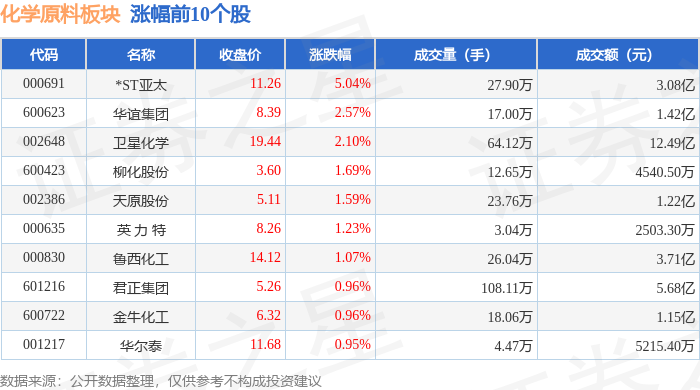
Group 1 - The chemical raw materials sector saw a slight increase of 0.21% on September 26, with *ST Asia leading the gains [1] - The Shanghai Composite Index closed at 3828.11, down 0.65%, while the Shenzhen Component Index closed at 13209.0, down 1.76% [1] - Notable gainers in the chemical raw materials sector included *ST Asia with a closing price of 11.26, up 5.04%, and Huayi Group with a closing price of 8.39, up 2.57% [1] Group 2 - The chemical raw materials sector experienced a net outflow of 202 million yuan from main funds, while retail investors saw a net inflow of 176 million yuan [2] - The top individual stock in terms of main fund inflow was Junzheng Group, with a net inflow of 96.31 million yuan, despite a net outflow from retail investors [3] - Other stocks with significant main fund inflows included Baofeng Energy and Zhonghe Titanium White, with net inflows of 26.83 million yuan and 17.72 million yuan, respectively [3]
政策东风起!化工板块深度回调,化工ETF(516020)盘中跌超2%!布局时机或至?
Xin Lang Ji Jin· 2025-09-23 03:32
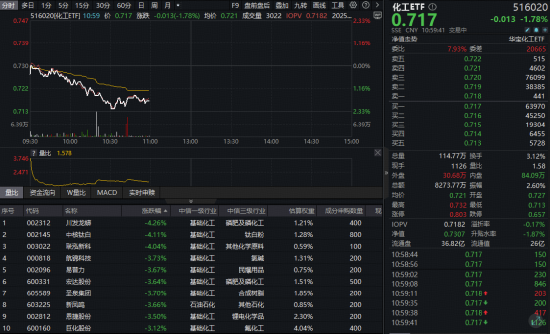
Group 1 - The chemical sector is experiencing a pullback, with the chemical ETF (516020) showing a decline of 1.78% as of the latest report, after a drop of 2.33% during intraday trading [1] - Key stocks in the sector, including Chuanfa Longmang, Zhonghe Titanium, and Lianhong Xinke, have seen declines exceeding 4%, contributing to the overall negative performance of the sector [1] - The recent statistics indicate that lithium-ion battery exports from China have reached 3 billion units from January to August 2025, marking an 18.66% year-on-year increase, with export value rising to $48.296 billion, a 25.79% increase [2] Group 2 - Guosen Securities suggests that leading companies in the lithium battery sector are expected to maintain stable profitability amid ongoing industry consolidation and technological advancements [3] - Debon Securities highlights that recent policy initiatives are likely to improve the supply-demand dynamics in the chemical industry, suggesting a potential new long-term growth cycle [4] - The outlook from Guohai Securities indicates that the chemical industry in China may see a significant slowdown in capacity expansion, which could enhance dividend yields and transform the sector's financial profile [5] Group 3 - The chemical ETF (516020) is noted for its diversified exposure across various sub-sectors, with nearly 50% of its holdings in large-cap leading stocks, providing an efficient way to invest in the chemical sector [6] - The chemical index's price-to-book ratio is currently at 2.24, which is at a low percentile compared to the last decade, indicating a favorable long-term investment opportunity [3]
多家公司受到证监会行政处罚,亿元级罚单频现|财富周历 动态前瞻
Sou Hu Cai Jing· 2025-09-22 00:59
A-shares Market - On September 18, A-shares experienced a rapid decline after an initial rise, with the Shanghai Composite Index closing at 3831.66 points, down 1.15%, and the Shenzhen Component Index at 13075.66 points, down 1.06%. The ChiNext Index fell by 1.64% to 3095.85 points. Despite the decline, the trading volume in the Shanghai and Shenzhen markets reached 3.135 trillion yuan, an increase of 758.4 billion yuan from the previous trading day, marking the third-highest trading volume of the year [2] - On September 18, 18 A-shares registered for equity distribution, with 17 companies proposing dividends and one company planning to implement dividends, capital increase, or stock distribution simultaneously [2] - The China Securities Regulatory Commission has imposed strict penalties on several companies for financial fraud, including *ST Dongtong and Yili Clean Energy, sending a strong signal of "zero tolerance" for such behaviors [2] - The Beijing Stock Exchange continues to see high activity in new stock listings, with the stock of Sanxie Electric rising by over 860% on its first trading day, closing up 785.62%, marking the highest first-day increase of the year [2] Insurance Sector - In the first half of the year, listed insurance companies showed a mixed performance in investment returns. Companies like Xinhua Insurance and China Ping An reported strong results after increasing their equity allocations, particularly in high-dividend stocks. Conversely, China Taiping's investment performance weakened significantly, with total investment income dropping by 41.6% year-on-year, and the annualized total investment return rate falling from 5.27% to 2.68% [3] Banking and Financial Products - Current bank deposit rates have generally fallen below 2%, although some private banks like Huari Bank and WeBank still offer large-denomination certificates of deposit with rates exceeding 2%. These high-yield products are in high demand and are quickly sold out [4] - As of September 12, the number of domestic securities investment private equity firms with assets exceeding 10 billion yuan has reached 92, with quantitative private equity firms making up nearly 50% of this group [4] - The Hong Kong Monetary Authority announced a reduction in the base interest rate to 4.5%, effective immediately, based on a formula referencing the lower limit of the current U.S. federal funds rate target range plus 50 basis points [4] Government Bonds - On September 17, the Ministry of Finance announced the completion of the competitive bidding for the second issuance of the 2025 ultra-long special government bonds, with a total face value of 35 billion yuan for a 20-year fixed-rate bond. The overall issuance scale of ultra-long special government bonds this year has reached 1.148 trillion yuan, with an issuance progress of 88.3% [4] Real Estate Market - In August, the sales prices of commercial residential properties in 70 large and medium-sized cities continued to show a narrowing year-on-year decline, with positive signals in property sales, inventory reduction, and corporate financing. A series of supportive policies have improved market expectations and accelerated demand release [6] Tax Revenue - In the first eight months of the year, tax revenue collected by the tax authorities increased by 2% year-on-year, with significant growth in July and August due to heightened activity in the capital markets, where tax revenue from the securities industry grew by over 70% in both months [7] - From January to August, the general public budget revenue reached 148.198 billion yuan, a year-on-year increase of 0.3%. Tax revenue was approximately 121.085 billion yuan, showing a slight increase of 0.02% [8]