微软

Search documents
Bug还没修完,又要往Windows里狂塞AI?全网怒骂微软:“住手吧,没人想要这玩意儿”
3 6 Ke· 2025-11-14 11:51
Core Viewpoint - Microsoft is evolving Windows into an "Agentic OS," an AI-driven platform that aims to understand user intent and automate tasks, but this has sparked significant backlash from users who prefer a stable operating system [1][3][10]. User Reactions - The majority of user comments express strong opposition to the concept of "Agentic OS," with many stating that they simply want a stable version of Windows [4][5]. - Users feel that Microsoft is out of touch with their needs, questioning why the company continues to push AI features despite overwhelming negative feedback [5][6]. User Frustrations - Users have expressed long-standing frustrations with Windows, citing issues such as system bloat and forced AI integration, which they find unacceptable given that Windows is not a free operating system [6][7]. - Many users believe that the core issues with Windows are not related to a lack of AI but rather to fundamental performance and stability problems that Microsoft has failed to address [7][10]. Microsoft's AI Focus - Microsoft has been heavily investing in AI, often at the expense of other departments, leading to a perception that the company prioritizes AI over user experience [8][9]. - The integration of AI features across Microsoft products has not improved user satisfaction, with many users feeling that the company is chasing AI trends rather than solving existing problems [9][10]. Trust Issues - Trust among long-time users has eroded due to Microsoft's history of discontinuing services and enforcing a "forced experience" with its products, leading to resistance against new features like Copilot and OneDrive [9][10]. - Windows 11's requirement for a Microsoft account during installation has further alienated users, contrasting with other operating systems that allow local account setups [10][12].


算力跌跌不休,新易盛较高点回撤超24%,创业板人工智能ETF(159363)失守60日线,未来机会如何?
Xin Lang Ji Jin· 2025-11-14 11:49
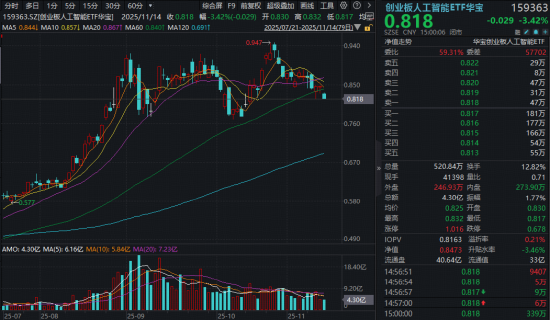
Core Viewpoint - The AI computing sector is experiencing significant adjustments, with the ChiNext AI Index dropping over 3% in a single day, indicating a broader market correction in this area [1][3]. Group 1: Market Performance - The ChiNext AI Index saw a weekly decline of 6.23%, reflecting a retreat in technology sentiment and increased trading difficulties [3]. - Major stocks in the AI computing sector, such as Xinyisheng and Zhongji Xuchuang, reported substantial revenue and profit growth, with Xinyisheng's revenue increasing by 221.7% year-on-year [2][5]. - The AI computing ETF (159363) fell by 3.42%, with a trading volume of 430 million yuan, indicating a net subscription of 44 million shares despite the downturn [1]. Group 2: Fundamental Analysis - The performance of key stocks in the AI computing sector has generally exceeded expectations, with Zhongji Xuchuang's revenue reaching 25.01 billion yuan and a profit increase of 90% [5]. - The market is witnessing a shift in investment strategies, with some funds moving towards "high-cut low" strategies, seeking new opportunities aligned with the "14th Five-Year Plan" [4]. Group 3: Future Expectations - Global cloud service providers are increasing their capital expenditures in AI computing, with a reported 68% year-on-year growth to 96.4 billion USD in Q3 2025 [6]. - The AI hardware and computing sectors are expected to remain strong, with projected net profit growth exceeding 30% next year, particularly in communication equipment and IT services [7].

复刻微软“Windows”霸业,OpenAI的阳谋与野心
3 6 Ke· 2025-11-14 11:05
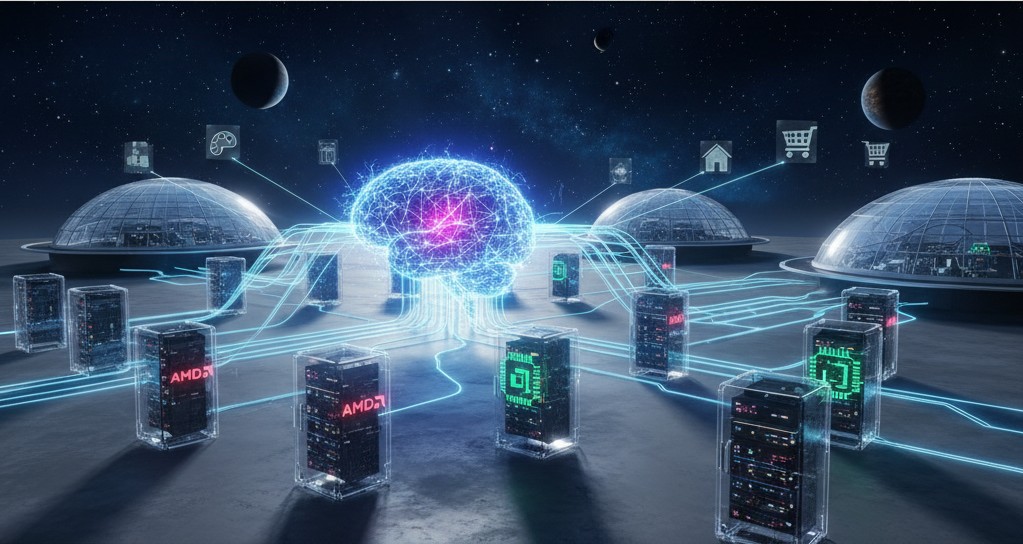
Core Insights - OpenAI aims to become the "Windows of AI," seeking to establish a dominant platform in the AI sector, similar to how Microsoft did in the PC era [3][4][10] - The company is integrating various applications directly into ChatGPT, allowing users to utilize these applications seamlessly within conversations, thereby enhancing user experience and engagement [6][8] Platform Development - OpenAI's strategy mirrors historical precedents in platform development, emphasizing the importance of user acquisition to attract developers and create a self-reinforcing ecosystem [5][8] - The integration of applications like Booking.com, Canva, and Zillow into ChatGPT signifies a shift towards making ChatGPT a central operating system for various tasks [7][8] Strategic Partnerships - OpenAI has announced a multi-billion dollar partnership with AMD to build AI data centers powered by AMD processors, marking a significant challenge to Nvidia's dominance in the AI hardware space [11][12] - The agreement includes a commitment to purchase 6 GW of AMD chips, with potential stock options for OpenAI, indicating a long-term investment in AMD's technology [11][12] Competitive Landscape - Nvidia currently leads the AI value chain, but OpenAI's moves could disrupt this by establishing itself as a critical software layer, potentially diminishing Nvidia's pricing power [10][12] - The historical context of IBM's dual-supplier strategy with Intel and AMD is echoed in OpenAI's approach to ensure a competitive supply chain and avoid reliance on a single vendor [9][11] Market Dynamics - OpenAI's aggressive strategy positions it to capture significant investment and interest in the AI sector, potentially benefiting from the ongoing AI "bubble" [14][15] - The company's focus on both consumer and enterprise markets reflects a desire to maximize growth opportunities before making strategic trade-offs [13][14]
突发清盘了。。
Ge Long Hui· 2025-11-14 09:04
Core Viewpoint - Michael Burry, a well-known short-seller, has announced the closure of his fund, Scion Asset Management, raising questions about his market outlook and signaling potential concerns about the current state of the AI and tech stock market bubble [1][8]. Group 1: Michael Burry's Actions - Burry has been betting against U.S. tech stocks, particularly those involved in AI, believing that the market is experiencing an unsustainable bubble similar to the 2000 internet bubble [6][10]. - The closure of his fund means he will no longer be required to publicly disclose his holdings, allowing him to operate privately [9]. - Burry's past experiences during the 2008 financial crisis, where he faced significant pressure and skepticism from investors, may have influenced his decision to exit the market quietly this time [9][10]. Group 2: Market Conditions - The U.S. stock market has recently faced significant declines, with major indices experiencing their worst performance since October 10, 2023, driven by a sell-off in tech stocks [10][12]. - Valuation data indicates that major U.S. indices are at high levels, with the Nasdaq index showing a year-to-date increase of 18.43% and a PE ratio of 41.04, placing it in the 65.43 percentile [14]. - The market is currently under pressure from dual factors: liquidity shortages and unstable interest rate expectations, which have contributed to the recent downturn [20][21]. Group 3: Liquidity and Interest Rate Expectations - A liquidity shortage has worsened due to a 44-day government shutdown, freezing funds that would typically enter the market, while increased U.S. debt issuance has further drained cash from the system [17]. - Recent shifts in interest rate expectations have also impacted the market, with the probability of a Federal Reserve rate cut dropping significantly due to internal disagreements among Fed officials [18][19]. - The combination of liquidity issues and fluctuating interest rate expectations has created a challenging environment for tech stocks, leading to increased volatility and investor caution [20][21].

小摩Q3持仓:科技股仍是主力 英伟达超微软成头号爱股
智通财经网· 2025-11-14 08:48
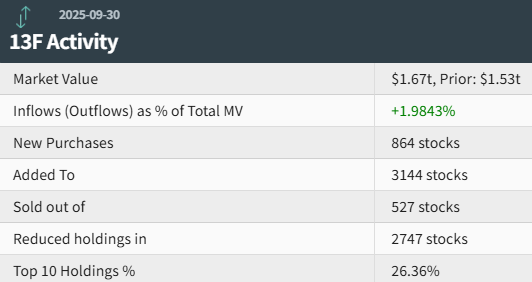
Core Insights - Morgan Stanley's total market value of holdings increased to $1.67 trillion in Q2 from $1.53 trillion in the previous quarter, reflecting a growth of 1.98% [1][2] - The firm added 864 new stocks, increased holdings in 3,144 stocks, reduced holdings in 2,747 stocks, and completely sold out of 527 stocks [1][2] - The top ten holdings account for 26.36% of the total market value [1][2] Holdings Overview - Nvidia became the largest holding with 488.6 million shares valued at approximately $91.17 billion, representing 5.46% of the portfolio, a 5.63% increase from the previous quarter [3][8] - Microsoft is the second-largest holding with 158.8 million shares valued at about $82.25 billion, making up 4.93% of the portfolio, a 1.11% increase [4][8] - Apple ranks third with 236.7 million shares valued at around $60.26 billion, accounting for 3.61% of the portfolio, a 10.2% increase [5][8] - Meta is the fourth-largest holding with 54.7 million shares valued at approximately $40.18 billion, representing 2.41% of the portfolio, a slight decrease of 0.01% [6][8] - Amazon is fifth with 182.7 million shares valued at about $40.11 billion, making up 2.40% of the portfolio, a decrease of 5.26% [7][8] Trading Activity - The top five purchases by percentage change in the portfolio include Apple, Nvidia, Alphabet Class C (GOOG), Alphabet Class A (GOOGL), and Palantir Technologies (PLTR) [8][10] - The top five sales by percentage change include Amazon, iShares Core S&P 500 ETF (IVV), Meta, Netflix (NFLX), and Visa (V) [9][10] - The adjustments indicate increased investment in major tech companies like Apple and Nvidia while reducing exposure to other tech stocks such as Meta and Tesla (TSLA) [10]


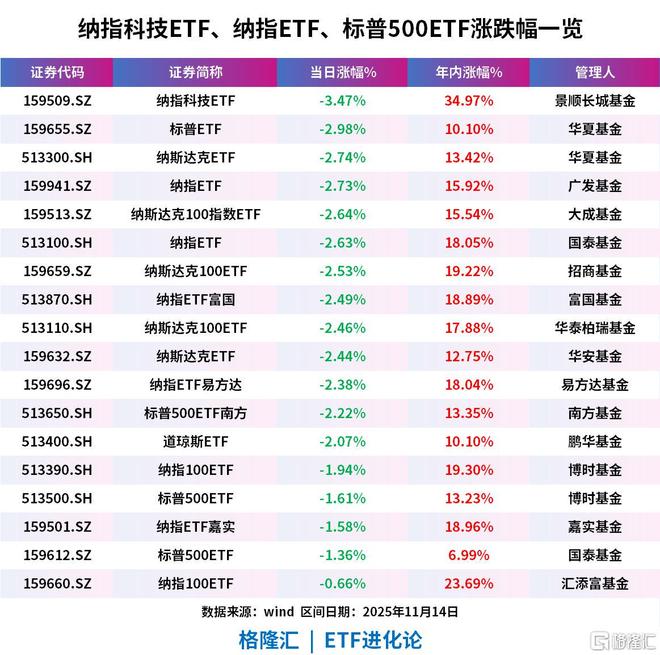
美股回调,纳指科技ETF、标普ETF、纳指ETF、道琼斯ETF下跌
Ge Long Hui· 2025-11-14 08:12
Market Performance - US stock market faced significant declines, with all three major indices recording their worst performance since October 10 [1] - Dow Jones dropped over 700 points, S&P 500 fell nearly 1.7%, and Nasdaq briefly dipped below the 50-day moving average [2] Sector Performance - Technology stocks were the primary focus of the sell-off, with Tesla down 7%, Nvidia and Broadcom down 5%, and Disney dropping nearly 8% due to disappointing earnings [2] - Nasdaq technology ETF fell over 3%, while various other ETFs including S&P ETF and Dow Jones ETF declined over 2% [2][3] Valuation Insights - Major US indices are currently at high valuation levels, with Nasdaq index PE at 41.04, S&P 500 at 28.67, and Dow Jones at 31.32 [4] - Year-to-date performance shows significant gains for some tech stocks, with Google up 47.64% and Nvidia up 39.18% [4] Liquidity and Interest Rate Dynamics - Liquidity conditions have rapidly deteriorated, exacerbated by a 44-day government shutdown that froze expected fiscal spending [9] - Increased US debt issuance has withdrawn substantial cash from the market, tightening the financing environment and reducing available lending capital [9] - The Federal Reserve's recent statements indicate a shift in interest rate expectations, with a notable decrease in the probability of a rate cut in December [10][11] Future Earnings Projections - Forecasts suggest that US stock earnings growth could reach 13.5% in 2026, driven by sustained AI demand and easing tariff risks [12] - The market is expected to focus on two main narratives: the ongoing strength of tech stocks, particularly in AI, and a potential recovery in cyclical sectors such as industrials and materials [12]
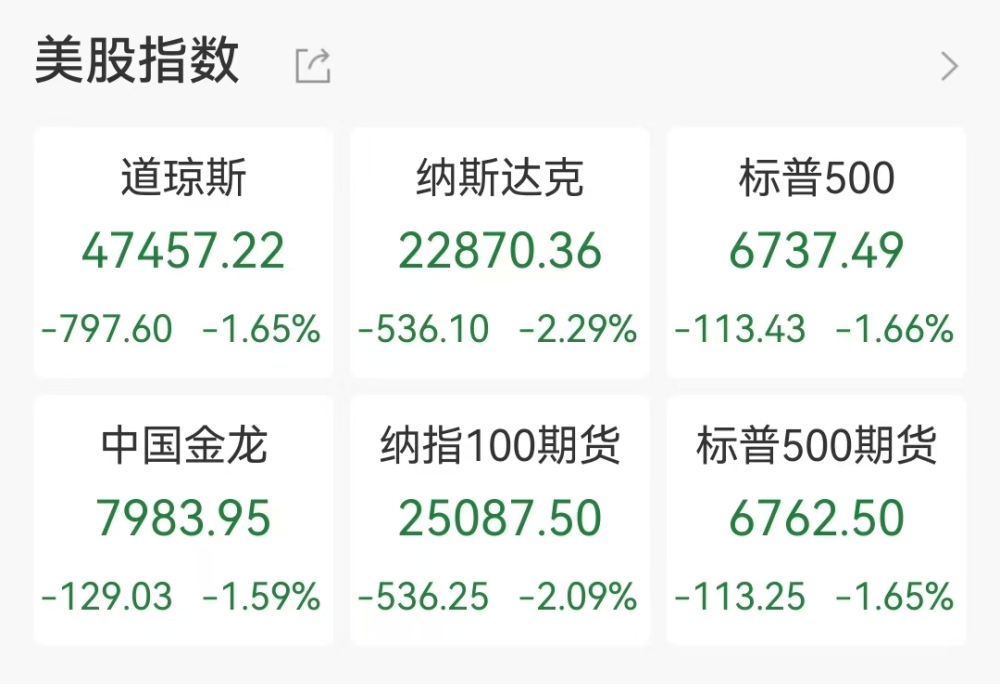
美股全线下跌,中概股下挫,加密货币近20万人爆仓
Sou Hu Cai Jing· 2025-11-14 01:00
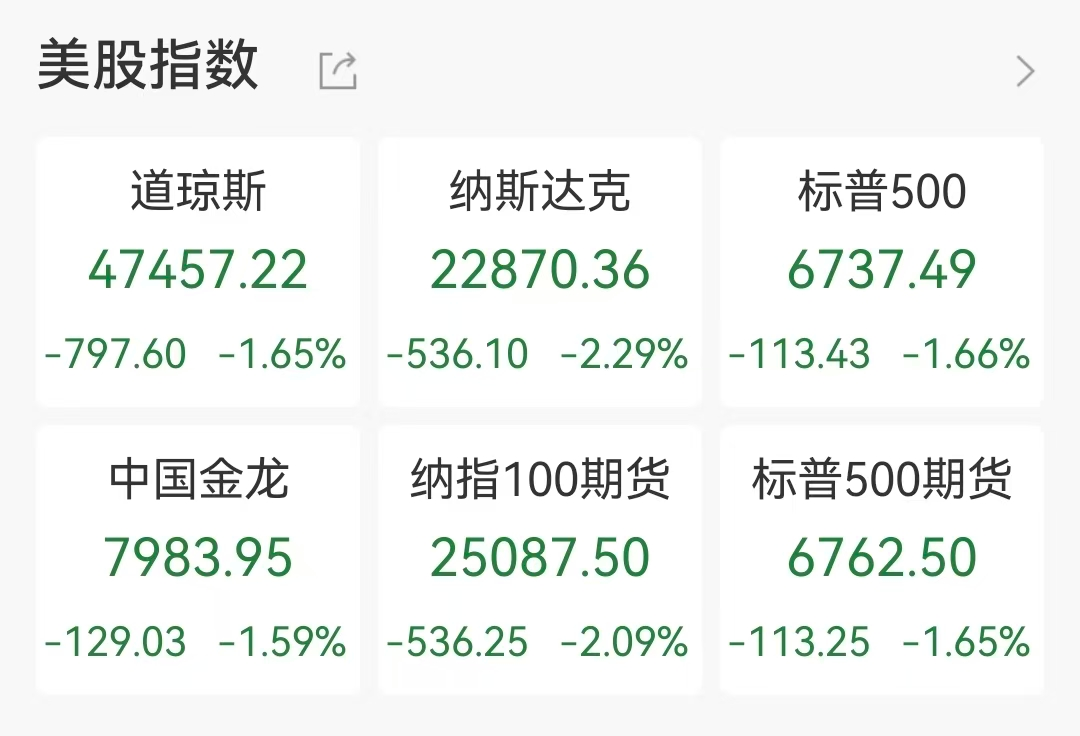
Market Performance - On November 13, U.S. stock indices closed lower, with the Dow Jones down 1.65%, S&P 500 down 1.66%, and Nasdaq down 2.29%, marking the third consecutive day of decline for Nasdaq [1][2] - Major technology stocks mostly fell, with the Wande American Technology Seven Giants Index dropping 2.29%. Tesla fell over 6%, while Broadcom, Oracle, and AMD each dropped over 4% [2] - Nvidia declined over 3% amid news that Michael Burry's Scion fund withdrew SEC registration and disclosed short positions on Nvidia and Palantir, although Burry clarified that the reported short position was a mathematical error, with actual investment being only $9.2 million [2] Company-Specific News - Disney's stock plummeted over 7% after the company reported fourth-quarter earnings that exceeded analyst expectations, but revenue fell short due to weak performance in its entertainment platform business, impacted by sluggish television networks and average movie releases [3] Commodity and Cryptocurrency Market - In the commodity market, U.S. oil futures rose by 0.19% to $58.6 per barrel, while Brent crude oil futures increased by 0.29%. The International Energy Agency (IEA) reversed previous forecasts, predicting continued growth in global oil and gas demand until 2050 [5] - Precious metals futures generally declined, with spot gold down 0.55% to $4,171.51, and COMEX gold futures falling by 0.93% [5] - In the cryptocurrency market, most cryptocurrencies fell, with Bitcoin dropping over 2% to $99,731.3, falling below the $100,000 mark. Approximately 200,000 individuals experienced liquidation in the past 24 hours [5][6] Federal Reserve Policy Outlook - The Federal Reserve's monetary policy remains uncertain, with a recent 25 basis point cut in the federal funds rate target range. Market expectations for a December rate cut of 25 basis points have shifted, with several decision-makers indicating that a cut is not guaranteed [7] - Boston Fed President Susan Collins noted that while she supported the last rate cut, the threshold for further cuts is "relatively high," and she expects rates to remain at current levels for some time. She warned that further cuts could hinder inflation from reaching the Fed's 2% target [7] - In contrast, Fed Governor Stephen Milan favors a 50 basis point cut in the next two meetings, arguing that current rates are too high [7] - The probability of a 25 basis point cut in December is approximately 60%, while the probability of maintaining current rates is about 40% [8]
海外科技周报(25/11/3-25/11/7):期待白宫复工,风险偏好有望修复-20251114
Hua Yuan Zheng Quan· 2025-11-14 00:57
Investment Rating - Investment rating: None [4] Core Insights - The report emphasizes the strategic importance of civil nuclear energy in global energy transition and climate governance, highlighting its current contribution of approximately 9% to global electricity and 23% to low-carbon electricity. It notes that nuclear energy has avoided around 70 billion tons of CO2 emissions over the past 50 years and could potentially reduce an additional 90 billion tons by 2050 if development accelerates [4][16] - The International Atomic Energy Agency (IAEA) predicts a 2.5-fold increase in nuclear power capacity by 2050, positioning it as a core support for achieving "net zero emissions" goals. Currently, there are about 440 operational reactors across 31 countries, with over 60 under construction and 30 more planned [4][16] - The report also highlights the potential applications of innovative technologies such as Small Modular Reactors (SMR) and Advanced Modular Reactors (AMR) in hydrogen production, heating, and non-electric sectors, calling for stronger policy and financial support to drive a new growth cycle in the global nuclear energy industry [4][16] Market Performance Review - During the week of November 3 to November 7, 2025, technology stocks experienced a pullback, with the Hang Seng Tech Index closing at 5837.4, down 1.2%, underperforming the Hang Seng Index by 2.5 percentage points. The Philadelphia Semiconductor Index closed at 6947.4, down 3.9%, also underperforming the Nasdaq 100 and S&P 500 indices [7][9] - The AI energy sector saw declines influenced by earnings reports, with the top five gainers being COHERENT (+17%), 亚舍立科技 (+8%), 艾马克技术 (+8%), 美光科技 (+6%), and 百度集团-SW (+6%). Conversely, the top five decliners included NUSCALE POWER (-32%), DUOLINGO (-26%), ENERGY FUELS (-24%), 超微电脑 (-23%), and CENTRUS ENERGY (-20%) [9][4] Web3 and Cryptocurrency Market - The total market capitalization of cryptocurrencies decreased to $3.37 trillion as of November 7, 2025, down from $3.64 trillion the previous week. The total trading volume for cryptocurrencies was $166.74 billion, accounting for 4.95% of the total market cap [18][24] - The sentiment in the cryptocurrency market is currently in a state of panic, with the Fear and Greed Index at 21, indicating a fear-driven market environment [20] - The report notes that the core assets in the cryptocurrency market experienced significant price declines due to tightening liquidity and expectations of interest rate hikes, with major assets briefly falling below $100,000 [29][30]
微软 CEO 纳德拉:这一次工业革命,从 “AI 超级工厂”开始
3 6 Ke· 2025-11-14 00:34
Core Insights - Microsoft is building the world's first "Planet-scale AI Superfactory," which integrates multiple data centers to enhance AI model training and operation [1][6][11] - CEO Satya Nadella describes this initiative as an industrial revolution, emphasizing the transformation of knowledge work through AI [2][3] - The focus is on creating a robust infrastructure that supports AI systems rather than just developing powerful models [5][9] Group 1: AI Superfactory and Infrastructure - The Fairwater 2 data center in Atlanta features 5 million network connections and has training capabilities that are 10 times greater than what GPT-5 requires [6][11] - Microsoft aims to increase training capacity by 10 times every 18 to 24 months, with Fairwater 2 connected to a data center in Wisconsin via a 1 Petabit high-speed network [6][11] - The AI factory architecture consists of three layers: training, inference, and interface, designed to create a closed-loop system for token generation and delivery [11][20] Group 2: Redefining Data Centers - Traditional data centers are being redefined as AI power plants, focusing on continuous token output and global responsiveness [12][15] - Microsoft is restructuring four core components of its AI data centers: chip deployment logic, liquid cooling systems, network connection structures, and site selection [16][18] - The goal is to create a global AI network (AI-WAN) that allows for intelligent resource allocation across different data centers [22][23] Group 3: Strategic Decisions and Market Position - Microsoft paused the leasing of several planned data center sites to avoid becoming merely a hosting provider for a single client, aiming instead for a scalable service network [31][33] - The company is focusing on software optimization to counteract hardware costs, significantly increasing capital efficiency [34][37] - Nadella emphasizes that market share decline in certain areas is not a negative sign but rather an indication of market expansion, prioritizing overall market growth over individual share [38][41] Group 4: Long-term Vision - The overarching strategy is to build a sustainable growth system that supports AI infrastructure over the next decade, focusing on foundational elements rather than immediate product releases [43][44] - The success of AI infrastructure will be measured by its stability and seamless integration into user experiences, rather than just the strength of individual models [45][46]
美股全线下跌,中概股下挫,小马智行跌近8%,加密货币近20万人爆仓
2 1 Shi Ji Jing Ji Bao Dao· 2025-11-13 23:28
Market Overview - Major US stock indices experienced declines, with the Dow Jones down 1.65%, Nasdaq down 2.29%, and S&P 500 down 1.66% [1] - The tech sector faced significant losses, particularly the "Magnificent Seven" tech stocks, which dropped 2.29% [1] - Notable individual stock movements included Tesla falling over 6%, and Nvidia declining more than 3% following news of a short position by Michael Burry [1][3] Company Performance - Disney's stock plummeted over 7% after reporting fourth-quarter earnings that exceeded analyst expectations for profit but fell short on revenue due to weak performance in its entertainment platform business [2] - In the tech sector, Facebook (Meta) saw a slight increase of 0.14%, while other major companies like Apple, Microsoft, Amazon, and Google experienced declines ranging from 0.19% to 2.89% [3] Chinese Market - The Nasdaq Golden Dragon China Index fell by 1.59%, with individual stocks like Xiaoma Zhixing down nearly 8% and Baidu down over 6% [3] - Alibaba was an exception, rising over 1% amidst the overall downturn in Chinese stocks [3] Commodity and Cryptocurrency Market - Crude oil prices saw slight increases, with WTI crude up 0.19% and Brent crude up 0.29% [4] - Precious metals generally declined, with spot gold down 0.55% [4] - The cryptocurrency market faced significant losses, with Bitcoin dropping over 2% and falling below the $100,000 mark, leading to a total liquidation of approximately $728 million in the past 24 hours [4][5] Federal Reserve Policy - The Federal Reserve's monetary policy remains uncertain, with a recent rate cut of 25 basis points and mixed signals regarding future rate cuts [6] - Boston Fed President Susan Collins indicated that further rate cuts may be challenging, while other members like Stephen Milan advocate for more aggressive cuts [6] - Market expectations show a 60% probability of a 25 basis point cut in December, with a 40% chance of maintaining current rates [7]