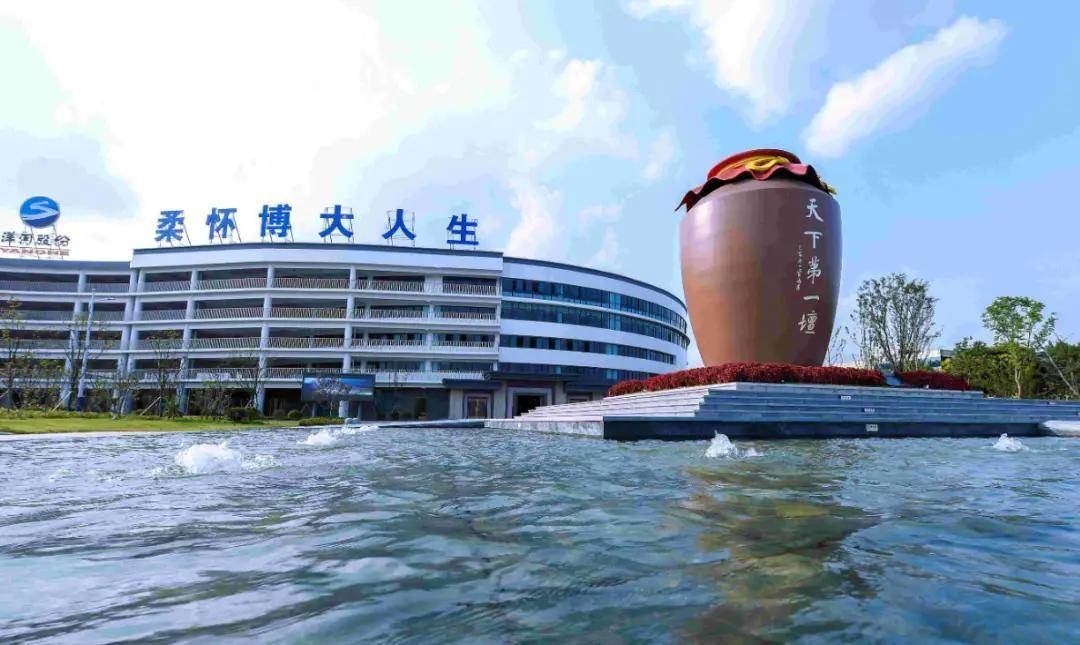
洋河股份

Search documents
A股白酒股普涨,舍得酒业涨超7%
Ge Long Hui A P P· 2025-08-25 02:07
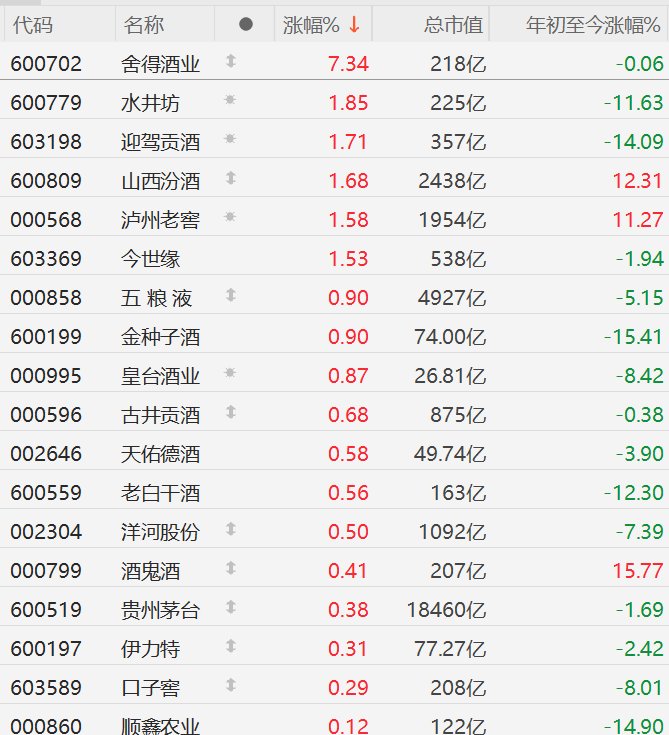
Group 1 - The core viewpoint of the article highlights a significant increase in the A-share market for liquor stocks, with Shede Liquor leading the gains by over 7% [1] - Other notable performers include Shui Jing Fang, Shanxi Fen Jiu, Ying Jia Gong Jiu, and Luzhou Laojiao, all experiencing gains of over 1% [1] Group 2 - Shede Liquor (600702) saw a rise of 7.34%, with a total market capitalization of 21.8 billion and a year-to-date change of -0.06% [2] - Shui Jing Fang (600779) increased by 1.85%, with a market cap of 22.5 billion and a year-to-date decline of -11.63% [2] - Ying Jia Gong Jiu (603198) rose by 1.71%, with a market cap of 35.7 billion and a year-to-date decline of -14.09% [2] - Shanxi Fen Jiu (600809) increased by 1.68%, with a market cap of 243.8 billion and a year-to-date increase of 12.31% [2] - Luzhou Laojiao (000568) rose by 1.58%, with a market cap of 195.4 billion and a year-to-date increase of 11.27% [2] - Other companies such as Jinzhongzi Jiu (600199) and Gujing Gong Jiu (000596) also showed minor increases, with market caps of 7.4 billion and 87.5 billion respectively [2]





东方财富等目标价涨幅超60%;桃李面包评级被调低丨券商评级观察
2 1 Shi Ji Jing Ji Bao Dao· 2025-08-25 01:24
Group 1 - From August 18 to August 24, brokers issued a total of 463 target prices for listed companies, with the highest target price increases for Hengmingda at 63.83%, Jiangsu Shentong at 62.24%, and Dongfang Caifu at 60.29%, belonging to the consumer electronics, general equipment, and securities industries respectively [1] - A total of 559 listed companies received broker recommendations during the same period, with Beixin Building Materials receiving 22 recommendations, Yanghe Co. receiving 21, and Runben Co. receiving 20 [1] - During this period, brokers upgraded ratings for 9 companies, including Dongbei Securities upgrading Changhai Co. from "Hold" to "Buy", and Pacific Securities upgrading Chuanjinno from "Hold" to "Buy" [1] Group 2 - Brokers downgraded ratings for 11 companies, including Minsheng Securities downgrading Taoli Bread from "Recommended" to "Cautious Recommendation", and Zhongyin International Securities downgrading Southern Airlines from "Hold" to "Increase" [1] - From August 18 to August 24, brokers provided 97 instances of initial coverage, with Southern Airlines receiving an "Increase" rating from Zhongyin International Securities, and Cuihua Jewelry receiving a "Buy" rating from Tianfeng Securities [2] - Other companies receiving initial coverage include Feiyada with a "Buy" rating from Dongbei Securities, Lihua Co. with an "Increase" rating from Huaxi Securities, and Sanhuan Group with a "Buy" rating from Huayuan Securities [2]




白酒企业瞄准光瓶酒赛道
Zhong Guo Chan Ye Jing Ji Xin Xi Wang· 2025-08-25 00:42
Core Insights - The light bottle liquor segment has become a significant focus for the Chinese liquor industry in 2023, with many companies targeting this market to capture lower-tier consumers [1][2] - The market for light bottle liquor is projected to grow from 988 billion yuan in 2021 to over 1500 billion yuan in 2024, with a compound annual growth rate of 13.8% [2] Industry Trends - Major liquor companies such as Jiangsu Yanghe Brewery Co., Ltd., Luzhou Laojiao Co., Ltd., Anhui Gujing Distillery Co., Ltd., and Jiangsu Jinshiyuan Liquor Co., Ltd. have launched new products in the light bottle liquor category this year [1] - The shift in consumer demand towards light bottle liquor is driven by a combination of rational consumption, the rise of younger demographics, and an upgrade in quality expectations [1][2] Market Dynamics - The light bottle liquor market is currently characterized by a fragmented competitive landscape, with no clear leading groups among participants [2] - The price range for light bottle liquor is expanding, with products now available from tens to hundreds of yuan, indicating a transition from being perceived as low-end to quality liquor [2]

中报陆续披露,关注底部布局机遇
Xiangcai Securities· 2025-08-24 13:59
Investment Rating - The report maintains a "Buy" rating for the food and beverage industry [2] Core Insights - The food and beverage industry saw a 3.29% increase from August 18 to August 22, 2025, underperforming the CSI 300 index by 0.89 percentage points [4][9] - The trend towards lower alcohol content beverages is accelerating, with major companies like Wuliangye and Gujinggong launching new low-alcohol products to capture the younger demographic [5][6] - The market for low-alcohol beverages is expected to exceed 74 billion yuan by 2024, with a projected annual growth rate of 25% [6] Summary by Sections Industry Performance - The food and beverage sector's relative performance over the past 12 months shows a decline of 20.4% compared to the CSI 300 index, while absolute returns were 11.4% [3] - The sector's valuation is currently at a PE ratio of 22X, ranking 22nd among the primary industries [16] Key Data Tracking - As of August 22, 2025, the wholesale price of Feitian Moutai has decreased by 1.07% to 1845 yuan per bottle [19] - Beer production in July 2025 was 3.741 million kiloliters, a year-on-year increase of 1.90%, while wine production saw a significant decline of 25% [19] Investment Recommendations - The report suggests focusing on two main lines: stable demand leaders with strong risk resistance and companies actively innovating in new products and channels [7][45] - Recommended companies include Shanxi Fenjiu, Kweichow Moutai, Qingdao Beer, and others that demonstrate strategic foresight and execution capabilities [7][45]

食品饮料行业周报:板块受益市场轮动,基本面继续等待验证-20250824
Shenwan Hongyuan Securities· 2025-08-24 05:43
Investment Rating - The report maintains a "Positive" outlook on the food and beverage industry, indicating a favorable investment environment despite current challenges [4]. Core Insights - The recent increase in the sector is attributed to market rotation, with the industry fundamentals requiring patience for improvement. The liquor segment is expected to undergo a bottoming process, while food companies should seek structural opportunities from the bottom up. Absolute returns are more dependent on market conditions rather than fundamental drivers, and relative returns are not favorable [8][9]. - Traditional consumer leading companies have adjusted and now possess long-term investment value from a dividend and yield perspective. Companies with new consumption characteristics are expected to differentiate based on performance in the future [8][9]. - The liquor sector faces significant pressure due to slow macro demand recovery and limited consumption scenarios, with expectations of continued challenges in sales and financial reports [8][9]. Summary by Sections 1. Weekly Insights on Food and Beverage - The food and beverage sector rose by 3.29% last week, with liquor increasing by 3.62%. However, it underperformed the Shanghai Composite Index by 0.20 percentage points, ranking 11th among 31 sub-industries [7]. - The top three gainers included JiuGuiJiu (25.1%), BaiRun Co. (13.26%), and *ST YanShi (12.94%), while the largest decliners were GuiFaXiang (-8.72%), HuangShangHuang (-3.66%), and WanChen Group (-2.99%) [7]. 2. Liquor Sector - Moutai's price for loose bottles is 1820 RMB, down 30 RMB week-on-week, while the box price is 1845 RMB, down 20 RMB. Wuliangye's price remains stable at approximately 860 RMB, and Guojiao 1573 is around 840 RMB [9][33]. - The report suggests patience in waiting for changes in the industry's fundamentals, with a focus on the peak season in August and September. Companies with solid base markets and price bands below 200 RMB are expected to show stronger resilience [9]. 3. Consumer Goods Sector - The report is optimistic about the dairy industry's cost decline and supply-demand improvement, recommending companies like Yili and New Dairy. Beer is seen as a necessity, with recommendations for Yanjing Beer and Qingdao Beer [10]. - The snack, beverage, and low-alcohol segments are highlighted for their structural growth opportunities, with key recommendations including Unified Enterprises China, WeiLong, and YanJinPuZi [10]. 4. Key Company Updates - Salted Fish Co. reported a total revenue of 1.403 billion RMB for Q2 2025, a year-on-year increase of 13.54%, with a net profit of 195 million RMB, up 21.75% [10]. - The report also highlights the performance of various companies, including ZhenJiu LiDu and Kuaijishan, with significant revenue and profit changes noted [12][27].

荣续ESG智库:2025年白酒行业ESG白皮书
Sou Hu Cai Jing· 2025-08-24 04:51
Group 1 - The report titled "2025 White Liquor Industry ESG White Paper" focuses on the development of the white liquor industry and its ESG practices, providing a comprehensive overview and future direction for practitioners and researchers [1][2] - The white liquor industry is a unique symbol of Chinese traditional culture and economic life, evolving from workshop-style brewing to industrial production, and expanding from regional consumption to national and global markets [1][8] - The report presents data on grain production, including a total planting area of 119,319.1 thousand hectares, a total yield of 70,649.9 million tons, and a yield per unit area of 5,921.1 kg/hectare, which serves as a reference for understanding the raw material supply for the white liquor industry [1][26] Group 2 - The ESG development section highlights the importance of ESG principles in the white liquor industry, emphasizing the need for companies to balance economic benefits with social value while enhancing long-term competitiveness through ESG practices [2][7] - The report analyzes the ESG practices of leading companies such as Kweichow Moutai, Wuliangye, and Shanxi Fenjiu, focusing on their carbon neutrality plans, greenhouse gas emission verification, and environmental information disclosure [2][3] - The white paper discusses the role of organizations like the Shanghai Modern Service Industry Association and the Hongxing ESG Research Institute in promoting ESG principles and providing solutions for companies [3][7] Group 3 - The white liquor industry is characterized by strong resource constraints, relying heavily on natural endowments such as quality water sources and specific grain materials, which creates a unique regional exclusivity [15][16] - The industry has a significant environmental impact, with high water usage and waste management challenges, particularly in regions like the Chishui River basin [17][18] - The production process of white liquor is complex, involving multiple stages from raw material selection to final product, with strict quality control measures in place [29][30] Group 4 - The competitive landscape of the white liquor industry shows a "Matthew effect," where leading companies are rapidly increasing their market share, with the top firms holding a significant portion of the market [50][51] - Financial performance data for leading companies in the industry indicates a clear tiered structure, with Kweichow Moutai leading with a revenue of 120.7 billion yuan and a net profit of 60.8 billion yuan [53][56] - The market share analysis reveals that the industry is becoming increasingly concentrated, with the top two companies holding a combined market share of 30% [57][59] Group 5 - The report identifies key trends in the white liquor industry, including diversification of consumption scenarios, innovation driven by younger consumer groups, and the acceleration of digital marketing and channel transformation [59][60] - The internationalization of the white liquor industry is gaining momentum, with companies exploring markets in Southeast Asia and Europe, leveraging cultural similarities and trade policies to expand their reach [61][62]


洋河股份(002304):2025年中报点评:优化调整,静待破晓
Changjiang Securities· 2025-08-23 15:03
Investment Rating - The investment rating for the company is "Buy" and is maintained [6]. Core Views - In the first half of 2025, the company reported operating revenue of 14.796 billion yuan, a year-on-year decline of 35.32% - The net profit attributable to shareholders was 4.344 billion yuan, down 45.34% year-on-year [2][4]. - In Q2 2025, the company achieved operating revenue of 3.729 billion yuan, a decrease of 43.67% year-on-year, with net profit of 707 million yuan, down 62.66% year-on-year [2][4]. Financial Performance - The company's revenue from outside the province was 7.392 billion yuan, a decline of 43% year-on-year, while revenue from within the province was 7.121 billion yuan, down 26% year-on-year [8]. - Revenue from mid-to-high-end liquor was 12.672 billion yuan, a decrease of 37% year-on-year, primarily due to the company's strategy of controlling volume and stabilizing prices for key products [8]. - The net profit margin for the first half of 2025 decreased by 5.38 percentage points to 29.36%, with a gross margin decline of 0.33 percentage points to 75.02% [8]. Cost and Expenses - The company's expense ratio increased, with the selling expense ratio rising by 3.1 percentage points and the management expense ratio increasing by 1.73 percentage points [8]. - Advertising and promotional expenses amounted to 1.45 billion yuan, a decrease of 21.03% year-on-year, mainly due to reduced advertising costs and rebates [8]. Future Outlook - The company is actively controlling inventory, which has shown initial results, and the prices of core products remain stable [8]. - The company is expected to see marginal improvements in performance as inventory is gradually reduced, alongside a strong dividend capability [8]. - The estimated EPS for 2025 and 2026 is projected to be 3.19 yuan and 3.41 yuan, respectively, corresponding to a valuation of 23 and 22 times [8].
洋河股份(002304):底部或将至,25H2有望改善
Tianfeng Securities· 2025-08-23 08:35
Investment Rating - The investment rating for the company is "Buy" with a 6-month outlook maintained [6][17]. Core Views - The company is expected to experience a bottoming out, with improvements anticipated in the second half of 2025. The revenue and net profit for the first half of 2025 are projected to be 14.796 billion and 4.344 billion yuan, respectively, reflecting year-on-year declines of 35.32% and 45.34% [1]. - The company is actively adjusting its operational pace in response to market conditions, focusing on strengthening channels such as banquets and emphasizing inventory metrics. Despite short-term pressure on revenue and profit, the company is expected to benefit from its strategic initiatives and product offerings [4]. Financial Performance Summary - For the first half of 2025, the company's liquor revenue is expected to be 14.513 billion yuan, down 35.47% year-on-year, with total sales volume decreasing by 32.35% to 78,200 tons. The average price per ton is projected to decline by 4.50% to 185,400 yuan [1]. - The company's revenue from high-end and ordinary liquor is forecasted to be 12.672 billion and 1.841 billion yuan, respectively, with ordinary liquor's share increasing by 1.44 percentage points to 12.68% [1]. - The company anticipates a significant decline in revenue from both domestic and foreign markets, with domestic revenue expected to drop by 25.79% and foreign revenue by 42.68% in the first half of 2025 [2]. - The average revenue per distributor has decreased by 33.72% to 1.6836 million yuan, with the total number of distributors declining by 224 to 8,609 [2]. Financial Forecasts - Revenue projections for 2025-2027 are adjusted to 20.778 billion, 21.393 billion, and 22.445 billion yuan, reflecting year-on-year changes of -28%, +3%, and +5% respectively. Net profit forecasts for the same period are 4.250 billion, 4.590 billion, and 4.895 billion yuan, with year-on-year changes of -36%, +8%, and +7% [4]. - The company's price-to-earnings (P/E) ratios for 2025-2027 are projected to be 25X, 23X, and 22X [4]. Key Financial Metrics - The company reported a total revenue of 33.126 billion yuan in 2023, with a projected decline to 28.876 billion yuan in 2024 and further to 20.778 billion yuan in 2025 [5]. - The net profit attributable to the parent company is expected to decrease from 10.016 billion yuan in 2023 to 6.673 billion yuan in 2024, and to 4.250 billion yuan in 2025 [5]. - The company's EBITDA is projected to decline from 13.425 billion yuan in 2023 to 5.855 billion yuan in 2025 [5].
全国“喝酒王者省份”出炉!前三让人意外,东北竟然没上榜
Sou Hu Cai Jing· 2025-08-23 02:21
Core Insights - The article discusses the evolving landscape of China's liquor consumption, particularly focusing on the white liquor market and the ranking of provinces based on consumption levels [1][11] - It highlights the stability of the market structure, with Shandong and Henan leading in consumption, while also emphasizing the need for innovation and adaptation to changing consumer preferences [1][3] Market Overview - The white liquor market in China is experiencing a slight decline in consumption momentum for 2024, but 2025 is seen as a pivotal year for deep adjustments in the industry [1] - The current consumption landscape is relatively stable, with Shandong and Henan holding the top two positions, followed by Jiangsu and Guizhou [1][3] Consumption Trends - There is a clear trend of consumption upgrading across provinces, with an increase in price points and a growing demand for quality [3][4] - In 2023, Henan's white liquor market sales reached approximately 66.82 billion yuan, nearing the 70 billion yuan mark, with leading brands capturing significant market share [3][5] - Jiangsu's market performance is notable, with a consumption figure of around 56 billion yuan in 2022, indicating a strong consumer base focused on high-quality products [3][8] Digital Transformation - The digital transformation is reshaping the white liquor consumption landscape, with online sales surpassing 50% of total consumption in 2023 and showing a 72% year-on-year growth in the first quarter of 2024 [4][11] Provincial Insights - Shandong, with a population of over 100 million and a GDP of 9.21 trillion yuan, leads the market with a size of approximately 45 billion yuan in 2022, and is expected to grow at a CAGR of 8% from 2022 to 2025 [5][7] - Henan's sales have shown a consistent upward trend from 37.18 billion yuan in 2017 to 66.82 billion yuan in 2023, indicating strong growth potential [7][9] - Jiangsu, despite a smaller population of under 90 million, has a market size close to 60 billion yuan, reflecting high consumer spending power and a preference for premium products [8][9] Regional Challenges - The Northeast provinces have not made it to the top five due to significant population decline and slower economic growth compared to leading provinces [9][11] - The traditional industrial structure in the Northeast, with a heavy reliance on heavy industry and underdeveloped service sectors, has negatively impacted overall consumption activity [11]

真慌了!一线价格崩盘,二线卖不动,白酒三巨头还剩几个能挺住?
Sou Hu Cai Jing· 2025-08-22 22:45
Core Viewpoint - Yanghe, once a leading player in the Chinese liquor industry, is facing unprecedented challenges, including a significant decline in market position and brand image [1][3]. Financial Performance - In 2024, Yanghe's parent company reported a profit drop of 33% and a revenue decrease of 13% [3]. - Yanghe's ranking among Chinese liquor brands has fallen to fifth place, overtaken by Shanxi Fenjiu and Luzhou Laojiao [3]. Management Changes - The sudden departure of former chairman Zhang Liandong has raised concerns within the industry, especially given the quick succession of a new chairman [3]. - Zhang's tenure lasted only four years, which is shorter than the typical five-year term for high-level executives [3]. Market Competition - Yanghe is facing intense competition from local brands like Jinshiyuan, which is encroaching on its market share in Jiangsu by offering affordable products [5]. - Luzhou Laojiao surpassed Yanghe in net profit in 2022, and Shanxi Fenjiu pushed Yanghe out of the top three in 2023 with nearly 32 billion yuan in revenue [7]. Historical Context - Yanghe has a rich history dating back to the Han Dynasty, with a strong reputation for its unique brewing environment [9]. - The company underwent significant expansion and modernization after the establishment of the People's Republic of China, becoming a major state-owned enterprise [9]. Strategic Shifts - In the early 2000s, Yanghe reformed its product offerings to cater to changing consumer preferences, focusing on a "soft" taste that appealed to social drinking [11]. - The "Blue Classic" series was launched, leading to a significant increase in brand recognition and sales, with annual growth rates exceeding 100% from 2003 to 2011 [11]. Current Challenges - Post-2020, the liquor industry has faced pressures, including high inventory levels and price discrepancies, particularly affecting Yanghe's premium products [12]. - The company is perceived to be struggling due to frequent management changes and the intense competition within the liquor sector [12]. Future Outlook - Yanghe must adapt and innovate to survive in a rapidly changing market, as falling out of the top three is a critical warning sign for the company [12].