52TOYS

Search documents
国泰海通|轻工:潮玩谷子一级投融资概览:项目数量趋稳&资本流向“周边”
国泰海通证券研究· 2025-08-01 09:44
Core Insights - The潮玩谷子 (trendy toy) sector is experiencing rapid development, with the peak of investment projects in the primary market having passed, yet the number of projects remains relatively stable. The secondary market leaders are intensifying their efforts in related businesses [1] - Despite a decline in the number of investment events in the primary market since its peak, the sector has maintained stability, with 19, 9, and 11 investment events recorded in 2022, 2023, and 2024 respectively, and 11 events noted by July 10, 2025 [1] Investment Landscape - The investment layout in the潮玩谷子 sector can be categorized into three core directions: IP content, derivative products, and platform types. The derivative products direction is the most focused on, with projected shares of 60% for derivative products, 40% for IP content, and 0% for platform types in 2024 [2] - Investment institutions are increasingly participating in the潮玩谷子 sector, with their share of projects rising to 45% in 2024, alongside 45% from industry chain capital and 9% from other investments [2] Valuation Changes of Key Projects - Hitcard's valuation fluctuated, starting at 30 million yuan in 2021 and peaking at 500 million yuan in 2022, before dropping to 150 million yuan in 2024 [3] - Yiqi Culture saw rapid valuation growth, starting at 100 million yuan in 2022 and rising to 500 million yuan by February 2025 [3] - 52TOYS maintained a leading valuation in the sector, increasing from 75 million yuan in 2015 to 4.273 billion yuan by May 2025, with plans to enter the secondary market [3] - KAYOU's valuation reached 900 million USD in 2021, with plans to enter the secondary market as well [3] - Xingyue Holdings maintained a stable valuation of 1.5 billion yuan, also preparing for a secondary market entry [3]


国泰海通:潮玩投融资项目保持相对稳定 资本流向衍生品“周边”
Zhi Tong Cai Jing· 2025-08-01 09:07
Core Insights - The潮玩谷子 (trendy toys) sector is still rapidly developing, with a relatively stable number of investment projects in the primary market despite a decline from peak levels. The secondary market is seeing increased activity from players, including stationery and cultural enterprises, as well as IP holders [1][2]. Investment Trends - Investment in the潮玩谷子 sector peaked in the mid-2010s, with over 40 investment events annually from 2015 to 2018. However, the number of events has decreased since 2022, stabilizing at 19 in 2022, 9 in 2023, and 11 in 2024, with 11 recorded by July 10, 2025 [2]. - The investment landscape is divided into three core directions: IP content, derivative products, and platform-type enterprises. The derivative products segment is the most favored, with projected investment proportions of 60% for derivative products, 40% for IP content, and 0% for platform-type projects in 2024 [3]. Valuation Changes - Hitcard's valuation fluctuated, starting at 30 million yuan in 2021 and peaking at 500 million yuan in 2022, before dropping to 150 million yuan in 2024 [4]. - Yiqi Culture's valuation grew rapidly from 100 million yuan in 2022 to 500 million yuan by February 2025 [4]. - 52TOYS maintained a leading valuation in the sector, increasing from 75 million yuan in 2015 to 4.273 billion yuan by May 2025, with plans to enter the secondary market [4]. - KAYOU's valuation reached 900 million USD in 2021, with plans to enter the secondary market as well [4]. - Xingyue Holdings maintained a valuation of 1.5 billion yuan since 2021 and is preparing to enter the secondary market [5].

中国IP玩具受追捧 企业加速“出海”
Zheng Quan Ri Bao· 2025-07-29 15:48
Group 1 - Goldman Sachs reports that China's current IP spending is significantly lower compared to mature markets like North America and Japan, indicating a potential for growth in the IP toy market [1] - The Chinese IP toy market is characterized by a competitive landscape, with the top five companies holding only 20.8% market share, suggesting opportunities for smaller players to capture market share [1] - The supply side of the market is driven by a diversified IP matrix and product design, with new original IPs being launched, such as those from 52TOYS and Letsvan [1] Group 2 - China's share of the overseas toy market has surged from 3% in 2020 to an expected 18% by 2025, showcasing rapid international expansion [2] - Leading global IP toy companies like LEGO, Bandai Namco, and Sanrio are projected to generate significant revenues in 2024, with LEGO at 78.6 billion yuan, Bandai Namco at approximately 60 billion yuan, and Sanrio at around 7.1 billion yuan [2] - Chinese company Pop Mart is expected to achieve 13 billion yuan in revenue for 2024, surpassing Sanrio, and is projected to see substantial growth in the first half of 2025 [2] Group 3 - The acceleration of Chinese companies' international expansion is evident, with Pop Mart's overseas sales expected to grow by 234% in 2025 [3] - The acceptance of Chinese brands in international markets, particularly in Thailand, is increasing, driven by the success of Pop Mart [3] - Companies like Quantum Song and Card Game are actively pursuing overseas markets, focusing on localized operations and adapting their IP offerings to meet regional preferences [3]

潮玩市场“一超多强”:商家蓄力,寻找下一个Labubu
2 1 Shi Ji Jing Ji Bao Dao· 2025-07-25 13:08
Core Insights - The Chinese潮玩 (trendy toy) market has experienced explosive growth, with market value increasing from 6.3 billion yuan in 2015 to 60 billion yuan in 2023, and projected to reach 110.1 billion yuan by 2026 [2][3] - The rise of Labubu has significantly influenced the潮玩 industry, attracting more consumers and capital, while also leading to increased competition among brands [2][3][4] - The潮玩 market is characterized by a shift from materialistic consumption to emotional and social value, with consumers seeking identity recognition and emotional connection through潮玩 products [1][4] Market Dynamics - The潮玩 market is becoming increasingly crowded, with new brands emerging and competition intensifying as established players like泡泡玛特 dominate [2][4] - The top five潮玩 IP companies hold only 20.8% of the market share, indicating a fragmented industry with no clear monopoly [4][5] - The trend of emotional connection and companionship is becoming central to潮玩 design, with companies focusing on creating relatable and emotionally resonant IPs [5][6] Investment and Mergers - Significant mergers and acquisitions have occurred in the潮玩 sector, including量子之歌 acquiring 61% of Letsvan and万达电影 investing 144 million yuan in 52TOYS [3][4] - The influx of capital and interest in潮玩 is expected to drive further industry development, although it may also lead to resource concentration on popular IPs [3][4] Consumer Behavior - The consumer base for潮玩 is expanding, with increased accessibility through various retail channels, including online platforms and physical stores [2][3] - Social media plays a crucial role in shaping潮玩 culture, with platforms facilitating community engagement and content creation around潮玩 products [3][6] Future Trends - Companies are increasingly focusing on self-developed IPs, with plans to enhance their proprietary product offerings [5][6] - The潮玩 industry is exploring innovative marketing strategies, including collaborations with celebrities and immersive experiences to enhance consumer engagement [6][8] - Despite the growth, the潮玩 market is still perceived as niche, with ongoing challenges in reaching broader consumer demographics beyond urban centers [8][9]
国联民生证券:传媒互联网业2025年继续关注AI应用、IP衍生品两大投资主线
智通财经网· 2025-07-23 02:25
Group 1 - The core viewpoint of the report is that the media and internet industry is rated as "outperforming the market," with a focus on two main investment themes for 2025: the acceleration of AI applications and the rapid development of the IP derivatives sector [1] - AI applications are expected to continue their rapid iteration, with advancements in models such as OpenAI's o3 and Google's Veo3, which are enhancing reasoning capabilities and multi-modal abilities [2] - The Agent paradigm is becoming a global consensus, with its ability to handle complex problems expanding, supported by improved infrastructure and ecosystem expansion [2] Group 2 - The IP derivatives sector is experiencing significant growth, driven by the rise of spiritual consumption and the ability of domestic IP companies to better manage and operate their IPs [2] - Notable trends include the international expansion of domestic IPs, with brands like Labubu achieving over 100 million GMV on TikTok in May, indicating strong growth [2] - There is an acceleration in transformation, mergers, and capitalization within the industry, with leading companies driving the transition and new brands actively pursuing acquisitions [2]




传媒互联网行业2025年度中期投资策略:AI引领,IP驱动
Guolian Minsheng Securities· 2025-07-22 12:46
Group 1 - The report highlights two main investment themes for 2025: 1) Accelerated AI application deployment and the continuous expansion of Agent capabilities, impacting industries such as marketing, e-commerce, education, film, and gaming, while also focusing on opportunities in AI toys and hardware [4][12] - The IP derivative products sector is entering a high-speed development phase, with spiritual and self-consumption becoming long-term growth points for consumption. The report is optimistic about high-quality domestic IPs expanding online content and offline physical derivatives to enhance their influence and open up commercialization opportunities [4][12] Group 2 - In the AI sector, the report notes that the application capabilities of Agents are continuously expanding, with significant advancements in model performance and multi-modal capabilities. OpenAI's o3 model and Google's Veo3 are leading the way in this evolution, while domestic models are narrowing the gap with international leaders [10][17][19] - The report emphasizes the rise of spiritual consumption and the expansion of the IP derivative products market, with companies like Pop Mart and MiHoYo successfully leveraging their IPs for international expansion and revenue growth [11][54][60] Group 3 - The report identifies key companies to watch, including Pop Mart, Light Media, Giant Network, Kunlun Wanwei, and others, which are expected to benefit from the trends in AI applications and IP derivatives [12] - The report also discusses the increasing commercialization of AI applications, with companies like Kuaishou's Keling and Meitu seeing significant revenue growth driven by their AI capabilities [44][47] Group 4 - The report outlines the importance of IP as a new production factor, reshaping the consumer sector and enabling companies to expand their revenue streams through effective IP management and commercialization strategies [52][60] - The analysis indicates that the market for IP derivative products is expected to grow significantly, with projections for the Chinese pan-entertainment product market reaching 335.8 billion yuan by 2029 [54][59]



中国潮玩行业竞争趋向多元化
Zheng Quan Ri Bao· 2025-07-18 16:07
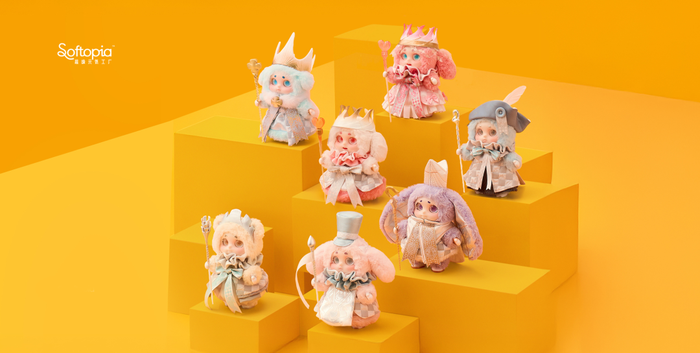
Core Viewpoint - The 2025 LEC Global Licensing Expo showcased the booming toy and trendy play market, highlighting significant growth in both domestic and international markets, with a focus on diverse product categories and the integration of cross-industry IP collaborations [1][2]. Industry Overview - The toy market in China is projected to reach a scale of 877 billion yuan by 2025, with exports of dolls and animal toys exceeding 13.31 billion yuan in the first four months of 2023, marking a 9.6% increase [1]. - The trendy play market is experiencing expansion in two dimensions: diversification of product categories and accelerated integration of cross-industry IP collaborations [1][2]. Company Activities - Companies are increasingly investing in the trendy play market, with notable transactions including Quantum Song Group's acquisition of a 61% stake in Shenzhen Yiqi Culture for 235 million yuan and investments by Wanda Film and Reading Group in various trendy play enterprises [1][2]. - The investment in "Super Vitality Factory," a plush toy brand, marks the first instance of a mainstream investment institution entering the plush toy industry in China [2]. Product Diversification - The market is shifting from a focus on blind box competition to a more diverse range of products, with companies like Pop Mart and 52TOYS expanding their offerings to include plush toys, action figures, and various collectibles [2]. - 52TOYS has developed a product range that includes static figures, movable toys, and plush toys, covering 2,800 SKUs, and emphasizes the importance of IP style and differentiation in product development [2][4]. IP Strategy - 52TOYS operates on a model of "self-owned IP operation + authorized IP cooperation," with 35 self-owned IPs and 80 authorized IPs expected to generate 24.5% and 64.5% of revenue, respectively, by the end of 2024 [4]. - The ability to successfully launch original IPs and creatively develop authorized IPs is seen as a competitive advantage in the evolving market landscape [4]. Future Trends - The competition in the trendy play market will increasingly depend on how brands enrich their IP ecosystems, with companies exploring various content forms such as animation and literature to enhance brand presence [4][5]. - The establishment of theme parks and the development of original animations are strategies being employed by leading companies like Pop Mart to deepen the impact of their original IPs [4].
八成受访消费企业今年拟引入或加大AI技术应用
Nan Fang Du Shi Bao· 2025-07-09 23:10
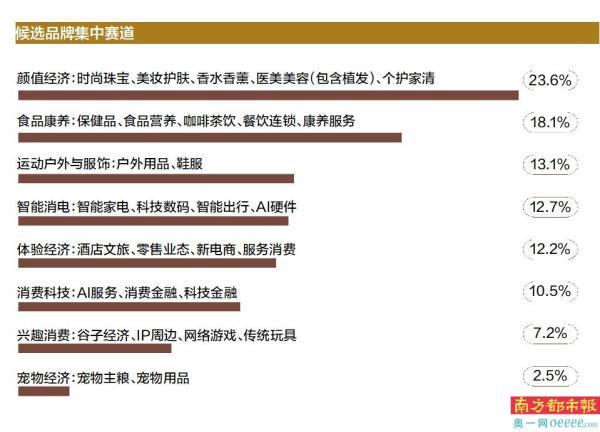
Core Insights - The "2025 High-Quality Consumption Brand TOP 100" list is being unveiled, highlighting trends in consumer behavior and brand innovation across various sectors [9] - The report identifies four major trends: health consciousness driving wellness and sports consumption, AI enhancing product and service upgrades, novel experiences igniting consumer enthusiasm, and emotional value unlocking new consumption scenarios [9] Group 1: Candidate Brands and Market Trends - Candidate brands are concentrated in nine primary sectors, including beauty economy, health food, outdoor sports, smart electronics, experience economy, consumer technology, interest consumption, and pet economy [10] - The health and wellness sector is seeing significant growth, with brands focusing on outdoor sports and health products, driven by a national initiative promoting weight management [11] - AI technology is becoming a core competitive advantage in high-end home appliances, with brands integrating AI features into their products [11] Group 2: Brand Age and Distribution - Over 70% of candidate brands were established within the last 30 years, with nearly 40% founded within the last 10 years, indicating a trend towards newer brands [13] - Shanghai has the highest concentration of candidate brands, with a significant presence of foreign brands, while Beijing is recognized for its consumer technology brands [14][15] Group 3: Emerging Consumption Trends - The demand for functional skincare products is rising, with brands focusing on specific skin issues and leveraging e-commerce for sales growth [16][17] - Outdoor sports consumption is becoming more segmented, with traditional apparel brands entering the market to capture this growing trend [18] - The concept of "new Chinese wellness" is gaining traction, with brands emphasizing health and wellness in their product offerings [20] Group 4: Cultural and Global Expansion - Companies are increasingly looking to expand internationally, with a focus on brand, culture, and service exports, adapting to global market demands [25][26] - The "AI + consumption" trend is reshaping the consumer landscape, with businesses planning to integrate AI technologies into various aspects of their operations [27][28]
布鲁可、52TOYS进军港股,IP玩具企业迎来上市热
Sou Hu Cai Jing· 2025-07-09 13:54
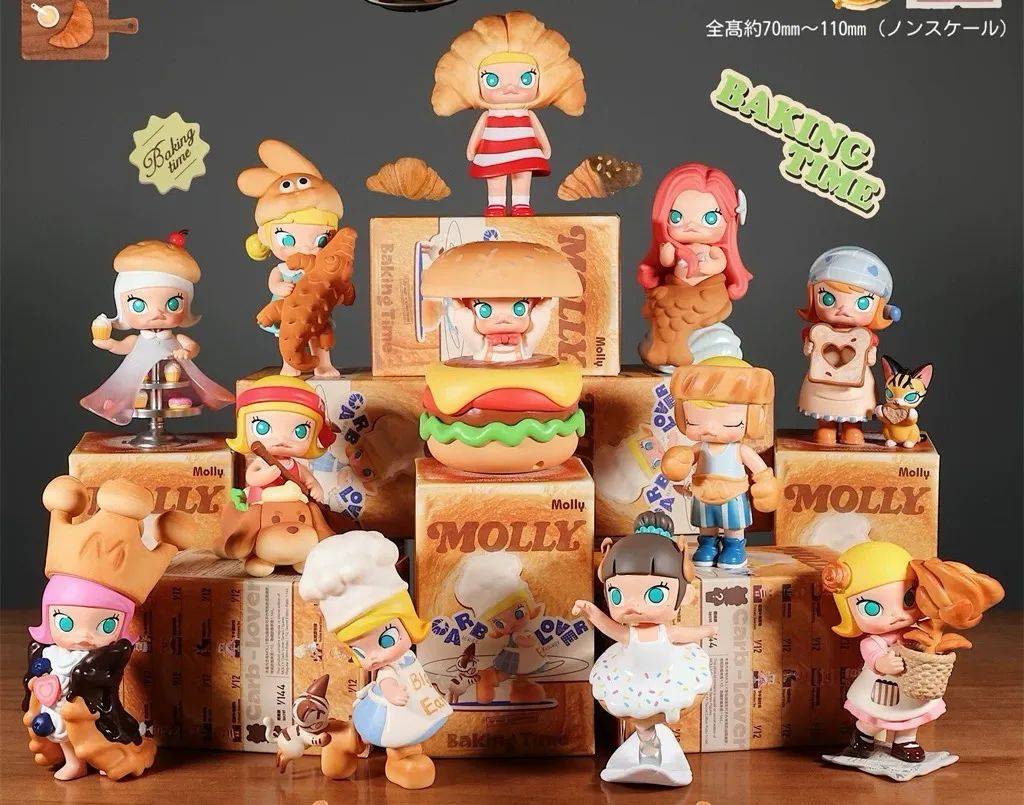
Core Insights - The Chinese潮玩 (trendy toy) industry is experiencing an IPO boom, with companies like Pop Mart leading the way, having seen significant stock price increases since their listings [1][3] - The market is gradually accepting潮玩 as a new consumption model, with capital increasingly favoring IP toy companies [3] - The future success of these companies will depend on their ability to create real value through IP development and operational strategies [3] Company Summaries - **Pop Mart**: - Successfully listed on the Hong Kong Stock Exchange in December 2020 at a price of 38.5 HKD, with a current stock price of 266.8 HKD as of July 9, 2025, representing a sixfold increase and a market capitalization of 354.268 billion HKD [1] - By 2024, Pop Mart had seven IPs generating over 100 million RMB in revenue, with self-owned IPs accounting for over 70% of its income, establishing a complete business loop from IP incubation to product design and sales [5] - **Blokus**: - Launched with a stock price increase of 81.61% on its first day, achieving a market capitalization of over 26.5 billion HKD [3] - Focuses on building block toys, with 30.3% of its products being proprietary, but relies on non-exclusive licensed IPs, which poses stability risks [6] - Recognizing its IP limitations, Blokus is gradually developing its own IPs [6] - **52TOYS**: - As of 2024, 52TOYS had 35 self-owned IPs and 80 licensed IPs, with sales from self-owned IPs contributing 24.5% of total revenue, while licensed IPs accounted for 64.5% [8] - The company is heavily reliant on licensed IPs, with sales from these IPs increasing significantly over the years [9] Market Trends - The潮玩 industry is shifting from being overlooked to becoming a major focus for capital investment, indicating a potential "stronger getting stronger" trend as more companies enter the market [11] - Companies are expanding their overseas presence, with Pop Mart's international business contributing 5.07 billion RMB in revenue in 2024, a 375% increase year-on-year, accounting for 38.9% of total revenue [10] - Blokus's overseas sales surged from 104 million RMB in 2023 to 642 million RMB in 2024, marking a 518% increase [10] - 52TOYS's overseas revenue grew from 35.4 million RMB in 2022 to 147.4 million RMB in 2024, with significant growth in markets like Japan and Thailand [10] Financial Performance - Pop Mart's total revenue for 2024 reached 630.13 million RMB, with a gross profit margin of 39.99% [11] - The company has seen a consistent increase in revenue and a decrease in the proportion of sales and marketing expenses over the years [11] - Despite the growth, Pop Mart reported a net loss of 121.514 million RMB in 2024, indicating challenges in profitability [11]
阅文追赶,朱啸虎入局,LABUBU赛道正在被重新定义
Xin Lang Cai Jing· 2025-07-09 07:27
Core Viewpoint - The investment in the plush toy brand "Super Vitality Factory" by the reading group signifies a growing interest in the collectible toy market, driven by the success of Bubble Mart and the potential of IP development in this sector [1][3][5]. Group 1: Investment and Market Dynamics - "Super Vitality Factory" has secured a strategic investment from the reading group, acquiring a 10% stake, marking a significant event in the plush toy industry [1][3]. - The investment reflects a broader trend where major companies are rapidly entering the collectible toy market, following the success of Bubble Mart, which has a market capitalization exceeding 300 billion [5][12]. - The collectible toy market is increasingly seen as a new narrative driven by emotional value, with companies exploring various avenues such as AI companions and virtual stars [3][5]. Group 2: IP Development and Brand Strategy - The success of Bubble Mart is closely tied to its ability to create and manage IP, with a reported revenue of 13.038 billion in 2024, a year-on-year increase of 106.92% [5][12]. - The reading group, with its extensive IP resources, is positioned to leverage its existing content to enhance the collectible toy market, potentially creating a closed-loop system where toys activate consumer engagement [13][28]. - The competitive landscape is shifting towards IP creation, with companies like Lehua Entertainment and its WAKUKU brand aiming to replicate the success of Bubble Mart through strategic partnerships and celebrity endorsements [9][25]. Group 3: Future Trends and Challenges - The future of the collectible toy market may not follow a single path but will likely balance emotional resonance and long-term value, with various models emerging, including traditional IP development, AI-driven companionship, and content-based strategies [29][30]. - The challenge remains in effectively translating literary IP into appealing visual symbols for the younger demographic, ensuring that the products resonate with both fans and casual consumers [28][30]. - The evolving landscape suggests that the next successful brand will be one that can deeply connect with users, transcending mere collectibles to become meaningful emotional companions [29][30].