
比亚迪

Search documents
亚太主要股指集体飘绿,A股化工股爆发,泡泡玛特涨超8%,黄金涨白银跌
2 1 Shi Ji Jing Ji Bao Dao· 2026-01-20 07:23
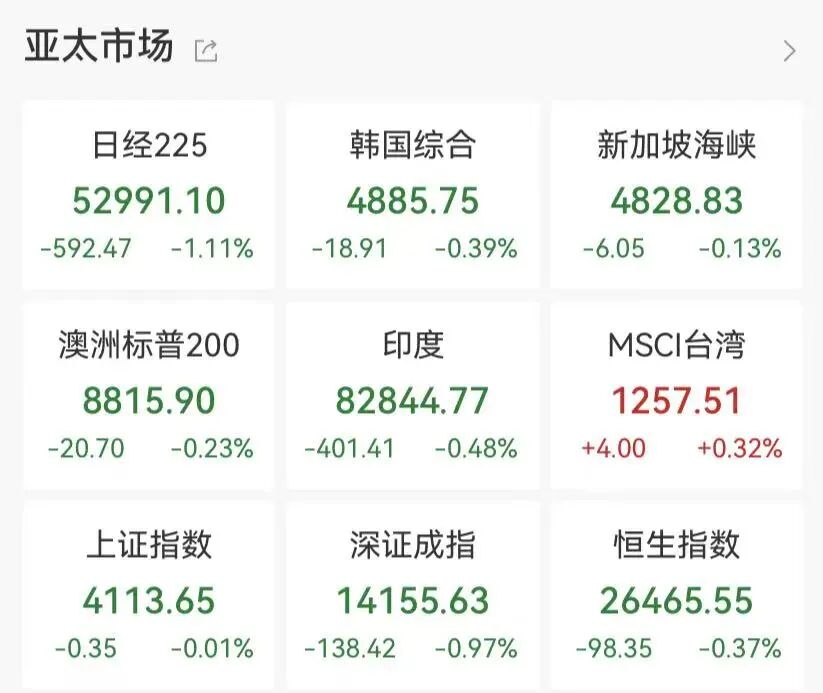
Market Overview - Major Asia-Pacific stock indices collectively declined on January 20, with the Nikkei 225 down by 592.47 points or 1.11%, the KOSPI down by 18.91 points or 0.39%, and the Straits Times Index down by 6.05 points or 0.13% [2] - The A-share market experienced fluctuations, with the Shanghai Composite Index down by 0.01%, the Shenzhen Component down by 0.97%, and the ChiNext Index down by 1.79%. Over 3,100 stocks in the market fell [2] Sector Performance - The satellite internet, CPO, commercial aerospace, and telecommunications sectors led the declines, with commercial aerospace stocks experiencing significant drops, including Shenjian Co. (002361) facing four consecutive trading halts and Aerospace Power (600343) facing two consecutive halts [3] - The chemical sector showed resilience, with over ten constituent stocks hitting the daily limit up, including Hongbaoli (002165), Shandong Heda (002810), Weiyuan Co. (600955), and Hongqiang Co. (002809) [3] - The real estate sector was active, with Dayuecheng (000031) and City Investment Holdings (600649) hitting the daily limit up [3] Hong Kong Market - In the Hong Kong market, the Hang Seng Technology Index fell over 1%, while the Hang Seng Index and Hang Seng China Enterprises Index saw slight declines. Most tech stocks were in the red, with SMIC, Sunny Optical Technology, and BYD (002594) down over 3%, while Xiaomi Group fell over 2%. Ctrip Group rose over 2.5%, and Midea Group (000333) and Baidu Group increased by over 1% [3] Gold and Silver Market - Gold prices rose, with spot gold surpassing $4,700, increasing by nearly 1% and up over 9% year-to-date. In contrast, spot silver fell nearly 0.5%, fluctuating around $94 per ounce [5] - Current prices for gold and silver include: - London Gold: $4,714.235, up by $45.051 or 0.96%, with a year-to-date increase of 9.17% - London Silver: $93.954, down by $0.444 or -0.47%, with a year-to-date increase of 31.26% - COMEX Gold: $4,712.5, up by $35.8 or 0.77%, with a year-to-date increase of 8.78% - COMEX Silver: $93.380, down by $0.900 or -0.95%, with a year-to-date increase of 31.58% [6]


韩国本土电动车企份额萎缩,比亚迪、特斯拉异军突起
Guan Cha Zhe Wang· 2026-01-20 07:16
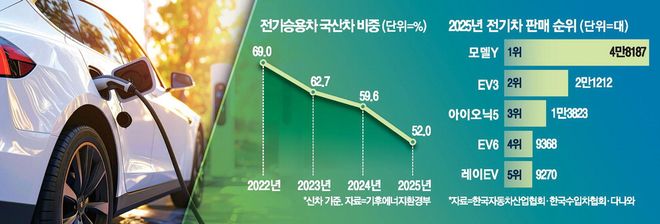
Core Insights - The market share of South Korean domestic electric vehicle manufacturers is declining, with a significant shift towards imported models like Tesla and BYD, raising concerns about the competitiveness of the local automotive industry [1][3][5] Market Trends - By 2025, the market share of South Korean domestic electric vehicle companies is projected to be 52%, down from 69% in 2022, with a gradual decline to 62.7% in 2023 and 59.6% in 2024 [1][3] - The younger consumer demographic shows a strong preference for imported models, particularly the Tesla Model Y and BYD Atto 3 [3][4] Sales Data - In 2025, Tesla and BYD are expected to be the top two electric vehicle brands in South Korea, with Tesla selling 59,916 units and BYD selling 6,107 units [3] - The Tesla Model Y is projected to be the best-selling imported vehicle in South Korea in 2025, with sales reaching 48,187 units [3] Competitive Landscape - Tesla's success in South Korea is attributed to cost advantages from its Shanghai Gigafactory, allowing for significant price reductions, including a decrease of approximately 20 million KRW (around 94,600 RMB) for a lower-priced Model Y version [3][4] - BYD is also making strides in the South Korean market with competitive pricing for models like the Atto 3, which has an official price around 30 million KRW (approximately 141,900 RMB) and can drop to just over 20 million KRW (around 94,600 RMB) after government subsidies [4] Government Policies and Industry Response - The South Korean government aims for half of new car sales to be zero-emission vehicles by 2030, but there are concerns that the market share of imported electric vehicles will continue to grow under current trends [4][5] - Experts suggest that existing subsidy policies are insufficient to boost the adoption of domestic electric vehicles, despite higher subsidies for local brands compared to Tesla and BYD [5] - Recommendations include increasing budget support for future vehicle development and introducing a "domestic production incentive tax" to protect and nurture local manufacturing [5]


雪球:永久封禁多个违规账号
财联社· 2026-01-20 06:49
Core Viewpoint - The article discusses the crackdown on market manipulation by influential figures in the stock market, highlighting recent penalties imposed on a prominent stock promoter for illegal activities [2][3]. Group 1: Regulatory Actions - The Zhejiang Securities Regulatory Bureau has imposed a penalty of 83.25 million yuan on stock promoter Jin Yongrong for manipulating the securities market through "hat trading" [2]. - Jin Yongrong's actions included promoting stocks on various platforms and conducting significant reverse sell transactions, totaling approximately 631 million yuan, leading to illegal gains of 41.62 million yuan [3]. - The crackdown is part of a broader initiative to address false information in the capital market, with several accounts permanently banned from the Snowball platform [3]. Group 2: Impact on Stock Recommendations - Stocks recommended by influential figures have shown significant volatility, with some investors reporting substantial losses due to price fluctuations [4]. - For instance, the stock of Luyan Pharmaceutical was noted to have risen from 11 yuan to 28.29 yuan within a month, only to drop sharply afterward, with a maximum decline exceeding 40% in six trading days [4]. - Legal experts warn that public recommendations followed by reverse trading could violate securities laws, urging influencers to be cautious in their statements [4]. Group 3: Community Reactions - Influential figures like "Lunhui666" have faced restrictions on multiple platforms, indicating a growing concern over their impact on market dynamics [5]. - The community has expressed mixed feelings, with some acknowledging the expertise of certain influencers while others criticize them for manipulating stock prices for personal gain [4].

福特或采购比亚迪电池加码混动市场?官方回应
Mei Ri Jing Ji Xin Wen· 2026-01-20 06:35
Core Viewpoint - Ford is in discussions with BYD for a battery cooperation plan, focusing on procuring BYD batteries for some of Ford's hybrid models, particularly for use in factories outside the U.S. [1] Group 1: Ford's Strategic Shift - Recently, Ford canceled a significant battery procurement contract with LG Energy Solution worth approximately 459 million RMB, retaining only a portion of the supply for 2026 to 2030 [2] - The cancellation was attributed to changes in policy environment and electric vehicle demand outlook, leading Ford to stop production of certain electric vehicle models [2] - Ford's recent strategic adjustment includes a shift towards high-return businesses, increasing investments in commercial vehicles and battery storage, while reducing focus on large electric vehicle production [4] Group 2: Battery Market Dynamics - The global battery installation volume reached 1,046 GWh in the first 11 months of 2025, marking a 32.6% year-on-year increase, with Chinese companies holding six out of the top ten spots in the global battery market [3] - BYD's lithium iron phosphate (LFP) battery technology is favored for its lower cost (30% cheaper than nickel-cobalt-manganese batteries) and superior safety and lifecycle performance [3] - The demand for LFP batteries is projected to grow by 38% to 420 GWh in 2025, capturing over 54% of the total battery market share [3] Group 3: Historical Context and Future Prospects - Ford and BYD have previously collaborated on battery supply, notably for the launch of the Ford Mustang's first electric SUV in 2021, establishing a foundation for renewed partnership [6] - The current strategic shift towards hybrid vehicles creates a pressing need for reliable and adaptable hybrid batteries, aligning with BYD's expertise in LFP battery production [6]

港股再融资迎“开门红” 募资超270亿港元
2 1 Shi Ji Jing Ji Bao Dao· 2026-01-20 05:23
Core Insights - The Hong Kong capital market has seen a significant increase in refinancing activities at the beginning of 2026, with over HKD 27 billion raised by listed companies through various methods, marking a more than 20-fold increase compared to HKD 1.1 billion in the same period of 2025 [1][2]. Group 1: Market Activity - As of January 18, 2026, Hong Kong listed companies have raised a total of HKD 27 billion through placements, rights issues, and other means, indicating a strong market confidence and financing demand [2][3]. - The robust start to refinancing in 2026 builds on a historical high in 2025, where the total refinancing scale reached HKD 325.32 billion, surpassing the IPO fundraising scale for the first time [2][3]. - Major companies like BYD, Xiaomi, and Geely have completed significant fundraising rounds in 2025, contributing to a trend of continuous capital replenishment [2][3]. Group 2: Structural Characteristics - The refinancing activities in early 2026 show a diverse industry distribution, including sectors such as oil and petrochemicals, construction, software services, and healthcare [4]. - Notably, five companies raised over HKD 1 billion each, with the majority of funds being allocated to support international expansion, enhance R&D capabilities, and optimize financial structures [4][5]. - Placement remains the dominant method for refinancing, with over 75% of the 36 cases in 2026 utilizing this approach, highlighting its efficiency and flexibility [4][5]. Group 3: Emerging Trends - A notable trend in 2026 is the strategic mutual holdings between companies through cost issuance, exemplified by the collaboration between SF Express and Jitu Express [5]. - The refinancing landscape is characterized by a higher proportion of traditional and consumer industries compared to emerging sectors, reflecting the complementary nature of Hong Kong and A-share markets [5][6]. - Future trends indicate that refinancing will maintain high levels but with a more stable growth rate, driven by ongoing demand in capital-intensive industries and an increasing focus on optimizing capital structures and enhancing R&D capabilities [6][7].
访华第三天,加拿大总理在北京突然提一个请求,中方的回应很直接
Sou Hu Cai Jing· 2026-01-20 05:08
时隔八年,加拿大总理卡尼终于踏上中国的土地。这一历史性的访问,刚进入第三天,便在北京掀起了不小的波澜。公开场合上,他向中方提出了一项至关 重要的要求,随即果断推翻了之前针对中国电动车征收的惩罚性关税政策。此举不仅意味着对美国主导的对华技术封锁路线的公开挑战,更引发了国际社会 的广泛关注。究竟卡尼提出了什么样的要求?又为何此举引起了特朗普的强烈反应?难道加拿大正在摆脱美国的影像,转向中国,建立更紧密的合作关系? 实打实的利益交换,电动车与菜籽油的双赢 前言 2026年1月16日,在完成了多轮经贸磋商后,卡尼突然提出了一个具有深远象征意义的举动——在两国记者团面前,他郑重地发出了邀请,希望中国高层能 够在适当时机访问加拿大。这并非一场简单的礼节性访问,而是带来了切实的实惠。卡尼宣布,废除之前对中国电动汽车征收100%高关税的政策,转而实 行配额管理制度。根据新的安排,每年将允许4.9万辆中国产电动汽车以6.1%的低关税进入加拿大市场,五年过渡期结束后,配额将提高至7万辆。这一政策 的调整,标志着特鲁多政府时期设立的贸易壁垒被彻底打破。 此前的100%关税政策,实际上将比亚迪、蔚来等中国主流新能源车企挡在了加拿大市 ...

2025年度车型榜单出炉:新能源渗透率飙升 自主品牌登顶全细分市场
Qi Lu Wan Bao· 2026-01-20 05:08
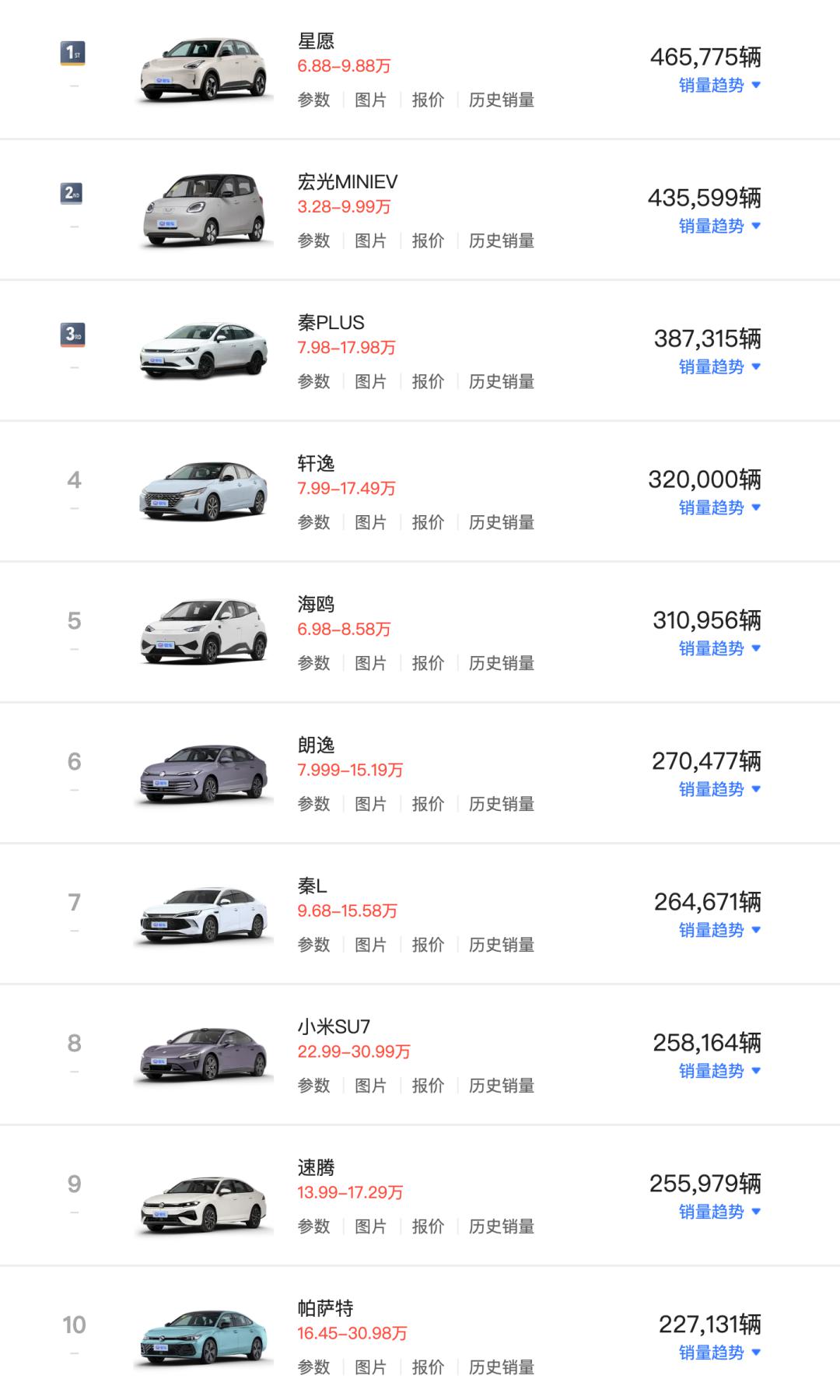
Core Insights - The 2025 Chinese automotive market is characterized by the continued penetration of new energy vehicles (NEVs), strong performance of domestic brands, and a reshaping of market dynamics across various segments [1][14]. Passenger Car Market - Domestic brand NEVs dominate the passenger car sales rankings, with Geely's Star Wish leading at 465,775 units sold, supported by its competitive pricing and features targeting young families [2][5]. - BYD's models, including the Qin PLUS and Dolphin, also performed well, with the Qin PLUS achieving significant sales due to its low fuel consumption and spacious design [2][5]. - The top ten passenger cars include six NEVs priced under 100,000 yuan, indicating a strong market presence for affordable electric vehicles [5]. SUV Market - The Tesla Model Y leads the SUV segment with 425,337 units sold, despite facing competitive pressure from domestic brands [6][10]. - Domestic brands like Geely and BYD have shown strong performance, with Geely's Xingyue L and Boyue L achieving notable sales growth [9][10]. - The SUV market remains diverse, with a mix of six fuel vehicles and four NEVs in the top ten, highlighting the growing influence of electric models [10]. MPV Market - The MPV segment is witnessing a shift towards NEVs, with the BYD D9 leading sales at 92,988 units, despite a slight decline [11][13]. - Toyota's Sienna and other models have also performed well, indicating a competitive landscape where both domestic and joint venture brands are adapting to market demands [11][13]. - The top ten MPVs include six NEVs, showcasing the increasing acceptance of electric and hybrid models in the market [13]. Overall Market Trends - The 2025 Chinese automotive market is undergoing significant structural adjustments, with domestic brands leveraging their technological advantages and competitive pricing to challenge the long-standing dominance of joint venture brands [14]. - The penetration rate of NEVs is on the rise across all segments, with electrification and intelligence becoming irreversible trends in the industry [14].
纯电续航超210km,综合续航破2000km!2026款比亚迪秦/宋长续航版南京上市
Yang Zi Wan Bao Wang· 2026-01-20 04:45
Core Viewpoint - The launch of BYD's 2026 models, including the Qin and Song series, emphasizes long-range capabilities and enhanced comfort for family travel, positioning these vehicles as leaders in the plug-in hybrid market [1][2][3] Group 1: Product Features - The 2026 Qin PLUS DM-i features a 25.28 kW·h battery, offering a pure electric range of up to 210 kilometers and a fuel consumption of only 2.79 liters per 100 kilometers when the battery is depleted [2] - The 2026 Qin L DM-i also includes a 25.28 kW·h battery, with a combined range of 2110 kilometers when fully charged and fueled, and a low fuel consumption of 2.79 liters per 100 kilometers [2] - The 2026 Song Pro DM-i is equipped with a larger blade battery, providing a pure electric range of 220 kilometers, allowing for zero fuel consumption during daily commutes [3] Group 2: Technological Innovations - The vehicles are equipped with the "Tian Shen Zhi Yan" auxiliary driving system, enhancing safety and driving ease [2][3] - The interior of the Qin L DM-i features advanced technology such as an 8.8-inch full LCD instrument panel and smart connectivity with devices like intelligent child seats [2] - The Song Pro DM-i supports OTA remote upgrades, ensuring that the smart configurations remain up-to-date [3] Group 3: Market Positioning and Strategy - The launch event highlighted BYD's commitment to innovation in smart, electric, and comfortable vehicles, aiming to redefine family travel standards [1][3] - The Qin and Song families are positioned as core models in BYD's strategy to capture the mainstream market with their strong sales and reputation [1] - The delivery ceremony for the first batch of vehicles marked a significant step in BYD's outreach to families, symbolizing the brand's vision of enhancing everyday life through advanced automotive technology [3]
德国30亿欧元电车补贴对中企开放,“不设限,有信心赢得竞争”
Guan Cha Zhe Wang· 2026-01-20 03:42
Core Viewpoint - Germany has reintroduced an electric vehicle (EV) subsidy program worth €3 billion to stimulate market growth, contrasting with restrictive measures in other European countries that limit access for Chinese automakers [1][3]. Group 1: Subsidy Program Details - The new subsidy plan targets private consumers and applies to new registrations of pure electric vehicles, certain plug-in hybrids, and range-extended electric vehicles starting from January 1, 2026, until 2029 [3][4]. - Subsidy amounts range from €1,500 to €6,000 based on vehicle type, household size, and income level, with an expectation to support approximately 800,000 new vehicle purchases or leases [4]. Group 2: Market Impact and Industry Response - The German automotive industry association (VDA) welcomed the new subsidy plan but emphasized the need for improved infrastructure to ensure the program's effectiveness [4]. - Companies like Volkswagen and Stellantis are expected to benefit from the subsidy, as well as Chinese brands like BYD that are expanding in the European market [4]. Group 3: Trade Relations and Market Share - Recent negotiations between China and the EU regarding electric vehicle trade have shown positive progress, potentially allowing Chinese automakers to enter the EU market without facing anti-subsidy taxes [6][10]. - Chinese brands are gaining market share in Europe, with projections indicating that by November 2025, their share in the European electric vehicle market could reach a record 12.8% [7][10].
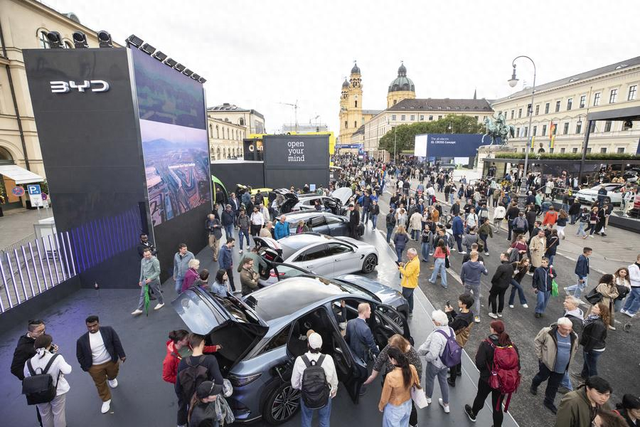
高盛:新款折叠手机带动比亚迪电子增长 重申“买入”评级
Jin Rong Jie· 2026-01-20 03:20
Group 1 - Goldman Sachs reports that BYD Electronic (00285.HK) management anticipates higher unit value from new foldable phones launched by major brand clients, which is expected to support future growth [1] - Management remains optimistic about the AI infrastructure cycle and is seeking opportunities among global and local clients [1] - BYD Electronic expects an increase in automotive parts shipment volume by 2026, with a faster rise in suspension system shipments and greater penetration of ADAS systems into more economical models [1] Group 2 - The firm maintains a positive view on BYD Electronic's strategy of focusing on leading clients and expanding its product line into AI infrastructure initiatives [1] - Goldman Sachs reiterates a "Buy" rating for BYD Electronic with a target price of HKD 53.08 [1]