碧桂园

Search documents
关注债息情况,港股料整固
Guodu Securities Hongkong· 2025-05-26 02:58
Group 1: Market Overview - The report indicates that the U.S. stock market experienced a decline last Friday, with the Dow Jones Industrial Average down by 0.61% and the S&P 500 down by 0.67% [2] - The Hang Seng Index closed at 23,601, up 0.2%, while the Shanghai Composite Index fell by 0.94% to 3,348.37 [3] - The overall market turnover for the day was 203.67 billion [3] Group 2: Macroeconomic and Industry Dynamics - The report highlights that China's self-regulatory mechanism has lowered the upper limit for bank deposit rates, with some banks reducing rates by 30 to 40 basis points, indicating regulatory efforts to improve banks' net interest margins [6] - The Hong Kong Insurance Authority is actively communicating with insurance companies interested in relocating their registrations to Hong Kong, aiming to facilitate the migration process under a new framework [7] Group 3: Company-Specific News - UBS has raised its year-end target for the S&P 500 index from 5,800 to 6,000, citing better-than-expected first-quarter earnings and improved GDP growth expectations as reasons for the adjustment [8] - The Hong Kong Stock Exchange plans to increase the position limits for Hang Seng Index derivatives starting July 2, pending regulatory approval, to enhance the development of the derivatives market [10] - Country Garden has reported that over 70% of its public noteholders have joined a restructuring support agreement, extending the deadline for early bird participation [11]






从“囤地”到“求生”:百强房企土储全面缩表
3 6 Ke· 2025-05-26 02:05
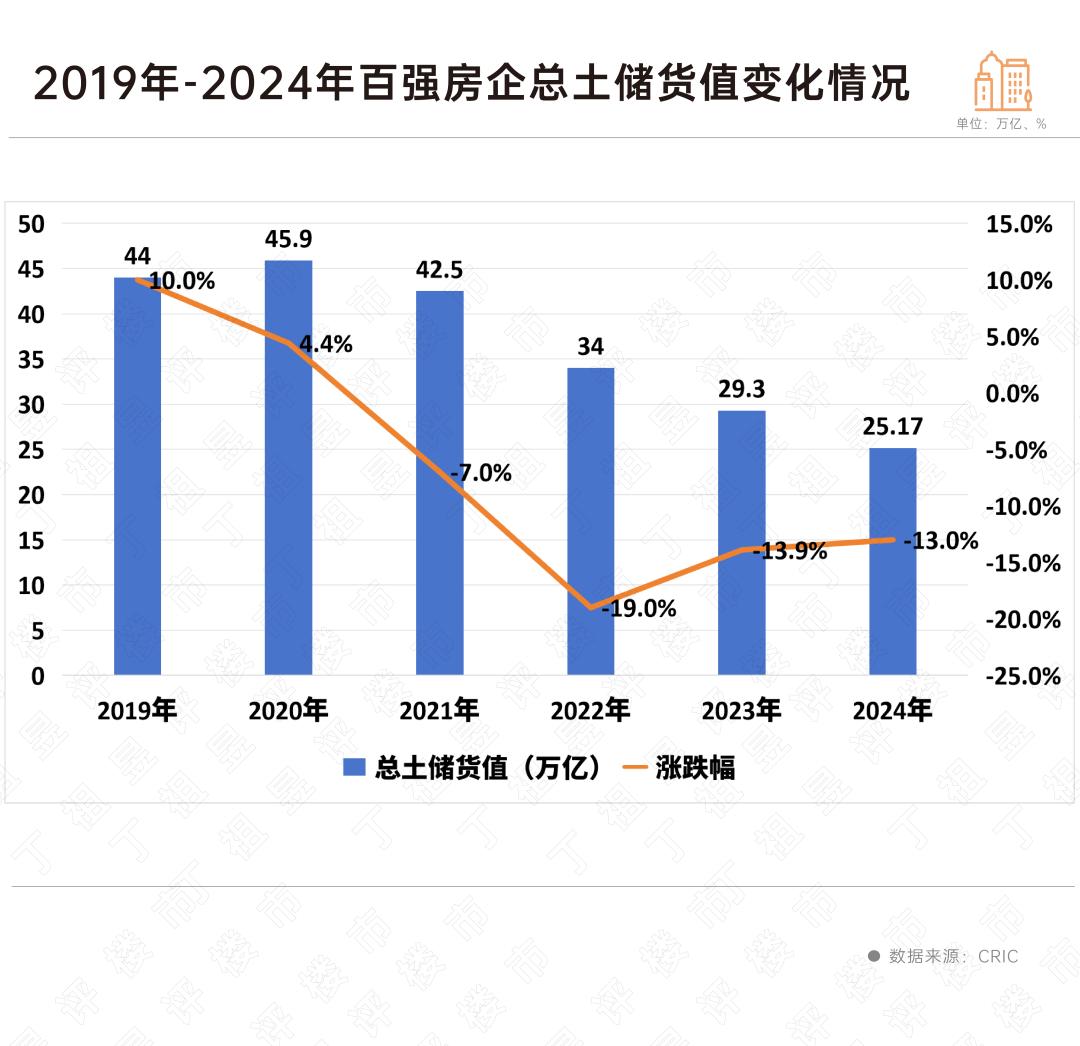
CRIC披露最新数据显示,截止2024年末TOP100房企土储总量收缩明显:总土储货值25.17万亿元,同比下降13%;总土储建面15.73亿平米,同比下降 12%。 具体到房企来看,百强房企中有96家房企总土储货值下降,降幅超过20%的房企数量占比达到15%。 不过,由于房企销售降幅大于土储总量收缩的速度,房企仍然面临较大的存货去化压力。百强房企截止2024年末的土储货值去化周期加权值以6.93年创历 史新高。货值规模在1000亿至3000亿房企的去化周期高达9.01年。 房企的投资逻辑被重构,货值规模高不再是优势,而小体量、健康的存货储备或是保障企业稳健运营的关键。 百强总土储货值同比降13% 龙头房企"瘦身"明显 百强房企总土储货值和建面双降。 截止2024年末,TOP100房企总土储货值和总土储建面分别为25.17万亿元和15.73亿平米,较去年分别下降13%和12%。 自房地产行业开启新一轮"去库存"以来,百强房企总土储货值自2020年达到峰值后逐年下降,到2024年百强房企总土储货值较2020年高峰期已下降了 45.2%。 2024年总土储货值排名前十的房企中,货值规模下降较大的分别为万科地产、碧 ...







碧桂园清盘聆讯押后至8月11日。
news flash· 2025-05-26 01:54
Group 1 - Country Garden's liquidation hearing has been postponed to August 11 [1]
楼市早餐荟 | 福建前4月商品房待售面积同比增长9.1%;珠海发布住房“以旧换新”专项补贴申报指引
Bei Jing Shang Bao· 2025-05-26 01:45
Group 1: Real Estate Market in Fujian - In the first four months of 2025, the sales area of new commercial housing in Fujian decreased by 16.9%, with residential sales area down by 16.6% [1] - The sales revenue of new commercial housing fell by 12.1%, while residential sales revenue declined by 13.3% [1] - As of the end of April, the unsold commercial housing area increased by 9.1%, with residential unsold area rising by 15.7% [1] Group 2: Housing Subsidy in Zhuhai - Zhuhai has introduced a "housing exchange" subsidy program, effective from May 6, 2025, to May 5, 2026 [2] - Individuals purchasing new commercial housing in Zhuhai can receive a subsidy of 1% of the new home's contract price, capped at 30,000 yuan, when selling their old home [2] - The subsidy application can be made regardless of the order of selling the old home and buying the new one, following a "sell one, buy one" principle [2] Group 3: Corporate Governance Changes at China Jinmao - China Jinmao announced the resignation of independent non-executive director Su Xijia, who will step down after the upcoming annual general meeting on June 17, 2025 [3] - Liu Feng has been nominated by the remuneration and nomination committee to be appointed as an independent non-executive director [3] Group 4: Debt Restructuring at Country Garden - Country Garden disclosed that over 70% of the holders of its public notes have joined the restructuring support agreement [4] - The company is extending the deadline for early bird restructuring support agreement fees from May 23, 2025, to June 6, 2025, and for general restructuring support agreement fees from June 6, 2025, to June 20, 2025 [4] Group 5: CIFI Holdings Debt Restructuring Plan - CIFI Holdings announced a debt restructuring plan involving seven domestic bonds with a total principal balance of 10.06 billion yuan [5] - The restructuring offers bondholders four options: bond buyback, equity economic rights, debt-for-equity swaps, and general debt claims [5] - If bondholders do not select any of the options, their bonds will enter a full repayment extension plan [5]
王健林再卖48座万达广场;旭辉公布境内债重组方案 | 房产早参
Mei Ri Jing Ji Xin Wen· 2025-05-25 23:24
Group 1: Real Estate Market Trends - Shanghai is set to launch 917 new housing units across 10 projects, with three high-end projects priced above 100,000 yuan per square meter, indicating a market segmentation trend [1] - The introduction of a "replacement subsidy" policy in Zhuhai aims to enhance liquidity in the second-hand housing market by providing a 1% subsidy on the net purchase price of new homes, capped at 30,000 yuan [2] - The "dumbbell-shaped" supply structure in Shanghai, with luxury properties accelerating entry, may lead to a further divide among buyers, concentrating funds on scarce and premium projects [1] Group 2: Corporate Debt Restructuring - CIFI Holdings has announced a debt restructuring plan involving seven bonds with a total principal balance of 10.06 billion yuan, offering bondholders four options including asset compensation and equity binding [3] - Country Garden has extended the deadline for its major offshore debt restructuring support agreement, with over 70% of bondholders already participating, indicating progress in risk mitigation [5][6] - The restructuring efforts by CIFI and Country Garden reflect a broader trend in the real estate sector towards innovative debt resolution strategies amid significant sales declines [3][5] Group 3: Mergers and Acquisitions - A consortium led by Taikang and Tencent has received unconditional approval to acquire 48 Wanda Plaza locations across major cities, signaling regulatory support for revitalizing quality commercial assets [4] - The acquisition may enhance market confidence in holding properties, although potential liquidity risks for remaining Wanda assets and management efficiency under multi-party collaboration should be monitored [4]
中美日第一季度GDP差距断崖:美7.32万亿,日0.99万亿,中国多少
Sou Hu Cai Jing· 2025-05-25 22:37
Economic Overview - The United States reported a GDP of $7.32 trillion, but with a quarter-on-quarter decline of 0.07% and an annualized growth rate of only 1.1%, indicating economic weakness [3] - Japan's GDP fell below $1 trillion, at $0.99 trillion, with household spending experiencing negative growth for four consecutive quarters, leading to a significant drop in consumer activity [3] - China's GDP stood at $4.44 trillion, showing a robust year-on-year growth rate of 5.4%, significantly outperforming G7 countries [4] Sector Performance - In the U.S., the automotive sector faced challenges due to tariffs, with Ford halting production and a high inflation rate of 5.2% affecting consumer purchasing power [3] - Japan's economy is struggling with a 12% decline in convenience store food sales and a 18% drop in Toyota's global sales, as competition from Chinese electric vehicles rises [3] - China's equipment manufacturing sector contributed 10.9% to GDP growth, with a notable 26.9% increase in retail sales from home appliance upgrades [4] Debt and Fiscal Health - The U.S. national debt reached $35 trillion, with interest payments becoming a significant burden [6] - Japan's government debt is 260% of its GDP, indicating severe fiscal challenges [6] - China is seeing improvements in local government debt management, with 28 out of 31 provincial capitals achieving fiscal surpluses [6] Global Supply Chain Dynamics - The U.S. is attempting to reduce reliance on China, but companies like Tesla still rely heavily on Chinese production for a significant portion of their output [8] - Japan's semiconductor industry is dependent on Chinese high-purity silicon, highlighting vulnerabilities in its supply chain [8] - China experienced a 120% increase in electric vehicle exports, showcasing its growing influence in the global automotive market [8] Future Economic Outlook - The economic performance of the three countries illustrates different paths: the U.S. faces potential decline due to financial bubbles, Japan struggles with an aging population, while China is advancing through technological independence and a large domestic market [8] - China's focus on new production capabilities, such as AI in pharmaceuticals and advancements in autonomous driving, positions it favorably for future economic competitiveness [8]
湾财周报 人物 董明珠孟羽童同框直播;安聪慧任吉利CEO
Nan Fang Du Shi Bao· 2025-05-25 12:41
Group 1 - China's digital economy continues to show strong growth, with the core industry value-added growth rate maintaining above 10%, significantly higher than the GDP growth rate during the same period [3][7]. - At the Guizhou Moutai shareholders' meeting, Chairman Zhang Deqin emphasized the need for the Chinese liquor industry to return to its roots, reflecting on the current macroeconomic environment and market conditions [8]. - Huawei launched the world's first Harmony OS foldable laptop, the MateBook Fold ULTIMATE DESIGN, which features an 18-inch screen when unfolded and a starting price of 23,999 yuan, positioning it as the largest commercial foldable screen laptop [9][10]. Group 2 - An Conghui is set to become the CEO of Geely Holding Group, marking a significant leadership change as the company aims to consolidate its operations under the "One Geely" strategy [10]. - Yang Huiyan of Country Garden received a disciplinary notice from the Shanghai Stock Exchange for failing to timely disclose the 2024 interim report, which was submitted late [14]. - The general manager of "fruit first stock" Hongjiu Fruit has been released from restrictions, while the founder remains under arrest due to ongoing investigations related to overdue bank loans [15].




中国家族企业传承的代际破局|基业长青
Jing Ji Guan Cha Wang· 2025-05-24 07:04
Core Viewpoint - The emergence of the "second generation" of Chinese private enterprises marks a significant shift in the business landscape, as these young successors bring diverse backgrounds and innovative approaches to family business succession [2][3]. Group 1: Characteristics of the New Generation - The new generation of successors, primarily born between the 1980s and 2000s, possesses strong educational backgrounds, with over 80% having studied abroad, including many with dual master's degrees from prestigious institutions [4]. - This group is characterized by a wide range of interests outside of business, including pursuits in arts, sports, and media, reflecting a desire for diverse life experiences before returning to family businesses [5]. Group 2: Succession Process - Many young successors undergo a period of exploration and self-discovery before accepting their roles in family businesses, often experiencing a journey from resistance to acceptance [6]. - Upon entering family businesses, successors typically start from the ground up, gaining comprehensive knowledge of operations before moving into management roles [6]. Group 3: Diverse Succession Strategies - Young successors exhibit a strong interest in digital technology, often leading traditional businesses through digital transformation, which has proven successful in many cases [8]. - They are also sensitive to trends in fashion and new consumer behaviors, often launching new brands or business lines that cater to younger demographics [9]. - The global perspective gained from studying abroad enables these successors to effectively expand family businesses into international markets [10]. Group 4: Financial Acumen and Innovation - The new generation is more familiar with complex financial tools compared to their predecessors, leading some to establish investment firms or engage in financial ventures related to family businesses [11]. - Successful transitions often involve innovative approaches to business operations, such as introducing new technologies or restructuring organizational hierarchies to foster a more collaborative environment [17]. Group 5: Communication and Learning - Effective communication between generations is crucial for successful succession, as misunderstandings can arise from differing experiences and perspectives [19]. - The process of succession is viewed as a mutual learning experience, where both generations must be open to understanding each other's viewpoints to facilitate innovation and growth [18]. Group 6: Family Dynamics and Governance - Successful succession often relies on strong family governance and a supportive environment that fosters shared values and mutual respect [23]. - In cases with multiple potential successors, collaborative approaches to leadership can enhance the likelihood of successful transitions [20]. Group 7: Future Outlook - As Chinese private family businesses enter a phase of increased succession activity, ongoing observations and case studies will continue to enrich understanding of effective succession practices [25].

中资离岸债风控周报:一级市场发行平稳 二级市场涨跌不一
Xin Hua Cai Jing· 2025-05-24 01:38
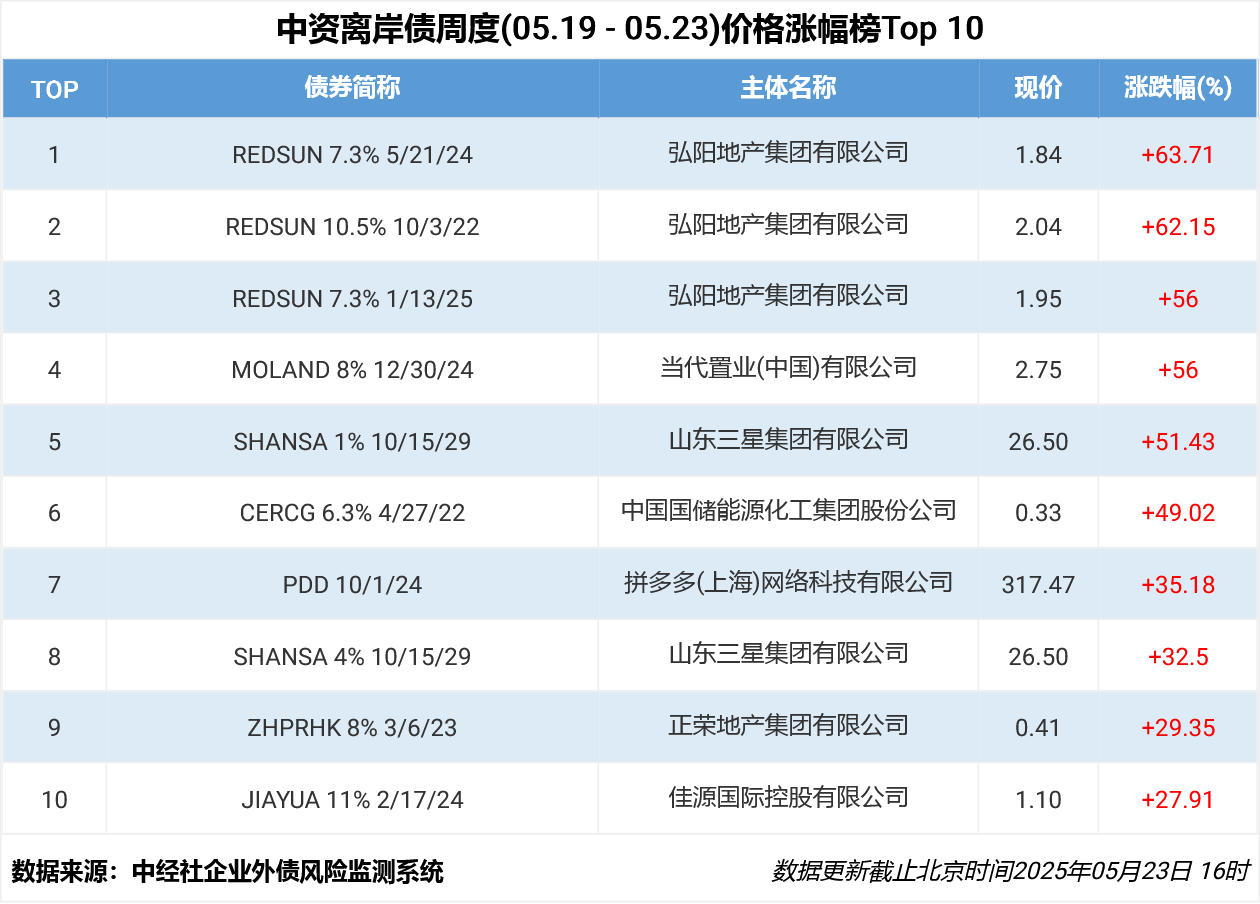
Primary Market - A total of 18 offshore bonds were issued this week (May 19-23, 2025), including 4 offshore RMB bonds, 11 USD bonds, and 3 HKD bonds, with issuance scales of 3.33396 billion RMB, 3.3429 billion USD, and 81.531 billion HKD respectively [2] - The largest single issuance in the offshore RMB bond market was 2 billion RMB by China Construction Bank Hong Kong Branch, while the highest coupon rate was 6.9% issued by Weifang Ocean Investment Group [2] - In the USD bond market, the largest single issuance was 1 billion USD by China Construction Bank Hong Kong Branch, with the highest coupon rate of 6.925% issued by China Hongqiao Group [2] Secondary Market Overview - The Markit iBoxx China USD Bond Composite Index fell by 0.06% this week, closing at 241.2, while the investment-grade USD bond index decreased by 0.07% to 233.82 [3] - The real estate USD bond index dropped by 0.33% to 180.87, while the city investment USD bond index rose by 0.12% to 148.55 [3] - The highest weekly increase in offshore USD bonds was seen in the REDSUN 7.3% 5/21/24 bond from Hongyang Real Estate, which rose by 63.71% to 1.84 [3] Price Changes - The largest weekly price increase in offshore bonds was for REDSUN 7.3% 5/21/24 from Hongyang Real Estate, priced at 1.84 [4] - The largest weekly price decrease was for REDSUN 9.5% 9/20/23 from Hongyang Real Estate, which fell by 73.33% to 1.95 [6] Benchmark Spread - The spread between the 10-year benchmark government bonds of China and the US widened to 285.32 basis points, an increase of 8.73 basis points from the previous week [7] Rating Changes - On May 20, S&P confirmed China Tourism Group's long-term issuer credit rating at "A-" with a negative outlook [10] - Moody's downgraded the corporate family rating of R&F Properties to "B2" with a stable outlook on May 20 [10] - On May 21, China Chengxin (Asia Pacific) Credit Rating Co. withdrew the rating for Zhengzhou Road and Bridge Construction Investment Group for commercial reasons [10] Domestic News - The People's Bank of China announced that the bond market "Technology Board" will support leading private equity investment institutions in issuing bonds, aiming to address financing challenges faced by these institutions [12] - In April, foreign investors increased their holdings of domestic bonds by 10.9 billion USD, indicating a strong willingness to invest in RMB assets [13] - The Shanghai Clearing House announced a full waiver of account maintenance fees for certain foreign institutional investors to enhance the investment environment [14] Overseas News - The US House of Representatives passed a large tax cut bill, raising concerns about increased federal debt and leading to a sell-off in US Treasuries, with the 10-year yield reaching 4.62% [15] - Both Japan and the US experienced weak demand in their long-term bond auctions, with Japan's 20-year bond auction showing the lowest bid-to-cover ratio since 2012 [16] Offshore Debt Alerts - Country Garden reported that over 70% of bondholders have joined the offshore debt restructuring support agreement as of May 23 [17] - China Hongqiao announced plans to issue 270 million USD of senior notes due in 2028 with a coupon rate of 6.925% [18] - CIFI Holdings announced a preliminary restructuring plan for its domestic bonds, involving a total principal balance of 10.06 billion RMB across seven bonds [19] - Vanke received a loan of 4.2 billion RMB from Shenzhen Metro Group, with additional agreements regarding stock pledges [20]
当行业巨头跨界餐饮,是搅局还是重塑?
Sou Hu Cai Jing· 2025-05-23 05:40
Core Insights - The restaurant industry has become a new battleground for various industry giants, including energy companies, internet firms, and luxury brands, all seeking to capture a share of this growing market [1] Group 1: Reasons for Interest in the Restaurant Sector - High-frequency consumption makes dining a necessity, providing a crucial touchpoint for brands to reach consumers [3] - Dining experiences enhance brand culture, increasing user loyalty [3] - The integration of data and scenarios allows for optimization of supply chains and user operations [4] - The restaurant sector offers higher profit margins compared to traditional retail, with some business models achieving gross margins of 60%-70% [5] Group 2: Motivations Behind Cross-Industry Entry - The restaurant industry has significant market potential, closely tied to daily life, with continuous growth driven by consumption upgrades and diverse consumption scenarios [7] - Many industry giants pursue not only profit but also traffic and brand extension through restaurant ventures, as seen with ByteDance's investments in coffee brands to engage younger consumers [8] - Companies leverage existing resources to support their restaurant initiatives, such as PetroChina and Sinopec utilizing their extensive gas station networks to launch coffee brands [10] Group 3: Successes and Challenges in Cross-Industry Practices - Successful examples include Country Garden's robot restaurant, which combines technology and agriculture for operational efficiency and a unique dining experience [12] - Haidilao's "Pomegranate Plan" introduces multiple sub-brands to cater to various consumer needs, reinforcing its market position [13] - Challenges are evident in cases like Wahaha's tea shops, which struggled due to brand misalignment with market demands and insufficient operational expertise [15] - Both Wahaha and Wanglaoji faced setbacks in the tea beverage market, negatively impacting their main brand reputations [16] Group 4: Future of Cross-Industry Dining - Opportunities for innovation and integration abound, with advancements in technology enabling more precise market targeting and personalized service experiences [18] - The restaurant sector faces intense competition and operational challenges, including supply chain management and food safety, as industry giants enter the market [19] - The trend of industry giants entering the restaurant space reflects a broader market evolution, emphasizing the need for resource utilization, market understanding, and continuous innovation [22]