
江淮汽车

Search documents
上半年车市三大阵营协同发力 “中国智造”动能澎湃
Zhong Guo Chan Ye Jing Ji Xin Xi Wang· 2025-09-11 21:40
Group 1: Overview of the Chinese Automotive Market - The Chinese automotive market is experiencing a "diverse bloom" in the first half of 2025, with significant growth in sales and revenue among various companies, including BYD, Leap Motor, and Changan [1] - The transition to new energy vehicles (NEVs) is being driven by state-owned enterprises, private companies, and new energy vehicle manufacturers, showcasing the resilience of the Chinese automotive industry [1] Group 2: State-Owned Enterprises - Dongfeng Motor Corporation reported a decline in sales to approximately 824,000 vehicles, a 14.7% decrease year-on-year, but achieved a revenue of 54.53 billion yuan, a 6.6% increase [2] - Changan Automobile's revenue reached 72.69 billion yuan, a 5.25% decrease, while its NEV sales grew by 49.1% to approximately 452,000 vehicles [3] - Beijing Automotive's revenue fell to 82.40 billion yuan, a 12.6% decrease, with a profit drop of 81.8% to 360 million yuan [4] Group 3: Private Enterprises - BYD's revenue for the first half of 2025 was 371.28 billion yuan, a 23.3% increase, with NEV sales reaching 2.146 million units, a 33% increase [6] - Geely's total revenue reached 150.3 billion yuan, a 27% increase, with a core profit of 6.66 billion yuan, a 102% increase [7] - Great Wall Motors reported a total revenue of 92.33 billion yuan, a 0.99% increase, with a total sales volume of 568,852 vehicles, a 2.52% increase [7] Group 4: New Energy Vehicle Manufacturers - Leap Motor achieved a revenue of 24.25 billion yuan, a 174% increase, with a delivery of 221,664 vehicles, leading among new energy brands [9][10] - XPeng Motors reported a revenue of 34.08 billion yuan, a 132.5% increase, with deliveries of 197,189 vehicles, surpassing the total for the previous year [10] - Li Auto's revenue for the second quarter was 30.2 billion yuan, a 4.5% decrease year-on-year, but with a significant increase in operating profit by 76.7% [11] Group 5: Market Dynamics and Future Outlook - The first half of 2025 has established a multi-faceted landscape in the Chinese automotive market, characterized by state-owned enterprises transitioning to NEVs, private companies leading in scale, and new energy manufacturers innovating to capture market share [11]



90多家境外商协会代表安徽觅合作
Zhong Guo Xin Wen Wang· 2025-09-11 18:49
Group 1 - The 2025 International Business Association Conference was held in Hefei, Anhui Province, with over 90 foreign business association representatives from 40 countries and regions attending [1] - "Made in China" was a focal point of interest among attendees, particularly in sectors like new energy vehicles, photovoltaics, and energy storage, indicating strong technological capabilities and investment potential in Poland [1] - The automotive industry in Anhui has seen rapid development, making it a major province for automobile exports in China, with over 300 American companies investing in the region by 2024 [1] Group 2 - Chinese enterprises are recognized for their rich technical experience and ability to handle challenges, suggesting broad cooperation opportunities between global and Chinese companies [2] - There is interest from Moldova in collaborating with Anhui automotive companies to introduce Chinese-made electric vehicles into the market [2]
安利股份(300218) - 2025年9月11日投资者关系活动记录表
2025-09-11 13:14
Revenue Distribution - In the first half of 2025, the revenue distribution among various product categories remained relatively stable compared to Q1, with functional shoe materials and sofa home furnishings accounting for nearly 70% of total revenue. Functional shoe materials maintained a stable revenue share, while sofa home furnishings saw a decline. The automotive interior category experienced rapid growth, increasing its share, while electronic products remained stable, and sports equipment saw a slight decline, collectively accounting for approximately 30% of total revenue [2][3]. Gross Margin Analysis - The company employs a customized production model based on diverse customer needs, leading to variations in gross margins across different product categories. Generally, electronic products and automotive interior categories exhibit higher gross margins. Functional shoe materials and sofa home furnishings show a "layered differentiation" in gross margins, with both stable and high-margin products present [3][4]. Growth Drivers - The continuous improvement in gross margins over recent years is attributed to the company's focus on customer and product transformation, resulting in an increase in high-margin, high-value-added products. Enhanced internal management practices have also contributed to cost reduction and efficiency improvements [3][4]. PU Material Market Potential - The application scope of PU materials is expanding beyond traditional uses in shoe materials and sofa home furnishings to include automotive interiors and consumer electronics. The demand for high-performance, multifunctional, and eco-friendly materials is expected to drive further penetration of PU materials in existing markets and new areas such as semiconductors and embodied intelligence [4][5]. Automotive Interior Market Insights - The trend initiated by Tesla's introduction of 100% leather-free interior models is influencing the adoption of PU synthetic leather in domestic electric vehicles. Currently, electric vehicle brands are the primary users of PU materials in automotive interiors. As the market penetration of electric vehicles increases, consumer expectations for interior quality and environmental performance are rising, positioning PU materials as a key competitive advantage for automakers [6][7]. Pricing Strategy - The company employs a flexible and prudent pricing strategy that considers customer needs, competitive landscape, application areas, and target gross margins, rather than a simple cost-plus model. The company has established itself as a leading player in the industry, enhancing its pricing power with various customer segments [8]. Financial Health - The company currently has no immediate financing needs, as short-term capital expenditures are largely completed, and cash flow remains stable. The asset-liability ratio is healthy, indicating strong risk resistance capabilities [8]. Semiconductor Sector Development - The semiconductor sector is a strategic focus for the company, with initial small-batch orders having been produced and delivered after two years of development. However, these orders are not expected to significantly impact overall revenue in the short term. The company plans to actively explore new growth opportunities in this area [8].

中国股票策略 - 2025 年第二季度业绩回顾-MSCI 中国符合预期,A 股走弱-China Equity Strategy-2Q25 Earnings Review – MSCI China in Line, A-Shares Soften
2025-09-11 12:11
Summary of MSCI China 2Q25 Earnings Review Industry Overview - The report focuses on the **MSCI China** and **A-shares** performance during the second quarter of 2025 (2Q25) - It highlights the earnings results of various sectors within the Chinese equity market Key Findings MSCI China Performance - **Earnings Results**: MSCI China reported earnings in line with consensus forecasts, with a weighted surprise of **+2.7%** and a miss by number of companies of **-2.7%** [2][26] - **Comparison to 1Q25**: The results showed a similar trend to 1Q25, which had a miss of **-3.8%** by number of companies and a weighted surprise of **+3.1%** [2][26] A-Shares Performance - **Earnings Results**: A-shares missed consensus forecasts by number of companies by **-13.8%**, but were in line by weighted surprise at **+0.2%** [3][26] - **Comparison to 1Q25**: This represents a softening compared to 1Q25, which had a miss of **-4.8%** by number of companies and a weighted surprise of **+3.3%** [3][26] Revenue Performance - **MSCI China and A-shares**: Both indices missed consensus revenue estimates by number of companies but posted in-line results by weighted surprise [4][44] - **Cost Control**: The better revenue trends were attributed to improved cost-control measures and self-help strategies [4] Sector Performance - **Strong Performers**: - **Communication Services** and **Financials** led with solid earnings beats [5][26] - **Pharma & Biotech** and **Materials** saw strong returns with earnings upgrades, with gains above **20%** [6] - **Weak Performers**: - **Onshore Real Estate** and **Utilities** posted net earnings misses by both weighted surprise and number of companies [5] Market Returns - **Overall Returns**: MSCI China delivered a **13%** return from end-June to September 9, while MSCI China A onshore gained **15%** [6][18] - **Sector Returns**: Notable sectors with returns above **20%** included Consumer Staples Retailing, Pharma & Biotech, and Semiconductors [15][18] Earnings Revisions - **Upward Revisions**: Sectors such as **Pharma & Biotech**, **Materials**, and **Tech** saw upward revisions to 2025 consensus EPS estimates [6][16] - **Downward Revisions**: The **Semiconductors** sector experienced downward earnings revisions [6][16] Notable Contributors - **Key Contributors to Earnings Beats**: - **Communication Services**: Mango Excellent Media and Giant Network [28] - **Consumer Discretionary**: PDD, XPENG, and TCOM [28] - **Financials**: BOC and CCB [28] - **Key Drags on Earnings**: - **Consumer Staples**: China Feihe, China Mengniu, and Yanghe Brewery [28] - **Energy**: ShaanXi Coal and Yankuang Energy [28] Revenue Surprises - **Aggregate Revenue Miss**: Reported revenue missed consensus by number of companies by **-12.5%**, an improvement from **-16.6%** in 1Q25 [45] - **Sector-Level Revenue Beats**: Only **Communication Services** and **Real Estate** posted beats by number of companies [45] Conclusion - The earnings season for 2Q25 showed mixed results across sectors, with some outperforming expectations while others fell short. The overall market demonstrated resilience with positive returns, but challenges remain in specific sectors, particularly in revenue generation.
“金九银十”临近,车市备战“黄金档”
Zhong Guo Qi Che Bao Wang· 2025-09-11 10:01
Core Insights - The traditional sales peak in China's automotive market, known as "Golden September and Silver October," is characterized by innovative promotional strategies beyond mere price cuts [2][3] - Automakers are leveraging government policies to enhance sales, with trade-in incentives becoming a key marketing strategy [3][4] - The introduction of new models prior to the sales peak is aimed at attracting consumers and boosting sales [7] Policy Support - The automotive industry is heavily reliant on government support due to limited profit margins, with trade-in subsidies being a significant promotional tool [3] - As of May 31, 2025, over 4.12 million applications for vehicle trade-in subsidies have been submitted, indicating strong consumer interest [3] - The Ministry of Commerce plans to introduce measures to stimulate service consumption, further supporting the automotive sector [3] Local Initiatives - Various local governments are implementing consumption policies, such as issuing vouchers to promote automotive purchases [4] - Sales personnel are actively promoting trade-in subsidies and local consumption vouchers to enhance consumer appeal [4] Inventory Management - Automakers are increasing their inventory of ready-to-sell vehicles to meet the demand during the sales peak [7] - The strategy includes preparing common configuration models to attract consumers who prefer immediate delivery [7][8] Sales Strategies - The "one-price" sales model is becoming prevalent, simplifying the purchasing process and enhancing consumer trust [10] - This model reduces price competition among dealers, shifting the focus to service quality and customer experience [10] - Many manufacturers are introducing "limited-time offers" during new car launches to stimulate sales [11]


六部门联手整治汽车行业“黑公关”乱象
Qi Lu Wan Bao· 2025-09-11 09:47
Core Viewpoint - The joint notice issued by six government departments aims to address the rampant online chaos in the automotive industry, targeting issues such as "black public relations," malicious attacks, and false advertising to foster a healthier public opinion environment and support high-quality development in the sector [1][5]. Group 1: Industry Issues - The automotive industry is facing severe online chaos, including malicious defamation and exaggerated false advertising, which are hindering healthy development [1][6]. - A notable incident involved a former executive from Chery Automobile making derogatory comments about a competitor's product, highlighting the ongoing "water wars" among car manufacturers [1][2]. - Companies like BYD and JAC Motors have begun legal actions against malicious online attacks, indicating a trend of using legal means to combat defamation [2][3]. Group 2: Illegal Profit and False Promotion - The notice identifies illegal profit-making activities, such as creating false images and videos, spreading negative topics about car companies, and manipulating sales data to gain commercial benefits [3][4]. - The use of AI technology to generate false content and manipulate public perception is a growing concern, with instances of individuals creating and disseminating false information for profit [4][5]. Group 3: Regulatory Actions - The six departments plan to implement a three-month special rectification action to purify the online environment, which includes self-inspections by automotive companies and establishing reporting channels for irregularities [5][6]. - The initiative aims to close and expose media accounts involved in online chaos and to investigate the public relations firms and marketing teams behind these activities [5][6]. Group 4: Impact on Industry and Consumers - The ongoing chaos in the automotive sector, particularly in the electric vehicle market, is seen as detrimental to fair competition and consumer trust, as it diverts focus from product and technology-based competition [6]. - The rectification action is viewed as a necessary correction to restore order in the industry, protect legitimate rights, and enhance consumer trust in the automotive market [6].
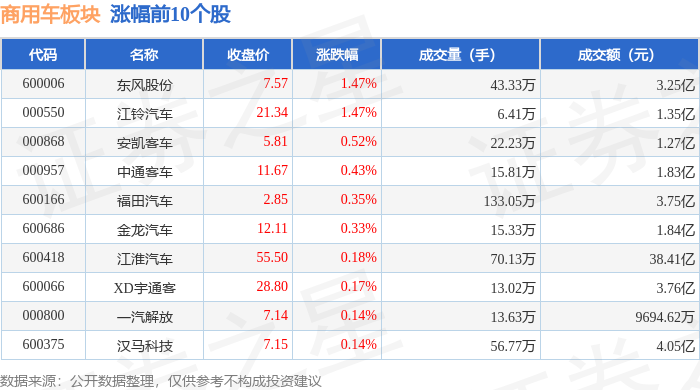
商用车板块9月11日跌0.09%,曙光股份领跌,主力资金净流出2.01亿元
Zheng Xing Xing Ye Ri Bao· 2025-09-11 08:43
Market Overview - The commercial vehicle sector experienced a slight decline of 0.09% on September 11, with Shuguang Co. leading the drop [1] - The Shanghai Composite Index closed at 3875.31, up 1.65%, while the Shenzhen Component Index closed at 12979.89, up 3.36% [1] Individual Stock Performance - Dongfeng Motor (600006) closed at 7.57, up 1.47% with a trading volume of 433,300 shares and a turnover of 325 million yuan [1] - Jiangling Motors (000550) also saw a 1.47% increase, closing at 21.34 with a trading volume of 64,100 shares and a turnover of 135 million yuan [1] - Shuguang Co. (600303) led the decline, closing at 3.75, down 1.57% with a trading volume of 335,700 shares and a turnover of 125 million yuan [2] Capital Flow Analysis - The commercial vehicle sector saw a net outflow of 201 million yuan from institutional investors, while retail investors contributed a net inflow of 112 million yuan [2] - The sector's overall capital flow indicates a mixed sentiment, with institutional investors pulling back while retail investors showed interest [2] Detailed Capital Flow by Company - Dongfeng Motor had a net inflow of 34.89 million yuan from institutional investors, but retail investors showed a net outflow of 15.53 million yuan [3] - Shuguang Co. experienced a significant net outflow of 14.54 million yuan from institutional investors, while retail investors contributed a net inflow of 9.45 million yuan [3] - Jiangling Motors had a net outflow of 6.12 million yuan from institutional investors, but retail investors showed a net inflow of 13.83 million yuan [3]

当出海成为必选项,中国企业的“链”路突围将走向何方?
Jing Ji Guan Cha Bao· 2025-09-11 07:49
Core Insights - The article discusses the evolution of Chinese companies' globalization strategies, emphasizing the shift from mere product export to a comprehensive output of brand, technology, capital, and standards [2][4] - It highlights the importance of building resilient and collaborative global supply chains, moving from a "conqueror" mindset to one of cooperation and integration with local markets [5][6] Group 1: Globalization Strategy - Chinese enterprises are transitioning from passive adaptation to active leadership in global supply chain restructuring, becoming a significant force in this transformation [2] - The need for a rational approach to overseas expansion is emphasized, with platform-type enterprises serving as "stepping stones" to reduce trial and error costs [3][5] - The ultimate goal of going abroad is to become a truly localized enterprise, as demonstrated by Haier's successful global branding strategy [3][4] Group 2: Collaborative Ecosystem - Future competition will focus on the collaborative evolution of ecosystems rather than zero-sum games between companies [5] - Companies are encouraged to deepen their domestic operations before expanding internationally, ensuring they find mutually beneficial markets and clients [5] - The article stresses the importance of building trust and a win-win ecosystem, where companies do not excessively squeeze profits from their supply chains [5][6]

为六部门联手整治汽车行业“黑嘴”乱象点赞 | 说商道市
Chang Sha Wan Bao· 2025-09-11 05:34
Core Viewpoint - The joint action by six government departments aims to address the rampant issues of "black mouths," "black public relations," and "water wars" in the automotive industry, fostering a positive public opinion environment to support high-quality development in the sector [1][2]. Group 1: Government Action - A three-month nationwide special rectification action has been launched to combat online chaos in the automotive industry [1]. - The action targets malicious behaviors such as defaming competitors and spreading false information about popular car models [1][2]. Group 2: Industry Response - Automotive companies have begun to take legal action to protect their rights, with examples including Jianghuai Automobile and BYD filing lawsuits against malicious online defamation [2]. - The automotive industry is increasingly recognizing the need for a supportive public opinion environment to ensure healthy development, particularly in the context of promoting domestic and electric vehicles [2]. Group 3: Industry Context - The Chinese government is actively supporting the development of the domestic automotive industry, especially in the electric vehicle sector, to overcome patent barriers and enhance energy security [2]. - A clean and positive industry environment is deemed essential for the sustainable growth of the automotive sector, reflecting a broader trend observed in other countries regarding key industries [2]. Group 4: Future Expectations - There is an expectation for immediate results from the government's strong measures to ensure a transparent and fair environment for the rapidly developing Chinese automotive industry [3].
两融业务火热,又见券商火速提升规模
Zheng Quan Shi Bao· 2025-09-10 22:49
Group 1 - The core viewpoint of the article highlights the booming margin financing business in the A-share market, prompting securities firms like Huayin Securities to increase their credit business scale to seize opportunities [1][3] - Huayin Securities announced an increase in its credit business scale limit from 6.2 billion to 8 billion yuan, reflecting a 29% increase, driven by surging demand for margin financing [1][3] - As of September 9, the A-share margin financing balance reached a historical high of 2.3197 trillion yuan, indicating strong market activity and investor interest [1][9] Group 2 - The increase in Huayin Securities' credit business scale is a response to the favorable market conditions and heightened investor financing needs, with a focus on margin financing [3][6] - The company maintains a strategy of balancing growth and risk control, with a collateral ratio of 267.01% for its margin financing business, ensuring overall risk remains manageable [6] - The overall trading volume in the A-share market surged to 162.66 trillion yuan in the first half of 2025, a year-on-year increase of 61.14%, further supporting the growth of margin financing [8]
