黑芝麻智能

Search documents
又一家!港股“无人驾驶矿卡第一股”来了!硬科技破冰,18C章“改写”港股版图?
证券时报· 2025-12-19 04:53
Core Viewpoint - The implementation of Chapter 18C is a "necessary but insufficient" condition for transforming the Hong Kong stock market into a "hard technology hub," as it opens the door for hard tech companies but requires further development of backend processes to fully realize this transformation [1][10]. Summary by Sections Chapter 18C and IPO Trends - Since the implementation of the 18C special technology listing system in March 2023, there has been a surge in companies applying for IPOs, with 20 companies currently in the pipeline [5][6]. - The first company to list under this chapter, Xidi Zhijia, experienced a significant drop of over 17% on its first trading day, indicating market volatility [1][5]. Market Dynamics and Challenges - The 18C chapter has led to a "submission frenzy," particularly among companies in the robotics and AI sectors, as they seek to capitalize on favorable market conditions and the global tech stock trend [5][6]. - Despite the enthusiasm, the market faces challenges such as liquidity issues and the need for a robust secondary market to support these new listings [10][12]. Dual-track System of Profitability and Valuation - The shift to a "profitability + valuation" dual-track system allows companies with disruptive technologies to list even if they are not yet profitable, which is seen as a significant change in the market's approach [6][9]. - This new system has attracted significant interest from investors, particularly in the robotics and AI sectors, which are perceived as having high growth potential [6][7]. Future Outlook and Structural Changes - The introduction of Chapter 18C is expected to alter the market structure, potentially increasing the representation of hard tech companies in the Hong Kong stock market [10][12]. - However, for a true transformation into a hard tech hub, the market needs to enhance backend processes such as analyst coverage, specialized indices, and regulatory frameworks [10][12].


港交所18C章迎来企业上市热潮,机器人与AI成焦点
Jin Rong Jie· 2025-12-19 04:26
Core Insights - The Hong Kong Stock Exchange's special listing system for technology companies (Chapter 18C) is experiencing a surge in IPO applications, with 20 companies having submitted applications since 2025 [1][3] - This system, implemented in March 2023, significantly relaxes financial thresholds for companies, allowing loss-making hard tech firms with core technologies to access funding [3] - The current wave of applications is primarily focused on the robotics and artificial intelligence sectors, with companies like Stand Robot, Rockstone Robotics, and XianGong Intelligent among those queuing for listing [3] Industry Developments - Since the introduction of the 18C chapter, only three companies—Yuejiang Technology, Black Sesame Intelligence, and Jingtai Holdings—had listed on the Hong Kong Stock Exchange before 2025 [3] - The launch of the "Tech Company Special Line" in May 2023 by the Hong Kong Stock Exchange has facilitated this surge by allowing 18C and 18A companies to submit applications confidentially, thus reducing initial communication costs and risks [3]


港股智能驾驶概念股集体走强,佑驾创新涨15%
Ge Long Hui· 2025-12-19 02:43
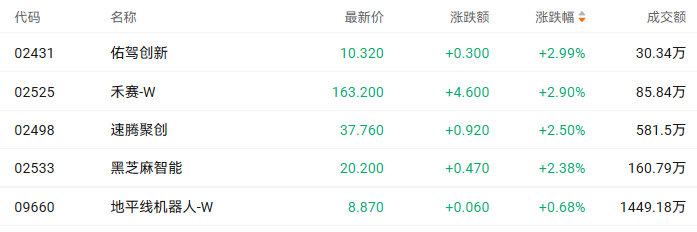
格隆汇12月19日|港股市场智能驾驶概念股集体走强,其中,佑驾创新涨15%,浙江世宝涨近12%,地 平线机器人-W涨7%,小鹏汽车-W、黑芝麻智能涨超4%,速腾聚创、禾赛-W、知行科技涨超3%,小马 智行-W、零跑汽车涨2%。 消息面上,日前,我国首批L3级有条件自动驾驶车型准入许可正式公布,分 别为长安牌SC7000AAARBEV型纯电动轿车和极狐牌BJ7001A61NBEV型纯电动轿车。根据《汽车驾驶 自动化分级》国家标准,L3级自动驾驶属于"有条件自动驾驶",即在特定设计运行条件下,车辆系统可 以完全接管动态驾驶任务,允许驾驶员脱手,但驾驶员仍需保持警觉并随时准备接管。 交银国际指 出,辅助驾驶功能已逐渐成为中国消费者购车决策的重要考量因素,部分车企已具备L3级智驾方案和 L3级车型量产能力。L3级自动驾驶法规的正式落地将成为2026年行业发展的关键催化剂,值得重点跟 踪。 ...

黑芝麻智能:快速增长背后,全维度竞争
Jing Ji Guan Cha Bao· 2025-12-19 02:23
Core Insights - The article highlights the rapid evolution of smart vehicles towards advanced autonomous driving and the increasing importance of AI chips as the core computational foundation [2] - Black Sesame Intelligence, known as the "first stock of autonomous driving chips," is expanding its business into humanoid robots while enhancing its product matrix through strategic acquisitions [2][11] - The company is expected to achieve over 60% revenue growth this year, driven by its dual focus on smart vehicles and robotics [2] Group 1: Business Strategy - Black Sesame Intelligence has established smart vehicles as its core business, focusing on autonomous driving and cross-domain integration to build a robust product system [3] - The company has formed a product tier covering mid to high-level autonomous driving, with the Huashan series A1000 chip achieving large-scale production and the A2000 chip targeting L3 autonomous driving scenarios [3][5] - The open platform model of Black Sesame Intelligence aligns with the trend of automakers seeking to develop their own autonomous driving solutions, enhancing the sustainability of its business model [3] Group 2: Robotics Expansion - The robotics sector is viewed as a growth area for Black Sesame Intelligence, leveraging its automotive chip technology to enter this market strategically [7] - The SesameX multidimensional embodied intelligent computing platform, set to launch in November 2025, is the first of its kind to meet automotive safety standards and is designed for commercial deployment in robotics [8] - The global robotics market is projected to have a shipment volume at least ten times that of the automotive market over the next five to ten years, indicating significant growth potential [9] Group 3: Acquisition and Ecosystem Development - The planned acquisition of Zhuhai Yizhi Electronics for 400 million to 550 million yuan aims to fill the gap in low-power edge chip products, enhancing Black Sesame's product matrix [11][12] - Yizhi Electronics' expertise in low-power AI SoC chips will complement Black Sesame's existing offerings, creating a comprehensive AI edge chip product line [11] - The acquisition is expected to optimize the SesameX platform's energy efficiency in robotics and enhance the decision-making capabilities of automotive chips, creating a beneficial feedback loop [12] Group 4: Financial Performance - Black Sesame Intelligence's revenue is derived from chips, solutions, and software algorithms, with higher margins from chips and algorithms being the core profit sources [13] - Future margin improvements are anticipated from increased chip shipments and market share, following the growth paths of industry giants like Qualcomm and MediaTek [13] - The strategic acquisition and expansion into the robotics sector are expected to accelerate revenue growth and enhance the company's market position in the AI chip industry [13]


地平线生态联盟扩张,抵御Momenta的猛攻
3 6 Ke· 2025-12-17 11:00
Core Viewpoint - Horizon Robotics aims to democratize urban assisted driving technology by making it available for vehicles priced at 100,000 yuan, targeting the mass market [3][8]. Group 1: Market Dynamics - In the first three quarters of this year, vehicles priced above 200,000 yuan accounted for 30% of the market share, while those below 130,000 yuan made up 50%, with the latter lacking urban assisted driving features [3]. - The competition in the intelligent driving sector is consolidating around a few leading companies, with Huawei and Momenta establishing strong positions in the high-end market [4]. - Horizon Robotics is rapidly expanding its market presence by introducing new algorithm service models and collaborating with various partners, including major automotive suppliers [6][10]. Group 2: Technological Developments - Horizon Robotics has transitioned from being solely a chip manufacturer to a full-stack solution provider, emphasizing the integration of hardware and software [6][10]. - The company plans to equip vehicles priced as low as 70,000 yuan with its urban assisted driving solutions next year, targeting a significant portion of the Chinese passenger car market [8][12]. - The introduction of the HSD Together model allows Horizon to collaborate with international partners, facilitating its entry into overseas markets [17][18]. Group 3: Competitive Landscape - The competition between Horizon Robotics and Momenta is intensifying, with both companies vying for market share in the L2+ segment and preparing for a direct confrontation in the lower-priced vehicle market [13][16]. - Momenta is also developing its own chips, which are expected to enhance its competitive edge in the intelligent driving space [14][15]. - The ongoing competition is characterized by a race to achieve higher performance at lower costs, with both companies focusing on production efficiency and ecosystem collaboration [15][19].
智能汽车ETF(159889)涨超1.2%,行业加速与结构性机会受关注
Mei Ri Jing Ji Xin Wen· 2025-12-17 07:14
Group 1 - The smart driving industry is expected to accelerate its development by 2025, with leading OEMs like BYD increasing their investment in smart driving, leading to a continuous rise in penetration rates [1] - In 2026, despite ongoing price competition among OEMs and pressure from subsidy reductions, there are still structural opportunities in the industry: 1) The competition landscape for smart driving chips is favorable, with significant room for domestic production rate improvement, as local manufacturers like Horizon Robotics, Black Sesame Intelligence, and Huawei have achieved mass production capabilities [1] - The overseas market is becoming an important growth driver, with low penetration rates in regions like Europe, the US, and Japan, allowing local Tier 1 and lidar companies to accelerate their international expansion based on product competitiveness [1] Group 2 - The new autonomous driving sector is witnessing breakthroughs from 0 to 1, with policies accelerating the commercialization of Robotaxi, and companies like Pony.ai are going public [1] - The commonality of technical architecture allows for the reuse of core components such as smart driving chips and sensors in the robotics field, creating industrial synergy effects [1] - The Smart Car ETF (159889) tracks the CS Smart Car Index (930721), which selects listed companies providing terminal perception and platform applications for smart cars from the Shanghai and Shenzhen markets, reflecting the overall performance of securities related to the smart car industry [1]
10月北美需求下滑,欧洲增幅收窄:汽车行业海外销量点评
Huachuang Securities· 2025-12-16 09:50
Investment Rating - The report maintains a "Buy" recommendation for the automotive industry [2]. Core Insights - Global light vehicle sales in October reached approximately 7.9 million units, a year-on-year increase of 2.6% and a month-on-month increase of 0.5%. However, overseas sales totaled about 4.77 million units, showing a year-on-year decline of 0.4% and a month-on-month decline of 1.5% [2]. - North American sales were 1.56 million units, down 5.0% year-on-year but up 1.1% month-on-month. European sales were approximately 1.48 million units, up 2.9% year-on-year but down 7.5% month-on-month. In contrast, Chinese sales reached 3.13 million units, up 7.6% year-on-year and 3.7% month-on-month [2]. - The report anticipates that overseas light vehicle sales will reach 55.88 million units in 2025, a year-on-year increase of 1.3%, and 56.14 million units in 2026, a year-on-year increase of 0.5% [2]. Summary by Sections 1. Industry: Sales, Exchange Rates, Freight - Global light vehicle sales data indicates a mixed performance across regions, with North America and Europe facing declines while China shows growth [2][5]. - The report highlights the impact of exchange rates and freight costs on the automotive industry, noting a downward trend in the CCFI (China Container Freight Index) [24]. 2. Market Competition - The competitive landscape is analyzed, showing the market shares of major automotive groups, including Toyota, Volkswagen, and BYD, with a focus on their performance in the global market [28][29]. - The report also discusses the dynamics of the global new energy vehicle market, emphasizing the growth of companies like BYD and Tesla [33][34]. 3. Export Situation of Automotive and Parts Companies - The report provides insights into the export performance of domestic automotive manufacturers, highlighting the monthly growth rates of narrow passenger vehicle exports [39][40]. - It lists companies with significant overseas revenue, indicating their reliance on international markets [42].



【大涨解读】无人驾驶板块:L3准入+特斯拉无人测试落地,2026年将进入B端无人车商业模式跑通阶段,商业化拐点催生板块行情
Xuan Gu Bao· 2025-12-16 02:22
Core Insights - The autonomous driving sector experienced significant gains, with companies like Zhejiang Shibao and Beiqi Blue Valley hitting the upper limit of their stock prices, indicating strong market interest and investor confidence in this industry [1] Event Summary - On December 15, the Ministry of Industry and Information Technology announced the first batch of L3 conditional autonomous driving vehicle permits in China, allowing Changan and Arcfox models to conduct road trials in designated areas of Chongqing and Beijing, marking a shift from testing to commercial application [3] - On the same day, Tesla launched its no-driver Robotaxi testing in Austin, USA, with the Model Y achieving fully autonomous operation, and plans to expand the fleet to 500 vehicles by year-end, currently operating 31 [3] - Multiple cities are accelerating the implementation of smart driving policies, with Beijing, Shenzhen, and Shanghai granting L4 road rights, and the Ministry of Industry and Information Technology expected to release a draft for national standards on L3-L4 by Q4 [3] Institutional Analysis - The approval of L3 vehicles signifies a transition in China's smart driving from "testing and validation" to "compliant mass production and controlled road use," which will accelerate the commercialization process of the industry. The three-pronged management model of "product access + user subject + operational area" provides a clear path for other automakers to follow, with 2026 anticipated as a critical year for L3 mass production [4] - The simultaneous advancement of high-level intelligent driving in China and the US creates a dual catalytic effect. The clear legal responsibilities established by China's L3 approval reduce social risks and regulatory uncertainties, while Tesla's fully autonomous testing validates the feasibility of L4 technology, shifting the industry focus from engineering challenges to commercial viability [4] - By 2026, leading automakers are expected to achieve over 30% growth in revenues related to intelligent driving, benefiting algorithm suppliers and core hardware companies as vehicle production ramps up. Long-term, smart vehicles are projected to reshape the automotive mobility market, establishing a new valuation system based on "intelligent entity revenue capacity = ownership × capability level" [5] - The rollout of L3 technology will create incremental opportunities in the automotive testing and hardware sectors, with increased demand for testing of smart driving vehicle permits. The penetration rates of core components like steer-by-wire and domain controllers are expected to grow rapidly, with the steer-by-wire market projected to increase by over 150% year-on-year by 2026 [5]

港股异动 部分智驾概念股高开 首批L3级自动驾驶车型获准入 产业拐点有望加速到来
Jin Rong Jie· 2025-12-16 02:06
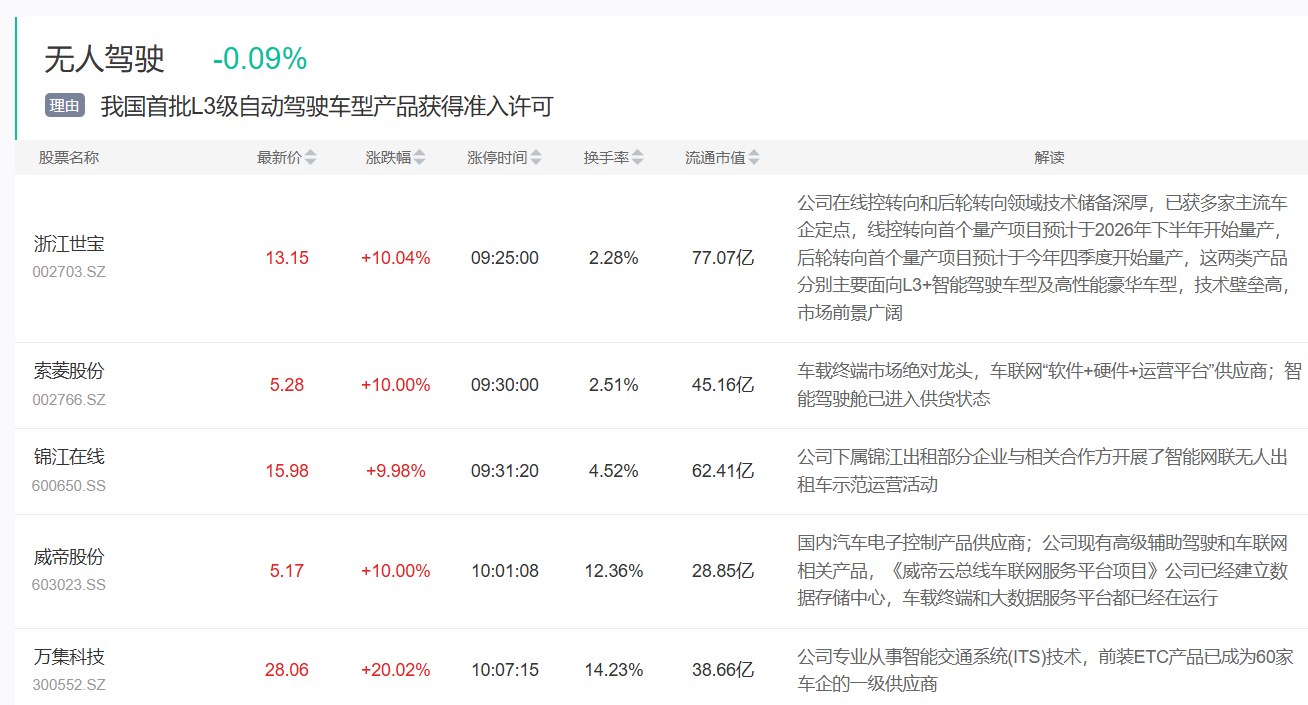
Group 1 - The core viewpoint of the articles highlights the significant advancements in the autonomous driving sector, particularly with the introduction of L3-level conditional autonomous driving vehicles in China, marking a shift from technology demonstration to regulatory compliance and operational deployment [1][2] - Several autonomous driving concept stocks experienced notable increases, with Zhejiang Shibao rising by 7.94% to 4.35 HKD, and others like Nexperia and Hesai also showing gains, indicating positive market sentiment towards the sector [1] - The Ministry of Industry and Information Technology in China officially released the first batch of L3-level conditional autonomous vehicle approval lists, with Chang'an Automobile and BAIC Jihe being the first companies to receive approval for their models [1] Group 2 - Haitong International suggests that the ongoing validation of Tesla's Robotaxi and the institutionalization of L3 vehicles in China are accelerating a pivotal moment in the high-level autonomous driving industry, which will significantly impact vehicle valuation systems and competitive dynamics [2] - Ping An Securities emphasizes that the technology behind L3-level conditional autonomous driving relies on mature and reliable environmental perception capabilities, necessitating the integration of various sensors such as cameras, millimeter-wave radar, and LiDAR for accurate perception in extreme weather and complex road conditions [2]
L3级自动驾驶落地关键一步,机构称L3正式准入节点有望在2026年后到来
Zhi Tong Cai Jing· 2025-12-16 02:05
Core Viewpoint - The Ministry of Industry and Information Technology of China has officially granted conditional approval for the first batch of L3-level autonomous driving vehicles, marking a significant step towards the commercialization of L3 autonomous driving in the country [1][3]. Group 1: Regulatory Developments - Two L3 autonomous driving models, suitable for urban congestion and highway conditions, will be tested in designated areas in Beijing and Chongqing [1][2]. - The approval signifies a transition from "technical validation" to "mass production application" in China's autonomous vehicle industry [3]. - The approval process for L3 vehicles has been ongoing for over a year, with nine automotive companies identified for initial trials [3][4]. Group 2: Market Reactions - Smart driving concept stocks in Hong Kong saw a positive response, with notable increases in share prices for companies such as Youjia Innovation, Hesai Technology, and Suyuan Juchuang [1][2]. - The stock performance reflects investor optimism regarding the future of L3 autonomous driving and its market potential [1][2]. Group 3: Industry Insights - The approval of L3 vehicles is seen as a recognition of technological maturity and a response to societal expectations for smart mobility [3]. - The automotive industry is preparing for a significant increase in demand for L3 and L4 autonomous driving technologies, with expectations for broader implementation by 2025 and 2030, respectively [4][5]. - Key players in the automotive supply chain are gearing up for advancements in technology and compliance with new regulations [5]. Group 4: Company Highlights - Horizon Robotics is positioned as a leader in the advanced driver assistance systems market, providing both chips and algorithms [5][6]. - Black Sesame Technologies has developed high-performance computing solutions for autonomous driving and is collaborating with major automotive OEMs [6][7]. - Youjia Innovation has made strides in both mid-to-high level assisted driving and L4 autonomous driving solutions, securing multiple contracts [7].