小米

Search documents
储能概念连续冲高,亿纬锂能涨超8%,新能源汽车ETF(516390)强势涨超5%,连续5日获资金净流入,锂电设备企业订单增长势头强劲
Xin Lang Cai Jing· 2025-09-05 02:29
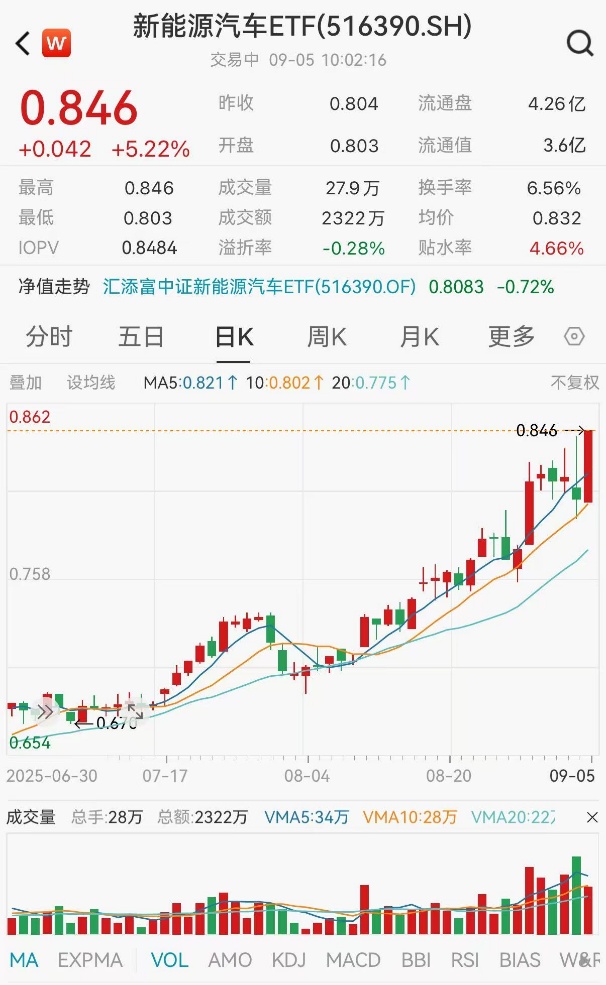
Core Viewpoint - The news highlights a significant increase in the performance and liquidity of the New Energy Vehicle (NEV) sector, particularly focusing on the New Energy Vehicle ETF and its constituent stocks, driven by positive market sentiment and supportive government policies [1][4][6]. Group 1: Market Performance - The China Securities New Energy Vehicle Industry Index rose by 4.90%, with leading stocks such as QianDao Intelligent up by 18.18% and Hangke Technology up by 15.69% [1]. - The New Energy Vehicle ETF increased by 5.22%, reaching a latest price of 0.85 yuan, with a weekly cumulative increase of 3.74% as of September 4, 2025 [1]. - The ETF experienced a turnover rate of 6.61% during the trading session, with a transaction volume of 23.4 million yuan [1]. Group 2: Fund Growth and Inflows - Over the past year, the New Energy Vehicle ETF's scale grew by 458.84 million yuan, ranking it in the top half among comparable funds [3]. - In the last two weeks, the ETF's shares increased by 18 million, also placing it in the top half of comparable funds [3]. - The ETF saw a continuous net inflow of funds over the past five days, totaling 18.36 million yuan, with a peak single-day inflow of 734.09 million yuan [4]. Group 3: Government Policies and Industry Outlook - The Ministry of Industry and Information Technology and the State Administration for Market Regulation released a plan for stable growth in the electronic information manufacturing industry from 2025 to 2026, emphasizing high-quality development in sectors like photovoltaics and lithium batteries [4]. - The plan anticipates an average growth rate of around 7% for the electronic equipment manufacturing industry, with an overall revenue growth of over 5% when including lithium batteries and related sectors [4]. - Major lithium equipment companies are showing signs of order recovery, indicating a positive shift in the industry [4]. Group 4: Supply Chain Dynamics - Recent disruptions in lithium resource supply, including production halts at significant projects, have led to a notable increase in lithium carbonate prices since July [5]. - The domestic retail sales of passenger vehicles and new energy vehicles have shown a month-on-month increase, with new energy vehicle retail sales reaching 288,000 units, a year-on-year growth of 13.2% [5]. - The penetration rate of new energy vehicles reached 55.5%, with cumulative retail sales for the year at 7.425 million units, reflecting a 24.3% year-on-year increase [5]. Group 5: Competitive Landscape - Companies like XPeng and Leap Motor have gained market traction through high cost-performance ratios and technological innovations, while traditional automakers are also improving their positions in the NEV sector [6]. - The entry of new brands like Xiaomi is introducing additional competition, further optimizing the industry landscape [6]. - The outlook for the NEV sector remains positive, driven by global expansion and technological advancements in smart driving and robotics [6].


“不及预期”的比亚迪,隐形的“另一半”
虎嗅APP· 2025-09-05 00:08
Core Viewpoint - BYD's performance in H1 2025 shows revenue growth but faces challenges from price wars and regulatory pressures, leading to a decline in stock prices and negative market sentiment [5][6][9]. Group 1: Financial Performance - In H1 2025, BYD reported revenue of 371.28 billion, a year-on-year increase of 23.3%, and a net profit of 15.51 billion, up 13.8% [5]. - Operating cash flow reached 31.83 billion, reflecting a significant year-on-year growth of 124.5% [5][16]. - BYD's gross profit from vehicle sales surpassed Tesla's, with a gross profit of 61.6 billion in H1 2025, compared to Tesla's 26.7 billion, marking a 231% increase in the profit ratio compared to Tesla [14]. Group 2: Sales and Market Dynamics - BYD's dual strategy of pure electric and plug-in hybrid vehicles has been crucial for maintaining its position as a global leader in new energy vehicle sales [9]. - In 2023, pure electric and plug-in hybrid sales reached 1.575 million and 1.438 million respectively, with pure electric contributing 57% to the growth of passenger vehicle sales [7]. - The sales dynamics shifted in 2024, with plug-in hybrids contributing 83.9% to the growth, indicating a potential resurgence in their popularity [7]. Group 3: Technological Advancements - BYD's fifth-generation DM hybrid technology has significantly reduced fuel consumption, making plug-in hybrids more appealing in urban settings [9]. - The introduction of the "Megawatt Charging" technology aims to revolutionize the charging ecosystem, allowing for rapid charging and addressing the "occupancy" issue at charging stations [41][43]. - BYD's R&D investment in H1 2025 was 30.88 billion, significantly higher than Tesla's 21.5 billion, showcasing its commitment to innovation [28]. Group 4: Financial Health and Debt Management - BYD's asset-liability ratio stood at 71.1% as of June 2025, a decrease of 3.6 percentage points from the end of 2024, indicating improved financial stability [18]. - The company has effectively managed its interest-bearing debt, which constituted only 3.6% of total liabilities as of mid-2025 [19]. - Financial expenses for H1 2025 were reported at 3.25 billion, reflecting a strategic focus on cost management [20].



阿里海外再加速,小米、泡泡玛特等或入围速卖通高级别出海项目
Xin Jing Bao· 2025-09-04 13:17
Core Insights - AliExpress is preparing a high-profile brand expansion project, with invitations sent to Fortune 500 and leading brands, expected to launch before Double 11 [1] - The shift from low-price competition to brand collaboration is seen as a potential solution to the profit decline faced by nearly half of cross-border e-commerce sellers in 2024 [2] - The brand expansion initiative aims to enhance the platform's brand positioning and has already shown success with previous brand plans, where 95% of participating brands achieved annual sales of over $1 million [2] Company Developments - AliExpress has previously launched a "Brand Going Global Plan," with a goal to support 1,000 new brands to achieve annual sales exceeding $1 million by 2025 [2] - The platform has seen significant sales growth from brands like Pop Mart, with a 300% year-on-year increase in the collectible toy category driven by the Labubu IP [3] - The introduction of "hourly delivery" services in the UK and the expansion of "overseas hosting" in multiple markets are part of AliExpress's strategy to enhance its supply chain and logistics capabilities [4] Financial Performance - Alibaba Group reported a 19% year-on-year revenue growth for its International Digital Commerce Group, reaching approximately 34.741 billion yuan (about $4.850 billion), with cross-border business being a key growth driver [5] - The CFO indicated that the core business revenue growth supports strategic investments, with a focus on optimizing resource allocation and increasing investments in instant retail and AI technology [6] - The competitive landscape in cross-border e-commerce is intensifying, with major players like Amazon and Shein enhancing their brand support initiatives, which poses challenges for AliExpress's new project [6]


小米出海三部曲:卖产品,打品牌,搬模式
证券时报· 2025-09-04 13:15
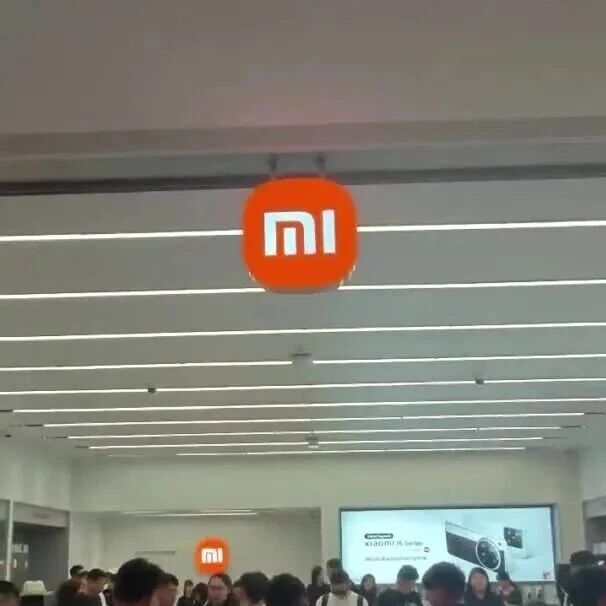
Core Viewpoint - Xiaomi is successfully implementing its "new retail" strategy in Southeast Asia, focusing on high-end products and a comprehensive customer experience through its physical stores, such as the Xiaomi Home in Bangkok, which has significantly contributed to its overseas revenue [1][5][6]. Group 1: Store Experience and Product Performance - The Xiaomi Home in Bangkok resembles a technology exhibition rather than a typical retail store, allowing customers to interact with various smart devices, enhancing the immersive experience [2][6]. - The flagship Xiaomi 15 series smartphones accounted for 45% of the store's total revenue shortly after launch, highlighting the strong performance of high-end products in a competitive market [4][6]. - In Q2 2025, Xiaomi regained the top position in the Southeast Asian smartphone market with a 19% market share, selling 4.7 million units, while the high-end smartphone segment saw a 54% year-on-year increase in sales [4][6]. Group 2: New Retail Strategy and Market Expansion - Xiaomi's new retail strategy aims to enhance efficiency and user experience through direct sales and digital management, eliminating intermediaries and reducing costs [5][6]. - The company plans to open over 100 new stores in Thailand and Malaysia this year, with a long-term goal of establishing 10,000 Xiaomi Homes globally within five years [6][7]. - Xiaomi's approach to international markets includes a mix of direct sales and local partnerships, allowing for rapid expansion while maintaining brand consistency [6][7]. Group 3: Product Diversification and Future Plans - 2025 marks the beginning of Xiaomi's major push into the home appliance market in Southeast Asia, with significant sales of air conditioners and other high-end products [4][7]. - The company is also exploring opportunities in the European market for home appliances and plans to expand its automotive offerings by 2027 [7][11].
蚂蚁“抢筹”背靠字节的昕原半导体
Huan Qiu Lao Hu Cai Jing· 2025-09-04 12:26
Core Viewpoint - Ant Group's subsidiary, Shanghai Yunwei, has acquired a 1.87% stake in Xinyuan Semiconductor, marking a significant move in the company's strategy to enhance its chip capabilities, particularly in the context of its "AI First" strategy initiated in 2023 [1][3][8]. Investment Details - Xinyuan Semiconductor specializes in ReRAM storage technology and has attracted investments from notable firms, including ByteDance and Saudi Aramco [1][4][5]. - The company recently completed a B+ round of financing, increasing its registered capital from approximately 46.54 million to 50.30 million yuan [2]. Shareholder Composition - Xinyuan Semiconductor's largest shareholder is Lianhe Investment, holding 16.59% of the company [4]. - Other investors include various venture capital firms and foreign entities, indicating a diverse shareholder base [5][6]. Market Position - Xinyuan Semiconductor is recognized as the only company in mainland China to achieve mass production of advanced process ReRAM, positioning it as one of the fastest in the commercialization of new storage products globally [8]. Broader Industry Trends - Major tech companies, including Alibaba and Tencent, are increasingly investing in semiconductor firms, reflecting a broader trend of "chip chasing" among internet giants [13][14]. - The trend of "chip manufacturing" is also gaining traction, with companies like Alibaba and Xiaomi developing their own chips to enhance their technological capabilities [15][16]. Future Outlook - The ongoing investments in semiconductor technology by major tech firms are expected to continue, driven by the need for enhanced AI capabilities and the integration of smart technologies across various business sectors [17].
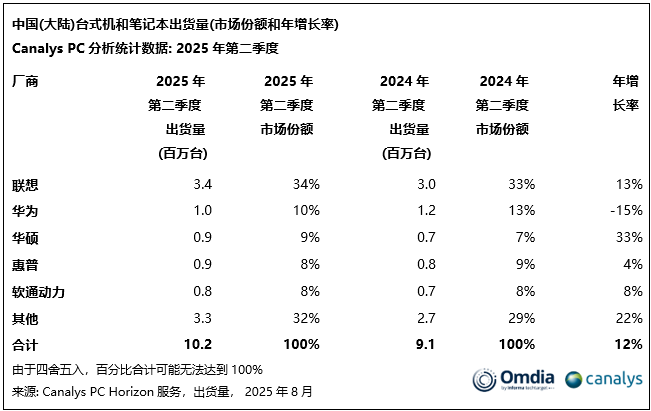
中国大陆最新PC出货量TOP5出炉:联想(00992)稳居市场第一
智通财经网· 2025-09-04 10:47
Core Insights - The Chinese mainland PC market (excluding tablets) is projected to show strong performance in Q2 2025, with shipments reaching 10.2 million units, a year-on-year increase of 12% [1] - Lenovo continues to solidify its leadership position in the Chinese PC market, particularly in the AI PC segment, which is gaining significant traction [1][4] - The tablet market also experienced an 18% year-on-year growth, with shipments totaling 9.1 million units, showcasing Lenovo's competitive strategy [1] PC Market Performance - In Q2 2025, Lenovo's desktop and laptop shipments reached 3.4 million units, reflecting a 13% increase, and its market share grew to 34% [2] - The growth in the PC market is primarily driven by government consumption subsidies and strong procurement from state-owned enterprises and government [1][4] - AI PCs accounted for 28% of the overall PC market in Q2 2025, with Lenovo's AI PC shipments making up 27% of its total notebook shipments in China [2] Tablet Market Performance - The tablet market in China saw a total shipment of 9.3 million units in Q2 2025, with a year-on-year growth of 18% [3] - Lenovo achieved a 54% annual growth rate in the tablet segment, increasing its market share to 8% through its Tab series targeting gamers and creators [3] Future Outlook - Canalys forecasts a 2% year-on-year growth for the Chinese mainland PC market in 2025, driven by subsidies and replacement demand, with AI PC penetration expected to rise to 34% [4] - By the end of 2029, approximately 107 million AI PCs are projected to be shipped in the Greater China region, establishing a solid foundation for widespread AI application [4] - The government's "Artificial Intelligence +" initiative is expected to accelerate local AI infrastructure development and the commercialization of AI devices, benefiting companies like Lenovo [4]

最近,VC/PE都去福建了
母基金研究中心· 2025-09-04 08:54
Core Viewpoint - The article highlights the active role of the Fujian provincial government investment fund in attracting VC/PE attention through various initiatives and funding announcements, which is seen as a positive development for private equity investment in China [2][3]. Group 1: Fund Activities and Announcements - On August 22, the Fujian provincial government investment fund announced the selection of GP for the second batch of specialized sub-funds, following the public announcement of the first batch of five sub-fund managers on July 21 [2]. - The provincial fund has been active this year, launching multiple funds with target sizes of 1 billion for a biomedicine fund, 5 billion for a merger fund, 5 billion for an S fund, and 3 billion for a cultural tourism fund, indicating consistent progress and announcements [2]. - The fund's establishment and operations are efficient, having received government approval in February and subsequently releasing the first batch of sub-fund selection announcements in March [3]. Group 2: Policy Support and Mechanisms - The Fujian provincial fund has implemented positive incentives for sub-funds, allowing for profit-sharing based on development outcomes, with a maximum of 50% of government investment returns [4]. - Significant adjustments have been made to the fund management guidelines, including lowering the minimum return ratio from 1.5 times to 1 time the government investment and establishing a compliance exemption mechanism for investment failures under certain conditions [5]. - The fund's investment period has been extended to 30 years, reflecting a commitment to "patient capital" that can endure long investment cycles typical of technology innovation [6]. Group 3: Strategic Goals and Collaborations - Fujian aims to establish a comprehensive fund matrix, targeting the creation of a 300 billion functional fund group and a 1 trillion industrial fund group within five years, enhancing the role of government-led funds [7][9]. - The provincial government has successfully set up nine government investment funds totaling 13.3 billion, focusing on industries such as digital technology, new energy, and biomedicine [8]. - Collaborations with leading industry players and national funds are being fostered to enhance the resilience and security of industrial supply chains, with specific funds established for carbon neutrality and biomedicine [10]. Group 4: Future Outlook - The article anticipates that Fujian's continuous optimization of policies and mechanisms will enhance its attractiveness to VC/PE, driving talent, enterprises, and resources to the region [11]. - The upcoming 29th World Investment Conference and the 8th Sharjah Investment Forum are expected to facilitate discussions on emerging industries and foreign investment cooperation [12].

港股收评:三大指数齐挫,科技股、金融股多数低迷,餐饮等消费股活表现活跃
Ge Long Hui· 2025-09-04 08:35
Market Overview - The Hong Kong stock market continued its downward trend, with the Hang Seng Index closing down 1.12%, barely holding above the 25,000-point mark [1] - The Hang Seng China Enterprises Index fell by 1.25%, while the Hang Seng Tech Index dropped by 1.85% [1] Sector Performance - Major technology and financial stocks, including Alibaba (down 3.2%) and Xiaomi (down over 2%), contributed to the market decline [1] - Securities firms like China Merchants Securities and GF Securities both fell nearly 2%, while China Pacific Insurance led the decline among domestic insurance stocks with a drop of over 5% [1] - Semiconductor stocks experienced significant losses, with GlobalFoundries down over 7% and leading stock SMIC down 6.67% [1] - Gold stocks retreated sharply due to profit-taking, with Tongguan Gold down nearly 9% and both China National Gold and Lingbao Gold down over 7% [1] Consumer and Other Sectors - Conversely, certain consumer stocks such as agricultural products, dining, and dairy sectors saw gains, with companies like Little Vegetable Garden, Yum China, and Xiaobai Xiaobai showing positive performance [1] - Wind power and entertainment stocks experienced intraday surges, with Orange Sky Golden Harvest rising over 25% at one point [1]
中钢天源(002057.SZ):公司产品与华为、小米没有直接业务往来
Ge Long Hui· 2025-09-04 06:51
Group 1 - The company, Zhonggang Tianyuan, specializes in rare earth permanent magnet devices, soft magnetic ferrite cores, and components [1] - The main applications of the company's products are in the fields of new energy, electric vehicles (EV) EMC, automotive electronics, and wireless charging [1] - The company has no direct business dealings with Huawei or Xiaomi [1]

2025年中国光电芯片经营主体分析 企业注册数量较少【组图】
Qian Zhan Wang· 2025-09-04 04:28
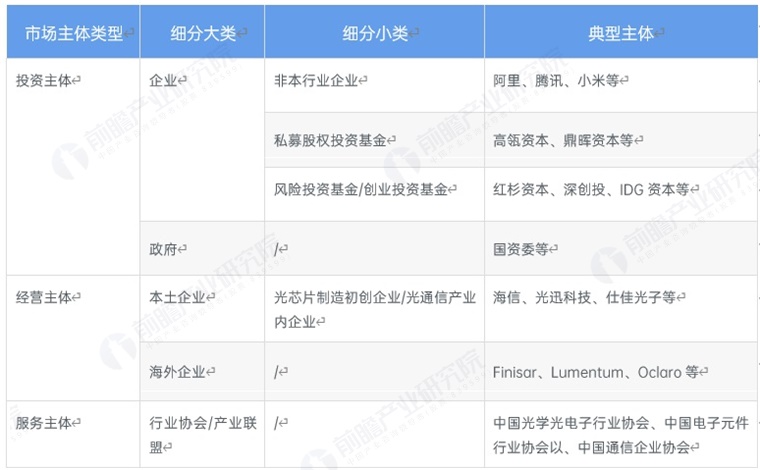
Market Structure - The Chinese optical chip industry consists of three main types of market entities: investment entities, operating entities, and service entities [1] - Investment entities include non-industry companies like Alibaba, Tencent, and Xiaomi, private equity funds such as Hillhouse Capital and IDG Capital, and government bodies like the State-owned Assets Supervision and Administration Commission [1] - Operating entities are categorized into domestic companies (e.g., Hisense, Lightwave Technology) and foreign companies (e.g., Finisar, Lumentum) [1] - Service entities include industry associations and organizations like the China Optical Optoelectronic Industry Association [1] Entry Methods - Companies in the Chinese optical chip industry adopt various entry methods, including independent R&D, collaboration with research institutions, acquisitions, and participation in industry standards [2][4] - Vertical integration (IDM model) allows companies to cover the entire supply chain from chip design to packaging, exemplified by Source Technology focusing on InP optical chips [4] - The "Fab-lite" model combines self-built facilities with outsourcing to balance flexibility and cost, as seen with Zonghui Chip Light [4] - Mergers and acquisitions are used to quickly gain core patents and resources, demonstrated by Shijia Photon acquiring Dongguan Fuke Xima [4] Industry Statistics - As of August 2025, there are approximately 56 registered optical chip companies in China, with a low annual increase of 1-2 companies from 2016 to 2024 [5] - Nearly 45% of these companies have registered capital exceeding 10 million yuan, while around 40% have capital between 1-5 million yuan [6] - Guangdong province leads in the number of registered optical chip companies, followed by Hubei and Jiangsu [7]