
蔚来

Search documents
观察| 你曾引以为傲的工作,正在成为历史
未可知人工智能研究院· 2025-12-15 10:02
Core Viewpoint - The article discusses a significant shift in the job market and societal structure due to the rise of AI, leading to a reversal of economic hierarchies where manual labor becomes more valuable than knowledge work [14][25][49]. Group 1: Job Market Changes - Millions of white-collar workers are entering the job market as AI tools replace many knowledge-based jobs, while manual labor jobs are becoming scarce and highly valued [14][25]. - The demand for skilled tradespeople, such as electricians and welders, is at an all-time high, with companies offering salaries of 20,000 to 30,000 yuan per month, which exceeds the pay of many mid-level positions in tech companies [25]. - The employment rate for vocational school graduates (96.5%) has surpassed that of bachelor's degree holders (88.1%) for two consecutive years, indicating a shift in job market dynamics [25]. Group 2: Societal Implications - The traditional perception of "white-collar" jobs as superior is being challenged, as blue-collar jobs may offer more economic security and stability in the future [27][28]. - The societal structure built around the idea that intellectual work is more valuable than manual work is being disrupted, leading to potential identity crises for those who have defined themselves by their professional titles [29][30]. - The article draws parallels to historical events, such as the Black Death, which drastically changed labor dynamics and power structures, suggesting that a similar transformation is occurring today due to AI [20][24]. Group 3: Psychological Impact - The rapid changes in job value and societal status may lead to significant psychological adjustments for individuals who have long identified with their professional roles [29][32]. - There is a potential for a new social order where success is redefined, and traditional markers of achievement, such as job titles, may lose their significance [40][43]. - The article emphasizes the need for flexibility and the ability to redefine success in the face of these changes, as the old systems of value may no longer apply [48].


从破土到成林 本土汽车芯片的“摘果”考验
Zhong Guo Qi Che Bao Wang· 2025-12-15 08:14
Core Insights - The release of Horizon's fourth-generation BPU architecture "Riemann" and the successful listing of Naxinwei on the Hong Kong stock market highlight the innovative momentum in China's automotive chip industry [2] - The automotive chip industry in China is transitioning from initial development to significant growth, driven by policy standards, core technology advancements, and market applications [2] Industry Developments - The upgraded "Automotive Chip Certification Review Technology System 2.0" was launched, featuring a comprehensive framework with 9 modules and 60 indicators, covering 10 categories of automotive chips for new energy vehicles [2][3] - The implementation of this certification system has improved quality control for chip manufacturers and reduced vehicle manufacturers' selection risks and costs, shortening the onboarding cycle by an average of 3 months [3] Market Performance - Chip manufacturers like Chipone and Horizon are achieving significant milestones, with Chipone's KungFu automotive-grade MCU deliveries surpassing 200 million units and Horizon's HSD system being integrated into more affordable vehicle models [3][9] - The domestic automotive chip industry has seen a rise in the number of companies, with over 1,000 firms involved in the supply chain, and a significant increase in the domestic chip application rate, which is projected to reach 20% by the end of 2024 [5][8] Competitive Landscape - Local companies are rapidly gaining market share in the mid-to-low-end automotive chip market, while high-end markets remain dominated by foreign giants [11] - The collaboration between automotive chip companies and vehicle manufacturers is fostering innovation and enhancing the reliability of domestic chips, which is crucial for market penetration [11][17] Future Opportunities - The automotive chip sector is viewed as a critical growth area, with companies exploring new applications in the robotics industry, which is expected to see significant growth in the coming years [12][14] - The integration of automotive chips with intelligent systems is seen as a pathway for companies to overcome existing growth bottlenecks and explore new market opportunities [14][15] Challenges Ahead - Despite progress, the domestic automotive chip industry still faces challenges, including a reliance on foreign technology for high-end chips and the need for a more robust supply chain [15][16] - The industry must focus on building a comprehensive ecosystem that includes software development capabilities alongside hardware reliability to meet the evolving demands of the automotive market [17]

再度回应24小时交易!港交所很快将开启每手买卖单位改革咨询
证券时报· 2025-12-15 05:27
Core Viewpoint - Hong Kong Stock Exchange (HKEX) is planning a reform regarding the trading unit size, aiming to simplify the current complex structure of over 40 different trading units, while ensuring that the reform does not disadvantage retail investors [1][8]. Group 1: Trading Unit Reform - The current trading unit sizes in the Hong Kong market are diverse, with 43 different units ranging from 10 shares to 100,000 shares [3][4]. - The most common trading unit is 2,000 shares, with 666 companies using this size, accounting for 24.9% of the total [4]. - HKEX plans to initiate a market consultation on the trading unit reform soon, with the goal of reducing the number of trading units without completely standardizing them [8]. Group 2: 24-Hour Trading Discussion - There is ongoing discussion about whether HKEX should implement 24-hour trading, similar to some overseas markets, but this requires thorough research and consideration of market dynamics [9][10]. - The CEO of HKEX expressed caution, noting that extending trading hours could complicate processes and increase risks, and emphasized the need for consensus among market participants before proceeding [10]. Group 3: Interconnectivity and REITs - HKEX is actively working to enhance interconnectivity, with significant increases in both northbound and southbound trading volumes, particularly in ETFs [12][13]. - The average daily trading amount for southbound ETFs reached 4.2 billion yuan in the first three quarters of 2025, marking a record high [13]. - HKEX aims to expedite the inclusion of Real Estate Investment Trusts (REITs) into the interconnectivity framework to further enhance market participation [14].

再度回应24小时交易!港交所很快将开启每手买卖单位改革咨询
Zheng Quan Shi Bao· 2025-12-15 04:44
Group 1 - The Hong Kong Stock Exchange (HKEX) is planning a reform regarding the trading unit size, with a market consultation expected to start soon [1][7] - Currently, there are 43 different trading unit sizes in the Hong Kong market, with the most common being 2,000 shares, accounting for 24.9% of companies [3][4] - The reform will not be a one-size-fits-all approach; instead, it aims to reduce the number of trading units while considering the impact on high-priced stocks and retail investors [7] Group 2 - Discussions about implementing 24-hour trading in the Hong Kong market are ongoing, but the HKEX is cautious and emphasizes the need for thorough research [9][10] - The CEO of HKEX highlighted that extending trading hours could increase market liquidity, but it also requires careful consideration of operational impacts [10] - There is potential for extending trading hours for derivatives, but further discussions with brokers are necessary for the cash market [10] Group 3 - The HKEX is focused on enhancing its role in the fixed income and currency markets, aiming to become a major hub for RMB-denominated bonds and commodities [12] - The mutual market access has seen significant growth, with northbound trading increasing by 70% compared to last year, and southbound trading also rising [12][13] - The average daily trading volume for southbound ETF transactions reached 4.2 billion yuan in the first three quarters of 2025, marking a record high [13]

11月新能源汽车销量
数说新能源· 2025-12-15 04:00
Core Insights - November wholesale vehicle sales reached 1.706 million units, a year-on-year increase of 18.5% and a month-on-month increase of 5.8%, with a penetration rate of 56.9%, up 1.6 percentage points from the previous month [1] - Retail sales in November totaled 1.321 million units, reflecting a year-on-year growth of 4.0% and a month-on-month growth of 3.0%, with a penetration rate of 59.4%, up 2.2 percentage points from the previous month [1] - Exports in November amounted to 284,000 units, showing a significant year-on-year increase of 255.0% and a month-on-month increase of 19.3%, with a penetration rate of 47.3%, up 3.1 percentage points from the previous month [1] Sales Data by Manufacturer - Tesla sold 86,700 units in November, including 13,600 units exported [3] - BYD's sales reached 474,900 units, with 128,100 units exported, including various models such as Qin DMI (15,700 units) and Dolphin (31,000 units) [3] - SAIC-GM-Wuling sold 107,800 units, with 12,500 units exported, including 53,600 units of Hongguang MINI [3] - NIO sold 36,300 units, with 6,000 units of ES6 [3] - Li Auto sold 33,200 units, with L9 contributing 2,200 units [3] - XPeng sold 36,700 units, with 5,100 units exported [3] - Leap Motor sold 70,300 units, with 7,200 units of C11 [3] - Chery sold 111,600 units, with 48,100 units exported [3] - GAC Aion sold 38,300 units, with 4,100 units exported [3] - Geely sold 187,800 units, with 15,600 units exported [3] - Volkswagen ID sold 4,800 units [3] - Great Wall sold 40,000 units, with 4,500 units exported [3] - SAIC Passenger Cars sold 42,000 units, with 10,800 units exported [3] - Changan sold 107,000 units, with 4,200 units exported [3] - AITO sold 51,700 units [3] - Xiaomi sold 46,200 units, with 12,500 units of Xiaomi SU7 [3]

超70亿市值的基石限售股即将解禁,三花智控(02050)能否顶住新一轮抛压?
智通财经网· 2025-12-15 03:33
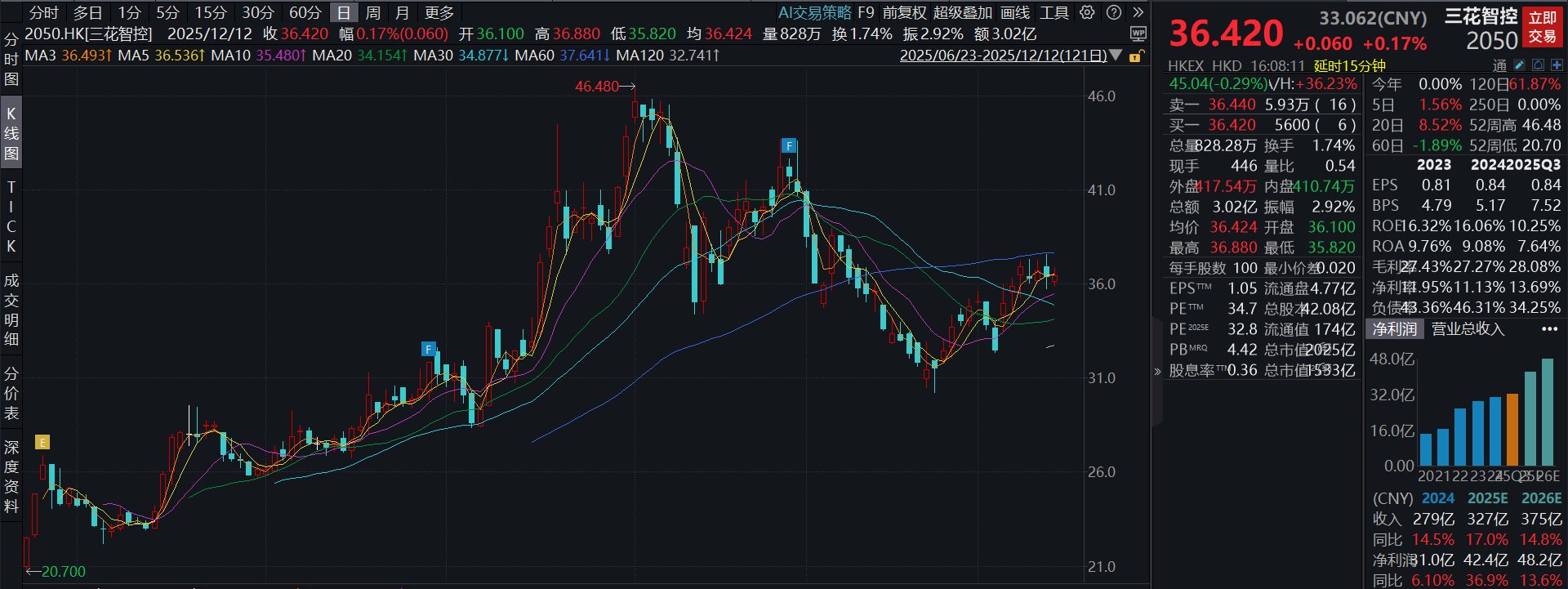
Core Viewpoint - The stock price of Sanhua Intelligent Control (02050) surged by 124.54% to a peak of HKD 46.48 per share within three months after its listing on June 23, 2025, but has since experienced a significant decline, raising concerns about the upcoming lock-up expiration for cornerstone investors [1][3][11]. Market Performance - After reaching its peak, Sanhua's H-shares fell by 35% over 36 trading days, forming a "M-top" pattern before a brief rebound of nearly 20% following a "golden needle bottom" on November 24 [3]. - The stock is currently constrained by the 60-day moving average and has not formed a significant breakout [3]. - The upcoming expiration of cornerstone investors' lock-up on December 23 may lead to increased selling pressure, particularly as these investors have substantial unrealized gains [3][11]. Investment Dynamics - The rapid price increase of Sanhua's H-shares was driven by a combination of a strong capital market, supportive policies, and industry news [4]. - The company was significantly oversubscribed during its IPO, with a subscription rate of 747.92 times, making it the second most popular new stock in 2025 [5][6]. - On the first trading day, the stock experienced a nearly 7% drop in the dark market, with a final closing decline of 3.91% [7][8]. Business Fundamentals - Sanhua Intelligent Control reported a revenue of CNY 24.03 billion for the first three quarters of 2025, a year-on-year increase of 16.8%, and a net profit of CNY 3.24 billion, up 40.8% [12]. - The growth is attributed to the performance of its refrigeration and automotive parts businesses, as well as cost-reduction initiatives [12]. - The company's robot business is emerging as a key growth area, with ongoing investments in technology and production capacity [12][13]. Industry Outlook - The robot business is expected to become a core driver of valuation fluctuations for Sanhua, with optimistic market expectations regarding future technological advancements and order fulfillment [14]. - The production timeline for Tesla's third-generation Optimus robot will significantly influence market sentiment; any delays could negatively impact stock performance [15].

超70亿市值的基石限售股即将解禁,三花智控能否顶住新一轮抛压?
Zhi Tong Cai Jing· 2025-12-15 03:32
作为特斯拉机器人概念股的核心标的,三花智控(02050)自2025年6月23日在港股上市后,其股价在短短三个月内最高涨至46.48港元每股,最大涨幅 124.54%。 但自10月初开始,三花智控H股股价见顶回落,在高位构建了一个左高右低的"M顶"之后加速下跌,36个交易日内从高位累计下跌35%。在11月24日"金针探 底"后才迎来了一波近20个点的反弹。 尽管近期反弹暂缓了三花智控H股的下行颓势,但其股价目前仍受制于60日均线压制,尚未形成有效突破。更值得关注的是,三花智控H股将于12月23日迎 来基石投资者限售股解禁。鉴于基石投资者短期内已积累可观浮盈,解禁后兑现收益的动机较强,这在流动性本就欠佳的H股市场,或将引发显著的短期抛 压,从而对股价构成下行压力。然而,从逆向投资视角来看,若此次解禁能带来股价的充分回调,或为长线投资者提供一个难得的逢低布局良机。 基石投资者小而散,若"抢跑"出现或令股价明显承压 三花智控H股三个月股价翻倍的背后,其实是资本市场走强、政策鼓励以及产业消息刺激等多重因素协同共振的结果。 而在产业消息层面,MWC上海2025展会、杭州国际人形机器人与机器人技术展览会均在6月举办,相关消 ...
蔚来在沪建成500座充换电站 补能网络正趋向“满格”
Zhong Guo Jin Rong Xin Xi Wang· 2025-12-15 03:07
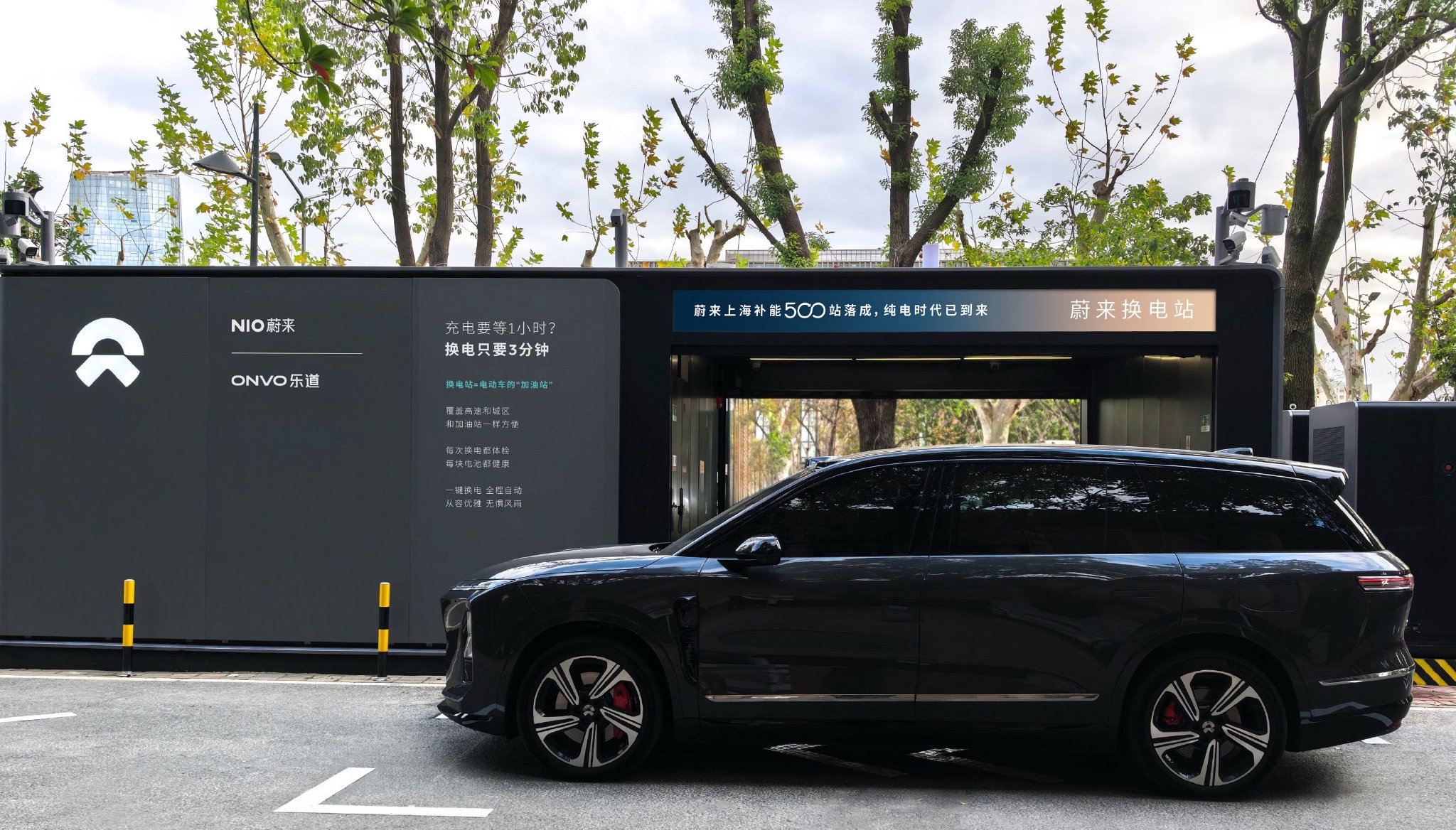
Core Insights - NIO has reached a significant milestone with the launch of its 500th battery swap station in Shanghai, indicating a new stage in the maturity of its electric vehicle charging infrastructure [1][3] Group 1: Infrastructure Development - The newly operational station is NIO's fourth-generation battery swap station, equipped with 23 battery slots, supporting multiple battery specifications and brands, with a maximum daily service capacity of 480 swaps [1] - NIO has established a total of 198 battery swap stations and 302 charging stations in the Shanghai area, providing over 10,000 battery swaps and nearly 5,000 charging services daily, with an average energy supply exceeding 600,000 kWh [1][3] - The coverage of battery swap stations within 3 kilometers of users' residences has increased from approximately 40% in 2020 to 95% [1] Group 2: Market Performance - NIO's new electric SUV models, including the L90 and the new ES8, are expected to launch in the second half of 2025, with the new ES8 achieving over 20,000 deliveries within 70 days of its launch, setting a record for electric vehicles priced above 400,000 yuan [3] - In September and October 2025, sales of pure electric large SUVs surpassed those of range-extended, fuel, and plug-in hybrid vehicles, marking a historic first in this market segment [3][4] Group 3: Industry Trends - The development of robust energy infrastructure is seen as a strong support for the growth of the electric vehicle market [4] - As of October 2025, the total number of electric vehicle charging infrastructure in China reached 18.645 million, a year-on-year increase of 54%, with public charging facilities accounting for 4.533 million, up 39.5% [4] - Shanghai has become a leading city in electric vehicle consumption, with a penetration rate of over 64% for new energy vehicles, and pure electric vehicles exceeding 50% for three consecutive months [4][5]

蔚来在上海建成500座充换电站
Zhong Guo Qi Che Bao Wang· 2025-12-15 02:57
Core Insights - NIO has launched a new battery swap station at the Shanghai Pudong Xinghe Bay Hotel, bringing the total number of charging and battery swap stations in Shanghai to 500 [1] Group 1: Infrastructure Development - NIO has established 198 battery swap stations and 302 charging stations in the Shanghai area [1] - The network can provide over 10,000 battery swap services and nearly 5,000 charging services daily, delivering an average of over 600,000 kWh of electricity per day [1] Group 2: Coverage Improvement - The coverage rate of "electric district housing" within 3 kilometers of a battery swap station has increased from approximately 40% in 2020 to 95% [1]
坤泰股份20251212
2025-12-15 01:55
Summary of KunTai Co., Ltd. Conference Call Company Overview - KunTai Co., Ltd. is a leading domestic producer of BCF fibers, with global production bases in Yantai, the USA, and Mexico, and plans to establish a new base in Morocco by 2026. The company supplies products to major automotive brands such as BMW, Audi, and NIO [2][3] Core Insights and Arguments - The profit growth in the first three quarters of the year is primarily driven by the overseas production bases in Mexico and Morocco, while domestic capacity utilization remains stable. However, net profit has declined due to overseas expansion projects not meeting the specified SOP timeline, with expectations for gradual ramp-up in the second half of 2026 [2][4] - To mitigate tariff impacts, KunTai has established a subsidiary in Mexico and closed its higher-cost subsidiary in the USA. The company is collaborating with global parts brands to establish a production base in North America, having secured projects like Robot Taxi, although market conditions in North America need to be monitored [2][6] - In the domestic market, KunTai focuses on partnerships with high-quality clients, enhancing gross margins through cost reduction and efficiency improvements. The gross margin has increased in Q3, and the company aims to avoid domestic market saturation by expanding into European and American markets [2][7] Market Potential - The automotive soft interior materials market has significant potential, with tufted carpets priced around 30 RMB per square meter and needle-punched carpets at about 15 RMB per square meter. The average cost of soft interior materials per vehicle ranges from 200 to 400 RMB, indicating a vast market capacity [2][8] Performance Guidance - The company anticipates stable revenue and profit growth from the end of 2025 through 2026, driven by the ramp-up of overseas expansion projects and the commissioning of the new Moroccan production base. Optimizing the client structure is expected to further enhance gross margins [2][9] Strategic Outlook - KunTai is currently experiencing pressure with unsatisfactory profit performance, expected to continue until the second half of 2026 when large-scale production in North America begins. The company has invested significantly in this market and anticipates a gradual recovery as demand increases. The construction of the Moroccan factory is also underway to cater to European clients, particularly the French interior group, Taif, which has committed to securing half of the production capacity [2][10][11] Response to Client Demands - KunTai aims to meet the core demands of overseas clients, including North American EV brands and the French Taif Group, by providing scalable supply of automotive carpets and soft interior materials. The current market in North America and Europe consists mainly of small workshops, which cannot meet the volume requirements of large interior and exterior groups, thus increasing the complexity of supplier coordination [2][12]