
易方达基金

Search documents
经济稳增+政策托底,2026年A股投资机遇凸显
Sou Hu Cai Jing· 2026-02-09 05:44
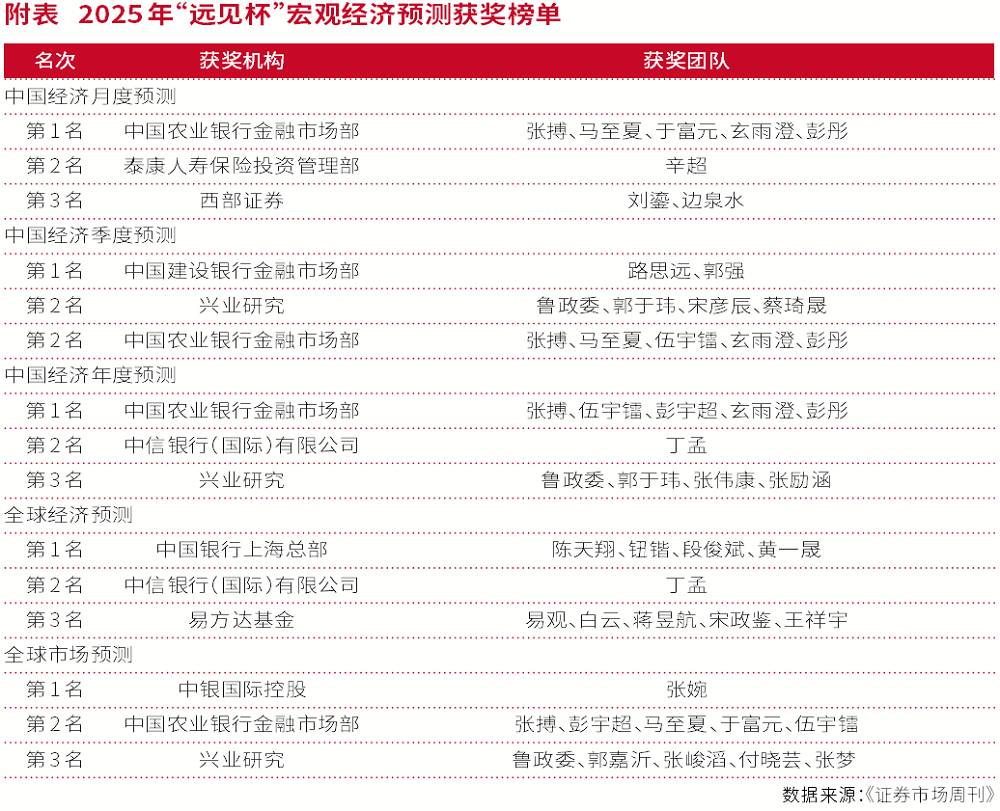
编者按: 2026年作为"十五五"的开局之年,中国经济与A股走向备受瞩目。 多地把2026年经济增长目标设定在4.5%-5.5%,机构预测中值为4.8%,经济稳中向好态势明确。在一系列政策发力见效背景下,中国的投资有 望企稳,消费则稳步回升,出口继续保持韧劲,物价水平或延续温和回暖的势头。 货币政策将继续保持宽松基调,同时在去美元化趋势不断加强的国际背景下,人民币汇率有望继续稳中走强,为A股高质量"慢牛""长牛"格局 奠定了坚实基础。 廖宗魁/文 2026年作为"十五五"的开局之年,中国经济能否延续2024年下半年以来的持续复苏势头,A股能否连续三年走牛,全球经济和国际市场又会如 何演进,成为当下投资者较为关心的问题。 从已经召开的地方两会看,绝大多数省份把2026年经济增长目标设定在4.5%—5.5%,意味着即将召开的全国两会很可能把2026年全国经济增 长目标定在5%左右。《证券市场周刊》"远见杯"宏观经济预测调查(以下简称"预测调查")显示,机构们对2026年中国GDP增长预测中值为 4.8%,经济稳中向好的态势延续。 在一系列政策发力见效的背景下,中国的投资有望企稳,消费则稳步回升,出口继续保持韧劲, ...

超110亿 加仓
Zhong Guo Ji Jin Bao· 2026-02-09 04:56
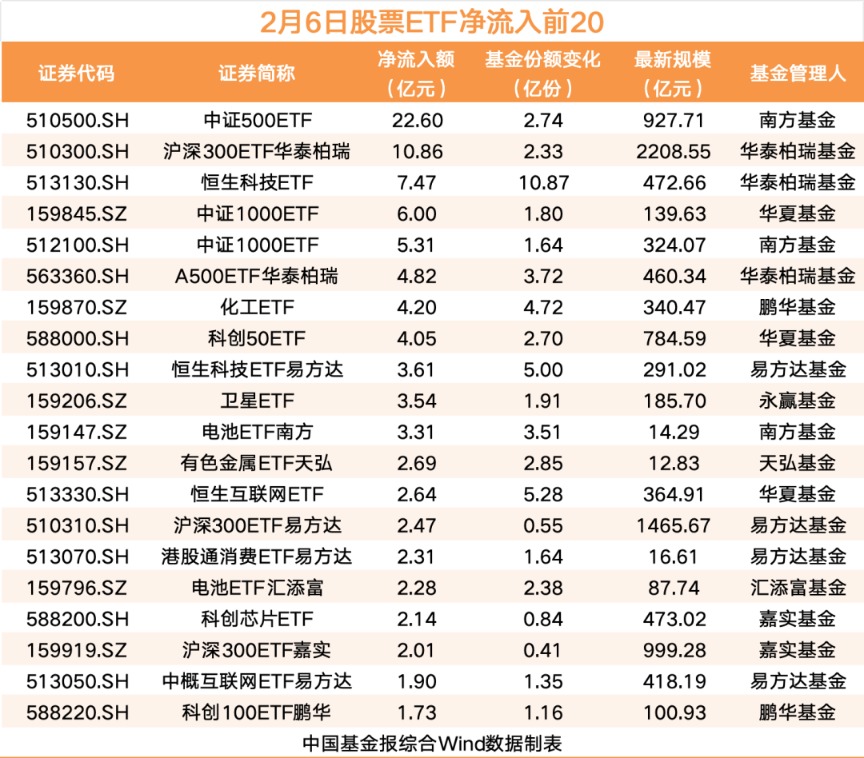
Core Viewpoint - The A-share market experienced a collective decline on February 6, with significant net inflows into stock ETFs, exceeding 11 billion yuan on that day [1]. Group 1: ETF Market Overview - As of February 6, the total scale of 1,333 stock ETFs in the market reached 4.1 trillion yuan, with a net inflow of 11.764 billion yuan and an increase of 9.347 billion fund shares [3]. - The leading categories for net inflows were broad-based ETFs and Hong Kong stock ETFs, with inflows of 7.112 billion yuan and 2.518 billion yuan, respectively [3]. - The CSI 500 Index ETF saw the highest net inflow at 2.585 billion yuan, while the Hang Seng Technology Index ETF and the Sci-Tech 50 Index ETF attracted over 11.2 billion yuan and 5 billion yuan, respectively, over the past five trading days [3]. Group 2: Top ETFs by Net Inflow - On February 6, 35 ETFs recorded net inflows exceeding 1 billion yuan, with the top three being the CSI 500 ETF (2.26 billion yuan), the CSI 300 ETF by Huatai-PB (1.086 billion yuan), and the Hang Seng Technology ETF (747 million yuan) [4]. - Notable inflows were also observed in the China Securities 1000 ETF and the Sci-Tech 50 ETF, with net inflows of 600 million yuan and 405 million yuan, respectively [5]. Group 3: ETFs with Net Outflows - The gold stock ETF experienced the largest net outflow, totaling 812 million yuan on February 6 [5]. - Other ETFs with significant outflows included the Tongwen Stock ETF (-559 million yuan), the SSE 50 ETF (-331 million yuan), and the Food and Beverage ETF (-324 million yuan) [6]. Group 4: Market Outlook - Fund managers from E Fund expressed optimism about the domestic macroeconomic outlook, expecting continued stability and progress, with emerging industries likely to see further development [7]. - Bosera Fund noted that financial conditions remain favorable for equity assets, suggesting that ETF outflows may have reached a turning point, with a potential return to growth in financing balances [7].
超110亿,加仓
Xin Lang Cai Jing· 2026-02-09 04:00
Core Viewpoint - On February 6, the A-share market saw a collective decline in the three major indices, while the stock ETF market experienced a net inflow of over 110 billion yuan, indicating continued bottom-fishing by investors [10][11]. Group 1: ETF Market Overview - As of February 6, the total scale of 1,333 stock ETFs in the market reached 4.1 trillion yuan, with a net inflow of 117.64 billion yuan on that day [2][11]. - The largest inflows were seen in broad-based ETFs and Hong Kong stock markets, with net inflows of 71.12 billion yuan and 25.18 billion yuan, respectively [2][11]. - The CSI 500 Index ETF led the inflows with 25.85 billion yuan, while the Hang Seng Technology Index ETF saw inflows exceeding 112 billion yuan over the past five trading days [2][11]. Group 2: Top ETFs by Net Inflow - On February 6, 35 ETFs had net inflows exceeding 1 billion yuan, with the top three being: - CSI 500 ETF: 22.6 billion yuan - CSI 300 ETF by Huatai-PB: 10.86 billion yuan - Hang Seng Technology ETF: 7.47 billion yuan [3][12]. - Other notable inflows included the CSI 1000 ETF and the Sci-Tech 50 ETF, which saw net inflows of 6 billion yuan and 4.05 billion yuan, respectively [13]. Group 3: ETFs with Net Outflows - The gold stock ETF experienced the largest net outflow, totaling 8.12 billion yuan on February 6 [6][14]. - Other ETFs with significant outflows included: - SSE 50 ETF: -3.31 billion yuan - Food and Beverage ETF: -3.24 billion yuan - Securities and Insurance ETF by E Fund: -2.78 billion yuan [7][14]. Group 4: Market Outlook - Fund managers from E Fund and Bosera Fund expressed optimism about the market, citing favorable financial conditions for equity assets and the potential for growth in financing balances [8][16]. - They noted that the domestic macroeconomic environment is expected to maintain a trend of "steady progress," with emerging industries likely to see further development [8][16].
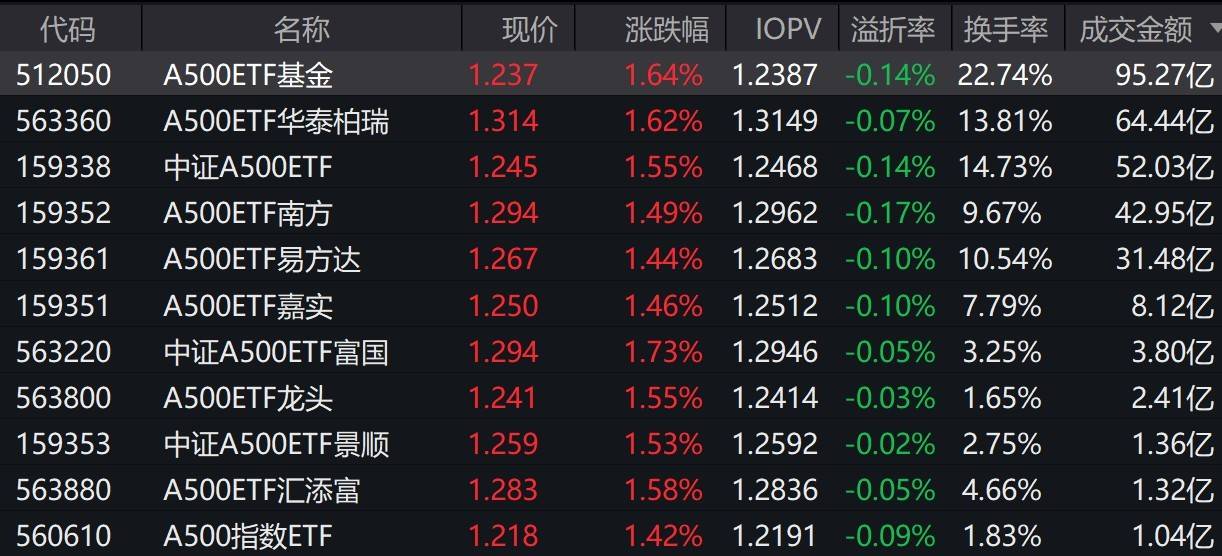
市场早盘高开高走,中证A500指数上涨1.63%,2只中证A500相关ETF成交额超64亿元
Sou Hu Cai Jing· 2026-02-09 03:59
Market Performance - The market opened higher with the Shanghai Composite Index rising over 1% and the CSI 500 Index increasing by 1.63% [1] - The photovoltaic sector experienced a significant surge, while computing hardware concepts collectively strengthened, and AI applications and the chemical sector showed active performance [1] - Conversely, oil and gas stocks exhibited weaker performance [1] ETF Trading Activity - Multiple ETFs tracking the CSI 500 Index saw gains of over 1%, with 11 ETFs having transaction volumes exceeding 100 million yuan, and 2 surpassing 6.4 billion yuan [1] - The A500 ETF Fund and A500 ETF Huatai Baichuan recorded transaction volumes of 9.527 billion yuan and 6.444 billion yuan, respectively [1] Market Sentiment and Outlook - Some brokerages indicated that external disturbances have not substantially impacted the fundamentals of Chinese industries, and the concentrated cooling operations have concluded [1] - Market sentiment has been fully released, and adjustments are considered adequate, suggesting that the A-share spring market rally may continue after the Spring Festival [1]
光伏ETF上周领涨,太空光伏新需求获机构看好丨ETF基金周报
2 1 Shi Ji Jing Ji Bao Dao· 2026-02-09 03:21
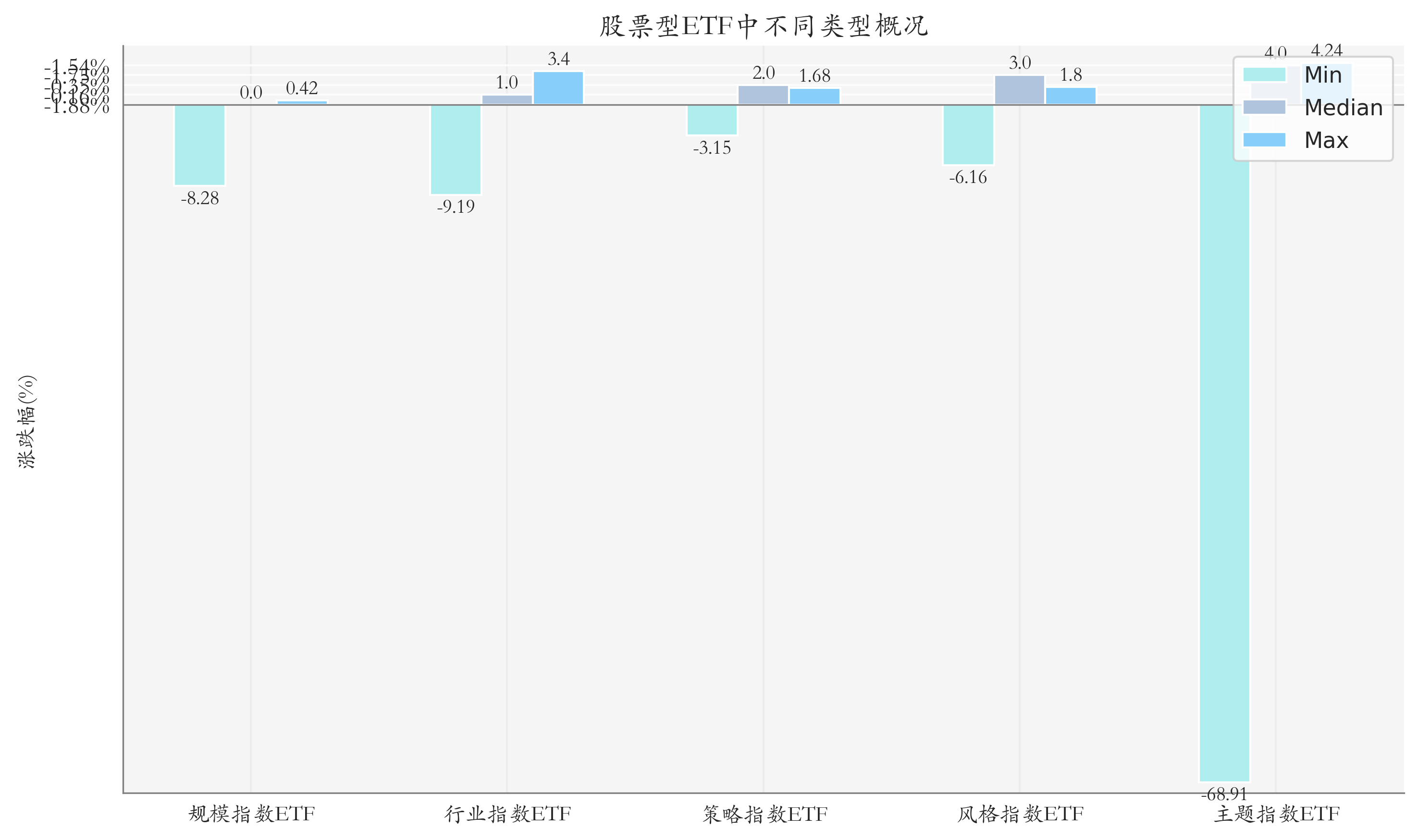
Market Overview - The Shanghai Composite Index fell by 1.27% to 4065.58 points, with a weekly high of 4104.62 points [1] - The Shenzhen Component Index decreased by 2.11% to 13906.73 points, reaching a high of 14213.61 points [1] - The ChiNext Index dropped by 3.28% to 3236.46 points, with a peak of 3390.3 points [1] - In the global market, the Nasdaq Composite Index declined by 1.84%, while the Dow Jones Industrial Average rose by 2.5% [1] ETF Market Performance 1. Stock ETF Overall Performance - The median weekly return for stock ETFs was -1.63% [2] - The highest weekly return among scale index ETFs was 0.42% for the Southern Shenzhen Main Board 50 ETF [2] - The highest weekly return in industry index ETFs was 3.4% for the China Southern Shanghai Composite Main Consumer ETF [2] 2. Stock ETF Gain and Loss Rankings - The top five performing ETFs were: - China Southern Photovoltaic Industry ETF (4.24%) - Fortune Shanghai Stock Exchange Sci-Tech Innovation Board New Energy ETF (4.09%) - E Fund Shanghai Stock Exchange Sci-Tech Innovation Board New Energy ETF (3.93%) - Penghua Shanghai Stock Exchange Sci-Tech Innovation Board New Energy ETF (3.88%) - Tianhong China Southern Photovoltaic Industry ETF (3.42%) [6] - The five ETFs with the largest declines included: - Guotai China Southern All-Index Communication Equipment ETF (-68.91%) - Guolian An Shanghai Stock Exchange Sci-Tech Innovation Board Chip Design Theme ETF (-54.59%) - Huaan China Southern Shanghai-Hong Kong Gold Industry Stock ETF (-13.25%) [6] 3. Stock ETF Liquidity - Average daily trading volume for stock ETFs decreased by 32.4%, while average daily trading volume increased by 20.9% [8] 4. Stock ETF Fund Flows - The top five ETFs with the highest inflows were: - Southern China 500 ETF (inflow of 2.26 billion) - Huatai-PB CSI 300 ETF (inflow of 1.086 billion) - Huaxia CSI 1000 ETF (inflow of 600 million) [11] - The top five ETFs with the largest outflows included: - Huaxia Shanghai 50 ETF (outflow of 331 million) - Huaxia CSI Subdivision Food and Beverage Industry Theme ETF (outflow of 324 million) [12] ETF Financing and Margin Trading - The financing balance for stock ETFs decreased from 53.0598 billion to 52.7352 billion [14] - The highest financing buy amount was for Southern China 500 ETF, totaling 845 million [14] ETF Market Size - The total market size for ETFs reached 5321.655 billion, a decrease of 135.866 billion from the previous week [17] - Stock ETFs accounted for 59.0% of the total ETF market size [19] ETF Issuance and Establishment - No new ETFs were issued last week, but nine new ETFs were established, including: - Huaan CSI Nonferrous Metal Mining Theme ETF - Wanji Guo Zheng New Energy Vehicle Battery ETF [20] Institutional Insights - CITIC Securities predicts exponential growth in space photovoltaic demand, with leading Chinese photovoltaic equipment manufacturers likely to enter the supply chains of companies like Tesla and SpaceX [21] - GF Securities anticipates that the demand for energy from space satellites and data centers will drive global photovoltaic demand, projecting a growth of 18.6% in global photovoltaic demand by 2026 [22]
芯联集成股价涨5.02%,易方达基金旗下1只基金位居十大流通股东,持有1.82亿股浮盈赚取6541.72万元
Xin Lang Cai Jing· 2026-02-09 02:41
Group 1 - Core viewpoint: ChipLink Integrated Circuit Manufacturing Co., Ltd. has shown a significant increase in stock price, rising by 5.02% to 7.53 CNY per share, with a trading volume of 533 million CNY and a market capitalization of 63.122 billion CNY as of February 9 [1] - Company overview: ChipLink, established on March 9, 2018, and listed on May 10, 2023, is located in Shaoxing, Zhejiang Province. The company specializes in wafer foundry and module packaging testing services in the MEMS and power device sectors, providing one-stop system OEM solutions [1] - Revenue composition: The main business revenue breakdown is as follows: integrated circuit wafer manufacturing foundry at 85.96%, module packaging at 9.24%, other supplementary services at 3.58%, and research and development services at 1.21% [1] Group 2 - Major shareholder activity: E Fund's ETF, the E Fund SSE STAR 50 ETF (588080), reduced its holdings by 23.2142 million shares in the third quarter, now holding 182 million shares, which represents 4.1% of the circulating shares. The estimated floating profit from this transaction is approximately 65.4172 million CNY [2] - Fund performance: The E Fund SSE STAR 50 ETF, established on September 28, 2020, has a current scale of 70.597 billion CNY. Year-to-date returns are 5.81%, ranking 1592 out of 5579 in its category, while the one-year return is 41.36%, ranking 1365 out of 4289 [2] - Fund manager details: The fund manager Lin Weibin has a tenure of 12 years and 344 days, with a total asset scale of 119.408 billion CNY and a best return of 84.18% during his tenure. Co-manager Cheng Xi has a tenure of 9 years and 281 days, managing assets of 236.954 billion CNY, with a best return of 131.04% [3]

帝尔激光股价涨5.21%,易方达基金旗下1只基金位居十大流通股东,持有288.93万股浮盈赚取1279.98万元
Xin Lang Cai Jing· 2026-02-09 02:14
Group 1 - The core viewpoint of the news is that Dier Laser's stock price increased by 5.21% to 89.42 CNY per share, with a trading volume of 367 million CNY and a turnover rate of 2.50%, resulting in a total market capitalization of 24.501 billion CNY [1] - Dier Laser, established on April 25, 2008, and listed on May 17, 2019, specializes in the design, research, production, and sales of precision laser processing solutions and related equipment [1] - The company's main business revenue composition is 98.79% from solar cell laser processing equipment and 1.21% from accessories, maintenance, and technical service fees [1] Group 2 - Among Dier Laser's top ten circulating shareholders, E Fund's Chuangye ETF (159915) reduced its holdings by 482,600 shares in the third quarter, now holding 2.8893 million shares, which accounts for 1.72% of the circulating shares [2] - The estimated floating profit from E Fund's Chuangye ETF is approximately 12.7998 million CNY [2] - E Fund's Chuangye ETF was established on September 20, 2011, with a latest scale of 100.446 billion CNY, yielding 1.14% this year, ranking 3994 out of 5579 in its category, and achieving a 54.96% return over the past year, ranking 563 out of 4289 [2]

投资大咖说 | 把握中国股票价值重估大周期——访安联基金程彧
Sou Hu Cai Jing· 2026-02-09 02:06
Core Viewpoint - The investment philosophy emphasizes long-term value creation over short-term market trends, with a focus on Return on Equity (ROE) as the key metric for assessing a company's intrinsic value and long-term returns [1][15][16] Investment Philosophy - The investment framework is characterized by a disciplined approach that avoids chasing short-term market fads and instead focuses on the fundamental logic of corporate profit generation [1][15] - ROE is viewed as the "North Star" for understanding a company's essence and driving long-term returns, with a focus on the sustainability and quality of profit growth [1][16] - The investment strategy aims to overcome common behavioral biases in investing through a systematic process, ensuring that investment performance is explainable, predictable, and sustainable [14][17] Market Dynamics - A significant "re-rating" cycle for Chinese stocks is underway, driven by three key factors: the enhancement of technological competitiveness, the improvement of the risk environment, and supportive government policies [18][19] - The rise in technological competitiveness has instilled greater confidence in the future of the Chinese economy, leading to a reassessment of corporate long-term profit potential [18][19] - The improvement in the risk environment allows for better quantification of risks, reducing emotional shocks and valuation discounts in the market [19] Investment Opportunities - The focus is on three main investment themes: artificial intelligence, robotics, and commercial aerospace, which are seen as pivotal in the current economic landscape [20] - In artificial intelligence, the investment focus has shifted from general model competition to specific applications that generate clear business models and cash flows [21] - The robotics sector presents opportunities in core hardware and decision-making AI, with expectations of rapid growth in industrial and commercial applications [21][22] - Commercial aerospace is viewed as a future industry with high barriers to entry, requiring identification of companies that achieve breakthroughs in key technologies and hold significant orders [22]
恒生科技指数“越跌越买”,近5日净流入超69亿元
Jing Ji Wang· 2026-02-09 02:06
Market Overview - The A-share market saw a rebound with the Shanghai Composite Index returning to 4100 points, while the ChiNext Index experienced a recovery after hitting a low [1] - The coal sector showed significant gains, and the space photovoltaic concept stocks continued their upward trend, whereas AI application stocks declined [1] ETF Market Dynamics - The stock ETF market experienced a net outflow of approximately 1.6 billion yuan, with notable outflows from products like the Huatai-PB CSI 300 ETF and the CSI 500 ETF [1] - The total scale of the stock ETF market reached 4.15 trillion yuan, with the Hang Seng Technology Index seeing a net inflow of 2.884 billion yuan, marking it as the top sector for fund inflows [3][5] Fund Inflows and Outflows - The top three ETFs by net inflow included the Hang Seng Technology Index ETF (1.021 billion yuan), the Hang Seng Internet ETF (957 million yuan), and the Sci-Tech 50 ETF (910 million yuan) [4] - The Huatai-PB CSI 300 ETF experienced the largest net outflow at 2.597 billion yuan, followed by the CSI 500 ETF with 1.662 billion yuan [8] Fund Management Insights - Leading fund companies like E Fund and Huaxia Fund reported significant net inflows across their ETFs, with E Fund's total ETF scale reaching 655.65 billion yuan, reflecting a net inflow of 2.33 billion yuan [5] - The market remains active with a high trading volume, particularly in the context of approaching the Chinese New Year holiday, indicating sustained liquidity support [9]
