OPPO

Search documents
《肯尼亚非正规经济背景下智能手机融资的未来》报告简介
Canalys· 2025-08-25 06:17
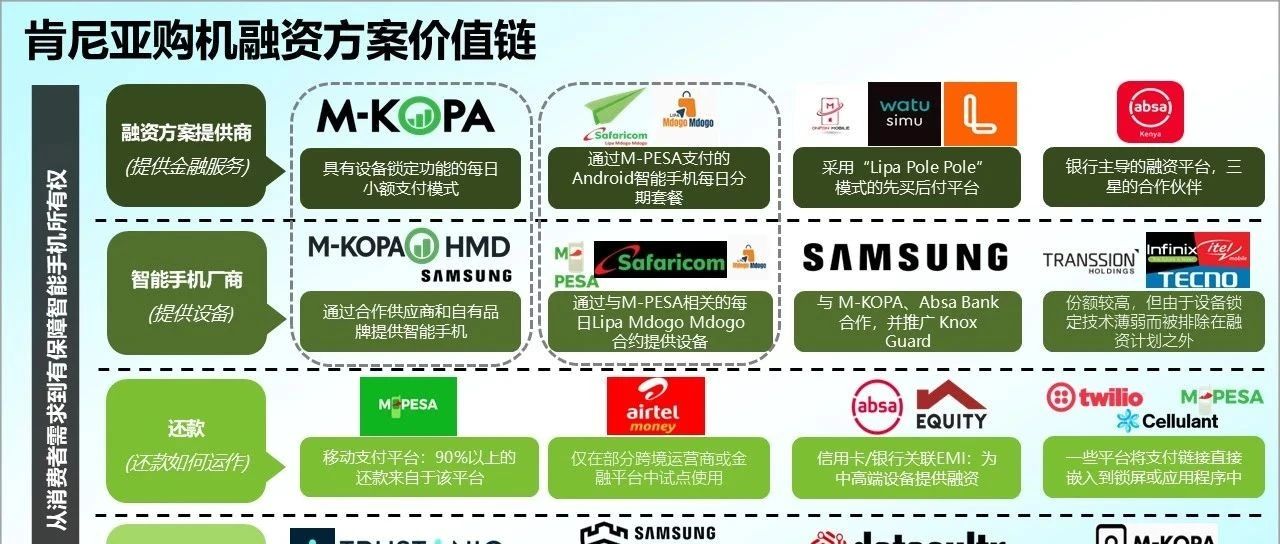
Core Insights - The article discusses Kenya's smartphone financing value chain as a successful model in Africa, addressing affordability challenges in emerging economies [1][2][10] - Financing has evolved from an optional strategy to a core distribution method in markets where income levels, credit availability, and device prices are mismatched [2][10] Background - Kenya's smartphone financing market provides a model for addressing long-standing affordability challenges in emerging economies [2] - As of March 2025, there will be 42.4 million smartphones in use in Kenya, accounting for 80.8% of total mobile connections [2] - Despite the growth in smartphone usage, 59% of mobile shipments in 2024 will still be feature phones, indicating a significant digital access gap [2] Price Trends - Since 2019, the average selling price (ASP) of smartphones in Kenya has nearly tripled, rising from KES 5,955 to KES 18,979 by Q2 2025 [3] - The share of smartphones priced below $100 has dropped to 32%, while mid-range devices priced between $100 and $199 now account for over half of total shipments [4] Financing Model - The financing model in Kenya is characterized by daily micro-payment plans, making smartphones accessible to low-income and informal employment groups [5][6] - The financing ecosystem includes various stakeholders such as lenders, manufacturers, and telecom operators, designed specifically for a mobile-first economy [7][8] Value Chain Complexity - Understanding the complexity of the financing value chain is crucial for success among participants in the ecosystem and for replicating best practices in other markets [8] - The report details four levels of the value chain, highlighting key players and technology drivers, including major brands and financial service providers [8] Emerging Market Insights - Kenya's smartphone financing value chain serves as a blueprint for addressing affordability challenges in emerging markets [10] - Financing is becoming a significant growth driver in environments where shipment volumes are stagnating, unlocking new value potential for manufacturers and ecosystem participants [12] Stakeholder Relevance - The insights are highly relevant for smartphone manufacturers, fintech providers, telecom operators, investors, and policymakers [11][15] - Strategies for expanding market penetration without sacrificing profit margins are discussed for manufacturers [15] - Recommendations for applying the Kenyan model to other emerging markets are provided, including insights for various stakeholders [15]

从"炫技"到"实用":人工智能加速落地应用
Zhong Guo Chan Ye Jing Ji Xin Xi Wang· 2025-08-25 03:01
Group 1: AI Technology Evolution - Artificial intelligence is transitioning from a "cool concept" to a practical tool integrated into various aspects of production and daily life, driven by policy guidance and market demand [1][2] - The State Council's recent approval of the "Artificial Intelligence+" action plan aims to promote large-scale commercial applications of AI across various sectors, providing clear direction for technology implementation [1][2] Group 2: Market Trends and Growth - By 2025, the AI terminal market is expected to flourish, with AI smartphones, glasses, and computers becoming mainstream, driven by practical applications rather than just technical specifications [4][5] - AI smartphone penetration is projected to reach 34% by 2025, with significant growth in the mid-range market, allowing more consumers to benefit from smart technology [4] - The global smart glasses market saw a shipment of 1.487 million units in Q1 2025, marking an 82.3% year-on-year increase, with China experiencing a 116.1% growth [4] Group 3: Intelligent Devices and Applications - AI computers are evolving to perform generative AI tasks and real-time data analysis, with expected shipments exceeding 100 million units by 2025, accounting for 40% of total PC shipments [5] - Wearable devices like headphones and smartwatches are emerging as new AI interaction points, contributing to a significant increase in sales in the digital product sector [5] Group 4: Intelligent Agents Development - Intelligent agents are evolving from auxiliary tools to decision-making hubs, capable of executing complex tasks and improving operational efficiency across various industries [6][7] - Companies like China Mobile and Lenovo are enhancing AI collaboration and integration, enabling intelligent agents to perform tasks across multiple applications and sectors [6][7] Group 5: Sector-Specific Applications - In education, AI tutors are personalizing learning paths, leading to significant improvements in student performance, while in healthcare, AI-assisted surgical systems are reducing error rates [7] - The application of intelligent agents in finance and manufacturing is streamlining processes and enhancing accuracy, indicating a shift from efficiency tools to collaborative partners in various industries [7]
阿里巴巴再调整集团业务;美团回应“退款未到账”丨科技风向标
2 1 Shi Ji Jing Ji Bao Dao· 2025-08-25 02:23
Group 1: Technology Developments - Elon Musk announced that his AI startup xAI has open-sourced the Grok 2.5 model and plans to do the same for Grok 3 in about six months, highlighting the competitive landscape with Chinese companies due to their superior hardware capabilities [2] - Huawei Cloud has restructured its organization to focus on "3+2+1" business segments, which include computing, intelligent computing, storage, AI PaaS, databases, and security [2] - Huawei's CEO of Intelligent Automotive Solutions announced the upcoming release of Huawei ADS 4 and Harmony Space 5, emphasizing the rapid adoption of assisted driving technology in China [3] Group 2: Corporate Responses and Adjustments - Meituan addressed user complaints regarding delayed refunds, stating that they have established a special customer service team to resolve the issues and clarified that most refund problems stemmed from incomplete information updates [4] - ZTE announced that its stock price fluctuations are normal, confirming that there are no undisclosed significant information affecting its operations [5] - OPPO responded to Apple's lawsuit regarding alleged theft of trade secrets, asserting that they respect all companies' trade secrets and found no evidence linking the allegations to their employee's actions [8] Group 3: Financial and Investment Activities - Jingwang Electronics plans to invest 5 billion yuan in expanding its Zhuhai Jinwan base, focusing on AI computing, high-speed network communications, and automotive intelligence [10] - Sunny Optical Technology announced a memorandum of understanding to acquire approximately 33.33% equity in GoerTek Optical, indicating a strategic investment move [11] - Databricks is conducting a K round financing exceeding 1 billion USD, with a valuation surpassing 100 billion USD, aimed at accelerating its AI strategy and global growth [12] - Kaipu Cloud intends to acquire 70% equity in Nanning Taike Semiconductor, which will add storage product business to its portfolio [13]




阿里巴巴再调整集团业务;美团回应“退款未到账”丨新鲜早科技
2 1 Shi Ji Jing Ji Bao Dao· 2025-08-25 02:10
Group 1: Technology Developments - Elon Musk announced that his AI startup xAI has open-sourced the Grok 2.5 model and plans to do the same for Grok 3 in about six months, with recent updates improving image generation speed and adding new features [2] - Huawei Cloud has restructured its organization to focus on "3+2+1" business segments, which include computing, intelligent computing, storage, AI PaaS, databases, and security [2] - Huawei's CEO of Intelligent Automotive Solutions announced the upcoming release of Huawei ADS 4 and Harmony Space 5 in September, highlighting the rapid adoption of assisted driving technology in China [3] Group 2: Corporate Actions - Meituan responded to user complaints regarding refunds, stating that they have established a special customer service team to address the issues and have resolved the delay in refund information [4] - ZTE Corporation confirmed that its production and operational activities are normal, despite its stock experiencing significant price fluctuations [5] - Sunyu Optical Technology announced a memorandum of understanding to acquire approximately 33.33% of Goer Optical's shares following a restructuring [11] Group 3: Financing and Investments - Jingwang Electronics plans to invest 5 billion yuan in the Zhuhai Jinwan base expansion project, focusing on AI computing power, high-speed network communication, and automotive intelligence [10] - Databricks is conducting a K round financing exceeding 1 billion dollars, with a valuation surpassing 100 billion dollars, aimed at accelerating its AI strategy and global growth [12] - Kaipu Cloud intends to acquire 70% of Nanning Taike's shares, which will add storage product-related business to its portfolio [13] Group 4: Legal and Competitive Landscape - Apple has filed a lawsuit against a former employee for allegedly stealing trade secrets related to the Apple Watch and providing them to OPPO, which OPPO has denied [8] - Zhou Hongyi, CEO of 360 Group, commented on OpenAI's open-sourcing, suggesting that domestic large model manufacturers have significantly reduced costs, allowing developers to run AI models independently [6][7] Group 5: Innovations and Infrastructure - NVIDIA announced the launch of Spectrum-XGS Ethernet technology to address the limitations of existing commercial Ethernet infrastructure, enabling the creation of a billion-watt AI super factory [9]


传奇瑞应届生员工发邮件反对周六培训开会,本人已离职;曝问界M8出现「预制车」,8月生产出9月的车;OPPO回应被苹果起诉员工窃密
雷峰网· 2025-08-25 00:40
Group 1 - Apple has filed a lawsuit against former employee Chen Shi for allegedly stealing 63 confidential files related to Apple Watch development and providing them to OPPO [4][5] - OPPO's legal department responded, stating they found no evidence linking the allegations to the employee's actions during their employment [5] - The lawsuit includes internal chat records indicating Chen Shi's intent to collect and share Apple's information with OPPO [4] Group 2 - A recent incident involving a Chery Automobile employee, who opposed mandatory Saturday training, has led to significant internal discussion and resulted in the cancellation of the meeting [7] - The employee, who has since left the company, expressed dissatisfaction with the company's practices and received support from many colleagues [7] Group 3 - The Aion M8 electric vehicle was reported to have a manufacturing date of September 2025, raising questions about production practices [9] - This incident follows a previous error regarding battery types in the Aion M8's certification documents [9] Group 4 - The Chinese cleaning robot industry is experiencing a surge in demand, with export orders reportedly extending to the end of the year [24] - Domestic sales of cleaning robots have also increased significantly, with a 40% year-on-year growth in revenue from January to July [24] - Global shipments of smart cleaning robots are projected to reach 20.6 million units in 2024, reflecting an 11.2% increase [24] Group 5 - Alibaba has restructured its business groups from six to four, consolidating various operations under new categories [15][17] - This restructuring follows a previous announcement in March regarding organizational changes aimed at improving efficiency [17] Group 6 - Four-dimensional Map Technology is reportedly in the final stages of acquiring Intelligent Robot, aiming to enhance its smart driving solutions [18] - The company has been increasing its investment in smart driving technology and expanding its team [18] Group 7 - Meta has been sued for allegedly using pirated adult films to train its AI models, with potential damages amounting to $359 million [31] - The lawsuit claims that Meta knowingly infringed on copyrights to enhance its AI capabilities [31] Group 8 - The U.S. government has acquired a 10% stake in Intel, a move aimed at supporting the semiconductor industry amid competition with TSMC [29] - This investment is expected to help Intel recover from financial difficulties and maintain its position in advanced semiconductor manufacturing [29] Group 9 - Apple is reportedly exploring partnerships with Google, OpenAI, and Anthropic to develop a new AI engine for Siri [34] - This initiative follows delays in the planned upgrade of Siri, which is now expected to launch next year [34]

早报 | 警方通报河北一女子疑家暴去世;美国政府成英特尔最大股东;中国中铁回应尖扎黄河特大桥事故;多地快递费涨价
虎嗅APP· 2025-08-25 00:16
Group 1 - The U.S. Vice President stated that new sanctions against Russia to pressure it to end the Ukraine conflict are "not impossible" and that the U.S. will continue to support Ukraine without deploying ground troops [2] - Russian Foreign Minister Lavrov indicated that President Putin is willing to meet with President Zelensky, but only if the meeting is expected to yield results, citing legal legitimacy issues regarding Zelensky's position [3] - Canada is considering sending ground troops to Ukraine, with a new $500 million aid package focused on drone production as a key outcome of discussions between Canadian Prime Minister and Ukrainian President [9] Group 2 - The U.S. government has become the largest shareholder of Intel by investing $8.9 billion to acquire 9.9% of the company's shares, which is expected to strengthen the U.S. position in the semiconductor industry [14][15] - The recent increase in express delivery fees in multiple regions, particularly in Guangdong and Zhejiang, is attributed to the need to address "involution" in the industry, with costs expected to rise for e-commerce businesses [12][13] Group 3 - China Evergrande announced that it will lose its listing status on August 25 due to failure to meet the requirements set by the stock exchange, with the last trading day being August 22 [27] - Nvidia is set to unveil a new humanoid robot "brain" and has partnered with several Chinese humanoid robot companies, indicating a significant advancement in robotics technology [28][30][36]




内测“AI万能搜”,淘宝要走条不一样的路
3 6 Ke· 2025-08-25 00:10
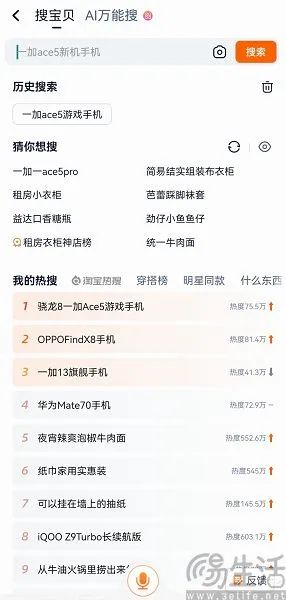
Core Viewpoint - Alibaba is adapting to the AI e-commerce era, with founder Jack Ma emphasizing the need for transformation and confidence in the company's future amidst competition from Pinduoduo [1] Group 1: AI E-commerce Strategy - Alibaba has been gradually advancing its AI e-commerce strategy, initially focusing on B2B applications but now shifting towards C2C user experiences [2][3] - The new "AI Universal Search" feature is currently in gray testing, targeting four key scenarios: outfit recommendations, gift lists, shopping guides, and product reviews [3][5] Group 2: AI Universal Search Functionality - "AI Universal Search" allows users to ask questions in natural language, generating a comprehensive report that includes text, products, and multimedia to assist with shopping decisions [3][5] - Unlike other AI shopping assistants, "AI Universal Search" does not provide direct product links but offers personalized solutions and recommendations based on user needs [5][10] Group 3: Market Trends and Insights - The introduction of "AI Universal Search" aligns with trends identified by a16z, which notes that AI is reshaping various purchasing behaviors, particularly in impulse and routine purchases [6][8] - A16z's report highlights that while AI influences smaller purchases significantly, its impact on major life purchases remains limited due to consumer skepticism [8] Group 4: Competitive Landscape - The emergence of "AI Universal Search" indicates a strategic shift for Alibaba, moving away from content-driven e-commerce that has been a focus since the pandemic [10][11] - Despite challenges from content platforms like Douyin and Kuaishou, Alibaba's users exhibit high purchase intent, with a conversion rate of 8.2%, significantly above the industry average [13]
【钛晨报】事关平台经济,价格行为将进一步规范;马斯克宣布Grok-2正式开源,Grok-3也将在大概6个月内开源;黄仁勋:想对华销售新型特供芯片,正在与...
Tai Mei Ti A P P· 2025-08-24 23:31
Group 1 - The National Development and Reform Commission, the State Administration for Market Regulation, and the National Internet Information Office have jointly drafted the "Internet Platform Pricing Behavior Rules (Draft for Comments)" to guide pricing behavior on platforms [2][3] - The rules emphasize the importance of allowing operators to set prices independently and prohibit unreasonable restrictions on pricing behavior by platform operators [2][3] - The draft includes requirements for clear price marking and transparency in promotional activities, ensuring that operators adhere to pricing standards [2][3] Group 2 - The draft aims to establish a collaborative governance mechanism, enhancing coordination among government departments and promoting industry self-regulation [3] - The document does not explicitly ban subsidies but requires platforms to disclose rules regarding promotional activities and avoid false advertising [3] Group 3 - Multiple ride-hailing platforms, including Didi and T3, have announced reductions in their maximum commission rates, with Didi's set at 27% and Cao Cao's at 22.5% [6] - The average commission for Didi's orders in 2024 is projected to be 14%, indicating that the maximum rates are rarely applied [6] Group 4 - NIO's CEO Li Bin stated that maintaining competitive pricing is crucial for the company's survival, highlighting a significant reduction in the cost of the new ES8 model [7] - Tesla has partnered with ByteDance's Volcano Engine to enhance its smart cabin interaction experience, integrating advanced AI models into its vehicles [8] Group 5 - Huawei Cloud is undergoing a major organizational restructuring, affecting over a thousand employees, with a focus on AI development and a streamlined business model [5] - Alibaba has restructured its business segments on its official website, consolidating its operations into four main groups without indicating any internal organizational changes [9] Group 6 - Intel has reached an agreement with the U.S. government for an $8.9 billion investment, acquiring a 9.9% stake in the company to support the semiconductor industry [11] - The Chinese smart computing market is expected to grow significantly, with a projected increase of over 40% by 2025, driven by advancements in AI applications [19]
AI时代,这家国产存储企业悄然崛起,备受关注
市值风云· 2025-08-24 10:08
Core Viewpoint - The article emphasizes the rapid expansion of the storage market driven by AI, highlighting the significant growth in sales and profits of major storage companies like SK Hynix and Micron, and the strategic positioning of Bawei Storage in advanced packaging and storage solutions [3][4][5]. Group 1: Market Dynamics - AI is accelerating the expansion of the storage market, with major tech companies increasing their capital expenditures in AI infrastructure [3]. - In Q2, SK Hynix's sales grew by 35% year-on-year to 22 trillion KRW, and Micron's revenue increased by 38% to $8.05 billion, with Micron's net profit doubling [3][4]. - The demand for high-performance, large-capacity storage is rising due to AI applications in PCs, smartphones, and other devices [5]. Group 2: Bawei Storage's Performance - Bawei Storage reported a 13.7% year-on-year revenue growth in the first half of the year, with Q2 revenue increasing by 38.2% year-on-year and 53.5% quarter-on-quarter [6][16]. - The gross profit margin for Bawei Storage improved significantly, with Q2 sales gross margin rising by 11.7 percentage points [6][16]. - Embedded storage remains a key focus, accounting for 58.4% of total revenue, with a 4.9% growth in the first half of the year [20][21]. Group 3: Advanced Packaging Technology - Bawei Storage is focusing on advanced packaging technology, which is crucial for enhancing memory communication bandwidth in the AI era [8][12]. - The company is developing a wafer-level advanced packaging project with a total investment of 3.09 billion CNY, expected to be operational in the second half of the year [13][14]. - The advanced packaging techniques, such as FOMS and CMC, are designed to meet the high-density interconnection and data transmission needs of AI applications [15][14]. Group 4: Competitive Positioning - Bawei Storage has established partnerships with major clients in various sectors, including AI, smartphones, and PCs, enhancing its market position [26][32]. - The company is positioned as the only domestic provider with both storage and wafer-level advanced packaging capabilities, which strengthens its competitive edge [39]. - The rise of domestic storage companies, such as Changxin Technology, is expected to benefit Bawei Storage by reducing raw material costs and enhancing collaboration [38][39].
苹果状告OPPO高管窃密,离职前夜打包63份文件U盘带走
36氪· 2025-08-24 09:00
Core Viewpoint - Apple has filed a lawsuit against former Apple Watch sensor architect Chen Shi for allegedly stealing trade secrets before joining Chinese smartphone manufacturer OPPO, which could undermine Apple's competitive advantage in wearable technology [3][7][12]. Group 1: Incident Details - Chen Shi worked as a sensor system architect for Apple Watch from January 2020 to June 2025, earning a monthly salary of $28,000 and was involved in the development of confidential technologies [6]. - Before leaving Apple, Chen Shi misled the company about his intentions, claiming he would return to China to care for his elderly parents and not seek new employment, while he had already accepted a position at OPPO [7]. - Evidence presented in court indicates that Chen Shi held numerous one-on-one meetings with Apple Watch team members to gather information on ongoing research and secretly downloaded 63 confidential files, including critical design documents and algorithms, just days before his departure [8][10]. Group 2: Implications for Apple - Apple argues that allowing Chen Shi and OPPO to benefit from this behavior would jeopardize its commitment to innovation and the value of its trade secrets, potentially giving competitors an unfair advantage [12]. - The health sensor technology is a cornerstone of Apple's market dominance in wearables, with the Series 9 model contributing 62% of the revenue for Apple's wearables division in 2024 [16]. - Apple emphasizes that the algorithms behind its sensor technologies are the result of extensive clinical validation and development, and any leakage could significantly reduce competitors' R&D costs and timelines [17]. Group 3: OPPO's Developments - Chen Shi is now leading a sensor technology development team at OPPO's Silicon Valley research center, where the company has made significant advancements in health tracking technology [11][19]. - OPPO's health tracking capabilities have improved dramatically since acquiring InnoPeak Technology, with their prototype showing a blood oxygen monitoring accuracy that closely resembles Apple's, with a deviation rate of only 1.2% [19]. - The lawsuit highlights a broader trend of employee poaching and trade secret theft involving Chinese companies, with Apple having initiated 17 employee-related lawsuits in the past five years, three of which involved criminal proceedings [20].