伊利股份

Search documents
食品饮料行业2025年半年度业绩综述:白酒加速出清,大众品结构分化
Dongguan Securities· 2025-09-04 09:15
Investment Rating - The report maintains an "Overweight" rating for the food and beverage industry [1] Core Insights - The food and beverage industry experienced a revenue growth of 2.47% year-on-year in H1 2025, totaling 582.81 billion yuan, while net profit decreased by 0.60% to 127.67 billion yuan [3][11] - The report highlights a significant performance divergence among sub-sectors, with the liquor sector facing challenges while other segments like snacks and soft drinks showed better performance [3][11] Summary by Sections 1. Industry Overview - The food and beverage industry achieved a total revenue of 582.81 billion yuan in H1 2025, with a year-on-year growth of 2.47%, a decline of 2.79 percentage points compared to the previous year [3][11] - The net profit attributable to shareholders was 127.67 billion yuan, down 0.60% year-on-year, with a notable decline in growth rate of 14.64 percentage points [3][11] 2. Liquor Sector - The liquor sector's revenue in H1 2025 was 241.51 billion yuan, a decrease of 0.86% year-on-year, with net profit at 94.56 billion yuan, down 1.18% [24][28] - In Q2 2025, the liquor sector's revenue was 88.09 billion yuan, down 5.01% year-on-year, and net profit decreased by 7.50% to 31.17 billion yuan [24][28] 3. Beer Sector - The beer sector showed a revenue growth of 2.36% in H1 2025, with a double-digit increase in net profit [3][11] - The sector's profitability improved steadily, benefiting from cost reductions and product structure optimization [3][11] 4. Seasoning Sector - The seasoning sector experienced a year-on-year revenue growth in Q2 2025, indicating a recovery in dining consumption [3][11] 5. Dairy Sector - The dairy sector's performance improved in Q2 2025, with growth driven by a low base effect [3][11] 6. Snack Sector - The snack sector showed a mixed performance in Q2 2025, with some companies benefiting from core products and online channels [3][11] 7. Investment Strategy - The report suggests focusing on high-certainty stocks in the liquor sector, such as Kweichow Moutai and Wuliangye, and highlights the potential in the snack and dairy sectors due to improving consumption trends [3][11]




饮料乳品板块9月4日涨1.1%,欢乐家领涨,主力资金净流入1.37亿元
Zheng Xing Xing Ye Ri Bao· 2025-09-04 08:50
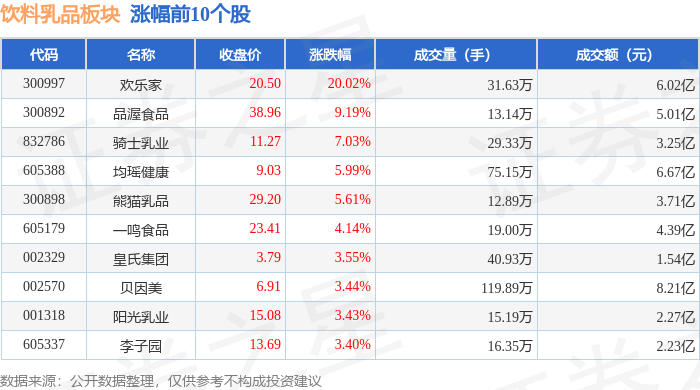
Market Overview - The beverage and dairy sector increased by 1.1% on September 4, with Huanlejia leading the gains [1] - The Shanghai Composite Index closed at 3765.88, down 1.25%, while the Shenzhen Component Index closed at 12118.7, down 2.83% [1] Top Performers - Huanlejia (300997) closed at 20.50, up 20.02% with a trading volume of 316,300 shares and a transaction value of 602 million yuan [1] - Pinwu Food (300892) closed at 38.96, up 9.19% with a trading volume of 131,400 shares and a transaction value of 501 million yuan [1] - Knight Dairy (832786) closed at 11.27, up 7.03% with a trading volume of 293,300 shares and a transaction value of 325 million yuan [1] Other Notable Stocks - Junyao Health (605388) closed at 9.03, up 5.99% with a trading volume of 1,751,500 shares and a transaction value of 667 million yuan [1] - Panda Dairy (300898) closed at 29.20, up 5.61% with a trading volume of 128,900 shares and a transaction value of 371 million yuan [1] - Yili Group (600887) closed at 28.16, up 0.90% with a trading volume of 1,946,300 shares and a transaction value of 2.655 billion yuan [2] Capital Flow - The beverage and dairy sector saw a net inflow of 137 million yuan from institutional investors, while retail investors experienced a net outflow of 1.33 billion yuan [2][3] - Huanlejia had a net inflow of 106 million yuan from institutional investors, but a net outflow of 54.47 million yuan from retail investors [3] - Yili Group had a net inflow of 8.5 million yuan from institutional investors, with a significant outflow of 182 million yuan from retail investors [3]



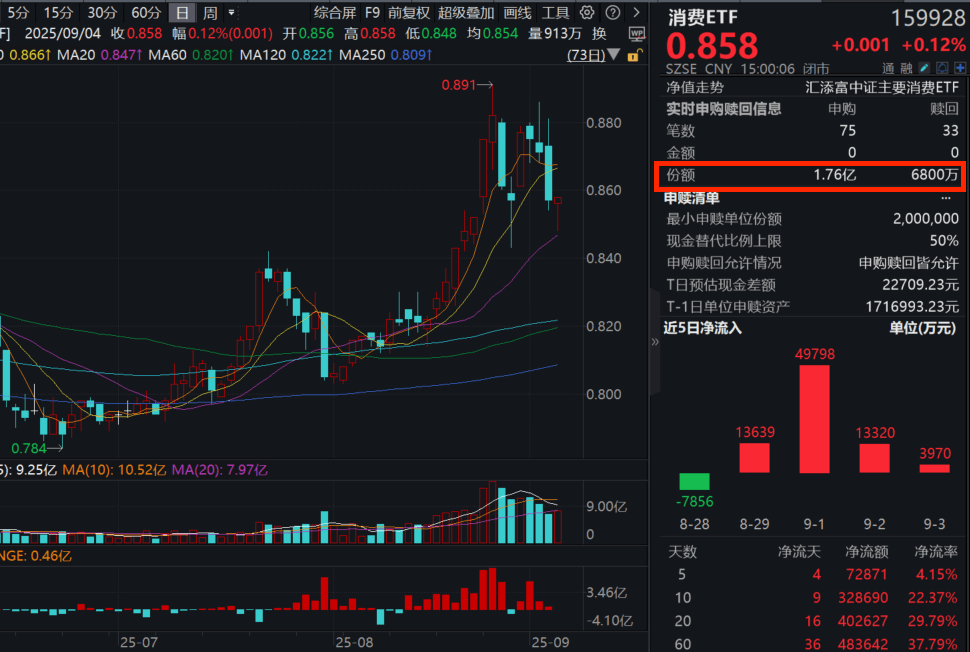
资金高切低,港A消费尾盘双双翻红!消费ETF(159928)逆市收涨,全天净申购超1亿份!港股通消费50ETF(159268)同样红盘大举吸金!
Xin Lang Cai Jing· 2025-09-04 08:47
Market Overview - The market showed a downward trend today, with the ChiNext Index dropping over 5% and the Shanghai Composite Index closing down 1.25% [1] - The Consumption ETF (159928) managed to gain 0.12% at the end of the trading session, with a trading volume exceeding 700 million yuan [1] - There was a significant shift in capital flow, with the Consumption ETF receiving a net subscription of over 10 million units and a financing balance soaring to 530 million yuan [1] Policy Initiatives - High-level officials announced plans to introduce several policies in September aimed at expanding service consumption, utilizing fiscal and financial measures to enhance service supply capabilities [3] - Local policies in Shaoxing, Zhejiang, include subsidies for hosting banquets in hotels, with a maximum subsidy of 5,000 yuan for events meeting specific criteria [6][7] - The "2025 Shaoxing City Consumption Promotion Policy" will focus on three areas: integration of culture, commerce, and tourism; expansion of new consumption scenarios; and distribution of consumption vouchers [3] Company Performance - In the first half of the year, Mao Geping achieved revenue of 2.588 billion yuan, a year-on-year increase of 31.28%, and a net profit of 670 million yuan, up 36.11% year-on-year [5] - Analysts are optimistic about Mao Geping's high-end positioning and the scarcity of Eastern aesthetics, indicating significant growth potential [5] Sector Outlook - Financial analysts are optimistic about cyclical sectors due to the anticipated policies, particularly recommending investments in the liquor and restaurant chains [6] - The consumption policies in Shaoxing are expected to directly stimulate demand for liquor, especially during the upcoming Mid-Autumn Festival and National Day holidays [6][7] - The restaurant supply industry is currently recovering from a cyclical low, with increasing competition but positive expectations for demand recovery due to ongoing policy support [7] ETF Insights - The Consumption ETF (159928) is characterized by its resilience through economic cycles, with the top ten constituent stocks accounting for over 68% of its weight [10] - The ETF includes major liquor brands, which collectively represent 32% of its weight, indicating a strong focus on the beverage sector [10][11] - The Hong Kong Stock Connect Consumption 50 ETF (159268) is highlighted as an efficient investment vehicle for the new consumption landscape, supporting T+0 trading and not occupying QDII quotas [10]
液奶企稳、奶粉“摘冠”,伊利的压力仍然存在
Hua Er Jie Jian Wen· 2025-09-04 07:37
Core Viewpoint - Yili has demonstrated resilience as a leading dairy company, with both revenue and net profit returning to positive growth after a deep adjustment period in the raw milk industry in 2024 [1] Financial Performance - Yili's revenue reached 61.9 billion yuan in the first half of the year, a year-on-year increase of 3.4%, with Q2 revenue at 28.9 billion yuan, up 5.8% year-on-year [1] - The company's net profit attributable to shareholders, excluding non-recurring items, increased nearly 32% year-on-year to 7.016 billion yuan, benefiting from lower raw milk costs and optimized sales expense ratios [2] - Despite a decline in cash flow from operating activities, Yili's confidence in achieving its annual targets of 119 billion yuan in revenue and 12.6 billion yuan in total profit remains strong [2][3] Operational Challenges - Yili faces dual pressures from weak demand and low milk prices, leading to a significant decline in net cash flow from operating activities, which fell over 44% year-on-year [3][28] - The company's interest-bearing liabilities reached 65.78 billion yuan by the end of the first half, an increase of over 5 billion yuan since the beginning of the year [4] - Cash reserves decreased by 7.8 billion yuan to 17.6 billion yuan due to dividend distribution for the 2024 fiscal year [5] Market Position and Strategy - Yili's liquid milk business has stabilized, with revenue of 36.126 billion yuan in the first half, a slight decline of 2% compared to a 13% drop in the same period last year [7] - The company has successfully reduced inventory by 7.6% and shortened inventory turnover days from 55 to 46 days [12] - Yili has introduced high-quality products in emerging channels and lower-tier markets, with non-traditional channels accounting for 30% of liquid milk revenue [15] Growth in Milk Powder Segment - The milk powder segment has become a significant growth driver, with revenue increasing from 26.3 billion yuan in 2021 to 29.7 billion yuan in 2024, reflecting a compound annual growth rate of 6.5% [18] - In the first half of 2025, milk powder revenue grew 14.26% year-on-year to 16.58 billion yuan, accounting for 26.8% of total revenue [19] - Yili's market share in the infant formula segment reached 18.1%, an increase of 1.3 percentage points year-on-year, positioning it as the market leader [20] Competitive Landscape - The competition in the infant formula market remains intense, with both Yili and Feihe offering subsidies to new parents, although their strategies differ [23] - Feihe is currently undergoing inventory adjustments, which has impacted its revenue and profit, while Yili's market position appears more stable [22][24] Future Outlook - Yili anticipates that the liquid milk industry will eventually stabilize, with a focus on achieving a balance between supply and demand [29] - The company believes that long-term growth potential exists in the liquid milk sector, driven by demographic trends and increasing consumer health awareness [35]
防守一波,白酒行业底部机会来袭?食品饮料ETF天弘(159736)跟踪指数最新估值处近十年低位
Sou Hu Cai Jing· 2025-09-04 04:00
Group 1: Food and Beverage ETF Performance - The Tianhong Food and Beverage ETF (159736) has seen a significant increase, with its tracked index component, Huanlejia (300997), rising by 12.82% as of September 4, 2025 [1] - The latest share count for the Tianhong Food and Beverage ETF reached 7.208 billion, marking a one-year high [1] - The ETF experienced a net inflow of 7.4699 million yuan recently, with a total of 74.0188 million yuan net inflow over the past five trading days, averaging 14.8038 million yuan per day [1] - The price-to-earnings ratio (PE-TTM) of the index tracked by the ETF is currently at 22.4 times, which is in the 9.22% percentile historically, indicating a low valuation [1] Group 2: Personal Consumption Loan Subsidy Policy - The personal consumption loan subsidy policy was officially implemented on September 1, 2025, with an effective period until August 31, 2026, aimed at reducing consumer credit costs and stimulating consumption [2] - The Ministry of Finance indicated that an evaluation of the policy's effectiveness will be conducted after its expiration, with potential for extension or expansion of support [2] Group 3: Insights on the Liquor Industry - According to招商证券, the white liquor industry is undergoing a significant clearing process due to the "ban on alcohol," with second and third-tier companies facing thorough elimination while leading companies show resilience [2] - The report anticipates that the impact of policies on sales will diminish, but consumer power has not yet improved, leading to expected double-digit declines in sales during the upcoming festivals [2] - 中信证券 predicts that the second half of the year may see the steepest decline in performance for most liquor companies, given the industry's underperformance compared to core indices and its valuation being at a three-year low, indicating a potential for rebound [3]
内蒙古:产业转型发展势头正旺
Zhong Guo Chan Ye Jing Ji Xin Xi Wang· 2025-09-04 02:40
Group 1: Energy Sector Development - Inner Mongolia is a significant energy base in China, focusing on transforming traditional industries and fostering emerging sectors [1][4] - The region is developing a "wind-solar-hydrogen-storage vehicle" industrial cluster, integrating energy production, equipment manufacturing, and application demonstration [3][4] - The "Photovoltaic Great Wall" project in Ordos effectively prevents desert encroachment while generating green electricity [3][4] Group 2: Agricultural and Ecological Innovations - The Inner Mongolia region is enhancing its agricultural sector, particularly in green livestock product processing and clean energy [2][3] - Mengcao Group is actively involved in ecological restoration, having restored nearly 33 million acres of various ecological types [2] - The dairy industry is expanding, with significant production capacities in liquid milk, milk powder, and cheese, indicating a robust modern dairy development [1][2] Group 3: Industrial Transformation and Growth - Baotou is accelerating its industrial transformation, aiming to establish wind power equipment manufacturing as a major industry cluster [2][3] - The region's non-coal industries are projected to grow at an average annual rate of over 8% from 2021 to 2024, with high-tech manufacturing and strategic emerging industries also showing strong growth [4] - The industrial economy of Inner Mongolia is expected to exceed 1 trillion yuan for the first time, reflecting a significant economic milestone [4]

2025年7月中国乳品进口数量和进口金额分别为24万吨和11.94亿美元
Chan Ye Xin Xi Wang· 2025-09-04 01:09
Core Insights - The report highlights the growth in China's dairy product imports, with a notable increase in both quantity and value in July 2025 compared to the previous year [1][1][1] Industry Overview - The dairy product import volume in July 2025 reached 240,000 tons, reflecting a year-on-year growth of 5.2% [1] - The import value for the same period was $119.4 million, marking a year-on-year increase of 16.2% [1] Companies Mentioned - Listed companies in the dairy sector include Yangguang Dairy, Huangshi Group, Beingmate, Maiqu'er, Yantang Dairy, Zhuangyuan Pasture, New Dairy, Western Pasture, Pinwo Food, Panda Dairy, Hairong Technology, Tianrun Dairy, Sanyuan, Guangming Dairy, Miaokelando, Yili, Yiming Food, Jiahe Food, and Knight Dairy [1][1][1] Research Report - The insights are derived from a report by Zhiyan Consulting titled "2025-2031 China Dairy Product Industry Market Research and Development Prospects Planning Report" [1]

发挥长钱长投优势 险资系私募偏好大蓝筹
Zhong Guo Zheng Quan Bao· 2025-09-03 22:44
Group 1 - A new insurance-funded private equity firm, Hengyi Chiying, has registered with a fund size of 30 billion yuan, bringing the total number of insurance-funded private equity firms to seven, with a combined trial amount of 222 billion yuan [1][2] - The insurance capital long-term investment reform pilot was approved in October 2023, with China Life and Xinhua Insurance each contributing 25 billion yuan to establish a 50 billion yuan company fund [2] - The investment strategy of these funds focuses on long-term and value investments, particularly in leading companies in the energy and infrastructure sectors, such as China Petroleum and China Shenhua [1][2] Group 2 - Six insurance-funded private equity funds are currently operational, with significant holdings in major companies like China Petroleum and China Shenhua, indicating a strategic shift towards stable, blue-chip stocks [3][4] - The Honghu Zhiyuan Fund has reported substantial holdings, becoming a major shareholder in companies like Sinopec and Daqin Railway, with corresponding market values exceeding 17 billion yuan and 19 billion yuan respectively [3][4] - The funds emphasize a long-term investment approach, aiming to reduce short-term market volatility impacts on financial statements and promote sustainable investment returns [5][6] Group 3 - The total assets of the Honghu Zhiyuan Fund reached 57.11 billion yuan, with a net profit of 9.68 billion yuan in the first half of the year, showcasing the effectiveness of their investment strategy [5] - The insurance companies are committed to establishing private equity funds to leverage their long-term capital advantages, supporting the capital market and aligning with national strategies [6]




发挥长钱长投优势险资系私募偏好大蓝筹
Zhong Guo Zheng Quan Bao· 2025-09-03 22:42
Group 1 - A new insurance-funded private equity firm, Hengyi Chiying (Shenzhen) Private Fund Management Co., Ltd., has completed registration with an initial fund size of 30 billion yuan [1] - The total number of insurance-funded private equity firms has reached seven, with a combined trial amount of 222 billion yuan [1][2] - The investment strategy of these firms is focused on long-term and value investments, favoring leading companies in energy and infrastructure sectors such as China Petroleum, China Shenhua, and Daqin Railway [1][4] Group 2 - The first batch of insurance capital long-term investment reforms was approved in October 2023, with China Life and Xinhua Insurance each contributing 25 billion yuan to establish a 50 billion yuan company fund [2] - As of now, six insurance-funded private equity securities investment funds are operational, with significant holdings in major companies [2][3] - The Honghu Zhiyuan Fund has become a major shareholder in China Petroleum and China Shenhua, with holdings valued at approximately 1.857 billion yuan and 2.116 billion yuan respectively [2][3] Group 3 - The Honghu Zhiyuan series of funds emphasizes a long-term investment approach, focusing on stable dividend yields through low-frequency trading and long-term holding [4] - The total assets of the Honghu Zhiyuan Fund I reached 57.112 billion yuan, with a net profit of 9.68 billion yuan in the first half of the year [3][4] - Insurance companies are establishing private equity funds to leverage their long-term investment advantages, supporting the capital market and promoting stable, sustainable investment returns [4]

国联安鑫发混合A:2025年上半年利润1.93万元 净值增长率0.45%
Sou Hu Cai Jing· 2025-09-03 14:44
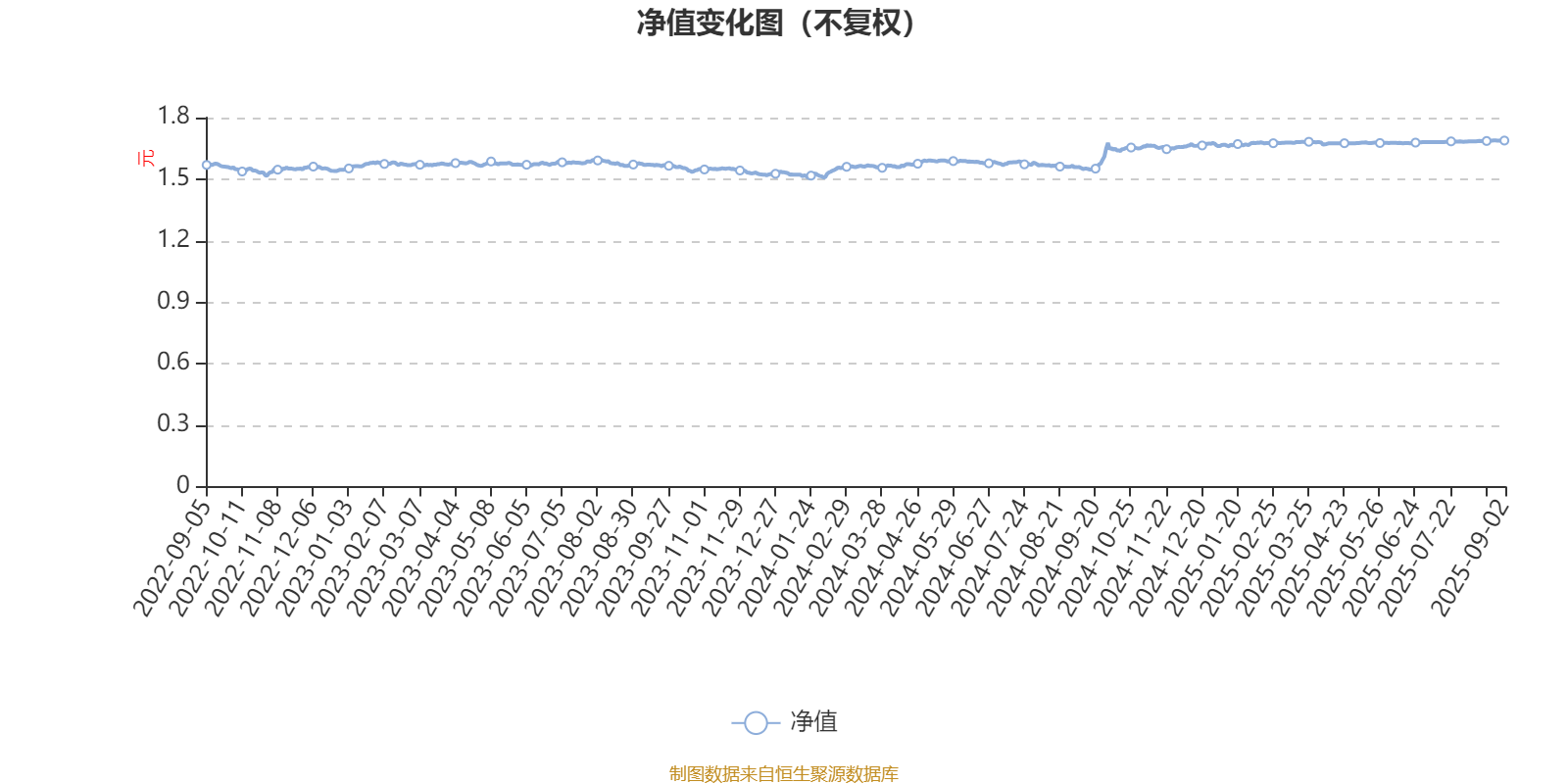
Core Viewpoint - The report indicates that the Guolian Anxin Mixed A Fund (004131) has shown modest performance in the first half of 2025, with a profit of 19,300 yuan and a net asset value growth rate of 0.45% [3]. Fund Performance - As of September 2, the fund's unit net value was 1.688 yuan [3]. - The fund's performance metrics include a three-month net value growth rate of 0.69%, a six-month growth rate of 0.75%, a one-year growth rate of 8.36%, and a three-year growth rate of 7.79% [6]. Fund Management Insights - The fund management anticipates greater economic pressures in the second half of the year due to delayed impacts of U.S. tariff policies, leading to a continuation of proactive fiscal and moderately loose monetary policies [3]. - The fund will maintain a diversified and stable asset allocation strategy, focusing on undervalued high-dividend assets and growth opportunities in sectors like TMT, automotive, and machinery [3]. Valuation Metrics - As of June 30, 2025, the fund's weighted average price-to-earnings (P/E) ratio was approximately 14.47 times, compared to the industry average of 17.52 times [10]. - The weighted average price-to-book (P/B) ratio was about 1.54 times, while the industry average was 1.75 times [10]. - The weighted average price-to-sales (P/S) ratio was approximately 1.7 times, slightly above the industry average of 1.59 times [10]. Growth Metrics - For the first half of 2025, the fund's weighted revenue growth rate was 0.02%, and the weighted net profit growth rate was 0.04% [18]. Fund Composition - As of June 30, 2025, the fund's total assets amounted to 3.9149 million yuan [33]. - The top ten holdings included companies such as Haier Smart Home, Bank of Communications, and Yili Group [42]. Investor Composition - The fund had a total of 659 holders, with individual investors holding 91.35% of the shares, while institutional investors accounted for 8.65% [36]. Trading Activity - The fund's turnover rate for the last six months was approximately 123.31%, which has been consistently below the industry average for two years [39].