腾讯

Search documents
港股科技50ETF(159750)放量下挫,盘中超5000万资金逆势净买入,机构:AI与新消费仍有较大空间
Ge Long Hui· 2025-09-23 07:40
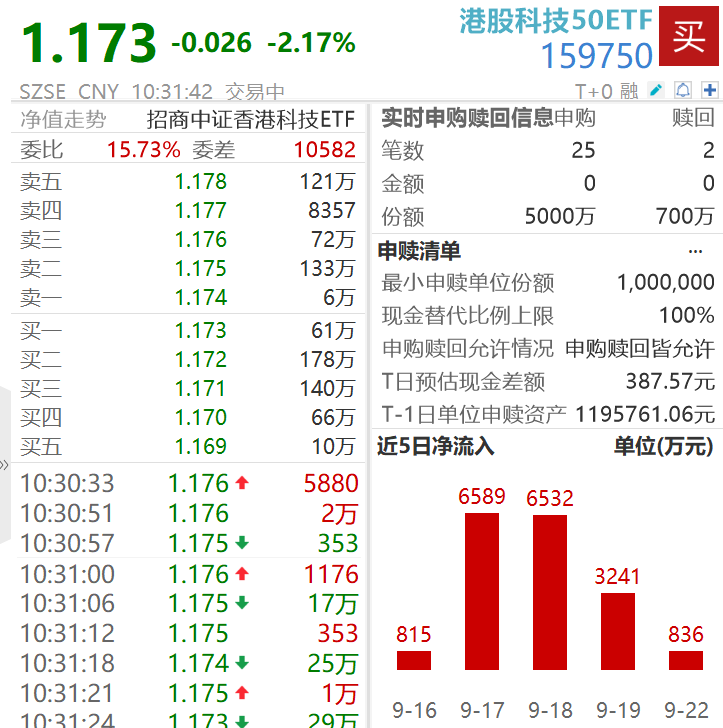
Market Performance - Hong Kong stocks experienced a decline, with NIO-SW dropping over 7% and Baidu Group falling over 6%. Other companies like ZTE, JD Group-SW, and BYD also saw declines exceeding 4% [1] - The Hong Kong Technology 50 ETF (159750) fell by 2.17%, with a trading volume of 116 million CNY, indicating significant market activity [1] - Despite the overall market decline, the Hong Kong Technology 50 ETF has seen a net inflow of over 500 million CNY in the past seven trading days [1] Foreign Investment Trends - Recent data shows a positive trend in foreign capital inflow, with the KraneShares CSI China Internet ETF (KWEB) experiencing its longest consecutive inflow period since February, totaling six weeks [2] - As of September 17, foreign capital net inflow into overseas Chinese stocks reached 1.86 billion USD, marking the highest weekly inflow since November of the previous year [3] Market Outlook - Analysts from CITIC Securities suggest that with the Federal Reserve's interest rate cuts, the liquidity situation is improving, which may lead to sustained foreign capital inflow into the Hong Kong market [3] - The Hong Kong technology index is currently valued at 24.56 times PE-TTM, which is significantly lower than the valuations of major global technology indices, indicating a favorable investment opportunity [3] - Long-term prospects for the Hong Kong market are positive, particularly in sectors such as AI technology and new consumption, which are expected to drive market growth [5]

具身智能IPO热潮涌动:资本狂欢背后,规模商用仍任重道远
Nan Fang Du Shi Bao· 2025-09-23 06:17
Group 1 - The domestic robotics sector has rapidly entered the capital market, with multiple companies like UBTECH and Yujian Technology going public, indicating a significant trend in the industry [2][3] - In 2024, Shenzhen led the nation with 34 successful robot company IPOs, reflecting the growing interest and investment in the robotics industry [2] - Despite the surge in IPOs and funding, there remains a gap between financing and practical application, with many humanoid robots still in demonstration stages and limited adoption of collaborative robots in factories [2][8] Group 2 - UBTECH became the first humanoid robot company to list on the Hong Kong Stock Exchange in December 2023, with projected revenue of approximately 1.305 billion yuan and a net loss of about 1.124 billion yuan for 2024 [2][7] - Yujian Technology followed as the first collaborative robot company to go public in December 2024, reporting an estimated revenue of 373.7 million yuan and a net loss of around 95.4 million yuan [3][7] - Other companies like Yushut Technology and Zhiyuan Robotics are preparing for IPOs, indicating a strong pipeline of new entrants in the market [5][7] Group 3 - The total financing in the domestic robotics sector reached approximately 38.624 billion yuan by August 2025, significantly higher than the previous year's total of 21.254 billion yuan [8] - Major tech companies like JD, Ant Group, and Tencent are heavily investing in the robotics sector, enhancing the financial backing for these companies beyond traditional venture capital [9] - Despite the influx of capital, many companies, such as Ledong Robotics, continue to report losses, highlighting the challenges of achieving profitability in the sector [9][10] Group 4 - The primary challenges facing the robotics industry include high production costs, the need for tailored applications in various scenarios, and the lack of a complete ecosystem for robotics technology [14][15] - Experts warn against the "capital rush" effect, where companies may rush to IPO without solidifying their technology and business models, potentially harming long-term competitiveness [12][13] - The future of the robotics industry in China is promising due to a large manufacturing market, a complete supply chain, and government support, but sustainable business models are essential for success [15]
KWEB连续第六周资金流入!港股科技50ETF(159750)融资余额创上市新高,机构:内外资有望持续流入港股
2 1 Shi Ji Jing Ji Bao Dao· 2025-09-23 03:15
Market Performance - Hong Kong stocks experienced a decline, with notable drops in companies such as NIO-SW (over 7%), Baidu Group (over 6%), and others like ZTE Corporation, JD Group-SW, and BYD Company (over 4%) [1] - The Hong Kong Technology 50 ETF (159750) fell by 2.17%, with a trading volume exceeding 116 million yuan, while it saw a net subscription of 43 million shares during the session [1] - The ETF has recorded a continuous net inflow of over 200 million yuan in the past seven trading days [2] Foreign Investment Trends - There is a positive trend in foreign capital inflow, with a reported net inflow of 1.86 billion USD into Chinese stocks, marking the highest weekly inflow since November of the previous year [2] - The KraneShares CSI China Internet ETF (KWEB) has seen a continuous inflow for six weeks, totaling 599 million USD, although this is less than one-third of the inflows recorded in January and February [1][2] Valuation Insights - As of September 22, the valuation of the Hong Kong Technology Index stands at 24.56 times PE-TTM, which is significantly lower than the Nasdaq Index (43.41x) and the ChiNext Index (43.65x) [2] - The Hong Kong Technology Index has shown a cumulative increase of 131.68% since its base date, outperforming the Hang Seng Technology Index, which increased by 109.81% during the same period [3] Investment Outlook - Long-term prospects for AI technology and new consumption sectors are viewed positively, with expectations of driving market growth [3] - Continuous inflow of southbound funds is expected to enhance marginal pricing power in the Hong Kong market, particularly in the context of a low-interest-rate environment [3] - The transition from broad monetary policy to broad credit policy in China, along with potential further interest rate cuts in the U.S., may support the Hong Kong market's upward trajectory [3]
从技术开源到文化融合:AI大模型如何重塑全球创新生态与人文温度
Huan Qiu Wang· 2025-09-23 02:53
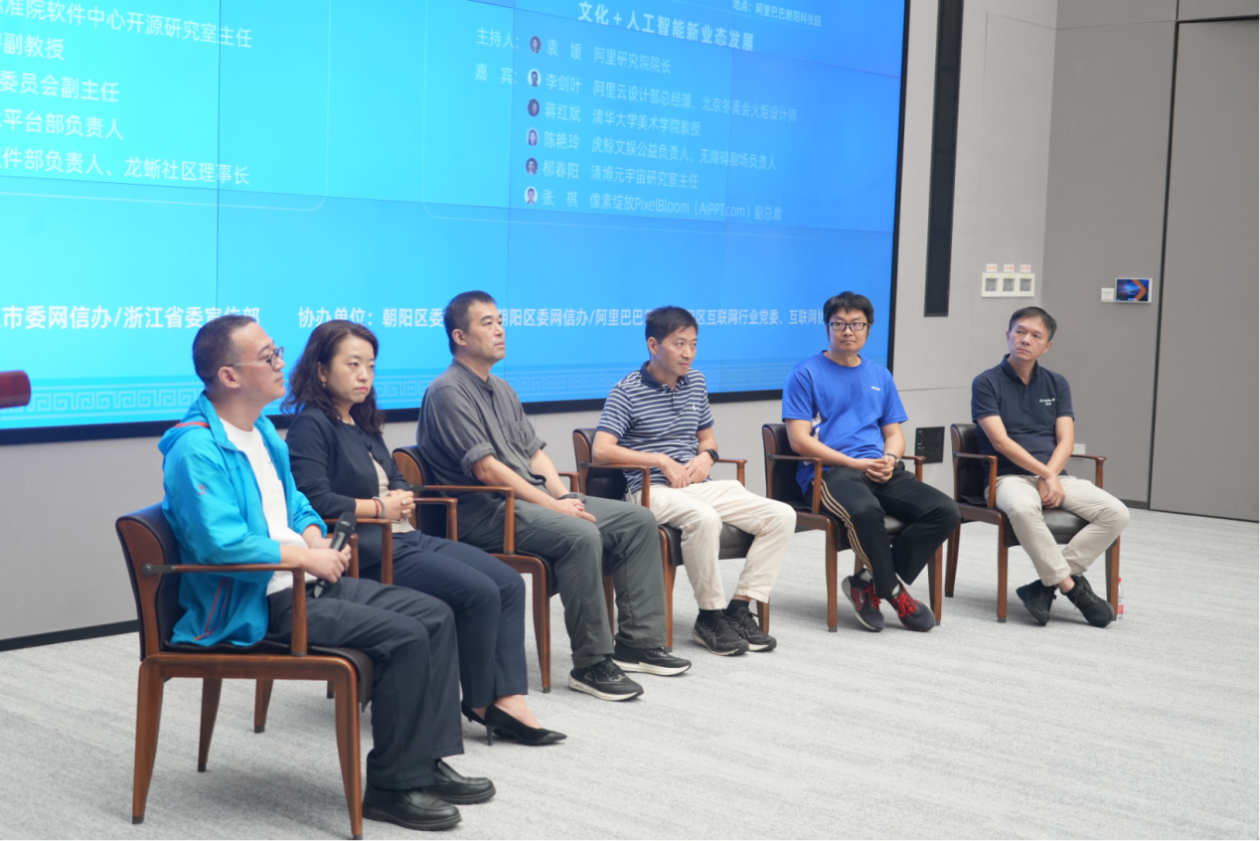
Core Insights - The event "Cultural Intelligence New Business Forms: Industry Empowerment and Innovation Pathways" was held to explore the integration of open-source AI technology with cultural industry innovation [1] - China has made significant progress in the open-source ecosystem, now leading globally in open-source large models [3][4] - The discussion emphasized the need for a governance framework addressing data quality, copyright, and ethical considerations in AI development [5][9] Group 1: Open Source Development - China has transitioned from being a user of open-source technology to a contributor, with major companies like Alibaba, Baidu, and Tencent leading this change [1][3] - The number of Chinese developers has surpassed that of the U.S., providing a strong foundation for a thriving open-source ecosystem [3] - Chinese companies are adopting a more open strategy in AI development compared to U.S. firms, which tend to keep core models closed [4] Group 2: AI and Cultural Integration - AI is transforming cultural creation and dissemination, moving from being a mere tool to becoming a creative partner [7][10] - Examples include the collaboration between Alibaba Cloud and the Paris Olympic Committee to restore historical images using AI [7] - AI is enhancing accessibility in cultural services, allowing for tailored experiences for visually and hearing-impaired audiences [7] Group 3: Governance and Ethical Challenges - The current lack of standardized licensing frameworks for AI models poses challenges for transparency and data quality [5] - Experts suggest that AI should be recognized as a co-creator in copyright discussions, with proposals for blockchain to document contributions [9] - Balancing model capabilities with safety and regulatory oversight is crucial for fostering innovation while ensuring ethical standards [9][10] Group 4: Future Directions - The synergy between technology and culture is essential for societal progress, with a focus on both innovation and humanistic values [10] - China's dual development path of "technological inclusivity + cultural integration" serves as a model for AI advancement [10] - The potential for China to lead in various fields, including mobile and consumer electronics, is highlighted as a significant opportunity for global influence [10]

AI产业的进一步推演——模型,芯片的下一步
2025-09-23 02:34
Summary of Key Points from the Conference Call Industry Overview - The AI industry is undergoing significant structural changes, with increased collaboration and competition among companies, notably highlighted by Nvidia's investment in Intel and Oracle's $450 billion order, indicating a shift in market dynamics [1][3][4] - The AI sector in the US stock market shows a mixed performance, with Nvidia's stock stagnating while Oracle's announcement sparked market enthusiasm, reflecting a focus on the commercialization of AI and the cloud service ecosystem [1][4] Core Insights and Arguments - AI capital expenditure is projected to reach $400 billion in 2025, while revenues are only expected to be $30 billion, indicating a heavy reliance on external financing to support infrastructure development [6][7] - The competition in the model segment is intensifying, with Google's TPU showcasing economic advantages over Nvidia's GPUs, positioning Google Cloud as a potential leader in the enterprise market [1][8][14] - The trend is shifting from high-performance computing to cost-effective and customized chip solutions, as cloud providers seek to break Nvidia's monopoly [11][12] Notable Developments - The partnership between OpenAI and Oracle may be influenced by political factors, as it aligns with US government initiatives, while also allowing OpenAI to diversify its partnerships beyond Azure [8] - The emergence of new models like Meta's Grok 4 and Gemini indicates a competitive landscape where traditional models like ChatGPT 5 are underperforming [8][14] - The AI industry is moving towards more complex applications requiring tailored solutions, emphasizing the need for effective technology application in specific scenarios [9] Investment Opportunities and Risks - In the consumer application space, companies face challenges due to market saturation and price wars, while enterprise applications show a more stable competitive landscape [10] - The investment landscape is shifting, with companies like Coreweave leveraging financing for computational investments, making data center construction more attractive amid anticipated interest rate cuts [5][6] - The AI sector's evolution necessitates a reassessment of investment strategies, particularly in light of the changing dynamics between US and Chinese companies in the AI field [15][27] Additional Insights - The AI industry's capital expenditure significantly exceeds its revenue, leading to a reliance on external funding sources for infrastructure development [6][7] - The increasing complexity of application scenarios in AI necessitates comprehensive solutions that integrate hardware and software effectively [9] - The competitive landscape in the AI sector is evolving, with established companies needing to adapt to new entrants and changing consumer demands [10][15]





每日投资策略-20250923
Zhao Yin Guo Ji· 2025-09-23 02:29
Global Market Overview - The Hang Seng Index closed at 26,344, down 0.76% for the day but up 31.33% year-to-date [1] - The S&P 500 and Nasdaq in the US saw increases of 0.44% and 0.70% respectively, with year-to-date gains of 13.81% and 18.01% [1] - The Shanghai Composite Index rose by 0.22%, reflecting a year-to-date increase of 14.23% [1] Sector Performance - In the Hong Kong market, the Hang Seng Financial Index fell by 0.85%, while the Hang Seng Industrial and Commercial Index decreased by 0.68% [2] - The Hang Seng Property Index dropped by 1.25%, indicating a year-to-date increase of 23.48% [2] - The energy and consumer staples sectors in the Chinese stock market experienced declines, while materials, healthcare, and information technology sectors saw gains [3] Monetary Policy and Economic Outlook - The People's Bank of China is expected to continue a loose monetary policy, with potential reserve requirement ratio cuts of 50 basis points and interest rate cuts of 10 basis points in Q4 [3] - The steel industry in China will implement capacity controls, prohibiting new capacity additions from 2025 to 2026, with an expected annual growth of around 4% in value added [3] Company Focus - Geely Automobile (175 HK) is rated as a buy with a target price of 25.00, representing a 34% upside potential [4] - Luckin Coffee (LKNCY US) is also rated as a buy, with a target price of 44.95, indicating a 20% upside [4] - Tencent (700 HK) has a target price of 705.00, suggesting a 10% upside potential [4] Technology Sector Insights - Nvidia plans to invest $100 billion to support OpenAI in building a 10GW data center, leading to a nearly 4% increase in its stock price [3] - The semiconductor sector is highlighted with companies like Horizon Robotics (9660 HK) and North Huachuang (002371 CH) rated as buy, with target prices indicating significant upside potential [4] Investment Opportunities - The report identifies several companies with strong growth potential, including BYD Electronics (285 HK) and Salesforce (CRM US), both rated as buy with substantial upside targets [4] - The healthcare sector is represented by companies like BeiGene (ONC US) and 3SBio (1530 HK), both rated as buy, indicating confidence in their future performance [4]



中信证券:国内外算力持续创新演进 持续看好NV链与国产AI算力
智通财经网· 2025-09-23 00:41
Core Viewpoint - The report from CITIC Securities reaffirms a positive outlook on the NV chain's prosperity and the innovation iteration of domestic AI, highlighting continuous advancements in demand from overseas companies like Oracle and ongoing technological innovations such as OCS [1] Group 1: North America Market Insights - CITIC Securities adjusts the 2025 capital expenditure forecast for the four major CSPs in North America to $383.6 billion, a 52% increase year-on-year from 2024, with an expected 2026 capital expenditure of $461.3 billion, a 20% increase from 2025 [1] - The firm believes that the continuous upward revision of capital expenditure by North American internet companies will sustain the prosperity of the NVIDIA supply chain, with core suppliers like Hon Hai Precision Industry expected to achieve rapid growth in performance over the coming years [1] Group 2: Domestic Market Developments - According to Alibaba and Tencent's Q2 2025 earnings calls, domestic internet companies are expected to continue investing in AI infrastructure, with projected capital expenditures exceeding 500 billion yuan in 2026, where AI servers are anticipated to account for over half of this investment [2] - The domestic AI server market is expected to reach 420 billion yuan and the AI computing chip market is projected to reach 350 billion yuan by 2026, with next-generation domestic chips expected to rapidly enhance software ecosystems and interconnectivity [2] Group 3: Technological Innovations - Oracle anticipates its cloud infrastructure revenue to reach $18 billion in FY2026, a 77% year-on-year increase, with projections for FY2027 to FY2030 reaching $32 billion, $73 billion, $114 billion, and $144 billion respectively [3] - OCS technology is expected to provide high bandwidth, low latency, and low-cost network solutions, with its adoption anticipated to replace traditional switching technologies in AI clusters, creating significant market opportunities [3] Group 4: Domestic AI Computing Innovations - Huawei has unveiled its Ascend AI chip development roadmap, indicating rapid improvements in hardware microarchitecture, low-precision performance, and interconnect bandwidth, which are expected to enhance product competitiveness and potentially replace overseas chips in certain scenarios [4] - The domestic AI computing market is projected to grow continuously due to increasing demand from downstream internet and government enterprises, with domestic chip market share expected to rise as competitiveness improves [4]

在中国做关系必须理解江湖
3 6 Ke· 2025-09-22 11:11
Core Insights - The article discusses the importance of understanding the "jianghu" (江湖) concept in public relations for companies, emphasizing that many enterprises fail to grasp this, leading to poor crisis management [4][5][7] - It highlights the difference between companies that can effectively handle crises and those that cannot, attributing this to their understanding of social networks and relationships within the media landscape [3][5][7] Group 1: Understanding "Jianghu" - Companies need to recognize the significance of "jianghu" in public relations, which involves understanding the social dynamics and relationships within the media [5][7] - The article points out that many large companies lack the necessary connections in the media, making them vulnerable to crises [5][7] - The concept of "jianghu" is broken down into three stages: entering the circle, maintaining face, and being sincere [5][16] Group 2: Importance of Networking - Successful public relations require individuals within companies to be well-connected in the media circle, as this can significantly impact crisis management [6][7] - The article mentions that many companies focus on internal competition rather than building external relationships, which is detrimental in times of crisis [7][8] - It emphasizes that having a strong network can provide crucial support during challenging times, as seen in the cases of companies like Huawei [11][13] Group 3: The Role of Face and Sincerity - Maintaining face is crucial for companies, as it influences how they are perceived by the media and the public [10][11] - The article argues that sincerity in communication and relationships is more valuable than superficial gestures or high budgets [16][19] - It suggests that genuine interactions, rather than extravagant events, foster better relationships with media professionals [18][19] Group 4: Crisis Management - Companies that fail to understand the importance of relationships often find themselves isolated during crises, leading to negative media coverage [15][19] - The article illustrates that arrogance in public relations can alienate media professionals, making it harder for companies to receive support when needed [15][19] - It concludes that the ultimate goal of public relations should be to achieve a recognition of the company's values by society, rather than merely maintaining a facade [21][22]
华尔街观察|美资兴趣回升,中国科网巨头迎估值重估2.0
Di Yi Cai Jing· 2025-09-22 10:13
Core Viewpoint - The resurgence of interest in Chinese tech stocks is driven by advancements in AI and the push for self-sufficiency in chip production, leading to significant stock price increases for major companies like Alibaba and Tencent [1][2][3] Group 1: Market Performance - The Hang Seng Tech Index has surged 41% year-to-date, outperforming the Nasdaq's 17% increase, with a notable 13% rise in the current month [1] - Alibaba, Tencent, and Baidu have seen substantial stock price increases this year, with Alibaba up 96%, Tencent up 55%, and Baidu up 59% [2] - AI-related companies, including Alibaba and Bilibili, are experiencing short squeezes, indicating heightened investor interest [1] Group 2: Valuation and Investment Sentiment - Chinese tech stocks are perceived as significantly cheaper than their U.S. counterparts, attracting speculative investments amid improving market sentiment following U.S.-China talks [2] - The anticipated return of capital to emerging markets, particularly in China, is bolstered by a weaker U.S. dollar and the Federal Reserve's potential interest rate cuts [2] Group 3: AI and Cloud Computing Developments - AI advancements are expected to enhance profitability for Chinese tech giants, with Alibaba's cloud business projected to grow 30%-32% year-on-year in the upcoming fiscal quarters [3] - Alibaba's new AI model, Qwen-3-Max-Preview, boasts a tenfold performance improvement and a significant reduction in construction costs [3] - Baidu's focus on its Kunlun chip has drawn attention, with analysts noting its low valuation despite recent stock price increases [3] Group 4: Semiconductor Industry Outlook - The shift towards a multi-chip strategy among Chinese cloud service providers reduces reliance on foreign chip supplies, positively impacting market sentiment [4] - Goldman Sachs expresses optimism about the Chinese semiconductor industry's growth, driven by a large domestic market and ongoing technological advancements [4] - Morgan Stanley forecasts a 62% year-on-year increase in capital expenditures for top Chinese firms, reaching 373 billion yuan [4]

主观逆袭?但斌、李剑飞等9位主观基金经理进入人气十强!
Sou Hu Cai Jing· 2025-09-22 09:27
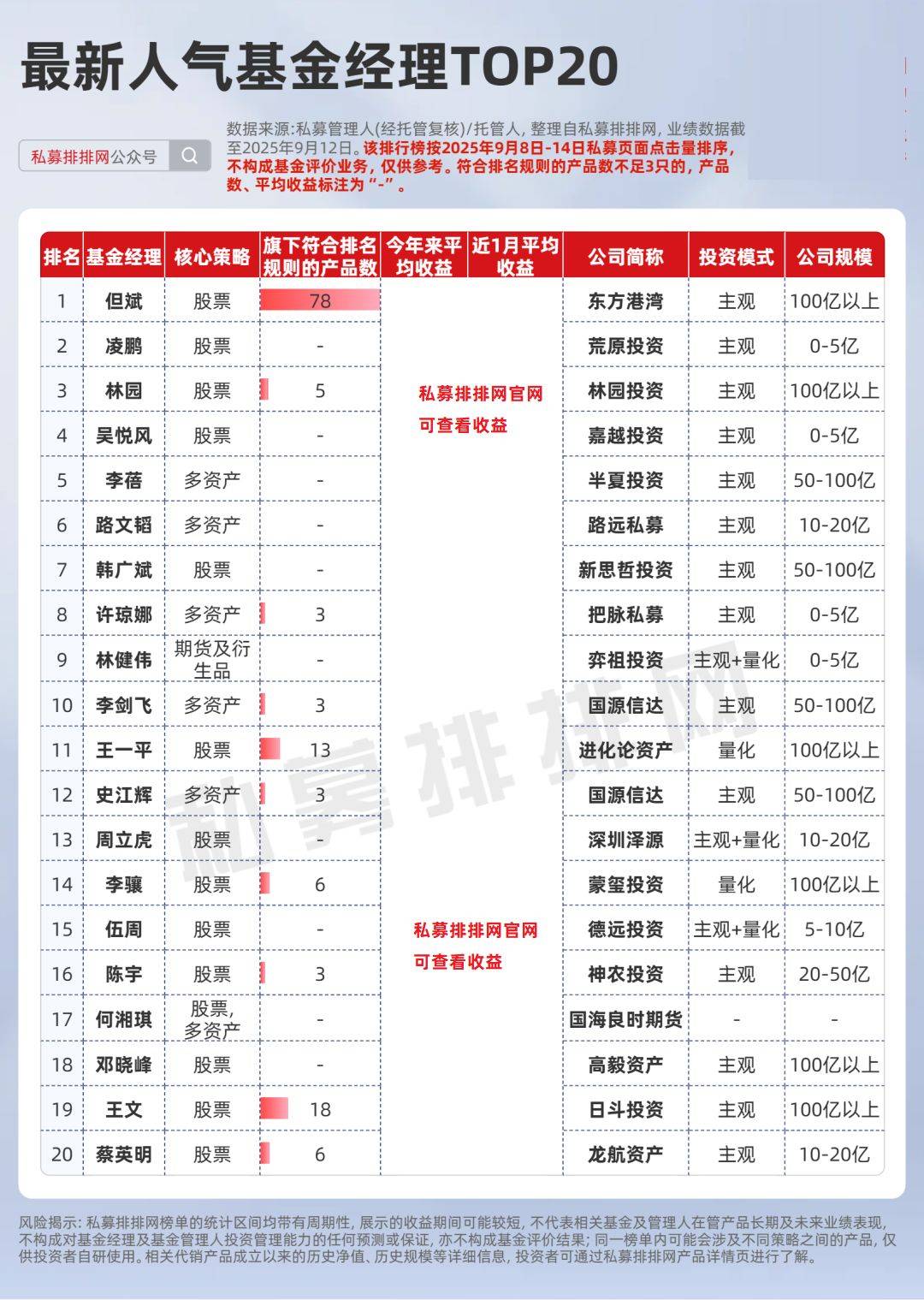
Core Insights - The A-share market has been performing strongly, but there is a noticeable divergence in sector performance, with previously popular quantitative products now struggling to outperform the market [1] - A resurgence of subjective products has been observed, with many previously quiet funds beginning to recover in net value, indicating a "subjective comeback" trend [1] Fund Manager Rankings - As of September 14, among the top 20 fund managers, 15 are from subjective private equity, dominating the rankings [1] - The top-ranked fund manager is Dan Bin, whose products have shown significant returns over the past month and year [3] - The second-ranked manager, Shi Zhi, and others in the top 8 are primarily from smaller private equity firms with assets under 5 billion [2] Performance of Specific Funds - Dan Bin's "Oriental Harbor Marathon Global A Class" has achieved a high cumulative net value and significant returns since inception [3] - Xu Qiongna, ranked 8th, has also seen impressive performance from her funds, particularly "Jinban Capital No. 5," which has shown the highest returns this year [6][7] Market Trends and Predictions - The current market is seen as being in a "slow bull" phase, with expectations of continued recovery driven by policy support and changes in industry supply-demand dynamics [8] - Chen Yu, a prominent fund manager, believes the market is at a pivotal point, similar to historical trends, and anticipates a long-term bull market driven by technological advancements [12][13] Notable Fund Managers - Li Jianfei and Shi Jianghui from Guoyuan Xinda are notable for having two fund managers listed among the top ranks, indicating strong performance across their funds [9] - Cai Yingming from Longhang Asset is recognized for focusing on undervalued, high-cost-performance targets, with his fund "Longhang No. 1" showing significant returns [14][15]