腾讯控股有限公司

Search documents
大模型第一股之争:MiniMax、智谱、月之暗面竞相赴港IPO
Sou Hu Cai Jing· 2025-12-11 13:45
Core Viewpoint - The competition among leading players in the AI sector is shifting from a focus on technology to the ability to create real value, as companies like MiniMax and Zhipu AI prepare for their IPOs in Hong Kong, aiming to establish themselves as the first major players in the domestic large model market [3][4]. Group 1: IPO Developments - MiniMax and Zhipu AI are planning to conduct their Hong Kong IPOs soon, with MiniMax potentially listing as early as January and aiming to raise hundreds of millions of dollars [4][5]. - The competition for the first large model IPO is not just about obtaining a stock code but also about establishing valuation benchmarks and competitive rules in the industry [5][6]. Group 2: Capital Dynamics - The race for the first IPO is fundamentally about capturing scarce capital market attention and pricing power, which is crucial for AI companies still in heavy investment phases [5][8]. - Successful IPOs will set valuation anchors that will influence the financing expectations and negotiation leverage of all players in the sector [5][10]. Group 3: Industry Trends - The demand for large models is surging, with a reported increase of approximately 363% in daily usage tokens for enterprise-level models in China by mid-2025 [9]. - The focus of companies is shifting from extreme performance competition to balancing scenario fit and commercial value, indicating a transition from technical validation to large-scale implementation [9][10]. Group 4: Challenges and Opportunities - The industry is moving into a phase where the ability to generate actual value and integrate with existing business systems is becoming critical [10][12]. - Companies that successfully go public will face new challenges, including transparent financial disclosures and performance evaluations, which will require them to demonstrate commercial capabilities rather than just technical prowess [10][14]. Group 5: Competitive Landscape - The concentration of market power is increasing, with leading companies like Alibaba and ByteDance capturing over 40% of model usage, indicating a "Matthew Effect" in capital, talent, and data [10][11]. - Smaller AI companies are finding their survival space shrinking, leading them to focus on niche verticals like healthcare and finance to build industry-specific knowledge barriers [11][12]. Group 6: Future Outlook - The successful IPOs of AI unicorns will only be the beginning, as the real test will be their ability to convert financing advantages into sustainable, scalable business benefits [12][14]. - The year 2026 is anticipated to be a pivotal moment for the industry, marking a shift from a technology-driven narrative to one focused on tangible value creation [14].


新LP入场,“麻花大王”出资近10亿
3 6 Ke· 2025-12-03 10:38
Core Insights - The primary sentiment in the primary market has shifted from pessimism to optimism, with increased activity in both investment and fundraising [1][3][10] - There is a notable resurgence of institutional Limited Partners (LPs), particularly from traditional industries, indicating a new influx of capital into the market [1][5][12] Investment Activity - Investment institutions are experiencing a significant increase in demand, with some VC firms projecting their total investment projects for the end of the year to reach three times that of the previous year [4][11] - The number of new registered funds has risen by 15.18% year-on-year, with a total of 3,434 new funds recorded [11] Fundraising Trends - The fundraising environment has improved, with multiple RMB funds closing and several dollar institutions announcing new fundraising activities, contributing to overall market confidence [4][10] - Institutional LPs have committed approximately 1.24 trillion yuan in the first three quarters of 2025, reflecting a 9% year-on-year increase [11] Emergence of New Capital - Traditional companies, such as Tianjin Guifaxiang, have begun to participate as LPs, with reported investments totaling nearly 1 billion yuan this year [1][5] - A growing number of consumer companies with strong cash flows are forming a "Consumer LP Army," actively investing in the primary market [7][9] Market Dynamics - The market is witnessing a structural change, moving from a focus on scale to prioritizing quality and cash returns, as evidenced by the return of previously cautious LPs and the entry of new industrial capital [12] - The overall investment sentiment is improving, with industry leaders expressing positive expectations for the market's future [11][12]

中国互联网:TMT 会议核心要点-China Internet_ TMT conference key takeaways
2025-12-01 00:49
Key Takeaways from the TMT Conference on China's Internet and AI Sector Industry Overview - The conference focused on the **China Internet** and **AI** sectors, particularly the advancements in **generative AI (GenAI)** applications and domestic AI chip solutions in 2025 [1][2]. Core Insights 1. **Surge in Generative AI Demand**: The demand for GenAI applications in China is rapidly increasing, supported by government policies and diverse use cases, leading to a significant rise in token consumption across various industries. The State Council's initiative aims for a penetration rate of intelligent terminals and AI agents to exceed 70% by 2027 and 90% by 2030 [2][3]. 2. **Shift to Domestic AI Chips**: Chinese hyperscalers are transitioning to domestic AI chip solutions, redirecting capital from foreign suppliers to local alternatives like Huawei's Ascend and Baidu's Kunlun. This shift is driven by U.S. export restrictions and government subsidies covering up to 50% of power costs for data centers using local chips [3][4]. 3. **Investment in AI Infrastructure**: Total investments in AI infrastructure in China are projected to reach **$98 billion** in 2025, with a focus on enhancing local sourcing and reducing supply chain vulnerabilities [3][4]. 4. **Advancements in AI Chip Technology**: Key players like Huawei and Baidu are producing competitive AI chips that meet the performance needs for GenAI deployment. Huawei's chips are now comparable to Nvidia's for inference tasks, enabling scalable applications [4][9]. 5. **Operational Efficiency Gains**: Enterprises are leveraging GenAI primarily for operational cost reductions and efficiency improvements, with sectors like internet, manufacturing, and finance adopting these tools for various applications [10][12]. 6. **Consumer Adoption of GenAI Tools**: General-purpose GenAI tools, such as chatbots and AI search engines, are gaining popularity in China, often provided for free to attract users. Meanwhile, specialized applications are emerging with monetization strategies [11][12]. 7. **Integration of GenAI in Mobile Apps**: Mid-to-large Chinese internet firms are embedding GenAI features into flagship mobile applications, enhancing user experiences and driving revenue growth. For instance, Tencent's Weixin reported a **15% year-over-year revenue increase** to **$27.1 billion** in Q3 2025, attributed to AI-driven ad monetization [12][13]. 8. **Evolution of GenAI Applications**: GenAI applications are evolving into sophisticated AI agents capable of autonomous task execution, with platforms like Baidu's GenFlow 3.0 serving over **20 million users** [13][14]. 9. **Market Opportunities for Custom AI Agents**: The emergence of marketplaces for custom AI agents indicates significant revenue potential, transforming GenAI from assistive tools to operational cores in e-commerce and other sectors [14][15]. Additional Important Insights - The strategic reallocation of resources towards domestic AI solutions not only enhances China's AI sovereignty but also aligns with government mandates for local sourcing in public data centers [3][4]. - The dual approach of offering free general-purpose tools while developing monetized vertical applications is driving growth in the overall AI ecosystem in China [11][12]. This summary encapsulates the key points discussed during the TMT conference, highlighting the rapid advancements and strategic shifts within China's internet and AI sectors.


100+企业已经申报,榜单倒计时一天!2025年度中国技术力量榜单申报即将截止
AI前线· 2025-11-29 05:32
Core Viewpoint - The "2025 China Technology Power Annual List" is set to recognize outstanding contributions in the AI sector, with a strong lineup of participating companies and a focus on AI innovations and applications [4][5]. Group 1: Event Details - The final registration date for the "2025 China Technology Power Annual List" is November 30, with only one day remaining for submissions [3]. - This year marks the fifth consecutive year of the list's evaluation, receiving submissions from over 100 companies, including industry giants like Alibaba, Tencent, and ByteDance, as well as innovative representatives [4]. - The theme for this year's list is "Insight into AI Transformation, Witnessing an Intelligent Future," covering eight major areas related to AI advancements [4]. Group 2: Award Categories - The awards will include eight categories: - 2025 AI Infrastructure Excellence Award TOP20 - 2025 AI Engineering and Deployment Excellence Award TOP20 - "Artificial Intelligence +" Best Industry Solution TOP20 - AI Agent Most Productive Product/Application/Platform TOP15 - Data & AI Most Valuable Product/Platform TOP10 - AI Coding Most Productive Product TOP5 - Embodied Intelligence Star Product TOP10 - AI Open Source Star Project TOP10 [5]. Group 3: Evaluation Process - The evaluation results will be announced on December 19 during the AICon·Beijing event, which will also feature a grand award ceremony [8]. - The evaluation criteria for various awards will involve scoring from an expert panel and the InfoQ editorial team, with user ratings contributing to some categories [9][11]. - Specific dimensions for evaluation will be outlined in the registration forms, focusing on factors such as internal implementation effectiveness, resource investment, replicability, data security, and community engagement in open-source projects [12][14].
8点1氪|香港火灾已致44人遇难;罗永浩喊话华杉公开道歉,无人应声;飞机锁座变相收费,10家航空公司被约谈
3 6 Ke· 2025-11-27 00:07
Group 1 - The fire incident in Hong Kong has resulted in 44 fatalities and 45 injuries, with three individuals arrested for suspected manslaughter due to negligence in fire safety standards [1] - The investigation revealed that the building's exterior had materials that did not meet fire safety standards, potentially contributing to the rapid spread of the fire [1] - The engineering company responsible for the installation of these materials is believed to have acted with serious negligence, leading to significant casualties [1] Group 2 - A total of 10 airlines, including China Eastern Airlines and China Southern Airlines, were summoned for discussions regarding issues related to seat locking and paid seat selection, which have raised consumer complaints [2] - The average seat locking rate in economy class was reported at 38.7%, with concerns over transparency and unfair terms in agreements affecting consumer rights [2] Group 3 - Singshan Group is seeking new investors for its restructuring after a previous proposal was rejected, with Far East Carbon agreeing to participate in the restructuring process [3] - The restructuring process will include initial and final selections, as well as a vote by the creditors' committee [3] Group 4 - Sinovac Biotech has secured a $700 million contract with Brazil to supply approximately 60 million doses of vaccines over the next decade, marking the largest international order for a Chinese vaccine company [4] - This contract includes the development of a vaccine production platform in Brazil, enhancing local vaccine manufacturing capabilities [4] Group 5 - HP Inc. announced a global workforce reduction of approximately 10%, equating to 4,000 to 6,000 jobs, as part of its AI transformation plan aimed at saving $1 billion annually [5] - The company's stock fell over 5% following the announcement, reflecting investor concerns over the impact of layoffs on future performance [5] Group 6 - OpenAI anticipates that by 2030, it will have 220 million paid subscribers for its ChatGPT service, representing 8.5% of its projected 2.6 billion weekly users [6] - The company expects to generate approximately $20 billion in revenue by the end of the year, despite increasing losses due to high development costs [6] Group 7 - Li Auto reported a revenue of 27.4 billion yuan for Q3 2025, a year-on-year decline of 36.2%, with a net loss of 624 million yuan [7] - The company plans to invest over 60 billion yuan in AI development as part of its overall R&D budget of 120 billion yuan for the year [7] Group 8 - High途 announced a revenue of 1.579 billion yuan for Q3 2025, reflecting a year-on-year growth of 30.7%, while reporting a net loss of 147.1 million yuan [8] Group 9 - ByteDance's "Tomato" business is projected to generate over 60 billion yuan in revenue this year, with significant contributions from its various platforms [9] - The company has denied reports regarding the accuracy of these revenue figures [9] Group 10 - Xiaomi has recruited a former Tesla Optimus team member to lead its robotics division, focusing on the development of dexterous robotic hands [10] - This move is part of Xiaomi's strategy to enhance its capabilities in robotics technology [10]

“始祖鸟平替”伯希和二度递表港交所:三年收入增长近4.67倍
Feng Huang Wang· 2025-11-20 07:36
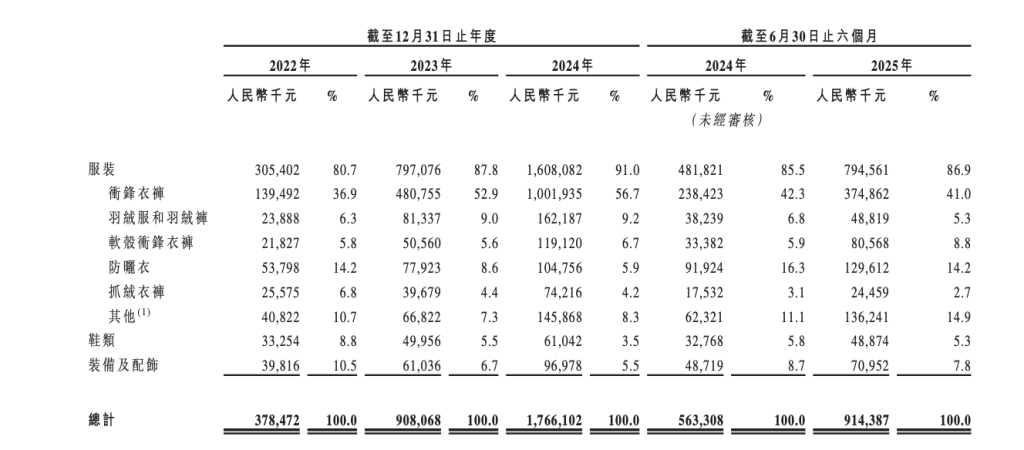
Core Viewpoint - The outdoor sports brand, BERSHKA Outdoor Group Co., Ltd. (referred to as "BERSHKA"), has submitted a new listing application to the Hong Kong Stock Exchange after its initial application expired in April 2025. The company is positioned as a high-performance outdoor lifestyle brand in China and is often referred to as the "alternative to Arc'teryx" on social media [1]. Financial Performance - BERSHKA has experienced rapid revenue growth, with income increasing from 378.5 million RMB in 2022 to 1.766 billion RMB in 2024, representing a growth of nearly 4.67 times over three years. Net profit rose from 24.3 million RMB to 283.1 million RMB during the same period, with adjusted net profit expected to reach 304.3 million RMB in 2024. In the first half of 2025, revenue grew by 62.3% year-on-year to 914.4 million RMB, with a gross margin of 64.2% [2][3]. - The net sales increased from 350.9 million RMB in 2022 to 1.733 billion RMB in 2024, achieving a compound annual growth rate (CAGR) of 122.2%. BERSHKA held a 5.2% market share among local high-performance outdoor apparel brands in mainland China in 2024, and a 1.7% share in the overall market [2]. Product and Sales Channels - BERSHKA's revenue primarily comes from product sales, including clothing, footwear, and accessories, with most sales occurring in mainland China. The company has developed four major product lines: Peak Series, Professional Performance Series, Mountain Series, and Classic Series. Clothing products accounted for 91.1% of revenue in 2024, with a similar proportion of 87% in the first half of 2025 [2]. - The sales channels are mainly online DTC (Direct-to-Consumer), e-commerce platforms, offline DTC sales, and distribution. In the first half of 2025, online DTC sales accounted for 53.6% of revenue, while e-commerce platforms contributed 17.1% [4][5]. Supply Chain and Manufacturing - BERSHKA operates a light asset business model, relying on third-party manufacturers for production. The company has established partnerships with approximately 270 contract manufacturers, primarily located in East and South China. This model allows BERSHKA to focus on product design and brand development while maintaining operational flexibility [7]. - The company has adopted a dual-source strategy for raw material procurement, either sourcing directly from suppliers or allowing manufacturers to procure materials independently. This strategy aims to optimize capital efficiency and reduce fixed costs [7]. Investment and Shareholding Structure - Tencent has invested 300 million RMB in BERSHKA, becoming the largest institutional shareholder with a 10.7% stake. The actual controller of the company, Liu Zhen, and his spouse hold approximately 63.18% of the shares. The company has completed two rounds of investment from various institutional funds, including Qiming Venture Partners [9][10]. - The funds raised from the IPO will be allocated to five main areas: enhancing R&D capabilities, expanding multi-channel sales networks, strategic brand incubation and investment, improving operational and digital infrastructure, and supplementing working capital [10].
阿里、腾讯等同步发力AI Agent,关注软件ETF(515230)
Mei Ri Jing Ji Xin Wen· 2025-11-19 03:02
Group 1 - The software ETF (515230) rose by 1.21% on November 18, indicating a rebound in the AI application sector after a period of adjustment [1] - Alibaba launched the Qianwen App on November 13, a personal AI assistant based on the Qwen model, aiming to compete with ChatGPT and expand into overseas markets. The app quickly climbed from 45th to 6th in the iOS free app rankings on its launch day [2] - Tencent is enhancing AI-native applications within WeChat, planning to introduce a personal agent assistant that can assist users with various tasks directly in the app, leveraging its extensive ecosystem [2] Group 2 - Huawei announced a breakthrough technology in AI set to be released on November 21, which could increase the utilization rate of computing resources from the industry average of 30%-40% to around 70%, significantly enhancing the multimodal capabilities of domestic large models [3] - Institutional holdings in the computer sector were at 3.2% in Q3 2025, showing a slight increase from Q2 but still at historical lows. The core focus remains on AI and technological self-reliance, with investment opportunities in software ETF (515230) and computer ETF (512720) [3]
11月18日大盘简报
Mei Ri Jing Ji Xin Wen· 2025-11-18 11:23
Group 1 - The A-share market experienced a decline today, with the Shanghai Composite Index down 0.81%, the Shenzhen Component Index down 0.92%, and the ChiNext Index down 1.16%. The total trading volume in the Shanghai and Shenzhen markets was 1.95 trillion yuan, an increase of 156 billion yuan compared to the previous day, with over 4,100 stocks declining [1] - The AI application sector rebounded this week after a period of adjustment, with major companies like Alibaba and Tencent launching new AI products. Alibaba introduced the Qianwen App, a personal AI assistant, while Tencent plans to launch a personal agent assistant within WeChat. ByteDance's Volcano Engine released the Doubao programming model, significantly reducing usage costs [1] - The current market environment is characterized by a lack of major adjustment risks, but upward momentum is weakening, leading to accelerated structural rotation. The market is expected to remain in a range-bound oscillation, with a focus on a "dumbbell" structure of technology and dividends for investment [1] Group 2 - The new energy sector saw a noticeable pullback today, primarily due to profit-taking after a recent surge, although the fundamentals remain strong with continued demand from downstream markets. Future attention should be paid to domestic battery production schedules and arrangements for the Spring Festival holiday, as well as the European electricity market's performance due to winter price increases [2] - Investors interested in the new energy sector can consider various ETFs, including the New Energy Vehicle ETF (159806), the Photovoltaic 50 ETF (159864), the ChiNext New Energy ETF (159387), and the Carbon Neutrality 50 ETF (159861) to capitalize on industry opportunities [2]
阿里秘密启动“千问”项目,全面对标ChatGPT;苹果小程序抽佣降为15%;新能源车购置税明年取消全免丨邦早报
创业邦· 2025-11-14 00:09
Group 1 - Alibaba has reportedly launched a secret project called "Qianwen," aiming to develop a personal AI assistant app to compete with ChatGPT, leveraging its Qwen model [2] - Apple has announced a new Mini Apps Partner Program, reducing its App Store commission from 30% to 15% for developers who integrate Apple's technologies [2] - Baidu's founder, Li Yanhong, emphasized the transformation of AI from a cost to a productivity driver, highlighting a shift in the AI industry structure towards a more sustainable model [3] Group 2 - Evergrande Auto has received a court ruling accepting bankruptcy and liquidation requests for its subsidiary, which has halted production since January 2024 [3] - Tencent reported an increase in employee count to 115,076 and a total compensation cost of RMB 32.4 billion for the three months ending September 30, 2025, up from RMB 29.6 billion in the same period last year [5] - A report indicated that the sales volume of consumer-grade AR/VR glasses in China reached 169,000 units in Q3 2025, marking a 17% quarter-on-quarter increase and a 57% year-on-year increase [12] Group 3 - XAI, Elon Musk's AI company, raised $15 billion in its E round of financing, increasing its valuation to $200 billion [7] - Zhejiang Yangli Pharmaceutical completed a B round financing of over RMB 100 million, aimed at advancing multiple products in clinical trials [7] - OPPO and Vivo are acquiring 100% of Guangdong Bubugao Education Development Co., with the transaction entering the public announcement phase [6] Group 4 - The new generation Kunlun chips M100 and M300 were announced by Baidu, with M100 optimized for large-scale inference and set to launch in early 2026, while M300 is designed for ultra-large-scale model training and will launch in early 2027 [10] - A report indicated that starting next year, the full exemption of purchase tax for new energy vehicles will end, with 17 major automotive brands promising to cover the tax for consumers who locked in orders this year [12] - The first commercial world model, Marble, was launched by WorldLabs, enabling the creation of high-fidelity 3D worlds from various inputs [8]



2.2亿元!段永平,又出手了
证券时报· 2025-11-11 11:24
Core Viewpoint - Duan Yongping, a renowned entrepreneur and investor, has made a significant donation of 220 million RMB to Beijing Normal University, aimed at supporting the construction of a comprehensive science and engineering complex and the development of teacher training and cutting-edge disciplines [1][3]. Group 1: Donation Details - The funds from Duan Yongping's donation will be utilized for the construction of a science and engineering complex at Beijing Normal University, which aims to foster interdisciplinary integration and the cultivation of innovative talents [3]. - This donation follows a previous contribution in October, where Duan Yongping donated 10,000 shares of Kweichow Moutai stock to Jiangxi Water Resources and Electric Power University [1][6]. Group 2: Historical Contributions - Duan Yongping has a history of supporting educational institutions, including the establishment of the "Beijing Normal University Yongping Self-Reliance Scholarship" in 2011 and a donation of 5 million USD for the construction of the Duan Ximing Library in 2007 [6]. - In addition to Beijing Normal University, Duan Yongping has made substantial donations to Zhejiang University, totaling over 1 billion RMB in 2023 alone, aimed at infrastructure, talent development, and academic construction [7][8]. Group 3: Personal Background - Duan Yongping's mother, Peng Jianhua, graduated from Beijing Normal University in 1951, which adds a personal connection to his recent donation [3]. - Duan Yongping is recognized in the investment community as "China's Warren Buffett," having made significant profits from investments in companies like NetEase, Apple, Kweichow Moutai, and Tencent [7].