长安

Search documents
上海推“模速智行”行动计划,自动驾驶产业有望迎来加速发展(附概念股)
Zhi Tong Cai Jing· 2026-01-15 01:09
Core Insights - Shanghai has launched the "Mosu Zhixing" action plan to promote high-level autonomous driving, focusing on technology innovation and industrial competitiveness [1][2] - The plan aims to establish public service platforms, including a digital twin training ground for autonomous driving, and expand the open area for autonomous driving to 2,000 square kilometers [1] - The initiative is expected to facilitate the demonstration of L3-level autonomous vehicles and promote their commercial application [2] Industry Development - Shanghai has been proactive in advancing the autonomous driving industry, with previous initiatives such as the 2022 implementation plan for smart connected vehicles and the issuance of road testing licenses for driverless vehicles in 2023 [2] - The action plan includes organized trials for L3-level autonomous taxis and aims to gradually scale up the production and application of L3 vehicles [2] - The demand for advanced autonomous driving components, such as chips and lidar, is anticipated to grow rapidly as the ecosystem expands [3] Company Progress - Several domestic companies, including Changan, BYD, and GAC, have made significant advancements in L3-level autonomous driving, with multiple models receiving road testing permits [4] - Companies like Huawei and GAC have developed solutions and vehicles capable of L3-level autonomous driving, indicating a shift in consumer preferences towards vehicles with advanced driving assistance features [4] - The formal implementation of L3-level autonomous driving regulations is expected to be a key catalyst for industry growth by 2026 [4] Market Opportunities - Companies such as Junsheng Electronics and Seres are actively engaging in strategic partnerships and product launches to enhance their positions in the autonomous driving market [5][6] - The introduction of new Robotaxi services by companies like Cao Cao Mobility marks a significant step towards the commercialization of autonomous driving solutions [6] - The collaboration between ZF and Horizon Robotics to develop L3-level systems is expected to lead to mass production by 2026, highlighting ongoing innovation in the sector [7]
上海推“模速智行”行动计划 自动驾驶产业有望迎来加速发展(附概念股)
Zhi Tong Cai Jing· 2026-01-15 00:14
Group 1 - Shanghai has launched the "Mosu Zhixing" action plan to promote autonomous driving technology innovation and its industrial competitiveness, with a focus on model-driven leadership and application demonstration [1] - The plan aims to establish public service platforms, including a digital twin training ground for autonomous driving, and expand the open area for autonomous driving to 2,000 square kilometers with over 5,000 kilometers of roads [1] - The action plan is expected to provide new support for the development of the autonomous driving industry, including organized smart taxi demonstration operations and pilot projects for L3 autonomous passenger vehicles [2] Group 2 - As of January 14, there are 7,767 companies related to intelligent driving in China, with the East China region accounting for 43.8% of these companies [3] - China holds 51,000 patents related to intelligent driving, with 85.9% being invention patents, indicating a significant growth in both companies and patents in the sector [3] - Nvidia has introduced an open-source AI model platform for autonomous driving, which is expected to enhance the capabilities of autonomous driving systems [3] Group 3 - Several domestic companies, including Changan, BYD, and GAC, have made substantial progress in the L3 autonomous driving field, with multiple models receiving road testing permits [4] - The formal implementation of L3 autonomous driving regulations is anticipated to be a key catalyst for industry development by 2026 [4] - Companies like Aichi Securities believe that automakers with advanced intelligent technology and supply chain control will benefit first from the commercialization of intelligent driving [2] Group 4 - Companies such as Junsheng Electronics and CAOCAO have entered strategic partnerships to develop L4 autonomous driving solutions and digital management platforms [5][6] - The launch of new models by companies like Seres and Leap Motor indicates a competitive landscape in the high-end user market for autonomous vehicles [6][7] - The collaboration between ZF and Horizon Robotics aims to develop L3 intelligent driving systems, with mass production expected in 2026 [7]
港股概念追踪 | 上海推“模速智行”行动计划 自动驾驶产业有望迎来加速发展(附概念股)
智通财经网· 2026-01-14 23:37
Core Insights - Shanghai is advancing its autonomous driving industry through the "Mosu Zhixing" action plan, aiming to transform technological innovation into industrial competitiveness [1][2] - The plan includes the establishment of public service platforms like digital twin training grounds and expands the autonomous driving open area to 2,000 square kilometers with over 5,000 kilometers of roads [1] - The action plan also promotes the orderly organization of smart taxi demonstration operations and the trial of L3 autonomous passenger vehicles [2] Industry Development - Shanghai has consistently pushed for the development of the autonomous driving industry, with previous initiatives such as the 2022 implementation plan for smart connected vehicles and the issuance of road testing licenses for driverless vehicles in 2023 [2] - The introduction of the action plan is expected to provide new support for the industry's growth, particularly in the commercialization of intelligent driving technologies [2] - The demand for advanced autonomous driving components like chips, lidar, and control systems is anticipated to grow rapidly as the ecosystem expands [3] Company Progress - Several domestic companies, including Changan, BYD, GAC, Dongfeng, SAIC, Geely, XPeng, and Li Auto, have made significant advancements in L3 autonomous driving, with multiple models receiving road testing permits [4] - Companies like Huawei and GAC have developed L3 solutions and are actively testing them in various cities, indicating a shift towards practical applications of autonomous driving technology [4] - The formal implementation of L3 autonomous driving regulations is expected to be a key catalyst for industry development by 2026 [4] Related Companies - Junsheng Electronics has signed a strategic cooperation agreement with Sien Intelligent Driving to develop L4 autonomous driving solutions [5] - Seres has launched multiple models, including the Aito M5 and M7, targeting the high-end user market with differentiated positioning [6] - Cao Cao Mobility is advancing its Robotaxi business with the launch of its autonomous driving platform, marking a significant step in operational integration [6] - Leap Motor has commenced nationwide deliveries of its Lafa5 model, which incorporates advanced AI and lidar systems [6] - Horizon Robotics and ZF are collaborating to develop an L3 intelligent driving system, expected to achieve mass production in 2026 [6]
驶入阿拉木图:满街的中国品牌,与一场正在发生的认知变革
2 1 Shi Ji Jing Ji Bao Dao· 2026-01-14 12:15
Core Insights - Chinese brands have established a strong presence in Kazakhstan, becoming a significant part of the local market with a wide range of products from automobiles to electronics [1][2][3] - The trade relationship between China and Central Asia has seen substantial growth, with trade volume expected to reach $60.7 billion from 2017 to 2024, marking a 150% increase [1] - Kazakhstan is emerging as a key hub for Chinese companies looking to expand overseas, with over 9,000 Chinese enterprises operating in the region [1][3] Trade and Investment - By 2024, China's direct investment and loans to Central Asia are projected to exceed $24 billion, with bilateral trade between China and Kazakhstan reaching a historic high of $43.8 billion [3][4] - The market share of Chinese automotive manufacturers in Kazakhstan has surged from approximately 2% in 2020 to 38% in 2024, indicating a rapid acceptance of Chinese vehicles [3][4] Market Dynamics - The local market in Kazakhstan is characterized by a young population, with 95% owning smartphones, making it an attractive target for internet and technology companies [1][2] - The presence of Chinese brands is evident in various sectors, including home appliances, automobiles, and mobile phones, with local production of Chinese vehicles already underway [4][5] Consumer Behavior - There is a notable shift in consumer perception of Chinese products, moving from low-cost options to recognizing their reliability and technological advancements [5][6] - The acceptance of new technologies and experiences by the young population in Kazakhstan provides fertile ground for the introduction of innovative products [5][6] E-commerce and Marketing Strategies - The e-commerce market in Central Asia is projected to reach $14.7 billion by 2024, with Kazakhstan's market alone estimated at $6 billion [6][7] - Companies are advised to adopt a dual approach in marketing: utilizing mainstream e-commerce platforms for quick consumer access while also developing direct-to-consumer (D2C) channels to build brand identity [7][8] Localization Challenges - Entering the Central Asian market requires a nuanced understanding of local languages and consumer habits, as each country has distinct preferences and regulatory environments [8][9] - Companies often underestimate the complexity of the market, leading to potential pitfalls if they do not conduct thorough market research and engage local partners [9]
净利暴涨 4 倍,营收突破百亿!复刻海力士逻辑,它靠“先进封装”杀疯了
市值风云· 2026-01-14 11:06
Investment Rating - The report indicates a strong bullish outlook for the storage industry, particularly for the company Bawei Storage, with expectations of significant revenue and profit growth in the coming years [4][22]. Core Insights - The storage industry is undergoing a transformation from a focus on capacity to a focus on technology, particularly advanced packaging and integrated solutions, which are crucial for meeting the demands of AI applications [39]. - Bawei Storage is positioned as a leader in advanced packaging technology, which allows it to create highly integrated and customized storage solutions, essential for AI edge devices [10][39]. - The company has secured significant contracts with major tech firms like Meta, indicating its strong market position and the effectiveness of its integrated R&D and packaging capabilities [12][14]. Summary by Sections Industry Overview - The semiconductor industry is shifting towards a model where advanced packaging technologies, such as TSV and MR-MUF, are critical for enhancing data transfer speeds and integration with computing [2][3]. - The integration of storage and computing, termed "storage-compute convergence," is becoming the core logic of the industry [3]. Company Performance - Bawei Storage is projected to achieve revenues between 10 billion to 12 billion yuan in 2025, with a net profit forecasted to increase by over 427% to 520% [22]. - The company is expected to see a significant increase in Q4 2025, with revenues projected between 3.4 billion to 5.4 billion yuan, reflecting a growth of over 105% [23]. Technological Edge - Bawei is the only independent storage solution provider globally with wafer-level advanced packaging capabilities, which allows for significant reductions in chip thickness and improvements in data transfer efficiency [10][18]. - The company's advanced packaging technology is crucial for meeting the compact and low-power requirements of AI edge devices, similar to how HBM technology has benefited SK Hynix [10][18]. Market Position and Strategy - Bawei has established a unique ecological position by offering a combination of hardware, firmware, and packaging solutions, which is not easily replicable by traditional module manufacturers [13][14]. - The company is expanding its market reach across various sectors, including AI glasses, smart wearables, and automotive storage solutions, indicating a comprehensive strategy to capture growth in multiple domains [30][32]. Future Outlook - The storage industry is entering a super cycle, with rising prices for NAND Flash and DRAM expected to continue into 2025, benefiting companies like Bawei [21][22]. - Bawei's proactive inventory management and long-term supply agreements with major manufacturers position it well to navigate future demand fluctuations [28].
净利暴涨4倍,营收突破百亿!复刻海力士逻辑,它靠“先进封装”杀疯了
市值风云· 2026-01-14 10:08
Core Viewpoint - The storage industry is undergoing a significant transformation, shifting from a focus on capacity to a focus on technology, particularly in packaging and solution capabilities. Companies like Baiwei Storage, which have successfully positioned themselves in the AI sector, are expected to reap substantial industry benefits [4][36]. Group 1: Industry Dynamics - The semiconductor industry's underlying logic is changing, with a focus on AI computing power and advanced packaging technologies like HBM (High Bandwidth Memory) becoming crucial for success [4][5]. - The integration of storage and computing, termed "storage-compute integration," is essential, with advanced packaging serving as a bridge to achieve this [6]. - The storage industry is entering a super cycle, with prices for NAND Flash and DRAM expected to rise significantly in 2025, reflecting a strong recovery from the downturn experienced in 2023 [22][23]. Group 2: Baiwei Storage's Position - Baiwei Storage has submitted an application for listing on the Hong Kong Stock Exchange and is projected to achieve revenues exceeding 10 billion yuan in 2025, with a remarkable increase in net profit expected in Q4 2025 [6][21]. - The company is the only independent storage solution provider globally with wafer-level advanced packaging capabilities, which allows for significant reductions in chip thickness and improvements in data transmission efficiency [11][20]. - Baiwei's unique business model includes integrated R&D and packaging, enabling it to optimize performance and power consumption, which is critical for AI applications [16][18]. Group 3: Client Relationships and Market Strategy - Baiwei Storage has secured partnerships with major tech companies like Meta, Google, and Xiaomi, positioning itself as a key supplier in the AI glasses market [13][14]. - The company's revenue from AI glasses is expected to grow over 500% in 2025, indicating strong demand in this emerging market [15]. - Baiwei's strategy encompasses a comprehensive approach across "cloud, edge, and endpoint" sectors, with significant engagements in smart automotive and enterprise-level storage solutions [30][31]. Group 4: Future Outlook - Baiwei Storage is well-prepared for future demand growth and has established long-term supply agreements with major manufacturers to secure raw materials [28][25]. - The company is actively pursuing global expansion and aims to leverage its successful projects with North American tech giants to enhance its market position [32][29]. - The combination of advanced packaging technology and a robust R&D framework positions Baiwei to replicate the success of companies like SK Hynix in the storage solutions sector [36].


汽车生产,谁在领跑?(锐财经)
Ren Min Ri Bao· 2026-01-12 20:23
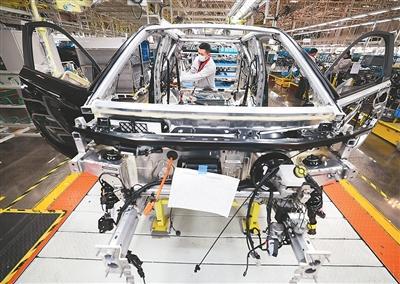
Core Insights - The automotive production landscape in China is evolving, with cities like Chongqing, Beijing, and Shanghai showing significant output figures, particularly in the electric vehicle (EV) sector [2][3][4] - Technological innovation and resilient supply chains are key competitive factors driving the growth of automotive production in various cities [3][5] Production Highlights - Chongqing produced approximately 2.5 million vehicles in the first 11 months of 2025, marking a 12.1% year-on-year increase, with a notable rise in EV production reaching 950,000 units, over six times that of 2021 [3] - Shanghai's vehicle production reached 1.6 million units, with 1.04 million being EVs, while Beijing's output was 1.34 million units, reflecting a 27.6% increase year-on-year [3] - Other cities like Zhengzhou and Qingdao are approaching the million-unit mark, with Zhengzhou's production at 956,300 units, a 16.52% increase [3] Electric Vehicle Leadership - Hefei leads the nation in EV production with 1.25 million units produced in the first 11 months of 2025, supported by a strong industrial base including major brands like NIO and BYD [4] - Hefei's rapid growth in the EV sector is attributed to strategic industry planning and the establishment of production bases for various automotive brands [4] Industry Support and Innovation - The automotive industry in cities like Liuzhou and Qingdao benefits from comprehensive supply chains, with Liuzhou being home to five major vehicle manufacturers [5] - Innovations in autonomous driving and vehicle networking are being spearheaded in Chongqing, with the first L3-level autonomous driving license plate expected by the end of 2025 [5] Policy and Strategic Initiatives - Local governments are implementing supportive policies, such as Chongqing's strategy to develop a world-class smart connected EV industry cluster [6] - Anhui province is also backing Hefei's ambition to become a globally influential EV hub [6] Statistical Changes Impacting Rankings - Changes in statistical methods for vehicle production reporting are reshaping the rankings of leading automotive cities, with a shift from "enterprise location" to "production location" affecting how output is measured [7] - In 2023, Guangzhou maintained the highest production at 3.18 million units, but projections for 2025 indicate shifts in rankings due to these new reporting standards [7] Overall Industry Performance - The Chinese automotive industry demonstrates strong resilience and vitality, with total production and sales reaching 31.23 million and 31.13 million units respectively in the first 11 months of 2025, both showing over 11% year-on-year growth [8] - Factors such as over 50% penetration of new energy passenger vehicles and advancements in L3 autonomous driving are propelling the industry into a new phase of high-quality development [8]
2025全年销量出炉:汽车行业维持“一超多强”格局,三大预期打开行业空间
智通财经网· 2026-01-08 06:29
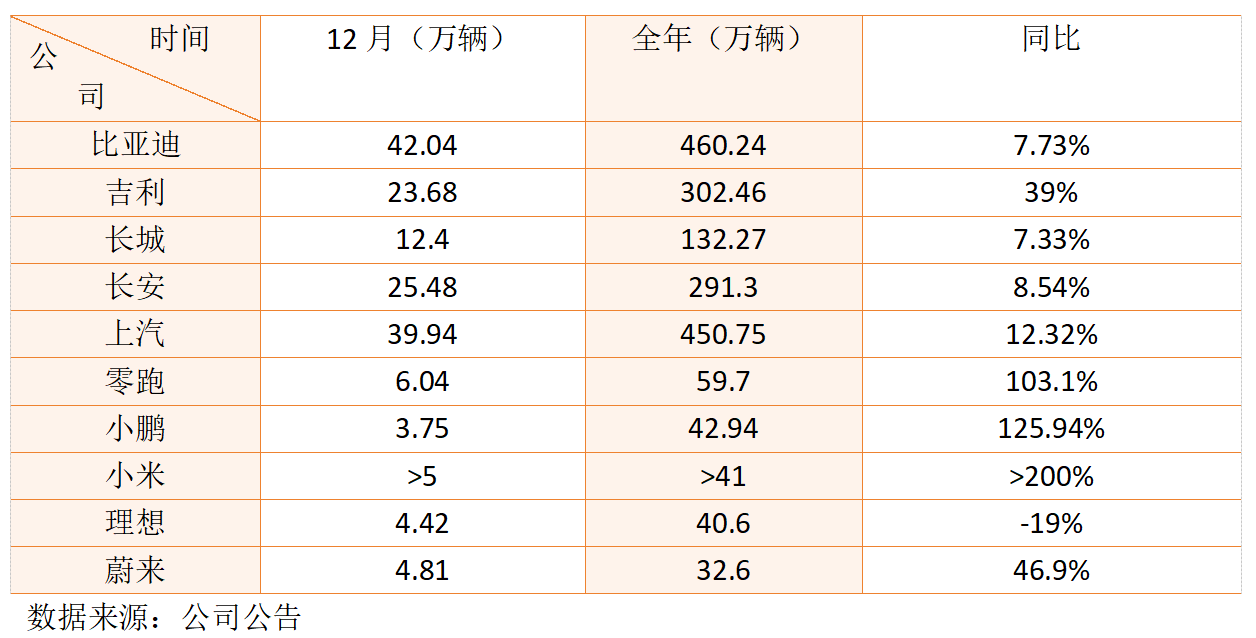
Core Insights - The automotive industry in 2025 has shown a mixed performance, with new energy vehicle (NEV) sales growing significantly while traditional brands face challenges [1][2][10] - BYD remains the dominant player with 4.6024 million units sold, while Leap Motor has emerged as a leading new force with 597,000 units sold [1][2][3] - The market is experiencing a shift towards domestic NEVs, with traditional brands like SAIC and Volkswagen seeing significant declines in sales [2][4] Sales Performance - In December, Leap Motor sold 64,000 units, a 42.11% increase, while NIO and Xiaomi also reported substantial growth [2] - For the entire year, BYD led with 4.6024 million units sold, followed by Geely with 302,460 units and Leap Motor with 597,000 units, which represents a 103.1% increase [3][4] - Traditional automakers, except for BYD, are accelerating their transition to NEVs, with SAIC's NEV sales reaching 1.643 million units, a 33.12% increase [4] Market Trends - The NEV retail penetration rate has surpassed 50%, indicating a slowing growth trend in a high base market [1][4] - The industry is witnessing three major trends: intelligent driving, long-range requirements, and increasing exports [4][5] - The introduction of L3-level autonomous driving vehicles is expected to create new market dynamics [5] Export Growth - NEV exports have surged, with BYD and Chery leading the charge, achieving over 90% growth in export volume [6] - BYD's overseas sales reached 1.0496 million units, a 145% increase, while Chery maintained its position as the top Chinese brand in passenger car exports [6] Investment Opportunities - The automotive sector is currently in an adjustment phase, with some stocks undervalued, presenting potential investment opportunities [8] - BYD is highlighted as a strong investment due to its comprehensive supply chain and rapid overseas growth [8] - Leap Motor is recognized as a leading new force with consistent sales growth and profitability, making it an attractive investment target [8][9] Competitive Landscape - The competition in the NEV market is intensifying, with traditional brands struggling against the rise of domestic manufacturers [7][10] - The market is expected to face challenges in 2026, including the potential withdrawal of purchase tax subsidies and increased competition [7][10]

车圈开年狂打价格战,14大车企秒跟,最狠狂降30万、6折卖车
3 6 Ke· 2026-01-05 05:23
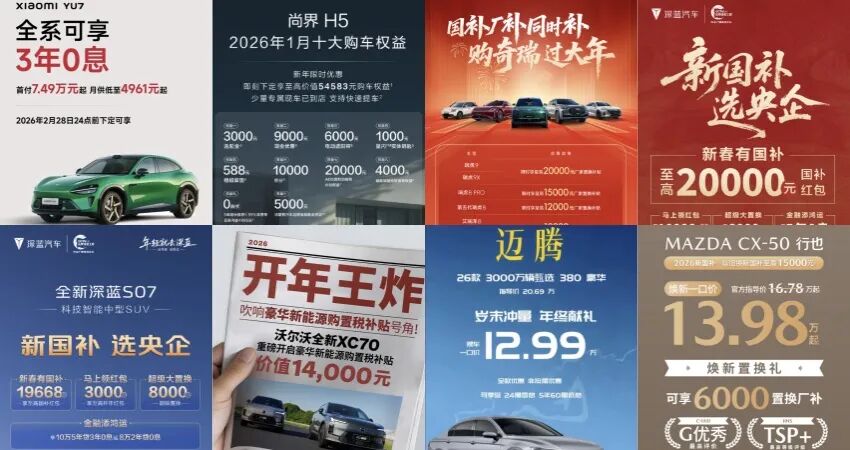
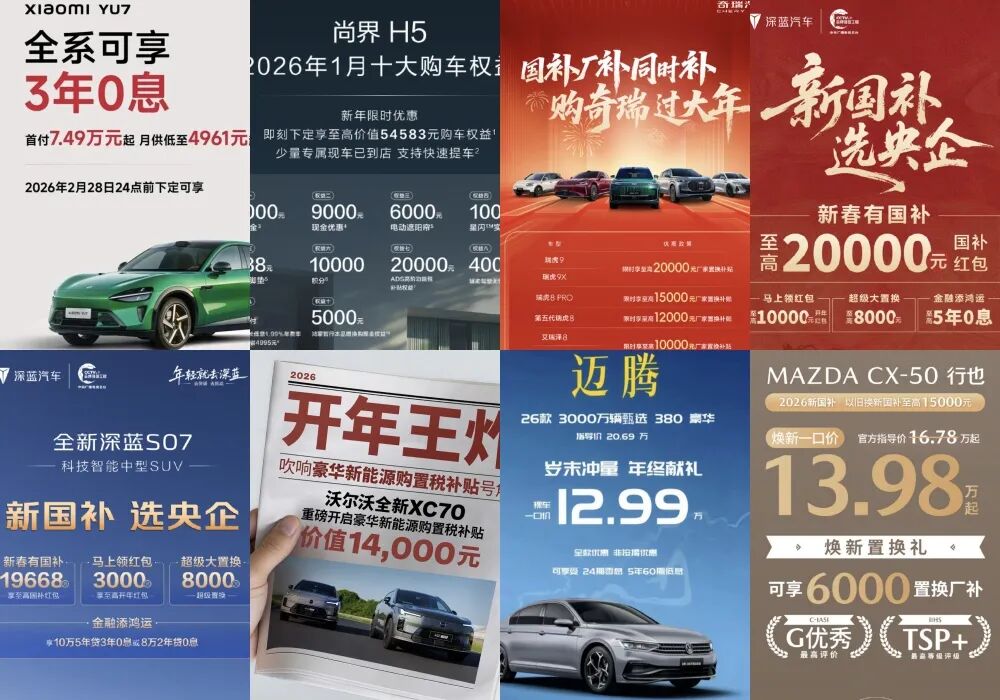
Core Viewpoint - The automotive industry is experiencing a significant price war at the beginning of the year, with over 70 models from 14 major car manufacturers offering substantial discounts, led by BMW's aggressive pricing strategy [1][3][33]. Group 1: Price Cuts and Promotions - BMW announced price reductions on 31 models, with discounts reaching up to 301,000 yuan, marking a strong entry into the new year's price war [1][8]. - Other brands, including Cadillac, are also offering significant discounts, such as the new XT5 priced at 229,900 yuan, down from 379,900 yuan, representing a 39% reduction [3][14]. - A total of over 76 models from various brands, including Volvo, Kia, and domestic manufacturers, are participating in this promotional wave [3][19]. Group 2: Specific Discounts and Offers - The BMW iX1 eDrive25L saw the highest discount of 24%, with its price dropping from 299,900 yuan to 228,000 yuan [11]. - The Volkswagen Magotan 3000 million selection is now available for 129,900 yuan, a 37% discount from its original price of 206,900 yuan [12][14]. - Xiaomi is offering financing options for its YU7 model, including a three-year interest-free plan with a down payment starting at 74,900 yuan [19][21]. Group 3: Market Strategy and Implications - The aggressive pricing strategies from foreign and domestic brands aim to boost sales and capture market share amid increasing competition and market pressures [18][32]. - The promotions not only reduce the financial burden on consumers but also enhance the appeal of advanced technology in vehicles, contributing to the overall growth of the automotive sector in China [33].

车圈开年狂打价格战!14大车企秒跟,最狠狂降30万、6折卖车
Xin Lang Cai Jing· 2026-01-05 01:40
Core Viewpoint - The automotive industry in China is experiencing an early and intense price war in 2026, with over 70 models receiving significant discounts from various manufacturers, marking a competitive start to the year [2][30]. Group 1: Price War Initiation - BMW announced price reductions on 31 models, with discounts reaching up to 301,000 yuan, initiating the first wave of the price war for the year [2][36]. - Other manufacturers, including FAW-Volkswagen and Cadillac, have also introduced substantial discounts, with the former's Magotan model priced at 129,900 yuan, a 40% reduction from its original price [2][13]. Group 2: Promotional Policies Overview - A total of over 76 models from various brands, including Volvo, Kia, and domestic manufacturers like Changan and Dongfeng, have launched promotional policies to attract buyers [4][32]. - Specific promotional offers include: - Xiaomi's YU7 with a 3-year interest-free plan and a down payment starting at 74,900 yuan [5][19]. - NIO's new ET5 models with tax exemptions ranging from 4,779 to 5,619 yuan [5][33]. - Changan's Deep Blue models offering up to 20,000 yuan in subsidies and 5 years of interest-free financing [5][26]. Group 3: Competitive Strategies - The price war is characterized by aggressive pricing strategies from foreign and domestic brands, with European manufacturers like BMW leading the charge [8][36]. - Domestic brands are focusing on value-added services and financial plans to enhance customer loyalty and market penetration, contrasting with the straightforward pricing strategies of foreign brands [28][57]. Group 4: Market Implications - The ongoing price war is expected to lower the barriers for consumers, providing them with more choices and the opportunity to experience advanced technologies at reduced prices [30][57]. - This competitive environment is likely to stimulate sales and improve market performance as companies aim to capture consumer demand at the beginning of the year [30][57].