卡游

Search documents
深耕航空文创,卡游“中国战机收藏卡”横空出世
Xin Jing Bao· 2025-08-01 01:44
Core Viewpoint - The collaboration between KAYOU and AVIC Cultural Co., Ltd. has led to the launch of the "Chinese Fighter Jet Collectible Cards," aimed at promoting national defense knowledge among youth and enhancing national pride [1][5]. Group 1: Product Overview - The "Chinese Fighter Jet Collectible Cards - Winning in Aerospace" includes eight categories of cards: parameter cards, casting cards, principle cards, news cards, lens cards, hunting cards, wing-adding cards, and imagination cards, featuring over 30 major aircraft models including J-20, J-35A, Y-20, Z-20, and the stealth drone Attack-11 [3][4]. - The design emphasizes "fun," "artistic," and "collectible" aspects, with innovative features such as disassemblable casting cards and imaginative future aircraft designs created by renowned mechanical designers [4][3]. Group 2: Educational and Cultural Impact - The cards aim to transform complex aerospace knowledge into accessible visual symbols, making it easier for non-military enthusiasts to understand the core advantages of Chinese fighter jets and showcase national strength [4][5]. - The collectible cards are positioned as cultural symbols of national technological prowess, appealing to the younger generation's interest in military technology and serving as educational tools for national defense [5][6]. Group 3: International and Cultural Exchange - KAYOU's collectible cards are becoming a significant medium for cultural exchange, allowing international collectors to gain insights into Chinese aviation achievements and fostering a sense of national pride among Chinese citizens [7][8]. - The global interest in aviation collectible cards facilitates discussions about different countries' aircraft models and design philosophies, promoting cross-cultural connections among enthusiasts [8].
半两财经|2024年中国时尚零售与时尚消费TOP100发布
Sou Hu Cai Jing· 2025-07-30 03:50
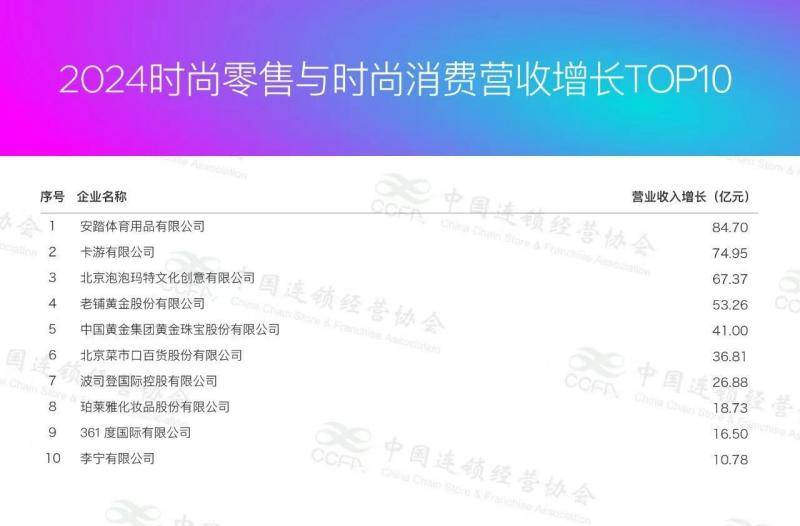
Group 1 - The "2024 China Fashion Retail and Fashion Consumption TOP 100" list was released by the China Chain Store and Franchise Association, highlighting that gold jewelry and sportswear companies dominate the top positions, with Chow Tai Fook Jewelry Group, Anta Sports Products, and China Gold Group ranking in the top three [1] - The overall revenue of the companies in the TOP 100 reached 820.68 billion yuan, showing a year-on-year decline of 2.44%, while the total number of stores decreased by 7.50% [4] - Nearly 60% of the companies experienced a decline in revenue in 2024, although most saw only a slight decrease, while 40% achieved revenue growth, indicating a differentiated development trend within the industry [4] Group 2 - Anta Sports, Kayo, and Pop Mart were the top three companies in terms of revenue growth [5] - 37% of the companies increased their number of stores in 2024, while most companies reported a reduction in store count compared to the previous year. Anta Sports surpassed 12,000 stores, with Semir and Xtep exceeding 8,000 stores [5] - Some companies are optimizing resource allocation and adjusting business strategies, shifting their focus from expanding the number of stores to enhancing store quality to adapt to market changes and strengthen core competitiveness [5]


中国IP玩具受追捧 企业加速“出海”
Zheng Quan Ri Bao· 2025-07-29 15:48
Group 1 - Goldman Sachs reports that China's current IP spending is significantly lower compared to mature markets like North America and Japan, indicating a potential for growth in the IP toy market [1] - The Chinese IP toy market is characterized by a competitive landscape, with the top five companies holding only 20.8% market share, suggesting opportunities for smaller players to capture market share [1] - The supply side of the market is driven by a diversified IP matrix and product design, with new original IPs being launched, such as those from 52TOYS and Letsvan [1] Group 2 - China's share of the overseas toy market has surged from 3% in 2020 to an expected 18% by 2025, showcasing rapid international expansion [2] - Leading global IP toy companies like LEGO, Bandai Namco, and Sanrio are projected to generate significant revenues in 2024, with LEGO at 78.6 billion yuan, Bandai Namco at approximately 60 billion yuan, and Sanrio at around 7.1 billion yuan [2] - Chinese company Pop Mart is expected to achieve 13 billion yuan in revenue for 2024, surpassing Sanrio, and is projected to see substantial growth in the first half of 2025 [2] Group 3 - The acceleration of Chinese companies' international expansion is evident, with Pop Mart's overseas sales expected to grow by 234% in 2025 [3] - The acceptance of Chinese brands in international markets, particularly in Thailand, is increasing, driven by the success of Pop Mart [3] - Companies like Quantum Song and Card Game are actively pursuing overseas markets, focusing on localized operations and adapting their IP offerings to meet regional preferences [3]

被小学生抬上市?卡游一年狂赚44亿,印卡变成“印钞机”
Hu Xiu· 2025-07-29 08:43
Core Insights - The company achieved over 10 billion in revenue within a year, with a net profit of 4.4 billion, indicating strong financial performance in the collectible card game market [1] - The company has successfully dominated the market, capturing 90% of the spending from children under 15 years old, showcasing its significant influence in this demographic [1] Company Focus - The company primarily targets popular intellectual properties (IPs) such as Ultraman and My Little Pony, which are key drivers of its success in the collectible card game sector [1]
以卡牌承载印刷之美,卡游亮相第 33 届全国书博会
Nan Fang Du Shi Bao· 2025-07-26 12:06
Core Viewpoint - The 33rd National Book Trade Fair showcased innovative products from Card Game Company, emphasizing the integration of printing technology and cultural elements through card designs [1][2]. Group 1: Product Innovation - Card Game Company presented a series of innovative products, including the upcoming launch of collectible cards featuring Chinese fighter jets, particularly the J-20, highlighting China's advancements in aviation technology [1]. - The cards are designed to vividly depict the J-20's aerial maneuvers, showcasing high printing precision and detailed illustrations that evoke a sense of national pride among viewers [1]. - The company aims to combine modern culture with Chinese characteristics, using innovative cultural carriers to promote the spirit of perseverance [1]. Group 2: Educational Initiatives - Card Game Company demonstrated the entire process of card creation at their booth, enhancing visitors' understanding of the synergy between card products and printing technology [2]. - The company collaborated with educational institutions to launch an anti-bullying book and accompanying cards, aiming to educate youth on bullying prevention in an engaging manner [2]. - During the fair, Card Game Company participated in a public donation initiative to provide quality cultural resources to children, promoting reading and long-term societal development [2]. Group 3: Market Reception and Strategy - Card Game Company has gained recognition among global consumers, with increasing interest in diverse IP cultural products [3]. - The company focuses on integrating innovative printing techniques with popular IP elements to meet various market demands and provide new cultural dissemination strategies [3]. - The showcased products reflect Card Game Company's commitment to exploring innovation and enhancing cultural communication and education across different fields [3].
集换式卡牌三问三答:新势已燎原,破局正当时
Changjiang Securities· 2025-07-25 14:38
Investment Rating - The report does not explicitly state an investment rating for the industry Core Insights - The domestic card market primarily relies on overseas high-quality IP, while the overseas market is dominated by proprietary IP [7][22] - The core advantages of trading card games (TCG) include longer lifecycles and broader monetization channels [8][10] - Recent efforts by domestic and international manufacturers have created a positive cycle in the trading card industry, potentially leading to new growth points [9] Summary by Sections Differences Between Domestic and International Card Markets - Domestic card companies mainly operate on overseas high-quality IP, while the US and Japan markets are mature with proprietary IP [7][22] - The card types differ, with TCG being predominant overseas and collectible card games (CCG) being more common in China [28] - The domestic card industry is expected to undergo accelerated integration across its value chain [40] Advantages of Trading Card Games - TCGs benefit from longer lifecycles due to evergreen IP and competitive content design [8][57] - The competitive nature and blind box attributes of TCGs enhance user loyalty and consumption frequency [62][71] - TCGs have diversified monetization channels through mobile games and other derivative products [8][10] Breaking Through in the Trading Card Industry - The industry is in a cultivation phase, with consumer habits around competitive play still developing [9] - Domestic manufacturers are enhancing their channel strategies and event experiences to foster a trading card culture [9][49] - The establishment of a robust ecosystem through collaboration between manufacturers and event organizers is crucial for market maturation [9][53]
国联民生证券:传媒互联网业2025年继续关注AI应用、IP衍生品两大投资主线
智通财经网· 2025-07-23 02:25
Group 1 - The core viewpoint of the report is that the media and internet industry is rated as "outperforming the market," with a focus on two main investment themes for 2025: the acceleration of AI applications and the rapid development of the IP derivatives sector [1] - AI applications are expected to continue their rapid iteration, with advancements in models such as OpenAI's o3 and Google's Veo3, which are enhancing reasoning capabilities and multi-modal abilities [2] - The Agent paradigm is becoming a global consensus, with its ability to handle complex problems expanding, supported by improved infrastructure and ecosystem expansion [2] Group 2 - The IP derivatives sector is experiencing significant growth, driven by the rise of spiritual consumption and the ability of domestic IP companies to better manage and operate their IPs [2] - Notable trends include the international expansion of domestic IPs, with brands like Labubu achieving over 100 million GMV on TikTok in May, indicating strong growth [2] - There is an acceleration in transformation, mergers, and capitalization within the industry, with leading companies driving the transition and new brands actively pursuing acquisitions [2]




专访“非洲鞋王”张华荣:现在仍是中国企业出海的最佳时机
Mei Ri Jing Ji Xin Wen· 2025-07-22 08:01
Group 1 - The core viewpoint of the articles emphasizes that going global has become a collective choice for Chinese companies to break through growth boundaries, with various companies like Pop Mart and CAT Games leading the way in cultural expansion and product offerings [1] - A survey indicates that 86% of responding companies have plans to expand overseas in the next three years, highlighting the current favorable conditions for Chinese enterprises to venture abroad [2] - Zhang Huarong, Chairman of Huajian Group, shares his philosophy on how companies can survive and thrive in international markets, emphasizing the importance of internal management and cultural adaptation [2][4] Group 2 - Zhang Huarong's journey from a small shoe workshop in Jiangxi to becoming a major player in Ethiopia's shoe manufacturing industry illustrates the potential for success through strategic international expansion [5] - The Huajian Group has achieved significant milestones in Ethiopia, with a peak workforce of 12,000 employees and accounting for 65% of the local shoe industry's exports, demonstrating the impact of effective management and cultural integration [6] - Zhang identifies two key criteria for selecting overseas markets: low labor costs and favorable tariff conditions, which are essential for maintaining competitiveness [7] Group 3 - The current era is characterized by the rise of artificial intelligence and industrial expansion, with Southeast Asia and Africa being highlighted as promising regions for Chinese companies to explore [7] - Singapore is positioned as a strategic hub for Chinese enterprises, with a strong track record of attracting foreign direct investment and facilitating trade agreements, making it an ideal location for regional operations [8] - Zhang plans to establish a research institute in Singapore to support Chinese companies in their overseas endeavors, leveraging the country's resources to foster regional partnerships [8] Group 4 - Zhang Huarong expresses a desire to mentor the next generation of industrial leaders rather than starting a new venture himself, indicating a commitment to sharing his extensive experience in international business [9]

中国潮玩全球化:IP生态与千亿市场新范式
Huaan Securities· 2025-07-21 07:29
Market Overview - The潮玩 industry in China is in a rapid growth phase, with low per capita spending on潮玩, indicating high growth potential[4] - Emerging markets like Southeast Asia and Latin America show significant growth potential due to demographic advantages and rapid e-commerce penetration[4] - Mature markets in North America and Europe are experiencing a shift in consumer demand from traditional content IP to emerging image IP due to market saturation and changing media consumption habits[4] IP Lifecycle and Characteristics - Content IP generally has a longer lifecycle compared to image IP, with a higher ceiling for derivative value due to a complete worldview[4] - Image IP tends to experience rapid bursts of popularity but relies heavily on ongoing management for sustained value[4] Company Analysis - Pop Mart's growth is not limited by existing IP like Labubu; its core advantage lies in its ability to cultivate new IP efficiently, emphasizing an industrialized approach to the IP ecosystem[4] - Big Media's IP business, backed by Alibaba, has strong operational capabilities and can attract quality IP rights holders and downstream customers[4] - Blucol's strategy focuses on strong IP and low-price products, with significant growth potential in lower-tier markets[4] - Card Game's core advantage is its channel strength, with a focus on managing inventory and capitalizing on market trends[4] Investment Recommendations - The潮玩 industry in China is recommended for investment due to its rapid growth and low PEG ratios compared to global peers, with a focus on companies like Pop Mart (9992.HK), Big Media (1060.HK), Blucol (0325.HK), and Card Game (not yet listed)[4] Risk Factors - Potential risks include underperformance in copyright renewals, intensified industry competition, and production capacity issues[4]
中金《秒懂研报》 | 从“小纸片”到“大生意”:卡牌经济如何撬动百亿元大市场?
中金点睛· 2025-07-19 13:14
Group 1 - The rise of card games has transformed them into trendy consumer products, merging elements of collection, social interaction, investment, and competition, thus creating a new category in consumer goods [1][2] - The card industry has seen rapid growth in China, with the collectible card market projected to reach 26.3 billion yuan by 2024, reflecting a compound annual growth rate of 56.6% from 2019 to 2024 [4][5] - Despite the rapid market growth, per capita spending on cards in China is only 15.7% of that in Japan and 29.2% of that in the United States, indicating significant room for growth [5][6] Group 2 - The consumer base for card games is driven by emotional connections to specific IPs, seeking emotional relief and low-barrier social interactions, leading to a lightweight consumption model [8][10] - Card games create diverse consumption scenarios through various gameplay styles, with competitive play providing intellectual satisfaction and collectible aspects appealing to aesthetic desires [10] - The integration of popular IPs significantly boosts consumer engagement, with 71.3% of consumers purchasing products due to beloved IP elements, demonstrating the effectiveness of content-driven marketing [10][15] Group 3 - The card industry is characterized by a collaborative supply chain involving IP owners, design and production entities, and sales channels, which enhances efficiency and reduces risks [11][13] - Recent trends show vertical integration within the card industry, with companies managing the entire supply chain from IP licensing to production and sales, optimizing profitability [13][15] - Approximately 70% of leading domestic IPs have ventured into card games, with a significant portion of sales coming from local IPs, indicating a strong market presence and potential for further growth [15][17]