极氪

Search documents
“未见车,先付全款?”极氪车主声讨车企税补“变脸”
Di Yi Cai Jing· 2026-01-12 08:40
Core Viewpoint - The article discusses the disputes arising from the "purchase tax subsidy" policy implemented by Zeekr, where customers are required to pay the final payment and issue an invoice before vehicle delivery, leading to dissatisfaction among some car owners [1][2]. Group 1: Customer Experiences - A customer named Wang Li refused to pay the final payment without seeing the vehicle, citing commercial principles, but Zeekr used this as a reason to deny the purchase tax subsidy [1]. - Many customers share similar experiences, with over 240 individuals reported in a dispute group regarding the purchase tax subsidy [2]. - Customers argue that the right to inspect the vehicle before payment is a legal entitlement and should not be waived due to contractual terms or tax policies [2]. Group 2: Company Policies and Responses - Zeekr's policy states that for orders locked by November 30, 2025, if the vehicle is delivered in 2026 due to Zeekr's reasons, the company will cover the purchase tax difference, up to a maximum of 15,000 yuan [3]. - The company has introduced a "pay first, inspect later" service to expedite the delivery process, which has led to confusion among customers regarding the communication of this policy [5]. - Zeekr is currently mediating disputes related to the purchase tax subsidy, offering various compensation solutions, including points equivalent to cash and adjustments to future orders [6]. Group 3: Changes in Subsidy Policy - The purchase tax subsidy policy for 2026 will see a reduction, with maximum subsidies dropping from 15,000 yuan in 2025 to between 7,000 and 12,000 yuan [6]. - Customers who placed orders in 2025 but failed to complete payment and invoicing by the end of the year will not be eligible for the subsidy, while those whose vehicles were not delivered due to Zeekr's reasons will still receive the subsidy [6].
若愚与硬哥转发了大博主对雷军王传福不提宁德的评论
理想TOP2· 2026-01-12 04:20
Core Viewpoint - The article discusses the shifting dynamics in the electric vehicle (EV) industry, particularly the changing power balance between battery manufacturers and automakers, with a focus on the growing trend of automakers developing their own batteries to gain more control over costs and supply chains [3][4]. Group 1: Industry Dynamics - The power dynamics in the EV industry are changing, with automakers increasingly moving away from reliance on major battery suppliers like CATL (Contemporary Amperex Technology Co., Limited) [3]. - The traditional model where automakers had to "kneel" to battery suppliers for production capacity is being replaced by a more balanced approach, where automakers are looking to self-manufacture batteries or choose from multiple suppliers [3][4]. - The shift is driven by rising costs and the need for supply chain security, which has become a new key performance indicator (KPI) for executives [3]. Group 2: Self-Manufacturing Benefits - Developing in-house batteries can lead to clearer cost structures, often resulting in savings of 10-20% compared to purchasing from external suppliers, while also allowing for better performance specifications [4]. - Automakers are exploring different strategies for battery production, with companies like BYD opting for a fully integrated approach, while others like Xiaomi and Changan are taking a more hybrid route [4]. Group 3: CATL's Response - In response to the changing landscape, CATL is also adapting its strategies by focusing on technological advancements, tighter partnerships with automakers, and shifting its business model from merely selling batteries to providing "battery services" [4]. - The competitive landscape is evolving, with consumers now having the option to choose between vehicles with CATL's technology or those with transparent, self-manufactured batteries that promise cost efficiency and reliability [4].


放下直营执念,新能源车企扎堆拥抱经销商
3 6 Ke· 2026-01-12 00:27
Core Insights - The operational costs of direct sales show significant financial strain for new energy vehicle companies, with annual costs for a single store reaching up to 5-6 million yuan, and a potential total investment of around 1 billion yuan for 200 stores [1][4][12] - The direct sales model, initially seen as a revolutionary approach, is shifting towards a mixed model of direct sales and dealerships due to increasing cost pressures and market competition [1][2][12] Group 1: Cost and Operational Challenges - The high operational costs in prime urban areas are forcing companies to reconsider their direct sales strategies, with some brands like Tesla and Xiaopeng transitioning to dealership models to share costs and expand market reach [1][2][5] - The average price of new energy vehicles is declining, with projections showing a drop from 184,000 yuan in 2023 to 169,000 yuan in 2025, which is squeezing profit margins further [4][8] - The automotive industry's sales profit margin fell to a record low of 4.4% in 2025, highlighting the unsustainable nature of the direct sales model under current market conditions [4][12] Group 2: Market Adaptation and Strategy Shifts - Companies like NIO and Zeekr are exploring more cost-effective channel strategies, with NIO testing a partnership model in lower-tier cities while Zeekr has shifted to a mixed model of direct sales and dealerships [5][6][11] - The shift towards dealership models is becoming widespread, with brands like Avita planning to convert 90% of their stores to a dealership system by 2024 [6][7] - The competition for market share is intensifying, particularly in lower-tier cities where sales growth is significantly higher than in first and second-tier cities, making these markets critical for future growth [9][10] Group 3: Channel Dynamics and Profitability - The transition to dealership models is reshaping the competitive landscape, as dealerships can offer lower prices and additional benefits, leading to a decline in foot traffic for direct sales stores [12][13] - Despite the advantages of dealership models, profitability remains a challenge, with only 42.9% of independent new energy vehicle dealerships reporting profits, while 34.4% are operating at a loss [12][13] - The high initial investment required for dealerships, including showroom renovations and training, poses a significant risk, especially if market performance does not meet expectations [13]
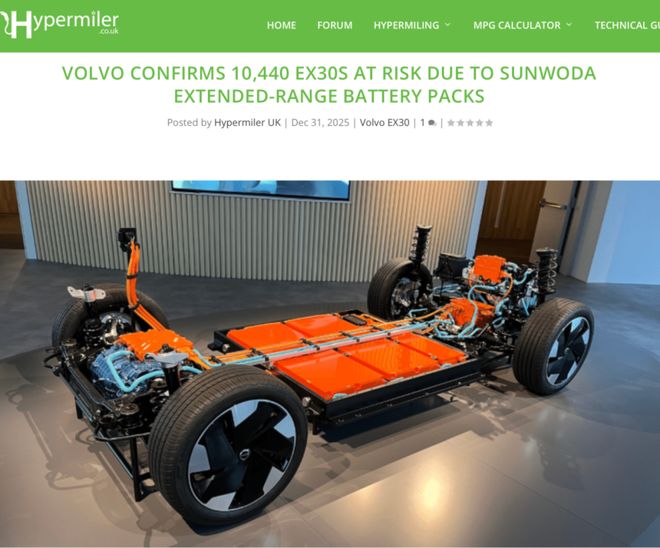
比23亿更严重:欣旺达或让数万海外车主陷入安全隐患
Tai Mei Ti A P P· 2026-01-11 12:03
Core Viewpoint - Volvo Cars, known for its commitment to safety, is facing unprecedented challenges in the electric vehicle era due to safety concerns related to its EX30 model's battery supplied by Sunwoda [1][4][11]. Group 1: Battery Safety Issues - A total of 10,440 EX30 vehicles in the UK are affected by potential safety issues related to high-voltage batteries from Sunwoda, marking a significant acknowledgment of the problem [12]. - Among 33,777 EX30 vehicles produced with Sunwoda batteries, approximately 0.02% have reported overheating issues [4]. - A fire incident involving an EX30 in Brazil raised alarms, leading Volvo to issue warnings to owners to limit charging to 70% to mitigate fire risks [7][11]. Group 2: Recall and Legal Actions - Volvo is preparing for a large-scale recall, with the South African National Consumer Commission already issuing a recall notice for 372 EX30 vehicles due to potential battery defects [7][14]. - Geely Holding, Volvo's parent company, has filed a lawsuit against Sunwoda for 2.314 billion RMB, citing quality issues with batteries supplied between June 2021 and December 2023 [14][17]. Group 3: Consumer Trust and Market Impact - The battery safety crisis has raised significant concerns among consumers, with many questioning the reliability of electric vehicle batteries and the overall quality control in the industry [23][29]. - Volvo's temporary measure of limiting charging to 70% has led to dissatisfaction among owners, as it significantly reduces the vehicle's usable range [12][13]. - The incident has broader implications for the electric vehicle industry, potentially leading to increased scrutiny and a shift towards prioritizing safety and quality over cost [29].

一周新车盘点 | 中改小米SU7开启小订 极氪8X官图发布
Xin Lang Cai Jing· 2026-01-11 07:54
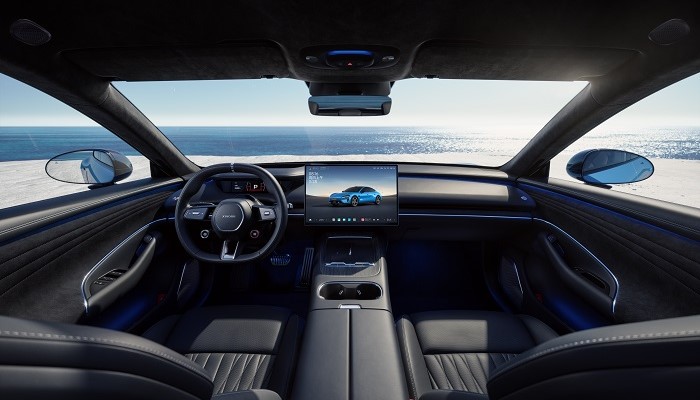
Group 1: Xiaomi SU7 Launch - Xiaomi announced the pre-sale price of the new generation SU7 starting at 229,900 yuan, marking its first mid-term facelift since launch [1] - The new SU7 maintains the overall design but features adjustments in exterior, interior, and configuration, with a maximum range of 902 kilometers under CLTC conditions [1][6] - Key changes include enhanced computing power, millimeter-wave and laser radar, improved driver assistance systems, and nine airbags as standard across all models [5] Group 2: Market Context for SU7 - The current competitive landscape for new energy sedans has intensified, with brands like XPeng, Zeekr, Tesla, and Hongmeng making significant advancements [8] - Xiaomi's strategy for the mid-term update focuses on configuration optimization and detail improvements to stabilize user expectations and balance the market dynamics [8] - The official launch in April may include new purchase incentives or product adjustments, which will be crucial for market performance [8] Group 3: Zeekr 8X Introduction - Zeekr recently unveiled the official images of its mid-large SUV, the Zeekr 8X, which is positioned as a high-performance flagship vehicle [10][11] - The expected starting price is around 400,000 yuan, with the main sales version anticipated to start at 430,000 yuan [11] - The 8X features a design similar to the Zeekr 9X, with a focus on sporty aesthetics and advanced driving assistance capabilities [11][12] Group 4: NIO ES9 Announcement - NIO's ES9 has appeared in the latest Ministry of Industry and Information Technology vehicle directory, marking its first official public appearance [16] - The ES9 is positioned as a flagship SUV with a design that aligns closely with the ES8, emphasizing administrative and high-end travel attributes [16][20] - It features a dual-motor all-wheel-drive system with a total output of 707 horsepower and is expected to utilize NIO's battery swap network for charging [18][20] Group 5: XPeng P7+ Launch - XPeng officially launched the 2026 P7+, offering four configurations with both pure electric and range-extended powertrains [22] - The pure electric version has a maximum CLTC range of 725 kilometers, while the range-extended version achieves a total range of 1550 kilometers [22][24] - The P7+ maintains its existing design while enhancing its intelligent features and charging efficiency, positioning it against competitors like BYD Han and LYNK & CO [24][26]

蔚来全新ES8获大型SUV销量冠军 纯电大三排SUV黄金时代到来?
Zheng Quan Shi Bao Wang· 2026-01-10 08:07
Group 1 - The core viewpoint of the articles highlights the significant growth and competitive dynamics in the large three-row SUV market, particularly focusing on NIO's new ES8 model, which has achieved impressive sales figures and strategic importance for the brand [1][2] - NIO's new ES8 achieved retail sales of 22,258 units in December 2025, becoming the best-selling large SUV and leading in the three-row SUV and models priced above 400,000 yuan [1] - The gross margin of the new ES8 is among the highest in NIO's product lineup, contributing directly to revenue growth, while the company is on track to reduce operating losses and potentially achieve profitability [1] Group 2 - In November 2025, pure electric large three-row SUV sales reached 46,209 units, marking a 16% month-on-month increase and setting a historical record, indicating the arrival of a golden era for this segment [2] - The market for large three-row SUVs in China is seen as a watershed in 2025, with a significant shift away from range-extended models, driven by advancements in technology, user demand, and infrastructure development [2] - The competitive landscape in the large three-row SUV market has evolved from a single-brand focus to a multi-brand, multi-technology approach, intensifying competition as new models enter the market [2]

王腾回应新公司不招应届生;阿里千问模型累计下载量达7亿;苹果CEO库克2025年总薪酬为7429.48万美元丨邦早报
Sou Hu Cai Jing· 2026-01-10 01:22
Group 1 - Wang Teng's new company will not hire fresh graduates initially, focusing on building a product development team first [1] - The company will offer competitive salaries and benefits, with an emphasis on stock incentives [1] - Employees will have the flexibility to rest at work, promoting a non-competitive work environment [1] Group 2 - Apple's CEO Tim Cook's total compensation for 2025 is reported to be $74.29 million, with a significant portion coming from stock awards [1] - The company plans to hold its annual shareholder meeting online on February 24, 2026 [1] Group 3 - Bosideng faced criticism for a down jacket priced at 2,099 yuan with only 86 grams of down filling, raising questions about brand premium [2] - The company stated that the down filling meets national standards and pricing is based on various factors beyond just filling weight [2] Group 4 - Alibaba's Qianwen model has achieved a cumulative download of 700 million, marking significant growth in the AI open-source community [5] - The model's download rate surpassed that of several major competitors, indicating its rapid adoption [5] Group 5 - OpenAI acquired the core team of Convogo, a platform for executive coaching, to enhance its AI cloud business [7] - The acquisition was a stock transaction, and Convogo's existing products will cease operations [7] Group 6 - General Motors plans to take an additional charge of approximately $6 billion due to adjustments in its electric vehicle business [11] - This decision follows a broader reassessment of EV production capacity and investment in response to market demands [11] Group 7 - Nvidia appointed a Google Cloud executive as its Chief Marketing Officer to enhance brand visibility [7] - This move indicates Nvidia's strategy to strengthen its market presence as it enters a new growth phase [7] Group 8 - The global humanoid robot market is expected to see shipments reach approximately 13,000 units by 2025, with ZhiYuan holding a 39% market share [15] - The report predicts significant growth in the humanoid robot market, with shipments projected to reach 260 million units by 2035 [15] Group 9 - The global semiconductor sales are forecasted to reach $75.3 billion in November 2025, marking a 29.8% increase from the previous year [15] - This growth is attributed to rising demand across all major product categories [15] Group 10 - The Chinese large language model market is expected to exceed 100 billion yuan by 2030, with a compound annual growth rate of 63.5% from 2024 to 2030 [15] - Recent IPOs of domestic AI model companies indicate a shift towards commercial viability in the sector [15]



王腾回应新公司不招应届生;阿里千问模型累计下载量达7亿;苹果CEO库克2025年总薪酬为7429.48万美元丨邦早报
创业邦· 2026-01-10 01:09
Group 1 - Wang Teng's new company will not hire fresh graduates initially, focusing on building a product development team with experienced professionals [2] - The company plans to establish branches in Shenzhen and Hangzhou after a year of operation in Beijing, with salaries and benefits comparable to major tech firms, emphasizing stock incentives [2] - Employees are encouraged to take breaks as needed, promoting a non-competitive work environment [2] Group 2 - Apple's CEO Tim Cook's total compensation for 2025 is reported to be $74.29 million, with significant portions coming from stock awards and non-equity incentives [3] - The company is set to hold its annual shareholder meeting online on February 24, 2026 [3] Group 3 - Bosideng faced criticism for a down jacket priced at 2099 yuan with only 86 grams of down filling, raising questions about brand premium [4][7] - The company stated that the down filling meets national standards and that pricing is influenced by various factors beyond just filling weight [4] Group 4 - Alibaba's Qianwen model has achieved a cumulative download of 700 million, marking a significant growth in the AI model sector [8] - The model's download rate surpassed that of other major AI models, indicating its rapid adoption [8] Group 5 - General Motors announced an additional charge of approximately $6 billion due to adjustments in its electric vehicle business, reflecting ongoing evaluations of production capacity and investment [15] - The company previously reported a $1.6 billion charge related to its electric vehicle strategy [15] Group 6 - The global humanoid robot market is projected to ship nearly 13,000 units by 2025, with ZhiYuan holding a 39% market share [21] - The semiconductor industry is expected to reach a record sales figure of $75.3 billion in November 2025, a 29.8% increase from the previous year [21] Group 7 - The Chinese large language model market is anticipated to exceed 100 billion yuan by 2030, with a compound annual growth rate of 63.5% from 2024 to 2030 [22] - Recent IPOs of domestic AI model companies signify a shift towards clearer business models and commercialization in the industry [22]



淘宝闪购、美团回应外卖市场调查,库克透露苹果或今年换帅,极氪回应购置税补贴问题,MiniMax香港上市,这就是今天的其他大新闻!
Sou Hu Cai Jing· 2026-01-09 16:32
Group 1: Food Delivery Market Investigation - The State Administration for Market Regulation has initiated an investigation into the competitive status of the food delivery platform service industry based on the Anti-Monopoly Law of the People's Republic of China [4] - Taobao Flash Sale stated that it adheres to principles of fairness and compliance with laws and regulations in its operations, including merchant management and consumer rights protection [4] - Meituan expressed its support for the investigation and emphasized the need for rational competition in the industry, aiming to promote innovation and healthy development within the food delivery platform service sector [4] Group 2: Apple CEO Succession - Apple is reportedly accelerating the selection process for a successor to CEO Tim Cook, with John Ternus, the current Senior Vice President of Hardware Engineering, emerging as the leading candidate [7] - Cook, aged 65, has indicated to management that he feels fatigued and may step down as CEO this year, potentially transitioning to the role of Chairman of the Board [8] Group 3: MiniMax IPO - MiniMax, a large model company, went public on the Hong Kong Stock Exchange, opening with a more than 50% increase and reaching a market capitalization exceeding 77 billion HKD [13] - The company priced its shares at a maximum of 165 HKD, with initial trading showing a significant rise, indicating strong investor interest [13]

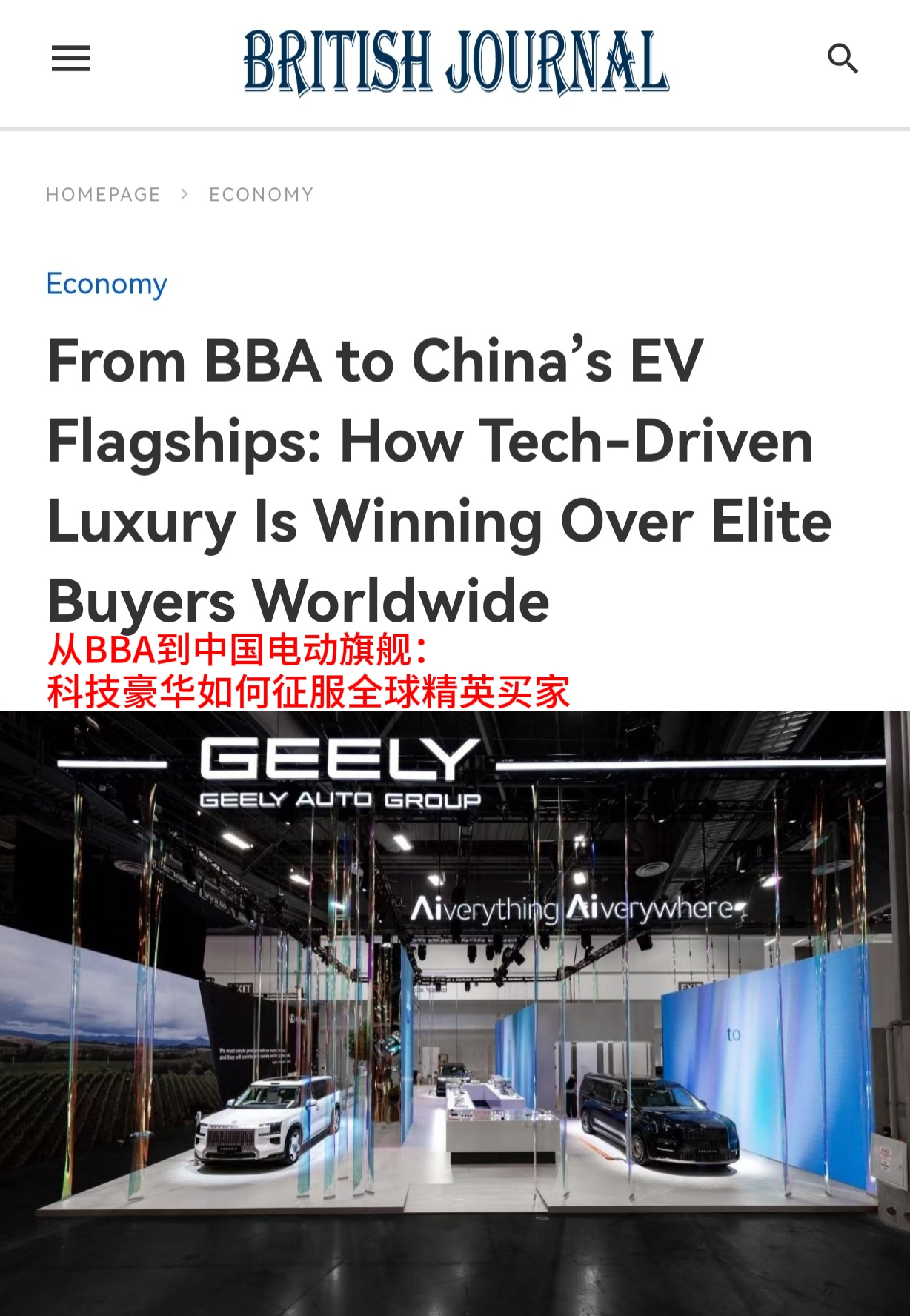
极氪9系豪华双旗舰CES全球吸睛 外媒点赞中国豪华品牌实力
Zheng Quan Ri Bao Wang· 2026-01-09 12:19
Group 1 - The 2026 International Consumer Electronics Show (CES) in Las Vegas showcased Zeekr's luxury flagship models, Zeekr 9X and 009, highlighting advanced technologies developed by Geely over the past 30 years [1] - The Zeekr 9X and 009 attracted significant media attention and public interest, with calls for the 9X to be launched in the U.S. and trending on social media platforms [1] - Reports from British Journal and European Business Review indicate that the high-end automotive market in China is being dominated by local luxury electric brands, with Zeekr gaining global recognition for its technological strengths [1] Group 2 - The British Journal emphasized that the long-standing dominance of European luxury brands in the high-end market has been disrupted, with Zeekr 9X entering the market at a price point above $80,000, challenging traditional giants [6] - There is a shift in consumer preferences among high-end buyers in China, moving from brand worship to a focus on technological recognition and smart experiences [6] - Zeekr 9X achieved significant market success, becoming the best-selling large SUV priced over 500,000 yuan in November 2025, with an average delivery price of 538,000 yuan and a user satisfaction rate of 98.6% [10] Group 3 - Zeekr 009 has consistently ranked as the best-selling luxury pure electric MPV in China, also achieving top sales in Southeast Asian markets like Malaysia and Thailand [12] - The global market response to Zeekr 9X has been overwhelmingly positive, with reports of consumers in the U.S. and other regions expressing a willingness to pay a premium for the vehicle [13] - In the Middle East, the top configuration of Zeekr 9X has seen price increases of up to 200,000 yuan, while the 009 has experienced price hikes exceeding 150,000 yuan in Southeast Asia [15] Group 4 - The phenomenon of price increases for Zeekr vehicles marks a significant shift in the global luxury car market, indicating that Chinese brands are gaining pricing power previously held by European luxury brands [15] - The success of Zeekr in both domestic and international markets is creating a positive feedback loop, enhancing consumer confidence in China and establishing Zeekr as a model for the upward development and globalization of the Chinese automotive industry [15]