贵州茅台

Search documents
从苹果到英伟达:段永平在巴菲特退场后的第一次“时代下注”
美股研究社· 2026-02-18 09:55
Group 1 - The core viewpoint of the article highlights the significant shift in investment strategy by Duan Yongping, moving from a long-term focus on Apple to a substantial increase in Nvidia holdings, reflecting a response to the evolving AI landscape [1][2] - Duan Yongping's reduction in Apple shares is not a bearish stance on the company but rather a reassessment of the boundaries of "certainty" in investment [3][4] - The article emphasizes that the traditional value investment framework is being challenged by the emergence of AI, which alters the competitive landscape and the definition of certainty in investments [5][6] Group 2 - The slowdown in the global smartphone market has further compressed Apple's growth potential, making it a predictable cash cow rather than a high-growth asset [5][6] - Duan Yongping's decision to reduce Apple holdings is framed as a rational choice based on risk-reward re-evaluation, indicating a departure from the "golden age" of consumer electronics [6][7] - The article discusses the transformation of Nvidia from a chip manufacturer to a foundational supplier of AI infrastructure, highlighting its new role in the AI era [9][10] Group 3 - The increase in Nvidia's position by over 11 times is seen as a redefinition of "new certainty" in investments, moving away from traditional high-volatility tech stocks [9][10] - The article argues that the definition of a "good company" must adapt to the technological paradigm shift, with Nvidia positioned as a critical player in the AI landscape [10][11] - Duan Yongping's strategy reflects a broader trend among investors to seek out companies that provide essential infrastructure in the digital age, rather than merely consumer products [11][12] Group 4 - The article posits that Duan Yongping's actions signify a personal evolution from a follower of Warren Buffett's investment philosophy to a defining figure in the new investment landscape shaped by AI [12][13] - It emphasizes that value investing is not static but must evolve with changing market dynamics, particularly in the context of technological advancements [14][15] - The conclusion suggests that the ability to redefine value in the context of new technologies will be crucial for investors in the coming years [16][17]



白酒企业仍然青睐春晚舞台,但玩法变了
Xin Lang Cai Jing· 2026-02-18 09:20
Core Viewpoint - The competition for sponsorship of the 2026 CCTV Spring Festival Gala is intensifying among liquor companies, particularly in the white liquor sector, which has a long-standing partnership with the event due to its alignment with the festive atmosphere and consumer behavior during the Spring Festival [1][5]. Group 1: Sponsorship and Marketing Strategies - CCTV has officially announced four white liquor sponsors for the 2026 Spring Festival Gala, with Wuliangye being the most talked-about due to its prominent presence in the magic performance segment [2][4]. - Wuliangye has been the exclusive interactive partner for the "Heavenly Gifts" segment of the Spring Festival Gala for four consecutive years, distributing 136,000 gifts valued at 100 million yuan during the event [4]. - Yanghe has been the exclusive timekeeping partner for the seventh consecutive year, while Gujinggongjiu and Langjiu also maintain significant sponsorship roles [4][5]. Group 2: Industry Trends and Consumer Behavior - The number of white liquor sponsors for the 2026 Spring Festival Gala has increased by one compared to the previous year, indicating sustained enthusiasm for sponsorship despite economic pressures [5]. - White liquor companies are increasingly focusing on creative and engaging marketing strategies, moving beyond traditional advertising to more integrated product placements in various segments of the gala [5][6]. - Local television stations are also seeing increased collaboration with liquor companies, showcasing a broader marketing strategy that emphasizes regional brand recognition and consumer engagement [5][6]. Group 3: Financial Performance and Market Challenges - The financial outlook for white liquor companies is challenging, with significant profit declines reported by major players such as Yanghe and Kweichow Moutai, indicating a tough market environment [6][8]. - Despite the high costs associated with sponsoring the Spring Festival Gala, companies view it as a strategic investment to maintain brand visibility and consumer engagement during a period of economic downturn [6][10]. - The industry is shifting towards more cost-effective marketing strategies, focusing on key moments and channels that can directly influence sales, rather than relying solely on broad advertising campaigns [10].





节前探访茅台门店:i茅台拉动门店客流,即买即用成新趋势
Bei Ke Cai Jing· 2026-02-18 03:12
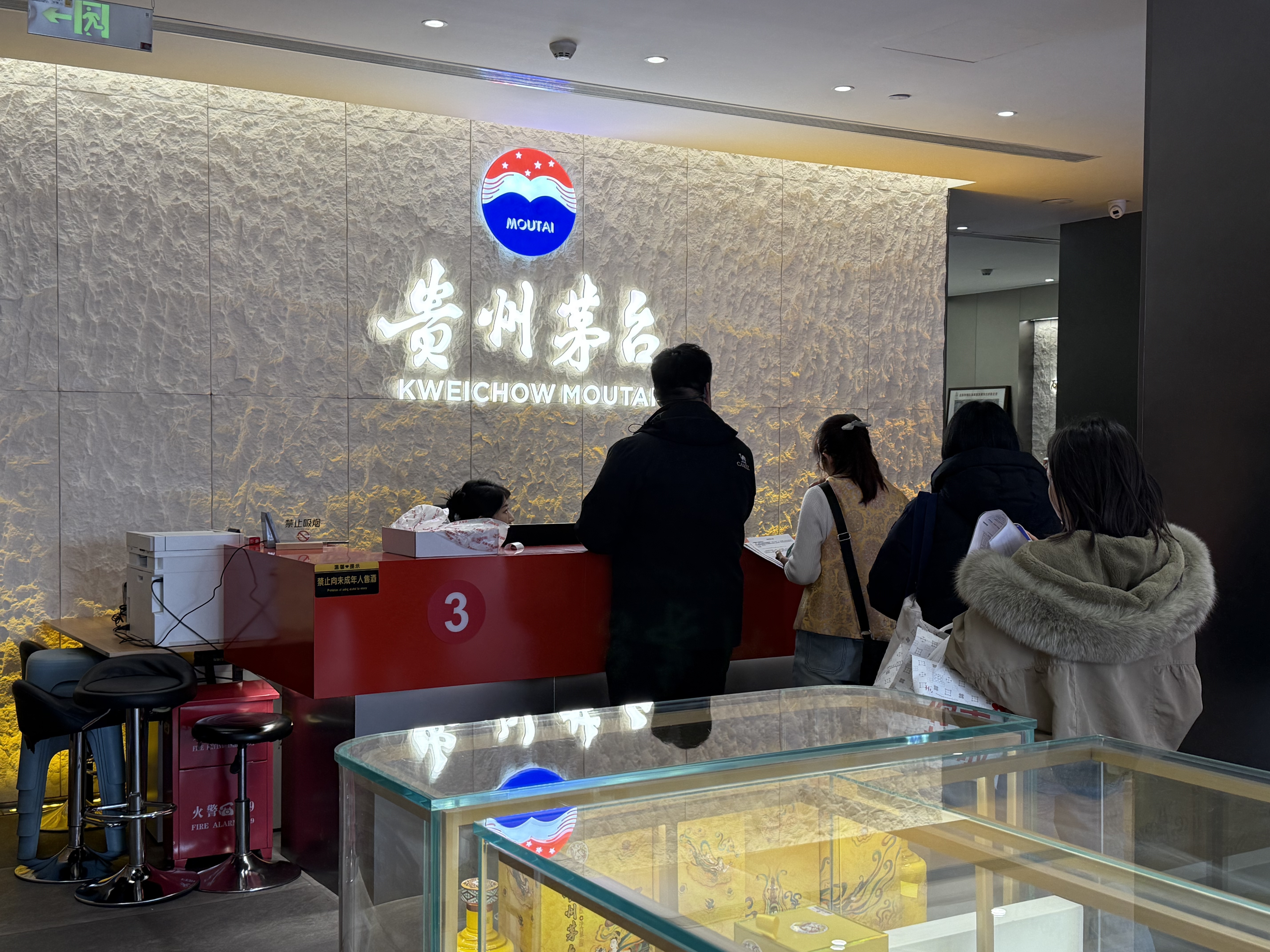
Core Insights - The popularity of Moutai continues to rise as key products like the 53-degree 500ml Flying Moutai are quickly sold out on the "i Moutai" platform, indicating strong consumer demand and successful market transformation efforts by the company [1][18][26] Group 1: Market Transformation - Moutai has launched a market-oriented transformation plan that adjusts its product system, operational model, channel layout, and pricing mechanism, significantly lowering the purchasing threshold for ordinary consumers [1][23] - The company aims to focus on consumer needs and enhance its market-oriented transformation, marking a significant shift in its marketing strategy [22][26] Group 2: Consumer Behavior - The consumer base is shifting towards younger demographics, with 80s and 90s consumers making up over 80% of recent buyers, indicating a trend towards immediate consumption rather than stockpiling [12][15] - Many consumers are opting for smaller packaging for personal use, reflecting a change in consumption patterns towards immediate enjoyment rather than long-term storage [16][17] Group 3: Sales Performance - The "i Moutai" platform has seen significant user growth, with over 6.28 million new users in January and a total of 15.31 million monthly active users, leading to a substantial increase in sales orders [18][19] - Sales data from Moutai stores indicate that the demand for the 53-degree 500ml Flying Moutai has led to a near sell-out of inventory, with some stores already utilizing March's product allocation due to high demand [10][11] Group 4: Pricing and Market Dynamics - The recent market strategy has led to a stabilization and increase in retail prices for Moutai products, with the price of the 53-degree 500ml Flying Moutai rising from over 1700 yuan to nearly 1900 yuan in just two weeks [24][25] - Analysts believe that the demand for Moutai will continue to grow, especially during festive seasons, as the company successfully expands its consumer base and increases purchase frequency [25][26] Group 5: Retail Strategy - Moutai stores are enhancing customer experience by creating festive atmospheres and offering complimentary gifts, which helps to attract and retain new customers [21][20] - The company is actively engaging with new consumer groups through innovative marketing strategies, including the use of social media and personalized service offerings [22][20]
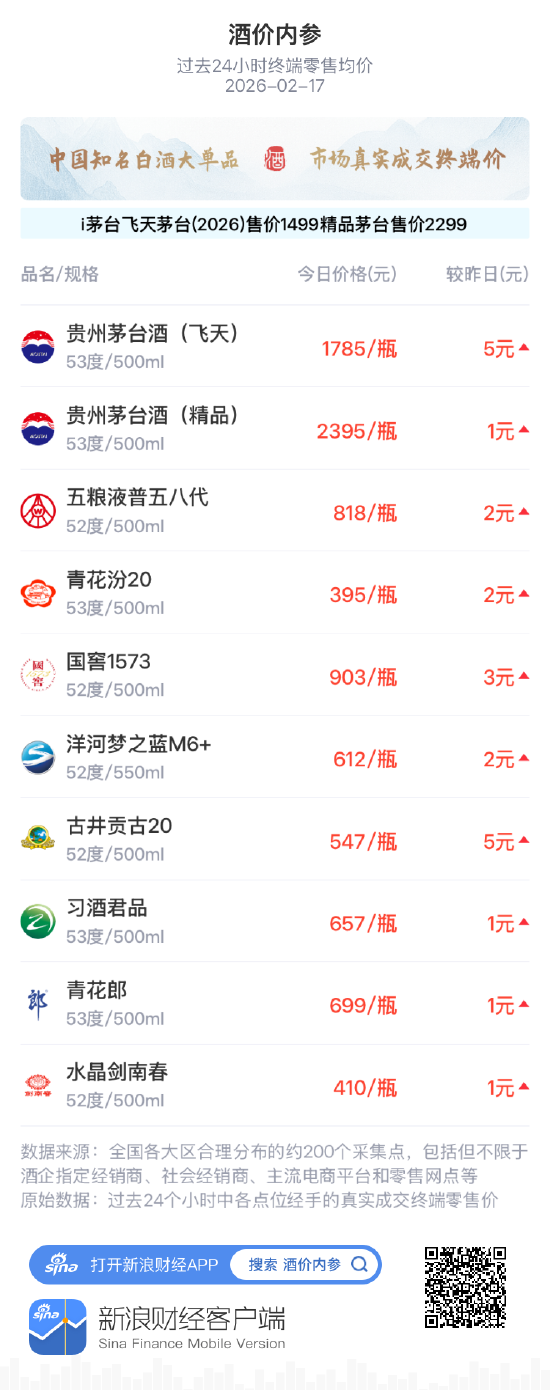
酒价内参2月18日价格发布 市场涨跌互现整体价格小幅回升
Xin Lang Cai Jing· 2026-02-18 01:17
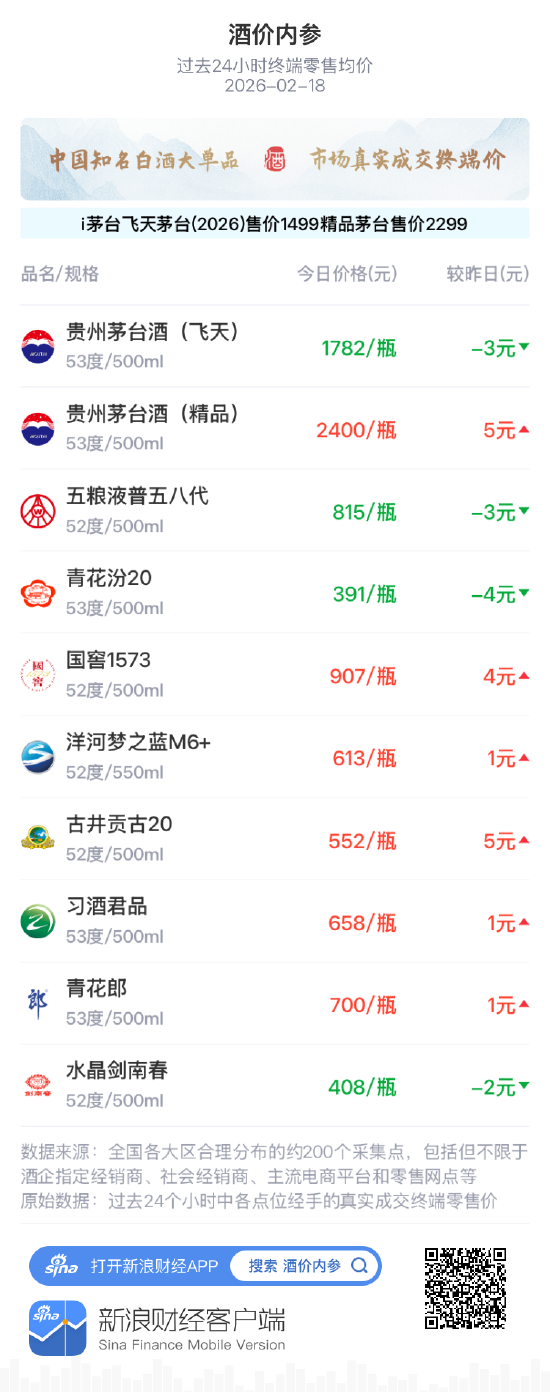
Core Insights - The article highlights the fluctuating prices of China's top ten liquor products, indicating a mixed market trend with a slight overall increase in retail prices, reaching a new high since 2026 [1][6]. Price Trends - The total retail price for a package of the top ten liquor products is 9226 yuan, up by 5 yuan from the previous day, marking a new high for 2026 [1][6]. - The market shows a pattern of six products increasing in price and four decreasing, indicating structural characteristics of price movements [1][6]. Specific Product Price Changes - Notable price increases include: - Premium Moutai and Gujing Gong 20, both up by 5 yuan per bottle [1][6]. - National Cellar 1573, up by 4 yuan per bottle [1][6]. - Yanghe Dream Blue M6+, Xijiu Junpin, and Qinghua Lang, each up by 1 yuan per bottle [1][6]. - Price decreases include: - Qinghua Fen 20, down by 4 yuan per bottle [1][6]. - Wuliangye Pu 58 and Flying Moutai, both down by 3 yuan per bottle [1][6]. - Crystal Jian Nan Chun, down by 2 yuan per bottle [1][6]. Market Analysis - The data for "Liquor Price Reference" is collected from approximately 200 points across various regions, aiming to provide an objective and traceable market price for well-known liquors [4][9]. - The recent introduction of official sales channels for Moutai products has begun to influence market prices significantly [4][9]. - The analysis suggests that the price increase during the 2026 Spring Festival is a short-term effect driven by supply contraction and holiday demand, without altering the underlying "volume reduction and price increase" issue in the industry [5][9].


春晚白酒品牌三十年浮沉:从'标王'争霸到'四强'鼎立,行业营销迈入高质量新阶段
Jing Ji Guan Cha Bao· 2026-02-17 06:48
Group 1 - The article discusses the evolution of the Chinese liquor industry as reflected through the partnerships with the Spring Festival Gala, highlighting three distinct phases: rapid expansion, recovery, and consolidation [1][2] - From the 1990s to 2012, liquor brands aggressively competed for prime advertising spots, with notable brands like Langjiu and Moutai establishing strong presences [1] - The period from 2016 to 2019 saw a resurgence of liquor brands returning to the Gala through special partnerships, with Guqingongjiu becoming a representative brand during this phase [1] Group 2 - Since 2020, the industry has entered a phase of solidified leadership, with top brands like Yanghe and Wuliangye forming a stable partnership structure, reducing the number of participating brands significantly [2] - The 2026 Spring Festival Gala will feature a reduced lineup of four leading brands, marking a new low in brand participation over the past six years, indicating a shift towards high-quality development rather than industry decline [2] - The evolution from competitive bidding to a focus on a few leading brands reflects a broader transformation in the liquor industry towards brand-driven strategies and rational marketing approaches [2]
未来白酒市场的竞争格局会因营销策略变化而如何发展?
Sou Hu Cai Jing· 2026-02-17 05:06
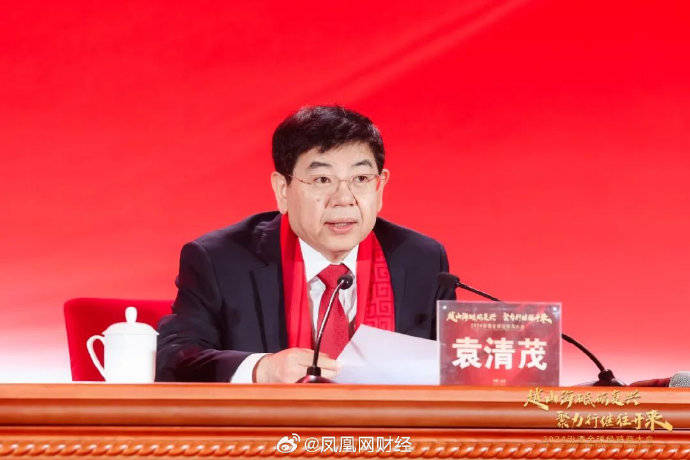
Core Viewpoint - The article discusses the significant transformation in the Chinese liquor industry, particularly focusing on Kweichow Moutai's shift from traditional distribution to a direct sales model, marking a consumer-centric evolution in the market landscape [1]. Group 1: Channel Revolution - The traditional long-chain distribution model in the liquor industry is rapidly disintegrating, with Kweichow Moutai canceling its traditional distribution system in 2026 to establish a multi-dimensional marketing network [2]. - The new model aims to reduce intermediaries and control channel inventory, allowing prices to reflect genuine supply and demand [2]. - The average gross margin for liquor distributors has dropped from over 20% in 2019 to around 15% by 2025, with net profit margins falling below 5% [2]. - The chairman of Moutai stated that the era of excessive profits for agents has ended, emphasizing the importance of enhancing consumer engagement and real consumption scenarios [2]. Group 2: Marketing Focus Shift - Traditional high-profile marketing strategies are losing effectiveness, as evidenced by the decline in participation of major liquor brands in the 2026 CCTV Spring Festival Gala [3]. - Three refined marketing strategies are emerging: 1. Scene penetration strategy focusing on high-frequency consumption scenarios [3]. 2. Regional precision strategies leveraging brand IP to break through homogeneous competition [3]. 3. Content value binding to create differentiated recognition through emotional connections [3]. - The industry consensus is shifting marketing focus from channel push to consumer pull, with a significant reduction in the primary consumer demographic [3]. Group 3: Future Market Structure - The transformation in marketing strategies is expected to redefine competition rules, leading to three major trends: 1. Supply chain efficiency becoming critical, with DTC models and O2O retail gaining prominence [4]. 2. A dual pricing system where high-end brands penetrate the mass market, with Moutai's price drop stimulating higher opening rates [4]. 3. Innovation capabilities becoming essential, as the demand for healthier, lower-alcohol, and personalized products rises [4]. Conclusion: Return to Essential Competition - The future competition in the liquor industry will be defined by "real opening rates" rather than "channel inventory levels" [6]. - The transformation in marketing strategies is fundamentally about dismantling speculative chains and rebuilding consumer trust [6]. - Leading companies will rely on direct sales efficiency and scene penetration, while regional brands will leverage differentiated IP to navigate challenges [6].
9家变4家,春晚含酒量创新低
盐财经· 2026-02-17 04:07
Core Viewpoint - The article discusses the changing landscape of the Chinese liquor industry, particularly the white liquor sector, as evidenced by the evolving advertising strategies during the 2026 Spring Festival Gala, indicating a shift in market dynamics and competition among leading brands [2][3]. Group 1: Advertising and Brand Presence - The 2026 Spring Festival Gala featured advertisements primarily from four major liquor companies, with Wuliangye being the largest investor, contributing gifts worth 100 million yuan [2]. - The number of white liquor brands participating in the Spring Festival Gala has decreased, with only four brands appearing in 2026 compared to nine in 2024 and six in 2025 [3]. - The use of product placements has also declined, with fewer brands opting for this strategy during the gala, indicating a shift towards more traditional sponsorship roles [3]. Group 2: Market Dynamics and Consumer Engagement - The white liquor market is experiencing intense competition, and while the Spring Festival Gala has historically been effective for brand image building, converting this exposure into sales remains challenging [4]. - Some liquor companies are shifting their marketing strategies towards social media platforms like Douyin and Xiaohongshu, focusing on content marketing related to the Spring Festival and cultural themes [4]. - The industry is moving towards a consumer-centric approach, aiming to reach a broader audience through diverse marketing strategies, while the overall market is expected to continue experiencing structural differentiation and increased concentration [5].

2026央视科技(广告?)春晚股民吐槽大赏
佩妮Penny的世界· 2026-02-17 02:14
大家好,我是佩妮。 本来想休假纯躺平的,但是看着春晚,实在是忍不住我吐槽的洪荒之力(我知道是老梗),必须爬上来和大家一起唠嗑…… 今年这届春晚,是我 过去几年看得最认真的一届春晚 。无它,过去两年"科技"成为了一二级市场的主旋律,连带这届春晚也成了科技(广 告?)含量最高的一届,也成为了和资本市场关系最紧密的春晚。 这就叫: 过去的我嗤之以鼻,现在的我逐帧学习…… 被玩梗说春晚导演是不是提前上杠杆重仓了,承载了全国股民的希望的一台晚会…… 当然,大 A 很体贴,春节期间赌场不开门,除了一些年前就埋伏了的朋友,就只能看看港股的表现了。 好了,正片开始,主要列一下我感兴趣的点: 1)大家最关注的肯定是这次 春晚 4 家机器人大战 了。 一开始大家都在传,几家机器人公司为了上市重金砸了上亿上春晚,但是咱们仍未知道到底花了多少钱。 说真的,这种编排好的表演有啥意思,都说直接让这4家公司各派一个机器人上去直接格斗得了,更好看。哈哈哈。 结果吧,有目共睹, 宇树杀死了比赛。 就这个武术表演动作控制的 流畅度和稳定度 吧,绝了! 最后超大型人形机器人的出场也非常惊艳,进步太大了,比去年扭秧歌被人拎着后脖颈 下台强太多了。 ...

酒价内参2月17日价格发布 总价延续上行再创一周新高
Xin Lang Cai Jing· 2026-02-17 01:17
Core Insights - The article highlights the recent upward trend in the retail prices of China's top ten liquor products, with a total price of 9221 yuan for a package of these products, marking a 23 yuan increase from the previous day, reaching a new weekly high [1][8] - The increase in prices is attributed to the concentrated release of consumer demand during the Spring Festival, leading to a strong market performance where all ten products saw price increases [1][8] Price Trends - The retail prices of the top ten liquor products have all increased, with notable price hikes for Feitian Moutai and Gujing Gong 20, both rising by 5 yuan per bottle [1][8] - Other products such as Guojiao 1573 increased by 3 yuan per bottle, while Wuliangye Pu 58, Qinghua Fen 20, and Yanghe Dream Blue M6+ saw a 2 yuan increase per bottle [1][8] - The overall price increase is balanced across the products, indicating a stable market operation [1][8] Data Collection Methodology - The daily data for "Wine Price Reference" is sourced from approximately 200 collection points across various regions, including designated distributors, social distributors, e-commerce platforms, and retail outlets [5][11] - The data aims to provide an objective, real, and scientifically traceable representation of the market prices for well-known liquor products [5][11] Supply Chain Developments - During the Spring Festival, the supply of Moutai liquor is tightening, with the Guizhou Moutai Double Dragon Smart Logistics Park experiencing a significant increase in workload compared to previous years [6][11] - To meet the rising logistics demand, the park has increased manpower, adding 30 to 40 personnel for B-end orders and over 70 for C-end orders, with daily order processing exceeding 10,000 [6][11] - The "i Moutai" platform has also expanded its delivery capabilities by adding new warehouses in Nanjing and Beijing to enhance delivery efficiency [6][11]
从9家到4家 春晚“含酒量”创新低
Di Yi Cai Jing· 2026-02-17 00:33
Group 1 - The overall presence of liquor brands in the 2026 Spring Festival Gala has decreased, with only four major liquor companies participating compared to nine in 2024 and six in 2025 [1] - Major liquor brands featured include Wuliangye, which was the largest investor, gifting 136,000 items worth 100 million yuan, and Yanghe, which has been the exclusive timekeeper partner for seven years [1][2] - The number of liquor brand placements has also declined, with fewer brands using product placements compared to previous years, indicating a shift in marketing strategies [2] Group 2 - Liquor companies are adjusting their marketing strategies by collaborating with platforms like Douyin and Xiaohongshu, focusing on content marketing around the Spring Festival [3] - Some companies are shifting their focus to local Spring Festivals to strengthen their influence in regional markets, such as Fenjiu sponsoring Beijing Satellite TV's Spring Festival Gala [3] - Since 2025, liquor companies have been transitioning to a consumer-centric growth model, aiming for diverse marketing strategies to reach a broader audience [4]