大全能源

Search documents
2025年光伏行业攻坚战:从价格厮杀到价值重构
Zhong Guo Zheng Quan Bao· 2025-12-21 20:12
2025年,"反内卷"成为光伏行业摆脱困境的核心共识与行动纲领。历经约两年产能过剩引发的惨烈价格 战,行业已全面进入深度调整期。从政策引导市场化转型到企业布局价值创造,从产业链价格触底回升 到产能出清持续深化,光伏行业正经历一场从"规模竞赛"到"质量比拼"的转型攻坚。 当前,行业破内卷成效初显,但彻底走出调整期仍面临多重考验。多位受访的业内人士对中国证券报记 者表示,这场攻坚的成效将取决于行业自律的执行力度、技术创新的突破速度以及政策与市场机制的完 善程度,这三个关键变量决定着光伏行业能否真正走出调整期,迈向高质量发展的新阶段。 ● 本报记者 刘杨 从价格战泥潭到反内卷共识 过去一段时期,产能过剩引发的惨烈价格战,让光伏行业陷入"增量不增利"的恶性循环,整个产业链利 润被极度压缩。中国光伏行业协会数据显示,2025年前三季度光伏主产业链环节企业亏损达310.39亿 元,其中三季度亏损64.22亿元,虽较二季度收窄46.7%,但亏损面仍未根本扭转。 价格战的后遗症不仅体现在财务数据上,更侵蚀了行业发展的根基。记者调研了解到,当组件价格被压 至现金成本线附近,研发投入成为最先被削减的选项,技术创新陷入停滞,部分产 ...


智者勇进•接续奋进新江苏|扬中:聚力“五个岛城”建设 共创“江中明珠”荣光
Xin Lang Cai Jing· 2025-12-21 15:33
扬中 建设"智造岛城" 提升产业能级 "十四五"时期,扬中产业根基愈发扎实,形成了智能电气、新能源、汽车零部件、临港装备制造四大产 业集群,中低压智能电气产业集群去年成功入选国家级中小企业特色产业集群。 转自:扬子晚报 规上工业企业数量和总产值均较"十三五"末翻了一番;农村人居环境整治提升工作连续4年列全省第一 等次;获评第七届全国文明城市……"十四五"时期,扬中牢牢把握高质量发展这一首要任务,经济总量 持续攀升,发展活力显著增强,社会大局和谐稳定,交出了一份过硬的发展答卷。 发力"生态岛城" 共绘绿美画卷 扬中是远近闻名的工程电器岛,系列化的工程电器产品都需要经过表面处理的环节,因此从事表面处理 的企业有其生存的"土壤",但其污染风险相对较高。如何实现两者的平衡?扬中通过持续集中整治和建 设"绿岛"喷涂中心,既满足产业发展之需,又履行生态环境保护之责。 近年来,扬中聚焦重点领域,深入打好污染防治攻坚战,积极引领广大企业走"绿色"发展之路,推动更 多企业向绿色化、智能化转型,共同构建绿色、低碳、循环的现代产业体系,已创成国家级绿色工厂3 家、省级绿色工厂28家。 迈向"十五五",扬中将以"生态"为底色,全面优 ...


年终盘点 | 光伏产业从“内卷”走向“破卷” 但明年才是行业治理的攻坚期
Di Yi Cai Jing· 2025-12-20 12:01
Core Viewpoint - The photovoltaic industry is undergoing significant changes to address severe supply-demand imbalances and "involution" issues, with a focus on capacity consolidation and high-quality development by 2025 [1][8]. Group 1: Industry Challenges - The photovoltaic industry faced unprecedented losses in the first half of 2025, with 31 A-share listed companies reporting a total net loss of 12.58 billion yuan, a year-on-year increase of 274.3% [2]. - Major companies such as Longi Green Energy, Tongwei Co., and TCL Zhonghuan reported substantial losses, with a combined loss of 17.26 billion yuan in the first half of 2025 [2][3]. - The industry has seen over 40 companies announce delistings, bankruptcies, or mergers since 2024 due to chaotic capacity expansion and severe supply-demand imbalances [2]. Group 2: Policy and Regulatory Developments - The establishment of the polysilicon capacity consolidation acquisition platform, "Guanghe Qiancheng," aims to address the industry's "involution" through market-oriented and legal mechanisms [1]. - The Chinese government has initiated various measures to combat low-price competition, including the passing of the Anti-Unfair Competition Law, which has positively impacted prices from July to October 2025 [5][8]. - The Ministry of Industry and Information Technology (MIIT) has emphasized the need for industry self-regulation and has organized discussions to address low-price competition [4]. Group 3: Market Recovery and Future Outlook - By the second half of 2025, prices across the photovoltaic supply chain began to recover due to industry self-regulation and reduced production, leading to improved profitability for some upstream companies [4][6]. - The photovoltaic industry is expected to enter a sustained capacity clearing cycle in 2026, with a focus on improving product quality and market entry standards [9]. - Industry leaders stress the importance of achieving profitability across all segments of the supply chain, not just in the upstream polysilicon sector, to ensure a healthy and sustainable market [9].




年终盘点| 光伏产业从“内卷”走向“破卷”,但明年才是行业治理的攻坚期
Di Yi Cai Jing· 2025-12-20 11:57
Core Viewpoint - The photovoltaic industry is undergoing significant changes to address severe supply-demand mismatches and "involution" issues, with a focus on capacity integration and acquisition platforms to promote healthy competition and profitability by 2025 [1][10]. Group 1: Industry Challenges - The photovoltaic industry faced unprecedented losses in the first half of 2025, with 31 A-share listed companies reporting a total net loss of 12.58 billion yuan, a year-on-year increase of 274.3% [3]. - Major companies such as Longi Green Energy, Tongwei Co., and JA Solar reported substantial losses, with a combined loss of 17.26 billion yuan in the first half of 2025 [3]. - The industry has seen over 40 companies announce delistings, bankruptcies, or mergers since 2024 due to chaotic capacity expansion and severe supply-demand imbalances [3]. Group 2: Market Recovery Efforts - The establishment of the multi-crystalline silicon capacity integration acquisition platform marks a significant step towards addressing "involution" in the industry [1]. - The government and industry associations are actively promoting measures to combat low-price competition and enhance product quality, as highlighted in various government meetings and publications [6][11]. - By the second half of 2025, industry prices began to recover due to self-regulation and reduced production, leading to improved profitability for some upstream silicon material companies [7]. Group 3: Future Outlook - The photovoltaic industry is expected to enter a critical phase of governance in 2026, focusing on capacity regulation and the establishment of a unified national market [11]. - Analysts predict that the industry will undergo a continuous capacity clearing cycle, with measures to improve product quality standards and increase market concentration [11][12]. - The need for a holistic approach to "de-involution" across the entire supply chain, including silicon materials, wafers, cells, and modules, is emphasized to ensure sustainable profitability [12].
供需结构改善,工业硅企稳反弹
Tong Guan Jin Yuan Qi Huo· 2025-12-19 01:56
Report Industry Investment Rating No relevant content provided. Core Views of the Report - In 2026, the Fed will gradually slow down the pace of interest rate cuts, and the US government's vision to revitalize traditional manufacturing will restrict the growth rate of the global photovoltaic industry. China is expected to implement an expansionary fiscal policy and a moderately loose monetary policy, aiming for a good start in the 15th Five - Year Plan [3][57]. - In terms of supply, Xinjiang's production share has increased this year, while Sichuan and Yunnan's operations are generally low. New production in Inner Mongolia and Gansu has been released steadily. The number of operating furnaces has decreased, and social inventory is high. Silicon enterprises' production profits turned positive in the second half of this year. The planned new production capacity in 2026 is only 700,000 tons. Domestic cumulative production is expected to drop to 4.15 million tons this year and further to 4 million tons in 2026, a year - on - year decrease of 3.6% [3][57]. - In terms of demand, with the establishment of a new polysilicon platform company, a new sustainable industry ecosystem will be built. The production capacity of downstream battery and component markets will be further compressed, and photovoltaic terminal installations will enter a self - adaptive deceleration period. The silicone industry will enter a new balance cycle through production cuts. The aluminum alloy industry's production growth is limited due to the decline in construction and building materials demand. The overall demand growth rate of industrial silicon will continue to slow down in 2026, with a projected 3% decline in consumption growth [3][58]. - In 2026, the supply - demand structure of industrial silicon is expected to improve. The anti - involution policy will be further implemented. The photovoltaic industry will shift from high - growth to high - quality development, and the futures price center may stabilize and recover. The main operating range of industrial silicon in 2026 is expected to be between 8,000 - 11,000 yuan/ton [3][58]. Summary by Directory 2025 Market Review - In 2025, the industrial silicon market showed a trend of bottoming out and rebounding. The futures price dropped from a maximum of 11,130 yuan/ton at the beginning of the year to a minimum of 6,990 yuan/ton in early June, a decline of 37.2%. In the second half of the year, due to supply contraction and improved market sentiment, the price gradually recovered. By December 12, the main contract SI2605 closed at 8,390 yuan/ton, a significant drop of 2595 yuan/ton compared to the end of last year, a decline of 23.6%. The annual price fluctuated between 6,990 - 11,130 yuan/ton [8]. Macroeconomic Analysis Fourth Plenary Session Focuses on High - Quality Development and Domestic Demand - China's traditional manufacturing faces internal and external pressures. The "15th Five - Year Plan" proposes requirements for economic development, including promoting high - quality development, technological innovation, and the development of strategic emerging industries such as new energy and new materials. The development of artificial intelligence is also emphasized in multiple aspects [11][12]. Dual Loose Monetary and Fiscal Policies for Stable Economic Growth - China's Q3 GDP grew by 4.8% year - on - year, and the cumulative GDP in the first three quarters increased by 5.2% year - on - year. The official manufacturing PMI in November was 50.2. The economy has maintained a stable and progressive development trend, with rapid industrial growth, stable employment, and increasing resident income. In 2026, China is expected to implement an expansionary fiscal policy and a moderately loose monetary policy [14]. Fundamental Analysis Increasing Northern Production Share and Profit Turnaround in Southwest - In November 2025, China's industrial silicon production was 401,700 tons, a year - on - year decrease of 11.2%. From January to November, the cumulative production was 3.868 million tons, a year - on - year decrease of 14.7%. Xinjiang's production showed a trend of low - to - high, while Sichuan and Yunnan increased production from the dry season to the wet season. The new production capacity in Inner Mongolia and Gansu was limited. In the context of anti - involution policies, the supply side has contracted [16]. Only 700,000 Tons of New Production Capacity Planned in 2026 - As of now, China's total industrial silicon production capacity is 7.879 million tons, with an effective capacity of 7.846 million tons. The new and expanded production capacity projects from the second half of 2025 to 2026 have significantly slowed down. The planned new production capacity in 2026 is only 700,000 tons, a significant drop compared to 2025. It is expected that the total production capacity in 2026 will reach about 8.3 million tons, with a decreasing growth rate [27][30]. High Social Inventory and Stable Export Growth - As of December 12, the social inventory of industrial silicon reached 561,000 tons, a 4.6% increase from the end of last year. The exchange's average warehouse receipt inventory was between 150,000 - 180,000 tons. From January to October, the export volume was 607,000 tons, a 1% year - on - year decrease. In 2026, the domestic social inventory is expected to be high in the first half and low in the second half, and the export growth rate is expected to be 5 - 8% [36][37]. Industrial Silicon Demand Analysis New Polysilicon Platform Company and Anti - Involution in Photovoltaic Industry - From January to November 2024, China's polysilicon production was 1.206 million tons, a 27.3% year - on - year decrease. In December 2025, the "polysilicon capacity integration and acquisition platform" was officially established. In 2026, the photovoltaic industry will focus on capacity regulation, price monitoring, and eliminating backward production capacity. The industry is expected to enter a new balance cycle [40][43]. Silicone Industry Enters a New Ecosystem - From January to November 2025, China's silicone DMC production was 2.272 million tons, a 4.6% year - on - year increase. After the industry's anti - involution meeting in November, enterprises reached a consensus on a 30% production cut and joint price support. The DMC price has rebounded from 11,050 yuan/ton to 13,600 yuan/ton. In 2026, the silicone production is expected to grow limitedly and enter a sustainable development model [44]. Limited Growth in Aluminum Alloy Production - From January to October, China's aluminum alloy production was 15.76 million tons, a 15.7% year - on - year increase. Affected by the real estate industry, the demand for aluminum processing products was weak. In the fourth quarter, there were both production increases and decreases in different regions. It is expected that the aluminum alloy production will maintain a low growth rate in 2026 [46]. Slowing Demand Growth but More Balanced Supply - Demand in 2026 - In 2026, the demand growth rate of industrial silicon will continue to slow down, but the supply - demand structure will be more balanced. The consumption growth rate is expected to decline by about 3% [47][48]. 2026 Market Outlook - In 2026, the Fed will slow down the interest rate cut, and the US government's policy will restrict the global photovoltaic industry. China will implement expansionary fiscal and monetary policies. The supply of industrial silicon will contract, and the demand growth will slow down. The supply - demand structure is expected to improve, and the futures price may stabilize and recover, with a main operating range of 8,000 - 11,000 yuan/ton [57][58].
光伏业2025:“反内卷”,创价值,见曙光
Shang Hai Zheng Quan Bao· 2025-12-18 18:24
Group 1: Industry Trends - The core consensus among solar companies is a shift from cost competition to value creation, indicating a transition towards high-quality development in the solar industry [1][5][8] - The "136 Document" is a pivotal policy that promotes market-driven pricing for renewable energy, marking a shift from fixed pricing to market-oriented evaluations [2][3] - The solar industry is expected to mature and stabilize by 2026, focusing on value creation and technological innovation as key drivers [9][10] Group 2: Market Dynamics - The market is witnessing a gradual recovery in prices since July, with key components like polysilicon and solar cells showing price increases, indicating a potential turning point for profitability [4][7] - The integration of energy storage with solar power is emerging as a new growth avenue, with companies like Canadian Solar and JinkoSolar positioning themselves to capitalize on this trend [6][10] - The industry is experiencing a phase of capacity clearing, with smaller players exiting the market, leading to a more competitive landscape focused on value rather than scale [8][9] Group 3: Future Outlook - The 2026 energy market is anticipated to be crucial for the solar industry, with a focus on self-regulation and adherence to market mechanisms to ensure sustainable growth [9][10] - Companies are expected to enhance their technological capabilities to improve efficiency and power output, which will be essential for navigating the upcoming market challenges [10]


科创新能源ETF(588830)涨超1.2%,2027年底红旗旗舰车型将搭载固态电池
Xin Lang Cai Jing· 2025-12-17 05:49
Group 1 - The core viewpoint is that the solid-state battery technology is advancing, with significant developments expected by 2027, particularly for China's FAW Hongqi brand [1][2] - The Shanghai Stock Exchange Sci-Tech Innovation Board New Energy Index has shown strong performance, with key stocks like Jiao Cheng Ultrasonic and Huasheng Lithium Battery experiencing notable increases [1] - The solid-state battery technology is expected to provide disruptive advantages in safety and energy density, shifting the focus of industrialization from material science to production engineering [2] Group 2 - The solid-state battery concept accounts for 49% of the Sci-Tech Innovation Board New Energy Index, which includes major companies in the photovoltaic, wind power, and new energy vehicle sectors [2] - The top ten weighted stocks in the Sci-Tech Innovation Board New Energy Index collectively account for 47.84% of the index, indicating a concentrated investment in leading companies [3] - The Yichun Natural Resources Bureau plans to cancel mining licenses for 27 expired permits, which is expected to positively impact the supply-demand dynamics for lithium and related minerals [1]
优必选获AI大模型公司订单,两部委优化集中式新能源市场报价 | 投研报告
Zhong Guo Neng Yuan Wang· 2025-12-17 05:08
Group 1: Industry Overview - The average price of 130um 182-183.75mm N-type silicon wafers is 1.18 RMB/piece, remaining stable compared to last week, while the 130um 210mm silicon wafers are priced at 1.23 RMB/piece, also unchanged [1][3] - Silicon wafer prices show signs of stabilization after a period of decline, with a production cut of approximately 16% in December, leading to a new low in output for the year [1][3] - The reduction in production is a consensus decision among companies due to insufficient demand, losses, and inventory pressure, indicating that silicon wafer prices are expected to remain in a consolidation phase in the short term [1][3] Group 2: Company Developments - UBTECH has secured over 50 million RMB in orders for humanoid robots from a leading AI model company, with the WalkerS2 robot being the primary product, set for delivery within the year [1] - Midea has officially launched the MIROU, a six-arm wheeled humanoid robot, which features stable elevation and 360-degree rotation capabilities, along with six bio-inspired mechanical arms for versatile operations [1] Group 3: Market Dynamics - The average price of polysilicon is 52.0 RMB/kg, remaining stable, while granular silicon is priced at 50.0 RMB/kg, also unchanged, with a projected production of 113,500 tons in December [3] - The average price of 182-183.75mm N-type battery cells is 0.28 RMB/W, reflecting a 1.8% decrease from last week, with a planned production cut of approximately 12.5% in December [4] - The average price of 182*182-210mm TOPCon double-glass modules is 0.693 RMB/W, remaining stable, while the 210mm N-type HJT modules have seen a price decrease [5] Group 4: Investment Recommendations - Key recommendations include companies focusing on BC new technology such as Aiko and Longi Green Energy, supply-side companies like Daqo New Energy and Flat Glass, and energy storage companies like HBS and Sungrow [6] - Companies to actively monitor include GCL-Poly, Tongwei, Xinyi Solar, TCL Zhonghuan, and others in the solar energy sector [6]
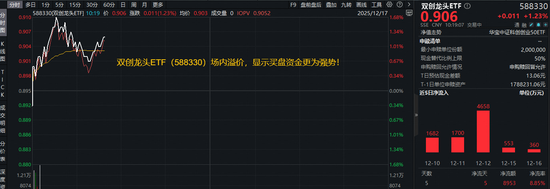
ETF盘中资讯|光模块+半导体携手上攻!硬科技宽基——双创龙头ETF(588330)盘中上探1.68%,近5日连续吸金8953万元!
Sou Hu Cai Jing· 2025-12-17 02:54
Core Viewpoint - The technology growth sector is showing active performance, with the Double Innovation Leading ETF (588330) experiencing a 1.23% increase, reflecting positive investor sentiment towards the technology sector's future performance [1] Group 1: ETF Performance - The Double Innovation Leading ETF (588330) has seen a net inflow of 89.53 million yuan over the past five days, indicating strong investor interest in technology [1] - The ETF's index has increased by 80.83% since its low point on April 8, significantly outperforming major indices such as the ChiNext Index (69.97%) and the STAR Market Composite Index (48.67%) [5][6] Group 2: Sector Highlights - In the semiconductor sector, notable stocks include: - Zhaosheng Microelectronics up over 6% - Jinghe Integrated Circuit up over 4% - China Resources Microelectronics up nearly 4% [3] - In the optical module sector, leading stocks include: - Tianfu Communication up over 5% - Xinyi Sheng up over 4% - Zhongji Xuchuang up over 2% [3] - The defense and military sector saw China Aviation City rise nearly 6%, while the photovoltaic sector leader Daqo New Energy increased by over 1% [3] Group 3: Market Outlook - UBS predicts a 30% increase in Chinese technology stocks by 2025, building on a 20% increase in 2024, while noting a 30% discount compared to the U.S. market [5] - Zhongyuan Securities emphasizes the importance of aligning with the "14th Five-Year Plan" and capitalizing on global monetary easing and industrial upgrades [5] - Huashan Securities asserts that technology remains the strongest investment theme [5]
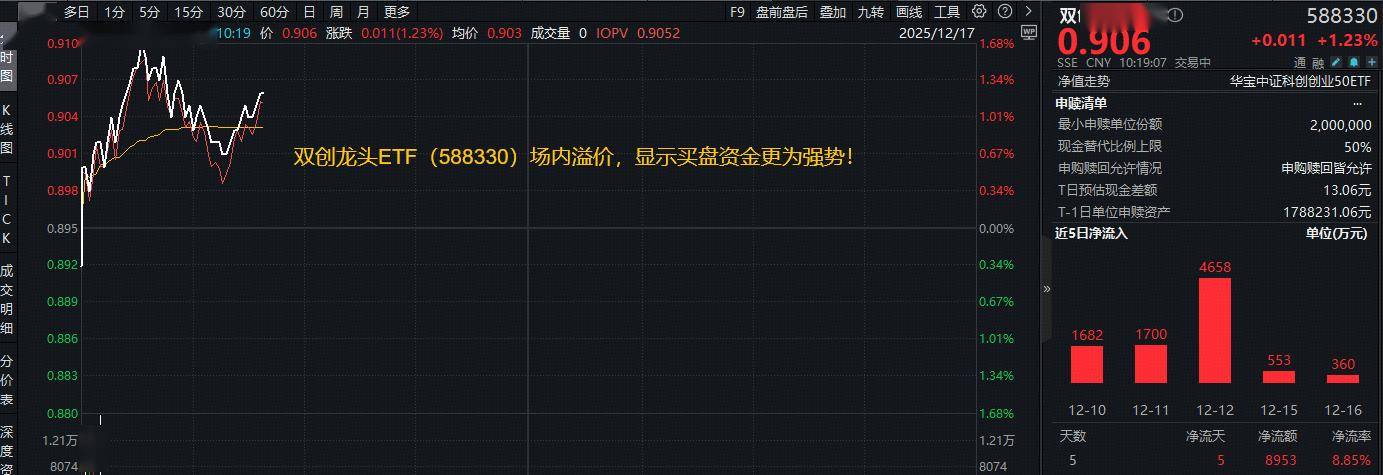
光模块+半导体携手上攻!硬科技宽基——双创龙头ETF(588330)盘中上探1.68%,近5日连续吸金8953万元!
Xin Lang Cai Jing· 2025-12-17 02:34
Core Viewpoint - The technology growth sector is showing active performance, particularly with the "Double Innovation Leading ETF" (588330), which has seen a recent increase in investment inflows, indicating positive market sentiment towards technology stocks [1][9]. Group 1: ETF Performance - The Double Innovation Leading ETF (588330) experienced a peak intraday increase of 1.68% and is currently up 1.23%, with a total net inflow of 89.53 million yuan over the past five days [1][9]. - Since its low point on April 8, the ETF has accumulated a rise of 80.83%, outperforming major indices such as the ChiNext Index (69.97%), the Sci-Tech Innovation Index (48.67%), and the Sci-Tech 50 Index (39.95%) [6][12]. Group 2: Sector Highlights - In the semiconductor sector, stocks like Zhaosheng Microelectronics rose over 6%, while other companies such as Jinghe Integration and Huazhong Microelectronics saw increases of over 4% [3][9]. - The defense and military sector saw significant gains, with AVIC rising nearly 6%, and the photovoltaic sector leader, Daqo Energy, increasing by over 1% [3][9]. Group 3: Market Sentiment and Predictions - The National Social Security Fund emphasized the importance of long-term capital in supporting technological and industrial innovation [4][10]. - UBS forecasts a 30% increase in Chinese tech stocks by 2025, building on a 20% rise in 2024, while noting a 30% discount compared to U.S. stocks [4][11]. - Zhongyuan Securities suggests that 2026 will align with the "14th Five-Year Plan" and highlights opportunities in the global monetary easing cycle and industrial upgrades, particularly in AI technology [4][11].