
佛燃能源

Search documents
燃气板块10月29日涨1.43%,德龙汇能领涨,主力资金净流入3310.87万元
Zheng Xing Xing Ye Ri Bao· 2025-10-29 08:41
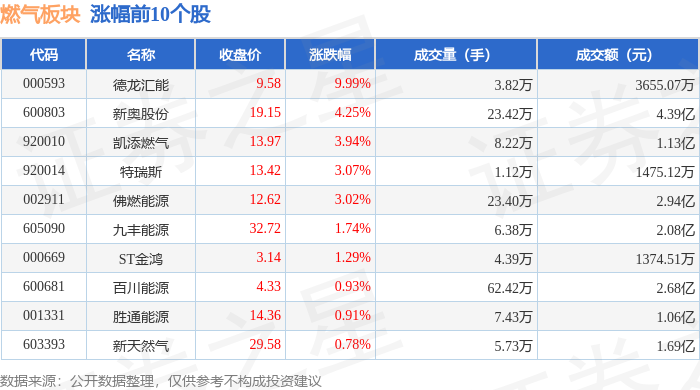
Core Insights - The gas sector experienced a rise of 1.43% on October 29, with Delong Huineng leading the gains [1] - The Shanghai Composite Index closed at 4016.33, up 0.7%, while the Shenzhen Component Index closed at 13691.38, up 1.95% [1] Gas Sector Performance - Delong Huineng (000593) saw a closing price of 9.58, with a significant increase of 9.99% and a trading volume of 38,200 shares, amounting to 36.55 million yuan [1] - Xin'ao Co. (600803) closed at 19.15, up 4.25%, with a trading volume of 234,200 shares and a transaction value of 439 million yuan [1] - Other notable performers included Kaitan Gas (920010) with a 3.94% increase, closing at 13.97, and Fuan Energy (002911) with a 3.02% increase, closing at 12.62 [1] Capital Flow Analysis - The gas sector saw a net inflow of 33.11 million yuan from main funds, while retail funds experienced a net inflow of 75.86 million yuan [2] - Notable net inflows from main funds included Fuan Energy (002911) with 42.44 million yuan and Xin'ao Co. (600803) with 40.47 million yuan [3] - Conversely, retail funds showed a net outflow from several companies, including Delong Huineng (000593) with a net outflow of 11.83 million yuan [3]




券商第三季度重仓股调整 新进93只增持19只减持25只
Zheng Quan Ri Bao· 2025-10-28 17:32
Core Insights - The recent adjustments in brokerages' heavy holdings reflect significant changes in their investment strategies based on market conditions and internal needs [1][4] Group 1: New Holdings - Brokerages have newly held 93 stocks in the third quarter, with a total of 11.29 billion shares valued at 16.984 billion yuan [2][3] - The sectors with the highest number of stocks among the 132 heavy holdings are chemicals (21 stocks), hardware equipment (19 stocks), and pharmaceuticals (17 stocks) [2] Group 2: Increased Holdings - A total of 19 stocks saw increased holdings from brokerages, with notable increases in 佛燃能源 and 大中矿业 [3] - 佛燃能源 was increased by two brokerages, while 大中矿业 saw the largest single brokerage increase of 4.3756 million shares by 红塔证券 [3] Group 3: Decreased Holdings - Brokerages reduced their holdings in 25 stocks, with 华北制药 experiencing the largest decrease of 12.1 million shares [3] - 盈方微 was reduced by 国新证券 and 东方证券 by 8.3949 million shares and 3.5418 million shares respectively [3] Group 4: Institutional Strategies - 华泰证券 holds the most heavy stocks at 21, followed by 中信证券 with 19 [4] - The performance of brokerages' proprietary trading is closely linked to their heavy stock holdings, with many brokerages adopting unique strategies for proprietary investments [4] - 中信证券 focuses on the fundamentals of listed companies, particularly long-term free cash flow, while 长城证券 employs a "high dividend +" strategy [4] Group 5: Market Observations - Brokerages' heavy stock holdings serve as an important observation window for institutional fund allocation, reflecting their professional judgment on industry trends and stock fundamentals [4]
燃气Ⅱ行业跟踪周报:天气转冷美国、中国气价上涨,欧洲进入库存提取季气价微增-20251027
Soochow Securities· 2025-10-27 06:06
Investment Rating - The report maintains an "Overweight" rating for the gas industry [1] Core Insights - The report highlights that colder weather has led to an increase in gas prices in the US and China, while Europe has entered the inventory withdrawal season with a slight price increase [1][9] - It emphasizes the ongoing adjustments in pricing mechanisms and the gradual recovery of demand, suggesting a positive outlook for gas companies [1][48] Price Tracking - As of October 24, 2025, gas prices have changed week-on-week as follows: US HH +25.4%, European TTF +1.2%, East Asia JKM +0.5%, China LNG ex-factory +6.5%, and China LNG CIF +0.4% [9][11] - The report notes that the price inversion between domestic and international markets has ended [9] Supply and Demand Analysis - The US natural gas market saw a week-on-week price increase of 25.4% due to colder weather, with storage levels rising by 870 billion cubic feet to 38,080 billion cubic feet, a year-on-year increase of 0.6% [14] - In Europe, gas prices increased by 1.2% as the region entered the inventory withdrawal phase, with gas consumption from January to July 2025 reaching 265.4 billion cubic meters, a year-on-year increase of 5% [15] - Domestic gas prices in China rose by 6.5% due to colder weather, with apparent consumption from January to September 2025 increasing by 0.7% to 318.8 billion cubic meters [21][24] Pricing Progress - Nationwide, 65% of cities have implemented residential pricing adjustments, with an average increase of 0.21 yuan per cubic meter [33] - The report indicates that there is still a 10% room for price adjustment in the gas distribution sector [33] Investment Recommendations - The report recommends focusing on companies that can optimize costs and benefit from the ongoing pricing adjustments, highlighting key companies such as Xin'ao Energy, China Gas, and Kunlun Energy [49] - It suggests monitoring companies with quality long-term contracts and flexible scheduling capabilities, such as Jiufeng Energy and Xin'ao Shares [49] - The report also emphasizes the importance of energy independence and suggests关注ing companies with gas production capabilities like New Natural Gas and Blue Flame Holdings [49]


\十五五\规划呼之欲出,推动氢能和核聚变能成为新的经济增长点:碳中和领域动态追踪(一百六十三)
EBSCN· 2025-10-26 09:07
Investment Rating - The report maintains a "Buy" rating for the electric power equipment and new energy sector, indicating an expected investment return exceeding 15% over the next 6-12 months compared to the market benchmark [6]. Core Insights - The "14th Five-Year Plan" emphasizes the development of hydrogen energy and nuclear fusion as new economic growth points, alongside other advanced technologies [1]. - The clean energy transition is crucial for achieving carbon neutrality, with hydrogen and nuclear fusion playing complementary roles in decarbonizing the energy sector [2]. - Recent policy support for hydrogen energy, including funding for green methanol projects, indicates a strong governmental push towards the hydrogen sector [3]. - China's nuclear fusion sector is experiencing rapid advancements, with multiple projects progressing simultaneously, suggesting a promising future for controlled nuclear fusion [4]. Summary by Sections Hydrogen Energy Sector - The hydrogen energy industry is expected to benefit from continuous cost reductions driven by technological advancements and supportive policies [3]. - Companies involved in green methanol production and those with advanced gasification technology are highlighted as key investment opportunities [5]. Nuclear Fusion Sector - Companies directly participating in nuclear fusion project construction and those supplying high-value components are identified as potential investment targets [5]. - The report notes significant breakthroughs in nuclear fusion technology in China, indicating a robust growth trajectory for the sector [4].
燃气板块10月24日跌1.64%,百川能源领跌,主力资金净流出2.83亿元
Zheng Xing Xing Ye Ri Bao· 2025-10-24 08:27
Core Insights - The gas sector experienced a decline of 1.64% on October 24, with Baichuan Energy leading the drop [1][2] - The Shanghai Composite Index closed at 3950.31, up 0.71%, while the Shenzhen Component Index closed at 13289.18, up 2.02% [1] Gas Sector Performance - Baichuan Energy's stock price fell by 10.02% to 4.58, with a trading volume of 950,300 shares and a turnover of 440 million [2] - Other notable declines included Guo Xin Energy down 9.76% to 3.70, and Changchun Gas down 7.61% to 6.56 [2] - Conversely, Delong Huineng saw a significant increase of 9.97% to 8.71, with a trading volume of 554,500 shares and a turnover of 474 million [1] Capital Flow Analysis - The gas sector saw a net outflow of 283 million from institutional investors, while retail investors contributed a net inflow of 314 million [2][3] - Delong Huineng attracted a net inflow of 69.23 million from institutional investors, while New Ao Co. experienced a net outflow of 29.23 million [3] - The overall trend indicates a shift in investor sentiment, with retail investors showing more interest in the gas sector despite the overall decline [2][3]

申万宏源:航运减碳大势所趋 重视生柴、RNG及绿色甲醇
Zhi Tong Cai Jing· 2025-10-24 06:01
Core Viewpoint - The shipping decarbonization policies from IMO and the EU are becoming more frequent, marking the transition of shipping decarbonization into a practical phase, with low-carbon fuel materials entering a favorable market environment [1][2] Group 1: Policy Developments - The EU will include the shipping industry in its carbon market starting in 2024, imposing fines of 100 EURO/tCO2e for non-compliance, and requires a 2% reduction in carbon emissions by 2025 and an 80% reduction by 2050, with penalties of 642 EURO/tCO2e for violations [2] - The IMO has proposed a net-zero strategy by 2050 and approved a net-zero framework draft in April 2025, establishing a unified carbon price of $380 or $100/tCO2e to significantly promote shipping decarbonization [2] - China is initiating green fuel pilot projects and has set a target for zero net emissions (ZNZ) usage of 5-10% by 2030, with compliance costs expected to drive ZNZ demand [2] Group 2: Supply and Demand Analysis - According to DNV's statistics as of August 2025, the demand for biodiesel, LNG, and green methanol is projected to be approximately 200 million tons, 40 million tons, and 6 million tons respectively, while the supply of ship fuel is only 70,000 tons, 10,000 tons, and 10,000 tons, indicating a severe shortage of low-carbon fuel supply [2] - The compliance costs in the EU are higher than those under the IMO framework and are expected to increase annually, with projected costs for 2025, 2030, 2040, and 2050 being $741, $953, $1649, and $3014 per ton respectively, compared to $525, $583, and $1362 per ton under the IMO framework [2] Group 3: Sector-Specific Insights - Biodiesel is identified as a core decarbonization measure for existing vessels, with a significant increase in biodiesel refueling at Singapore ports since 2022, reflecting a growing demand [3] - The demand for renewable natural gas (RNG) is expected to surge, driven by the IMO's net-zero framework and the potential for green premiums, with historical RNG development being slow due to high costs [4] - The number of methanol ships is rapidly increasing, with current estimates of 406 ships corresponding to a demand of over 800,000 tons of methanol, while global green methanol production capacity is expected to be only 124,000 tons by the end of 2025 [5]
券商三季度重仓股陆续浮现 三类投资机遇获看好
Zhong Guo Zheng Quan Bao· 2025-10-23 20:12
Group 1 - As of October 23, 2025, 20 listed companies have seen brokerages appear among their top ten circulating shareholders, with a total holding value of approximately 49.63 billion yuan [1][2] - Notable companies with brokerage holdings exceeding 1 billion yuan include Guangqi Technology, Cangge Mining, Xiangnong Chip, Shenhuo Co., Longjing Environmental Protection, and Furan Energy [2][4] - Brokerages have shown increased interest in sectors such as mechanical equipment and non-ferrous metals, particularly in investment opportunities related to controllable nuclear fusion, gold, and copper [3][4] Group 2 - Furan Energy reported a year-on-year increase in both revenue and net profit for the first three quarters of 2025, with brokerages such as China Merchants Securities and Dongfang Securities increasing their holdings [1][3] - Cangge Mining and Minsida have also seen slight increases in brokerage holdings, with China Merchants Securities holding 15.82 million shares of Cangge Mining, valued at 9.23 billion yuan [2][3] - The mechanical equipment sector is currently attracting attention due to the capital expenditure expansion phase in controllable nuclear fusion, with analysts highlighting the potential for core companies involved in project construction [4]
佛燃能源(002911):发布股东回报规划,进一步推进绿醇投资
Guotou Securities· 2025-10-23 14:32
Investment Rating - The investment rating for the company is "Buy-A" with a target price of 12.43 CNY over the next six months [6]. Core Insights - The company reported a revenue of 23.501 billion CNY for Q1-Q3 2025, representing a year-over-year increase of 5.38%, and a net profit of 490 million CNY, up 6.07% year-over-year, primarily due to the expansion of supply chain operations [1]. - The company has announced a shareholder return plan for 2025-2027, committing to a cash dividend of no less than 65% of the net profit attributable to shareholders each year [2]. - The demand for decarbonization in the shipping industry is increasing, creating significant growth opportunities for green methanol, as international regulations push for reduced greenhouse gas emissions [3]. - A collaboration framework agreement was signed with Hong Kong China Gas to invest in green fuel and chemical projects, with a total planned investment of 10 billion CNY [4]. Financial Summary - For the first three quarters of 2025, the company achieved a natural gas supply of 3.524 billion cubic meters, with supply chain and other business revenues reaching 13.621 billion CNY, a year-over-year growth of 20.67% [1]. - The company’s operating cash flow was 524 million CNY, down 57.74% year-over-year, mainly due to increased inventory for business expansion [1]. - The projected revenue growth rates for 2025-2027 are 3.9%, 9.0%, and 8.0%, respectively, with net profit growth rates of 7.7%, 9.7%, and 8.7% [9]. - The company’s earnings per share (EPS) for 2025 is estimated at 0.71 CNY, with a price-to-earnings (PE) ratio of 17.2 [10].
碳中和系列报告七:航运减碳大势所趋,重视生柴、RNG及绿色甲醇
Shenwan Hongyuan Securities· 2025-10-23 08:46
Investment Rating - The report indicates a positive investment outlook for the shipping decarbonization sector, emphasizing the importance of biofuels, RNG, and green methanol as key areas for investment opportunities [3]. Core Insights - The shipping industry is entering a critical phase of decarbonization, driven by frequent policies from the IMO and the EU. The global shipping fuel consumption is approximately 300 million tons, corresponding to carbon emissions exceeding 1 billion tons, with the EU accounting for about 18% of this [3][8]. - The demand for low-carbon fuels is expected to outstrip supply in the short term, with significant compliance costs driving the need for zero or near-zero emissions fuels (ZNZ) [3][36]. - Biofuels are identified as a core measure for existing vessels, with a notable increase in biofuel bunkering at ports like Singapore [3][36]. - The report highlights the potential for biogas, particularly RNG, to significantly reduce emissions and improve energy security, with ambitious production targets set for 2030 in both China and the EU [3][36]. - Green methanol is projected to see rapid growth in demand, with a current estimate of 406 methanol vessels corresponding to a demand exceeding 800,000 tons [3][36]. Summary by Sections 1. Decarbonization Policies - The report outlines the increasing frequency of decarbonization policies from the IMO and the EU, marking a significant acceleration in the implementation of these measures [3][11][18]. 2. Low-Carbon Fuel Demand - There is a broad demand space for low-carbon fuels, with a short-term supply shortage anticipated. The report notes that the compliance costs associated with EU regulations are higher than those of the IMO, which will further stimulate demand for low-carbon fuels [3][36]. 3. Biofuels - Biofuels are highlighted as a critical decarbonization measure for existing vessels, with a significant increase in biofuel bunkering observed at ports like Singapore. The global production of biodiesel is approximately 52 million tons, with expectations for increased usage in shipping as electric vehicles proliferate [3][36]. 4. Biogas - The report emphasizes the growing demand for LNG vessels and the potential for RNG to drive significant growth in the sector, supported by a green premium that could lead to an industry explosion [3][36]. 5. Green Methanol - The report notes a rapid increase in methanol vessels, with a projected demand of over 800,000 tons. However, the global production capacity for green methanol is expected to be only 1.24 million tons by the end of 2025, indicating a supply-demand imbalance [3][36]. 6. Investment Recommendations - The report suggests focusing on companies involved in biofuels, RNG, and green methanol production, including notable firms such as卓越新能, 山高环能, 维尔利, and 中国天楹, among others [3][36].





佛燃能源集团股份有限公司关于为子公司提供担保的进展公告
Zhong Guo Zheng Quan Bao - Zhong Zheng Wang· 2025-10-21 10:44
Summary of Key Points Core Viewpoint - The company has approved a total guarantee amount of up to RMB 180 million for its wholly-owned subsidiary, Foshan Huayuan Energy Trading Co., Ltd., to conduct hedging activities [2]. Group 1: Guarantee Overview - The company has provided a guarantee for Foshan Huayuan Energy Trading Co., Ltd. for a maximum amount of USD 6.9 million to Standard Chartered Bank for foreign exchange and financial derivative transactions [3]. - The actual guarantee amount utilized for hedging activities is USD 6.9 million, leaving a remaining guarantee capacity of RMB 150,262.31 million for further hedging activities [3]. Group 2: Subsidiary Information - Foshan Huayuan Energy Trading Co., Ltd. was established on September 18, 2019, and is a wholly-owned subsidiary of Shenzhen Qianhai Furun Energy Co., Ltd. [5]. - As of December 31, 2024, the total assets of Foshan Huayuan Energy were RMB 568.84 million, with a net asset value of RMB 64.68 million, and for the first nine months of 2025, the total assets increased to RMB 827.12 million [5]. Group 3: Guarantee Agreement Details - The guarantee provided by the company covers all obligations of Foshan Huayuan Energy Trading Co., Ltd. to Standard Chartered Bank under the NAFMII Master Agreement and foreign exchange trading terms [7]. - The guarantee period lasts for two years from the date of the guarantee letter, covering the last settlement or payment date of the guaranteed debts [7]. Group 4: Cumulative Guarantee Information - As of the announcement date, the company has a cumulative external guarantee amount of RMB 298.15 million, with an actual balance of RMB 115.99 million, representing 13.77% of the company's audited net assets as of December 31, 2024 [8].