
中航产融

Search documents
资讯早班车-2025-12-30-20251230
Bao Cheng Qi Huo· 2025-12-30 02:43
1. Report Industry Investment Rating No relevant content provided. 2. Core Views of the Report - The global economic and financial markets are experiencing significant fluctuations, with various industries showing different trends. For example, the metal market has seen extreme price swings, the energy market has supply - related changes, and the stock and bond markets have their own performance characteristics [4][10][30] - China is implementing a series of economic policies, such as tariff adjustments and promoting the development of digital RMB, which will have an impact on domestic and international trade and the financial system [2][15] 3. Summary by Relevant Catalogs Macro Data - GDP in Q3 2025 grew by 4.8% year - on - year, slightly lower than the previous quarter's 5.2% [1] - In November 2025, the manufacturing PMI was 49.2%, and the non - manufacturing PMI for business activities was 49.5%, both showing certain trends compared to the previous month and the same period last year [1] - Social financing scale, M0, M1, M2, and other monetary indicators also had corresponding changes in November 2025 [1] Commodity Investment Comprehensive - From January 1, 2026, China will implement import provisional tax rates lower than the most - favored - nation rates for 935 commodities to enhance resource linkage and expand high - quality supply [2] - On December 29, 2025, 40 domestic commodity varieties had positive basis, and 26 had negative basis [2] Metal - Precious metals had a volatile "Black Monday". Silver first soared and then plunged, dragging down other precious metals. International and domestic metal prices and futures contracts showed significant declines [4][5] - On December 29, 2025, CME Group raised metal futures trading margins, triggering price drops [5] - In 2025, silver prices broke a 45 - year record and were higher than crude oil prices, driven by industrial and investment demand [5] Coal, Coke, Steel, and Ore - Bauxite miner Axis has filed a $29 billion claim against Guinea [9] Energy and Chemicals - U.S. refineries are expected to have capacity outages in the coming weeks, with the scale increasing [10] - India's oil imports from Russia in December 2025 are expected to exceed 1 million barrels per day [10] Agricultural Products - China's grain output in 2025 was 1.43 trillion jin, a 1.2% increase from the previous year, mainly due to the increase in corn production [12] - As of December 2025, the autumn grain purchase volume exceeded 200 million tons, a year - on - year increase of 32 million tons [13] Financial News Open Market - On December 29, 2025, the central bank conducted 482.3 billion yuan of 7 - day reverse repurchase operations, with a net investment of 415 billion yuan [14] Important News - The Chinese military conducted the "Justice Mission - 2025" exercise around Taiwan [15] - China will start to pay interest on digital RMB from January 1, 2026 [15] Bond Market - The bond market was generally weak, with treasury bond futures falling and bond yields rising [21] Foreign Exchange Market - The on - shore RMB against the US dollar closed at 7.0098 on December 29, 2025, down 13 points from the previous trading day [26] Research Report Highlights - Xingzheng Fixed Income believes that in the short term, the bond market carry strategy is relatively certain, and there is room for the repair of long - end bonds [27] - CITIC Securities suggests paying attention to high - grade state - owned enterprise perpetual bonds in industries such as public utilities, transportation, and construction [27] Stock Market - A - shares showed a divergence between large and small indexes. The Shanghai Composite Index rose 0.04%, while the Shenzhen Component Index and the ChiNext Index fell [30] - Hong Kong stocks fluctuated, with the Hang Seng Index falling 0.71% [30]
2026:信用债投资的风险边界与机会展望
2025-12-26 02:12
Summary of Key Points from the Conference Call Industry Overview - The conference call primarily discusses the credit bond market, focusing on the outlook for 2026 and the performance of various sectors within the industry, including local government financing platforms (城投) and non-bank financial institutions. Core Insights and Arguments 1. **2025 Credit Bond Market Performance**: The credit bond market in 2025 is expected to be stable, with coupon yields providing solid returns, particularly during the March allocation window. However, long-term credit bonds face challenges as the credit spread for long-term bonds is expected to widen, making trading more difficult [3][5]. 2. **Investment Opportunities in 2026**: The focus for 2026 will be on the value of coupon yields in a volatile market, with attention on the transformation of local government financing platforms, risks in financial and industrial bonds, and opportunities arising from the expansion of southbound investment channels [6][11]. 3. **Risks in a Low-Interest Environment**: There is a need to be cautious of tail risks in the current low-interest environment, emphasizing the importance of fundamental research to understand valuation fluctuations and liquidity loss [7][49]. 4. **Transformation of Local Government Financing Platforms**: The transformation of local government financing platforms is accelerating, which will significantly impact local government construction. The focus will be on policy guidance to ensure the successful resolution of hidden debt issues [8][9][12]. 5. **Regional Disparities**: Investment demand is increasing in coastal regions and first-tier cities, while some southwestern and northern regions face significant debt pressure and limited financing support [2][14]. 6. **Institutional Behavior Impact**: The expansion of wealth management scale has increased demand for short-term credit bonds, while the decline in fund sizes has reduced allocations for medium to long-term bonds. This shift in institutional behavior significantly affects pricing and demand structures [10][11]. 7. **Future of Local Government Financing**: Local government financing platforms are expected to gradually de-platform, no longer assuming debt responsibilities, yet they will remain crucial for local government operations in the next 5-10 years [12][13]. 8. **Policy Adjustments**: Recent policy adjustments have aimed to alleviate fiscal pressures, including the resumption of issuing special bonds and flexible adjustments in their usage [16]. 9. **Credit Risk in Non-Bank Financial Institutions**: Non-bank financial institutions face various risks, including market, liquidity, credit, and refinancing risks. The central bank's new liquidity support mechanism aims to prevent individual liquidity issues from escalating into systemic risks [4][27][29]. 10. **Investment Strategy for 2026**: The investment strategy should focus on identifying coupon yield opportunities, recognizing credit risks based on fundamentals, and observing structural changes and opportunities from the product and institutional behavior perspectives [11][60]. Other Important but Potentially Overlooked Content - The credit bond market is expected to face a significant gap in high-yield assets in 2026, with a large volume of high-yield deposits maturing, which could push credit spreads and yields higher [47][48]. - The performance of the real estate sector remains uncertain, with ongoing liquidity and credit risk issues, particularly highlighted by the Vanke incident, which has affected overall market sentiment [40][43]. - The future of the credit bond market will likely see a rise in credit risk premiums due to potential unexpected risk events, necessitating careful monitoring and strategic adjustments [52][68]. This summary encapsulates the key points discussed in the conference call, providing insights into the credit bond market's current state and future outlook, as well as the implications for investment strategies.
“退市不免责”成常态 资本市场退出机制更规范
Jing Ji Ri Bao· 2025-12-25 07:31
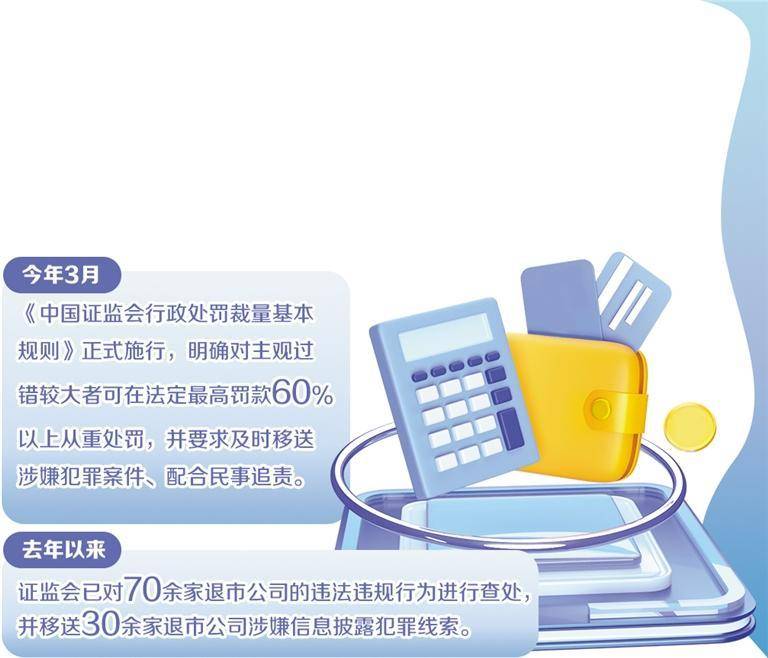
Core Viewpoint - The implementation of stricter delisting regulations in China's capital market has led to a significant increase in both mandatory and voluntary delistings, reflecting a more mature and regulated market environment [1][2][3] Group 1: Delisting Mechanisms - The current delisting methods in the capital market include mandatory delisting and voluntary delisting, with a notable increase in voluntary delisting cases this year [2] - As of December 17, 30 companies have had their stocks delisted, with five companies, including Haitong Securities and China Heavy Industry, opting for voluntary delisting due to strategic mergers or significant operational uncertainties [2] - The rise in voluntary delistings indicates an optimization of delisting policies, encouraging market-driven exits to clear risks more smoothly [2][3] Group 2: Regulatory Environment - The phrase "delisting does not exempt from responsibility" has become a key highlight in the enforcement of delisting regulations, emphasizing the regulatory body's zero-tolerance stance towards illegal activities by delisted companies [4][5] - The China Securities Regulatory Commission (CSRC) has taken action against over 70 delisted companies for illegal activities, with a focus on expediting investigations and penalties [5][6] - A comprehensive accountability system has been established, ensuring that major stakeholders are held responsible for violations, thereby enhancing market fairness and legal standards [6] Group 3: Investor Protection - The regulatory framework has shifted from merely facilitating delisting to ensuring investor protection, with measures such as advance compensation and special representative lawsuits being implemented [7][8] - Companies that voluntarily delist are generally required to offer cash options to protect small investors, with examples showing premiums over pre-suspension prices [8] - The introduction of special representative lawsuits allows investors to participate in collective legal actions without upfront costs, streamlining the process for seeking redress [8]
陆家嘴财经早餐2025年12月25日星期四
Wind万得· 2025-12-24 22:50
Group 1 - Beijing has further optimized housing purchase restrictions, easing conditions for non-Beijing households and allowing multi-child families to purchase additional properties [2] - The People's Bank of China (PBOC) is set to conduct a 400 billion yuan MLF operation on December 25, marking a net injection of 100 billion yuan for the month [3] - The new Encouragement Directory for Foreign Investment will take effect on February 1, 2026, adding 205 new items and modifying 303 to attract more foreign investment in advanced manufacturing and high-tech sectors [3] Group 2 - A-shares have seen a six-day rise, with the Shanghai Composite Index up 0.53% to 3940.95 points, and over 4100 stocks rising [6] - The Hong Kong stock market is expected to see a full recovery in 2025, with IPOs projected to reach 286.3 billion HKD, returning to the top globally [6] - The market is experiencing significant stock differentiation as year-end approaches, with private equity firms adapting strategies to embrace trends or maintain value [7] Group 3 - The semiconductor sector is facing a new wave of price increases, with companies like SMIC and World Advanced notifying clients of price hikes around 10% [10] - The National Energy Administration reported that electricity consumption in November reached 835.6 billion kWh, a 6.2% year-on-year increase, with the charging and swapping service sector seeing a 60.2% rise [10] - The global LED video display product shipments increased by 8.3% year-on-year in Q3, although China's market share has dropped to its lowest since 2021 [11] Group 4 - The market for precious metals has seen significant inflows, with silver futures experiencing a surge and related funds hitting daily limits [20] - International oil prices showed mixed results, with WTI crude up 0.03% and Brent crude down 0.05%, influenced by geopolitical events [21] - The domestic bond market is experiencing limited volatility, with government bonds showing mixed performance [19]


资本市场退出机制更成熟规范
Sou Hu Cai Jing· 2025-12-23 22:53
作为资本市场基础性制度之一,退市制度是市场新陈代谢的重要一环。进退有据的市场才能优胜劣汰,更好 配置资源,更好发挥资本市场功能。去年4月,证监会发布《关于严格执行退市制度的意见》。新规实施以 来,在"应退尽退"原则下,我国资本市场的退市改革迎来显著深化,推动市场向更加成熟规范的方向迈进。 退出渠道多元化 当下,资本市场的退出方式主要是强制退市与主动退市。过去很长时间,A股退市情形以强制退市为主。财 务指标类、交易指标类、规范运作类、重大违法类四类强制退市标准在我国退市改革中逐步完善。 以往少见的主动退市案例在今年显著增加。据统计,截至12月17日,今年A股已有30家上市公司股票被交易 所作出终止上市决定。其中,海通证券、中航产融、玉龙股份、中国重工、*ST天茂5家公司选择主动退市, 均已摘牌。 主动退市的公司主要分为两类:一是基于产业整合与战略协同的吸收合并;二是因经营存在重大不确定性或 为寻求更灵活发展空间而主动退出。以中国重工为例,其退市是因为与中国船舶实施了换股吸收合并,导致 不再具有独立主体资格,从而主动申请终止A股上市。这一合并旨在整合双方资源、消除同业竞争,打造全 球领先的船舶制造企业。 "退市不 ...
年内9家公司宣布主动退市
Shen Zhen Shang Bao· 2025-12-18 17:23
Core Viewpoint - A total of 9 companies have voluntarily delisted this year, with 5 due to absorption mergers and 4 through privatization methods such as tender offers, indicating a trend towards more companies opting for voluntary delisting as regulatory channels for delisting diversify [1][2] Group 1: Company Delisting Trends - 9 companies have voluntarily delisted this year, with 5 involved in absorption mergers and 4 through privatization [1] - Companies that have announced or completed voluntary delisting include Yulong Co., Ltd., AVIC Capital, Tianmao Co., Ltd., Hangzhou Steam Turbine B, Dongxing Securities, and others [1] - The delisting of companies like Hangzhou Steam Turbine B and Dongxing Securities is attributed to absorption mergers, while Yulong Co., Ltd. and others have chosen voluntary delisting due to poor performance or financial difficulties [1] Group 2: Reasons for Delisting - Yulong Co., Ltd. faced severe operational stagnation and cash flow issues, leading to a lack of self-sustaining capability [2] - AVIC Capital, the first financial holding company listed in A-shares, cited significant operational uncertainties that could have major impacts [2] - Industry insiders suggest that voluntary delisting is a strategic choice for controlling shareholders to mitigate greater risks, allowing for better planning and reduced compliance costs [2]


“湘”当给力!湖南国资创投改革加速
Zheng Quan Shi Bao Wang· 2025-12-17 01:39
Core Insights - Hunan Province is accelerating its state-owned venture capital reform towards "technology innovation empowerment," with significant growth in private equity market activities [1][5] Fundraising Market - Institutional Limited Partners (LPs) in Hunan contributed a total of 30.4 billion yuan from January to November 2025, marking a 67% increase compared to the entire year of 2024 [2] - Nationally, institutional LP contributions reached approximately 1.4 trillion yuan, with state-owned capital accounting for 62.5% [2] - Major contributors in Hunan include Changsha Zhenwang Investment Development Co., Ltd. with 4 billion yuan, and Changsha Kaifu State-owned Capital Investment Operation Co., Ltd. with 2.277 billion yuan [2] Fund Scale and Structure - By November 2025, the newly registered fund scale in Hunan reached 51.1 billion yuan, nearly matching the 51.5 billion yuan from the entire year of 2024 [3] - The Hunan Jin Furong Fund, established in September 2024, aims to create a fund cluster of 300 billion yuan, with a structure of one main fund, five major guiding funds, and multiple sub-funds [4] Investment Market - Hunan led the Central Triangle region with 286 investment projects from January to November 2025, outperforming Hubei and Jiangxi [7] - Key investment sectors in Hunan include new materials, new energy, biopharmaceuticals, and intelligent manufacturing, aligning with the province's modernization goals [7] - Hunan Xingxiang Capital Management Co., Ltd. emerged as the most active fund manager in the province, with a registered fund scale of 7.3 billion yuan [8]
中航重机:拟向控股子公司增资8550万元
Xin Lang Cai Jing· 2025-12-15 11:32
中航重机公告称,为增强控股子公司激光公司技术研发和产业能力,公司拟向其增资8550万元。激光公 司股东中航投资控股有限公司系公司关联方,本次增资构成关联交易,但不构成重大资产重组。截至本 次关联交易,过去12个月内相关关联交易累计金额8550万元,未达公司最近一期经审计净资产绝对值 5%,无需提交股东会审议。增资后,公司对激光公司持股比例将由61.95%增至83.60%。本次增资尚需 取得上级单位批准。 ...

信用周报20251210:连续调整后,二永的机会在哪儿?-20251210
China Post Securities· 2025-12-10 08:56
1. Report Industry Investment Rating No information provided in the content. 2. Core Viewpoints of the Report - Last week, interest rate bonds fluctuated slightly weaker, and credit bonds adjusted synchronously with interest rates but declined more significantly. This might be due to the continuous fermentation of the Vanke incident, causing the market's credit risk preference to turn cautious [2][10]. - After three weeks of phased adjustment, the "volatility amplifier" characteristic of Tier 2 and perpetual bonds reappeared, with a decline higher than that of general - credit bonds and interest - rate bonds of the same maturity. There is a certain opportunity for left - side participation [3][18]. - The selling pressure of ultra - long - term credit bonds was strong last week. The market became more cautious about duration at the end of the year. The Vanke incident made the market more risk - averse, and investment institutions' willingness to invest in real - estate and related sectors decreased [4][22]. - Currently, the coupon strategy is still the best. After the recent adjustment, about 28.7% of the 1 - 3 - year credit bonds with implied ratings of AA and AA(2) have yields between 2.2% - 2.6%, leaving some room for bond selection. It is still not advisable to pursue ultra - long - term credit bonds. For allocation portfolios with a more stable liability side, the Tier 2 and perpetual bonds of large state - owned banks with a maturity of 3 - 5 years can be considered for appropriate participation [5][34]. 3. Summary According to Relevant Catalogs 3.1 Bond Market Performance - **Interest Rate and Credit Bond Yield Changes**: From December 1 to December 5, 2025, the 1Y, 2Y, 3Y, 4Y, and 5Y Treasury bond yields changed by - 0.0BP, - 1.5BP, - 1.5BP, - 0.2BP, and + 1.4BP respectively, while the yields of the same - maturity AAA medium - term notes increased by 1.1BP, 2.6BP, 2.9BP, 2.6BP, and 3.7BP respectively, and AA + medium - term notes increased by 2.1BP, 3.6BP, 1.9BP, 3.6BP, and 4.7BP respectively [10]. - **Ultra - long - term Credit Bond Performance**: The decline of ultra - long - term credit bonds was higher than that of general - credit bonds and interest - rate bonds of the same maturity. The 7Y performance was generally better than that of the 10Y. The yields of 10Y AAA/AA + medium - term notes increased by 4.18BP, the yields of 10Y AAA/AA + urban investment bonds increased by 5.80BP and 7.79BP respectively, and the yield of 10Y AAA - bank Tier 2 capital bonds increased by 8.54BP, while the 10Y Treasury bond yield increased by 0.68BP [12]. 3.2 Yield Curve and Historical Quantiles - **Yield Curve Steepness**: The steepness of the 1 - 2 - year yield curve was the highest for all ratings, and the 2 - 3 - year steepness of low - grade bonds was also relatively high. For AA + medium - term notes, the slopes of the 1 - 2 - year, 2 - 3 - year, and 3 - 5 - year intervals were 0.1433, 0.0837, and 0.0748 respectively; for AA urban investment bonds, they were 0.1476, 0.1402, and 0.0864 respectively [13]. - **Historical Quantiles**: The protection cushion of 3 - 5Y general - credit bonds has increased, and they currently have a certain cost - effectiveness. From December 1 to December 5, 2025, the valuation yields to maturity of 1Y - AAA, 3Y - AAA, 5Y - AAA, 1Y - AA +, 3Y - AA +, 5Y - AA +, 1Y - AA, and 3Y - AA ChinaBond medium - and short - term notes were at the 27.27%, 39.87%, 43.38%, 23.34%, 35.74%, 38.84%, 20.04%, and 30.99% levels since 2024. The historical quantiles of their credit spreads were 7.85%, 19.21%, 22.31%, 7.02%, 12.80%, 14.04%, 6.81%, and 17.76% respectively [15]. 3.3 Tier 2 and Perpetual Bonds - **Yield Changes**: The yields of 1 - 5Y, 7Y, and 10Y AAA - bank Tier 2 capital bonds increased by 2.98BP, 3.18BP, 7.48BP, 7.65BP, 4.97BP, 6.64BP, and 8.54BP respectively. The part with a maturity of 4 years and above is still 45BP - 65BP away from the lowest yield point since 2025. Compared with the sharp decline at the end of July, the yield points of varieties with a maturity of over 2 years are higher than the previous round [18]. - **Trading Activity**: Last week, the long - and short - side forces in the market were relatively balanced, and the market fluctuated repeatedly. From December 1 to December 5, the proportion of low - valuation transactions of Tier 2 and perpetual bonds was 100.00%, 5.00%, 50.00%, 0.00%, and 100.00% respectively; the average transaction duration was 4.62 years, 1.29 years, 2.23 years, 0.68 years, and 6.14 years respectively. The amplitude of transactions below the valuation was generally low, within 2.5BP, and the amplitude of discount transactions was also mostly within 3BP [19]. 3.4 Ultra - long - term Credit Bond Transactions - **Discount Transactions**: From December 1 to December 5, the proportion of discount transactions of ultra - long - term credit bonds was 25.00%, 60.00%, 65.00%, 80.00%, and 57.50% respectively. About 30.5% of the discount transaction amplitudes were above 4BP, mainly individual bonds with credit flaws such as AVIC Industry - Finance, and there were also many discount transactions of Shenzhen Metro above 4BP [22]. - **Transactions Below Valuation**: The willingness to buy ultra - long - term credit bonds was not strong, and the focus of market trading was still on low - quality urban investment bonds. About 30% of the transactions below the valuation had an amplitude of 3BP or more, but the proportion of ultra - long - term credit bonds was not high. Transactions with an amplitude of 3BP or more were mainly 2 - 5Y AA(2) and AA - low - quality urban investment bonds [23][25]. 3.5 Institutional Behavior - **General - credit Bonds**: Public funds and wealth management products mainly increased their holdings of general - credit bonds in the short - and medium - term, mainly within 3 years. Last week, funds net - bought 59.40 billion yuan of credit bonds within 1 year and 53.40 billion yuan of 1 - 3Y credit bonds, and were in a state of net - selling for credit bonds over 7 years. Wealth management products mainly net - bought 90.99 billion yuan of credit bonds within 1 year and 26.79 billion yuan of 1 - 3Y credit bonds [27]. - **Tier 2 and Perpetual Bonds**: The selling pressure of public funds and insurance companies on Tier 2 and perpetual bonds has weakened, and the buying power of wealth management products is not strong. Other asset management products are the main force for increasing holdings. Last week, fund companies net - sold 93.9 billion yuan of Tier 2 and perpetual bonds, insurance companies net - sold 40.1 billion yuan, and bank wealth management products net - bought 36 billion yuan. Only other products net - bought 197.4 billion yuan [27].
把握政策窗口期的投资机会
AVIC Securities· 2025-12-07 13:35
Market Overview - The A-share market is currently in an N-shaped consolidation phase with relatively low trading volume, indicating a wait-and-see approach ahead of policy announcements for the coming year[3] - The China Securities Regulatory Commission has released a draft regulation to enhance market value management, cash dividends, and share buybacks, aiming to improve investment value and investor returns[3] Currency Trends - Since November, the RMB has appreciated against the USD, driven by a stable Sino-US economic environment and year-end settlement demand, with the exchange rate reaching approximately 7.0583[3][10] - The RMB's rapid appreciation may slow down in the short term, but the long-term upward trend remains intact, supported by internal economic adjustments and external monetary policy shifts[10][11] Investment Opportunities - The recent adjustment of risk factors for insurance companies is expected to introduce over 100 billion RMB in potential insurance capital into the market, supporting technology innovation[3] - The report suggests focusing on sectors with marginal catalysts, such as commercial aerospace and robotics, while maintaining a dividend-based investment strategy[4] Foreign Investment Insights - In Q3 2025, the top five sectors favored by northbound capital were power equipment, electronics, pharmaceuticals, banking, and food and beverage, indicating a strong preference for technology sectors[5] - Historical data shows that during the last six rounds of RMB appreciation, the stock market generally performed well, with A-shares and Hong Kong stocks showing significant gains[5][17] Economic Outlook - The upcoming Federal Reserve meeting and China's Central Economic Work Conference are critical events that may influence market sentiment and policy direction[4] - The report highlights that the CDS spread for Chinese sovereign bonds has decreased significantly, reflecting improved perceptions of credit risk and increasing foreign interest in Chinese assets[15]