
博时基金

Search documents
行业竞争激烈 黄金类ETF产品不断优化
Shang Hai Zheng Quan Bao· 2026-01-18 18:40
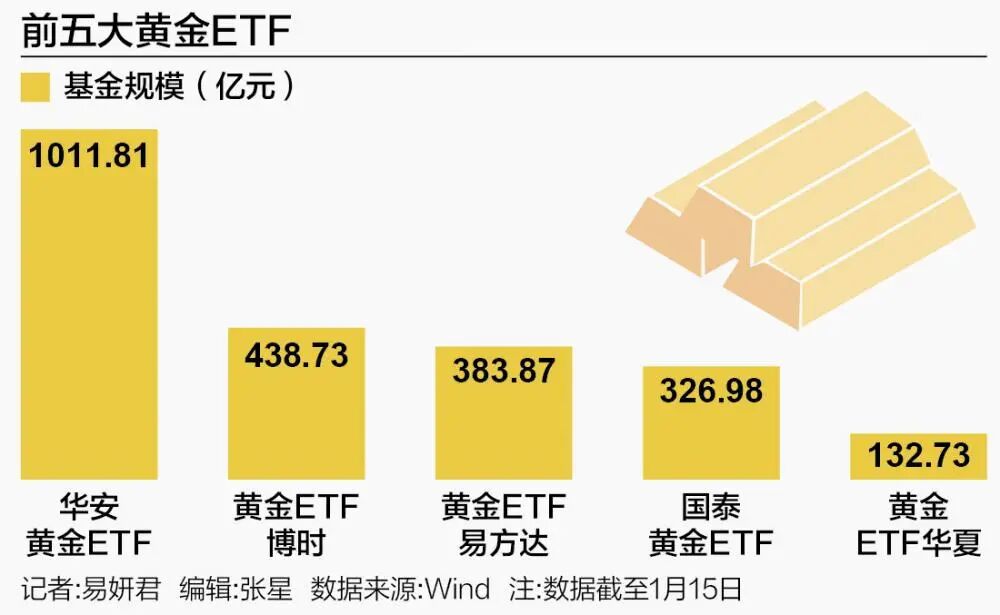
Core Viewpoint - The gold market is experiencing significant growth, leading to an increase in the scale of related ETFs, with competition among similar products intensifying [1][3]. Group 1: ETF Adjustments - E Fund announced adjustments to its gold ETF, reducing the minimum subscription and redemption units from 300,000 shares to 100,000 shares, and the minimum gold contract from 3,000 grams to 1,000 grams, effective January 19, 2026 [2]. - The ETF will only accept the Au99.99 spot contract from the Shanghai Gold Exchange for physical transactions, enhancing liquidity and execution efficiency [2]. Group 2: Market Competition - The net subscription volume for gold ETFs reached nearly 20 billion shares in 2025, with the Huazhong Gold ETF surpassing 100 billion yuan in scale by January 15, 2026 [3]. - Fund companies are accelerating product optimization, as seen with the Huazhong CSI Hong Kong Gold Industry ETF, which revised its dividend policy to enhance flexibility in profit distribution [3]. Group 3: Industry Dynamics - The gold ETF market is dominated by five major fund companies: Huazhong, E Fund, Bosera, Guotai, and Huaxia, indicating a "Matthew Effect" where the strong continue to grow stronger [4]. - The demand for gold as an asset class is expected to drive long-term growth in gold ETFs, necessitating continuous product optimization by fund companies to enhance competitiveness [4].
细分赛道激战正酣 公募竞相发行行业主题ETF
Xin Lang Cai Jing· 2026-01-18 18:28
Group 1 - The A-share market has entered a new round of structural trends in 2026, with sectors like commercial aerospace, new energy, and artificial intelligence (AI) applications showing strong performance, leading to a significant increase in the issuance of thematic ETFs [1][3] - The Satellite ETF from Yongying Fund has achieved a return of 17.92% year-to-date and a 99.10% increase over the past six months, with its scale rising from 2.4 billion to 17 billion, becoming the first thematic ETF in the market to exceed 10 billion [1] - The gold and silver prices have been rising, leading to increased interest in precious metal thematic ETFs, with the Huaan Gold ETF surpassing 100 billion, becoming the first gold ETF in China to enter the "100 billion club" [1] Group 2 - Recent thematic ETF issuance shows strong interest in the electric utility sector, with the Invesco Great Wall Fund's electric utility ETF raising 1.667 billion in just 7 days, indicating investor preference for this sector [2] - The semiconductor and AI sectors have also seen significant fundraising, with Tianhong Fund's semiconductor ETF raising 607 million and Southern Fund's AI ETF raising 514 million within short subscription periods [2] - The battery thematic ETF has experienced intense competition, with Dachen Fund's ETF raising 442 million in just 4 days, the shortest in the market, while Southern Fund's similar product raised 322 million [2] Group 3 - The recent surge in thematic ETF issuance is closely linked to the structural trends in the A-share market in 2026, with institutional investors rapidly deploying capital into popular sectors through these products [3] - Over the past five years, the number of new ETFs has increased significantly, from 281 in 2021 to 363 in 2025, with technology, new energy, and healthcare thematic ETFs showing remarkable performance [3] - The AI thematic ETF has seen explosive growth, with the Guangfa Shanghai Stock Exchange AI ETF's issuance increasing from 326 million to 3.476 billion [3] Group 4 - There is a noticeable trend of differentiation within thematic ETFs, with some products experiencing rapid shrinkage in scale post-issuance, particularly in sectors like consumer leaders and biotechnology, where some products have seen reductions exceeding 96% [4] - The ability of thematic ETFs to attract and retain capital depends on the long-term viability of the sector, product differentiation, and market conditions [4] - Fund companies need to focus on the sustainability and market demand alignment of their products while expanding into new sectors [4]


债市投资2026:固收基金经理重构攻防体系
Shang Hai Zheng Quan Bao· 2026-01-18 18:25
Group 1 - The bond market has faced adjustments since the second half of 2025, with rising yields and increased volatility, putting pressure on bond funds known for their stability [1][2] - Fund managers are focusing more on drawdown control and investment strategy iteration, with "negative duration" risk hedging strategies gaining attention [1][4] - The bond market is expected to present a volatile pattern in 2026, with traditional strategies regaining effectiveness and the allocation of convertible bonds and equity assets becoming important for enhancing returns [1][8] Group 2 - Over the past six months, bond market yields have continued to rise, with the 10-year government bond yield increasing from approximately 1.65% in early July 2025 to nearly 1.9% by January 7, 2026, a rise of 25 basis points [2] - The net value of pure bond funds has been under pressure, with the pure bond fund index rising only 0.05% over the past six months, while the mid-to-long-term pure bond fund index fell by 0.51% [2] - The current challenges for bond investments include poor odds and changes in traditional pricing logic, with institutional behavior and risk asset performance becoming more influential [2][3] Group 3 - The "negative duration" strategy is gaining attention as it allows for capital gains during rising interest rate cycles by constructing a portfolio with short-term liabilities and long-term assets [4][5] - This strategy has practical value in specific market conditions, particularly when interest rates are clearly on the rise and the yield curve steepens [4] - Fund managers are advised to be cautious with the "negative duration" strategy due to its high entry barriers, significant trading costs, and potential risks if interest rate directions are misjudged [6] Group 4 - In a volatile market, the ability to control drawdowns is crucial, but fund managers must also be able to generate excess returns to demonstrate their value [7] - The bond market is expected to experience a wide range of fluctuations in 2026, with traditional strategies like riding strategies, leverage strategies, and variety rotation strategies becoming more effective [7][8] - Fund managers are encouraged to adapt their strategies to the changing market dynamics, focusing on high-yield assets and maintaining flexibility in their investment approaches [8][9]
黄金ETF近一年吸金规模猛增近3倍
Xin Lang Cai Jing· 2026-01-18 06:11
Core Insights - The article highlights the significant growth of gold ETFs in China, particularly the Huaan Gold ETF, which surpassed 100 billion yuan in assets for the first time, reaching 101.81 billion yuan on January 15, 2026 [1][3][15] - The total assets of 14 gold ETFs in the domestic market exceeded 260 billion yuan, marking a nearly threefold increase compared to the previous year [3][15][21] Group 1: Growth of Gold ETFs - The Huaan Gold ETF's assets reached 100.76 billion yuan on January 14, 2026, and continued to grow to 101.81 billion yuan the following day [1][19] - As of January 15, 2026, the total assets of 14 gold ETFs amounted to 2630.61 billion yuan, an increase of over 210 billion yuan from 2415.61 billion yuan on December 31, 2025 [20][21] - Over the past year, the total assets of these gold ETFs increased by more than 190 billion yuan, with a growth rate close to three times [4][21] Group 2: Fund Inflows and Performance - Inflows into gold ETFs have been substantial, with the Huaan Gold ETF, Guotai Gold ETF, and Bosera Gold ETF attracting net inflows of 14.72 billion yuan, 13.78 billion yuan, and 10.86 billion yuan respectively from January 1 to January 15, 2026 [3][18] - The total net inflow for the 14 gold ETFs over the past year was 123.17 billion yuan, with the Huaan Gold ETF leading with 43.79 billion yuan [5][23] - The average return for these gold ETFs exceeded 61% from January 15, 2025, to January 15, 2026, driven by rising international gold prices [6][26] Group 3: Market Dynamics and Future Outlook - The rise in gold prices has been attributed to factors such as declining real interest rates, increased geopolitical risks, and a growing supply-demand gap for gold [7][28] - As of January 16, 2026, spot gold prices approached 4600 USD, reflecting a 6.5% increase since the beginning of the year [9][28] - Fund managers are enhancing liquidity and risk management in response to market conditions, with adjustments to the minimum subscription and redemption units for the gold ETFs [10][29]
黄金ETF近一年吸金规模猛增近3倍
21世纪经济报道· 2026-01-18 05:59
Core Viewpoint - The article highlights the significant growth of gold ETFs in China, driven by rising international gold prices and increased investor interest, with the total scale of gold ETFs surpassing 2600 billion yuan, nearly tripling in a year [1][3][4]. Group 1: Growth of Gold ETFs - As of January 14, 2026, the largest commodity ETF in the domestic market, Huaan Gold ETF, reached a scale of 100.76 billion yuan, marking the first time it surpassed the 100 billion yuan threshold [1]. - By January 15, 2026, the scale of Huaan Gold ETF further increased to 101.18 billion yuan, contributing to a total of 14 gold ETFs in the market with a combined scale of 2630.61 billion yuan, up from 2415.61 billion yuan at the end of December 2025 [3][4]. - Over the past year, the total scale of these 14 gold ETFs increased by over 190 billion yuan, with a growth rate close to 300% [4]. Group 2: Fund Inflows and Performance - In the first half of January 2026, major gold ETFs attracted significant net inflows, with Huaan Gold ETF, Guotai Gold ETF, and Bosera Gold ETF receiving net inflows of 1.472 billion yuan, 1.378 billion yuan, and 1.086 billion yuan respectively [3]. - The total net inflow for the 14 gold ETFs reached 123.17 billion yuan over the past year, with Huaan Gold ETF leading with 43.79 billion yuan [4]. - The return rate for these gold ETFs exceeded 61% from January 15, 2025, to January 15, 2026, driven by strong international gold prices influenced by various economic factors [4]. Group 3: Market Dynamics and Investor Behavior - The continuous rise in gold prices, geopolitical tensions, and financial market volatility have led investors to favor gold ETFs as a safe-haven investment [7]. - The convenience and low cost of investing in gold ETFs have attracted a large number of investors, further boosting their popularity [7]. - Adjustments in the minimum subscription and redemption units for gold ETFs by various fund companies indicate a response to market changes and a strategy to ensure stable fund operations [9]. Group 4: Future Outlook - Analysts suggest that while gold prices may slow down in the short term due to reduced uncertainty in U.S.-China trade relations, the long-term outlook remains positive due to ongoing central bank gold accumulation and high demand for gold ETFs [11]. - Investment strategies should focus on maintaining a reasonable allocation to gold, with recommendations for a 10%-20% portfolio allocation to optimize returns and manage risks [10].

这类ETF单周缩水超2000亿元,发生了什么?
Mei Ri Jing Ji Xin Wen· 2026-01-18 05:55
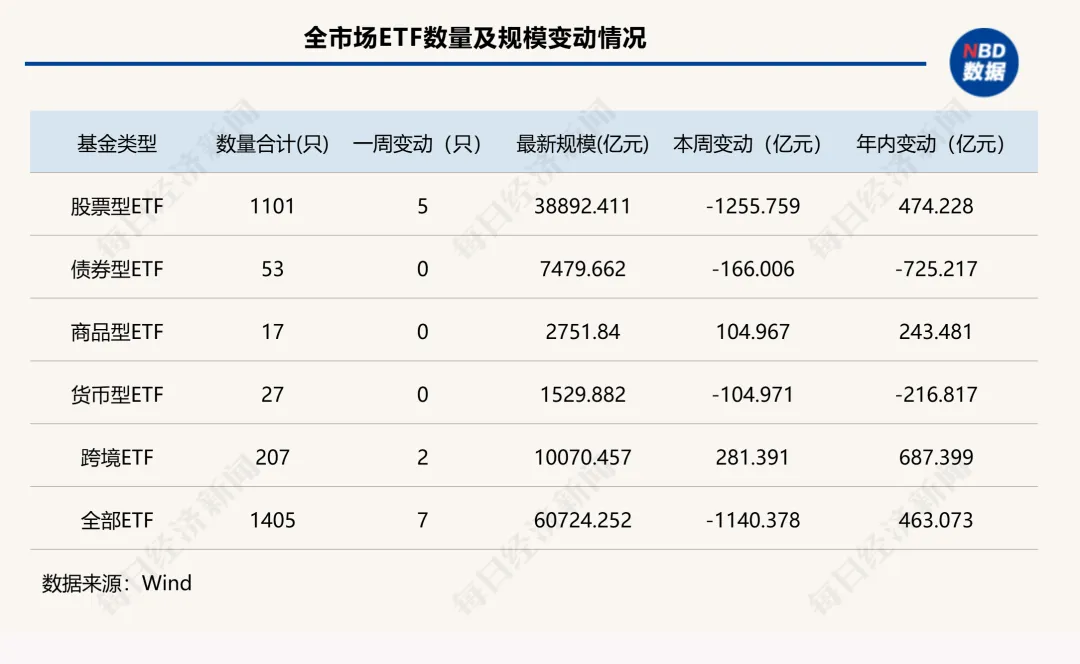
Market Overview - A-shares experienced volatility with the CSI 300 index declining by 0.57% and the ChiNext index increasing by 1% during the week of January 12 to January 16 [1][18] - The Hong Kong market rebounded, with the Hang Seng Index rising by 2.34% [1] ETF Market Dynamics - The ETF market faced a significant downturn, with a loss exceeding 200 billion yuan in a single week, leading to a total scale drop below 4 trillion yuan for stock ETFs [1][19] - Major ETF managers, including Huaxia, E Fund, and Huatai-PB, saw their management scales shrink by over 340 billion yuan due to the outflow of funds from broad-based ETFs [1][19] - Despite the downturn in stock ETFs, cross-border ETFs saw a historic increase, surpassing 1 trillion yuan in total scale for the first time [1][33] ETF Scale Changes - The total market ETF scale decreased by 1,140.38 billion yuan, with stock ETFs alone shrinking by 1,255.76 billion yuan [2][19] - Bond and money market ETFs also faced declines, with reductions of 166.01 billion yuan and 104.97 billion yuan, respectively [2][19] - Conversely, cross-border ETFs added 289.39 billion yuan, marking a significant growth [2][19] ETF Product Performance - The CSI 300 index-linked ETFs saw a dramatic scale reduction of 1,091.49 billion yuan, primarily due to a net outflow of 1,033.66 billion yuan [4][21] - In contrast, the Hong Kong Internet index-linked ETFs experienced a growth of over 100 billion yuan, becoming the "increment king" of the week [4][21] Fund Management Changes - Huaxia Fund's ETF management scale briefly surpassed 1 trillion yuan but fell back below this threshold due to significant fund outflows [15][32] - E Fund and Huatai-PB also reported substantial reductions in their ETF management scales, with E Fund's scale dropping below 900 billion yuan [7][27] Notable ETF Developments - The first gold ETF in the domestic market surpassed 1 trillion yuan, becoming a significant milestone [17][34] - The total number of listed ETFs reached 1,405, with 7 new ETFs launched during the week [1][20]
博时基金2026年展望:总量修复方向确定,聚焦成长周期双主线
2 1 Shi Ji Jing Ji Bao Dao· 2026-01-17 14:33
Group 1: Investment Strategy and Market Outlook - The core viewpoint of the conference is the emphasis on multi-asset allocation for 2026, with a focus on the macroeconomic trends and investment opportunities in the technology sector [1][2] - The Chief Investment Officer of Bosera Fund highlighted that the technology investment framework involves two key valuation phases: initial valuation elasticity during the early growth stage and quality of growth during the profit realization phase [1] - Artificial intelligence is identified as a significant investment direction for 2026, with opportunities in overseas computing power, domestic computing power, AI large models, commercial aerospace, humanoid robots, quantum computing, and controlled nuclear fusion [1] Group 2: Fixed Income and Equity Market Analysis - The Senior Investment Director of Bosera Fund expects a marginal improvement in bond market returns in 2026, with fiscal policy maintaining a reasonable expansion and monetary policy keeping interest rates low [2] - The equity market is projected to show signs of stabilization in 2025, with A-share profits expected to maintain a growth rate above 0%, and a recovery in profitability indicated by a 11.3% growth rate in the latest quarterly reports [2][3] - The report suggests that while there may be short-term fluctuations in A-share earnings in Q4 2025, leading indicators point towards a clearer direction for profit recovery in 2026, supported by a weak recovery in PPI [3] Group 3: Sector Rotation and Investment Opportunities - The report indicates that cyclical sectors are likely to become important rotation themes, with communication, electronics, and non-ferrous metals sectors expected to maintain balanced valuations amid high prosperity [3][4] - The investment landscape for 2026 suggests a more balanced style between large and small-cap stocks, influenced by the recovery of PPI and liquidity trends [4]

ETF市场跟踪与配置周报-20260117
Xiangcai Securities· 2026-01-17 12:21
Report Industry Investment Rating No relevant content provided. Core Views - PB-ROE framework's ETF rotation strategy recommends next week to focus on the communication, agriculture, forestry, animal husbandry, and transportation industries, corresponding to their industry ETFs; the ETF redemption sentiment indicator model suggests focusing on the Science and Technology Innovation 50 ETF, SSE 50 ETF, Medical ETF, Photovoltaic ETF, and Robot ETF [9][40] - Combining PB and ROE for industry configuration may be a better choice; the third quadrant's high PB high ROE and the fifth quadrant's low PB medium ROE are key focus areas; combining the third and fifth quadrants to construct a comprehensive PB-ROE strategy has an annualized return of 11.93% and an annualized excess return of 13.22% [32][33] Summary by Directory 1. Recent Market Overview (January 12 - January 16, 2026) - Index performance: Shanghai Composite Index closed at 4101.91, down 0.45% for the week; Shenzhen Component Index closed at 14281.08, up 1.14%; ChiNext Index closed at 3361.02, up 1.00%; Beijing Stock Exchange 50 closed at 1548.33, up 1.58%; Hang Seng Index closed at 26844.96, up 2.34%. The average daily trading volume of the Shanghai and Shenzhen stock markets was 34250.96 billion yuan, and the total trading volume for the week was 17.13 trillion yuan [12] - Industry performance: Among 31 Shenwan primary industries, 13 industries rose and 18 fell. The top three gainers were computer (up 3.82%), electronics (up 3.77%), and non-ferrous metals (up 3.03%); the top three losers were national defense and military industry (down 4.92%), real estate (down 3.52%), and agriculture, forestry, animal husbandry, and fishery (down 3.27%) [5][12] - Main funds: Main funds had net outflows for 5 trading days and no net inflows, with a total net outflow of 2752.39 billion yuan for the week. The industries with more net inflows were banks, public utilities, and coal; the industries with more net outflows were national defense and military industry, power equipment, and computer [5][13] 2. Recent ETF Market Performance (January 12 - January 16, 2026) - Overall situation: As of January 16, 2026, there were 1411 ETFs in the Shanghai and Shenzhen stock markets, with a total asset management scale of 60766.01 billion yuan. There were 1101 equity ETFs (38892.41 billion yuan), 53 bond ETFs (7479.66 billion yuan), 27 money market ETFs (1529.88 billion yuan), 17 commodity ETFs (2751.84 billion yuan), 207 cross-border ETFs (10070.46 billion yuan), and 6 unlisted ETFs (41.76 billion yuan) [20] - Newly listed and established ETFs: 8 ETFs were newly listed, all equity ETFs; 7 ETFs were newly established, with a total issuance scale of 51.24 billion yuan [21] - Equity ETFs: The median weekly increase or decrease was 0.59%. Science and technology semiconductor ETFs and semiconductor equipment ETFs performed well, with the Science and Technology Semiconductor ETF Peng Hua rising the most at 12.46%; aerospace and high-end equipment ETFs performed poorly, with the Aerospace ETF falling the most at 6.88%. The average weekly share change was a decrease of 19.4716 million shares. Software ETFs and media ETFs had more share increases, while the Science and Technology Innovation 50 ETF and CSI 300 ETF had more share decreases [24] - Bond ETFs: The median weekly increase or decrease of 53 bond ETFs was 0.12%. The convertible bond ETF had the highest increase of 0.91%, while the science and technology innovation bond ETF had the highest decrease of 0.00%. As of January 16, 2026, the Haifutong CSI Short-term Financing ETF had the largest scale of 631.50 billion yuan [27] - Cross-border ETFs: The median weekly increase or decrease was 1.18%. The China-South Korea Semiconductor ETF and Hong Kong Stock Connect Internet ETF had the highest increases, with the China-South Korea Semiconductor ETF rising 6.11%; the Hong Kong Securities ETF and Nasdaq Biotechnology ETF had the highest decreases, with the Hong Kong Securities ETF falling 2.28%. Since the beginning of the year, the median increase or decrease was 3.82%, with the China-South Korea Semiconductor ETF and Hong Kong Medical ETF having higher increases, and the Nasdaq ETF and Nasdaq Technology ETF having higher decreases [29] 3. PB-ROE Framework's ETF Rotation Strategy Tracking - Factor effectiveness: PB factor and PB quantile factor show certain stratification ability, and PB quantile factor is more effective; ROE factor's effectiveness declined after 2018; using ROE factor is better than ROE quantile factor; expected ROE factor is better than expected ROE year-on-year factor. Combining PB and ROE for industry configuration may be a better choice [32] - Key quadrants: The third quadrant's high PB high ROE and the fifth quadrant's low PB medium ROE are key focus areas. From 2017 to February 2024, the compound annualized excess returns of the third and fifth quadrant portfolios were 4.27% and 1.55% respectively [32] - Strategy improvement: After supplementing the PB-ROE framework with four dimensions, the annualized excess returns of the third and fifth quadrant strategies were 4.78% and 3.94% respectively. Combining the two strategies, the annualized return was 11.93% and the annualized excess return was 13.22% [33] - Recent performance: This week, the strategy focused on the communication, agriculture, forestry, animal husbandry, and transportation industries, with a cumulative return of -0.86%, and an excess return of -0.29% compared to the CSI 300 Index [8][34] - Performance since 2023: The cumulative return was 26.03%, with an excess return of 3.81% compared to the CSI 300 Index [8][36] - Performance since 2022: The cumulative return was 7.77%, with an excess return of 11.99% compared to the CSI 300 Index [39] 4. Investment Recommendations - PB-ROE framework: Focus on the communication, agriculture, forestry, animal husbandry, and transportation industries next week, corresponding to their industry ETFs [9][40] - ETF redemption sentiment indicator model: Focus on the Science and Technology Innovation 50 ETF, SSE 50 ETF, Medical ETF, Photovoltaic ETF, and Robot ETF next week [9][40]
公募基金能否接下这50万亿?
投中网· 2026-01-17 07:03
Core Viewpoint - The article discusses the significant inflow of funds into public offerings, particularly focusing on "fixed income +" and Fund of Funds (FOF) products, as a response to the upcoming maturity of a large volume of fixed deposits, estimated to be between 30 trillion to 60 trillion yuan by 2026, with an average forecast of around 50 trillion yuan [4]. Group 1: Performance of Multi-Asset Products - The "fixed income +" and FOF products have shown impressive performance, with the total management scale of public FOF funds reaching 238.3 billion yuan by the end of 2025, marking a historical high with an annual growth of 100 billion yuan [5]. - The "fixed income +" funds reached a scale of 2.53 trillion yuan, growing over 700 billion yuan within the year, indicating a strong market demand for these products [5][20]. - Notable performances include the "fixed income +" fund from China Universal, which achieved a return of 37% in 2025, and the FOF fund from Guotai, which returned 66.14% [6][17]. Group 2: Trends in Public Fund Products - There are two prominent trends in public fund products: the toolization of products, particularly ETFs, and the multi-asset allocation strategy that aims for stable performance across different market conditions [9][10]. - The toolization trend is evident in both equity and bond products, with a significant increase in bond ETFs, which have surpassed 700 billion yuan [9]. - The multi-asset allocation strategy seeks to balance investments between stocks and bonds based on market conditions, enhancing the potential for stable returns [10][12]. Group 3: Market Dynamics and Future Outlook - The growth of multi-asset products is expected to continue, driven by the increasing acceptance of "fixed income +" and FOF products among retail and institutional investors [22]. - The public fund industry is witnessing a shift towards more systematic and quantitative asset allocation strategies, moving away from reliance on subjective judgment [24][27]. - The competitive landscape is changing, with companies like China Universal and Invesco Great Wall rapidly expanding their multi-asset offerings, indicating a potential shift in market leadership [38][41].

岁末年初,公募密集布局这类ETF
Sou Hu Cai Jing· 2026-01-17 06:48
Core Viewpoint - The precious metals market has seen significant price increases since the beginning of 2026, leading to heightened interest and investment in related ETFs, with public funds actively launching products in this sector [1][2]. Group 1: Market Performance - Since the beginning of 2025, the precious metals index has increased by nearly 107% [3]. - As of January 16, 2026, related ETFs have attracted a total of 242.93 billion yuan in investments this year [3]. - The Southern Precious Metals ETF has seen a growth of 129.9 billion yuan, reaching a total size of 335.50 billion yuan [4]. Group 2: Fund Launches - A total of 15 precious metals-related fund products have been reported since early December 2025, with major fund companies like Huatai-PineBridge, Huaxia, and Ping An among those launching new ETFs [3]. - The focus on upstream rare resources in the precious metals mining sector has been highlighted as a strong performer [3]. Group 3: Market Dynamics - Short-term volatility in the precious metals sector is expected to increase, driven by high market sentiment and rising margin balances [5][6]. - Despite recent price corrections, the long-term value proposition of the sector remains intact, supported by expectations of interest rate cuts and strong demand from energy transition and digital infrastructure [7]. Group 4: Supply and Demand Factors - Supply constraints are evident due to declining ore grades, insufficient capital expenditure, and geopolitical risks, while demand is bolstered by the explosive growth in electric vehicles and renewable energy sectors [7]. - The competition for resources in high-end manufacturing, including AI and semiconductors, is expected to further support metal prices [7]. Group 5: Risks and Uncertainties - Investors are advised to be cautious of multiple uncertainties, including potential volatility from high valuations and geopolitical tensions affecting supply chains [9]. - The market is also sensitive to changes in monetary policy and economic growth rates, which could impact the sector's performance [9].