
小鹏

Search documents
蔚来李斌:四季度月销5万辆,不是天方夜谭|36氪专访
3 6 Ke· 2025-06-05 01:31
Core Viewpoint - NIO's CEO Li Bin expressed confidence that the company has reached its lowest point in Q1 and expects to enter a growth phase starting in Q2 [1][2] Financial Performance - In Q1, NIO delivered 42,000 vehicles, a year-on-year increase of 4.1%, with an average vehicle price of 286,000 CNY [1] - NIO reported a net loss of over 6.7 billion CNY in Q1, with cash reserves decreasing from 41.9 billion CNY in Q4 of the previous year to 26 billion CNY [2] - NIO's Q2 delivery guidance is set between 72,000 and 75,000 vehicles, representing a year-on-year growth of 25%-37% [2] Sales Strategy - NIO aims for a monthly sales target of 50,000 vehicles by Q4, with expectations of significant contributions from its brands NIO and Lada [6][10] - The company plans to enhance its sales strategy through a combination of "territorial warfare" (opening new stores) and "guerrilla warfare" (leveraging battery swap stations for vehicle demonstrations) [9] Product Development - NIO's four main models (ET5, ET5T, ES6, EC6) are expected to boost sales and improve gross margins, with ES6 projected to exceed a 20% gross margin [6][12] - The new generation ES8 is anticipated to be more competitive in the global market, with a focus on design and space [13] Cost Management - NIO plans to reduce R&D expenses from over 3 billion CNY per quarter to between 2-2.5 billion CNY by eliminating low ROI projects [14] - The company emphasizes controlling costs and improving operational efficiency as key components to achieving profitability [12][16] Market Competition - NIO faces intense competition from peers like Xiaomi, Li Auto, and Xpeng, all of which are also targeting profitability in the near future [8][11] - The competitive landscape is expected to become more challenging with the upcoming launches of new electric models from competitors [11]
地平线机器人-W:深度报告:国产智驾方案龙头 迈向高阶新征程-20250604
Minsheng Securities· 2025-06-04 14:23
Investment Rating - The report maintains a "Buy" rating for the company, indicating a positive outlook on its future performance [4][6]. Core Insights - The company is positioned as a leading provider of domestic intelligent driving solutions, having undergone significant transformation over the past decade. It has established a comprehensive product portfolio that includes both automotive and non-automotive solutions, with a strong focus on intelligent driving technology [1][15]. - The intelligent driving industry is expected to accelerate its penetration into mainstream markets, with 2025 projected to be a pivotal year for "intelligent driving equality." Major automotive manufacturers are increasingly adopting intelligent driving strategies, which will create opportunities for leading suppliers [2][48]. - The company has built a robust ecosystem that empowers partners in the intelligent driving space, leveraging its complete technology stack that spans algorithms, specialized processing architectures, and development tools [3][4]. Summary by Sections Company Overview - The company has evolved into a key player in the intelligent driving sector, providing comprehensive advanced driver assistance systems (ADAS) and high-level autonomous driving (AD) solutions. It has a significant market share in the domestic market, exceeding 40% in the advanced driving assistance segment [15][18]. - The company has established a large and high-quality customer base, with over 310 models targeted for production by the end of 2024, reflecting its strong market presence [29][39]. Industry Insights - The intelligent driving market is witnessing a shift towards affordability, with traditional manufacturers like BYD and Geely launching strategies to democratize intelligent driving technology. This trend is expected to reshape the industry landscape [2][48]. - The report highlights the importance of third-party suppliers in the intelligent driving ecosystem, as they can provide scalable solutions to traditional manufacturers, thereby accelerating the adoption of advanced driving technologies [12][13]. Financial Performance - The company has experienced significant revenue growth, with a compound annual growth rate (CAGR) of 72.2% from 2021 to 2024, increasing from 467 million RMB to 2.384 billion RMB. The automotive solutions segment accounts for 97% of total revenue, with a strong contribution from licensing and service fees [39][46]. - The gross margin has remained stable, with an increase to 79% in 2024, driven by the higher proportion of high-margin licensing and service revenues [39][46]. Future Outlook - The company is expected to continue expanding its market share in the intelligent driving sector, with projected revenues of 3.603 billion RMB, 5.264 billion RMB, and 7.645 billion RMB for 2025, 2026, and 2027, respectively [4][5].
新势力车企财报丨 Q1业绩分化加剧 蔚来、小鹏仍亏损预计今年Q4盈利
Cai Jing Wang· 2025-06-04 10:24
Core Insights - The new energy vehicle (NEV) industry in China is entering a new phase where companies are focusing on profitability rather than just revenue growth [4][6][12] Financial Performance - NIO reported a revenue of 12 billion RMB for Q1, marking a year-on-year growth of 21.5% [1] - Li Auto achieved the highest revenue among new forces at 25.9 billion RMB [1] - Xpeng's gross margin improved to 15.6%, a 2.7 percentage point increase year-on-year [6] - The overall revenue for the NEV sector is expected to grow, with NIO projecting Q2 revenue between 19.51 billion and 20.07 billion RMB, a year-on-year increase of approximately 11.8% to 15% [6] Sales and Deliveries - In May, several companies reported strong delivery numbers, with Li Auto delivering 40,856 vehicles, a 16.7% increase year-on-year [11] - Zeekr, Li Auto, and others exceeded 40,000 deliveries in May, indicating robust market demand [3][9] - NIO's May deliveries reached 23,231 units, a 13.1% increase year-on-year, with expectations of 72,000 to 75,000 deliveries in Q2 [12] Profitability Goals - Companies are setting clear profitability targets, with NIO aiming for profitability in Q4 of this year, expecting to achieve a monthly sales volume of 50,000 units with a gross margin exceeding 20% [4][6] - Xpeng's chairman expressed confidence in achieving profitability in Q4, alongside a doubling of sales volume [6] Market Trends - The NEV market is experiencing intense competition, with a shift towards sustainable profitability models as companies move away from loss-making strategies [3][4] - Analysts predict that the price war in the NEV sector will continue but may be less aggressive than in previous years, with traditional fuel vehicles facing greater market challenges [12]

五部门联合开展新能源汽车下乡 扩大乡村地区消费
Zheng Quan Shi Bao· 2025-06-03 18:36
活动鼓励新能源汽车产业链各环节的市场主体共同参与,结合购车优惠、用能支持和服务保障等措施, 制定一体化促销方案,并完善售后服务网络,覆盖购车、用车、养车的全周期。 从已公示的参与2025年新能源汽车下乡车型目录来看,比亚迪(002594)、奔腾、东风纳米、岚图、阿 维塔、深蓝、长安启源、埃安、小鹏、吉利银河、极氪、零跑、理想、蔚来旗下的多款新能源汽车产品 位列其中。 据悉,此次新能源汽车下乡活动还会落实车购税、车船税减免,汽车以旧换新,县域充换电设施补短板 等政策,鼓励车企丰富产品供给、提升服务水平,积极扩大新能源汽车乡村地区消费。 组织方式上,活动将选取一批新能源汽车推广比例较低但市场潜力较大的县域城市,举办专场活动,并 辐射周边乡镇,开展特色活动。这些活动将与县域充换电设施补短板试点、智能网联汽车"车路云一体 化"试点等工作协同推进,引导优质资源向乡村地区倾斜。 6月3日,工业和信息化部办公厅、国家发展改革委办公厅、农业农村部办公厅、商务部办公厅、国家能 源局综合司联合发布通知,决定开展2025年新能源汽车下乡活动,以加快补齐乡村地区新能源汽车消费 使用短板,构建绿色低碳、智能安全的乡村居民出行体系。 此 ...
汽车智能化主线6月投资策略
2025-06-02 15:44
Summary of Conference Call Records Industry Overview - The focus is on the automotive industry, specifically the trends in automotive intelligence and electrification strategies. The current market dynamics are influenced by a price war in the electric vehicle (EV) sector, which is seen as a temporary disruption to the long-term growth of automotive intelligence [1][3]. Key Points and Arguments - **Investment Strategy**: The electric vehicle price war, while disruptive, presents a good opportunity for bottom-fishing investments. The long-term logic of automotive intelligence remains unchanged, and investors should focus on structural opportunities [1][2]. - **Consumer Willingness**: Consumer willingness to pay for automotive intelligence is expected to increase with the rising penetration of electric vehicles. The penetration rate for urban NOA (Navigation on Autopilot) is projected to accelerate in the second half of the year, particularly in Q3 [1][6]. - **Market Growth**: The domestic market is expected to grow by 4% in 2025 due to the old-for-new policy. Traditional automakers like BYD and Geely are rapidly advancing in the mid-to-low price segment, but the effectiveness of these strategies remains to be observed [1][8]. - **Market Share**: Domestic brands have achieved a market share of 70.81% based on transaction value, but merely relying on price cuts to increase market share is challenging without stronger product capabilities [1][10]. - **Technological Advancements**: The acceleration of autonomous driving technology is anticipated, with a significant update expected in July. The installation of LiDAR is increasing rapidly, and the market is closely watching developments from companies like Xiaomi [1][11][13]. Important but Overlooked Content - **Stock Recommendations**: Key stocks to watch include XPeng in Hong Kong, and in A-shares, companies related to Huawei such as Desay SV, Bertel, and Jin Hong Holdings. In the US market, Pony.ai is highlighted, along with Jinwei Co., Run Technology, and Xingling Technology in A-shares [1][4][5]. - **Consumer Sentiment**: There is a gradual decline in consumer hesitation towards electric vehicles, with a notable increase in transaction volumes reported by BYD. The penetration rate for electric vehicles is expected to exceed 60% this year, reflecting a year-on-year growth of 33% [1][9]. - **Future Outlook**: The overall sentiment towards the automotive intelligence sector remains optimistic despite short-term fluctuations. The potential for new business models, particularly in autonomous taxi services, could significantly impact the automotive industry [2][3]. Conclusion The automotive industry is at a pivotal moment with the interplay of electrification and intelligence. While short-term price wars may create volatility, the long-term outlook remains positive, driven by technological advancements and changing consumer preferences. Key players and stocks in this space are positioned to benefit from the ongoing transformation.
“价格战”影响多大?理想成绩“不理想”
第一财经· 2025-06-02 13:39
2025.06. 02 本文字数:2355,阅读时长大约4分钟 作者 | 第一财经 李隽 短短两年时间内,不断推迟公布财报披露时间,单车平均净利润不断下滑,理想汽车(02015.HK) 给到投资者"并不理想"的趋势印象。 财务数据显示,2023年第一季度一度实现单车平均净利润1.78万元的理想汽车,两年间的这个数据 就一下子堕落到2025年第一季度的不到0.7万元/辆,单车利润降逾六成。 有业内人士认为,整车"价格战"影响着行业内每一家企业的财务报表,而对理想汽车来说,也包括了 L6等中低价产品销售占比上升的影响,增程技术路线能实现盈利,也有越来越多车企加入,"护城 河"并不深。 迟来的财报 相比2023年5月10日就公布一季报,这一次理想汽车的一季报在5月29日晚间才公布,来得比以往晚 了近20天。 理想汽车公布的2025年第一季度财报显示,公司前三月实现营业收入259.3亿元,同比增长1.1%;净 利润为6.46亿元,同比增长9.4%。一季度,理想汽车交付量为9.3万辆,同比增长16%。 2024年5月20日,理想汽车公布的2024年一季报显示,当季交付量8.04万辆,收入总额256亿元,较 2023年第 ...


理想“慢”下来了:汽车单价直降12%,净利首次被赛力斯超越
Xin Lang Ke Ji· 2025-05-29 12:04
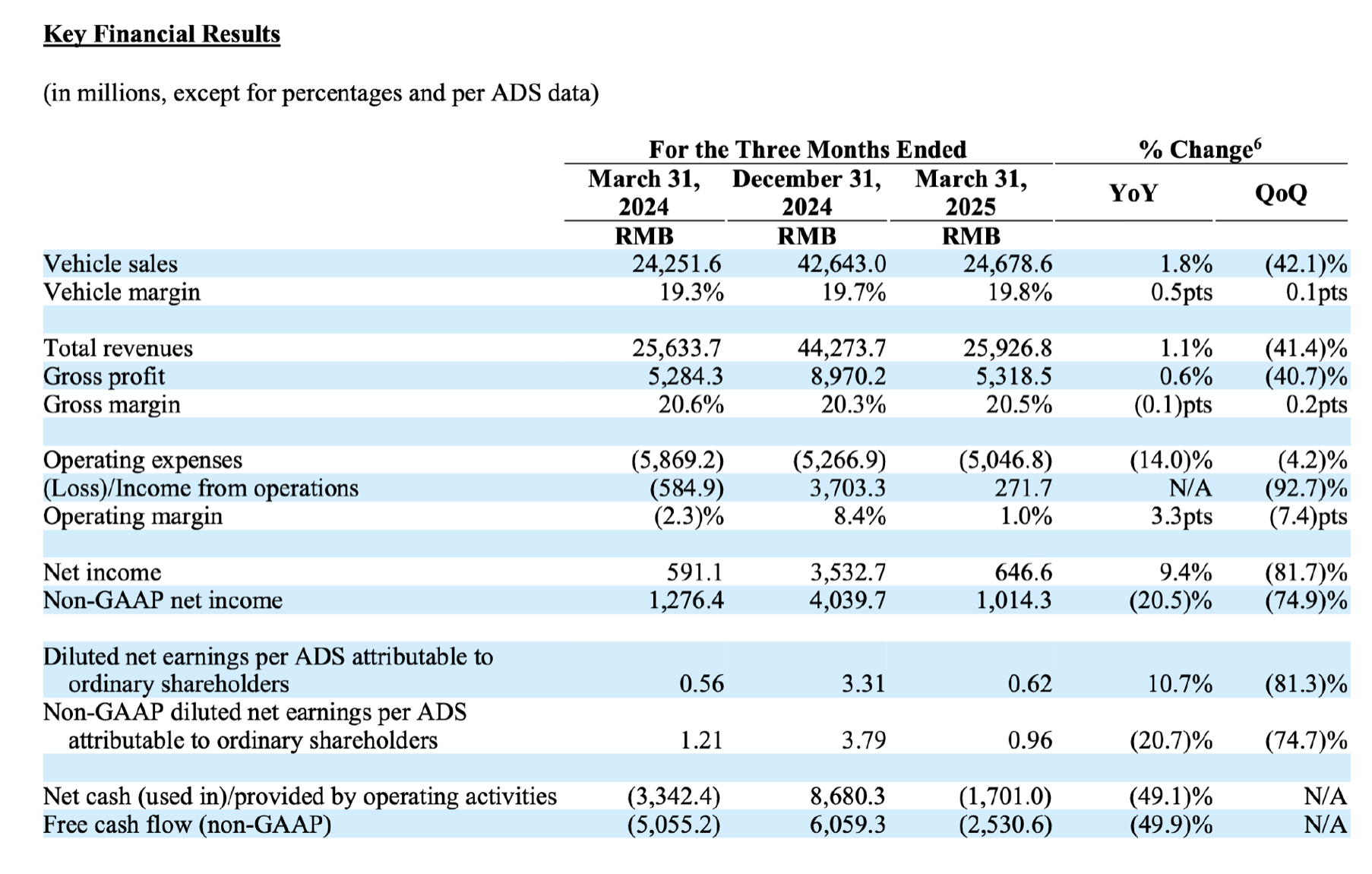
Group 1 - The core viewpoint of the article indicates that while the company remains a leader in the new energy vehicle sector, it is no longer experiencing the same level of rapid growth as before, signaling a need for strategic adjustments [1] - In Q1, the company reported a revenue of 25.9 billion yuan, a year-on-year increase of 1.1%, maintaining its position as a leader among new energy vehicle manufacturers [1] - The average selling price of vehicles decreased to approximately 265,700 yuan, down 11.9% year-on-year, attributed to seasonal factors, previous price reductions, and changes in product mix [1] Group 2 - The company's gross profit for Q1 was 5.319 billion yuan, with a gross margin of 20.5%, showing a slight year-on-year decline of 0.1 percentage points [1] - Operating expenses for the quarter were 5 billion yuan, a decrease of 14% year-on-year, with reductions in both R&D and sales, general, and administrative expenses [1] - The company achieved a net profit of 647 million yuan, a year-on-year increase of 9.4%, although its adjusted net profit of 1.014 billion yuan represented a 20.5% decline [1] Group 3 - In terms of vehicle deliveries, the company delivered 92,864 vehicles in Q1, a year-on-year increase of 15.5%, aligning with its guidance for the quarter [4] - Despite maintaining a strong delivery volume, the company fell to third place in sales among new energy vehicle manufacturers, overtaken by competitors [5][7] - In April, the company delivered 34,000 vehicles, while competitors delivered 41,000 and 35,000 vehicles, further solidifying its third-place position in the market [7]

汽车降价潮引发的估值回撤:捡漏智驾产业链龙头耐世特(01316)
智通财经网· 2025-05-29 03:55
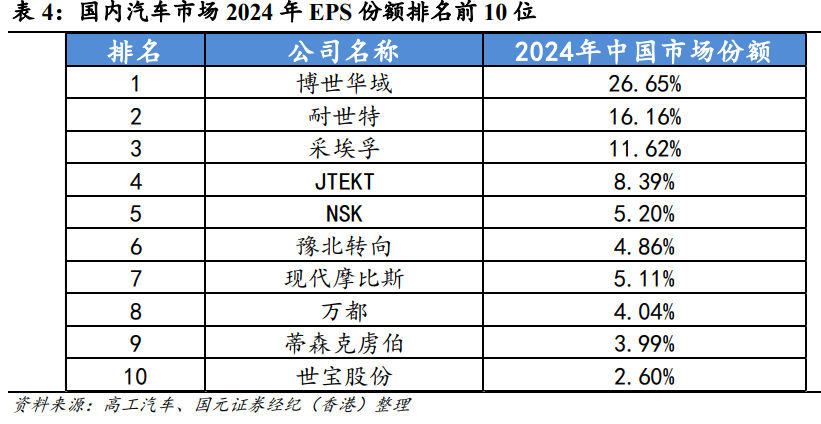
Core Viewpoint - The automotive industry's price-cutting trend has led to a continuous decline in valuations across the supply chain, yet savvy investors are beginning to acquire undervalued stocks, particularly in the intelligent driving sector [1] Group 1: Intelligent Driving Sector - The intelligent driving segment is a core investment theme in the automotive industry, with domestic new energy vehicle penetration exceeding 40%, but high-level intelligent driving penetration remains low, primarily at the L2 stage [1] - Companies like Xpeng and Tesla are leading the push for higher-level intelligent driving, with only a few models achieving L2+ and L3 capabilities [1] - The steer-by-wire system is a key component of high-level intelligent driving, and the global steering system leader, Nexteer (耐世特), is gaining investor interest [1] Group 2: Company Performance and Market Position - Nexteer's valuation has dropped by 7% recently but has increased by over 77% this year, driven by improved fundamentals and strong competitiveness in the steer-by-wire sector [1] - The company is strategically expanding into the steer-by-wire chassis sector to meet industry mass production demands, further enhancing its fundamentals [1] - Nexteer holds a strong position in the global automotive steering system market, ranking among the top three with a market share of 16.16% in China, second only to Bosch Huayu [2][4] Group 3: Financial Outlook - Despite being a market leader, Nexteer faces significant competitive pressure from price wars and domestic substitution in the Chinese market, with revenue growth slowing to only 1.65% in 2024 [4] - The company has a high customer concentration, with its top three clients contributing 68.8% of revenue, which poses operational risks if major clients like General Motors face performance issues [4] - In Q1 2025, Nexteer secured $800 million in new orders, a 60% year-on-year increase, with a significant rise in orders from Chinese clients, indicating strong product recognition [5][11] Group 4: Product Development and Market Trends - The steer-by-wire system is becoming mainstream as the automotive industry shifts from traditional hydraulic systems to electronic systems, with significant growth potential in the L2+ and L3 intelligent driving segments [7][10] - Nexteer's product portfolio includes traditional hydraulic and electric power steering systems, with a notable increase in orders for steering columns and intermediate shafts in 2025 [8] - The company has made breakthroughs in steer-by-wire technology, winning multiple orders from leading electric vehicle manufacturers, which positions it well for future growth [10] Group 5: Investment Sentiment - Several investment banks are optimistic about Nexteer's prospects, forecasting a compound annual growth rate of 29% in net profit from 2025 to 2027, supported by strong order growth and product diversification [11] - The intelligent driving sector remains a hot investment theme, with Nexteer's fundamentals and multiple growth drivers expected to support its market value in the long term [12]
汽车零件ETF(159306)开盘拉涨,新能车ETF(515700)、光伏ETF基金(516180)盘中震荡,机构:固态电池商业化落地进程有望持续加速
Sou Hu Cai Jing· 2025-05-28 02:00
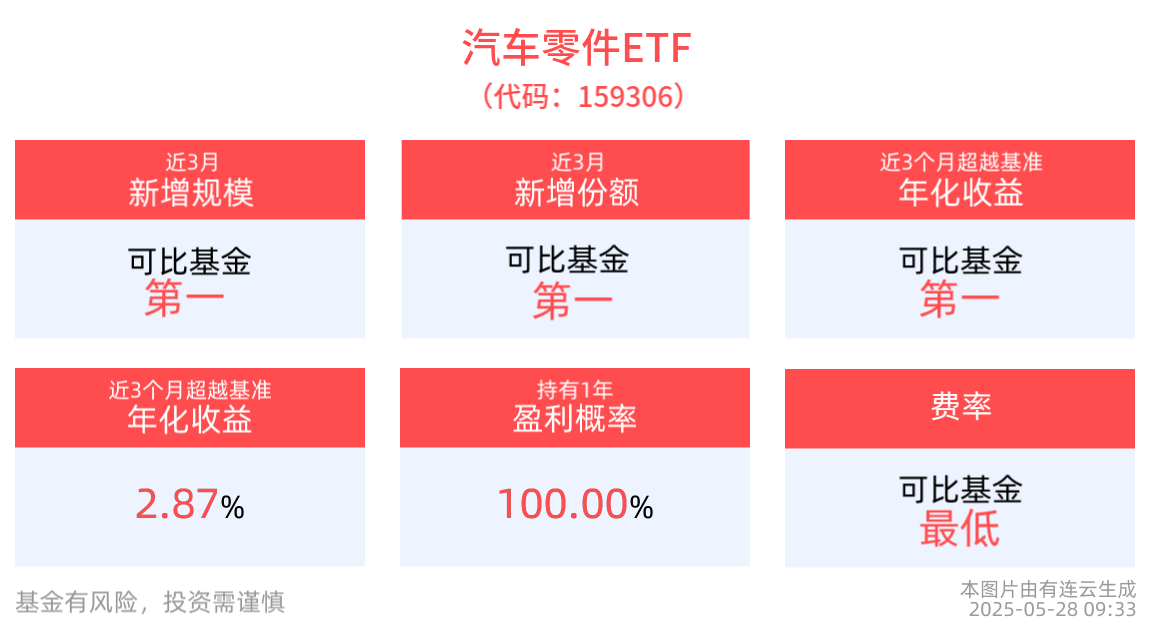
Group 1: Automotive Parts Industry - The China Securities Automotive Parts Theme Index (931230) increased by 0.43%, with notable gains from Dongfeng Technology (600081) up 5.85% and Haon Automotive (301488) up 4.94% [1] - The Automotive Parts ETF (159306) rose by 0.45%, with a recent price of 1.12 yuan, and has seen a 3.44% increase over the past month [1] - The Automotive Parts ETF experienced significant growth in scale, increasing by 580.17 thousand yuan and 600.00 thousand units over the past three months, ranking first among its peers [1] Group 2: New Energy Vehicles - BYD launched a limited-time promotional campaign covering 22 models, with subsidies up to 53,000 yuan, indicating a new round of price competition in the new energy vehicle market [2] - Haidong International predicts that the new energy price war will intensify in June, affecting the fate of car manufacturers, with expectations for similar promotions from Xiaopeng and Leap Motor [2] Group 3: New Materials Industry - The China Securities New Materials Theme Index (H30597) decreased by 0.09%, with mixed performance among constituent stocks, including a 1.52% increase in China Materials Technology (002080) [4] - The New Materials ETF Index Fund (516890) fell by 0.20%, currently priced at 0.49 yuan, while the solid-state battery commercialization process is expected to accelerate, opening new markets [5] - The recent release of the "Solid-State Battery Determination Method" standard by the China Automotive Engineering Society marks a new phase in the solid-state battery industry, impacting technology development and market order [5] Group 4: Photovoltaic Industry - The China Securities Photovoltaic Industry Index (931151) rose by 0.04%, with significant gains from KWH Data (002335) up 1.36% and JinkoSolar (688223) up 0.58% [11] - The Photovoltaic ETF Fund (516180) increased by 0.19%, currently priced at 0.53 yuan, with a historical monthly return of 24.05% since inception [11] - Investors are encouraged to consider the Photovoltaic ETF Fund, New Materials ETF Index Fund, New Energy Vehicle ETF, and Automotive Parts ETF for investment opportunities in related sectors [11] Group 5: ETF Performance and Composition - The New Energy Vehicle ETF (515700) decreased by 0.31%, with a recent price of 1.61 yuan, and has shown a 2.53% increase over the past month [7] - The top ten weighted stocks in the New Energy Vehicle Industry Index (930997) account for 58.64% of the index, with BYD (002594) being the largest component [12] - The top ten weighted stocks in the Automotive Parts Theme Index (931230) account for 45.48%, with Huichuan Technology (300124) leading the list [17]
畅谈Robotaxi和机器人配送小车
2025-05-27 15:28
Summary of Key Points from the Conference Call Company Overview - The document discusses the company Xiaoma Zhixing, which is set to go public in November 2024 with an IPO valuation of approximately $4.2 billion, lower than the pre-IPO valuation of $9 billion. Post-IPO, the stock price rebounded, indicating market interest in the company [1][5]. Industry Insights - Xiaoma Zhixing's revenue is expected to be predominantly from its Robotaxi business, projected to account for 80% of total revenue by 2028. Currently, the main revenue source is technology licensing, including sales of domain controllers and autonomous driving technology to companies like Meituan and Cainiao [1][5]. - The company showcased its seventh-generation Robotaxi, which has reduced operational costs by 70% and is collaborating with local automakers like BAIC and GAC to lower vehicle prices [1][6]. Financial Projections - The average Gross Merchandise Value (GMV) per Robotaxi is currently around several hundred thousand RMB annually, with expectations to exceed 200,000 RMB in the future. The company anticipates achieving group-level breakeven between 2028 and 2029, with single-vehicle breakeven expected by late 2025 to early 2026. By 2030, gross margins are projected to exceed 50%, with net margins reaching over 20% [3][20]. Technological Advancements - Xiaoma Zhixing possesses L4 level autonomous driving technology, which is a significant competitive advantage. The company collaborates with platforms like Gaode, Tencent, and Lichi to secure customer acquisition channels [1][7]. - The document outlines the complexity of autonomous driving applications, categorizing them into four scenarios: closed cargo, closed passenger, open cargo, and open passenger, with the latter being the most challenging [4]. Competitive Landscape - Key competitors include WeRide, Waymo, and various domestic and international automakers such as XPeng, Xiaomi, Huawei, and Tesla. While these competitors have technical capabilities, they are still catching up to L4 level autonomous driving technology [8]. Market Dynamics - The autonomous driving ecosystem is heavily reliant on technology, partnerships with ride-hailing platforms, and collaborations with automakers. Team stability is also crucial for maintaining operational efficiency and technological advancement [9]. Future Outlook - The document highlights the potential for autonomous delivery systems, particularly in low-density areas abroad and high-density areas domestically, indicating a growing market for such technologies [22]. - The differences between Robotaxi and autonomous delivery vehicles are noted, with Robotaxi companies providing both technical and hardware support, while delivery vehicles are easier to commercialize due to simpler operational scenarios [23]. Valuation Methods - Various valuation methods are discussed, including Price-to-Sales (PS), Price-to-Earnings (PE), and Discounted Cash Flow (DCF) approaches, with conservative estimates suggesting significant future valuation potential [21]. Conclusion - Xiaoma Zhixing is positioned to capitalize on the growing demand for autonomous driving solutions, with a strong focus on technology development and strategic partnerships, while navigating a competitive landscape that includes both domestic and international players.
