
华为

Search documents
现在是入手智能眼镜的好时候吗?
Xin Hua Wang· 2026-02-21 02:30
Core Insights - The smart glasses market in China is experiencing significant growth, with projected sales reaching 1.454 million units in 2025, representing a year-on-year increase of 211% [1] - Major tech companies such as Alibaba, Baidu, ByteDance, Huawei, and Xiaomi are entering the smart glasses sector, indicating a competitive landscape for the next generation of mobile devices [1][2] - The demand for smart glasses is driven by the need for a new mobile terminal as smartphone innovation reaches physical limits, with smart glasses offering immersive interaction and hands-free capabilities [2] Market Dynamics - The smart glasses market is characterized by a wide variety of brands, styles, and functionalities, leading to increased consumer interest [1] - The global traditional eyewear market is substantial, and capturing just 10% of it could yield over $10 billion in revenue for smart glasses [2] - The competition is shifting from hardware specifications to ecosystem development, user habit cultivation, and commercial value extraction [3] Consumer Experience - Current smart glasses are available in a price range from 1,000 to nearly 10,000 yuan, with two main categories: non-display models and those with display capabilities [3] - Consumer feedback highlights issues with weight and comfort, as mainstream smart glasses weigh between 40-80 grams compared to regular glasses at around 20 grams [4] - Battery life is a concern, with advertised durations of 4-8 hours often dropping to 2-3 hours under heavy usage [5] Industry Challenges - The "impossible triangle" of balancing weight, battery life, and display quality presents a significant challenge for the smart glasses industry [5] - Many current models rely on smartphones for processing, limiting their independence and functionality [5] - The industry is expected to transition from novelty to regular use within the next three years, with advancements in chip technology and design [6] Future Directions - The development of AI operating systems (AIOS) is seen as a key factor for enhancing user experience and interaction [7] - There is a push for full-color displays to meet consumer expectations for richer visual experiences [7] - Addressing comfort and usability will be crucial for widespread adoption, as consumers seek more than just a display but a comprehensive smart assistant experience [7]
王晖参赞到阿玛丽亚水电站慰问一线职工
Shang Wu Bu Wang Zhan· 2026-02-20 17:07
大年初二,王晖参赞到特变电工阿玛丽亚水电站给节日期间奋战在一线的职工拜年,向大家致以新春祝福的同时,提醒大家节日期间一定要注意 安全生产,一起过个祥和平安的中国年。 (原标题:王晖参赞到阿玛丽亚水电站慰问一线职工) 此外,节日期间,王晖参赞还陪同孙勇大使到中水对外凯雷塔和苏阿皮提水电站、博法中铝铝土矿和国电投氧化铝厂考察慰问、与中铝国电投河 南矿业和益丰船务等公司举行座谈会,并到宝武、华为和云南斯盖尔等公司走访慰问。 微信图片_20260219190406_372_48.jpg ...


中国十大最具发展潜力城市
泽平宏观· 2026-02-20 16:05
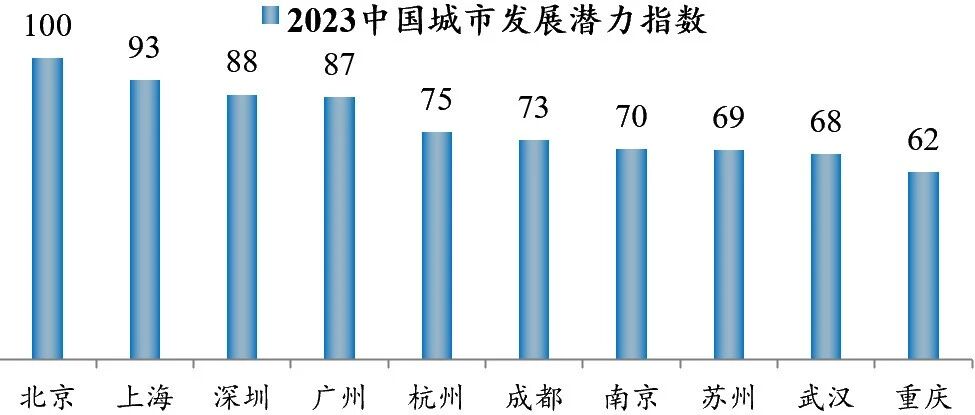
Core Viewpoint - The article discusses the competitive landscape of Chinese cities, highlighting the rapid urbanization and the emergence of new economic centers, while ranking the development potential of 337 cities in China, with Beijing, Shanghai, Shenzhen, and others leading the list [2]. Group 1: Beijing - Beijing is positioned as the political, cultural, international exchange, and technological innovation center of China, with a GDP exceeding 4.1 trillion yuan in 2022, making it the second-largest city after Shanghai [9][10]. - The service sector accounts for 84% of Beijing's economy, with finance, headquarters economy, and technological innovation as key pillars [10]. - Future plans include transforming Beijing into a world-class harmonious city while optimizing population distribution to enhance urban vitality [11][13]. Group 2: Shanghai - Shanghai has established itself as an international economic center, with a GDP of approximately 4.5 trillion yuan in 2022, and aims to rival New York in global economic influence [16][24]. - The city’s industrial structure is supported by the automotive, electronics, and financial sectors, with finance contributing 19.3% to the GDP [17][19]. - Shanghai plans to continue its open policies and develop into a globally competitive city, enhancing the Yangtze River Delta region [24]. Group 3: Shenzhen - Shenzhen's GDP surpassed 3.2 trillion yuan in 2022, marking it as the third-largest city in China, with a significant annual population increase of around 600,000 [25][26]. - The city is recognized as a leading innovation hub, with strategic emerging industries accounting for over 41% of its GDP [26]. - Future initiatives focus on enhancing collaboration within the Guangdong-Hong Kong-Macau Greater Bay Area to solidify its status as a global innovation city [29]. Group 4: Guangzhou - Guangzhou's GDP reached approximately 2.9 trillion yuan in 2022, ranking fifth nationally, with a strong manufacturing base in automotive and electronics [30][31]. - The city faces challenges in innovation capacity and financial sector development, with financial services contributing only 9.2% to the GDP [33]. - Future goals include enhancing its role as a national center city and participating in global economic cooperation [34]. Group 5: Hangzhou - Hangzhou's economy has shown robust growth, with a GDP of around 1.9 trillion yuan in 2022, driven by a vibrant private and digital economy [36][37]. - The city is recognized for its strong digital economy, with core digital industries contributing 27.1% to the GDP [37]. - Plans for the future include improving transportation infrastructure and fostering a more open and innovative business environment [41][42]. Group 6: Chengdu - Chengdu's GDP exceeded 2 trillion yuan in 2022, accounting for 36.7% of Sichuan province's economy, and it is recognized as a key economic hub in Western China [43][44]. - The electronics sector is a major contributor, with a significant portion of the industrial output [44]. - Future strategies involve enhancing its role as a national center city and collaborating with Chongqing to develop the Western economic highland [49]. Group 7: Nanjing - Nanjing's GDP approached 1.7 trillion yuan in 2022, with a per capita GDP of 179,000 yuan, ranking fifth among major cities [50][51]. - The city is focusing on developing its automotive, steel, electronics, and petrochemical industries while nurturing emerging sectors [51]. - Future aspirations include becoming an "innovation city" and enhancing its influence in the Yangtze River Delta region [54]. Group 8: Suzhou - Suzhou's GDP reached nearly 2.4 trillion yuan in 2022, making it the top city among prefecture-level cities in China [56]. - The city is recognized as a global industrial powerhouse, with significant contributions from electronics and manufacturing sectors [56]. - Future plans emphasize its role in the Yangtze River Delta urban cluster and advancing towards a high-tech manufacturing base [59].
任泽平带你看前沿科技:2026研学计划
泽平宏观· 2026-02-20 16:05
以下文章来源于泽平宏观商学 ,作者泽平宏观商学 2025 年 12 月 用心打造最有品质的实战研学。读万卷书,行万里路。把教室搬到世界上最优秀的企业, 请最优秀的企业家和科学家讲课。顺势而为,把握机遇。正心正念,坚持做长期正确的 事! 我们期待与更多的企业家朋友们携手同行,共赴 2026 实战研学之旅! 泽 ZEP 平 INGM 宏 ACR 观 O RE 商 SEAR 学 CH 1-6月日程安排 · 2月27日 北京 国内头部智驾科技企业 人形机器人 年研学安 型成 11月4日-11日 泽平宏观商学 . 前沿科技企业实战研学 读万卷书行万里路 洛杉矶、拉斯维加斯、旧金山 CES、英伟达、特斯拉 谷歌、罗宾汉、playground 斯坦福大学、伯克利大学 3月27日-28日 苏州 追觅科技、魔法原子、灵猴机器人 闭门投研会-2026 Al 的中国力量(一) 3月29日 上海 长三角校友会 4月20日-21日 香港 2026 香港 Web3 嘉年华 复星财富、HashKey、港交所 5月22日-23日 1151 11:47:50 深圳 华为、新凯来、江波龙、莫界科技 闭门投研会—2026 Al 的中国力量(二) ...

王腾回应换iPhone17,称因适配睡眠监测设备
3 6 Ke· 2026-02-20 15:35
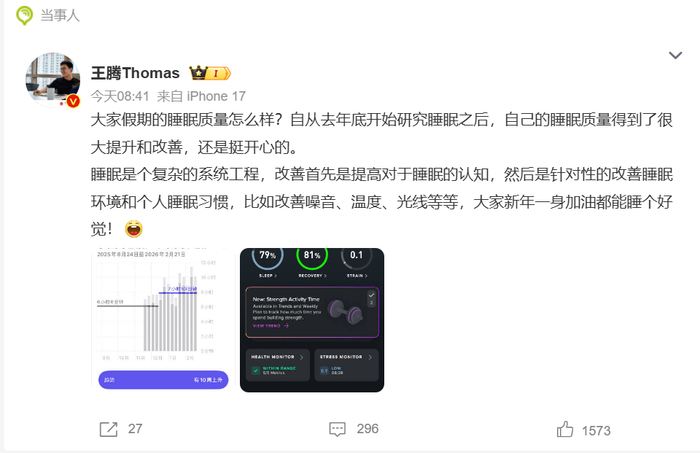
Core Viewpoint - Wang Teng, the founder of Today Sleep Technology, has publicly switched to using an iPhone 17 for better compatibility with sleep monitoring devices, marking his first use of a non-Xiaomi phone since leaving the company in September 2025 [1] Group 1: Company Transition - Wang Teng previously served as the General Manager of Xiaomi's China Marketing Department and General Manager of the REDMI brand before founding Today Sleep Technology [1] - The company, Today Sleep Technology, was established in January 2026 and has completed seed round financing of several million yuan [1] Group 2: Product and Market Insights - Wang Teng highlighted that sleep is a complex system requiring multifaceted improvements, sharing his sleep data from the past six months [1] - The switch to iPhone 17 was specifically due to better adaptation with sleep monitoring devices such as Whoop, Oura, and Eight Sleep [1]
智驾洗牌,“五大”要统一江湖了吗?
Jing Ji Guan Cha Wang· 2026-02-20 13:54
刘晓林/文 2025年9月公布的《智能网联汽车 组合驾驶辅助系统安全要求》强制性国家标准(征求意见稿)(下称《意见稿》)已结束公开征求意见阶段, 预计于2027年1月1日正式实施。这意味着,车企的智驾合规准备已进入一年倒计时。 这一被称为"智能驾驶史上最严新规"的落地,使得整车组合安全、极端场景测试、全生命周期合规迭代将成为硬性约束,行业准入门槛与持续运营成本也会 随之大幅抬升,车企研发路径和智驾行业的格局将不可避免地迎来震荡。是继续自研智驾技术还是采购成熟解决方案?这个一直伴随着汽车企业的命题,将 在2026年得到新的答案。 随着订单被华为、Momenta、地平线等几大智驾头部供应商瓜分,更现实的问题将浮出水面:全栈自研是否成为少数头部玩家的特权?绝大多数车企是否被 迫转向头部供应商?技术同质化与供应链集中风险如何化解?无规模优势的中小车企,能否在合规高压下找到生存支点?2026年,围绕智能驾驶技术主权、 供应链安全、规模效率的行业格局重构已经开启。 新规压顶:自研合规成本飙升 对整车企业而言,技术合规难度和能否承担自研成本,是智驾国标带来的最大挑战。 目前看来,虽然面临新规与成本的双重约束,但智驾行业并未 ...

告别泡沫叙事:九大关键词看懂2025中国消费 | 年终盘点
Sou Hu Cai Jing· 2026-02-20 12:37
Group 1: Core Insights - The Chinese consumer market in 2025 is characterized by both chaos and fragmentation, with a shift towards efficiency, value, and trust as the essence of competition [2] - The year witnessed significant events such as the end of the food delivery war, a crisis in the prepared food sector, and the rise of hard discounts while soft discounts declined [2] - Major international brands are seeking survival through divestitures, while the middle class experiences repeated disillusionment in consumption [2] Group 2: Food Delivery War - The food delivery war was ignited by JD's aggressive entry into the market, leading to a fierce subsidy competition among major players like Meituan and Alibaba [5][6] - In Q2 2025, the three major players burned through at least 30 billion yuan, equivalent to the total industry profit of the previous year [6] - The war has severely impacted small businesses and delivery personnel, highlighting the unsustainable nature of the competition [6] Group 3: Prepared Food Crisis - The prepared food crisis began with a public dispute involving a well-known restaurant, exposing significant gaps in consumer trust and industry standards [10][11] - The crisis has led to the closure of 102 stores by the affected restaurant and highlighted the precarious state of the industry, with many companies facing severe losses [12] - The market for prepared foods is projected to grow significantly, with the government moving towards establishing clearer standards [12][13] Group 4: Hard Discount Battle - The hard discount retail sector is experiencing explosive growth, with major players like JD and Hema aggressively expanding their store presence [16][18] - The distinction between hard and soft discounts is becoming more pronounced, with hard discounts focusing on sustainable low prices through private label products [18][19] - The competition is shifting from price wars to efficiency in supply chains and operational capabilities [19] Group 5: Dairy Product Trends - The "milk skin" product has gained immense popularity, evolving from a local specialty to a nationwide trend, with significant sales figures reported [21][22] - The product's success is attributed to its versatility and the ability to integrate into various food categories, driving demand and industry expansion [22] Group 6: Medicinal Food Market - The market for medicinal food has surpassed 370 billion yuan, with a growing emphasis on integrating traditional Chinese medicine into everyday food products [25][26] - The industry is witnessing an expansion of raw materials and innovative product forms, driven by advancements in technology and consumer demand [27][28] Group 7: International Brand Divestitures - In 2025, international brands like Starbucks and Burger King began divesting their Chinese operations, indicating a shift in market dynamics [31][32] - The decline in market share for these brands is attributed to their inability to adapt to the rapidly changing consumer landscape in China [32] - Successful local brands have capitalized on this opportunity, demonstrating the potential for growth through localized strategies [33] Group 8: Middle-Class Consumer Sentiment - The middle class in China is experiencing a sense of disillusionment, reacting negatively to price increases and perceived quality issues [36][39] - This demographic is increasingly critical of brands that do not meet their expectations, indicating a shift in consumer behavior and brand loyalty [39] Group 9: Weight Management Trends - 2025 has been dubbed the "Year of Weight Management," with a national initiative promoting healthy weight control [41][44] - The market for weight management products is projected to reach 326 billion yuan, with a significant increase in demand for functional foods [45][46] Group 10: IPO Activity in Hong Kong - The Hong Kong stock exchange has seen a surge in IPO activity, with 111 companies raising over 250 billion yuan in 2025, surpassing previous expectations [49][50] - The consumer sector has been a major focus, with numerous retail and consumption-related companies going public [50][51] - The trend of dual listings (A+H shares) is also gaining momentum, indicating a robust interest in capital markets [52]
环烯烃聚合物,一家巨头扩产,一家延期!
DT新材料· 2026-02-20 11:59
【DT新材料】 获悉,2月18日,日本巨头 瑞翁Zeon 为其新型环状烯烃聚合物(COP)生产厂举行奠基仪式,扩产以应对除光学应用外,以及医疗和半导 体领域应用的不断扩展所带来的预期需求增长。该项目大规模建设将于2026年3月开始,目标在2028财年上半年竣工, 届时Zeon的COP年产能将比当前水 平增加约30%。 早在2025年6月,在更新的中期战略中,瑞翁就表示将继续进行投资组合重组,并扩大高利润产品的产能。其中就包括 建立一座年产1.2万吨 环烯烃聚合物 (COP) 装置, 成为其冈山县仓敷市的水岛工厂之后的第二个COP生产基地, 产能将从当前的42,000吨提升至约 54,000吨。 同时,瑞翁 将逐步停止德山弹性体工厂的低利润产品生产, 到2026年,计划停止生产 ESBR-1 和 NBR胶乳 。从2028年起,还将逐步淘汰德山基地的 丁 二烯橡胶 生产。 据透露,这些产能削减将占该日本工厂弹性体产能的60%。 不过,瑞翁将继续生产ESBR-2、 丁腈橡胶 和溶聚丁苯橡胶,这些产品被归类为高利润产品。 同时,去年7月,公司宣布已经开始动工建设一座小型实验设 施,旨在高效利用源自生物质及其他原料的乙 ...

中美关税大战: 最大成果不是中国胜了, 而是美国再无手段控制中国
Sou Hu Cai Jing· 2026-02-20 11:56
中美的这场关税大战,是一场没有硝烟的硬仗,双方较量的不只是关税数字,而是国家综合实力。 最终的结果也很清楚,美国失败了,但在尘埃渐落之后,比胜负更重要的问题开始浮现。 2018年是中美关税战的起点,美国先拿钢铁、铝制品开刀,对这类中国商品加征25%的关税。 没过多久,加税范围一步步扩大,从家电、家具、纺织品,到电子产品、机械零件,前后覆盖了数千亿 美元的中国输美商品。 美国,那个曾指挥全球秩序的超级强国,在一次次"出招失败"中,动用了全部手段,却收效甚微。 而中国却稳稳化解了风险,逐步夺回主动。 美国当时打的算盘,普通人都能看明白。 一是盯着中美贸易逆差,觉得中国卖给美国的东西太多,美国卖过来的太少,想靠加税把逆差强行压下 去。 二是眼红中国的产业升级,眼看着中国制造业从低端加工往高端制造走,新能源、光伏、高端装备越做 越强,怕中国动摇美国的产业主导地位,想把中国摁在全球产业链的底端。 三是想借关税施压,让中国在技术转让、贸易规则上妥协,说白了就是要掌控中国的发展方向,不让中 国继续变强。 美国之所以敢这么做,是因为以前这招屡试不爽。 当年对付日本,美国用贸易施压逼日本签下广场协议,日本经济随后陷入长期停滞; ...
无方向盘踏板的Cybercab正式下线意味着什么
2 1 Shi Ji Jing Ji Bao Dao· 2026-02-20 08:26
Group 1 - The core point of the article is that Tesla's first mass-produced Cybercab, which lacks a steering wheel and pedals, marks a significant milestone in the commercialization of autonomous driving, transitioning from concept to production [1] - The industry landscape is changing as Tesla shifts from merely selling cars to becoming a mobility service provider, focusing on fleet operations and mileage-based revenue, which will pressure domestic automakers to enhance their autonomous driving capabilities and operational efficiency [2] - The supply chain will undergo rapid transformation, with companies that secure key components for autonomous vehicles, such as onboard computing power and vehicle-to-everything (V2X) technology, gaining a competitive edge [2] Group 2 - The commercialization of autonomous vehicles faces significant challenges, including regulatory hurdles in the U.S. that require special exemptions for vehicles without traditional controls, and similar restrictions in China regarding L4 autonomous vehicle licensing [3] - Technical challenges remain, particularly regarding the reliability of vision-based systems in adverse weather and complex traffic conditions, as well as uncertainties around mass production quality and failure rates [3] - Consumer trust is a critical barrier, with unresolved issues regarding passenger safety, insurance policies, and liability in the event of accidents, indicating that a comprehensive framework is yet to be established [4] Group 3 - The launch of the Cybercab is a milestone but not the endpoint, signaling the start of the race for autonomous driving commercialization, which is expected to take at least two to three more years to integrate into daily life [5] - Chinese automakers should not panic but must accelerate their efforts in smart and autonomous technologies to maintain their competitive advantage, especially since they are already leading in electrification [5]
