问界

Search documents
新能源车企花式比拼前备箱:实用价值几何?
Mei Ri Shang Bao· 2025-08-13 22:54
Core Insights - The recent trend in the automotive industry highlights the increasing focus on front trunks as a differentiating feature among electric vehicle manufacturers, with various innovative designs emerging to attract consumer attention [1][2][3] Group 1: Market Trends - The introduction of front trunks has shifted from being a niche feature in traditional fuel vehicles to a mainstream consideration in electric vehicles, driven by advancements in electric motor miniaturization and battery layout [2] - The competition among manufacturers has intensified, with models like the Leida L90 boasting a front trunk capacity of 240 liters, equivalent to the trunk space of a compact SUV, showcasing the trend towards larger and more functional front trunks [2][3] Group 2: Consumer Experience - Consumers have reported practical benefits from front trunks, such as enhanced storage for outdoor activities, which alleviates the need for additional trips to retrieve items [3] - However, there are concerns regarding the practicality of front trunks, with some users finding the operation cumbersome compared to traditional trunks, highlighting a gap between marketing and actual usability [4] Group 3: Industry Dynamics - The competition surrounding front trunks has evolved into a demonstration of technical capabilities, with manufacturers needing to balance large capacity and safety within limited space [4] - Ultimately, the success of front trunk designs will depend on their ability to meet real consumer needs while addressing usability issues, indicating a deeper understanding of market demands [4]
科技与性价比拉满!2025齐鲁车展(秋季)新车型亮点抢先看
Qi Lu Wan Bao· 2025-08-13 09:32
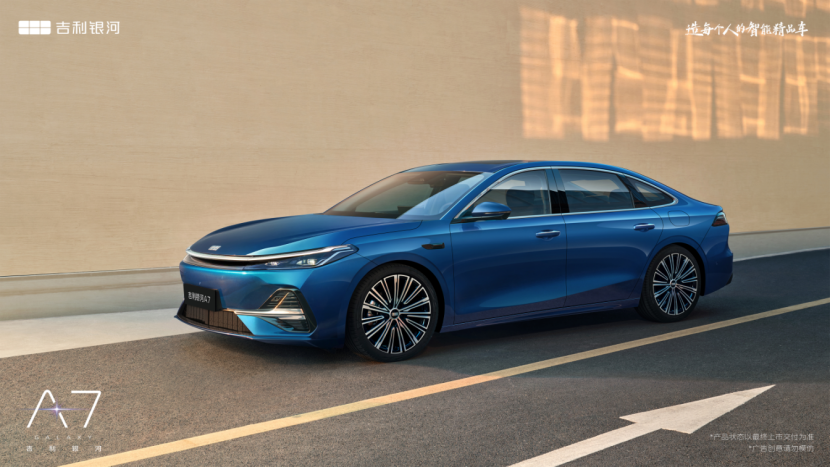
Core Viewpoint - The 2025 Qilu Auto Show (Autumn) will take place from September 4 to 8 at the Shandong International Convention and Exhibition Center, showcasing over a hundred mainstream automotive brands and featuring a record exhibition area of nearly 80,000 square meters [1][16]. Group 1: Event Details - The event will include four exhibition halls and will present luxury brands, new energy vehicles, joint ventures, and independent new forces, along with dozens of newly launched models [1][16]. - The auto show is positioned as a significant opportunity for car purchases and a window to witness industry trends, featuring cutting-edge technologies and immersive experience zones [16]. Group 2: Featured Models - The Geely Galaxy A7, a mid-size plug-in hybrid sedan, boasts a pure electric range of 70/150 kilometers and a comprehensive range exceeding 2100 kilometers, with a fuel consumption of only 2.67L/100km [1]. - The SAIC Audi A5L Sportback, priced between 260,000 to 320,000 yuan, is the first model on the PPC platform, integrating Huawei's intelligent driving assistance and a fifth-generation EA888 engine [3]. - The FAW Audi Q6L e-tron features a CLTC range of 765 kilometers and can charge from 10% to 80% in just 20 minutes, aiming to reshape the luxury pure electric SUV market [5]. - The Aito M8 pure electric version has a pre-sale exceeding 10,000 units, with a range of 705 kilometers and equipped with Huawei's ADS4 intelligent driving system [7]. - The new FAW-Volkswagen Teramont is priced between 299,900 to 319,900 yuan, featuring a new generation EA888 2.0T engine and upgraded interior with a floating dual-screen design [10]. - The XPeng G7, a mid-size SUV, features a "Chasing Light" panoramic AR-HUD and a range of 702 kilometers, with a pre-sale price of 235,800 yuan [12]. - The Chery Fengyun A9L, a mid-large executive sedan, has a pre-sale starting at 159,900 yuan and offers a range of 2500 kilometers with a hybrid system [14].

增程,难卖
3 6 Ke· 2025-08-13 03:14
Core Viewpoint - The article discusses the challenges faced by range-extended electric vehicles (REEVs) in the Chinese automotive market, highlighting a shift in consumer preference towards pure electric vehicles (BEVs) and plug-in hybrids (PHEVs) [1][2][3]. Market Performance - In July, the retail penetration rate for new energy vehicles reached a historical high of 54%, with BEV sales at 607,000 units (up 24.5% year-on-year), PHEV sales at 278,000 units (down 0.1% year-on-year), and REEV sales at only 102,000 units (down 10.4% year-on-year) [3]. - From January to July, REEVs had a year-on-year growth of 12.1%, significantly lower than BEVs at 35.2% and PHEVs at 25.2% [3]. Market Dynamics - The decline in REEV sales is attributed to the explosive growth of BEVs, which have increasingly crowded the market, particularly in the mainstream segment [5][8]. - Many early REEV adopters are now switching to BEVs as they enter the vehicle replacement cycle, indicating a broader industry trend [7]. Competitive Landscape - The mid-to-high-end market for REEVs has become increasingly competitive, with numerous brands entering the space, leading to intensified competition [11][13]. - Companies like Li Auto and Aito have experienced significant fluctuations in delivery volumes, with Li Auto's July deliveries dropping from 50,000 to 30,000 units year-on-year [11][14]. Consumer Preferences - The article notes that consumers are increasingly favoring larger battery capacities and faster charging capabilities in REEVs, which are seen as a response to range anxiety [19][21]. - The perception of REEVs is shifting, with some consumers questioning the rationale behind choosing REEVs over BEVs, given the advancements in battery technology [19][21]. Future Outlook - The article suggests that the future landscape will likely see BEVs dominating the mainstream market, with REEVs remaining relevant in the mid-to-high-end segment, albeit as a smaller player [16][23]. - The trend towards larger batteries and faster charging in REEVs is expected to continue, as manufacturers adapt to consumer demands [17][23].

价格战如何影响车市?汽车均价走出“倒U曲线”
Jing Ji Guan Cha Wang· 2025-08-11 14:11
Core Insights - The Chinese automotive market is experiencing a significant price war, with 227 models seeing price reductions in 2024, averaging a decrease of 18,000 yuan for new energy vehicles and 13,000 yuan for fuel vehicles, representing declines of 9.2% and 6.8% respectively [2] - Despite the price war, the average retail price of vehicles has increased from 151,000 yuan in 2019 to 186,000 yuan in the first half of 2024, indicating a structural shift in the market [2][3] - The market is witnessing a decline in low-end fuel vehicle sales while high-end fuel vehicle sales are increasing, leading to an overall rise in average prices [2][3] Price Dynamics - In 2024, 84.4% of automotive dealers reported price inversions, with over 40% operating at a loss, resulting in a profit margin drop to 4.3%, down from 7.8% in 2017 [2] - The average price of new energy vehicles is projected to decrease from 184,000 yuan in 2023 to 161,000 yuan in 2025, driven by supply chain maturity and an increase in high-end models [3] - The market for vehicles priced above 200,000 yuan has seen significant growth, with sales increasing from 2.15 million units in 2019 to 6.99 million units in 2024, while sales of vehicles below 200,000 yuan have declined [3] Future Trends - By 2025, the average price of passenger vehicles is expected to decline, with projections showing a drop to 172,000 yuan in Q2 and 169,000 yuan in July, an 8,000 yuan decrease from 2024 [3][4] - The "trade-in" policy is contributing to the decline in average vehicle prices, with a resurgence in the low-end market and increased sales of micro electric vehicles [5] - The potential for domestic brands to fill the gap left by traditional luxury vehicles is being discussed, with several new high-end models from domestic manufacturers gaining traction [6] Market Structure Changes - The high-end fuel vehicle market has seen a significant decline, with market share dropping from 96% in 2019 to 39.8% in July 2024 [4] - The demand for traditional luxury vehicles is decreasing, as consumers find that vehicles priced under 400,000 yuan meet their needs, leading to a potential shift in market dynamics [6] - The overall trend indicates that while the average price of vehicles may have peaked, the market is likely to continue evolving with changing consumer preferences and economic conditions [5][6]

越降价,车越贵?中国汽车均价已到顶峰
Hu Xiu· 2025-08-11 13:44
另一方面,新能源车虽以"降价先锋"姿态冲击市场,均价从2023年的18.4万元降至2025年的16.1万元, 但其价格下行主要是由于供应链成熟所带来的"技术普惠",同时高端新能源车型的占比也逐渐提升。例 如,2021年至2024年,在30万—40万元市场中,新能源车的占比从14.4%提升39.8%,40万元以上市场 新能源车的占比从12.3%提升42.8%。 更重要的是,近几年中高端车市场整体仍在持续增长。2019年时,20万元以上的新车销量为215万辆, 到2024年为699万辆,翻了3.25倍;而20万元以下的新车销量从2019年的1657万辆,减至2024年的1590 万辆,减少67万辆。 在上述多方面因素的共同影响下,国内汽车市场抗住了"价格战"的冲击,汽车均价一直维持在高位。但 到了2025年,中国乘用车市场迎来转折点,汽车整体均价开始出现下降。乘联会数据显示,2025年二季 度汽车均价降至17.2万元,7月降至16.9万元,较2024年降了8000元。 "以旧换新"政策也成为今年汽车均价下降的重要推手之一。乘联会秘书长崔东树表示,2024年随着报废 更新政策推动,车市的中低端市场回暖,中低价位消费 ...
销量占比超七成,自主汽车品牌加速“超车”
Bei Jing Shang Bao· 2025-08-11 11:08
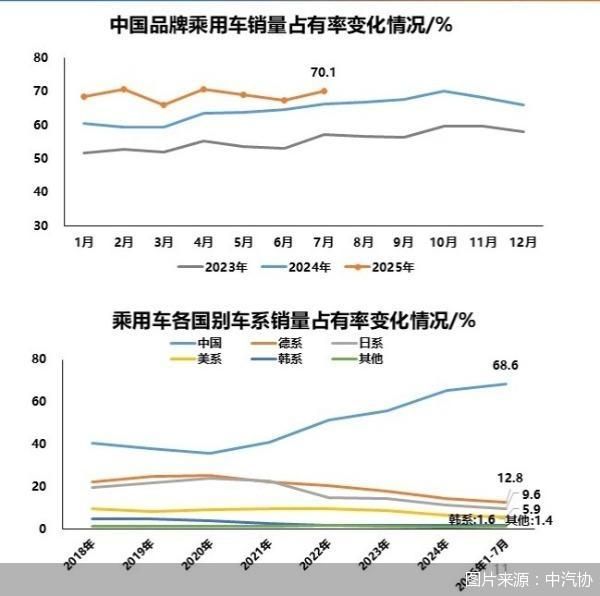
Group 1 - In July 2023, China's automotive production and sales reached 2.591 million and 2.593 million units respectively, showing a month-on-month decline of 7.3% and 10.7%, but a year-on-year increase of 13.3% and 14.7% [2] - The decline in July is attributed to the traditional off-season for the automotive market and some manufacturers conducting annual equipment maintenance, leading to a seasonal slowdown in production and sales [2] - The "trade-in" policy continues to show positive effects, and the comprehensive rectification of the industry is making progress, with new models being continuously launched by companies, contributing to stable market operations [2] Group 2 - In July 2023, the production and sales of passenger vehicles were 2.293 million and 2.287 million units, respectively, with year-on-year growth of 13% and 14.7% [3] - Chinese brands are becoming a significant support for passenger vehicle sales, with sales of Chinese brand passenger vehicles reaching 1.604 million units in July, a year-on-year increase of 21.3%, and a market share of 70.1%, up 3.8 percentage points year-on-year [3] - The market share of Chinese brand sedans, SUVs, and MPVs in July was 64.9%, 73.7%, and 68% respectively, indicating growth in all categories [3] Group 3 - In the first seven months of 2023, the domestic sales of new energy vehicles reached 6.913 million units, a year-on-year increase of 32.3%, with new energy passenger vehicles accounting for 6.499 million units, up 30.9% [4] - The top fifteen groups in new energy vehicle sales accounted for 95.1% of total sales, with BYD and Geely being the top two, together holding over 42% of the market share [4] - The competition among Chinese brands is intensifying, with Leap Motor surpassing Li Auto to become the sales champion in the first half of the year, and new entrants like AITO and Xpeng also showing strong sales performance [5] Group 4 - In July 2023, exports of Chinese vehicles reached 575,000 units, a year-on-year increase of 22.6%, with Chery and BYD leading the export growth [5] - Chery exported 119,000 units, a year-on-year increase of 31.9%, while BYD's exports reached 81,000 units, a significant increase of 160% [5] - Chinese brands are actively expanding into overseas markets, with several companies establishing overseas R&D and production bases [5]

新能源车ETF(159806)涨超2.1%,新能源车行业供需向好
Mei Ri Jing Ji Xin Wen· 2025-08-11 02:41
Group 1 - The core viewpoint of the news highlights the growth and investment in the new energy vehicle (NEV) sector in China, with significant developments from major players like Changan Automobile and the introduction of new models [1] - Changan Automobile plans to launch over 50 new energy products in the next five years, with an investment of 200 billion yuan in the new automotive sector [1] - The NEV ETF (159806) has risen over 2.1%, reflecting positive market sentiment towards the NEV industry [1] Group 2 - New models such as the Ledo L90 and Li Auto i8 have been launched, with the Ledo L90 utilizing a 900V high-voltage architecture and supporting NIO's charging and battery swap system [1] - The Li Auto i8 supports a 5C charging rate, with the number of supercharging stations reaching 3,000 [1] - In July, new energy vehicle sales showed a divergence among new forces, with Leap Motor achieving a monthly sales record of 50,000 units, while other brands like AITO, XPeng, and Xiaomi also saw month-on-month growth [1] Group 3 - Heavy-duty truck sales in July increased by 42% year-on-year, primarily driven by the vehicle replacement policy [1] - The overall industry is experiencing growth in domestic demand by 11% and export growth by 13% [1] - The NEV ETF tracks the CS New Energy Vehicle Index, which includes companies across the entire NEV supply chain, reflecting the performance of representative and growth-oriented enterprises in the sector [1]
汽车OTA,消失的上半年
汽车商业评论· 2025-08-10 23:08
Core Viewpoint - The article discusses the evolution and challenges of the automotive OTA (Over-The-Air) market in China, highlighting the impact of regulatory changes and the competitive landscape among domestic and joint venture brands [4][33]. Group 1: Market Dynamics - In early 2025, the OTA market experienced explosive growth with a peak of 54 version releases in a month, signaling a new era for smart vehicles [5]. - However, regulatory measures from the Ministry of Industry and Information Technology and the State Administration for Market Regulation led to a noticeable decline in OTA frequency in February and March 2025 [8][12]. - By May 2025, the OTA frequency rebounded, with a total of 264 version releases covering 60 brands and 183 models in the first half of the year [8][12]. Group 2: Structural Challenges - The OTA industry faces three structural contradictions: the mismatch between hardware capabilities and software development, the increasing consumer demand for updates, and the regulatory constraints on upgrade processes [12][15][16]. - The new regulations categorize OTA upgrades based on their impact on core technical parameters, requiring different levels of approval for various types of upgrades [15]. Group 3: Brand Performance - Domestic brands continue to lead the OTA market, with companies like Chery, Geely, and Li Auto making significant advancements in smart features and user experience [20][22][25][27]. - Joint venture brands are rapidly catching up, indicating a more intense competitive environment in the second half of 2025 [16][33]. Group 4: Future Trends - The article predicts that AI-driven agile iterations will become mainstream, with a focus on voice interaction and scenario-based services [29][31]. - The integration of hardware and software upgrades is expected to extend the lifecycle of older models, enhancing their value [32]. - The construction of a seamless "car-person-home" experience is anticipated to be a key focus for leading brands [30][31].

理想i8统一售价,配置升级!全新小鹏P7开启预售!马斯克再获约290亿美元股权激励!丨一周大事件
电动车公社· 2025-08-10 15:43
New Car Launches - Geely Galaxy A7 launched with a limited price range of 81,800 to 117,800 yuan, featuring seven models and a focus on energy efficiency with a fuel consumption of 2.67L per 100km and a comprehensive range of over 2100km [3][20][26] - Audi Q6 e-tron family launched with prices ranging from 348,800 to 398,800 yuan, featuring a new design language and advanced technology including a 107kWh battery and a range of 709-765km [27][30][36][37] - Li Auto i8 adjusted its price to 339,800 yuan, offering a unified configuration with additional features such as a platinum sound system and rear entertainment screen [37][49] - New models from Zhijie R7 and S7 opened for pre-sale with starting prices of 268,000 and 258,000 yuan respectively, achieving over 20,000 reservations in just 8 hours [50][58] - The all-new XPeng P7 opened for pre-sale, achieving over 10,000 reservations in just 6 minutes and 37 seconds, showcasing strong market interest [59][74] - New MG4 launched with a pre-sale price range of 73,800 to 105,800 yuan, featuring advanced safety configurations and a unique battery integration technology [75][84] Company Developments - Buick's new Zhi Jing L7 features the True Dragon range extender system, offering a pure electric range of 302km and a comprehensive range exceeding 1400km [146][150] - Shenzhou Car Rental plans to introduce 100,000 units of CATL's chocolate battery swap models, aiming to enhance the rental experience with efficient battery management [155][160] - Xiaoma Zhixing launched its fully autonomous Robotaxi service in Shanghai, marking a significant step in commercializing autonomous driving technology [161] - Luobo Kuai Pao announced a strategic partnership with Lyft to provide autonomous driving services in Europe by 2026, indicating a push into international markets [164][165] - Tesla's board approved a stock grant worth approximately $29 billion to CEO Elon Musk, reflecting the company's reliance on his leadership amid competitive pressures [167][169]




卖车销售盆满钵满,卖车老板赔得退网?
创业邦· 2025-08-09 01:09
Core Viewpoint - The article highlights the contrasting experiences of individual car salespeople who can earn high incomes from selling popular new models, while traditional dealerships face significant financial challenges and a wave of closures due to declining profitability and market pressures [9][16][32]. Group 1: Sales Performance and Challenges - In late 2023, the launch of the AITO M9 saw salespeople achieving remarkable sales figures, with one salesperson selling 28 units in a month [6][8]. - Despite the potential for high earnings, the reality for many salespeople is marked by intense work pressure and high turnover rates, as many leave due to the demanding nature of the job [12][15]. - The sales environment is increasingly competitive, with new models from various brands entering the market, yet many salespeople report low sales during off-peak months [10][13]. Group 2: Dealership Financial Struggles - The China Automobile Dealers Association predicts that over 4,400 dealerships will close in 2024, with a loss rate among dealers reaching 41.7% [9][17]. - Price inversion affects 84.4% of dealerships, with over 60.4% experiencing a price drop exceeding 15% [17][18]. - Major dealership groups like Zhongsheng Holdings and Yongda Automotive are experiencing significant declines in new car sales and profitability, with some reporting net profit drops of over 80% [19][20]. Group 3: After-Sales Service as a Revenue Stream - After-sales services are becoming a crucial revenue source for traditional dealerships, with Zhongsheng Holdings reporting a 9.6% increase in after-sales revenue in 2024 [25][26]. - The focus on after-sales services is seen as a potential lifeline for dealerships struggling with new car sales [25][32]. Group 4: Industry Transformation and Future Outlook - The article discusses the need for dealerships to adapt to changing market conditions, emphasizing collaboration with manufacturers and a shift towards after-sales and user engagement strategies [32]. - The success of individual salespeople and mid-sized dealerships in the new energy vehicle market illustrates the potential for growth and adaptation within the industry [30][32]. - The ongoing transformation in the automotive industry highlights the importance of flexibility and innovation for both dealerships and sales personnel to thrive in a competitive landscape [32].