
宝武镁业

Search documents
宝武镁业(002182):新能源汽车新材料研究之七:宝武镁业,耐蚀性突破撬动5倍镁合金消费蓝海
Minmetals Securities· 2025-06-20 11:09
Investment Rating - The report initiates coverage with a "Buy" rating for Baowu Magnesium Industry [3][45]. Core Viewpoints - The improvement in the corrosion resistance of magnesium alloys is crucial for their application in the automotive sector, with a potential market growth of 5 times due to enhanced economic viability as magnesium prices decline [1][2]. - Baowu Magnesium has launched corrosion-resistant magnesium alloy components, indicating progress in applications requiring high corrosion resistance, such as electric motor housings [1][26]. - The company has a comprehensive layout in the magnesium alloy manufacturing sector, with significant reserves and production capacities planned for the future [1][29]. Summary by Sections 1. Magnesium Alloy Corrosion Resistance - Enhancing corrosion resistance is key to unlocking the market for automotive magnesium alloy components [10]. - Magnesium alloys have shown better weight reduction compared to aluminum alloys, making them economically viable as magnesium prices have decreased [12][13]. - The current application of magnesium alloys in vehicles is limited, with potential usage significantly higher than current levels [18][19]. 2. Baowu Magnesium's Capabilities - Baowu Magnesium has successfully developed a magnesium alloy electric drive assembly that meets industry corrosion resistance requirements [26]. - The company has invested in R&D and established various innovation platforms to enhance product development [28]. 3. Industry Layout and Production Capacity - Baowu Magnesium has a well-structured layout in magnesium resources, production, and customer development, ensuring a competitive edge in the market [29]. - The company holds substantial magnesium ore reserves, with a total of 175,359.38 million tons available for extraction [32]. - Planned production capacities include 50,000 tons of raw magnesium and 60,000 tons of magnesium alloys by the end of 2024 [34][41]. 4. Profitability and Valuation Forecast - The forecasted EPS for Baowu Magnesium for 2025, 2026, and 2027 are 0.241, 0.374, and 0.606 respectively, with dynamic PE ratios indicating a favorable investment outlook [2][45]. - The company is positioned to benefit from the anticipated growth in the automotive magnesium alloy market due to improvements in corrosion resistance [45].

爆款预定!小米YU7六月底正式上市,有望联手SU7冲击百万辆大关
Xuan Gu Bao· 2025-06-20 06:32
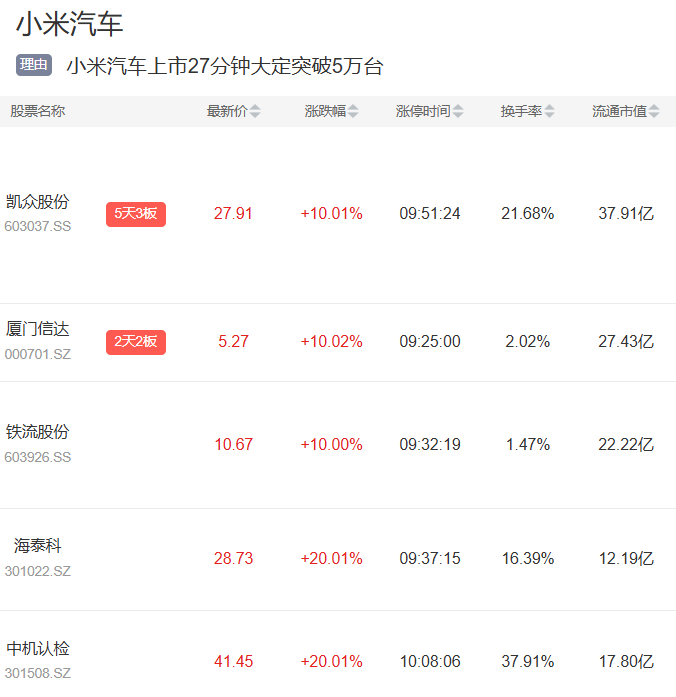
Group 1 - Xiaomi's Yu7 is set to launch at the end of June, with a starting price of around 250,000 RMB and expected monthly sales of 30,000 to 40,000 units [1][2] - The Yu7 features a 800V silicon carbide platform, a 96.3 kWh lithium iron phosphate battery with a CLTC range of 835 km, and advanced driver assistance systems [1] - The Yu7 has already attracted significant interest, with three times the number of user inquiries compared to the SU7 at the same stage, indicating a potential for greater market impact [1] Group 2 - The launch of the SU7 saw over 50,000 pre-orders within 27 minutes, leading to a surge in stock prices for related companies [3] - Companies such as Huayang Group and Longli Technology are set to supply components for the Yu7, indicating a robust supply chain [5][6] - Various suppliers, including Fuyou Glass and Baowu Magnesium, are providing essential parts for Xiaomi's automotive products, showcasing a diverse supplier network [7][8]

东兴证券晨报-20250616
Dongxing Securities· 2025-06-16 11:03
Group 1: Banking Industry Insights - The overall growth of social financing (社融) in May 2025 was supported by proactive fiscal policies, with a year-on-year increase of 8.7% [2][3] - The increase in social financing was primarily driven by government bond issuance, which net financed 1.46 trillion yuan, reflecting a positive fiscal stance [3] - Credit demand remains weak, with a year-on-year decrease in new RMB loans by 3.3 billion yuan in May, indicating a need for further stimulation of credit demand [4][6] Group 2: Loan Structure and Trends - In May, short-term loans for enterprises increased by 2.3 billion yuan year-on-year, while medium and long-term loans decreased by 1.7 billion yuan, influenced by debt replacement policies [4] - The residential loan sector showed a slight increase, with new loans of 540 million yuan, but short-term loans decreased, indicating weak consumer credit demand [4][6] - The weighted average interest rate for new loans remained stable at approximately 3.2% for enterprises and 3.1% for personal housing loans [6] Group 3: Market Outlook and Investment Strategy - The banking sector is expected to maintain stable growth due to the issuance of special government bonds and a shift in local government focus towards economic recovery [7][8] - The net interest margin is anticipated to narrow gradually, but the impact on profitability is expected to be manageable due to declining deposit rates [7] - The report suggests a focus on high-dividend stocks within the banking sector, particularly state-owned banks and regional banks with growth potential [8] Group 4: A-Share Market and Economic Recovery - The A-share market is positioned for a long-term slow bull phase, driven by structural economic changes and improved asset quality [9][10] - The report highlights the importance of manufacturing and the potential for growth in sectors such as semiconductors and high-end manufacturing [10][11] - The anticipated gradual economic recovery is expected to reflect positively on the stock market, with a focus on mid-cap and growth stocks [12][13] Group 5: Electronic Industry Trends - The electronic industry is entering a new development phase driven by AI advancements, with significant growth expected in wafer foundry, SoC, and thermal management materials [20][21] - The global semiconductor sales are projected to exceed 1 trillion USD by 2030, with a strong demand for chips driven by AI applications [20] - The SoC market is expected to grow at a CAGR of 8.3% from 2024 to 2029, fueled by the increasing demand for AI-optimized solutions [21] Group 6: Photovoltaic Industry Developments - The photovoltaic industry is focusing on supply-side optimization through self-regulation and technological innovation, with a recovery in Q1 2025 performance [23][24] - The report emphasizes the importance of silicon materials and battery cells in optimizing the supply structure, with a focus on reducing costs through new technologies [25][26] - The demand for energy storage solutions is expected to rise, particularly in the context of distributed energy projects [26] Group 7: Lithium Battery Industry Insights - The lithium battery sector is experiencing a recovery in demand, with solid-state and sodium batteries poised for significant growth [27][28] - The report highlights the potential for profitability improvements in the battery segment, driven by new applications and technological advancements [27] - Solid-state battery technology is expected to accelerate commercialization, benefiting companies with early-stage advantages [29]
东吴证券晨会纪要-20250616
Soochow Securities· 2025-06-16 02:31
Macro Strategy - The report discusses the shift in policy focus from "controlling high prices" to "controlling low prices" to boost core CPI, suggesting that service price subsidies could increase core CPI by approximately 0.3 percentage points, offsetting declines in housing service prices [1][10][11] - Core CPI has shown a significant rebound since September of the previous year, despite four months of negative growth driven mainly by food and energy prices [10][11] - The report emphasizes the limited upward potential for core goods and housing service prices, indicating that future policy should focus on enhancing prices of other services [10][11] Industry Insights - The report highlights the new phase of controllable nuclear fusion as a potential ultimate energy solution, driven by policy and capital support, with multiple devices under construction [5][16][17] - It identifies key suppliers in the nuclear fusion sector, including West Superconducting, Lianchuang Optoelectronics, and Aikesaibo, suggesting that the industry is moving from experimental to industrial stages with significant future potential [5][16][17] - The report also discusses the trend towards lightweight robots, emphasizing the increasing application of magnesium alloys and PEEK materials, which are expected to enhance performance and reduce weight in humanoid robots [18]

轻量化报告:镁合金&PEEK材料在机器人中的应用(附40页PPT)
材料汇· 2025-06-13 15:14
点击 最 下方 关注《材料汇》 , 点击"❤"和" "并分享 添加 小编微信 ,寻 志同道合 的你 正文 1. 人形机器人为何需要实现轻量化? 轻量化设计就是在满足机器人功能和性能要求的前提下,通过优化结构、选用轻质材料、改进制造工艺等手段,尽可能地减轻机器人的重量。通过轻量化减重,人 形机器人可以实现更长的续航以及更高的运动动态响应速度。 当前人形机器人主机厂普遍将"轻量化"作为迭代核心之一,通过 自研高扭矩密度电机、拓扑优化结构、一体化伺服模组、碳纤维及复合材料等 手段持续降低整机质 量,头部人形机器人厂商的机器人产品迭代大多伴随着整体重量的减轻。 目前机器人轻量化主要采用 铝合金、镁合金(或铝镁合金)、碳纤维和高性能工程塑料PEEK等材料 ,但单一材料难以兼顾强度、刚性、成本与加工工艺。我们判 断 未来趋势是镁合金、碳纤维、PEEK等多材料协同应用,按功能分区优化设计 。 2.镁合金:成本下探&压铸工艺渐近成熟,镁合金渗透率有望逐步提升 镁合金密度仅为铝合金的2/3,却在比强度、减震性、电磁屏蔽性和加工性能等方面展现出综合优势。尤其适用于对轻量化、吸能性和成型效率要求较高的结构件。 过去镁合金 高成本、 ...

东吴证券:轻量化成为人形机器人迭代核心 镁合金与PEEK材料迎机遇
智通财经网· 2025-06-13 03:37
Core Insights - Lightweight design is becoming a core direction for humanoid robot iteration, significantly enhancing endurance and dynamic response speed through structural optimization and the use of lightweight materials like magnesium alloy, carbon fiber, and PEEK [1] Group 1: Importance of Lightweight Design - Lightweight design aims to reduce the weight of humanoid robots while meeting functional and performance requirements, allowing for longer endurance and higher dynamic response speed [1] - Leading humanoid robot manufacturers are focusing on lightweight as a core aspect of their product iterations, utilizing self-developed high-torque density motors, topological optimization structures, and composite materials [1] - Current lightweight materials include aluminum alloy, magnesium alloy, carbon fiber, and high-performance engineering plastics like PEEK, with a future trend towards multi-material collaborative applications [1] Group 2: Magnesium Alloy Insights - Magnesium alloy has a density of only two-thirds that of aluminum alloy, showcasing advantages in specific strength, shock absorption, electromagnetic shielding, and processing performance [2] - The industrialization of magnesium alloy has been previously hindered by high costs, complex forming processes, and corrosion resistance issues, but recent improvements in price and processing have boosted its penetration rate [2] - The price of magnesium has decreased, with the magnesium-aluminum price ratio dropping to nearly 1.0, alleviating price pressures [2] - Advances in semi-solid magnesium alloy die-casting technology have improved safety and performance, with leading companies investing in this technology for various applications, including industrial robots [2] Group 3: PEEK Material Characteristics - PEEK exhibits excellent mechanical properties, flame resistance, wear resistance, corrosion resistance, hydrolysis resistance, heat resistance, and biocompatibility, outperforming metal materials [3] - The high cost of PEEK is a barrier to large-scale use, primarily due to complex production processes and limited supply of core raw materials [3] - The application of PEEK in humanoid robots is expected to open new scenarios, with potential for cost reduction as demand increases [3]

东兴证券晨报-20250612
Dongxing Securities· 2025-06-12 10:50
Core Insights - The report highlights that the AI wave is driving the electronic industry into a new development phase, with three core areas showing significant growth momentum: wafer foundry, SoC, and thermal management materials [2][3][6]. Wafer Foundry - The wafer foundry segment is expected to benefit from AI development, particularly in servers, data centers, and storage, which are the fastest-growing sub-markets. Global semiconductor sales are projected to exceed $1 trillion by 2030, with wafer demand expected to reach 11.2 million pieces per month in 2025 and grow to 15.1 million by 2030. The growth rates for 2024 and 2025 are forecasted at 6% and 7%, respectively [2][3]. SoC (System on Chip) - AI technology is becoming a crucial component of SoC architecture, enhancing smart processing capabilities for edge devices. The global SoC market is predicted to grow from $138.46 billion in 2024 to $205.97 billion by 2029, with a compound annual growth rate (CAGR) of 8.3% from 2024 to 2029. The demand for SoC in the automotive sector is also rising significantly [3][6]. Thermal Management Materials - The demand for thermal management materials is expected to grow rapidly due to the increased heat generation from AI-enabled devices. The global thermal management market is projected to expand from approximately $15.98 billion in 2023 to $26.43 billion by 2028, with an average annual growth rate of 10.5% [6][7]. Photovoltaic Industry - The photovoltaic industry is currently in a phase of supply-side optimization driven by self-discipline and technological innovation. The first quarter of 2025 saw a performance recovery due to installation rushes, but the industry remains in a loss phase. Key areas for supply-side optimization include silicon materials and battery cells, with a focus on reducing silver usage in production [6][7][8]. Lithium Battery Industry - The lithium battery sector is experiencing a recovery in market conditions, with solid-state batteries and sodium batteries expected to reach a scale application phase. The report suggests that the overall profitability of the lithium battery sector is improving, driven by new technologies and increasing demand from emerging applications [14][15][16]. Metal Industry - The report indicates that the supply-demand structure in the metal industry is improving, particularly for magnesium and lithium. The magnesium industry is expected to enter a state of sustained tight balance, while the lithium supply surplus is gradually improving. The global magnesium demand is projected to grow significantly due to its applications in lightweight and green technologies [18][19][23][24].
东兴证券晨报-20250611
Dongxing Securities· 2025-06-11 11:00
Core Insights - The report indicates that the global metal industry is still in a weak supply cycle, with exploration investments declining for the second consecutive year, down 3% to $12.5 billion in 2024 [3] - The magnesium industry is expected to enter a state of sustained tight balance, while the lithium industry is gradually improving its oversupply situation [2][11] Supply and Demand Analysis - Global mining supply growth is significantly constrained, with actual supply growth dropping from 6.35% to 2.22% in 2024, which is only 49.8% of the average growth rate over the past 30 years [4] - China's actual supply growth for ten non-ferrous metals is projected to remain within the fluctuation range observed since 2012, averaging 6.79% from 2023 to 2024 [4] Industry Trends - The report emphasizes the cyclical, growth, and hedging value of the metal industry, highlighting three main lines of focus: industrial metals with resilient supply-demand states, small metals with enhanced growth attributes, and precious metals with tight supply-demand fundamentals [7] - The proportion of holdings in the non-ferrous metal sector has significantly increased, reaching a historical high of 5.43% in Q1 2024, although it is expected to decline to 2.85% by Q4 2024 due to economic weakness and declining downstream demand [8] Magnesium Industry Insights - The magnesium industry is forming a new modern industrial cluster in China, which is expected to enhance scale efficiency and profitability, aligning with the development of the new energy industry [9] - Global magnesium production is projected to increase from 1.12 million tons in 2024 to 2 million tons by 2027, with a compound annual growth rate (CAGR) of 21% [9] Lithium Industry Insights - The lithium industry is expected to see a gradual improvement in supply-demand dynamics, with global lithium supply projected to grow from 1.231 million tons LCE in 2024 to 1.86 million tons LCE by 2027, reflecting a CAGR of 15% [11] - The demand for lithium is driven by the growth of the electric vehicle market and energy storage systems, with total lithium battery shipments expected to rise from 1,545 GWh in 2024 to 2,778 GWh by 2027 [11] Investment Opportunities - The report identifies key companies in the magnesium sector, such as Baowu Magnesium and Xingyuan Zhuomai, and in the lithium sector, including Tianqi Lithium, Ganfeng Lithium, Yongxing Materials, and Jinyinhai [10][12]
2025下半年有色金属行业投资策略:商品和金融属性共振,高景气进一步扩散
Shenwan Hongyuan Securities· 2025-06-10 12:41
Macro Environment - The macro environment is characterized by intensified trade frictions and a continued interest rate cut cycle by the Federal Reserve, with a focus on changes in tariff policies [3][5][12] - The U.S. Federal Reserve stopped raising interest rates in July 2023 and is expected to cut rates by 100 basis points by May 2025, maintaining a high rate level [9][10] Precious Metals - The financial attributes of precious metals are expected to continue to shine, with gold prices projected to rise due to weakened dollar reserve credit and increasing global central bank diversification of reserve assets [3][5][30] - Silver, which has lagged behind gold, is anticipated to experience strong demand for a rebound, with a focus on companies like Shandong Gold, Zhongjin Gold, and others [3][5][38] Base Metals - The base metal sector is expected to see a shift in weak expectations, with aluminum production nearing capacity limits and demand from new energy and power sectors offsetting declines in real estate demand [3][5][60] - Copper supply shortages are expected to persist, with a favorable outlook for price recovery following interest rate cuts [3][5][77] Minor Metals - The minor metals sector is witnessing a bottoming cycle with positive changes emerging, particularly in strategic minor metals like rare earths and tungsten, as well as a rebound in cobalt prices due to supply constraints from the Democratic Republic of Congo [3][5][98][99] - Lithium prices are declining, and high-cost production is expected to accelerate exit from the market, while nickel supply disruptions are anticipated [3][5][60]
宝武镁业(002182) - 2025年6月9日投资者关系活动记录表
2025-06-09 08:16
Company Overview - Baowu Magnesium Industry Technology Co., Ltd. was established in 1993 and listed on the Shenzhen Stock Exchange in 2007, evolving into a high-tech enterprise integrating mining, non-ferrous metal smelting, and recycling processing [1] - The company specializes in the production and deep processing of magnesium and aluminum alloy materials, with key products including magnesium alloys, magnesium alloy die-castings, aluminum alloys, and metal strontium [1] - The complete industry chain from mining to recycling enhances product cost structure and risk resilience, ensuring stable product supply to customers [1] Export and Market Dynamics - The U.S. has imposed anti-dumping measures on Chinese magnesium products since the 1990s, leading to a cessation of exports from the company to the U.S. for many years [2] - The company is not directly affected by U.S. tariffs on magnesium products [2] Automotive Applications - The penetration rate of magnesium materials in automotive components is expected to increase, particularly for parts like instrument panel brackets, seat brackets, and display screen backplates, as the cost-performance ratio improves [2] - In 2024, the company anticipates over 20% growth in steering wheel, CCB, and seat products compared to 2023, bolstered by strategic collaborations with leading industry players [4] Robotics Sector - Magnesium alloys offer significant advantages in the robotics industry, including reduced weight, improved speed, enhanced thermal conductivity, and effective electromagnetic shielding, leading to increased operational efficiency [3]