
陶氏公司

Search documents
【招银研究|行业深度】化工行业研究之产能转移篇——从制造中心到创新引擎的跃迁机遇
招商银行研究· 2025-08-13 10:33
Core Viewpoint - The global chemical industry is undergoing significant transformation, with China rapidly rising to dominate the market while Europe faces declining competitiveness and substantial operational challenges [3][4][7]. Group 1: Global Chemical Industry Landscape - In 2023, global chemical sales reached €5.2 trillion, with China accounting for €2.2 trillion, representing a 43% market share, an increase of 9 percentage points over the past decade [9]. - The EU remains the second-largest chemical market, but its share has decreased from 16% in 2013 to 13% in 2023 [9]. - The trend of "East rising, West declining" is evident, making investment in China a consensus choice among global investors [17]. Group 2: European Chemical Industry Challenges - The chemical sector is a cornerstone of the European economy, with a trade surplus of €52 billion in 2023, but is now under severe pressure due to rising energy costs and regulatory burdens [25][29]. - The conflict in Ukraine has led to soaring natural gas prices, significantly impacting the competitiveness of European chemical producers [34]. - Approximately 11 million tons of chemical production capacity in Europe has been permanently shut down in recent years, with ongoing indications of further closures [50]. Group 3: China's Chemical Industry Growth - China's chemical production capacity continues to expand, with the country leading in basic chemical raw materials and rapidly growing in fine chemicals [4][61]. - In 2024, China's total chemical industry output is projected to reach ¥16.3 trillion, accounting for about 12% of the national industrial output [57]. - China is expected to produce over half of the world's chemical products by 2030, with capital expenditures and R&D investments leading globally at 46% and 32%, respectively [17][81]. Group 4: Investment Trends and Strategic Shifts - European chemical companies are increasingly investing in China, with BASF committing €10 billion to build an integrated production base in Zhanjiang [89]. - The shift in investment focus from Europe to Asia is evident, with major companies like BASF and INEOS adjusting their strategies to enhance competitiveness in the Chinese market [54][89]. - Cross-national companies are establishing R&D centers in China to better align with local market demands and leverage China's growing innovation capabilities [94].

项目集中签约 外资持续看好中国市场
Xin Hua Wang· 2025-08-12 06:25
Group 1 - The third Multinational Corporation Leaders Qingdao Summit showcased significant foreign investment confidence, with 186 Fortune Global 500 companies and 290 industry leaders participating, resulting in 99 key foreign projects signed with a total investment of $15.6 billion, a 31.4% increase from the previous summit [1] - Major multinational companies such as AstraZeneca, Lloyds, Mitsui & Co., and ZF Friedrichshafen announced new investment plans during the summit, focusing on sectors like new-generation information technology, new energy materials, high-end equipment, and advanced chemicals [2] - The resilience of the Chinese economy has bolstered foreign investment confidence, with China’s GDP accounting for 18% of the global total and 399 Chinese companies listed in the latest Forbes Global 2000, indicating a rising trend [3] Group 2 - China is enhancing its business environment by streamlining market access, promoting fair competition, and improving trade and investment liberalization, which supports multinational companies in their investment and development in China [4] - The Ministry of Commerce is actively revising the encouraged foreign investment industry catalog and promoting foreign investment in manufacturing and service sectors, particularly in central and northeastern regions [4] - The evolving global supply chain dynamics present new opportunities for multinational companies in China, driven by the country's vast market, complete industrial chain capabilities, and improving business environment [5] Group 3 - Companies like Air Products and Dow are increasing their investments in China, with Air Products emphasizing the importance of China's ongoing opening-up policies for their market expansion [3][5] - Qualcomm is optimistic about the digital economy in China, highlighting the successful deployment of 5G technology as a significant opportunity for collaboration [5][6] - Jaguar Land Rover is supporting global suppliers to establish local parts factories in China, indicating a trend towards localization and deeper collaboration with domestic suppliers [6]
液冷材料及电子氟化液更新
2025-08-11 01:21
Summary of Conference Call Records Industry Overview - The conference call discusses advancements in liquid cooling technology, particularly influenced by NVIDIA's bidirectional cold plate solution, which impacts the traditional single-phase silent cooling market while maintaining existing applications [1][2]. Key Points and Arguments - **Bidirectional Cold Plate Technology**: - This technology offers better cooling capabilities than air cooling and single-phase cold plates, handling nearly 2,500 watts of power, but is still less effective than single-phase or bidirectional silent systems [1]. - The design is complex and limited in medium selection, primarily using high-cost, low-supply low-boiling-point fluorinated liquids [1][5]. - **R134a Refrigerant**: - Tianhong Technology has validated the use of R134a refrigerant in bidirectional cold plates, raising market interest in new refrigerant applications. China, as a major refrigerant producer, may see companies expand market share due to this development [1][4][7]. - The potential demand from tech giants like Google could significantly impact the global refrigerant market, with estimates of 2,000 tons needed annually if adopted [19]. - **Market Dynamics**: - Despite the emergence of bidirectional cold plates, traditional silent cooling systems remain stable in specific scenarios, with companies like Alibaba and ByteDance continuing to use established technologies [8][12]. - The industry is exploring new cooling solutions to meet increasing chip power demands, with various manufacturers actively seeking new refrigerant solutions [13]. - **Challenges in Liquid Cooling**: - The selection of liquid mediums poses significant challenges, as high-performance liquids are often expensive, while cheaper options may have critical drawbacks [17]. - The complexity of designing and deploying liquid cooling systems adds to the overall costs and challenges [17]. Additional Important Content - **Comparative Analysis of Cooling Solutions**: - Bidirectional cold plates have higher cooling capacities compared to single-phase cold plates and air cooling, but they still have limitations and may only serve as a temporary solution for high power demands [10]. - The design complexity of hybrid cooling solutions combining cold plates and silent systems is high, making implementation difficult [9]. - **Future Trends**: - The industry is expected to see a shift towards more advanced cooling technologies if existing solutions cannot meet future demands [13]. - Companies like New Oriental are pivoting towards semiconductor temperature control etching liquids to address growth bottlenecks in cleaning businesses [26]. - **Refrigerant Market Status**: - The refrigerant market is transitioning from third-generation to fourth-generation products, with third-generation products still dominating due to their maturity and high output [20]. - Major players in the refrigerant market include traditional companies like Juhua and Sanmei, which have performed well amid rising demand due to hot weather [20]. - **Liquid Mediums in Cooling Solutions**: - The first-generation liquid cooling solutions primarily used water and glycol mixtures, while newer solutions utilize various expensive liquids, including fluorinated liquids and silicone oils [11][15]. - High-end fluorinated liquids are considered the best choice for performance, but their high cost limits widespread adoption [16]. This summary encapsulates the key insights and developments discussed in the conference call, highlighting the evolving landscape of liquid cooling technologies and their implications for the industry.

环保监管严格和能源成本高企,化工巨头产能退出欧洲市场
环球富盛理财· 2025-08-07 02:09
Investment Rating - The report indicates a negative outlook for the chemical industry in Europe, with major chemical companies withdrawing production capacity due to strict environmental regulations and high energy costs [1][33]. Core Insights - The European Union is the second-largest chemical production region globally, but the ongoing Russia-Ukraine conflict has exacerbated energy price increases, impacting the competitiveness of the European chemical industry [2][34]. - The EU is actively pursuing carbon neutrality, with significant regulatory changes and initiatives aimed at reducing carbon emissions [2][51]. - Leftist political parties in Europe are pushing for stricter regulations on the chemical industry, which has led to increased operational challenges for chemical manufacturers [2][66]. - Major chemical companies are exiting the European market, citing high energy costs and regulatory burdens as primary reasons for their decisions [2][74]. Summary by Sections Industry Overview - The chemical industry is the highest value-added and investment-intensive sector in EU manufacturing, employing approximately 3.4 million people [3][4]. - In 2020, the chemical sector contributed significantly to the EU's manufacturing employment, second only to the food products industry [3]. Market Dynamics - The EU chemical industry accounted for 13% of global chemical sales in 2023, a decline from 16% in 2013, with sales dropping to approximately €655 billion, a 12.4% decrease year-on-year [15][19]. - The production capacity utilization in the EU remains low, fluctuating around 75%, compared to a historical average of 81% [44]. Financial Performance - Capital expenditures in the EU chemical sector reached €32.1 billion in 2023, marking a 53% increase compared to pre-pandemic levels, but growth rates lag behind those in China and the US [25]. - R&D spending in the EU chemical sector has also seen a decline in global share, with a 25% increase from €8 billion to €10 billion, while China's R&D spending doubled in the same period [30]. Regulatory Environment - The EU's carbon emissions trading system has generated significant revenue, reaching nearly €29.1 billion from 2013 to 2023, reflecting the EU's commitment to carbon neutrality [51]. - The upcoming Carbon Border Adjustment Mechanism (CBAM) will impose carbon costs on certain imported goods, including organic chemicals, starting in 2026 [56]. Company Actions - Major chemical companies, including Dow, Shell, and BASF, are restructuring their European operations, closing or selling high-cost production facilities due to unfavorable market conditions [75][76].
界面早报 | 就理想i8碰撞测试相关方发布联合声明;特朗普对印度加征25%的额外关税
Sou Hu Cai Jing· 2025-08-06 23:16
Group 1 - The summer box office in 2025 has surpassed 200 million viewers as of August 6, indicating a strong recovery in the film industry [1] - Ideal Automotive, China Automotive Research, and Dongfeng Liuzhou Motor issued a joint statement addressing the collision test incident involving the Ideal i8, emphasizing the need for industry self-discipline and integrity in product development and marketing [2] - TSMC confirmed the dismissal of multiple employees due to the leakage of 2nm process trade secrets, with investigations revealing that around 10 individuals were involved in the incident [3] Group 2 - *ST Dongtong announced that its actual controller and chairman, Huang Yongjun, is under investigation by the China Securities Regulatory Commission for suspected violations of information disclosure laws [4] - President Trump signed an executive order imposing a 25% additional tariff on goods from India in response to India's continued importation of Russian oil [5] - The White House announced that Apple will increase its investment commitment in the U.S. by $100 billion, reflecting the company's ongoing expansion plans [6] Group 3 - Federal Reserve official Kashkari indicated that two interest rate cuts this year may still be appropriate, suggesting a potential response to economic slowdown [7] - U.S. stock markets saw all three major indices close higher, with Apple shares rising over 5%, indicating strong performance in the tech sector [8]


苹果承诺追加1000亿美元投资!股价单日狂飙5.09%,创5月来最大涨幅
Sou Hu Cai Jing· 2025-08-06 23:05
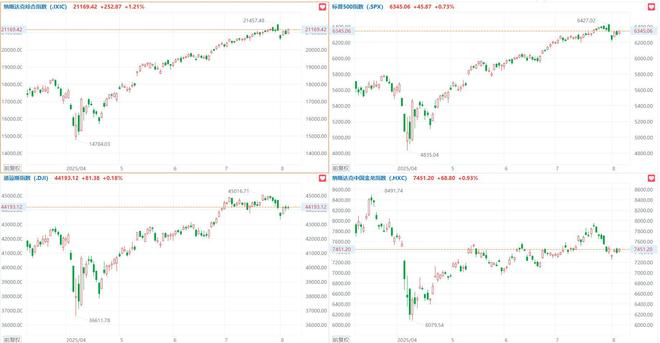
Group 1 - The U.S. stock market saw all three major indices rise on August 6, with the Nasdaq Composite showing the strongest performance, closing up 252.87 points, or 1.21% [1] - The Dow Jones Industrial Average increased by 81.38 points, closing at 44,193.12 points, a rise of 0.18%, while the S&P 500 rose by 45.87 points, closing at 6,345.06 points, a gain of 0.73% [1] - Apple's stock price surged by 5.09%, becoming a significant driver of the market's upward movement [1] Group 2 - Apple's stock experienced its largest single-day increase since May 12, attributed to a new investment commitment from the White House, which includes an additional $100 billion investment in the U.S. [3] - This new investment will bring Apple's total investment in the U.S. to $600 billion, following a previously announced plan to invest $500 billion over the next four years [3] - The investment plan aims to shift more of Apple's supply chain to the U.S. and includes the construction of a large factory in Texas for AI servers, creating approximately 20,000 new R&D jobs nationwide [3] Group 3 - Major technology stocks generally performed well, with Amazon rising by 4%, Tesla by 3.62%, and Broadcom by 2.98%, contributing to positive market sentiment [4] - Retail and consumer electronics sectors showed strong performance, with Shopify soaring by 21.97% and Walmart increasing by 4.08% [4] - Conversely, sectors such as weight loss drugs and chemical products faced declines, with Dow Chemical falling by 4.83% and Novo Nordisk by 3.9% [4]

美股三大指数集体收涨,苹果涨超5%,中概指数涨0.93%
Ge Long Hui A P P· 2025-08-06 22:25
Market Performance - The three major US stock indices closed higher, with the Dow Jones up 0.19%, the Nasdaq up 1.21%, and the S&P 500 up 0.73% [1] - Notable technology stocks saw significant gains, including Apple rising over 5%, Amazon up 4%, Tesla increasing over 3%, and Broadcom up nearly 3% [1] Sector Performance - Retail and consumer electronics sectors led the gains, with Shopify surging over 21%, Walmart up over 4%, Ross Stores increasing over 3%, and Costco and Kohl's both rising over 2% [1] - Conversely, weight loss drugs and chemical products experienced declines, with Dow Chemical down over 4%, Novo Nordisk nearly 4%, and Eli Lilly down over 2% [1] Company-Specific Movements - AMD reported earnings below expectations, resulting in a decline of over 6%, while Super Micro Computer fell over 18% and Snap dropped over 17% [1] - The Nasdaq Golden Dragon China Index rose by 0.93%, with most popular Chinese concept stocks increasing, including Xiaoma Zhixing up 4.2%, Alibaba up 3.3%, and Yum China, Tencent, NIO, and Bilibili all rising by at least 2% [1] - Pinduoduo increased by over 1%, while TSMC fell by 0.5%, New Oriental down 0.9%, Xiaomi down 2.4%, and Li Auto down 5.5% [1]
多重不稳定因素影响 乙烯产业发展在欧洲或将停滞
Zhong Guo Chan Ye Jing Ji Xin Xi Wang· 2025-08-05 22:58
Group 1 - The European chemical industry has experienced a wave of steam cracker shutdowns and downstream capacity consolidation over the past 18 months due to rising raw material costs, low naphtha cracking margins, low-priced imports, structural market oversupply, and weak demand [1] - Six steam crackers in Europe have been shut down or are planned to be shut down, with the potential for this number to increase in the future [1] - Major companies like Saudi Basic Industries Corporation and Dow Chemical have announced closures of their steam cracker facilities in the UK and Germany, respectively, indicating a necessary reduction in ethylene capacity to alleviate oversupply [1] Group 2 - Global demand for feedstock for steam crackers is projected to increase from 432 million tons in 2024 to 610 million tons by 2034, with ethylene production from ethane and naphtha expected to reach 74 million tons each in 2024 [2] - The report emphasizes that unless Europe consolidates its ethylene market to address years of oversupply, it will face a prolonged downturn [2] - As of the end of 2024, the operating rate of European steam crackers is expected to be around 75%, necessitating a reduction of approximately 2 million tons per year of ethylene capacity to rebalance the market [2] Group 3 - European ethylene production profits and prices are expected to remain under pressure for the remainder of the year, with spot prices fluctuating around €790 per ton since the end of 2022 and dropping to €563 per ton in July 2023 [3] - European ethylene producers have gradually lost global competitiveness due to consistently lower spot prices compared to other regions since Q2 2022, forcing them to reduce operating rates or shut down facilities [3] - High costs and geopolitical, tariff, and macroeconomic instability are severely restricting the development of the European ethylene industry, with a potential stagnation in growth if there are no relevant policy subsidies [3]
中国供给侧结构性改革 2.0:更聚焦市场机制-Chinese Supply-Side Structural Reform 2.0_ More Focus On Market Mechanisms
2025-08-05 03:15
Summary of Key Points from the Conference Call Industry Overview - The conference call focuses on the **Chinese chemicals industry** and its supply-side structural reforms, particularly in the context of the **petrochemical sector** [1][2]. Core Insights and Arguments - The **Chinese Politburo** meeting on July 30 indicated a shift towards **gradual adjustments** rather than aggressive mandates, suggesting a preference for market-driven solutions to overcapacity and industry 'involution' [1][2]. - The omission of the term "low prices" and the change in language regarding production capacity management indicates a more patient approach to resolving excess capacity issues, relying less on administrative measures [2]. - Key policy focus areas include **fertility subsidies**, **demographic challenges**, **local government debt**, and **international competitiveness**, with supply-side measures expected to be implemented in a measured manner [3]. - The **15th Five-Year Plan (15FYP)** is anticipated to provide clearer directions for these adjustments, with a focus on maintaining overall stability [3]. Company-Specific Insights - The report suggests that the Chinese government will continue to support **coal-based chemical production** and pursue **CTC projects** that are significantly lower in cost compared to naphtha crackers [4]. - For **US petrochemicals**, the likelihood of aggressive structural reforms appears reduced, with expected capacity closures primarily involving higher-cost units being replaced by larger, more efficient ones [4]. - The report identifies **ALB (Albemarle Corporation)** and **LAC (Lithium Americas Corp.)** as favorable investments under current policies, while **EMN (Eastman Chemical Company)** and **MEOH (Methanex Corp.)** would benefit from more aggressive policies [4]. Additional Important Information - The report highlights that the current policies may lead to a longer period of margin pressure in the petrochemical sector, indicating potential risks for investors [1][4]. - The absence of emphasis on profitability or returns on capital suggests that adjustments in the industry could take longer, particularly for older or quasi-utility industries [3]. - The report includes a distribution of ratings for various companies, indicating a majority of **Buy** ratings, with specific companies mentioned such as **CE (Celanese Corporation)** and **DOW (Dow Inc.)** rated as **Hold** [21]. This summary encapsulates the key points discussed in the conference call, providing insights into the current state and future outlook of the Chinese chemicals industry and specific companies within the sector.


CIA:英国化工业继续承受重压
Zhong Guo Hua Gong Bao· 2025-08-05 02:57
Group 1 - The core viewpoint of the article highlights that one-third of UK chemical companies experienced declines in sales, production levels, and capacity utilization in the second quarter, attributed to energy costs, international economic uncertainty, and global supply overcapacity [1] - The CEO of the Chemical Industries Association (CIA) noted that global overcapacity, intense international competition, and uncompetitive industrial policies are threatening the future of UK manufacturing, leading to several companies announcing shutdowns, restructurings, or profit warnings over the past two years [1] - The CIA's chief economist indicated that the industry has been in a contraction phase for over two years, with both investment and employment in the chemical sector declining, particularly with employment shrinking for six consecutive quarters, likely due to long-term market share losses [1] Group 2 - The industry outlook for the third quarter and the next 12 months is described as "bleak," with expectations of a potential sales rebound in a year, but continued declines in employee numbers, indicating a risk of long-term market share loss [1] - Approximately 70% of UK chemical companies anticipate worsening labor costs, and nearly 60% expect a decrease in demand [1] - The CIA emphasizes the need for immediate government action on industrial strategy, including energy cost relief and regulatory changes to support growth and protect high-skilled jobs in critical areas [2]