
地平线

Search documents
理想智驾的2020年:封闭强势的Mobileye,左右为难的易航智能
雷峰网· 2025-10-22 10:57
Core Insights - The article emphasizes the importance of supply chain collaboration in the evolution of the smart automotive industry, highlighting that without past cooperation, the current advancements in smart vehicles would not be possible [32]. Group 1: Historical Context and Key Players - The article discusses the pivotal role of Li Auto's early partnership with EasyGo Intelligent, which was the only mass-produced smart driving solution provider in 2019, crucial for the success of the Li One vehicle [4][6]. - EasyGo's founder, Chen Yuhang, demonstrated foresight by choosing to collaborate with Li Auto when the company was still small, which later led to significant growth and valuation increases [6][7]. - The partnership allowed EasyGo to develop critical components for Li One's smart driving features, showcasing a successful collaboration between a car manufacturer and a technology supplier [9][10]. Group 2: Challenges and Shifts in Collaboration - The relationship between Li Auto and EasyGo began to strain due to conflicts arising from the self-research route of car manufacturers versus the strong supplier model represented by Mobileye [14][31]. - Li Auto's desire to upgrade its smart driving system led to complications, as EasyGo was caught between the demands of Li Auto and the restrictions imposed by Mobileye [15][16]. - The article notes that EasyGo's decision to pivot towards a more open platform, like Horizon Robotics, was influenced by the limitations imposed by Mobileye, indicating a strategic shift in response to market dynamics [19][31]. Group 3: Future Directions and Industry Impact - Following the split from Li Auto, EasyGo has successfully engaged with other automotive companies, indicating its resilience and adaptability in the smart driving sector [25][29]. - The article highlights that Li Auto's focus on self-research and development has positioned it among the top players in the smart driving field, showcasing the competitive landscape of the industry [24][31]. - The ongoing collaboration between Li Auto and EasyGo, despite their separation, underscores the enduring significance of supplier relationships in the automotive industry [31].



快时代,慢功夫 齐泽凯书写大众品牌中国新答卷
Zhong Guo Qi Che Bao Wang· 2025-10-22 04:38
Core Insights - The article discusses the strategic transformation of Volkswagen in the Chinese market under the leadership of Dr. Kai Ze, emphasizing the shift from "German manufacturing" to "Chinese speed" in innovation and product development [4][5][11] Group 1: Leadership and Strategy - Dr. Kai Ze has taken on significant roles within Volkswagen, including Vice President of Products and Strategy in China and CEO of Volkswagen Passenger Cars in China, overseeing a base of 46 million users [1] - The company has adopted a strategy of "In China, for China," which is reflected in its product planning and the establishment of the largest R&D center outside Germany [5][7] Group 2: Market Dynamics and Innovation - China is leading global innovation, particularly in smart electric vehicle technology, with a projected penetration rate of over 50% for new energy vehicles by 2024 [4] - Volkswagen's approach includes deep collaboration with local companies like Horizon and Xpeng, moving beyond simple technology procurement to joint R&D [5][7] Group 3: Product Development and Efficiency - The restructuring of the organization has granted the Chinese team more decision-making power, aiming to reduce product launch cycles by 30% and optimize costs by 40% [7] - The introduction of the CEA electronic architecture is a core part of Volkswagen's strategic transformation, enhancing software update efficiency and reducing complexity [9] Group 4: Brand Positioning and Consumer Trust - Volkswagen emphasizes reliability and quality over speed in a competitive market, with a focus on long-term consumer trust [11][15] - The shift from an incremental market to a replacement market in China highlights the increasing importance of brand trust, with 65% of sales coming from replacement users [11] Group 5: Future Product Plans - Volkswagen plans to launch 21 new energy models in China by 2027, expanding to 31 models by 2029, indicating a strong commitment to the Chinese market [15] - The company is also exploring the introduction of classic models like ID. Buzz, focusing on adapting products to better fit the local market rather than simply importing them [13] Group 6: Balancing Innovation and Tradition - Volkswagen is committed to both digitalization and electrification while maintaining its fuel vehicle business to fund new technologies [15] - The company aims to find a balance between global innovation and local adaptation, ensuring that its core brand values are preserved while meeting market demands [15]

汽车大芯片,成长惊人
半导体行业观察· 2025-10-22 01:20
Group 1 - The automotive processor market is projected to reach $8.9 billion in 2024, driven primarily by ADAS and infotainment segments, with ADAS being the main growth driver, particularly in centralized computing [2] - Centralized computing is expected to dominate the market by 2030 as more vehicles adopt centralized architectures, while radar and LiDAR technologies are anticipated to grow rapidly [2][4] - The demand for processors is shifting towards high-performance computing required for autonomous driving and infotainment, which will reshape automotive architecture over the next decade [2][6] Group 2 - The automotive processor market is undergoing a rapid transformation, with a slowdown in front camera sales due to inventory adjustments, and centralization becoming the new battleground [4] - Companies like Tesla, BYD, NIO, and XPeng are designing their own chips, while NVIDIA maintains a leading position among traditional suppliers [4] - Mobileye holds a 36% share of the ADAS market and is transitioning to launch streamlined and scalable high-performance chips [4] Group 3 - Automotive computing is entering a new era, with processors becoming smarter and more centralized, increasingly driven by artificial intelligence [6] - Front cameras now integrate powerful AI engines for detection, classification, and tracking, while radar and LiDAR are shifting from expensive FPGAs to more efficient APUs [6] - Chiplet technology is expected to reshape the market by providing flexibility, security, and supply chain resilience, creating new opportunities for OEMs and tier-one suppliers to develop custom processors for the next generation of vehicles [6]
从地平线自动驾驶2025年的工作,我们看到了HSD的野心......
自动驾驶之心· 2025-10-22 00:03
Core Insights - Horizon is advancing in the autonomous driving sector by focusing on large-scale production of the new HSD system and reshaping the foundational logic of autonomous driving through cutting-edge research papers [2][3] - The company is transitioning from a technology supplier to a standard-defining entity in the industry, supported by capital influx following its Hong Kong listing [2] Group 1: End-to-End Autonomous Driving - ResAD introduces a normalized residual trajectory modeling framework that simplifies the learning task and enhances model performance, achieving a PDMS score of 88.6 in NAVSIM benchmark tests [8] - CorDriver enhances safety in end-to-end autonomous driving by explicitly defining safe passage areas, resulting in a 66.7% reduction in collision rates with traffic participants [11] - TTOG unifies motion prediction and path planning tasks, demonstrating a 36.06% reduction in average L2 error on the nuScenes dataset [15] - MomAD addresses trajectory prediction consistency and stability issues by introducing momentum mechanisms, showing significant improvements in collision rates and trajectory smoothness [19] - GoalFlow generates high-quality multimodal trajectories by using precise target point guidance, achieving a PDMS score of 90.3 in NavSim benchmark tests [22] - RAD employs a large-scale 3DGS-based reinforcement learning framework to enhance safety, reducing collision rates by three times compared to pure imitation learning methods [26] - DiffusionDrive utilizes a truncated diffusion model for real-time end-to-end autonomous driving, achieving an 88.1 PDMS score and significantly improving planning quality [30] Group 2: Autonomous Driving Scene Generation & World Models - Epona is a self-regressive diffusion world model that achieves high-resolution, long-term future scene generation and trajectory planning, outperforming existing methods in the NuScenes dataset [33] - UMGen generates diverse, multimodal driving scenes, supporting user-controlled scenario generation and demonstrating superior authenticity and controllability compared to existing methods [38] - DrivingWorld constructs a world model for autonomous driving via a video GPT framework, generating high-fidelity videos with strong temporal consistency and structural integrity [41] Group 3: Autonomous Driving VLM & VLA - AlphaDrive integrates reinforcement learning and reasoning into visual language models for high-level planning in autonomous driving, improving planning accuracy by 25.52% compared to standard fine-tuning models [45] - The company has established a community of nearly 4,000 members and over 300 autonomous driving companies and research institutions, focusing on various autonomous driving technology stacks [49]

自动驾驶赛道“回暖”24起融资吸金超350亿元
Mei Ri Jing Ji Xin Wen· 2025-10-21 12:59
Core Insights - The autonomous driving industry is experiencing a significant resurgence in investment, with over 100 billion RMB raised in 11 financing events in the past month alone, and a total of 24 financing events exceeding 350 billion RMB since the beginning of 2025, indicating a strong recovery from previous years' downturns [1][2][6] Financing Trends - The 24 financing events in 2025 cover four main areas: L2-level assisted driving, L4-level niche markets, Robotaxi, and the autonomous driving supply chain, with 10 events raising over 10 billion RMB each, accounting for 50% of the total financing [2][3] - L2-level assisted driving saw 5 financing events, with the largest being Horizon Robotics raising approximately 58.12 billion RMB, while significant investments were also made in Robotaxi, with Didi Autonomous Driving completing a 20 billion RMB round [2][3] Market Dynamics - L4-level autonomous driving is advancing in specific applications like mining and logistics, with 9 companies raising over 30 billion RMB in total [3] - The supply chain for autonomous driving, particularly in chips and LiDAR, is also attracting substantial investments, with notable rounds from companies like Chipone Technology and Hesai Technology [3] Policy and Capital Influence - The financing landscape is characterized by a shift towards state-owned and industrial capital, which is replacing traditional financial investors, indicating a new dynamic in the industry [6][7] - The period from 2024 to 2025 has seen a significant increase in policy support, with over 71 new policies introduced in the first half of 2025 alone, laying a legal and institutional foundation for the commercialization of autonomous driving [7][8] Technological Advancements - The penetration rate of L2-level assisted driving in China has surpassed 50%, leading globally, with emerging technologies becoming standard in mid-to-high-end vehicles [8] - The cost of hardware has halved over the past two years, and the driving experience has improved tenfold, indicating rapid technological advancement [8] Profitability Challenges - Despite the influx of capital, many companies in the autonomous driving sector are still in the investment phase and have not yet achieved profitability, with significant losses reported by leading firms [9][10] - Companies like Horizon Robotics and Pony.ai are facing challenges in achieving stable profits, highlighting the ongoing need for financing to support R&D and market expansion [9][10] Future Outlook - The market for intelligent connected vehicles in China is projected to grow from 161.1 billion RMB in 2023 to 222.3 billion RMB by 2025, with expectations that China will become the largest market for autonomous driving by 2030 [11][12] - Industry leaders emphasize the importance of safety in the deployment of AI technologies in driving, suggesting a cautious yet optimistic approach to the future of autonomous driving [12]
2025年度国产AI芯片产业白皮书-与非网
Sou Hu Cai Jing· 2025-10-21 08:05
Core Insights - The report titled "2025 National AI Chip Industry White Paper" outlines the current status, innovation paths, industrial landscape, and core applications of domestic AI chips, emphasizing their strategic significance as the computational foundation of the AI industry while highlighting multiple challenges and breakthrough directions faced by the industry [1]. Group 1: Current Development and Challenges - Domestic AI chip development is crucial for ensuring supply chain autonomy and competing for the next generation of computing dominance, transitioning from "technological breakthroughs" to "ecological rise" [1]. - The industry faces three core challenges: insufficient architectural leadership, shortcomings in the ecosystem (software stack, development tools, and model compatibility), and obstacles in scaling from laboratory performance to industrial-grade reliability [1][2]. Group 2: Innovation Directions - Domestic AI chips are making strides in multiple architectural fields, focusing on x86, Arm, RISC-V, GPU, and DSA dedicated accelerators, while also targeting breakthroughs in sparse computing, FP8 precision optimization, memory-compute integration, and Chiplet heterogeneous integration [1]. - Companies like MoXing AI, Huawei, and Cambricon have accumulated technology in sparse computing, while companies like Moore Threads have achieved mass production of FP8 computing power [1][2]. Group 3: Industrial Landscape and Key Applications - The industry exhibits a collaborative development trend across various fields, with CPU, AI SoC, cloud/edge/vehicle AI chips, and GPU companies each having unique characteristics, primarily concentrated in key regions such as Shanghai, Beijing, and Guangdong [2]. - Core application scenarios are accelerating, with intelligent computing expected to reach 725.3 EFLOPS by 2024, and companies like Huawei and Moore Threads deploying large-scale clusters [2]. Group 4: Future Focus Areas - Future domestic AI chips should concentrate on full-stack closure and open collaboration, enhancing autonomous solutions in intelligent computing, breaking through dedicated computing architectures in automotive electronics, and prioritizing real-time collaborative architectures in robotics [2]. - The goal is to achieve a transition from "usable" to "user-friendly" through technological innovation, ecosystem improvement, and deepening application scenarios, thereby promoting high-quality industrial development [2].

地平线(9660.HK)解禁观察:多维验证价值与潜力
Ge Long Hui· 2025-10-21 00:57
随着解禁窗口10月24日临近,资本市场对地平线的关注再度升温。 长期以来,许多港股投资者对解禁消息格外敏感,一方面这意味着股票供给在短时间内大幅增加,投资 者的博弈程度随之增加,另一方面解禁也是一场"价值校准",对于本身质地优异的企业来说往往会平稳 渡过,迎来反弹,相当于带来了一个投资窗口期。 站在当前节点,要理性看待地平线的解禁,首先需要厘清这背后的核心事实。 可以看到,此次地平线解禁股票主要来自创始团队,除创始团队外其他解禁股份占比较低,而创始团队 的持股逻辑往往与公司长期发展深度绑定,短期大规模减持可能性较低。 上市一周年答卷优异,股价与业绩双重验证内在价值 站在上市一周年的节点回望,地平线实现了业绩与股价双升,双重印证其内在价值。 股价是最直观的市场投票机、称重机。自2024年10月24日登陆港股以来,地平线的股价成功穿越了资本 市场的多轮情绪波动,实现上市首年"倍翻"——以3.99港元的发行价为起点,随后一路震荡走高,2025 年9月中旬最高触及11.32港元。 同期,其股价增幅大幅跑赢恒生综指与恒生科指,成为赛道中极具代表性的优质标的。 地平线还同时获纳入恒生科指、富时50指数,MSCI指数等全球 ...
自动驾驶再现融资热,24起融资超350亿元,但行业尚未进入盈利期
Mei Ri Jing Ji Xin Wen· 2025-10-20 11:30
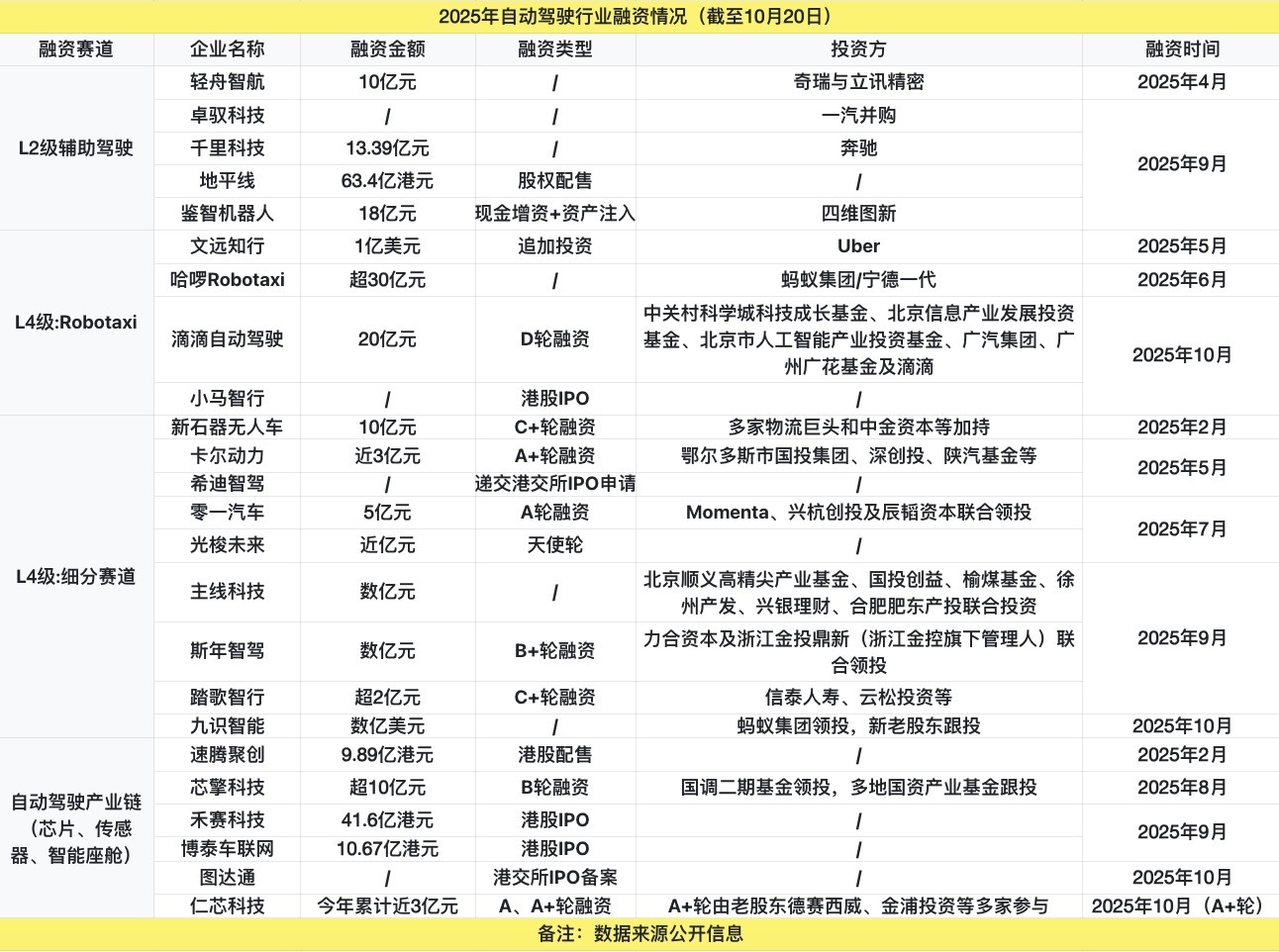
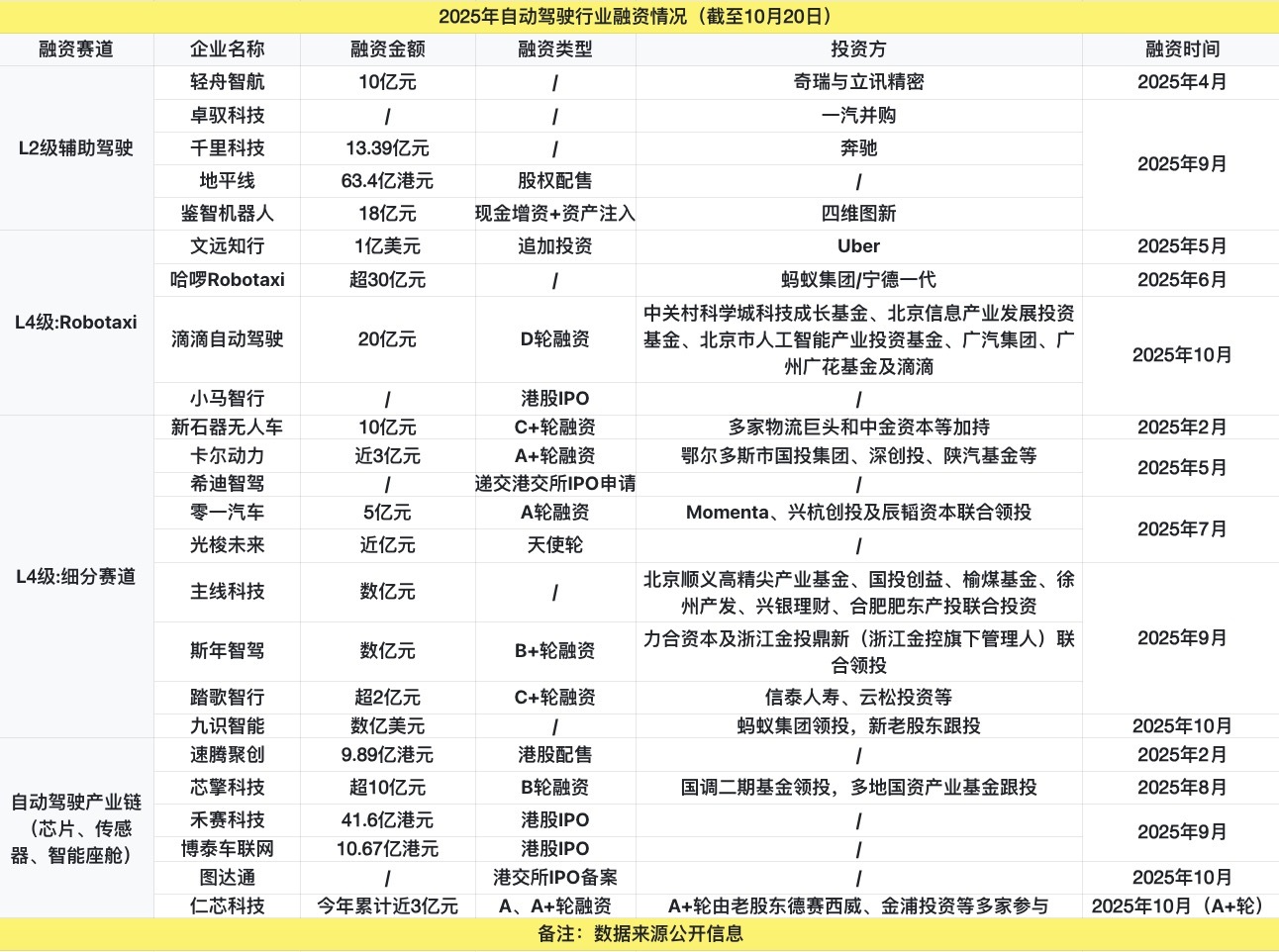
Core Insights - The autonomous driving industry is experiencing a significant resurgence in investment, with over 100 billion RMB raised in 11 financing events in the past month alone, totaling 350 billion RMB for the year as of October 20, 2025, indicating a strong recovery from the previous three years of capital winter [1][2][6] - The financing landscape is characterized by a preference for companies with clear application scenarios, with state-owned and industrial capital increasingly replacing traditional financial investors as key drivers of industry development [6][7] Financing Overview - As of October 20, 2025, there have been 24 financing events in the autonomous driving sector, with a total amount exceeding 350 billion RMB, including 10 events with disclosed amounts of 10 million RMB or more, accounting for 50% of the total financing [2][3] - The L2 level assisted driving segment has seen five financing events, with the largest being Horizon Robotics raising approximately 58.12 billion RMB through a share placement [2][3] - The Robotaxi segment has attracted significant investment, with notable financing events including Didi's 20 billion RMB Series D round and Hello's over 30 billion RMB funding [3][4] Market Dynamics - The L4 level autonomous driving sector is entering a phase of accelerated commercialization, particularly in specific scenarios such as mining and logistics, with nine companies raising over 30 billion RMB [4][6] - The supply chain for autonomous driving, particularly in chips and lidar technology, has also seen substantial financing, with companies like Hesai Technology raising approximately 38 billion RMB through an IPO [4][6] Policy and Technological Support - The autonomous driving industry is supported by a surge in relevant policies, with over 71 policies released in the first half of 2025, including national-level approvals for L3 vehicle production [7][8] - Technological advancements and increased market acceptance are crucial for commercial viability, with L2 level assisted driving penetration exceeding 50% in China, the highest globally [7][8] Financial Performance and Challenges - Despite the financing boom, many companies in the autonomous driving sector remain unprofitable, with significant losses reported alongside revenue growth, indicating ongoing challenges in achieving stable profitability [8][10] - Companies like Horizon Robotics reported a revenue of 1.567 billion RMB in the first half of 2025, a 67.6% increase, but also faced a loss of 5.233 billion RMB, highlighting the financial strain in the industry [8][10] Future Outlook - The market for intelligent connected vehicles in China is projected to grow from 161.1 billion RMB in 2023 to 222.3 billion RMB by 2025, with expectations that China will become the largest autonomous driving market globally by 2030 [10][11] - The emphasis on safety and the gradual expansion of application scenarios for autonomous driving technologies are critical for the industry's future development [11]
自动驾驶再现融资热!24起融资超350亿元,但行业尚未进入盈利期
Mei Ri Jing Ji Xin Wen· 2025-10-20 11:01
Core Insights - The autonomous driving industry is experiencing a significant resurgence in investment, with over 100 billion RMB raised in 11 financing events in the past month alone, and a total of 24 financing events exceeding 350 billion RMB since the beginning of 2025, indicating a strong recovery from the previous three years of capital winter [1][2][7] Financing Overview - The 24 financing events cover four main areas: L2 level assisted driving, L4 level subfields, Robotaxi, and the autonomous driving supply chain, with 10 events having disclosed amounts of 1 billion RMB or more, accounting for 50% of the total financing [2][5] - Notable financing events include Horizon Robotics raising approximately 58.12 billion RMB through share placement, and a strategic investment of 18 billion RMB by NavInfo in PhiGent Robotics to enhance its high-level intelligent driving technology [2][3] Sector-Specific Highlights - The Robotaxi sector has attracted significant investment, with Didi Autonomous Driving securing 20 billion RMB in D round financing and Hello announcing over 30 billion RMB in funding for its entry into the field [5][6] - In the autonomous driving supply chain, chip companies like Chipone Technology raised over 10 billion RMB in B round financing, while Hesai Technology raised approximately 38 billion RMB through a Hong Kong IPO [6][7] Policy and Market Dynamics - The financing landscape is characterized by a shift towards companies with clear application scenarios, with state-owned and industrial capital becoming key drivers of industry development, replacing traditional financial investors [7][8] - The period from 2024 to 2025 has seen a significant increase in policy support, with over 71 relevant policies released in the first half of 2025 alone, including national-level approvals for L3 vehicle production [8][9] Industry Challenges - Despite the influx of capital, most companies in the autonomous driving sector remain in a phase of continuous investment without profitability, with significant losses reported by leading firms such as Horizon Robotics and Pony.ai [9][10] - The industry is expected to face challenges in converting substantial R&D investments into revenue, as the maturity of technology and commercialization processes remain uncertain [9][10] Future Outlook - The market for intelligent connected vehicles in China is projected to grow from 161.1 billion RMB in 2023 to 222.3 billion RMB by 2025, with expectations that China will become the largest autonomous driving market globally by 2030, generating over 500 billion USD in revenue from new car sales and mobility services [10][12]
中国智能网联汽车加速驶来
Huan Qiu Shi Bao· 2025-10-20 08:13
Core Insights - The 2025 World Intelligent Connected Vehicle Conference in Beijing highlighted China's significant achievements in the automotive industry during the "14th Five-Year Plan" and its future prospects in smart vehicle development [1] - China is establishing a "decisive leading position" in the global smart automotive industry, achieving rapid advancements that foreign companies aspire to replicate [1] Industry Developments - The Chinese automotive industry has developed a comprehensive ecosystem encompassing smart cockpits, autonomous driving, and connected cloud control, with over 60% of new passenger cars sold featuring advanced driver assistance systems [1][2] - The market for new energy vehicle exports has surged from approximately 1 million units in 2019 to over 5.8 million units by 2024, with new energy vehicle exports increasing from about 250,000 to around 1.28 million in the same period [2] Technological Advancements - The rapid development of smart driving technology in China is attributed to the integration of artificial intelligence across domestic and joint venture automotive companies, enhancing user experience and brand recognition [3][4] - Approximately half of the new cars sold in China are equipped with L2-level intelligent driving systems, with projections indicating that by 2030, China will dominate the global L2+ intelligent driving market [4][5] Regulatory Environment - China's regulatory framework has evolved to support extensive testing of autonomous driving technologies, with over 30,000 kilometers of roads approved for testing, fostering innovation through local policy initiatives [5][6] - Recent regulatory tightening aims to enhance quality standards in the industry, requiring manufacturers to undergo stricter technical testing and approval processes [6] International Collaboration - European automotive companies are increasingly collaborating with Chinese smart driving technology firms, with partnerships emerging for the development of advanced driver assistance systems [7] - Chinese smart driving companies are expanding their market presence in the Middle East and Europe, indicating a competitive landscape with U.S. firms in these regions [8]