
零跑汽车

Search documents
乘用车1月月报:内需静待改善,出口韧性较强
Soochow Securities· 2026-01-30 08:24
Investment Rating - The report maintains a positive outlook on the passenger car sector, particularly in the context of the new vehicle replacement policy and the resilience of exports [2][3]. Core Insights - The passenger car industry experienced a significant decline in retail sales in December 2025, with a year-on-year drop of 16% and a total retail volume of 227,000 units. The wholesale volume was 279,000 units, reflecting a decrease of 9.7% year-on-year [7][10]. - The penetration rate of new energy vehicles (NEVs) reached 58.7% in December 2025, showing a year-on-year increase of 10.9% [10][12]. - The report highlights the stability of the NEV market, with BYD holding a market share of 25% and Geely at 11% in December 2025 [16]. Electric Vehicle Data Tracking - The report indicates that the old-for-new vehicle replacement policy was implemented in January 2026, which is expected to stimulate demand in the passenger car market [2][3]. - In December 2025, the NEV wholesale volume was 156,300 units, with a year-on-year increase of 3.4% [12]. - The report notes a significant inventory reduction in the passenger car sector, with a total decrease of 69,000 units in December 2025, including 43,000 units of NEVs [13]. Globalization Data Tracking - The report tracks the performance of Chinese car manufacturers in international markets, noting that in December 2025, 641,000 passenger cars were exported, with 245,000 being NEVs, resulting in a penetration rate of 38.2% for NEVs [3][43]. - The report highlights the strong performance of BYD in exports, particularly in Southeast Asia, where the NEV penetration rate exceeded expectations [3][27]. - The market share of Chinese brands in various regions, including Southeast Asia and Europe, showed positive trends, with notable increases in the UK market [38][40].





奇德新材:公司搭建起“材料开发-结构设计-模具开发-多工艺成型-表面处理”的全链服务
Zheng Quan Ri Bao Wang· 2026-01-30 06:46
Core Viewpoint - The company, Qide New Materials, has established a comprehensive service chain for carbon fiber products and has entered the supply systems of major new energy vehicle manufacturers such as BYD, Xiaomi, and Leap Motor [1] Group 1: Business Development - The company has built a full-chain service that includes material development, structural design, mold development, multi-process forming, and surface treatment for carbon fiber products [1] - The products are primarily used in critical components such as front hoods, side skirts, tail wings, front and rear bumpers, and interior trims [1] Group 2: Market Expansion - In addition to automotive clients, the company is actively exploring applications in emerging industries such as low-altitude flight and robotics [1] - The company maintains positive interactions with several major manufacturers to support the lightweight structure of new products [1] Group 3: Operational Efficiency - The company is continuously optimizing processes and enhancing efficiency while planning to expand production capacity to meet future market growth demands [1]
去年汽车保值率:奔驰G级开三年能9折卖,最保值电车是它
Nan Fang Du Shi Bao· 2026-01-30 06:07
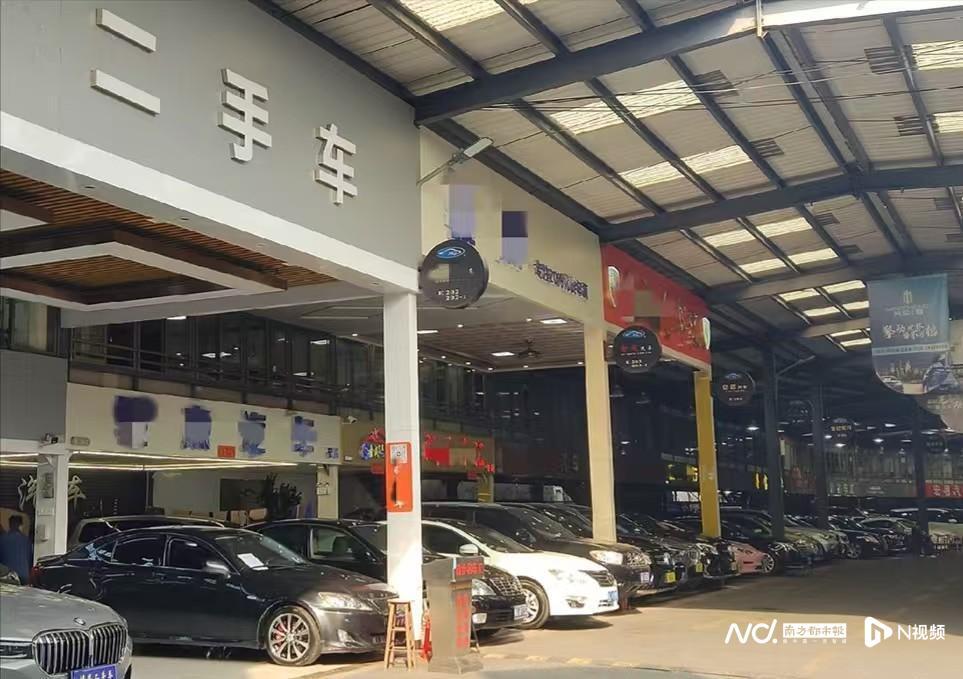
Core Insights - The 2025 Automotive Resale Value Report reveals the competitive landscape and changing consumer demands in the Chinese automotive market, highlighting the performance of various brands and models in terms of resale value [1][3]. Group 1: Overall Resale Value Rankings - Porsche leads the three-year resale value rankings with 67.34%, followed by Lexus at 60.22%, making them the only brands exceeding 60% [3][4]. - GAC Trumpchi ranks first among domestic brands with a three-year resale value of 56.82%, outperforming renowned Japanese brands like Honda and Toyota [3][4]. - Tesla is the only electric vehicle manufacturer with a three-year resale value exceeding 50%, while Li Auto is the only domestic new energy brand in the top 10 [4][6]. Group 2: Specific Model Performance - The Mercedes-Benz G-Class has the highest three-year resale value at 89.5%, while the Xiaomi SU7 leads the new energy vehicle category with an impressive one-year resale value of 86.05% [5][6]. - The AITO M9, a plug-in hybrid, ranks first in its category with a one-year resale value of 83.14%, surpassing the Porsche Cayenne [10][11]. Group 3: Market Trends and Consumer Behavior - Traditional joint venture brands maintain strong resale value, with models like the Toyota Highlander and Honda Fit retaining over 65% after three years, indicating their long-term stability in the second-hand market [12]. - In contrast, some luxury brands are experiencing a decline in resale value, with models like the Land Rover Range Rover Evoque and Volvo S60 dropping to around 40% [12]. - The second-hand market is seeing a shift towards higher-value models, with younger consumers prioritizing vehicle condition and overall value over low prices [18][19].



中国车企欧洲狂飙
Hua Er Jie Jian Wen· 2026-01-29 13:33
Core Insights - The European automotive market is experiencing a significant shift, with battery electric vehicles (BEVs) achieving a market share of 22.6% in December 2025, surpassing traditional gasoline vehicles at 22.5% [1] - Chinese automakers are no longer distant players but are aggressively entering the European market, aiming to capitalize on the transition to electric vehicles [1][2] - The competition is intensifying as Chinese companies invest heavily in Europe, with a focus on scaling operations before traditional giants adapt to the changing landscape [1] Market Performance - In 2025, new car registrations in Europe reached 13.3 million, with a modest growth rate of 2.3%. Chinese automakers saw a remarkable performance, with sales exceeding 100,000 units for the first time, achieving a year-on-year growth of 127% [3] - Chinese brands captured a market share of 9.5%, up from 4.5% in the previous year, indicating that one in ten new cars sold in Europe has Chinese origins [3] Company Strategies - BYD's sales in Europe surged from 49,000 units in 2024 to 186,600 units in 2025, marking a 276% increase. The company is focusing on local partnerships and expanding its sales network [5] - SAIC's MG brand achieved sales of 307,282 units in Europe in 2025, leveraging localized operations and design to position itself as a high-value local brand [5] - Leap Motor emerged as a significant player, with sales skyrocketing from 771 units to 22,077 units, utilizing existing global channels for rapid expansion [6] Localization Efforts - Chinese automakers are accelerating localization, with companies like Leap Motor and BYD establishing local production facilities to reduce costs and enhance competitiveness [8] - BYD plans to double its sales outlets in Europe to 2,000 by the end of 2026, while Chery aims for over 80% localization in its Barcelona facility by 2026 [8] Future Outlook - The year 2026 is projected to be a pivotal moment for the Chinese automotive industry, with expectations of valuation recovery driven by high export growth and profitability from overseas markets [9] - The average profit per vehicle in overseas markets is estimated to be 2-3 times higher than in the domestic market, with overseas gross margins surpassing domestic ones in some cases [10] - Chinese brands are transitioning from merely selling cars to providing comprehensive solutions for smart, green, and efficient mobility, becoming integral to the European automotive landscape [11]

2026车企目标大“PK”
Guo Ji Jin Rong Bao· 2026-01-29 12:48
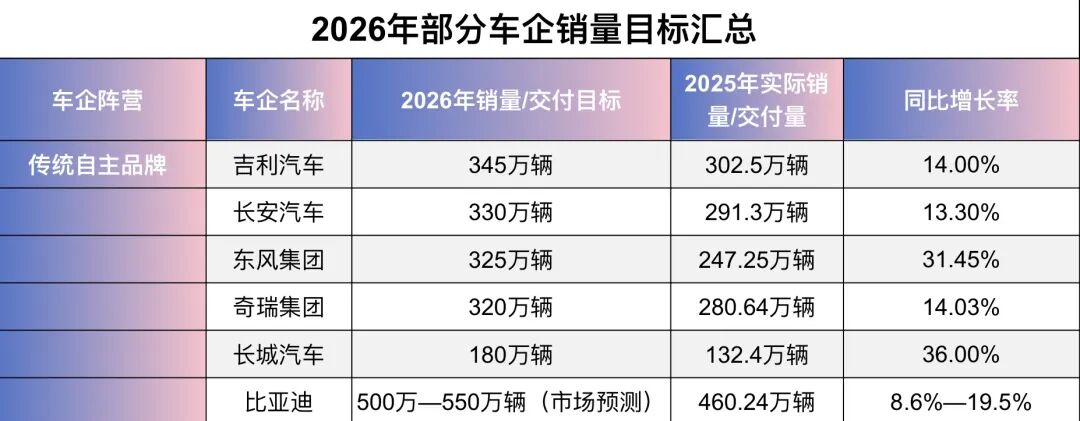
Core Insights - The Chinese automotive industry has shown impressive growth, with production and sales reaching 34.53 million and 34.40 million units respectively in 2025, marking a year-on-year increase of 10.4% and 9.4% [1] - New energy vehicle (NEV) sales reached 16.49 million units, achieving a penetration rate of 47.9% [1] - Major automakers have set ambitious sales targets for 2026, amidst challenges from policy changes, technological advancements, and global competition [1] Company Targets - Geely aims for a sales target of 3.45 million units in 2026, up 14% from 2025's 3.025 million units, with 64.3% of sales coming from NEVs [4] - Changan targets 3.3 million units, with NEV sales projected at 1.4 million units, reflecting a 26.2% increase [5] - Dongfeng Group's target is 3.25 million units, a 31.45% increase from 2025, with NEVs making up 52% of sales [6] - Great Wall Motors aims for 1.8 million units, a 36% increase, focusing on NEV and export markets [6] - BYD's projected sales for 2026 are between 5 million and 5.5 million units, with a growth rate of 8.5% to 19.5% [6] New Entrants and Growth - New entrants like Leap Motor and Hongmeng Zhixing are targeting sales of 1 million units, with significant growth rates of over 67% [7][9] - Leap Motor's sales target is 1 million units, up from 596,600 units in 2025 [9] - Hongmeng Zhixing is expected to reach between 1 million and 1.3 million units, with a growth rate of 70% to 120% [11] Industry Trends - The penetration rate of NEVs is expected to exceed 60% in 2026, driven by policy support and technological advancements [12] - The export model is shifting from "complete vehicle export" to "localized production and full industry chain layout," with significant growth in NEV exports [13] - The competitive landscape is transitioning from price wars to value-driven strategies, with a focus on technological innovation [15] - Market concentration is increasing, with leading brands capturing a larger market share, while weaker brands are likely to exit the market [15] Challenges and Uncertainties - The market faces uncertainties due to policy changes, such as the reduction of NEV purchase tax, which may affect consumer purchasing behavior [16] - Economic recovery is slower than expected, impacting consumer spending and demand for traditional vehicles [17] - Trade barriers and compliance risks are increasing for Chinese automakers expanding overseas, necessitating a balance between global operations and local compliance [17] Conclusion - The Chinese automotive market in 2026 is poised for significant transformation, emphasizing the shift towards NEVs and smart technologies, while navigating various uncertainties and competitive pressures [19]
理想汽车比谁都现实
Xin Lang Cai Jing· 2026-01-29 12:13
Core Viewpoint - Li Auto is undergoing a strategic recalibration by closing approximately 100 inefficient retail stores while simultaneously investing in AI and robotics, reflecting a dual approach of contraction and expansion in response to market challenges [2][4][12]. Group 1: Retail Strategy and Market Position - In early 2026, Li Auto plans to close around 100 low-efficiency retail stores, which are often located in prime areas of first and second-tier cities, as part of a broader strategy to adapt to changing consumer behaviors [4][27]. - The adjustment is not merely a cost-cutting measure but a strategic realignment following a year of declining performance, as consumers increasingly prefer shopping in multi-level commercial spaces rather than traditional car showrooms [6][29]. - In 2025, Li Auto set an ambitious sales target of 700,000 vehicles, which was later revised down to 640,000, with actual deliveries falling to approximately 406,343 vehicles, resulting in a loss of market leadership to competitors like Leap Motor [7][30]. Group 2: Financial Performance and Challenges - Li Auto's third-quarter revenue for 2025 was reported at 27.4 billion yuan, a year-on-year decline of 36.2%, with a net loss of 624 million yuan, marking the end of 11 consecutive profitable quarters [9][32]. - The decline in performance is attributed to setbacks in the pure electric vehicle market and increased competition from rivals employing aggressive pricing strategies [9][32]. - The company currently operates 548 retail centers, which incurs significant costs, prompting the need for channel optimization to improve overall efficiency [10][33]. Group 3: Future Strategy and AI Investment - Li Auto is shifting its focus towards AI technology and robotics, with plans to develop foundational models, chips, and intelligent systems, aiming to position itself among the top three global players in this field by 2028 [12][37]. - The company has expressed intentions to expand its brand identity from merely creating "mobile homes" to a broader vision encompassing "embodied intelligence," including the development of humanoid robots [14][37]. - Following the announcement of store closures and AI investments, Li Auto's stock rose by 4.9%, indicating positive market reception despite differing opinions among investors regarding the company's long-term competitiveness [16][39]. Group 4: Market Reactions and Analyst Ratings - Analysts are divided on Li Auto's long-term prospects, with optimistic views focusing on the potential of self-developed chips and AI models, while cautious perspectives highlight immediate operational pressures [18][42]. - Some analysts maintain a positive rating, projecting a target price of 100 HKD for the stock, while others have downgraded their ratings due to concerns over short-term challenges, setting a target price of 17.5 USD [18][43].

英国汽车产量跌至73年最低 中国车企成“复苏关键”
Zhong Guo Xin Wen Wang· 2026-01-29 10:56
中新社伦敦1月29日电 (记者欧阳开宇)英国汽车制造商和贸易商协会(SMMT)29日披露,2025年英国汽 车、货车等各类车辆总产量为764715辆,同比下降15.5%,创下1952年以来的73年最低纪录,较2016年 170万辆的峰值缩水超半数。 SMMT首席执行官迈克·霍斯称2025年为"一代人以来最艰难的一年"。多重打击直接拖累产量:捷豹路 虎遭遇严重网络攻击,导致核心工厂停产超一个月,5万辆生产计划搁置;沃克斯豪尔卢顿工厂永久关 闭,致使商用车产量暴跌62%;美国输美汽车关税上调,叠加英国脱欧后的贸易不确定性,让依赖78% 出口占比的英国汽车产业雪上加霜。 行业困境非一日之寒。自2016年起,脱欧博弈、本田工厂关闭、新冠疫情及供应链中断等因素,持续削 弱英国汽车产业竞争力。不过,电动化转型为复苏带来转机,日产桑德兰工厂已启动新款电动聆风生 产,捷豹路虎电动车型也将于2026年下线。SMMT预测,2026年汽车产量有望增长10%,2027年或将重 回百万辆级。 英国政府设定2035年130万辆年产量的目标,霍斯明确表示,引入新制造商是关键,中国车企被视为核 心潜在合作伙伴。近期奇瑞汽车与捷豹路虎的合作磋 ...
第十二届金轩奖颁奖 揭晓年度汽车营销标杆案例
2 1 Shi Ji Jing Ji Bao Dao· 2026-01-29 10:29
Group 1 - The importance of marketing in the automotive industry is emphasized, highlighting that effective marketing is essential for reaching target users and driving sales growth [1] - The Jin Xuan Award aims to recognize innovative marketing practices and their market impact, with a total of 20 gold awards, 6 annual awards, and 43 excellent case awards across various categories [2] - The 12th Jin Xuan Award has selected 20 gold award winners, including Volkswagen Group (China) and Toyota China for public welfare and sustainable development, and Great Wall Motors for personalized marketing [3] Group 2 - The 12th Jin Xuan Ceremony took place on January 23, 2026, in Beijing, providing insights into automotive marketing trends and solutions for the year [4] - Marketing in the new automotive era transcends the product itself, focusing on user experience and the integration of AI technology to enhance value [4] - The current Chinese consumers are characterized by their demand for quality and experience, presenting a challenge for marketers to redefine marketing significance and reconstruct value [4]
8点1氪:盒马回应将鲜百合误送成水仙球致用户中毒;水贝知名黄金平台“杰我睿”被曝经营异常;追觅CEO首次回应“断指计划”
36氪· 2026-01-29 00:16
Group 1 - Hema mistakenly delivered narcissus bulbs instead of fresh lilies, leading to customer poisoning and subsequent medical treatment [2][3] - The affected customer reported symptoms including vomiting and abdominal pain after consuming the narcissus bulbs, which were misidentified as lilies [2][5] - Hema has expressed sincere apologies and is in negotiations regarding compensation, but there are significant disagreements on the compensation amount [5] Group 2 - Shenzhen Metro Group has provided an additional loan of 2.36 billion yuan to Vanke for debt repayment, with a three-year term and an interest rate of 2.34% [7] - 31 provinces in China have announced their economic growth rates for 2025, with 20 provinces exceeding or matching the national average growth rate of 5% [4][6] - Meta reported a fourth-quarter revenue of $59.89 billion, a 24% year-over-year increase, with advertising revenue also rising by 24% [21]

8点1氪丨盒马回应将鲜百合误送成水仙球致用户中毒;水贝知名黄金平台“杰我睿”被曝经营异常;追觅CEO首次回应“断指计划”
3 6 Ke· 2026-01-29 00:13
Group 1 - 31 provinces in China have announced their economic growth rates for 2025, with nearly half exceeding last year's targets. Tibet leads with a growth rate of 7%, followed by Gansu at 5.8% and Hebei and Henan at 5.6% [4] - Shenzhen Metro Group has provided an additional loan of 2.36 billion yuan to Vanke for debt repayment, with a three-year term and an interest rate of 2.34% [4] - Hang Seng Bank has officially delisted from the Hong Kong Stock Exchange, following a privatization plan by HSBC that was approved by the Hong Kong High Court [5] Group 2 - ByteDance has implemented new social media guidelines prohibiting employees from using company resources for personal profit, which is expected to significantly reduce the number of commercial accounts operated by employees [6] - Amazon announced a restructuring that will affect nearly 16,000 jobs, while continuing to recruit talent in key strategic areas [7] - Tesla plans to cease production of the Model S and Model X vehicles to focus on its "Optimus" robot production line, marking a shift towards a future based on autonomous driving [9] Group 3 - Meta reported fourth-quarter revenue of $59.89 billion, a 24% year-over-year increase, with advertising revenue also up by 24% [17] - Microsoft announced second-quarter revenue of $81.27 billion, with significant contributions from its cloud and productivity segments [17] - Tesla's fourth-quarter revenue was $24.90 billion, a 3% year-over-year decline, with net profit down 61% to $840 million [17]




