中国铝业

Search documents
基金经理瞄准顺周期方向
Zhong Guo Zheng Quan Bao· 2026-01-27 20:57
Core Viewpoint - The non-ferrous metal sector has become a prominent investment focus in the A-share market since the beginning of 2026, with significant inflows into related ETFs and a rise in the popularity of fund managers specializing in this sector [1][2]. Group 1: Performance and Fund Inflows - The non-ferrous metal sector has shown remarkable performance, becoming the best-performing industry in the A-share market as of January 27, 2026, with ETFs tracking this sector collectively rising over 20% [1]. - As of January 26, 2026, non-ferrous themed ETFs have seen a net inflow exceeding 34 billion yuan, with leading products attracting significant investments, including over 13 billion yuan for the Southern CSI Non-Ferrous Metals ETF and over 9 billion yuan for the Huaxia CSI Sub-Sector Non-Ferrous Metals ETF [2]. Group 2: Fund Manager Strategies - Fund managers have adjusted their holdings within the non-ferrous sector, with notable increases in positions in companies like Shandong Gold and Zijin Mining, while reducing exposure to others like Tongling Nonferrous Metals [3]. - In addition to focusing on the non-ferrous sector, fund managers have diversified their portfolios by including cyclical sectors such as chemicals, oil and gas, coal, and transportation, aiming to balance their holdings [3][4]. Group 3: Future Outlook and Economic Indicators - Fund managers are optimistic about the potential recovery of domestic Producer Price Index (PPI) data, which could signal a mild recovery in the domestic economy over the next six months, driven by continued policy support [1][5]. - The anticipated changes in the PPI and the implementation of "anti-involution" policies are expected to enhance the competitive landscape for traditional industries, including steel, coal, and chemicals, leading to significant revaluation opportunities for leading companies in these sectors [5].
2026年度策略系列报告之工业金属篇:春潮裂壤,沛然东向
Sou Hu Cai Jing· 2026-01-27 12:44
Group 1 - The industrial metals sector is expected to enter a golden window in 2026, driven by macroeconomic factors and fundamental demand, with the Federal Reserve's interest rate cuts and domestic policies boosting liquidity and demand [1] - Supply constraints are evident due to insufficient long-term capital expenditure, declining ore grades, and frequent mine production cuts, leading to sustained pressure on copper and aluminum supplies [1][5] - Demand remains resilient in traditional sectors while emerging fields like AI data centers and energy storage are experiencing explosive growth, becoming key drivers of marginal demand [1][2] Group 2 - The copper market is characterized by a structural shortage, with refined copper expected to face a shortfall of 380,000 tons in 2026, leading to an upward price trend [1][5] - The aluminum sector is in a tight balance phase, with domestic production capacity nearing its limit and new capacity additions constrained by high costs and power supply issues in regions like Indonesia [2][5] - Demand for aluminum is significantly improving, particularly in transportation and power electronics, with a projected domestic aluminum shortfall increasing from 150,000 tons in 2025 to 1,070,000 tons by 2027 [2][5] Group 3 - The financial attributes of copper are strengthened by the ongoing interest rate cuts, while its commodity attributes are constrained by supply-side tensions [5] - The demand for copper in data centers is projected to reach 268,000 tons by 2026, driven by the growth of AI and energy storage applications [1][24] - The aluminum demand in data centers is estimated at 78,000 tons globally and 20,000 tons domestically by 2026, with aluminum primarily used in structural and electrical applications [39][40] Group 4 - Investment recommendations focus on companies in the copper sector with sustainable growth, including Zijin Mining, Minmetals Resources, and China Nonferrous Mining, while also highlighting aluminum companies with strong dividend yields and profit elasticity [5][52] - The report emphasizes the importance of monitoring supply chain risks related to bauxite, as the industry remains highly dependent on external sources [5][55]





1月狂涨69.8%,显著跑赢所有板块
Ge Long Hui· 2026-01-27 11:29
Group 1: Precious Metals Surge - The global silver market has experienced an "epic" short squeeze, with the main silver contract in Shanghai soaring by 14% on January 26, reaching over 30 yuan per gram, while gold surpassed 1150 yuan per gram, both hitting historical highs [1][4] - Since the beginning of 2026, the A-share precious metals sector has risen by 69.8%, significantly outperforming other sectors, while the non-ferrous metals sector has increased by 30.85% [1][3] - In the first 17 trading days of the year, the gold stock ETF (517400) rose by 38.06%, and the mining ETF (561330) increased by 26.89% [1] Group 2: Underlying Logic of Precious Metals Rally - The surge in precious metals is driven by heightened international geopolitical tensions, particularly actions taken by the Trump administration, including military actions and withdrawal from international organizations [4][6] - The ongoing geopolitical instability has led to increased global demand for gold as a safe-haven asset, with many countries significantly increasing their gold purchases since the onset of the Russia-Ukraine conflict [6][7] - Countries are planning to repatriate gold reserves from the U.S. due to concerns over geopolitical safety, with Germany and several African nations planning to return over 400 tons of gold [7][10] Group 3: Super Cycle in Non-Ferrous Metals - The non-ferrous metals sector has also seen significant price increases, with the mining ETF (561330) showing a 106.11% rise in 2025, making it the top performer among all non-ferrous ETFs [16] - Prices of various non-ferrous metals, including tin, nickel, and lithium, have shown substantial weekly increases, indicating strong demand and supply constraints [18][19] - The ongoing geopolitical tensions have made non-ferrous resources strategic assets, leading to increased control and demand for these materials globally [20][21] Group 4: Institutional Outlook - Major investment banks are bullish on gold prices, with Goldman Sachs raising its 12-month gold price target from $4800 to $5500, citing geopolitical risks and the ongoing demand from central banks [23] - Morgan Stanley has also increased its gold price forecast for the end of 2026 from $4600 to $5300, emphasizing the beginning of a global reserve asset restructuring [23] - The demand for non-ferrous metals is expected to grow due to macroeconomic factors and industry-specific needs, with institutions favoring copper, aluminum, cobalt, and rare earths as key investment areas [23][26]

1月狂涨69.8%,显著跑赢所有板块
格隆汇APP· 2026-01-27 10:45
Core Viewpoint - The precious metals market has experienced a historic surge, with silver and gold prices reaching all-time highs due to geopolitical tensions and increased demand from central banks and investors [2][4][11]. Group 1: Precious Metals Performance - As of January 26, 2026, the main silver contract in Shanghai surged by 14%, surpassing 30 yuan per gram, while gold reached 1150 yuan per gram, marking significant increases [2]. - The A-share precious metals sector has risen by 69.8% year-to-date, outperforming all other sectors, while the non-ferrous metals sector increased by 30.85% [2]. - Year-to-date, the Gold Stock ETF (517400) has risen by 38.06%, and the Mining ETF (561330) has increased by 26.89% [2]. Group 2: Underlying Drivers of Precious Metals Surge - The surge in precious metals is driven by escalating geopolitical tensions, particularly actions taken by the Trump administration, including military interventions and withdrawal from international organizations [6][10]. - The ongoing conflict in Ukraine and the geopolitical climate have led to increased global demand for gold as a safe-haven asset, with many countries significantly increasing their gold reserves [11][12]. - A notable trend is the repatriation of gold reserves by various countries, including Germany and several African nations, driven by concerns over the safety of gold stored in the U.S. [12]. Group 3: De-dollarization and Its Impact - The trend of de-dollarization is gaining momentum, with Denmark's decision to sell U.S. Treasury bonds signaling a potential shift among other central banks towards buying gold instead [13]. - The share of U.S. Treasury bonds in global central bank reserves has fallen below 25%, while gold's share has risen to 28.9%, indicating a shift in reserve asset preferences [16]. - A recent survey by the World Gold Council revealed that 95% of central banks plan to increase their gold holdings in 2026, the highest proportion in recent years [17]. Group 4: Silver Market Dynamics - The silver market is experiencing a supply-demand imbalance, exacerbated by export controls from major silver-producing countries, leading to a significant delivery shortfall on the COMEX [20][21]. - As of late January 2026, the deliverable silver inventory on COMEX was only 29% of total inventory, with a delivery gap exceeding 65% [20]. Group 5: Non-Ferrous Metals Performance - The non-ferrous metals sector has also seen substantial growth, with the Mining ETF (561330) recording a 106.11% increase in 2025, making it the top-performing sector [24]. - Prices for various non-ferrous metals, including tin, nickel, and lithium, have shown significant weekly increases, reflecting strong demand [25]. - The ongoing geopolitical tensions have made non-ferrous resources strategic assets, leading to increased control and investment in these sectors by various countries [27]. Group 6: Institutional Outlook - Major investment banks are bullish on gold and non-ferrous metals, with Goldman Sachs raising its 12-month gold price target from $4800 to $5500, citing geopolitical risks and de-dollarization as key drivers [31]. - Morgan Stanley and Bank of America have also adjusted their gold price forecasts upward, indicating a consensus among institutions regarding the bullish outlook for precious metals [31]. - The strong inflow of funds into gold and mining ETFs further supports the positive sentiment in these sectors, with significant net inflows recorded in early 2026 [32].
热门赛道速递|有色金属大年?不是全面起飞,而是结构性上涨已经发生
和讯· 2026-01-27 10:44
Core Viewpoint - The A-share non-ferrous metal market has shown a comprehensive strengthening trend since 2026, with the non-ferrous metal index rising by 24.31%, significantly outperforming the broader market. Precious metals (silver, gold) and minor metals (tungsten, tin) have performed particularly well, with price increases notably higher than industrial metals (lead, aluminum) [2][6]. Market Overview - The report titled "Comprehensive Analysis of the Non-Ferrous Metal Industry" systematically reviews the current non-ferrous metal market from multiple dimensions, including macro strategic environment, industry chain dynamics, competitive landscape, and industry trends, providing a reference for market decision-makers [2]. Price and Production Changes - Certain metals have entered an upward price channel, indicating a structural increase rather than a comprehensive recovery. The industry is transitioning from a low point to recovery, with a clear differentiation between strong and weak products [6][10]. - Global major metal varieties face significant supply constraints due to declining resource grades, insufficient capital expenditure, and geopolitical disturbances. Export restrictions from resource-rich countries are tightening, impacting the industry's international trade dynamics [10]. Demand Resilience - Emerging sectors such as new energy vehicles, energy storage, and AI computing centers are becoming core drivers of demand. For instance, China's new energy vehicle sales are projected to reach 16.49 million units in 2025, a year-on-year increase of 28.17%, boosting demand for copper, aluminum, and rare earths [11][22]. Market Price Support - The Producer Price Index (PPI) for China's non-ferrous metal manufacturing is expected to rise to 117.200 in 2025, up from 113.200 in 2024, indicating robust industry demand [12]. Policy Environment - The policy environment is shifting from "cyclical adjustment" to "strategic resource management," accelerating industry upgrades. The Ministry of Industry and Information Technology has outlined plans for the non-ferrous metal industry to achieve an average annual growth of around 5% in value added from 2025 to 2026 [13][16]. Industry Integration and Technological Support - Policies encourage mergers and acquisitions among large smelting enterprises and support the technological research and industrial application of high-end new materials like magnesium alloys and tungsten [14]. Resource Recycling - The EU's Carbon Border Adjustment Mechanism (CBAM) is pushing for greener production of high-energy-consuming metals. By the end of 2025, 30% of the electrolytic aluminum industry's capacity is expected to meet benchmark energy efficiency levels [15]. Competitive Landscape - The competitive landscape in the industrial metals sector is stable, with leading companies like Zijin Mining and Luoyang Molybdenum Company maintaining strong positions through global resource layouts and price elasticity [43][44]. - In the energy metals sector, companies like Ganfeng Lithium and Tianqi Lithium are leading with a dual drive of resources and technology, while Huayou Cobalt leads in the nickel sector with a collaborative model [47][48]. Long-term Trends - The non-ferrous metal industry is expected to maintain a structurally tight balance in supply and demand, with resource-constrained metals remaining tight in the long term. However, the supply-demand gap will exhibit differentiation across varieties and phases, indicating significant structural opportunities rather than systemic trends [54][55].



金属行业周报:地缘局势紧张,金价强势运行-20260127
BOHAI SECURITIES· 2026-01-27 08:29
Investment Rating - The report maintains a "Positive" rating for the steel industry and a "Positive" rating for the non-ferrous metals industry, with "Buy" ratings for specific companies including Luoyang Molybdenum, Zhongjin Gold, Huayou Cobalt, Zijin Mining, and China Aluminum [6][6][6]. Core Insights - The report highlights that geopolitical uncertainties and concerns over the independence of U.S. Federal Reserve policies are expected to boost gold prices in the short term [6][6]. - The copper market is facing supply constraints due to incidents at major mines, which is likely to support copper prices despite high prices potentially suppressing actual consumption [36][36]. - The aluminum sector is expected to see price support due to downstream inventory demand, while the lithium market is anticipated to maintain a strong price trend due to export tax incentives and tight supply expectations [6][6][6]. Summary by Sections Steel - The steel industry is expected to improve profitability as growth policies are implemented, with demand in shipbuilding and construction likely to increase [3][3]. - Current steel prices are showing seasonal trends, with expectations of price fluctuations following raw material prices [19][19]. - As of January 23, 2026, the total steel inventory has increased by 0.79% compared to the previous week, indicating a potential accumulation ahead of the Spring Festival [26][26]. Copper - The copper market is experiencing a tightening supply due to strikes affecting production at key mines, which may provide price support [36][36]. - The copper smelting processing fees remain negative, indicating pressure on the supply side, while demand is expected to rise in sectors like electric power and new energy vehicles [36][36]. Aluminum - The aluminum market is characterized by stable supply and high operating rates at alumina plants, with expectations of price support from downstream inventory needs [46][46]. - As of January 23, 2026, the average price of alumina is reported at 2,657.00 CNY/ton, reflecting a slight decrease from the previous week [50][50]. Precious Metals - Geopolitical tensions and economic data are influencing gold prices, with a notable increase in prices observed recently [54][54]. - As of January 23, 2026, gold prices have risen by 8.30% on COMEX and 8.07% on SHFE compared to the previous week [54][54]. Lithium and Cobalt - The lithium market is expected to maintain a strong price trend due to export tax incentives and tight supply conditions, with battery-grade lithium prices increasing by 12.46% recently [58][58]. - Cobalt supply is constrained due to limited export quotas from the Democratic Republic of Congo, while demand is driven by the electric vehicle and consumer electronics sectors [6][6].


兴业证券:电解铝质量与周期共振 看好板块价值重估
智通财经网· 2026-01-27 03:41
智通财经APP获悉,兴业证券发布研报称,2026年预计是电解铝产能增长的最后一年,计划新增产能近 60万吨。2023-2025年全球电解铝平均需求增量约180万吨/年,2年CAGR增速为2.5%。预计2026E增量 150-200万吨,同比增速2.0-2.7%,需求侧有结构增量。中国电解铝企业具备全球竞争力、正将行业红利 转化为股东回报。看好铝价中枢抬升,铝价每上涨10%,将带来约30%的EPS增厚,质量与周期共振, 看好电解铝板块价值重估。 中国低廉的电价和稳定的电力供应在全球具有竞争力,盈利丰厚。同时,中国电解铝企业早已陆续加码 一体化产业链布局,解决铝土矿资源限制堵点,上游资源自给率稳步提升,一体化龙头业绩稳定性更 强。 公司派息意愿高,股东回报持续改善,红利属性凸显。电解铝公司几乎没有大的新增投资,行业普遍进 入到资本开支中枢下移、压降负债,自由现金流持续改善的阶段,股东回报有持续改善的潜力。 (三)投资观点:质量与周期共振 中国电解铝企业具备全球竞争力、正将行业红利转化为股东回报。看好铝价中枢抬升,铝价每上涨 10%,将带来约30%的EPS增厚,质量与周期共振,看好电解铝板块价值重估。推荐公司中国宏 ...

分歧加剧!湖南黄金二连板,湖南白银盘中巨震,有色矿业ETF招商(159690)连续11日吸金2.3亿
Sou Hu Cai Jing· 2026-01-27 03:10
Group 1: Precious Metals Market Overview - The price of spot gold has surpassed $5,070 per ounce, with a daily increase of 1.24%, while silver contracts have seen gains of over 6% [1] - Eastern Securities believes that the current U.S. long-term debt cycle is in its late stage, indicating a loss of trust in the existing fiat currency system, leading to a natural inclination to buy physical assets for wealth preservation [1][13] - The outlook for precious metals prices is optimistic, with expectations of continuous record-breaking prices through 2026 [1][13] Group 2: Industrial Metals and Market Dynamics - The logic of rising precious metal prices also applies to industrial metals, which are expected to accelerate in price due to comparative effects [1][13] - The China Securities Index focuses on the upstream mining sector of the non-ferrous metal industry, with copper, gold, and aluminum making up over 57% of the index's weight [3] Group 3: Historical Performance and Trends - The non-ferrous mining index has shown a cumulative increase of 293.80% over the past decade, with an annualized growth rate of 15.14% [7] - The index's historical performance indicates higher elasticity compared to similar indices, with a Sharpe ratio of 0.64, suggesting a favorable risk-adjusted return [9] Group 4: Central Bank Activities - Global central banks continued to net buy gold, with a total net purchase of 45 tons in November, maintaining a high level compared to earlier months [10] - The People's Bank of China reported a gold reserve of 74.15 million ounces as of the end of December, having increased its holdings for 14 consecutive months [10]


53股获融资客大手笔净买入
Zheng Quan Shi Bao Wang· 2026-01-27 02:29
截至1月26日,市场融资余额合计2.71万亿元,较前一交易日增加18.81亿元,其中,沪市融资余额 13667.99亿元,较前一交易日增加13.82亿元;深市融资余额13323.04亿元,较前一交易日增加5.73亿 元;北交所融资余额89.19亿元,较前一交易日减少7343.29万元。 证券时报·数据宝统计显示,具体到个股,1月26日共有1936只股获融资净买入,净买入金额在千万元以 上的有707只,其中53只融资净买入额超亿元。中国平安融资净买入额居首,当日净买入4.44亿元,其 次是北方稀土、中国铝业,融资净买入金额分别为4.17亿元、4.16亿元,融资净买入金额居前的还有西 部矿业、迈为股份、东方财富等。 | 代码 | 简称 | 1月26日涨跌幅 | 融资净买入额 | 最新融资余额 | 占流通市值比例 | 所属行 | | --- | --- | --- | --- | --- | --- | --- | | | | (%) | (万元) | (万元) | (%) | 业 | | 601318 | 中国平 | 0.38 | 44408.15 | 3316709.51 | 4.85 | 非银金 | | | ...

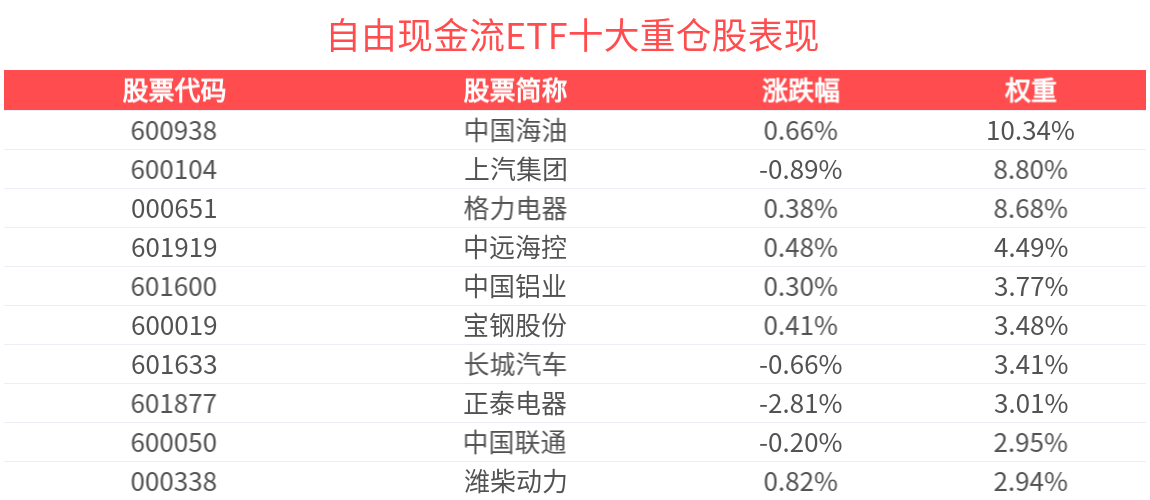
低费率的自由现金流ETF(159201)连续7天净流入,合计“吸金”17.07亿元
Xin Lang Cai Jing· 2026-01-27 02:10
截至2026年1月27日9:45,国证自由现金流指数下跌0.21%。成分股方面涨跌互现,三生国健、白银有色、景津装备等领涨;华人健康、上海建工、株冶集团 等领跌。自由现金流ETF(159201)下跌0.53%,最新报价1.32元。流动性方面,自由现金流ETF盘中换手1.31%,成交1.54亿元。拉长时间看,截至1月26日, 自由现金流ETF近1周日均成交6.66亿元。 从资金净流入方面来看,自由现金流ETF近7天获得连续资金净流入,合计"吸金"17.07亿元。自由现金流ETF最新份额达89.40亿份,最新规模达117.82亿 元,创成立以来新高。数据显示,杠杆资金持续布局中。自由现金流ETF本月以来融资净买额达301.53万元,最新融资余额达1.38亿元。 从收益能力看,截至2026年1月26日,自由现金流ETF自成立以来,最高单月回报为7%,最长连涨月数为6个月,最长连涨涨幅为22.69%,涨跌月数比为 8/2,上涨月份平均收益率为3.3%,月盈利百分比为80%,月盈利概率为80.57%,历史持有6个月盈利概率为100%。 自由现金流ETF(159201)紧密跟踪国证自由现金流指数,国证自由现金流指数反映沪 ...