嘉能可

Search documents
银河期货铜12月报-20251201
Yin He Qi Huo· 2025-12-01 08:25
1. Report Industry Investment Rating No relevant content provided. 2. Core Viewpoints of the Report - Long - term, the US loose monetary policy is expected to drive up inflation, and the copper - gold ratio will support prices. The supply side of copper concentrates faces more disturbances, and the smelting industry is expected to reduce internal competition. Consumption is in a stage of transformation between old and new drivers. Although traditional consumption with low added - value is weakening, the growth of energy - storage batteries, new - energy vehicles, and future AI will offset the negative impact of the decline in traditional consumption to some extent, so the long - term upward trend of copper remains unchanged. In the short term, after the previous upward trend, there is a lack of new stimuli, and the downstream needs time to accept the price, so the market will mainly consolidate at a high level [5]. - The supply of copper mines is tightening, and the increase in refined copper production is expected to be 950,000 tons or a year - on - year increase of 3.53%, lower than 4.3% in 2024. The consumption growth rate is expected to decline to 3%, lower than 3.76% last year. The market is expected to fluctuate between 85,000 - 90,000 yuan/ton in the short term, and the long - term upward trend continues, so a low - buying strategy is recommended [5][11]. 3. Summary by Relevant Catalogs First Part: Copper Market Review a. Market Review - In November 2025, copper prices consolidated at a high level, with the lowest reaching 84,900 yuan/ton for SHFE copper on November 5 and the highest reaching 87,920 yuan/ton on November 14. The market focused on the December interest - rate cut expectation and the AI bubble risk. The Fed's hawkish remarks in the middle of the month lowered the interest - rate cut expectation to 40%, weakening market sentiment. Later, the release of NVIDIA's earnings report and the Fed's dovish turn increased the probability of a December interest - rate cut to over 80%, supporting prices [4][9]. - Fundamentally, Freeport expects the Grasberg output to decline to 1 billion pounds in 2026, and the spot processing fee is reported at over - 40 dollars/ton. The Cl spread remained at 3% - 5% this month. The reasons for the decrease in US copper imports may be the decline in Chilean copper production, some goods being held by traders, and the narrowing of cross - market arbitrage space. The supply tension in the LME market has been alleviated, and domestic downstream buyers mostly priced at below 86,000 yuan/ton [10]. b. Market Outlook - In terms of supply, the increase in copper mine supply is adjusted down to - 30,000 tons, and the overall supply tension of copper mines has intensified. Overseas smelters are increasing production cuts, and domestic smelters are also affected by problems such as the decline in anode plate supply, regular maintenance, and insufficient raw material supply. It is expected that the refined copper production will increase by 950,000 tons or a year - on - year increase of 3.53%, lower than 4.3% in 2024. The negotiation of TC and long - term premium is difficult, and attention should be paid to the signing of long - term import contracts [11]. - In terms of price, macroscopically, whether there is an interest - rate cut in December or not, the US loose - money policy has not ended, which will have a positive feedback on the market. Fundamentally, the supply tension persists, and the downstream's acceptance of high prices is insufficient, but the overall market remains resilient. It is expected to fluctuate between 85,000 - 89,000 yuan/ton, and the long - term upward trend continues, so a low - buying strategy is recommended [11]. Second Part: Repeated Expectations of Fed Interest - Rate Cut - In November 2025, the release of US non - farm payroll data in September lowered the market's expectation of a Fed interest - rate cut in December to below 40%. Later, Williams' remarks increased the probability of a 25 - basis - point interest - rate cut to 69.4%. The market seems more willing to believe that the Fed will cut interest rates in December. The NAR expects that the sales of existing and new residential properties in the US will increase in 2026 due to lower expected loan interest rates, continuous employment growth, and market stability [21]. - In October 2025, China's manufacturing PMI fell to 49%, a month - on - month decrease of 0.8%. The personal income tax increased year - on - year, but the per - capita disposable income growth rate was lower than last year, and the consumption growth momentum was insufficient [22][25]. Third Part: Increased Disturbances in Copper Mines, and the Supply Tension is Difficult to Alleviate a. Sharp Decline in the Increase of Copper Concentrate Supply - In September 2025, the global copper concentrate production was 1.914 million tons, a year - on - year decrease of 1,000 tons. From January to September, the global copper concentrate production was 17.232 million tons, a year - on - year increase of 440,000 tons. Chile's copper production in September was 456,663 tons, a year - on - year decrease of 4.5%. Peru's copper production in September was 240,995 tons, a year - on - year increase of 3.7% [35]. - Many mining companies have lowered their production plans. It is expected that the global copper concentrate increase in 2025 will drop to - 30,000 tons, far lower than 665,500 tons in 2024. The supply tension of copper mines is difficult to alleviate, and the processing fee is likely to be less than 0 dollars/ton. China's copper concentrate imports in October 2025 increased by 5.94% year - on - year [36][37]. b. Decline in the Start - up of Recycling and Processing Enterprises, and the Tension in Scrap Copper Supply is Alleviated Temporarily - In October 2025, China's imports of copper scrap and scraps reached 197,000 physical tons, a year - on - year increase of 7.35%. The imports from the US through Japan and Thailand increased significantly, while the imports from the EU decreased. The policy of standardizing investment promotion may affect the start - up of recycled copper rod enterprises. In October 2025, China's imports of anode copper decreased year - on - year, while the imports of scrap copper ingots increased [47][48][50]. c. Accelerated Transmission of Insufficient Raw Material Supply to the Smelting End - In 2025, the supply of copper mines is tight. It is expected that the global refined copper production will increase by 950,000 tons or a year - on - year increase of 3.53%, lower than 4.3% in 2024. Overseas smelters are increasing production cuts, and domestic smelter production has also declined. The supply of imported refined copper may slow down [53][54][56]. Fourth Part: Consumption Analysis a. Obvious Decline in Traditional Consumption Growth - In the real - estate market, from January to October 2025, the sales area of new commercial housing and the completion area decreased year - on - year. The real - estate market is in an adjustment and bottom - building stage, and the decline in real - estate completion will continue to drag down electrolytic copper consumption. It is estimated that the copper consumption in the construction industry will decrease by 123,700 tons to 1.1137 million tons [64][65]. - In the power grid and power - source projects, from January to October 2025, the investment in power grids and power - source projects increased year - on - year, but at a lower rate than last year. High copper prices inhibited the procurement willingness of downstream enterprises, and the wire - and - cable start - up rate decreased. In October 2025, the export of wire and cable decreased month - on - month [71]. - In the household - appliance industry, from January to October 2025, the cumulative sales of air conditioners increased year - on - year, but in October, the sales decreased year - on - year. The air - conditioner production plan for December 2025 decreased significantly year - on - year. It is expected that the annual consumption growth rate of air conditioners will decline to 2%, and the copper consumption will decrease slightly [76][77]. b. Resilience in Automobile Consumption - In China, from January to October 2025, the production and sales of automobiles and new - energy vehicles increased year - on - year. The new - energy vehicle production and sales accounted for 46.7% of the total. The resumption of the new - energy vehicle purchase tax in 2026 will drive the sales in 2025 [85][86]. - In Europe and the US, from January to October 2025, the sales of new - energy vehicles increased year - on - year. BNEF expects that the sales of new - energy passenger vehicles will reach 21.9 million this year, with China accounting for nearly two - thirds. The global new - energy vehicle copper consumption is expected to increase to 1.4011 million tons [93][95]. c. Unexpected Growth in Wind and Solar Power Generation - In terms of photovoltaic installation, from January to October 2025, China's new photovoltaic installation increased by 39.47% year - on - year. The China Photovoltaic Industry Association raised the new installation forecast for this year. The IEA expects that the global new photovoltaic installation will reach 630GW in 2025 [105][106]. - In terms of wind - power installation, from January to October 2025, China's new wind - power installation increased by 52.86% year - on - year. The CWEA predicts that China's new wind - power installation will reach 105 - 115GW in 2025. The GWEC expects that the global new wind - power installation will increase to 138GW in 2025. The copper consumption of wind and solar power is expected to increase by 208,500 tons in 2025 [119][120]. d. Explosive Growth in Lithium - Ion Copper Foil - In 2024, the global copper - foil production capacity was 2.544 million tons, with the lithium - ion copper - foil production capacity growing by 37.55% year - on - year. From January to September 2025, China's lithium - ion copper - foil production increased by 38% year - on - year. It is estimated that the production will reach 853,800 tons this year, driving domestic consumption by 1.38%. The GGII expects that China's energy - storage shipments will reach 580GW in 2025, with a copper consumption of about 300,000 tons [126]. e. Consumption Summary - It is expected that the global consumption growth rate will decline to 3% in 2025, lower than 3.76% last year, and China's consumption growth rate will decline from 4.5% to 3.5%. Overseas demand remains stable, while domestic demand weakens marginally in the second half of the year. New - energy vehicles, energy - storage batteries, etc. are the key factors driving consumption, and downstream procurement is concentrated below 86,000 yuan/ton [130]. Fifth Part: Supply - Demand Balance Sheet - In terms of supply, it is expected that the copper - mine growth in 2025 will be - 30,000 tons, and the refined - copper production will increase by 950,000 tons. In terms of consumption, the consumption growth rate is expected to decline to 3.4% in 2025. The supply gap of copper concentrates is expected to widen to 790,000 tons in 2025, and the refined - copper surplus is expected to be 380,000 tons [135]. - The report also provides the supply - demand balance sheets of China's refined copper and global copper, showing the production, import, export, consumption, and balance of copper in different years [137][138].
有色月跟踪:钴供应危机持续,价格有望再上新台阶
Minmetals Securities· 2025-12-01 08:19
Investment Rating - The report rates the non-ferrous metals industry as "Positive" [4] Core Insights - The cobalt supply crisis continues, with prices expected to rise to new heights due to supply constraints from the Democratic Republic of Congo (DRC) [14][16] - The DRC's new quota management system has significantly reduced annual cobalt export volumes, with a maximum of 96,600 tons allowed for 2026/2027 [14][15] - Global cobalt supply is projected to decrease to 206,000 tons in 2025, with consumption expected to reach 221,000 tons in 2026 and 231,000 tons in 2027, indicating a rigid supply shortage [21][22] Summary by Sections Cobalt Supply and Demand - The DRC's new export quota system has replaced previous export bans, leading to a projected annual export volume of less than 100,000 tons [14][16] - The global cobalt supply is expected to sharply decline to 200,000 tons, with the DRC contributing significantly to this reduction [16][21] - Cobalt consumption is anticipated to maintain growth, with projections of 221,000 tons in 2026 and 231,000 tons in 2027, indicating a persistent supply shortage [21][22] Price Trends - Cobalt product prices have seen a significant increase, with the average CIF price for cobalt intermediates in China rising from $5.95 per pound to $24.15 per pound, a 306% increase [26] - Current prices for cobalt products in China are reported at 402,000 CNY per ton for cobalt metal and 432,000 CNY per ton for cobalt sulfate [26] - The report suggests that as cobalt raw material inventories are consumed, there is potential for further price increases in cobalt products [26] Market Dynamics - The overall non-ferrous metals market continues to show strength, with significant price increases observed in tungsten, lithium, and aluminum [30] - The report highlights that the U.S. Department of Defense is set to restart a $500 million cobalt procurement program, marking a significant move in cobalt supply dynamics [26]

德银预警:严重供应中断+行业大整合,明年铜市赤字状态恐将持续
Hua Er Jie Jian Wen· 2025-12-01 07:23
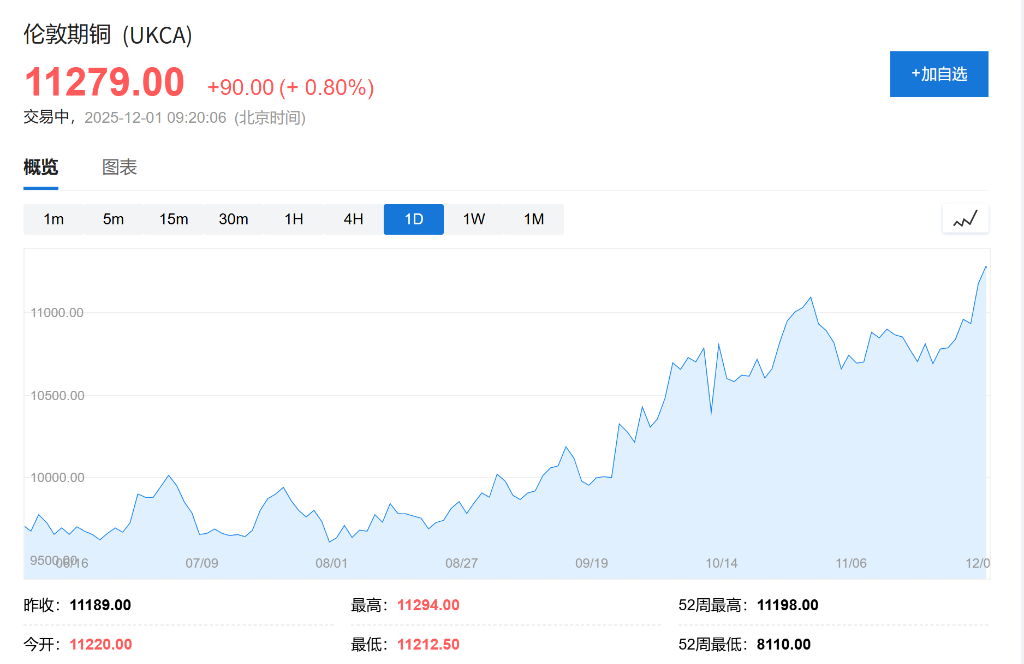
Core Viewpoint - Deutsche Bank's analysis indicates a supply squeeze in the global copper market, driven by severe supply disruptions and accelerated industry consolidation, pushing copper prices close to historical highs [1][3]. Group 1: Copper Market Outlook - As of December 1, copper prices reached $11,279 per ton, marking a historical peak [2]. - Deutsche Bank forecasts a decline in mine supply by 2025, with only a 1% rebound expected the following year, leading to a "clear deficit" in the market [1][3]. - The long-term drivers for copper prices include the electrification and digitalization trends, with global electricity demand growth outpacing GDP growth in 2024 [3]. Group 2: Company Recommendations - Deutsche Bank has identified Anglo American, Glencore (GLEN), and Freeport-McMoRan (FCX) as preferred stocks in the copper sector [3][6]. - The report has upgraded Boliden (BOL) to a "buy" rating while downgrading First Quantum (FM) to "hold" [3]. Group 3: Glencore's Capital Markets Day - Glencore is set to hold its first Capital Markets Day since 2022 on December 3, aiming to restore investor confidence in its operational capabilities and showcase growth options in its copper business [4][6]. - If Glencore limits its 2026 production guidance to copper and maintains its recovery targets for 2027/28, the market is likely to respond positively [4]. - The potential for mergers and acquisitions (M&A) discussions during the event is a significant focus, with Glencore reportedly in talks to sell its Kazzinc business [4]. Group 4: Rio Tinto's Focus - Rio Tinto will host its Capital Markets Day on December 4, emphasizing business simplification, capital discipline, and divestment of non-core assets [7]. - The company is expected to reaffirm its annual capital expenditure guidance of $10-11 billion and may introduce cost targets while updating plans to sell smaller divisions [7]. Group 5: Investor Implications - Deutsche Bank has raised its 2026 copper price forecast to $10,600 per ton, with expectations that prices could peak above $11,000 per ton in the first half of 2026 [6]. - Investors are advised to closely monitor upcoming Capital Markets Days from major mining companies, particularly Glencore's M&A activities and its attractive projected free cash flow yield of 10% for 2026 [6].


降息预期提升贵金属与铜铝并举,重视白银新高的信号意义
Changjiang Securities· 2025-11-30 14:56
Investment Rating - The report maintains a "Positive" investment rating for the metal, non-metal, and mining industry [6]. Core Insights - The weakening dollar and rising expectations for interest rate cuts have led to a recovery in risk assets, with silver leading the way. The probability of a rate cut in December has surged to 80%, benefiting precious metals and industrial metals like copper and aluminum [2][4]. - The report emphasizes the importance of silver, which has recently reached a new historical high due to futures market dynamics. The outlook for gold remains positive amid expectations of continued economic recession in the U.S. and attractive valuations in the A-share market for gold stocks [4]. - Industrial metal prices have strengthened, driven by enhanced rate cut expectations, with copper and aluminum showing significant price increases [4]. Summary by Sections Precious Metals - The report highlights that the weakening dollar and the anticipated rate cuts are driving precious metals, particularly silver, to new highs. The analysis suggests that the macroeconomic environment and trading structures favor silver's continued rise [4]. - For gold, the report maintains a bullish stance, predicting that if gold prices break previous highs, the sector will see significant recovery in valuations. The report recommends focusing on specific stocks such as Zhaojin Mining, Chifeng Jilong Gold Mining, and Shandong Gold Mining [4]. Industrial Metals - The report notes that the enhanced expectations for interest rate cuts are likely to improve the short-term outlook for copper and aluminum. Recent price movements include a 3.7% increase in LME copper and a 2% increase in LME aluminum [4][21]. - The report also discusses the supply dynamics, indicating that copper and aluminum inventories have shown mixed trends, with copper inventories increasing while aluminum inventories have decreased [4][36]. Energy and Minor Metals - The report identifies 2026 as a pivotal year for lithium, with supply and demand dynamics expected to shift positively. The recovery in lithium prices is anticipated as production constraints and rising demand from electric vehicles and energy storage continue [4]. - Strategic metals like rare earths and tungsten are highlighted for their potential value appreciation, particularly in light of government policies affecting supply and ongoing demand recovery [4]. Market Performance - The report indicates that the metal materials and mining sector has outperformed the broader market, with a 3.16% increase compared to a 1.40% rise in the Shanghai Composite Index over the past week [12][15].
消费强势背景下供给压力难显现
Hua Tai Qi Huo· 2025-11-30 07:53
Report Industry Investment Rating No relevant content provided. Core Viewpoints - In 2026, there is an expectation of tight supply at the mine end. Overseas mine supply growth is slowing, and domestic mines are affected by depletion. The Huoshaoyun Mine may not contribute significantly to the market due to poor market utilization. TC is unlikely to rise, and the Benchmark may remain below $100/ton, failing to stimulate overseas smelting growth. In China, smelters are also facing comprehensive cost losses. Therefore, with the expected tight supply at the mine end in 2026, the pressure on smelting supply is expected to weaken significantly. - At the beginning of the 14th Five-Year Plan and during the overseas interest rate cut cycle, there are positive expectations for the consumer end. Even if the production of the Huoshaoyun Mine is realized smoothly, the supply and demand will remain balanced in 2026, but there is still a possibility of the invisibility of visible inventory, resulting in a downward trend in social inventory. If the Huoshaoyun Mine fails to be put into production as expected, the supply and demand will be tight. - The report is not pessimistic about the zinc price in 2026 [5]. Summary by Directory I. Zinc Ore - **1.1 Overseas mines are growing as expected, but the supply pressure will significantly decline in 2026** - In Q3 2025, overseas mine production was 1.3 million tons, a year-on-year increase of 126,000 tons; the cumulative production of the sample from January to September was 3.755 million tons, a year-on-year increase of 326,000 tons. The increase mainly comes from new and复产 projects as expected. Kipushi has复产 as scheduled, with improved grade and recovery rate, and its production is expected to increase further. Its production is expected to increase by 60,000 tons year-on-year in 2026. Antamina is one of the main mines contributing to the increase overseas this year, with a year-on-year increase of 172,000 tons in zinc concentrate production from January to September. However, it will shift to copper production from 2026 - 2028, and its production is expected to be lower than in 2025, with a year-on-year decline of 150,000 tons in 2026. The复产 of the Tera Mine is slower than expected, with a production of 60,000 tons in the first three quarters. It is expected to contribute an incremental output of 10,000 - 20,000 tons in 2026. Gamsberg's production has increased significantly due to improved capacity utilization and a higher proportion of high-grade ore, and it is expected to contribute an incremental output of 50,000 tons in the second half of 2026. Grupo Mexico's production has increased due to improved mine grade, but its incremental output in 2026 is expected to be less than 10,000 tons. The OZ Mine is expected to contribute an incremental output of 100,000 tons in 2026. The Red Dog Mine's production has declined due to grade decline, and it is expected to continue to decline by 80,000 - 100,000 tons year-on-year in 2026 [11][12][13]. - It is estimated that the overseas zinc concentrate production will be 8.29 million tons in 2025, a year-on-year increase of 420,000 tons, and is expected to contribute an incremental output of 90,000 tons in 2026 [6]. - For domestic mines, from January to October, the domestic zinc ore production was 3.058 million tons, a year-on-year decrease of 56,000 tons. Due to factors such as depletion of existing domestic mines, the production of old mines in the sample is showing a downward trend. The Huoshaoyun Mine has great uncertainties, and its impact on the market needs to be further observed. In 2025, without considering the Huoshaoyun Mine, the new and复产 capacities will contribute 50,000 tons, but considering the decline in the production of sample mines, the domestic ore supply will increase slightly by 30,000 tons year-on-year. In 2026, the new and复产 projects are expected to contribute an output of about 60,000 tons, and with the use of a small amount of ore sold by the Huoshaoyun Mine for blending, the domestic ore supply is expected to increase by 100,000 tons (excluding the contribution of the Huoshaoyun Mine's self - smelting into zinc ingots). At the same time, attention should be paid to the production decline of old sample mines due to depletion problems [14][15][16]. - From January to October, the import of zinc ore was 4.349 million tons, a cumulative year-on-year increase of 36.6%. Since June, zinc ore imports have been facing continuous losses, and the year-on-year growth rate of monthly zinc ore imports has dropped rapidly [16]. II. Refined Zinc - **2.1 High profit pressure at home and abroad, and the supply pressure will be alleviated quarter-on-quarter** - In China, the supply pressure began to appear in the second half of the year. From June, the daily average output increased significantly month-on-month, and from July, the year-on-year growth rate of monthly output exceeded 20%. The social inventory of zinc ingots began to accumulate rapidly from July, and the domestic spot market quickly changed from a premium structure to a discount structure under high supply pressure. In terms of absolute price, after the price dropped rapidly from a high of over 25,000 yuan/ton to 22,000 yuan/ton in the first half of the year due to supply pressure, in the second half of the year, after the supply pressure was realized, the absolute price fluctuated in the range of 21,500 - 23,000 yuan/ton, mainly supported by the macro - environment. Compared with copper and aluminum prices, the relative price of zinc is still declining [29]. - From January to October, the cumulative output of zinc ingots was 5.686 million tons, a cumulative year-on-year increase of 10.1%. It is estimated that the annual output will be 5.9 million tons, a cumulative year-on-year increase of 11.5%. From January to October, China's cumulative import of refined zinc was 277,000 tons, a cumulative year-on-year decrease of 26.6%. In 2025, China's long - term import order of zinc ingots was about 15,000 - 20,000 tons per month. The import window closed in May, and the pattern of strong overseas and weak domestic markets continued, with the import loss expanding. The export window opened in October. It is expected that China's long - term import order of zinc ingots will significantly decrease in 2026 and may even approach zero, and the export window may open periodically, and China will become a net exporter of zinc ingots, which will effectively relieve the domestic supply pressure [29][30][31]. - Since September, the domestic mine TC has started to decline, and since October, the imported mine TC has also declined synchronously. The smelting losses of domestic smelters have expanded, from a minimum loss of 100 yuan/ton to a loss of 1,300 yuan/ton. Even with the continuous increase in the sulfuric acid price, the industry is currently at the break - even point, and high - cost areas are facing comprehensive cost losses. The daily average output of the supply side has dropped from a high of 20,200 tons to 19,900 tons. Although the overseas mine production is increasing as expected, the TC is showing a downward trend. From the perspective of mine supply, although the supply will still grow in 2026, the worst - expected period has ended. Therefore, considering the smelting profit, the current supply pressure still exists, but it is expected to be alleviated quarter - on - quarter [30][31]. - Overseas supply problems may still not be resolved. It is predicted that the overseas zinc ingot output will be 6.836 million tons in 2025, a quarter - on - quarter decrease of 1.4%. The European region has contributed to the continuous decline, which is inevitably related to the power cost problem. Since the European energy crisis, the power cost has not returned to the pre - crisis level and is even higher than the domestic electricity price. In addition, regions such as Australia and the United States are also facing power cost problems. If the 2026 zinc ore Benchmark pricing does not improve significantly compared to this year, in the long run, the overseas supply side will not put pressure on the zinc price, and more attention should be paid to the sustainability of consumption [32]. - **2.2 The social inventory accumulation is lower than expected** - In the first half of the year, strong domestic demand and export - driven consumption, combined with the fact that the supply side had not yet released pressure, led to lower - than - expected inventory accumulation during the Spring Festival and inventory depletion to a historical low during the peak season. In the second half of the year, after the supply expectations were realized, the social inventory was originally expected to accumulate to 200,000 tons, but in fact, due to the unexpected growth of domestic demand and the overseas warehouse receipt risk, the export window opened. Since October, although the social inventory is at a historical high for the same period, it has shown a seasonal downward trend. The highest point of the social inventory this year was only 160,000 tons. The reasons for the lower - than - expected inventory accumulation include: consumption structural reform, which made us underestimate the actual consumption as the decline of traditional real estate and infrastructure offset by new consumption; the expansion of the alloying scale of intermediate processed products, resulting in the invisibility of visible inventory; the opening of the export window, which enabled traders and smelters to open up overseas sales channels. If the domestic supply side is compressed due to cost problems in the future, the inventory depletion rhythm is expected to accelerate, which will be a positive factor for the zinc price [53][54][56]. - The LME inventory has dropped from 230,000 tons at the beginning of the year to a minimum of 35,000 tons, and there has been a warehouse receipt risk with a rapid increase in the spot premium. Although there has been a slight increase subsequently, the absolute inventory level is still low, and the warehouse receipt risk has not been resolved. On the one hand, there has been an unexpected production cut on the overseas supply side, and on the other hand, consumption has been strong, and overseas tariff trade wars have not affected the actual consumption [56]. III. Downstream Consumption - **3.1 Export drives galvanized consumption** - From January to October, China's cumulative net export of galvanized strips was 11.101 million tons, a cumulative year-on-year increase of 12.4%. The cumulative growth rate of excavator sales reached 17%, which is not in line with the growth rate of China's real estate and infrastructure, and is more due to the infrastructure demand in third - world countries driven by China's development. Therefore, in 2026, exports are expected to maintain a high - growth contribution to commodity consumption and may continue for many years. Considering the export of galvanized strips, angle steels, and automobile tires, it is estimated that exports will drive zinc consumption to increase by 120,000 tons in 2026 [64]. - **3.3 New energy power drives consumption growth** - From January to September, China's photovoltaic installed capacity was 240.4GW, a year-on-year increase of 49.4%. Affected by the policy, the installed capacity was pre - consumed, and the annual installed capacity is expected to be 280 - 290GW, with the year-on-year growth rate dropping to 3 - 5%. In 2026, the preliminary expected installed capacity is about 250GW, a year-on-year decrease of about 10%. Considering the increase in the proportion of centralized photovoltaics driving the demand for galvanizing, it is estimated that the zinc consumption in the photovoltaic sector will be 380,000 tons in 2026, a year-on-year decrease of 40,000 tons. - At the beginning of the 14th Five - Year Plan, there are clear goals for the power grid and new energy power. It is estimated that the cumulative incremental installed capacity in five years can reach 600GW, with an average annual incremental installed capacity of 120GW, and there is a possibility of accelerating the completion at the beginning. From January to October, China's wind power installed capacity was 70GW, and the annual installed capacity is expected to be 104GW, corresponding to a zinc consumption of 310,000 tons, a year-on-year increase of 70,000 tons. In 2026, the expected installed capacity is 120GW, corresponding to a zinc consumption of 360,000 tons, contributing an incremental output of 50,000 tons. - From January to October, China's cumulative investment in power grid construction was 437.8 billion yuan, a cumulative year-on-year increase of 9.9%. In 2026, as the starting year of the 14th Five - Year Plan, UHV projects such as "Xinjiang Power to Sichuan" and "Gansu Power to Zhejiang" will be promoted, and rural power grid upgrading and transformation will be carried out. It is estimated that the average annual compound growth rate of the 14th Five - Year Plan power grid can reach 8%, and there is a possibility of accelerating in the first two years. It is estimated that the power grid towers, transformers, etc. will drive zinc consumption by 50,000 tons [67][68]. - **3.4 Halving of domestic purchase tax, and the growth of automobile output depends on exports** - From January to October, China's cumulative automobile production was 27.692 million vehicles, a cumulative year-on-year increase of 13.2%, among which the cumulative year-on-year increase in new energy vehicle production was 33.1%, and the cumulative year-on-year decrease in traditional vehicle production was 0.1%. The comprehensive data is much better than the initial expectations. It is estimated that the annual cumulative automobile production will be 33.5 million vehicles, a cumulative year-on-year increase of 10.3% (3.22 million vehicles). - In terms of exports, from January to October, China's cumulative automobile export volume was 5.615 million vehicles, a year-on-year increase of 15.7%. According to this data, the annual export is estimated to contribute an incremental output of 1.1 million vehicles. According to customs data, China's cumulative automobile exports (including chassis) were 6.51 million vehicles, a year-on-year increase of 23.3%. According to this data, the annual export is estimated to contribute an incremental output of 1.8 million vehicles. Although this includes second - hand car exports, it can also be seen that automobile exports have made a significant contribution to China's automobile production. In 2026, although the halving of the domestic automobile purchase tax may put pressure on automobile production, under the optimistic export expectations, it is estimated that the automobile production in 2026 can reach 37.2 million vehicles, with a cumulative year-on-year growth rate of 7.8%, corresponding to an increase in zinc consumption of 60,000 - 70,000 tons [73]. - **3.5 Domestic consumption structural reform** - From January to October, China's cumulative infrastructure investment increased by only 1.5% year-on-year, the cumulative year-on-year decline in new real estate construction was 19.8%, the cumulative year-on-year decline in real estate construction was 9.4%, and the cumulative year-on-year decline in real estate completion was 16.9%. The traditional consumption sector has dragged down consumption. However, structural reform brings new hope. In addition to the automobile and power investment sectors mentioned above, attention should also be paid to the investment growth rate of water transportation, which was 9.4% from January to October. - From January to October, China's cumulative air - conditioner production increased by 3% year-on-year, the cumulative year-on-year decline in color TV production was 2.3%, the cumulative year-on-year increase in household refrigerator production was 0.9%, and the cumulative year-on-year increase in household washing machine production was 6.4%. The performance of the home appliance sector was mediocre [81]. Supply - Demand Balance - In 2025, the actual apparent consumption growth rate is estimated to reach 7.1%, and there is a phenomenon of the invisibility of visible inventory into finished product inventories such as zinc alloys, which also indicates that zinc alloy enterprises are expanding production due to consumption growth. After the decline in the absolute price, it is estimated that downstream enterprises will shift from active inventory depletion to active inventory replenishment, and the actual consumption growth rate can reach 4.3%. - For 2026, the actual consumption growth rate is estimated to reach 2.8%, and there is a possibility that the apparent consumption growth rate will be greater than the actual due to continuous inventory replenishment by downstream enterprises. Regarding the supply side's attitude towards the Huoshaoyun Mine, without considering its production contribution, the smelting supply growth rate is expected to be 1.7%, and there will be a domestic supply shortage of 150,000 tons. Even if an optimistic expectation is given to the Huoshaoyun Mine, contributing an incremental output of
有色金属2026年铜价展望:宏观与供需平衡共振,牛市有望加速
GOLDEN SUN SECURITIES· 2025-11-30 06:37
Investment Rating - The report maintains an "Overweight" rating for the copper sector, indicating a positive outlook for investment opportunities in this industry [5]. Core Insights - The report highlights that the copper market is expected to experience a supply shortage in 2026 due to ongoing disruptions in mining operations and insufficient capital expenditure (CAPEX) [1][2][3]. - It emphasizes that macroeconomic factors, particularly the interplay between U.S. and China policies, will support a bullish trend in copper prices, with expectations of a price increase driven by demand from sectors like electric grids, new energy vehicles, and AI [3][4][8]. Summary by Sections 1. Review of 2025 - The copper market faced unexpected supply disruptions in 2025, leading to a confirmed shortage for 2026. Major incidents included mining disruptions at Kamoa-Kakula, El Teniente, Grasberg, and Quebrada Blanca, collectively reducing production guidance by 490,000 tons [1][13][19]. 2. Outlook for 2026 2.1 Macroeconomic Factors - 2026 is a pivotal year for U.S.-China relations, with expectations of a more stable trade environment and supportive fiscal policies, which are likely to enhance copper price stability and growth [3][23]. 2.2 Supply Side - The report notes that supply constraints will persist in 2026, with CAPEX needing to rise to incentivize new projects. Current CAPEX levels are significantly lower than historical peaks, indicating a cautious approach from mining companies [3][36][37]. 2.3 Demand Side - Demand for copper is projected to grow, particularly from electric grid investments and the burgeoning AI sector. The report estimates a compound annual growth rate (CAGR) of 3.7% for copper demand from 2025 to 2029 [4][8]. 3. Supply-Demand Gap from 2025 to 2029 - The report forecasts a widening supply-demand gap for copper, with expected shortages of 470,000 tons in 2025, increasing to 244,000 tons by 2029 if production does not ramp up significantly [4][41]. 4. Key Investment Recommendations - The report suggests focusing on companies such as Zijin Mining, Luoyang Molybdenum, and others, which are expected to benefit from the anticipated price increases and improved earnings [8][9].


上海又一家国企揭牌
Sou Hu Cai Jing· 2025-11-29 04:36
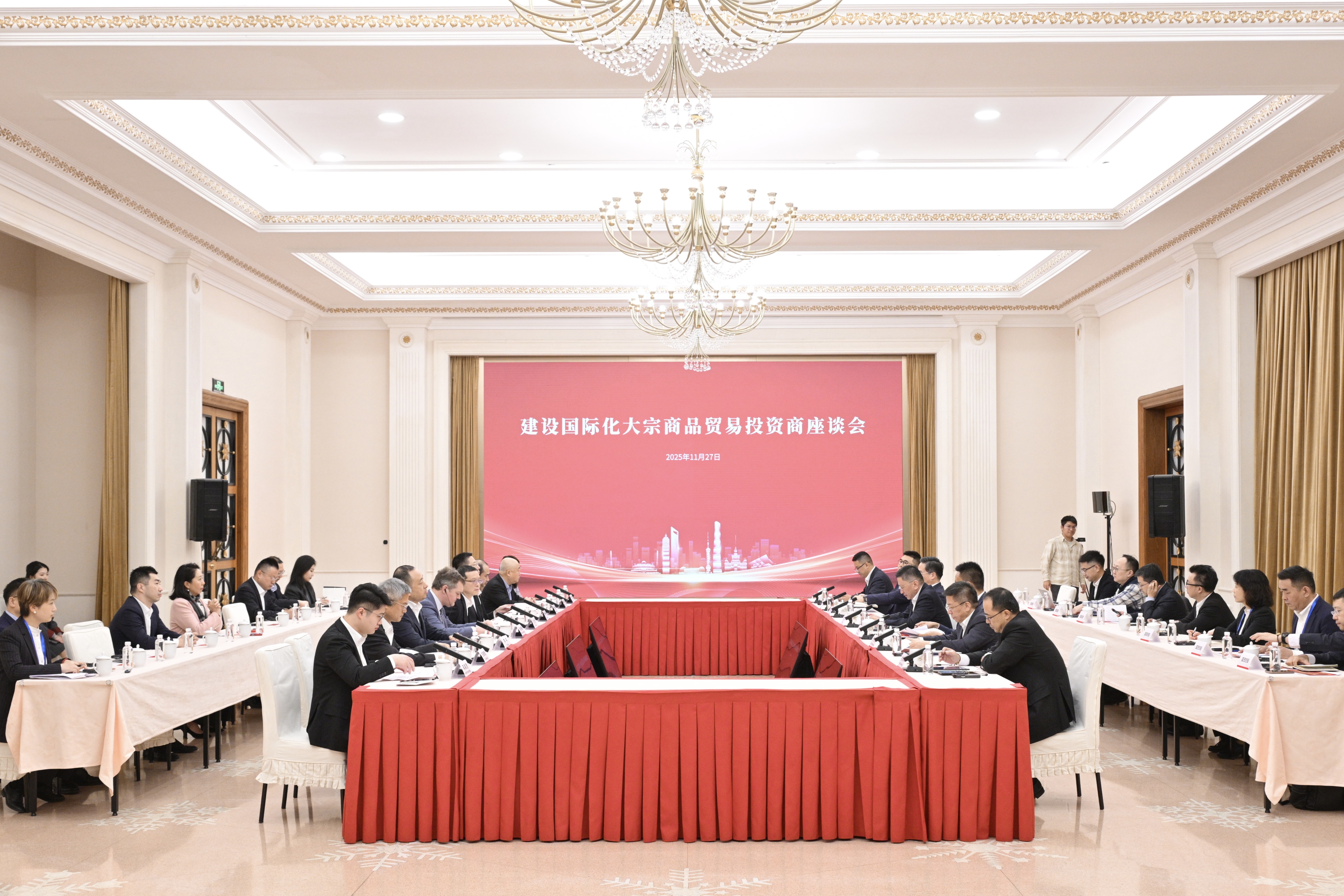
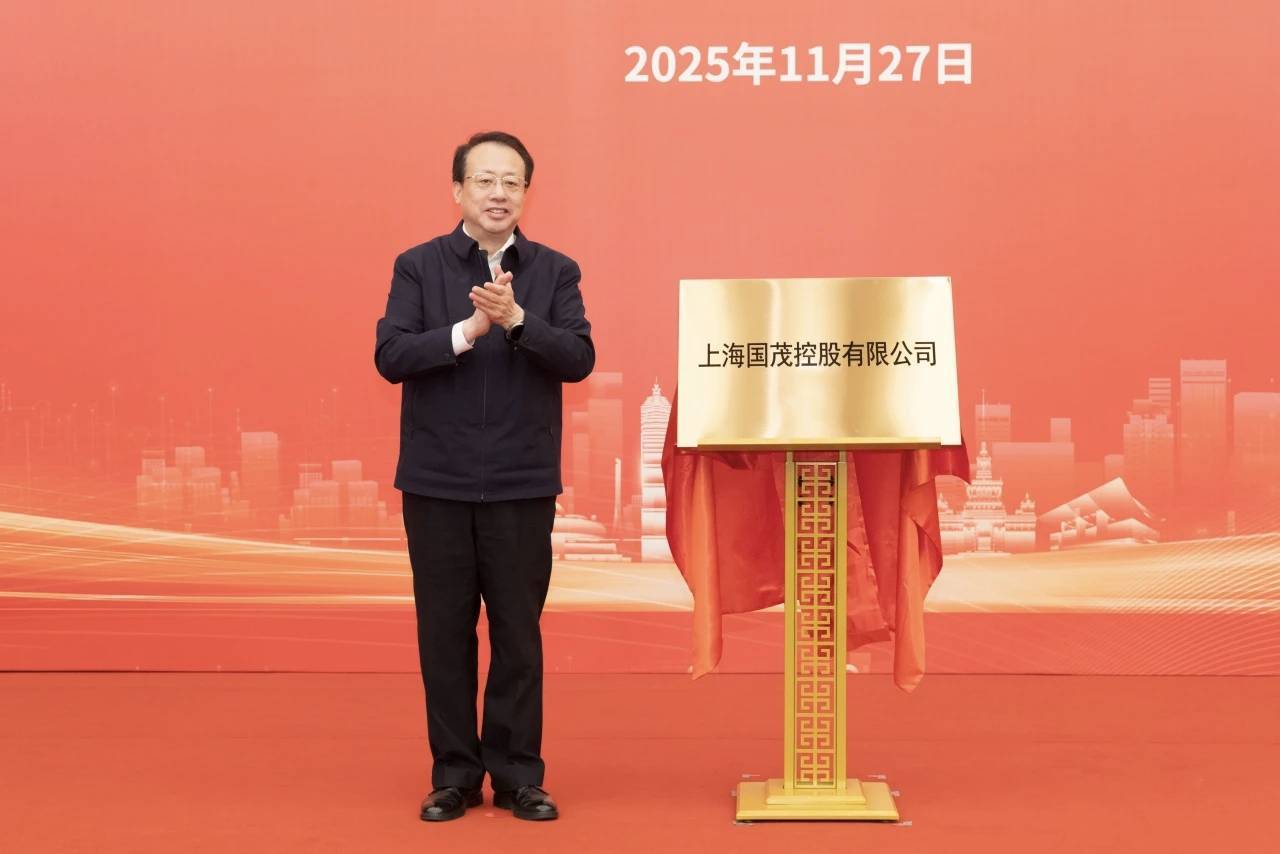
Group 1 - The core viewpoint of the news is that Guomao Holdings aims to establish a comprehensive industrial and financial ecosystem by forming partnerships and enhancing its operational model in the global commodity market [2][3]. - Guomao Holdings is a state-owned enterprise approved by the Shanghai government, focusing on a business model that integrates spot trading, financial futures, upstream resource investment, midstream supply chain management, and downstream industrial layout [2][3]. - The registered capital of Guomao Holdings is 13 billion RMB, with significant investments from various state-owned enterprises, including 3 billion RMB from the International Group and 2 billion RMB from the Port Group [2]. Group 2 - The Shanghai State-owned Assets Supervision and Administration Commission emphasizes that the establishment of Guomao Holdings is a key initiative for enhancing the international trade center and adapting to the restructuring of global supply chains [3]. - The company aims to transition from traditional trade to modern trade, focusing on a model that combines global trade, industrial organization, and financial investment [3]. - Guomao Holdings plans to strengthen cooperation with various stakeholders to enhance its global resource allocation capabilities, particularly in strategic sectors with high market potential [7].
“黑色星期五”真实上演!芝商所突然宕机 全球交易员集体傻眼
智通财经网· 2025-11-28 12:54
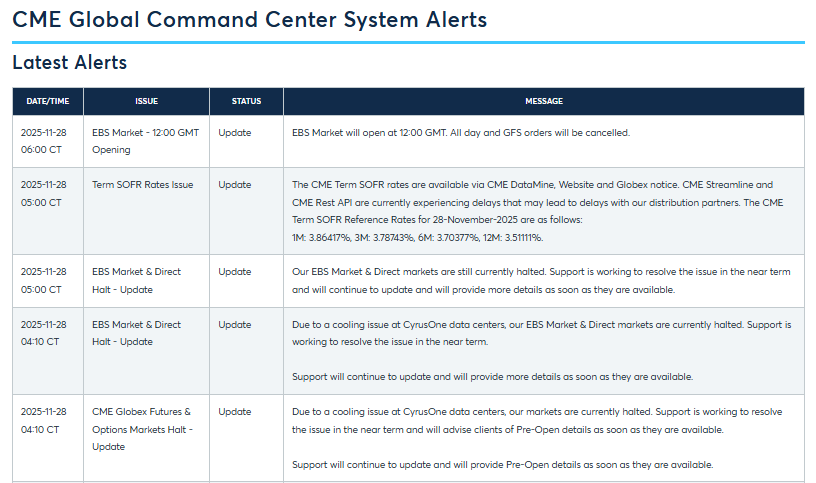
Core Viewpoint - The Chicago Mercantile Exchange (CME) experienced a significant system outage that halted trading across various markets, affecting contracts worth trillions of dollars, highlighting its critical role in global financial infrastructure [1][2]. Group 1: Incident Overview - The CME's trading of futures and options was completely suspended due to a data center failure, impacting a wide range of assets including S&P 500 futures, foreign exchange, U.S. Treasury bonds, and various commodities [1]. - The outage occurred on a day when trading was already expected to be light due to the Thanksgiving holiday, exacerbating the situation for traders who rely on CME for liquidity [4]. Group 2: Market Reactions - Traders expressed frustration over the inability to execute trades, with some seeking alternative channels to maintain operations, although liquidity was significantly lower than that provided by CME [1][4]. - The incident has raised concerns about the reliability of exchanges and data center operators, as similar outages have occurred at other exchanges in recent years, indicating a growing risk in the global pricing system [2]. Group 3: Impact on Trading Activities - The outage coincided with the monthly expiration of gasoline and diesel futures, which could involve physical delivery, complicating the situation for oil brokers [3]. - Cash bond trading was intermittently affected, leading to reduced hedging capabilities for traders, although some alternative hedging tools saw increased activity in the London market [4]. Group 4: Broader Implications - The freezing of trades worth trillions of dollars during a critical year-end period poses significant risks for mutual funds and other market participants [4]. - Investors, already cautious due to low liquidity, opted to stay on the sidelines amid the system disruption, further highlighting the vulnerability of trading operations during such outages [4].

银河期货铜12月报-20251128
Yin He Qi Huo· 2025-11-28 07:45
| | | | 利多显性化,市场维持高位震荡 | | 3 | | --- | --- | --- | | 第一部分 铜市场综述 | | 3 | | 【行情回顾】 | | 3 | | 【市场展望】 | | 3 | | 【策略推荐】 | | 3 | | 第一部分 | 铜市场综述 | 4 | | 一、 | 行情回顾 | 4 | | 二、 | 行情展望 | 4 | | 第二部分 | 降息不确定性增加 | 6 | | 第三部分 | | 铜矿扰动增加,供应紧张的情况难以缓解 8 | | 一、 | 铜精矿供应增量骤降 | 8 | | 二、 | | 再生加工企业开工下滑,废铜供应紧张阶段性缓解 10 | | 三、 | | 原料供应不足向冶炼端传导加速 11 | | 第三部分 | 消费面分析 | 13 | | 一、 | | 传统消费增速明显下滑 13 | | 二、 | 汽车消费韧性凸显 | 16 | | 三、 | 风光发电超预期增长 | 19 | | 四、 | 锂电铜箔爆发式增长 | 22 | | 五、 | 消费总结 | 23 | | 第四部分 | 供需平衡表 | 23 | 有色金属研发报告 铜 12 月报 2025 年 11 ...
上海国企+1,国茂控股打造国际化大宗商品贸易投资商
Di Yi Cai Jing· 2025-11-28 04:00
Core Viewpoint - Shanghai Guomao Holdings has been established with a registered capital of 13 billion yuan to create an internationalized new type of bulk commodity trading and investment platform with core competitiveness in key areas [1][5] Group 1: Company Establishment and Structure - Shanghai Guomao Holdings was officially unveiled on November 27, with the Shanghai Municipal Government approving its establishment as a state-owned enterprise [1] - The company aims to develop a business model based on spot trading, characterized by financial futures, and focuses on upstream resource investment, midstream supply chain management, and downstream industrial layout [1][5] - The registered capital of 13 billion yuan includes contributions from various stakeholders, with Shanghai International Group contributing 3 billion yuan for a 23.08% stake, and other groups contributing 2 billion yuan to 1 billion yuan for smaller stakes [1] Group 2: Strategic Goals and Operational Model - The establishment of Guomao Holdings is a key initiative for Shanghai to accelerate the construction of "five centers" and enhance the international trade center [5] - The company will transition from traditional trade to modern trade, aiming to build an operational model that integrates global trade, industrial organization, and financial investment [5] - Guomao Holdings will focus on global resource allocation capabilities for key resources, energy, and high-value agricultural products, emphasizing strategic value and market scale [5] Group 3: Collaboration and Ecosystem Development - The company aims to create a full industrial chain cooperation ecosystem by announcing its first batch of industrial, financial, and shareholder ecological partners [6] - Representatives from various organizations, including the People's Bank of China and major trading companies, participated in discussions on enhancing Shanghai's international trade center and building a global resource allocation hub [6] - Guomao Holdings seeks to align with international standards and foster win-win cooperation with global partners to develop a competitive international bulk commodity trading and investment platform [6]