宝马

Search documents
【人民日报】柔性屏,打开“显示”新视窗
Ren Min Ri Bao· 2025-12-01 03:29
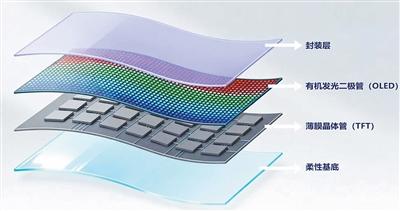
Core Insights - The article discusses the rapid advancement of flexible display technology, highlighting significant breakthroughs in materials and applications that are reshaping the industry landscape [3][4][6]. Group 1: Technological Advancements - Recent developments include the successful creation of high-performance stretchable polymer light-emitting diodes (PLED) by the Chinese Academy of Sciences, which show improved optical performance and mechanical stability [3]. - LG Display has showcased a prototype of a stretchable display capable of approximately 53% deformation, indicating significant progress in flexible display technology [3]. - The flexible display market is projected to exceed $173 billion by 2031, with a compound annual growth rate (CAGR) of 34.3% [6]. Group 2: Material and Structural Innovations - Achieving flexible displays requires a multi-layered approach, including flexible substrate materials, core electronic components, and advanced packaging technologies [4][5]. - Commonly used flexible substrate materials like polyimide and polyester can be as thin as 0.1 mm and withstand high temperatures and thousands of folds without deformation [4]. - The integration of high-performance electronic materials, such as oxide semiconductors and organic semiconductors, is crucial for ensuring rapid current flow and self-emission capabilities in flexible displays [5]. Group 3: Application Expansion - Flexible displays are increasingly being utilized across various sectors, including smart terminals, wearable devices, automotive, healthcare, and public services [6][7][8]. - In the automotive sector, flexible displays are enhancing user interaction, with companies like Mercedes and BMW integrating large OLED screens into their vehicles [7]. - The healthcare industry is adopting flexible displays for real-time monitoring, with products like flexible health patches and wearable medical devices becoming more prevalent [8]. Group 4: Future Prospects - The development of intrinsic flexible materials aims to address challenges such as fragility and resolution loss, potentially leading to new applications in smart homes and IoT [9][10]. - Intrinsic flexibility allows displays to bend and stretch without relying on external structures, enhancing durability and stability [10]. - Future flexible displays may incorporate sensors and AI algorithms for real-time data analysis and adaptive interaction, transforming user experiences and expanding the scope of applications [10].

柔性屏 打开“显示”新视窗(国际科技前沿)
Ren Min Ri Bao· 2025-11-30 22:04
Core Insights - The display technology is rapidly transitioning from "rigid" to "flexible," with flexible displays being increasingly utilized in consumer electronics, commercial spaces, and smart interactions [1] - Recent advancements include the development of high-performance stretchable polymer light-emitting diodes (PLED) by a research team from the Chinese Academy of Sciences, and a prototype of a stretchable display by LG Display, capable of approximately 53% deformation [1] Group 1: Flexible Display Technology - Flexible displays are not merely traditional glass screens bent; they require a multi-layered structure where each layer must possess flexibility to ensure overall bending and folding while maintaining display quality and durability [2] - Key components include flexible substrate materials, core electronic components, and packaging technology, all of which must innovate collaboratively [2][3] - Common flexible substrate materials include polyimide and polyester, which can be as thin as 0.1 mm and withstand high temperatures and thousands of folds without deformation [2] Group 2: Core Electronic Components - Core electronic components such as thin-film transistors (TFT) and organic light-emitting diodes (OLED) rely on high-performance electronic materials, including oxide semiconductors and organic semiconductors [3] - These components work together to ensure rapid current flow, self-emission of light, and effective stress release during bending, maintaining the integrity and functionality of the display [3] Group 3: Market Expansion and Applications - The global market for flexible displays is expanding, with projections indicating that by 2024, shipments of flexible active matrix organic light-emitting diode (AMOLED) panels will reach 631 million units, accounting for 42% of the smartphone screen market [4] - By 2031, the flexible display market is expected to exceed $173 billion, with a compound annual growth rate (CAGR) of 34.3% [4] - Applications are diversifying across various sectors, including smart terminals, wearable devices, automotive, healthcare, and public services [4][5][6] Group 4: Innovations in Automotive and Healthcare - In the automotive sector, flexible displays are enhancing human-vehicle interaction, with companies like Mercedes and BMW integrating flexible OLED screens into their vehicles for improved display and energy efficiency [5] - In healthcare, flexible displays are being utilized in wearable medical devices, providing real-time health data monitoring and improving clarity and portability [6] Group 5: Future of Intrinsic Flexibility - Current flexible displays still rely on external structures for deformation, facing challenges such as fragility and resolution loss [7] - The development of intrinsic flexible materials aims to address these issues by enabling the display itself to withstand deformation through molecular structure and micro-design [7][8] - This innovation could lead to new applications, allowing displays to adapt to various devices and user needs, enhancing the overall user experience [8]
柔性屏,打开“显示”新视窗(国际科技前沿)
Ren Min Ri Bao· 2025-11-30 22:01
Core Insights - The article discusses the rapid advancement of flexible display technology, highlighting its transition from rigid to flexible forms, which is increasingly applied in various sectors such as consumer electronics, commercial spaces, and smart interactions [5][8]. Group 1: Flexible Display Technology Development - Flexible displays are characterized by their ability to bend and stretch, leading to innovative applications in products like foldable phones and curved screens [5][8]. - Recent breakthroughs include the development of high-performance stretchable polymer light-emitting diodes (PLEDs) by the Chinese Academy of Sciences, which significantly enhance optical performance and mechanical stability [5][11]. - LG Display has showcased a prototype of a stretchable display capable of approximately 53% deformation, indicating significant progress in the field [5][8]. Group 2: Manufacturing Process of Flexible Displays - The creation of flexible displays involves a complex multi-layer structure, requiring innovations in flexible substrate materials, core electronic components, structural design, and packaging technology [6][7]. - Flexible substrates must be thin, soft, and resistant to high temperatures and corrosive environments, with common materials including polyimide and polyester [6]. - Core electronic components like thin-film transistors (TFT) and organic light-emitting diodes (OLED) rely on high-performance materials to ensure rapid current flow and energy efficiency [7]. Group 3: Market Expansion and Applications - The global market for flexible displays is projected to grow significantly, with an estimated shipment of 631 million flexible AMOLED panels in 2024, accounting for 42% of the smartphone screen market [8]. - By 2031, the flexible display market is expected to exceed $173 billion, with a compound annual growth rate (CAGR) of 34.3% [8]. - Applications are expanding across various sectors, including smart terminals, wearables, automotive, healthcare, and public services, enhancing user experience and functionality [9][10]. Group 4: Future Innovations and Challenges - The concept of intrinsic flexibility is emerging, which refers to the inherent ability of materials to withstand deformation without relying on external structures [11][12]. - Research teams are exploring new material systems to improve the mechanical strength and durability of flexible displays, with ongoing challenges in achieving large-scale applications [11][12]. - The integration of sensors and AI algorithms in intrinsic flexible displays could lead to personalized and intelligent user experiences, transforming the interaction between devices and users [12].


全球车市 “东升西落” 已成定局?三季报数据揭露中国车企崛起密码
智通财经网· 2025-11-29 07:59
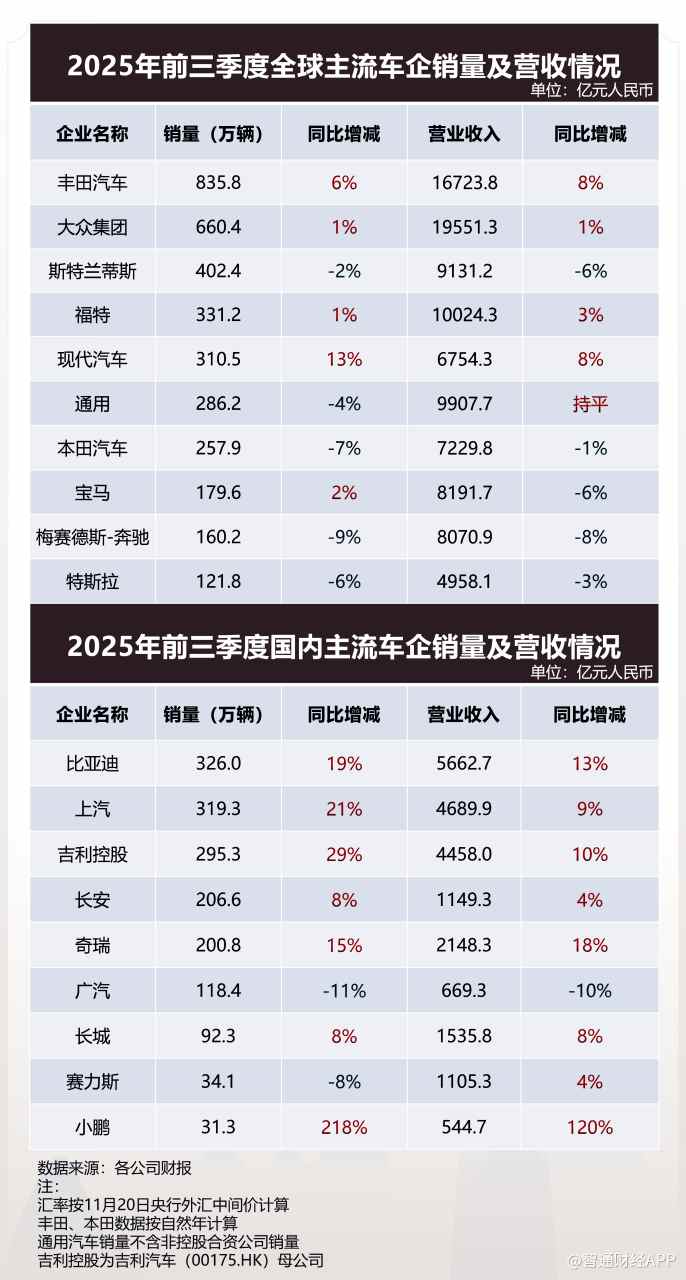
Group 1 - The global automotive market is witnessing a shift with Chinese automakers leading in growth while traditional overseas giants are slowing down, indicating a competitive balance tilting towards the East [1] - In the first three quarters of 2025, Toyota led global sales with 8.358 million units, a 6% increase, while other major brands like Volkswagen and Ford saw minimal growth of 1%, and some like Mercedes-Benz experienced a 9% decline [2][3] - Chinese automakers are showing significant sales acceleration, with BYD leading domestic sales at 3.26 million units, a 19% increase, and companies like Xpeng achieving a remarkable 218% growth [4][5] Group 2 - Revenue growth among overseas automakers is limited, with none exceeding 10%, while Chinese companies like BYD and Geely reported revenue increases over 10%, and Xpeng's revenue doubled [5] - Profit margins for overseas automakers are under pressure, with companies like General Motors and Mercedes-Benz experiencing over 30% declines in net profit, while Chinese firms like Chery and SAIC reported net profit increases of over 15% [6][9] - R&D investment is crucial for competitiveness, with Chinese automakers significantly increasing their R&D spending, such as BYD's 31% increase to 43.75 billion yuan, while many overseas brands reduced their R&D budgets [10][11] Group 3 - The data from the first three quarters of 2025 reflects a transitional phase in the global automotive industry, with Chinese companies moving from "catching up" to "running alongside" their global counterparts [12] - The shift in market dynamics is attributed to Chinese firms leveraging their early advantages in new energy vehicles and smart technologies, leading to increased market share and competitiveness [12] - Chinese automotive exports reached 4.95 million units, a 14.8% increase, with new energy vehicle exports soaring by 89.4%, indicating a growing global presence led by companies like BYD and Chery [12]

安世之乱:一场撕裂全球芯片命脉的控制权战争
Zhong Guo Jing Ying Bao· 2025-11-28 21:12
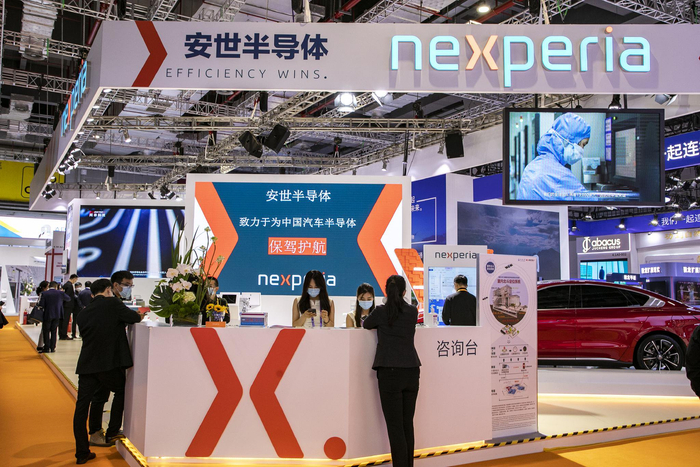
Core Viewpoint - The semiconductor supply chain crisis, triggered by a power struggle within a Chinese-controlled semiconductor company, has led to significant production disruptions for major automotive manufacturers like Volkswagen, BMW, and Ford, highlighting the vulnerability of global supply chains to geopolitical interventions [2][3][4]. Summary by Sections 1. Event Overview - The crisis began with a governance dispute at Nexperia (安世半导体), a semiconductor company acquired by a Chinese consortium in 2017, which has become a key supplier for the automotive industry [3][4]. - The U.S. imposed new export controls in September 2025, leading to the Dutch government freezing Nexperia's global assets under the pretext of national security, which resulted in a near collapse of the global automotive chip supply chain [5][6]. 2. Impact on Automotive Industry - Major automakers, including Volkswagen, BMW, and Honda, issued production warnings, with the European Automobile Manufacturers Association predicting a potential 15% reduction in European automotive production capacity within weeks if the supply issue is not resolved [7][8]. - The automotive industry relies heavily on specific components produced by Nexperia, and the lack of these components could halt production lines, as seen with Volkswagen reporting its first quarterly loss in five years [6][7]. 3. Geopolitical Context - The incident illustrates the intersection of geopolitics and high-tech industries, revealing the fragility of global supply chains under political pressure [3][9]. - The U.S. strategy to curb China's technological advancements has been implemented through European allies, as evidenced by the timing of the Dutch government's actions following U.S. directives [9][10]. 4. Corporate Governance Issues - The governance conflict within Nexperia escalated when the Dutch court intervened, leading to the removal of the Chinese CEO and the appointment of a temporary Dutch CEO, which was perceived as a politically motivated takeover [5][6]. - The internal governance issues at Nexperia, including differing strategic priorities between Chinese and European management, contributed to the crisis [11][12]. 5. Future Implications - The semiconductor crisis signals a shift in the global semiconductor landscape from an "efficiency-first" model to a "security-first" approach, prompting companies to reassess their supply chain strategies [15][16]. - The event serves as a wake-up call for Chinese companies regarding the importance of political risk assessment and the need for a more resilient and localized supply chain strategy [15][19].

座舱芯片战事:谁能撬开高通「铁王座」的裂缝?
雷峰网· 2025-11-28 13:48
Core Viewpoint - The article discusses the competitive landscape of cockpit chips in the automotive industry, highlighting Qualcomm's dominance and the emerging opportunities for domestic manufacturers like MTK, Huawei, and others in the context of cost and localization advantages. Group 1: Qualcomm's Dominance - Qualcomm's cockpit chip, the Snapdragon 8797, supports cabin and driving integration, establishing strong partnerships with major global automakers, including luxury brands like Mercedes and BMW, as well as new players like Li Auto and NIO [2][3]. - The collaboration creates a positive feedback loop where automakers rely on Qualcomm's performance, Tier 1 suppliers adapt to Qualcomm's solutions, and developers optimize applications around Qualcomm's ecosystem [3][4]. - Despite its strong position, Qualcomm faces challenges from domestic competitors who are increasing their market share, with companies like Chipone and Huaqin making significant inroads [3][4]. Group 2: Competitive Landscape - Domestic manufacturers are leveraging cost advantages and localized services to penetrate the market, with MTK's chips like the MT8676 and MT8678 offering competitive pricing and features [15][16]. - The market share of domestic cockpit chip manufacturers is projected to rise from under 3% in 2023 to over 10% in 2024, indicating a significant shift [36]. - MTK's strategy includes targeting entry-level markets, where cost advantages are most pronounced, and it is expected to capture over 30% market share by 2025 [18][36]. Group 3: Challenges in Cabin-Driving Integration - The integration of cabin and driving functions is seen as a critical step towards achieving centralized computing architecture in vehicles, but it presents significant technical and organizational challenges [21][24]. - Different safety standards for cabin and driving systems complicate the integration process, requiring higher levels of certification and increasing development costs [25][26]. - The complexity of developing a true cabin-driving integration chip involves balancing various technical requirements, which can lead to internal conflicts within organizations [30][31]. Group 4: Future Outlook - The future of cockpit chips will likely see a division where domestic manufacturers focus on the Chinese market while Qualcomm maintains its stronghold in the global high-end market [39]. - Companies that can combine localized services with global compatibility will have greater growth potential in the evolving automotive landscape [39].


美国被反击,全世界集体沉默,为什么越被打压,中国反而越稳?
Sou Hu Cai Jing· 2025-11-28 12:32
Group 1 - The trade war initiated by the U.S. under Trump's administration has intensified, with significant tariffs imposed on Chinese electric vehicles and solar batteries, leading to increased costs for American companies and consumers [2] - Despite the tariffs, China's exports of photovoltaic components and batteries have seen substantial growth, with a 25% increase in solar component exports and a 23% increase in battery exports in the first half of the year [2] - In response to U.S. sanctions, China has implemented export controls on rare earths and permanent magnets, which are critical for high-tech and defense applications, potentially impacting U.S. military capabilities [4][6] Group 2 - The U.S. has faced challenges in its manufacturing sector, with the manufacturing purchasing managers' index dropping below 48, indicating contraction, while China maintains a strong position in the global supply chain, particularly in the renewable energy sector [8] - China's dominance in the global supply chain is evident, with 90% of the global market share in the renewable energy sector, and significant export figures, including $52 billion in electric vehicle exports and $7.6 billion in battery exports in the first eight months [8] - The response from other countries to China's export controls has been muted, as many nations rely on Chinese markets and materials, with significant trade volumes between China and "Belt and Road" countries [12][14] Group 3 - The U.S. strategy of "friend-shoring" has not yielded the expected results, as countries like Vietnam and India face logistical challenges and infrastructure bottlenecks, while China continues to strengthen its supply chain resilience [16][20] - China's Belt and Road Initiative is expanding, with investments in green energy projects and mineral supply chains, indicating a long-term strategy to enhance its global trade network [18][22] - The resilience of China's supply chain is attributed to its comprehensive policies and strong partnerships, positioning it favorably in the face of U.S. trade pressures [22]

欧媒:欧洲没有工业危机,有危机的是德国,而德国的危机在中国
Sou Hu Cai Jing· 2025-11-28 08:46
Group 1 - The core issue in Europe is not an "industrial crisis" affecting the entire region, but rather a specific industrial crisis in Germany [1] - Despite Germany's economic downturn, other European countries like France and Poland continue to show growth, indicating a decoupling from Germany's industrial performance [2][4] - Germany's industrial output has declined significantly, recently hitting a 20-year low, while other European economies have maintained or recovered their manufacturing output [2][4] Group 2 - The decline in Germany's industrial sector is attributed to internal factors rather than external pressures, particularly its relationship with China and competition in the domestic market [4][6] - German manufacturers face intense competition from Chinese electric vehicles, which have become strong contenders in terms of technology and cost, undermining Germany's traditional automotive dominance [4][6] - The sluggish domestic demand and investment in Germany are exacerbated by a rigid economic approach and a reluctance to adopt expansive fiscal policies during economic downturns [4][6][8] Group 3 - To address its economic challenges, Germany may need to break free from fiscal constraints and increase government spending to stimulate growth and facilitate industrial upgrades [6] - Embracing "European protectionism" could provide a temporary solution for Germany, allowing it to create demand through integrated European markets and cooperative initiatives [8]

高端装备制造产业研究周报:智元机器人百公里跨省行走 FIGURE02参与3万辆宝马汽车生产
Xin Lang Cai Jing· 2025-11-28 06:33
Industry Developments - OpenEuler released the world's first operating system for super nodes on November 15 [1] - EverMind team announced the launch of EverMemOS, a world-class long-term memory operating system for AI entities on November 16 [1] - Samsung Electronics announced a plan to invest 450 trillion KRW (approximately 2.2 trillion RMB) in AI infrastructure and R&D over the next five years on November 16 [1] - China Academy of Information and Communications Technology promoted two new proposals: EAI-bench for embodied intelligence system benchmarking and evaluation framework, and technical requirements for data collection systems for remote operation in real scenarios on November 17 [1] - Figure's founder revealed that Figure 02 has participated in the production of 30,000 BMW vehicles, executing welding and setting performance metrics [1] Capital Trends - Yuanli Lingji received hundreds of millions in A+ round financing from Alibaba on November 14 [2] - Jinwo Co., Ltd. raised 721 million RMB through a private placement for the expansion of bearing sleeve production base and forging capacity on November 18 [2] - Zhaomin Technology plans to issue convertible bonds to raise no more than 590 million RMB for precision components and the construction of a production base in Thailand [2] - Xingdong Jiyuan completed nearly 1 billion RMB in A+ round financing [2] Insights of the Week - Embodied intelligence is considered the strongest application of AI, with humanoid robots being a key direction [3] - The ROBO+ track, representing electrification, is expected to reshape the entire automotive industry chain and become a major industry trend [3] - Automotive manufacturers and 3C brands are gaining competitive advantages due to their understanding of demand scenarios and hardware supply chains [3] - Companies like Huawei, ByteDance, and Xiaomi, which possess brain and hardware iteration capabilities, are seen as having the most coherent business logic in humanoid robotics [3] - Tesla's supply chain is expected to quickly enter small-batch production, with a temporary halt followed by a restart [3] - Changes in the Zhiyuan supply chain are focused on the reconstruction of vertical business models, while Huawei's supply chain emphasizes the implementation of downstream vertical application scenarios [3]

市场监管总局召开企业公平竞争座谈会,三星、宝马、强生等外资企业到场
Sou Hu Cai Jing· 2025-11-28 06:13
Core Viewpoint - The State Administration for Market Regulation (SAMR) held a meeting on November 27, 2023, focusing on promoting fair competition and optimizing the business environment, engaging with foreign enterprises such as Samsung, BMW, Johnson & Johnson, Bayer, Charoen Pokphand, Procter & Gamble, and IKEA [1]. Group 1 - The SAMR is enhancing antitrust enforcement and deepening institutional openness in the competition sector [1]. - The meeting emphasized the importance of implementing the spirit of the 20th Central Committee's Fourth Plenary Session, with a commitment to strengthen antitrust enforcement in key areas [1]. - The SAMR aims to eliminate barriers to the construction of a unified national market and create a top-tier business environment that is market-oriented, law-based, and internationalized [1].