长江存储

Search documents
半导体设备板块催化密集,资金持续布局半导体设备ETF易方达(159558)等产品
Mei Ri Jing Ji Xin Wen· 2025-09-22 04:56
Group 1 - The semiconductor equipment sector is experiencing a positive trend, with the China Securities Semiconductor Materials and Equipment Theme Index rising by 1.1% as of 10:40 AM [1] - The semiconductor equipment ETF, E Fund (159558), has seen a net subscription of 6 million shares during the trading session, indicating strong investor interest [1] - Huawei announced its roadmap for Ascend chips at the 2025 Global Connectivity Conference, planning to launch the Ascend 950PR chip in Q1 2026 and the Ascend 950DT chip in Q4 2026, with further upgrades planned for 2027-2028 [1] Group 2 - Yangtze Memory Technologies has officially launched its third-phase expansion plan, aiming to increase monthly production capacity to 150,000 wafers by 2025 and capture a 15% share of the global flash memory market by 2026 [1] - The development and capacity construction of domestic AI chip-specific memory HBM are actively progressing, which is expected to drive demand for semiconductor equipment [1] - The China Securities Semiconductor Materials and Equipment Theme Index consists of 40 stocks related to semiconductor materials and equipment, with nearly 60% weight in semiconductor equipment [1]
帮主郑重:长电科技存储业务暴增150%!三筛铁律挖出封测龙头的黄金买点
Sou Hu Cai Jing· 2025-09-21 02:15
Core Insights - Longji Technology's storage business revenue surged over 150% year-on-year in the first half of the year, significantly outperforming the industry average, raising questions about the sustainability of this growth [1] Group 1: Market Trends - The storage chip supercycle has begun, driven by three main factors: 1. Explosive demand for AI servers leading to a surge in high bandwidth memory (HBM) demand, with a projected market growth rate of 80% by 2025 [3] 2. Acceleration of domestic substitution as local chip leaders like Yangtze Memory and Changxin Memory ramp up production, with domestic orders for Longji Technology reaching 40% in the first half of 2025 [3] 3. Technological upgrades from DDR4 to DDR5, increasing packaging prices by over 30%, and advancements in 3D NAND stacking from 128 layers to over 200 layers [3] Group 2: Fundamental Analysis - Longji Technology has three strengths and three weaknesses: - Strengths: 1. Strong technical barriers, being one of only three global companies capable of HBM packaging [4] 2. Deep customer relationships with major clients like Apple, Qualcomm, and domestic leaders [4] 3. Leading capacity layout with a monthly production capacity of 82,000 chips and an industry-leading yield rate of 99.5% [4] - Weaknesses: 1. A 24% year-on-year decline in net profit for the first half of 2025 due to increased financial costs from the acquisition of a semiconductor company [5] 2. Operating cash flow decreased by 22.7% year-on-year, indicating pressure from significant expansion investments [5] 3. High valuation with a dynamic PE of 35.3 times for 2025, above the industry average of 28 times [5] Group 3: Valuation Assessment - Short-term valuation is under pressure with a projected PE of 35.3 times for 2025 and 29.0 times for 2026, while long-term valuation could be reasonable if storage business growth continues, potentially lowering PE to 24.3 times by 2027 [6] - If the storage business share increases from the current "mid-teens" to over 30%, the valuation could shift from "packaging factory" to "high-end manufacturing," targeting a PE of 40 times [6] Group 4: Investment Strategy - Ideal buying point is at or below 35 yuan, with current price at 38.73 yuan being slightly high [7] - Position management suggests limiting single stock positions to 8% and total positions in the packaging sector to 15% [7] - Key indicators for monitoring include monthly capacity utilization rates and HBM packaging yield rates [7]



海外存储巨头集体涨价 国内厂商迎来机遇
Zhong Guo Jing Ying Bao· 2025-09-19 20:15
Group 1 - The storage chip market is experiencing a new wave of price increases, with major companies like Sandisk and Micron announcing price hikes of over 10% and 20%-30% respectively [2][3] - The price adjustments are driven by strong demand from North American cloud service providers (CSPs) for server construction, leading to a robust procurement demand for storage chips, including DRAM and NAND Flash products [2][3] - The current market environment is characterized by supply shortages, prompting NAND Flash suppliers to signal price increases, followed by DRAM suppliers pausing quotes [2][5] Group 2 - Major storage manufacturers attribute the price hikes to the growing storage needs driven by artificial intelligence applications and the increasing demand in data centers and mobile sectors [3][4] - The price increases are expected to continue as the supply side holds a stronger bargaining position, leading to sustained revenue growth for global storage suppliers [5][7] - The stock prices of storage module manufacturers have risen significantly in response to the price hikes and the tightening supply situation [6][7] Group 3 - The overall stock prices of A-share storage industry companies have seen substantial increases since September, with some companies experiencing over 80% gains [7] - The price adjustments by major manufacturers are expected to have immediate effects on consumer market products, while business-to-business markets will see price transmission in future contracts [8] - Domestic storage manufacturers may benefit from the price increases, as customers might shift towards local suppliers due to price stability and competitive pricing strategies [8]

【招商电子】国产算力芯片链深度跟踪:华为披露AI芯片3年规划,国内自主可控加速发展
招商电子· 2025-09-19 15:21
Core Viewpoint - Huawei's Full Connect 2025 Conference showcased the Lingqu Unified Interconnection Protocol, announcing the launch of Ascend 950/960/970 and Kunpeng 950/960 over the next three years, highlighting the gradual enhancement of domestic AI computing chip capabilities amid US-China tensions [9][58]. Group 1: AI Computing Chip Development - The Ascend NPU roadmap includes the release of Ascend 950 (PR and DT versions) in 2026, followed by 960 in 2027 and 970 in 2028, with significant performance improvements [15][20]. - The Kunpeng CPU will see the launch of Kunpeng 950 in late 2026 and Kunpeng 960 in early 2028, supporting advanced computing needs [20][34]. - Domestic chip manufacturers like Haiguang and Cambricon are projecting substantial revenue growth, with Haiguang targeting a CAGR of 44% over three years [3][58]. Group 2: Advanced Manufacturing and Semiconductor Industry - The domestic lithography machine industry is focusing on complete machines and related components, with expectations for advanced process expansion by 2026 [3][59]. - The domestic semiconductor industry is expected to benefit from the acceleration of independent and controllable demands, particularly in advanced logic and storage production lines [3][62]. Group 3: Storage and Edge Computing - The demand for inference and edge computing storage is increasing, with significant growth expected in AI PCs, smartphones, and wearable devices by 2026 [4][58]. - Domestic manufacturers are enhancing their enterprise storage product lines, with companies like Jiangbolong and Baiwei Storage launching new enterprise-level solutions [4][58]. Group 4: Investment Recommendations - Investment opportunities are suggested in AI computing chips, high-end chip manufacturing, packaging, storage, and related equipment and materials [5].

存储芯片:周期属性凸显,AI基建打开新空间
Tebon Securities· 2025-09-19 09:29
Market Overview - The storage chip market is the second largest segment in the semiconductor industry, with a projected market size of $165.5 billion in 2024, accounting for 26% of the total semiconductor market of $630.5 billion[8] - In 2023, the storage chip market size was $92.3 billion, a year-on-year decline of 29%, while it is expected to grow by 79% to $165.5 billion in 2024[5][8] Industry Characteristics - The storage chip industry exhibits strong cyclical characteristics, typically operating on a 3-4 year cycle[8] - The market is dominated by 3-5 major players, with over 90% market share in both DRAM and NAND Flash segments[19] Historical Cycles - The storage industry has experienced three cycles since 2016, with the current cycle driven by AI infrastructure demand, differing from previous cycles that were more reliant on consumer electronics[14][20] - The first cycle (2016-2019) was driven by the transition to DDR4, while the second cycle (2020-2023) benefited from increased demand for laptops and smartphones during the pandemic[14][15] Future Outlook - The new cycle starting in 2024 is expected to be sustained by AI infrastructure, with significant demand for DDR5 and HBM memory chips[20] - According to WSTS, the storage chip market is projected to grow to $184.8 billion in 2025 and $214.8 billion in 2026, with year-on-year growth rates of 12% and 16% respectively[20] Company Performance - In Q2 2025, DRAM industry revenue reached $31.63 billion, a quarter-on-quarter increase of 17.1%, while NAND Flash revenue from the top five brands grew by 22% to $14.67 billion[22][24] - Major companies like SK Hynix and Micron reported significant revenue growth, with SK Hynix's DRAM revenue increasing by 57.9% year-on-year in Q2 2025[26][30] Risks - The industry faces risks including market competition, macroeconomic fluctuations, and potential delays in research and development progress[36]

收评:消费周期异动 生肖马炒玄学
Sou Hu Cai Jing· 2025-09-19 09:03
当然,整点时刻,又有一些拉升护盘的迹象。所以汪汪队控制慢牛节奏,可能也意味着慢熊,跌起来可能也会持续阴跌为主,偶尔来一根大中阴线。值得 一提的是午后2点多跌停数量有点明显,已经有19家了,而涨停数量只有45个。说明高位股的回落还是比较明显的。跌幅超过3%的票也已经有500个了。 实际上今天我们看到微盘股跌1.1%,它是持续跌破了4条均线,30天线都破掉了,有头尖顶的结构了。 上午是上海市场是横盘震荡为主,深圳市场出现了几次跳水、几次拉升,波动幅度比较大,明天中午的时候也有一次强势拉升,结果午后开盘10分钟左右 又开启了一波跳水。现在不清楚能不能守住,因为已经在创盘中的新低了。昨天我分析市场下跌有五大理由,其中有一个要重申一下,就是国庆长假要到 了,节前通常是有缩量的,而且主力资金不愿意拉高,然后承受一周的外盘波动风险。 今天结束之后就还有7个交易日,所以未来几天基本上可以确认市场量能会逐渐的萎缩,昨天是3.14万亿,今天就只有2.4万亿了。 两点缩量已经达到6,000 亿了,在这种情况下你不要想强势拉起来很难,这种反差还是过于明显的带量下跌、缩量反抽,还不如缩量下跌呢。今晚我们看到主力资金2点出逃了600 多 ...
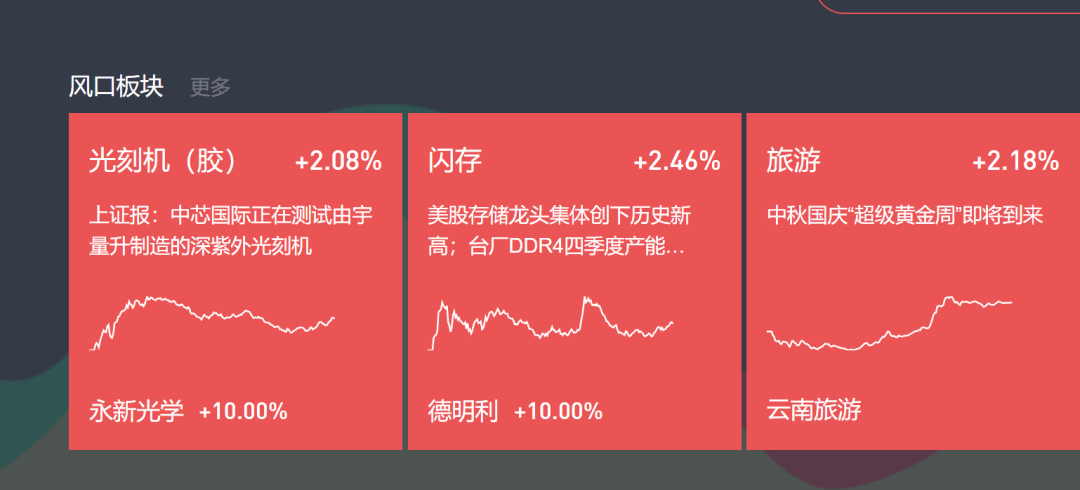
【大涨解读】内存、闪存:存储巨头携手掀起涨价潮,隔夜美股集体新高,供给缺口下国产存储厂商也有望受益于新周期
Xuan Gu Bao· 2025-09-19 02:11
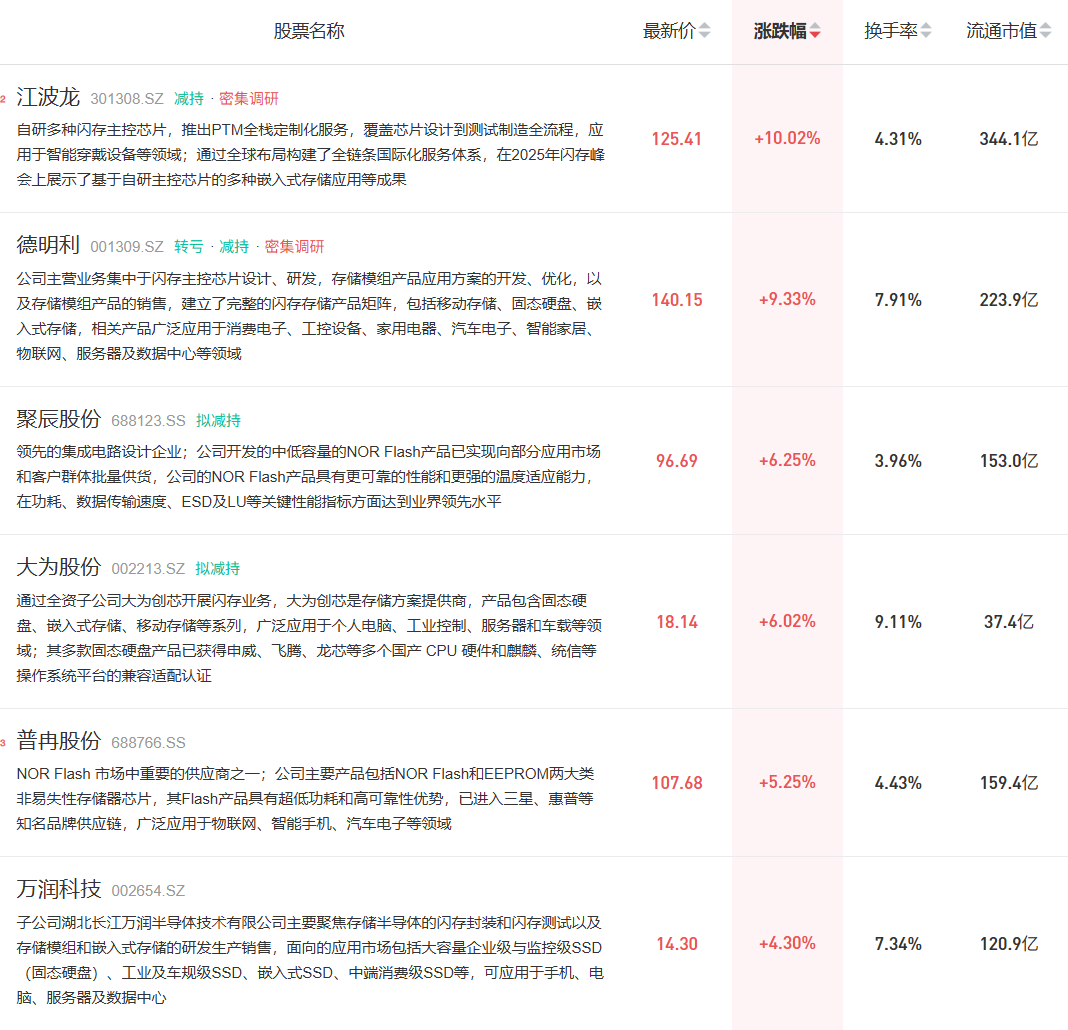
Core Viewpoint - The memory and flash memory sectors experienced a significant rally on September 19, with multiple companies seeing substantial stock price increases, indicating a positive market sentiment and potential growth in the industry [1]. Group 1: Stock Performance - Companies such as Demingli, Jiangbolong, and Lankai Technology saw stock price increases of over 10%, with Demingli reaching a peak increase of 9.33% and Jiangbolong at 10.02% [1][2]. - The market capitalization of Jiangbolong is reported at 34.41 billion, while Demingli's market cap stands at 22.39 billion [2]. Group 2: Price Increase Trends - U.S. storage companies, including Micron Technology and SanDisk, saw stock prices rise over 5%, reaching historical highs [3]. - Samsung is expected to increase prices for DRAM products by 15%-30% and NAND products by 5%-10% in Q4 [3]. - Micron has halted pricing for various storage products, indicating potential price increases of 20%-30% [3]. Group 3: Market Dynamics - The DRAM market is anticipated to experience a comprehensive price increase by the second half of 2025 due to supply-demand imbalances [4]. - The NAND market is under pressure to improve profit margins as some applications have not yet reached profitability [4]. - AI-driven demand is significantly boosting the storage sector, leading to supply shortages and price hikes [5]. Group 4: Future Outlook - The global DRAM market is expected to expand continuously, benefiting the storage industry as AI computing needs grow [5]. - The transition of NAND production lines to newer technologies is causing a significant drop in overall capacity, further driving price increases [5]. - Innovations in DRAM architecture, such as 3D DRAM, are being developed to enhance efficiency and meet growing demand [5].


德明利:公司已经形成稳定的存储晶圆采购渠道
Zheng Quan Ri Bao Zhi Sheng· 2025-09-17 12:09
Core Viewpoint - The company has established stable procurement channels for storage wafers through years of operation and resource accumulation in the storage sector, enabling it to support downstream customer development effectively [1] Group 1: Strategic Partnerships - The company has formed long-term strategic partnerships with major storage manufacturers and their key distributors, including Yangtze Memory Technologies, Changxin Memory Technologies, SK Hynix, Samsung, and SanDisk [1] Group 2: Competitive Advantage - The company possesses a scale procurement advantage, which enhances its ability to support the expansion of downstream customers [1]
【大涨解读】光刻机:官方再提加速攻关“卡脖子”技术,光刻机传闻扰动市场,半导体设备等有望加速国产化
Xuan Gu Bao· 2025-09-17 02:42
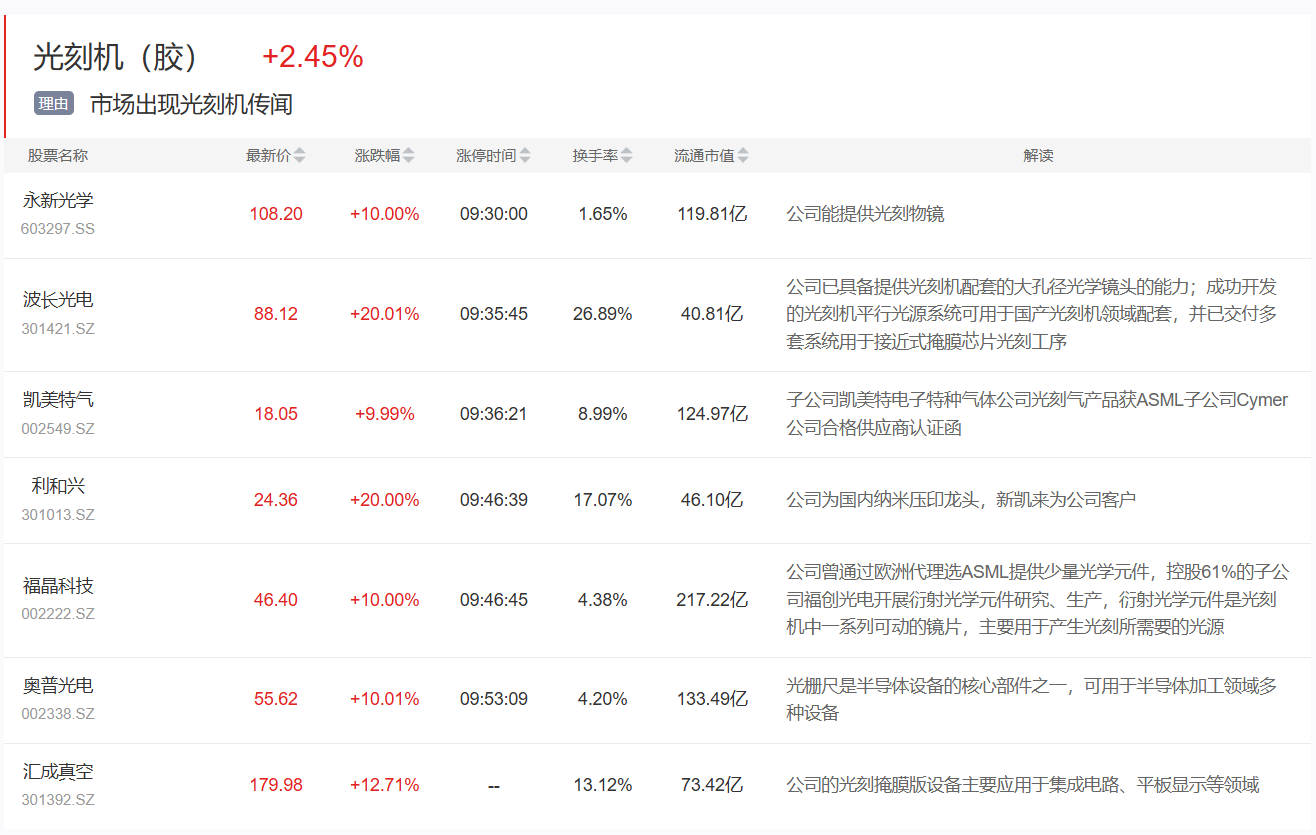
Core Viewpoint - The domestic semiconductor and photolithography sectors experienced significant stock price increases, driven by market rumors and government initiatives aimed at enhancing self-sufficiency in chip technology [1][3]. Group 1: Market Performance - Domestic chip and photolithography stocks surged, with companies like Yongxin Optical and Wavelength Optoelectronics hitting their daily price limits [1]. - Notable stock performances included: - Yongxin Optical: +10.00% to 108.20, market cap of 11.98 billion [2] - Wavelength Optoelectronics: +20.01% to 88.12, market cap of 4.08 billion [2] - Kai Mei Teqi: +9.99% to 18.05, market cap of 12.50 billion [2] - Lihexing: +20.00% to 24.36, market cap of 4.61 billion [2] - Aopu Optoelectronics: +10.01% to 55.62, market cap of 13.35 billion [2] Group 2: Industry Developments - The market is responding to rumors regarding advancements in photolithography technology, with a focus on overcoming "bottleneck" technologies in chip production [3]. - The National Internet Information Office emphasized the need for leading companies to take responsibility for tackling key technology challenges, particularly in the semiconductor sector [3]. - The Ministry of Commerce announced an anti-dumping investigation into imported analog chips from the U.S., effective September 13, 2025 [3]. Group 3: Future Market Outlook - The global photolithography equipment market is projected to reach $31.5 billion in 2024, accounting for 20% of the wafer production equipment market [4]. - Domestic semiconductor companies are expected to increase their share of global wafer foundry capacity from 21% in 2024 to 30% by 2030 [4]. - The establishment of a fully domestic NAND production line by Yangtze Memory Technologies is anticipated to begin trial operations in the second half of this year, with a goal to ramp up production by 2026 [4]. - The ongoing competition in computing power highlights the gap between China's AI data center construction and that of the U.S., indicating potential growth opportunities in the domestic semiconductor sector [4].




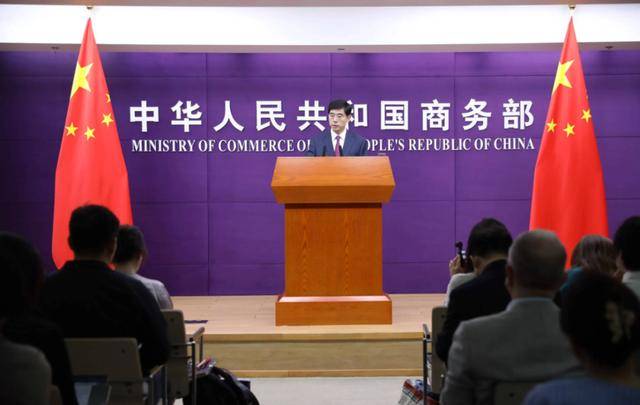
美制裁13家中企,中方以1敌38国!商务部两记重拳,有三大底气!
Sou Hu Cai Jing· 2025-09-16 11:16
Group 1 - The U.S. added 13 Chinese semiconductor companies to an export control "entity list," prompting China to respond with two announcements regarding anti-dumping and anti-discrimination investigations against U.S. chips [1][3] - China's swift and strong reaction indicates its impatience with what it perceives as insincere negotiations from the U.S. [1][3] Group 2 - The anti-dumping investigation targets U.S. companies that have been selling chips below cost in China, aiming to protect local industries and market rights [4] - The anti-discrimination investigation challenges the U.S. for its double standards in restricting high-end chip exports while criticizing China for not following rules [5] Group 3 - China's confidence in confronting the U.S. stems from three pillars: being the largest chip consumer market, having a developing domestic supply chain, and adhering to WTO rules to counter U.S. unilateralism [6][7][9] Group 4 - The U.S. attempted to rally 37 countries to pressure China, but many countries, including those in the EU and ASEAN, have significant trade ties with China, undermining U.S. efforts [8][10] Group 5 - China's exports to the U.S. fell by 33.1% in August, but exports to the EU and ASEAN grew by 10.8% and 22.7%, respectively, indicating a shift towards market diversification [12] Group 6 - The future of U.S.-China negotiations hinges on whether the U.S. will abandon its strategy of pressure for concessions, with two potential outcomes: a temporary agreement or China accelerating its domestic alternatives [14] Group 7 - The ongoing chip conflict represents a broader competition for technological dominance, with China focusing on short-term countermeasures, medium-term industrial upgrades, and long-term market diversification [15]