中宠股份

Search documents
未知机构:申万农业行业景气依旧迎接科学养宠时代2025年宠物食品行业回顾及202-20260210
未知机构· 2026-02-10 01:55
Summary of Pet Food Industry Conference Call Industry Overview - The pet food industry is experiencing sustained growth, driven by an increase in new pet owners and resilient long-term customer spending patterns. The primary demographic for pet ownership in China is individuals aged 20-35, with a projected increase in new pet owners supported by a steady rise in the number of graduates from 2025 to 2038 [1][2] Long-term Trends - The number of new pet owners is expected to remain strong over the next 15-20 years, contributing to industry expansion [1] - The pet food sector is undergoing a consumption upgrade, with significant growth in the mid-to-high-end price segments for cat and dog food expected between 2024 and 2025 [1] Mid-term Developments - Product innovation and the upgrading of raw materials are key drivers of consumption upgrades in the pet food industry [2] - The trend towards scientific pet care is emerging, with consumers increasingly aware of specialized pet food needs, which will further support consumption upgrades [2] Short-term Insights - Despite overall consumer pressure, the pet food industry continues to show strong growth resilience, with projected GMV for online sales on platforms like Tmall, JD, and Douyin reaching 30.71 billion yuan in 2025, reflecting a year-on-year increase of 10.2% [2] Market Concentration - The industry is witnessing an acceleration in market concentration, with a clear trend towards the dominance of leading brands [3] - Online market concentration rates for pet food in China are increasing, with CR5, CR10, and CR20 reaching 25.3%, 38.3%, and 51.9% respectively in 2025, marking increases of 3.4 percentage points, 5.0 percentage points, and 3.5 percentage points year-on-year [4] Competitive Landscape - The "two super, many strong" market structure is re-emerging, with leading brands like Maifudi and Royal Canin maintaining their positions at the top for eight consecutive years from 2018 to 2025 [4] - The peak cycle for strong domestic brands is approximately 3-4 years, indicating a dynamic competitive environment [4] Investment Recommendations - The pet food industry is expected to see continued brand concentration and a trend towards higher-end product structures [5] - Leading companies benefit from comprehensive brand and product portfolios, achieving growth rates that exceed the industry average while maintaining upward profitability [6] - Recommended companies for investment include Guibao Pet, Zhongchong Co., and Petty Co. [7] Future Trends - The trend of consumption upgrades is expected to persist [8] - Market share for leading foreign brands is likely to continue increasing [8] - The industry is entering a phase of micro-innovation, with rising brand awareness among consumers [8] - Functional and prescription pet food may become new trends in the industry [8] - Industry consolidation is increasing, with smaller brands seeking pathways for survival [8]
渤海证券研究所晨会纪要(2026.02.10)-20260210
BOHAI SECURITIES· 2026-02-10 00:30
Macro and Strategy Research - Long-term care insurance (referred to as "long-term care insurance") is designed to mitigate the financial risks associated with long-term disabilities, providing economic security or service payments to individuals requiring ongoing personal care and medical assistance. There are three models in practice: social insurance, commercial insurance, and care allowances. To address the medical care needs arising from an aging population, China's long-term care insurance system has been piloted in 49 cities, transitioning from a "pilot" phase to a "promotion" phase during the 14th Five-Year Plan period [2][4]. - Japan's long-term care insurance was implemented in 2000, mandating that individuals over 40 must enroll. Funding is shared equally between public funds (taxes) and insurance premiums. Care service costs are generally covered 90% by the insurance, with individuals responsible for 10%, and some high-income groups covering 20-30%. The application process for care services follows a detailed recognition process, ensuring that public resources are prioritized for those in greatest need. As of April 2024, approximately 6.7% of the insured population utilizes care services, indicating that the insurance primarily addresses the low-frequency, high-risk care needs of the elderly [3]. - Currently, China's long-term care insurance system is still in the "pilot" stage, with only 0.8% of beneficiaries among participants as of 2024. Under the directive to "promote long-term care insurance" during the 14th Five-Year Plan, provinces like Hainan, Yunnan, and Hebei have released implementation plans. The insured groups include employees, retirees, flexible workers, and unemployed rural residents, with payment ratios of approximately 70% for employees and around 50% for non-employed rural residents [4]. - In comparison, there are notable differences between China's long-term care insurance and Japan's system in terms of funding sources, insured groups, benefit systems, and protected populations. Japan's long-term care insurance has undergone eight rounds of reforms, emphasizing a "prevention-first" approach, which can help control costs and establish community prevention and intervention systems for mild disabilities, serving as a significant reference for China's long-term care insurance system [5]. Fund Research - The public fund market saw a total scale exceeding 280 billion yuan, with the equity market experiencing a downturn. During the week from February 2 to February 6, 2026, all major equity indices declined, with the largest drop being 5.76% in the STAR 50 index. Among 31 primary industries, 18 saw gains, with the top five performing sectors being food and beverage, beauty care, electrical equipment, comprehensive, and transportation [6][8]. - The average decline for equity funds was 2.27%, with only 18.81% achieving positive returns. Fixed-income plus funds fell by an average of 0.23%, with 40.77% showing positive returns. Pure bond funds increased by 0.08%, with a remarkable 98.70% positive return rate. The average decline for pension target funds was 0.73%, with only 3.52% achieving positive returns. QDII funds also saw an average decline of 2.54%, with 13.95% showing positive returns [8]. - The ETF market experienced a net inflow of 14.899 billion yuan, with only cross-border ETFs achieving net inflows of 21.624 billion yuan. The average daily trading volume in the ETF market reached 619.629 billion yuan, with an average turnover rate of 9.49% [8]. Industry Research - The report highlights the importance of the upcoming Spring Festival consumption, with a focus on the potential recovery of valuations in the home furnishing sector. Nine departments have jointly issued a document to create a festive consumption atmosphere during the Spring Festival [10][13]. - From February 2 to February 6, the light industry manufacturing sector outperformed the CSI 300 index by 2.29 percentage points, while the textile and apparel sector outperformed by 2.66 percentage points [10]. - The Ministry of Commerce and other departments have launched the "2026 'Happy Shopping Spring' Special Activity Plan," which will take place from February 15 to 23, aiming to stimulate consumption through innovative cross-sector collaborations and incentives to enhance consumer participation. This policy is expected to positively impact the consumption of home appliances and home decoration products during the implementation period [13].


温氏股份挤入宠物食品赛道
Bei Jing Shang Bao· 2026-02-09 17:07
Core Viewpoint - Company Wens Foodstuff Group is entering the pet food market by acquiring a stake in Qingdao Shuang'an Biotechnology Co., aiming to leverage synergies and enhance sustainable development capabilities amid declining profits in its main business [1][2]. Group 1: Investment Details - Wens Investment, a wholly-owned subsidiary of Wens Foodstuff Group, plans to invest up to 147 million yuan in Qingdao Shuang'an, acquiring 14.8684 million yuan of registered capital for 44.3854 million yuan and subscribing to an additional 34.4579 million yuan of registered capital for 103 million yuan [1]. - Post-transaction, Wens Investment will hold 48.18% of Qingdao Shuang'an, becoming its largest shareholder [1]. Group 2: Market Context - The pet food market in China is experiencing significant growth, with the urban pet consumption market surpassing 312.6 billion yuan in 2025, a 4.1% increase year-on-year, and the pet food market reaching 167.9 billion yuan, growing by 5.9% [2]. - The competitive landscape includes major foreign players like Mars and Nestlé Purina, as well as domestic brands such as Zhongchong Co., Guai Bao Pet, and Peidi Co., all vying for market share [2]. Group 3: Industry Trends - Major meat companies are recognizing opportunities in the pet food sector, with several, including Shengnong Development and Deli Foods, establishing joint ventures and production projects for pet food [3]. - Experts highlight that Wens Foodstuff Group's advantage lies in its upstream resources and established supply chain, allowing for cost control and quality assurance in pet food production [3].

农牧巨头切入宠物赛道!温氏拟1.47亿元收购青岛双安股权
Nan Fang Du Shi Bao· 2026-02-09 13:08
Core Viewpoint - The investment by Wens Foodstuff Group in Qingdao Shuang'an Bio-Tech Co., Ltd. aims to strengthen its core business while exploring strategic opportunities in the pet food sector, enhancing sustainable development and risk resilience [1][3]. Investment Details - Wens Investment plans to invest no more than 147 million yuan in Qingdao Shuang'an, acquiring approximately 22.19% of its equity and subscribing to an additional capital increase of 103 million yuan [4]. - After the transaction, Wens Investment will hold 48.18% of Qingdao Shuang'an's equity, making it the largest shareholder [4][5]. Company Background - Qingdao Shuang'an, established in 2010, operates in the pet food industry, including the development and production of pet food and health products, with brands like Black Nose and Cat Doctor [5]. - The company is projected to achieve revenues of 407 million yuan and a net profit of 12.16 million yuan by 2025, with total assets of 506 million yuan and net assets of 144 million yuan [6]. Market Context - The pet consumption market in China is expected to grow significantly, reaching 405 billion yuan by 2028, with pet food accounting for 53.7% of the market share [7]. - The competitive landscape includes major players like Guai Bao Pet and Zhong Chong Co., with significant revenue figures, highlighting the challenges faced by Qingdao Shuang'an [9]. Strategic Implications - The investment is seen as a strategic move for Wens Foodstuff Group to diversify and stabilize its business amid declining profits, with a projected net profit drop of 40.73%-46.12% in 2025 [9][10]. - By acquiring Qingdao Shuang'an, Wens aims to leverage synergies in cost reduction, product upgrades, and channel sharing, potentially enhancing future profit growth [10].

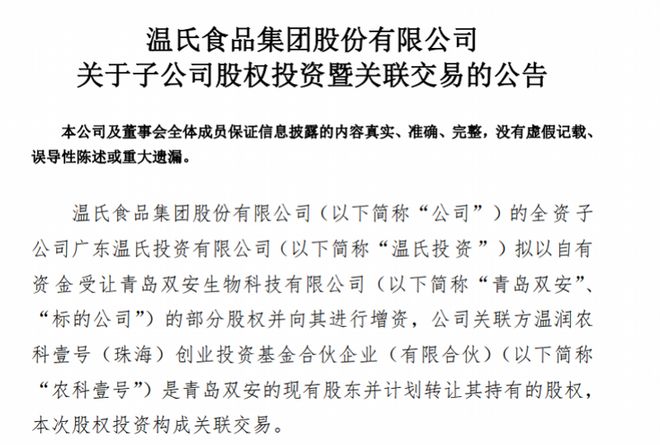
拟投资不超过1.47亿元,温氏股份杀入宠物食品赛道
Bei Jing Shang Bao· 2026-02-09 12:05
Core Viewpoint - Wens Foodstuff Group is entering the pet food market by acquiring a stake in Qingdao Shuang'an Biotechnology Co., aiming to leverage synergies and enhance sustainable development capabilities amid declining profits in its core business [1][3]. Group 1: Investment Details - Wens Investment plans to invest up to 147 million yuan, acquiring 14.8684 million yuan of registered capital from four counterparties for 44.3854 million yuan [3]. - Additionally, Wens Investment intends to subscribe to 34.4579 million yuan of newly registered capital for 103 million yuan, resulting in a 48.18% ownership stake in Qingdao Shuang'an, making it the largest shareholder [3]. Group 2: Market Context - The pet food market in China is experiencing significant growth, with the urban pet consumption market exceeding 312.6 billion yuan in 2025, a 4.1% increase from the previous year [4]. - The pet food segment alone reached 167.9 billion yuan in 2025, reflecting a 5.9% year-on-year growth [4]. - Major foreign companies like Mars and Nestlé Purina dominate the market, while domestic brands are increasingly competing for market share [4]. Group 3: Strategic Advantages and Challenges - Wens Foodstuff's entry into the pet food sector is supported by its upstream resources in the meat supply chain, allowing for cost control and quality assurance [5]. - The company benefits from acquiring an established brand and production system through Qingdao Shuang'an, avoiding the lengthy process of building from scratch [5]. - However, Wens Foodstuff faces challenges such as intense market competition and the need for effective management integration with Qingdao Shuang'an to ensure smooth operations [5].

宠物食品行业系列深度报告之八:行业景气依旧,迎接科学养宠时代
Shenwan Hongyuan Securities· 2026-02-09 09:43
Investment Rating - The report maintains a positive outlook on the pet food industry, highlighting the continued growth and resilience of leading brands in the market [3][5]. Core Insights - The pet food industry is experiencing a consumption upgrade driven by product innovation and changing consumer demands, with a notable shift towards high-end and functional pet food products [3][5]. - The market is witnessing a significant concentration of leading brands, with top players expanding their market share amidst increasing competition [5][3]. - The aging pet population in China is expected to further drive demand for specialized and high-quality pet food products [5][3]. Long-term Trends - The report indicates that the number of new pet owners is expected to grow, supported by a stable increase in the population of young adults aged 20-35, who are the primary pet owners [4][12]. - The pet population in urban areas is projected to continue increasing, with dog and cat numbers reaching 53.43 million and 72.89 million respectively by 2025, reflecting a year-on-year growth of 1.6% and 1.9% [12][4]. Mid-term Trends - Product innovation is leading to a consumption upgrade, with mid to high-end price segments (60-100 RMB/kg) showing significant growth rates compared to lower price segments [3][28]. - The report notes that the demand for specialized pet food, including functional and prescription diets, is on the rise as pet owners become more aware of their pets' nutritional needs [5][45]. Short-term Trends - The pet food industry is expected to maintain strong growth, with online sales projected to reach 30.71 billion RMB in 2025, reflecting a year-on-year increase of 10.2% [5][3]. - The concentration of market share among top brands is increasing, with the top five brands accounting for 25.3% of the market, indicating a trend towards fewer but stronger players in the industry [5][3]. Future Outlook - The report anticipates that the trend towards consumption upgrades will continue, with high-end and functional pet food products leading the market [5][3]. - The increasing recognition of brand quality and the aging pet population are expected to enhance the market share of foreign brands, particularly in the prescription food segment [5][3]. - The report highlights that product innovation will be crucial for companies to differentiate themselves in a competitive market, with functional and prescription diets likely to become the next growth drivers [5][3].

轻工制造、纺织服饰行业周报:关注春节假期消费,家居估值修复仍可期-20260209
BOHAI SECURITIES· 2026-02-09 09:10
Investment Rating - The investment rating for the light industry manufacturing and textile apparel sectors is maintained at "Neutral" [7][43]. Core Insights - The report highlights the upcoming "2026 'Le Gou New Spring' Special Activity Plan" issued by nine departments, aimed at boosting consumption during the Spring Festival from February 15 to 23, which is expected to stimulate demand in key consumer sectors such as home furnishings, home appliances, and home decoration [6][42]. - The report notes a price increase of 50 yuan/ton for various paper products, including kraft and corrugated paper, effective from March 2, driven by changes in market supply and demand dynamics [6][15]. - The light industry manufacturing sector outperformed the CSI 300 index by 2.29 percentage points during the period from February 2 to February 6, with a sector performance of 0.96% compared to the CSI 300's -1.33% [4][35]. - The textile and apparel sector also outperformed the CSI 300 index by 2.66 percentage points during the same period, with a sector performance of 1.32% [4][39]. Summary by Sections Industry News - The "2026 'Le Gou New Spring' Special Activity Plan" aims to enhance consumption through innovative cross-sector collaborations and incentives to stimulate immediate consumer spending [6][15]. - The report mentions a price adjustment in the paper industry, indicating a recovery in the corrugated paper market due to various factors including reduced production and low inventory levels [6][15]. Key Company Recommendations - The report recommends "Buy" ratings for companies such as Oppein Home (603833), Sophia (002572), and Semir Apparel (002563) [4][43]. - The report also highlights the performance of companies like Tianan New Materials and Jian Sheng Group, noting their recent share buybacks and shareholder actions [3][34]. Market Performance - The light industry manufacturing sector's performance was bolstered by factors such as changes in control and acquisitions, while some companies faced adjustments due to previous overvaluation [4][36]. - The textile and apparel sector saw significant gains in specific companies, with notable increases in stock prices for firms like Cai Bai Co. and Bang Jie Co. [4][39].
整个社会都在喊没钱了,为什么这些公司反而年赚百亿?
创业家· 2026-02-08 10:00
Core Viewpoint - The article emphasizes that despite the prevailing narrative of economic hardship, certain industries are thriving and generating substantial profits, particularly in the context of Japan's "lost 30 years" and the evolving consumer behavior in China [3][4]. Group 1: Economic Shifts and Opportunities - The concept of a "low-desire society" does not equate to a lack of opportunities, as consumer demand is shifting towards different sectors [4]. - The article identifies eight key industries that are capitalizing on changing consumer preferences, highlighting that demand migration presents significant business opportunities [5]. Group 2: Key Industries - **Second-Hand Economy**: The second-hand luxury market in Japan, exemplified by companies like Daikokuya, has seen a dramatic revenue increase. In China, platforms like Hongbulin and Panghu are experiencing similar growth [6][7][8]. - **Pet Economy**: With declining birth rates, spending on pets is rising. Companies like Inaba in Japan and Guobao in China are benefiting from this trend, with various pet brands seeing continuous sales growth [12][13][14][15][16]. - **Adult Care**: The adult diaper market in Japan has surpassed $10 billion, indicating that aging populations can create substantial economic opportunities rather than being a burden [17][18][19]. - **Health Food and Beverages**: Changes in population structure and rising health awareness have led to the growth of sugar-free beverages and functional foods in both Japan and China [21][22]. - **Beauty Economy**: The demand for beauty products, such as collagen supplements and at-home beauty devices, remains strong, indicating that consumers prioritize personal care even in economic downturns [23][24][25][26]. - **Outdoor Recreation**: Companies in the outdoor equipment sector, like Snow Peak in Japan, are thriving as consumers seek leisure activities despite economic constraints [29][30][31]. - **Convenience Economy**: The rise of frozen foods and smart home appliances reflects a shift towards convenience, with brands like Anjijia and Kewotai seeing steady growth [39][40][42]. - **Lazy Economy**: The trend of reduced cooking time among younger generations has led to increased demand for time-saving products, suggesting that time-saving solutions may hold more commercial value than cost-saving ones in a low-desire economy [39][42]. Group 3: Market Sentiment - The article argues against the notion that the current market is in a "cold winter," suggesting that the true winners in a low-desire era are those who can identify and invest in counter-cyclical opportunities [44].

耐用消费产业行业研究:国际烟草巨头财报频出,泡泡年会更新,苹果官宣AI硬件布局
SINOLINK SECURITIES· 2026-02-08 06:35
Investment Rating - The report maintains a "Buy" rating for the durable consumer goods industry [1] Core Insights - The durable consumer goods industry is experiencing growth driven by various segments, including trendy toys, new tobacco products, home furnishings, and AI technologies [1][2][3] - The report highlights the expansion of brands like Bubble Mart and the collaboration with Takara Tomy to enhance IP development in the trendy toy sector [1][8] - The new tobacco segment shows long-term growth potential, with companies like Philip Morris International reporting significant revenue increases [2][14] - The home furnishings market is showing signs of recovery, particularly in the second-hand housing market, while new housing remains under pressure [15][16] - The report emphasizes the importance of adapting to regulatory changes in the personal care and AI glasses sectors, which are expected to reshape marketing and distribution strategies [19][23] Summary by Relevant Sections Trendy Toys - Bubble Mart is expanding into the Japanese market and collaborating with Takara Tomy to enhance its IP development [1][8] - The company reported that it aims to sell over 400 million products across all IP categories in 2025, with significant growth in registered members and store numbers [9] New Tobacco - Philip Morris International's revenue reached $40.6 billion in 2025, with a 7.3% year-on-year increase, driven by a 15% increase in new tobacco product sales [14] - The market for heated tobacco products is expected to accelerate, despite potential regulatory challenges in various countries [2][13] Home Furnishings - The report notes a significant increase in transaction volumes in the second-hand housing market, with a 754.6% year-on-year increase in certain cities [15] - Export figures for furniture show a decline, but there is potential for recovery driven by policy support and improved consumer sentiment [16] AI and Personal Care - New regulations are set to transform marketing strategies in the personal care sector, emphasizing compliance and professional channels [19][21] - The AI glasses market is witnessing innovation, with companies like Oakley and Meta launching new products, indicating a growing trend towards smart technology integration [23] 3D Printing - The report highlights advancements in 3D printing technology, particularly in multi-color printing solutions, which are expected to enhance efficiency and usability in consumer applications [35] Two-Wheeled Vehicles - The electric bicycle market is facing challenges due to policy changes and high base effects, while the motorcycle sector is showing positive trends due to regulatory relaxations [36][37]





经济越来越差,这八大行业越赚爆!
创业家· 2026-02-07 10:24
Core Insights - The article discusses how certain industries are thriving despite a general perception of economic downturn, highlighting eight key sectors that present significant business opportunities in a low-desire society [3][4]. Group 1: Key Industries - **Second-Hand Economy**: The second-hand luxury market in Japan, represented by companies like Daikokuya, has seen a surge in revenue. In China, platforms like Hongbulin and Panghu are experiencing similar growth, indicating a shift in consumer spending towards second-hand goods [6][7][8][9]. - **Pet Economy**: With declining birth rates, young people are spending more on pets, leading to significant growth in pet food and healthcare products. Companies like Inaba in Japan and Guobao in China are capitalizing on this trend [11][12][14][15]. - **Adult Care Products**: The adult diaper market in Japan has surpassed $10 billion, indicating a growing demand for adult care products in China, with companies like Kexin showing potential for growth [16][17][18]. - **Health Food and Beverages**: The rise in health consciousness has led to increased demand for sugar-free beverages and functional drinks. Brands like Dongfang Shuye and Jianchun are gaining traction in this sector [21][22]. - **Beauty Economy**: The demand for beauty products, including collagen supplements and at-home beauty devices, is on the rise. Companies like Jinbo Biological are seeing significant market value growth [23][25]. - **Outdoor and Leisure Products**: The outdoor equipment market is thriving, with brands like Kailas and Camel experiencing rapid sales growth, as consumers seek leisure activities despite economic constraints [25][26][27]. - **Emotional Economy**: Brands like Labubu and Rio are tapping into the emotional needs of consumers, providing products that offer comfort and joy, even in a tight economic climate [28][29][30]. - **Convenience Economy**: The demand for convenience products, such as frozen foods and smart home appliances, is increasing as younger generations spend less time cooking. Companies like Anjijia and Kewot are benefiting from this trend [33][35][36]. Group 2: Market Trends - The article emphasizes that the current economic climate, often viewed as a "winter," presents opportunities for those willing to invest in counter-cyclical sectors. The key to success lies in recognizing and seizing these opportunities [39].