
卓创资讯

Search documents
今日61只股长线走稳 站上年线
Zheng Quan Shi Bao Wang· 2026-01-21 05:18
Market Overview - The Shanghai Composite Index closed at 4120.10 points, above the annual line, with a change of 0.16% [1] - The total trading volume of A-shares reached 1,645.83 billion yuan [1] Stocks Above Annual Line - A total of 61 A-shares have surpassed the annual line today, with notable stocks showing significant deviation rates [1] - The stocks with the highest deviation rates include: - Huawi Design (华维设计) with a deviation rate of 24.42% - Hualing Co. (华岭股份) at 5.51% - Huilong Piston (汇隆活塞) at 4.81% [1] Detailed Stock Performance - The following table summarizes the performance of selected stocks that have crossed the annual line: - Huawi Design (华维设计): Today's change of 29.96%, turnover rate of 26.39%, annual line at 14.64 yuan, latest price at 18.22 yuan [1] - Hualing Co. (华岭股份): Today's change of 12.70%, turnover rate of 9.21%, annual line at 24.90 yuan, latest price at 26.27 yuan [1] - Huilong Piston (汇隆活塞): Today's change of 18.06%, turnover rate of 13.30%, annual line at 9.86 yuan, latest price at 10.33 yuan [1] - Other notable stocks include: - Wuhan Fangu (武汉凡谷) with a deviation rate of 4.17% - Meirui New Materials (美瑞新材) with a deviation rate of 3.81% [1] Additional Stocks with Minor Deviations - Stocks with smaller deviation rates that have just crossed the annual line include: - Gongdong Medical (拱东医疗) and Chongqing Gas (重庆燃气) [1] - The performance of these stocks indicates a cautious upward trend in the market [1]





A股AI应用概念股回升,久其软件、浙文互联涨停
Ge Long Hui A P P· 2026-01-21 03:32
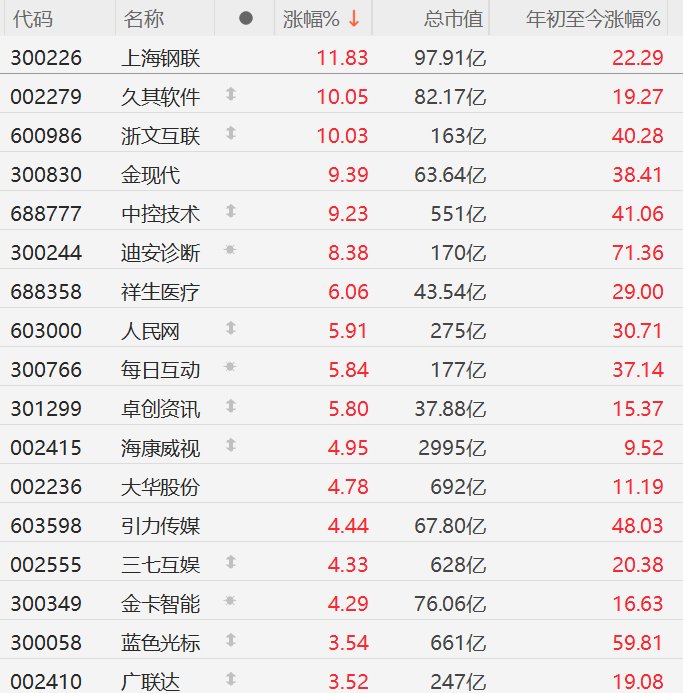
Group 1 - The A-share market has seen a rebound in AI application concept stocks, with Shanghai Steel Union rising over 11% [1] - Other notable gainers include Jiuqi Software and Zhejiang Wenhu Internet, both hitting the 10% limit up, while Jinxi Modern and Zhongkong Technology increased by over 9% [1] - The overall trend indicates a positive momentum in the AI sector, as evidenced by the MACD golden cross signal formation [2] Group 2 - Shanghai Steel Union's market capitalization is approximately 9.791 billion, with a year-to-date increase of 22.29% [2] - Jiuqi Software has a market cap of around 8.217 billion and a year-to-date increase of 19.27% [2] - Zhejiang Wenhu Internet's market cap stands at about 16.3 billion, with a significant year-to-date increase of 40.28% [2]


成品油价格或迎年内首次上调
Qi Lu Wan Bao· 2026-01-20 13:57
Group 1 - The domestic refined oil retail prices are expected to increase for the first time in 2023, with a predicted rise of 85 yuan per ton for both gasoline and diesel [1] - As of January 19, the reference crude oil change rate was 2.03%, leading to an increase in retail prices of approximately 0.07 yuan per liter for 92 and 95 gasoline, and 0.07 yuan for 0 diesel [1] - After the price adjustment, the standard price for 92 gasoline in Zibo will rise to around 6.74 yuan per liter, while 95 gasoline will increase to approximately 7.23 yuan per liter [1] Group 2 - Geopolitical risks continue to create uncertainties that may disrupt international oil prices, while macroeconomic pressures and industry oversupply are suppressing upward momentum [2] - Analysts predict that the global oil supply will remain relatively loose by 2026, with structural oversupply pressures continuing, leading to a rebalancing period characterized by inventory accumulation and price pressure [2] - The next price adjustment window is scheduled to open on February 3, 2026 [2]

油价迎2026年首涨!
Zheng Quan Ri Bao Zhi Sheng· 2026-01-20 11:53
Core Viewpoint - The domestic retail price of refined oil in China has been raised for the first time in 2023, with gasoline and diesel prices increasing by 85 yuan per ton, effective from January 20, 2023 [1] Group 1: Price Adjustments - The price adjustment results in an increase of approximately 0.07 yuan per liter for 92 and 95 octane gasoline and 0.07 yuan for 0 diesel, leading to an additional cost of about 3.5 yuan for filling a 50-liter tank in small private cars [1] - The adjustment is based on the average price of the first ten working days of January compared to the previous adjustment period [1] Group 2: International Oil Price Trends - International oil prices experienced fluctuations due to geopolitical tensions, with Brent crude oil prices rising from around 60 USD per barrel to a peak of 67 USD, before settling around 64 USD [1] - The National Development and Reform Commission (NDRC) indicates that geopolitical risks are a significant factor influencing international oil price volatility, while concerns over supply disruptions have eased [1] Group 3: Future Outlook - Analysts from Zhuochuang Information predict that geopolitical risks will continue to create uncertainties affecting international crude oil prices, while macroeconomic pressures and industry oversupply will suppress upward momentum [2] - The oil market is expected to experience increased volatility, with a challenging environment for a clear directional trend in international oil prices [2]
2025年化工产品涨跌榜
Zhong Guo Hua Gong Bao· 2026-01-20 09:26
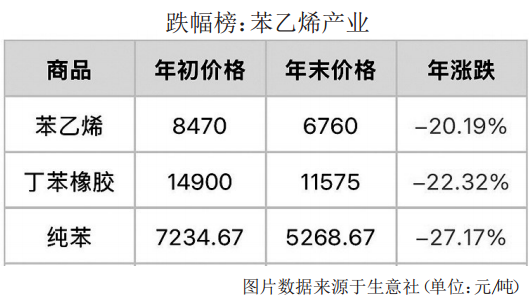
Group 1: Overall Market Trends - In 2025, the chemical industry experienced significant structural differentiation, moving away from uniform price fluctuations, with 71 out of 314 monitored chemical products showing price increases, while 236 products saw declines [1] - The overall market exhibited a "more drops than rises" pattern, with a notable 36.6% of products stabilizing within a 5% price change range by the fourth quarter [15][17] Group 2: Specific Product Performance - Styrene prices fell by 20.19% from 8,470 to 6,760 yuan, reflecting a broader downward trend across the industry due to supply pressures and weak demand [3][6] - Pure benzene saw a significant decline of 27.17%, with prices dropping from 7,234.67 to 5,268.67 yuan, driven by an imbalance in supply and demand [5][3] - The market for ABS experienced a dramatic 30.31% drop, with prices falling from 11,837.5 to 8,250 yuan, primarily due to increased supply and weak domestic demand [12][3] Group 3: Key Drivers of Price Changes - The rise in inorganic chemical products, particularly sulfur and sulfuric acid, was attributed to strong demand from agriculture and new energy sectors, with sulfur prices increasing by 116.5% [16][23] - The decline in organic chemical products was largely due to structural demand shrinkage and oversupply, with refrigerants like R22 dropping by 49.22% [16][27] - The lithium battery sector saw substantial growth, with lithium hydroxide and industrial-grade lithium carbonate prices rising by 59.11% and 53.18%, respectively, driven by strong downstream demand and supply constraints [17][18][20] Group 4: Future Outlook - The chemical industry is expected to continue facing a supply-demand imbalance, particularly in the organic sector, while inorganic products may benefit from ongoing structural upgrades and policy support [14][24] - The lithium market is projected to transition from a resource-driven cycle to a demand-driven cycle, with price fluctuations influenced by seasonal production and actual demand realization [21][19]
成品油价将迎来2026年首次上调
2 1 Shi Ji Jing Ji Bao Dao· 2026-01-20 09:18
Core Viewpoint - The retail price of refined oil in China will see its first increase in 2026, with gasoline and diesel prices rising by 85 yuan per ton, translating to an increase of 0.07 yuan per liter for 92 gasoline, 95 gasoline, and 0 diesel, effective from 24:00 tonight [1]. Group 1: Price Adjustment Details - The price adjustment is triggered by a shift in the crude oil price change rate from negative to positive during the current pricing cycle [1]. - After the adjustment, the cost for filling a 50-liter tank in a small private car will increase by approximately 3.5 yuan, and for a small car running 2,000 kilometers per month with an 8-liter fuel consumption per 100 kilometers, the total fuel cost will rise by 5 yuan before the next price adjustment window [1]. - For heavy trucks running 10,000 kilometers per month with a fuel consumption of 38 liters per 100 kilometers, the fuel cost will increase by around 124 yuan before the next adjustment [1]. Group 2: Market Analysis and Future Outlook - Geopolitical risks in the Middle East and South America have provided support for oil prices, leading to a cumulative increase of over 10% in crude oil prices over five days, but subsequent easing signals from the U.S. have led to a price decline [3]. - Analysts expect ongoing geopolitical uncertainties to continue affecting international oil prices, while macroeconomic pressures and industry oversupply may suppress upward momentum, resulting in a volatile market [3]. - As the Spring Festival approaches, there is a certain demand for gasoline, which may support prices, but diesel consumption is expected to decline due to reduced activity in industries like mining and construction [3].
成品油价年内首次上调,加满一箱油多花3.5元左右
Xin Lang Cai Jing· 2026-01-20 09:07
Core Viewpoint - Domestic fuel prices in China have experienced their first increase of the year, with gasoline and diesel prices rising by 85 yuan per ton, translating to an increase of 0.07 yuan per liter for 92-octane gasoline, 95-octane gasoline, and 0-octane diesel [1][2][3] Price Impact - Consumers will see a slight increase in fuel costs; for example, filling a 50L tank of 92-octane gasoline will cost an additional 3.5 yuan, while a heavy truck running 10,000 kilometers per month with a fuel consumption of 38L per 100 kilometers will incur an additional fuel cost of approximately 124 yuan before the next price adjustment [2] Market Dynamics - The recent price adjustment is the second for 2026 and the first for this year [3] - International oil prices have fluctuated due to geopolitical tensions in the Middle East and South America, which initially supported prices but later saw a decline as the U.S. signaled easing tensions. Overall, the average international oil price increased during the pricing cycle [5][10] - As of January 20, WTI crude oil futures closed at $59.35 per barrel, and Brent crude oil futures closed at $64.13 per barrel, both showing a slight increase of 0.03% [7] Future Price Predictions - Analysts are divided on the outlook for the next round of fuel price adjustments, with some indicating a high probability of an increase due to ongoing geopolitical risks and seasonal demand for fuel [9][12] - Others suggest that there may be expectations for price stabilization, particularly as demand for diesel may decrease with lower industrial activity [13][14] - The next price adjustment window is set to open on February 3 at 24:00 [16]

明晚,油价或将上调
Zhong Guo Zheng Quan Bao· 2026-01-19 11:58
Core Viewpoint - The domestic refined oil retail price is expected to increase for the first time in 2026, with an adjustment window opening on January 20, 2023, due to international crude oil price fluctuations indicating a rise above the adjustment threshold of 50 yuan/ton [1][2]. Group 1: Price Adjustments - The current pricing cycle for domestic refined oil has seen international crude oil prices initially rise and then fall, but the average price has increased compared to the previous cycle, with a reference crude oil change rate of 2.01% as of January 16, 2023, suggesting a potential retail price increase of 85 yuan/ton for gasoline and diesel [2][3]. - Analysts predict that the retail price for 92 gasoline and 0 diesel may rise by approximately 0.07 yuan per liter if the adjustment is implemented [2]. Group 2: Market Trends - Recent data indicates that the wholesale prices for both gasoline and diesel have been declining, with 92 gasoline averaging 7279 yuan/ton (down 0.19%) and diesel at 5994 yuan/ton (down 1.54%) as of January 16, 2023 [4]. - The supply side shows an increase in gasoline production while diesel supply is decreasing, leading to a divergence in market trends, with gasoline demand expectations improving but facing inventory accumulation, while diesel demand is weakening due to seasonal factors [4]. Group 3: Future Outlook - The geopolitical uncertainties continue to influence short-term international crude oil prices, with OPEC+ halting production increases, suggesting ongoing support for oil market supply [4]. - Geopolitical factors remain a primary driver for the international oil market, but their impact is considered short-term and may not alter the overall downward trend in oil prices [4].
卓创资讯:北方降温降雪提振,生猪价格上涨
Cai Jing Wang· 2026-01-19 06:18
Core Viewpoint - Recent cold weather and snowfall in northern regions have disrupted the transportation of live pigs, leading to increased purchasing difficulties for downstream slaughter enterprises and a subsequent rise in pig prices [1] Group 1: Price Dynamics - The price of live pigs has increased due to transportation challenges caused by adverse weather conditions in northern regions [1] - The bullish market sentiment, driven by rising prices in the north, has also initiated an upward trend in pig prices in southern regions [1] Group 2: Future Outlook - Despite the short-term price increase due to weather impacts, it is anticipated that as road conditions improve and transportation normalizes, pig prices may experience a high-level correction [1] - According to Zhuochuang Information, live pig prices are expected to rise initially and then decline over the next week [1]
数据驱动的管理
3 6 Ke· 2026-01-19 03:29
Core Insights - Data has become an indispensable strategic resource for enterprises, often referred to as the "new oil" of business development. Efficient data collection, scientific analysis, and effective utilization are essential for driving decision-making, optimizing operations, and unlocking innovation [1] Group 1: Necessity of Data-Driven Management - The rapid development of IoT, big data, and AI is driving a comprehensive digital transformation in the global economy, resulting in massive data generation across all operational aspects of businesses [2] - Traditional management models relying on experience and intuition are becoming inadequate in the face of explosive data growth and rapidly changing market conditions, leading to slower responses and inaccurate judgments [2] Group 2: Core Elements of Data-Driven Management - **Data Resource Optimization**: Companies are shifting focus from merely pursuing advanced models to deeply optimizing their unique internal data resources, which are crucial for AI application and differentiated innovation [3] - **Technological Empowerment**: Advanced technologies like AI, machine learning, and big data analytics serve as the engine for data-driven management, enabling precise market trend predictions and operational insights [4] - **Talent Development**: There is a growing need for composite talents who understand both business and data, with positions like data scientists experiencing significant growth in demand [6] Group 3: Practical Pathways for Data-Driven Management - **Precision Decision-Making**: Companies should establish data-based decision-making mechanisms, integrating data analysis into strategic planning, market expansion, and product iteration [7] - **Process Optimization**: Businesses should utilize data to identify and eliminate redundant processes, enhancing efficiency in production, supply chain management, and financial operations [8] - **Risk Prevention**: A data risk warning system should be established to capture potential market, credit, and operational risks in real-time [9] - **Value Creation**: Companies need to leverage data as a core driver for innovation in business models and services, enhancing customer engagement and operational efficiency [10] Group 4: Challenges and Responses in Data-Driven Management - **Data Security and Privacy**: Companies must strengthen data security measures to prevent breaches and ensure compliance with legal regulations [11] - **Data Quality and Governance**: Establishing stringent data quality standards and governance frameworks is essential to avoid misleading decisions due to low-quality data [12] - **Technological Iteration and Talent Shortage**: Companies should invest in R&D and collaborate with educational institutions to keep pace with rapid technological advancements and address talent shortages [13] Group 5: Future Outlook for Data-Driven Management - The latest accounting standards require companies to recognize data resources as assets, marking a significant step towards data assetization. Several companies have begun to disclose the monetary value of their data resources [14] - The emergence of financialization cases for data assets indicates new financing channels for businesses, driven by technological advancements and regulatory frameworks [15] - Embracing a data culture and building core competitive capabilities will be crucial for companies to navigate the challenges and opportunities in the digital economy [16]