联电

Search documents
联电迎来急单
半导体芯闻· 2025-09-23 10:38
Core Viewpoint - TSMC's stock price reached a record high of 1,295 TWD, with market attention focused on when foreign investment firms will adjust their target prices upward [1] Group 1: TSMC Performance - TSMC's short-term operational momentum and long-term competitiveness remain strong, unaffected by Nvidia's investment in Intel, leading to a resurgence in the Taiwanese stock market [1] - Foreign investment firms, including Citigroup, Morgan Stanley, Goldman Sachs, and others, have set TSMC's target stock price between 1,300 and 1,400 TWD, raising discussions on potential new catalysts for TSMC's profitability [1] Group 2: UMC's Market Position - UMC's stock has been stagnant, with mixed opinions from foreign investors; some maintain a positive outlook while others are more conservative [2] - UMC has recently seen an "earlier than usual" surge in urgent orders, indicating a potential recovery in stock price and boosting sentiment in the semiconductor sector [2] - Analysts note that the semiconductor industry may experience a new wave of order demand starting in the second half of 2026 as uncertainties around tariffs diminish [2]

晶圆代工半年报:晶合集成毛利率优于另外两家 新品导入推动产品结构优化
Xin Lang Cai Jing· 2025-09-18 08:23
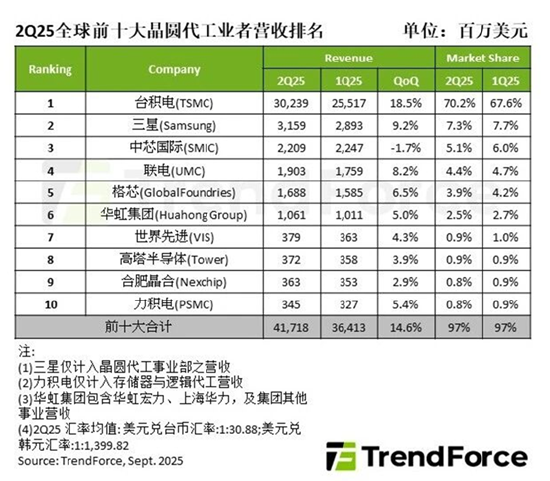
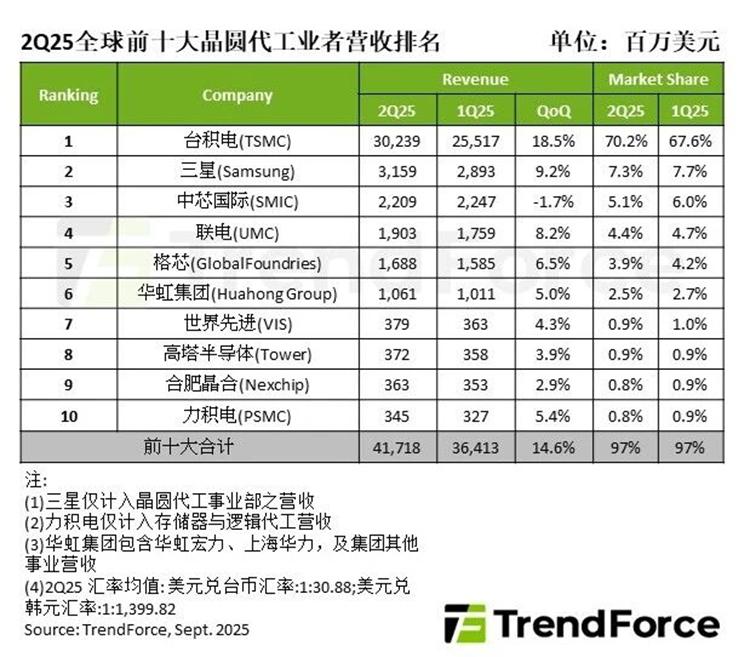
Core Viewpoint - The semiconductor industry is experiencing a recovery in 2025, driven by explosive growth in AI technology and domestic consumption subsidies stimulating demand for new devices [1] Group 1: Industry Overview - In Q2 2025, the top ten global foundries generated a total revenue of 41.718 billion, reflecting a quarter-on-quarter growth of 14.6% [3] - TSMC's revenue reached 30.239 billion, with a market share increase of 2.6 percentage points to 70.2%, while other major players saw a decline in market share [1][3] - The competition focus in the foundry market is shifting from "advanced processes" to "advanced packaging," with TSMC holding a significant advantage in both areas [1] Group 2: Company Performance - SMIC, Hua Hong, and JCET showed revenue growth rates of 23.14%, 19.09%, and 18.21% respectively in H1 2025, indicating a recovery in their financial performance [4] - SMIC's gross margin improved by 8 percentage points year-on-year, while Hua Hong and JCET also saw slight increases in their gross margins [4] - SMIC's capital expenditure reached 3.3 billion in H1 2025, maintaining a pace of adding 50,000 12-inch wafers annually [5] Group 3: Product Development - Hua Hong's revenue from power semiconductors grew by 59.3% year-on-year, with its share of total revenue increasing by 7.4 percentage points to 28.5% [5] - JCET is diversifying its product offerings, with significant advancements in OLED, CIS, and logic chip markets, including mass production of 40nm OLED display driver chips [5][6] - The revenue structure of JCET shows a growing contribution from 40nm products, which is expected to enhance profitability [6]



晶圆代工,分化加剧
3 6 Ke· 2025-09-15 00:21
Core Insights - The semiconductor foundry industry is experiencing significant differentiation, with TSMC dominating the market, capturing 70.2% of global market share in Q2 2025, and achieving a revenue of $30.239 billion, marking an 18.5% quarter-over-quarter increase [1][2][5] - TSMC's success is attributed to its advanced process technologies (3nm, 5nm) and unique packaging solutions, which have positioned it as a critical player in the AI and high-performance computing (HPC) sectors [5][9][11] - Other foundries, such as Samsung, SMIC, and UMC, are facing challenges in maintaining market share and profitability, with Samsung's revenue at $3.159 billion and a market share of 7.3%, while SMIC's revenue declined slightly to $2.209 billion [2][6][12] Industry Overview - The top ten foundries collectively generated $41.718 billion in revenue in Q2 2025, reflecting a 14.6% increase from the previous quarter, indicating a recovery in the semiconductor cycle [2][4] - TSMC's revenue for the first half of 2025 reached $55.6 billion, with a gross margin of 58.7% and a net profit of $24 billion, showcasing its strong financial performance compared to its competitors [5][19] - The foundry landscape is characterized by a "one strong, many strong" dynamic, where TSMC leads while other firms like UMC and GlobalFoundries maintain stability through specialized processes [4][5][6] Trends and Challenges - The industry is witnessing three major trends: AI-driven demand, structural recovery in mature processes, and geopolitical reshaping of global supply chains [8][13] - AI and HPC demand have intensified the focus on advanced packaging, with TSMC being the only supplier capable of large-scale, high-yield CoWoS packaging, which is critical for AI chip production [9][16] - Mature process nodes are undergoing a recovery phase after significant inventory adjustments, with companies like UMC and VIS reporting improved margins due to rising demand in consumer electronics and automotive sectors [12][13] Future Outlook - The second half of 2025 will be pivotal, with TSMC expanding its packaging capacity and Samsung betting on its 2nm technology to regain competitiveness [15][17] - SMIC and other Chinese foundries need to enhance their product mix and manage depreciation pressures to improve profitability, while companies like Huahong and PSMC face challenges in maintaining financial stability [17][18] - The evolving landscape suggests that future winners will be those who can provide comprehensive system solutions rather than just excel in individual technologies [19]
研报 | 2Q25晶圆代工营收季增14.6%创新高,台积电市占达70%
TrendForce集邦· 2025-09-01 06:21
Core Insights - The overall revenue of the top ten foundries reached over $41.7 billion in Q2 2025, marking a record high with a quarter-on-quarter increase of 14.6% driven by pre-stockpiling effects from consumer subsidies in China and new product launches in the second half of the year [2][5]. Group 1: Industry Performance - The second quarter saw a strong recovery in foundry capacity utilization and shipment volume, primarily due to seasonal demand for new products in smartphones, laptops, and servers [2]. - The advanced process technology is expected to boost revenue significantly, with high-priced wafers contributing positively to the industry's overall performance [2]. Group 2: Company Revenue Performance - TSMC reported a revenue of $30.24 billion in Q2 2025, a quarter-on-quarter increase of 18.5%, achieving a market share of 70.2% [5][6]. - Samsung's revenue reached approximately $3.16 billion, with a 9.2% quarter-on-quarter increase, maintaining a market share of 7.3% [5][7]. - SMIC's revenue slightly decreased by 1.7% to around $2.21 billion due to shipment delays and ASP decline, resulting in a market share of 5.1% [5][8]. - UMC's revenue grew by 8.2% to $1.90 billion, with a market share of 4.4% [5][9]. - GlobalFoundries achieved a revenue of nearly $1.69 billion, increasing by 6.5% quarter-on-quarter, with a market share of 3.9% [5][10]. - HuaHong Group's revenue increased by approximately 5% to $1.06 billion, maintaining a market share of 2.5% [5][11]. - Vanguard's revenue was close to $0.38 billion, with a 4.3% increase, ranking seventh [5][12]. - Tower's revenue reached $0.37 billion, growing by 3.9% [5][13]. - Nexchip's revenue was $0.36 billion, with a nearly 3% increase [5][14]. - PSMC's revenue grew by 5.4% to $0.35 billion, ranking tenth [5][15].

华虹半导体(01347):需求景气度持续向好,产能提升驱动未来增长
Orient Securities· 2025-08-25 02:44
Investment Rating - The report maintains a "Buy" rating for the company [4][7]. Core Views - The demand outlook remains positive, with capacity expansion driving future growth [2][12]. - The company is expected to achieve revenue growth, with projected revenues of $2.419 billion in 2025, $2.949 billion in 2026, and $3.390 billion in 2027, reflecting year-on-year growth rates of 21%, 22%, and 15% respectively [6][12]. - The company is actively expanding its production capacity, with the monthly capacity increasing from 391 thousand wafers in Q4 2024 to 447 thousand wafers in Q2 2025 [12]. Financial Forecasts and Investment Recommendations - The forecast for the company's net asset per share for 2025-2027 is $3.66, $3.75, and $3.87 respectively, with a target price of HKD 79.63 based on a comparable company average PB of 2.8 times for 2025 [4][13]. - The company reported a revenue of $566 million in Q2 2025, a year-on-year increase of 18% and a quarter-on-quarter increase of 5% [12]. - The gross margin for Q2 2025 was 10.9%, exceeding the company's guidance of 7%-9% [12].
财报超预期市值却跳水,中芯国际怎么了?
3 6 Ke· 2025-08-12 02:55
Core Viewpoint - SMIC's Q2 financial report slightly exceeded expectations, showing a slowdown in revenue and gross profit decline compared to previous quarters, but still better than the company's guidance and market expectations [1][8]. Financial Performance - In Q2 2025, SMIC achieved revenue of $2.21 billion, a year-on-year increase of 16.2%, but a quarter-on-quarter decline of 1.7% [3]. - The revenue breakdown shows that 12-inch wafer products contributed $1.59 billion (76.1% of total revenue), while 8-inch wafer products generated $499 million (23.9% of total revenue), with the latter showing a quarter-on-quarter growth of 6.6% [3]. - The Chinese market accounted for over 80% of revenue, with Q2 revenue from China at $1.86 billion, a 1.9% decline quarter-on-quarter [3]. Gross Profit and Margins - SMIC reported a gross profit of $450 million in Q2, a year-on-year increase of 69.7%, but a quarter-on-quarter decline of 11.1%, resulting in a gross margin of 20.4% [5][6]. - The decline in gross margin was attributed to production volatility and changes in product mix, leading to a decrease in average selling price (ASP) by 6.4% [5][6]. Operating Expenses - Operating expenses increased by 24.0% quarter-on-quarter and 9.3% year-on-year, primarily due to rising R&D and management costs [7]. - R&D expenses rose by 22.1% quarter-on-quarter, reflecting ongoing challenges in advanced process yields [7]. Market Reaction and Future Outlook - Despite the slightly better-than-expected results, SMIC's stock fell 8.2% in Hong Kong and 4.3% in A-shares on the day following the report, indicating market skepticism [2][9]. - For Q3, SMIC expects revenue growth of 5%-7% and a gross margin of 18%-20%, but expressed concerns about visibility for Q4 due to potential adjustments in smartphone market demand [9][10]. Strategic Considerations - The shift towards mature processes raises concerns about future earnings volatility, especially if demand driven by policy incentives diminishes [11]. - The company's ability to advance in technology and maintain competitive positioning is critical, given the capital-intensive nature of the semiconductor industry [13][14]. Valuation Insights - SMIC's current price-to-book (PB) ratio is 2.4x, compared to an average of 1.9x for peer companies, suggesting a relatively high valuation [15]. - The A-share PB is currently at 4.6x, reflecting market expectations, but there is potential for further valuation increases if domestic substitution trends strengthen or if advancements in technology occur [15].
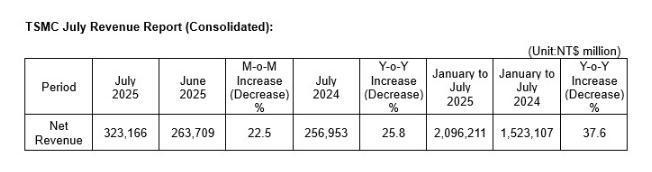
AI需求持续热捧!台积电7月营收同比大增25.8%
Ge Long Hui· 2025-08-08 08:27
Core Viewpoint - TSMC continues to experience strong revenue growth driven by sustained demand for AI chips, with significant year-over-year increases in revenue reported for July 2025 and the first seven months of the year [1][2]. Revenue Performance - In July 2025, TSMC's revenue reached NT$323.17 billion, marking a month-over-month increase of 22.5% and a year-over-year increase of 25.8% [1][2]. - For the period from January to July 2025, TSMC's total revenue amounted to NT$2,096.21 billion, reflecting a 37.6% increase compared to the same period in 2024 [1][2]. Market Position and Strategic Developments - TSMC's stock reached an all-time high amid news of potential tariff exemptions for its investments in the U.S., particularly a $200 billion investment plan [3]. - Analysts suggest that TSMC and GlobalWafers are likely to benefit from new tariff policies due to their substantial investments in U.S. production facilities, while UMC and ASE may lose market share due to limited local presence [5]. - TSMC maintains a significant share in the smartphone chip market, which is showing signs of recovery, as indicated by Sony's recent financial report [5]. - Morgan Stanley's report aligns with expectations that TSMC's commitment to U.S. wafer fabrication investments should qualify for tariff exemptions, which is a more favorable outcome than many investors anticipated [5]. Future Investment Plans - Morgan Stanley indicates that TSMC plans to invest $165 billion in U.S. operations through 2030, maintaining a bullish outlook on the stock with a target price of NT$1,388 [6].
台积电2nm泄密,日企光速解雇一人
Guan Cha Zhe Wang· 2025-08-08 06:16
Group 1 - Tokyo Electron announced the dismissal of an employee from its Taipei branch following the arrest of six individuals suspected of stealing TSMC's trade secrets [1] - TSMC confirmed the leak of trade secrets related to its 2nm process, resulting in the dismissal of multiple employees and legal actions against them [1][2] - The investigation revealed that approximately 10 individuals were involved, including a former TSMC employee who contacted R&D personnel to obtain confidential information [1] Group 2 - Three individuals from the 2nm trial production team were found to have leaked over 400 images of process integration technology to Tokyo Electron employees while working remotely [2] - TSMC maintains a zero-tolerance policy towards violations of trade secret protection and has implemented strict monitoring mechanisms to detect such breaches [1][2] - In the global foundry market, TSMC holds a dominant position with a 67.6% market share, while Samsung and SMIC follow with 7.7% and 6.0% respectively [3]

94岁张忠谋2万字访谈全文:台积电如何“搞定”苹果、英伟达
3 6 Ke· 2025-08-06 04:29
Core Insights - The interview with Zhang Zhongmou highlights TSMC's strategic decisions that led to its dominance in the semiconductor industry, particularly in securing contracts with major clients like Apple and Nvidia [1][2][3] Group 1: TSMC's Strategic Decisions - TSMC's success in securing Apple's orders was attributed to Intel's arrogance and TSMC's ability to meet customer demands, unlike Intel [1][2] - The 28nm node was identified as a pivotal moment for TSMC, with significant investments made to capitalize on its potential during the smartphone boom [2][3] - Zhang Zhongmou's decision to increase capital expenditure to nearly $6 billion in 2010 was based on the belief that 28nm would be the "sweet spot" in performance, cost, and energy efficiency [2][3] Group 2: Relationships with Key Clients - TSMC's relationship with Nvidia began in 1997 when Zhang Zhongmou responded to a letter from Nvidia's CEO, leading to a partnership that positioned Nvidia as one of TSMC's top clients [3][8] - In 2009, TSMC faced challenges with Nvidia regarding the 40nm node, which led to a compensation agreement exceeding $100 million to resolve disputes [2][3][26] - The partnership with Apple was solidified after a dinner meeting where Apple proposed a 40% profit margin, which TSMC found acceptable despite initial concerns about resource allocation for the 20nm node [66][67] Group 3: Organizational Structure and Management Philosophy - Zhang Zhongmou opposed performance-based layoffs, advocating for a functional organizational structure that prioritized employee retention and development [16][18][20] - The restructuring of TSMC's business development and marketing teams aimed to enhance operational efficiency and customer engagement [42][49] - Zhang's leadership style emphasized maintaining strong relationships with clients and fostering a collaborative environment within the company [28][56]


30多家半导体大厂Q2财报:有复苏信号!
芯世相· 2025-07-31 07:05
Group 1: Industry Overview - The semiconductor industry is experiencing a moderate recovery, with Q1 2025 global sales reaching $167.7 billion, a year-on-year increase of 18.8% [66] - In May 2025, global semiconductor sales were $59 billion, showing a year-on-year growth of 19.8% [66] - The recovery is driven by strong demand in the Americas and Asia-Pacific regions, particularly in high-end computing and storage due to AI [66] Group 2: Company Performance - Texas Instruments reported Q2 revenue of $4.45 billion, a 9% quarter-on-quarter increase and a 16% year-on-year increase, driven by a broad recovery in the industrial market [6] - STMicroelectronics experienced a 14.4% year-on-year decline in Q2 revenue to $2.76 billion, resulting in a net loss of $133 million due to restructuring costs [7] - NXP's Q2 revenue was $2.93 billion, a 6% year-on-year decline but a 3% quarter-on-quarter increase, with all key end markets performing better than expected [9] Group 3: Specific Company Highlights - Qualcomm's Q3 revenue increased by 10% year-on-year to $10.365 billion, with automotive chip revenue growing by 21% [11] - MediaTek's Q2 revenue was NT$150.37 billion, a 1.9% quarter-on-quarter decline but a 4.3% year-on-year increase, driven by demand for AI and automotive chips [13] - Samsung's Q2 operating profit fell by 55.2% year-on-year to 4.7 trillion KRW, marking a six-quarter low due to AI chip sales issues [14][15] Group 4: Market Trends - The industrial market is showing signs of recovery, while the automotive market is lagging behind by about a year [6] - AI-related demand continues to be strong, particularly in high-performance computing and storage sectors [66] - The overall semiconductor market is expected to see varied recovery rates across different sectors, with traditional markets like industrial applications rebounding first [66] Group 5: Financial Performance of Key Players - SK Hynix reported record high Q2 revenue of 22.232 trillion KRW, driven by strong demand for AI-related memory products [16] - Micron Technology's Q3 revenue reached $9.3 billion, a 37% year-on-year increase, attributed to record DRAM revenue [19] - TSMC's Q2 revenue was approximately NT$933.8 billion, with a net profit increase of 60.7% year-on-year [43]