鸿蒙智行

Search documents
奔驰、宝马、奥迪在华销量集体下滑,开启自救
2 1 Shi Ji Jing Ji Bao Dao· 2026-01-19 14:37
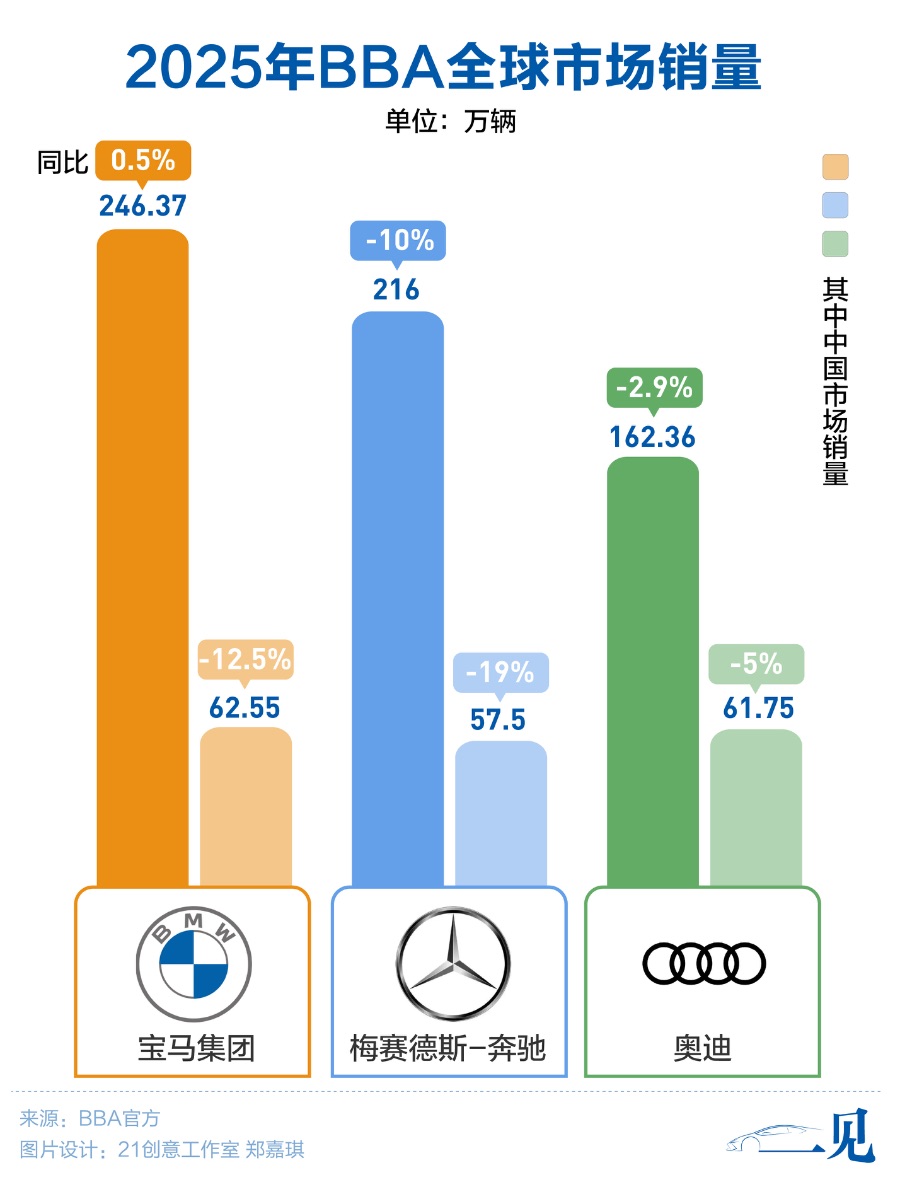
Core Insights - The traditional luxury car brands are losing their appeal in the wave of new energy vehicles, as evidenced by the sales data from BBA (Benz, BMW, Audi) [1][5] - BBA's global sales performance is closely tied to their weak performance in the Chinese market, which is their largest single market [2][6] Group 1: Sales Performance - BMW leads with global sales of 2.4637 million units in 2025, a slight increase of 0.5% year-on-year; Mercedes-Benz sold 2.16 million units, down 10%; Audi's sales were 1.6236 million units, down 2.9% [1] - In China, BMW's sales fell to 625,500 units in 2025, a decrease of 12.5%; Mercedes-Benz's sales dropped to 575,000 units, down 19%; Audi's sales were 617,500 units, down 5% [2] - BMW's sales in China have seen a continuous decline from 825,000 units in 2023 to 714,500 units in 2024, and further down to 625,500 units in 2025, losing about 200,000 units in two years [4] Group 2: Market Dynamics - The core models of BBA, such as BMW 3 Series, Mercedes-Benz C-Class, and Audi A4L, are facing significant threats as the market for fuel vehicles in the 300,000 to 400,000 yuan price range is declining [7] - In 2025, the market share of Chinese brands in passenger vehicles reached 69.5%, while the share of German brands shrank to 12.1% [8] Group 3: Strategic Responses - BBA is facing a dual challenge of a shrinking fuel vehicle market and a lack of presence in the electric vehicle segment [8] - BMW plans to implement aggressive price cuts across 31 models starting January 1, 2026, with reductions exceeding 10% for 24 models and over 20% for 5 models [11] - Mercedes-Benz aims to focus on product upgrades and smart technology, planning to launch over 15 new and updated products in 2026 [13] Group 4: Future Outlook - BBA's strategic shift towards localized development and operations is becoming increasingly important in the rapidly evolving Chinese market [14] - The success of BBA's transformation efforts in 2026 will depend on their ability to enhance product capabilities and restructure their organizational frameworks [14]


从“全球车”到“中国定制”,BBA在华转型路径渐明
2 1 Shi Ji Jing Ji Bao Dao· 2026-01-19 12:36
Core Insights - The traditional luxury car brands are losing their appeal in the face of the new energy wave, as evidenced by the sales data from BBA (Benz, BMW, Audi) [1] - BBA's global sales performance is closely tied to their weak performance in the Chinese market, which remains their largest single market but has seen a significant reduction in contribution [1][4] Group 1: Sales Performance - BMW leads with global sales of 2.4637 million units in 2025, a slight increase of 0.5% year-on-year; Mercedes-Benz sold 2.16 million units, down 10%; Audi sold 1.6236 million units, down 2.9% [1] - In China, BMW's sales fell to 625,500 units in 2025, a decrease of 12.5%; Mercedes-Benz's sales dropped to 575,000 units, down 19%; Audi's sales decreased to 617,500 units, down 5% [1] - BMW's sales in China have seen a continuous decline from 825,000 units in 2023 to 714,500 units in 2024, and further down to 625,500 units in 2025, losing approximately 200,000 units in two years [3] - Mercedes-Benz's sales have sharply declined from a peak of 774,000 units in 2020 to 575,000 units in 2025 [3] Group 2: Market Dynamics - The core models of BBA, such as BMW 3 Series, Mercedes-Benz C-Class, and Audi A4L, are facing significant threats as the market for fuel vehicles in the 300,000 to 400,000 yuan price range is declining [6] - In 2025, the market share of Chinese passenger cars reached 69.5%, while the share of German brands shrank to 12.1% [6] - BBA is caught in a dual dilemma of a shrinking fuel vehicle market and a lack of presence in the electric vehicle segment [7] Group 3: Strategic Responses - BMW plans to implement aggressive price cuts starting January 1, 2026, with reductions exceeding 10% for 24 models and over 20% for 5 models, including a significant drop of 301,000 yuan for the flagship electric model i7 M70L [10] - Mercedes-Benz is focusing on product upgrades and smart technology, planning to launch over 15 new and updated products in 2026, including a new generation of S-Class and GLC electric models [12] - Audi aims to continue its localization strategy in 2026, with new models like the Q5L and A6L, and plans to leverage local technology to enhance market competitiveness [12] Group 4: Future Outlook - The year 2026 is seen as a critical period for BBA to transform and recover in the Chinese market, with a focus on localizing product development and enhancing customer experience [13] - Positive changes are occurring, such as increased involvement of local teams in the development of new technologies tailored to Chinese consumer preferences [13]
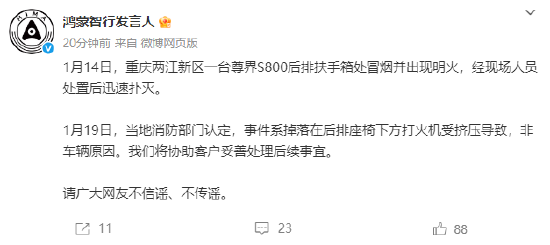
鸿蒙智行回应“重庆一台尊界S800起火”:系打火机被挤压,非车辆原因
Feng Huang Wang· 2026-01-19 09:38
Group 1 - The core incident involved a smoking and flame occurrence from the rear armrest of the ZunJie S800 vehicle, which was quickly extinguished by on-site personnel [1][2] - The official response clarified that the cause of the incident was a lighter that was crushed under the rear seat, and it was not due to any vehicle malfunction [1][2] - The company emphasized the importance of not spreading rumors regarding the incident and stated that they would assist customers in handling subsequent matters [2]

重庆一尊界S800起火,鸿蒙智行回应
Xin Lang Cai Jing· 2026-01-19 09:29
Core Viewpoint - The spokesperson for Hongmeng Zhixing addressed the incident involving the Zun Jie S800 vehicle, clarifying that the fire was caused by an external factor rather than a vehicle malfunction [1][3]. Group 1 - On January 14, a Zun Jie S800 vehicle in Chongqing's Liangjiang New Area experienced smoke and flames from the rear armrest box, which was quickly extinguished by on-site personnel [1][3]. - The local fire department concluded that the fire was caused by a dropped lighter being pressed under the rear seat, confirming it was not due to the vehicle itself [1][3]. - The company stated it would assist customers in handling subsequent matters and urged the public not to spread rumors [1][3].
奔驰、宝马销量跌回十年前,押注“本土化”背水一战
Xin Hua Cai Jing· 2026-01-19 01:48
Core Viewpoint - The BBA (Benz, BMW, Audi) brands are experiencing significant sales declines in China, with projections indicating a return to sales levels not seen in a decade, highlighting the increasing pressure from domestic competitors and changing market dynamics [1][2][4]. Sales Performance - In 2025, Benz's global sales are projected to be 2.16 million units, a 10% decrease year-on-year, with sales in China at 551,900 units, down 19% [1]. - BMW's global sales are expected to reach 2.46 million units, a slight increase of 0.5%, while its Chinese sales are forecasted at 625,500 units, a decline of 12.5% [1]. - Audi's global sales are projected at 1.62 million units, down 2.9%, with Chinese sales at 617,500 units, a decrease of 5% [1]. - BBA brands have seen consecutive sales declines in China for two years, dropping to levels last seen in 2017 [1]. Market Dynamics - By 2026, both Benz and BMW are expected to forecast annual sales of less than 500,000 units in China, reverting to sales levels from a decade ago [2]. - Domestic high-end brands are setting ambitious sales targets, with NIO aiming for 456,400 to 489,000 units, Xiaomi targeting 550,000 units, and Hongmeng Zhixing projecting 1 to 1.3 million units by 2026 [3]. Financial Performance - BBA brands reported significant profit declines in recent financial statements, with Benz's net profit down 50%, Audi's down 25%, and BMW's down 6.8% [4]. Pricing Strategies - BMW initiated a price reduction across 31 models, with discounts reaching up to 301,000 yuan, indicating market pressure [6]. - The luxury car pricing structure is under significant strain, with reports of discounts reaching as low as 60-70% on various models [6]. Competitive Landscape - The BBA brands face intense competition from domestic brands that are rapidly gaining market share, particularly in the high-end segment [8]. - The shift towards electric and smart vehicles has left BBA brands lagging, as their products are often based on older platforms, leading to a competitive disadvantage [7][8]. Strategic Responses - BBA brands are beginning to adapt to the Chinese market by enhancing their product offerings and integrating local technology solutions [9][10]. - Benz plans to launch over 15 new models by 2026, while BMW aims to introduce around 20 new products, focusing on electric and smart vehicle technologies [10][11].
产销连续3年保持3000万辆以上规模 汽车产业竞争力源自硬实力
Xin Hua Wang· 2026-01-14 23:37
核心阅读 电动化技术持续进阶、前沿技术加快应用、反内卷措施先后落地……我国汽车产销量持续增长。亮 眼成绩单,折射出我国经济顶压前行、向新向优发展的强大韧性和澎湃动能。 重庆市沙坪坝区三峡广场,市民在试驾新能源汽车。孙凯芳摄(影像中国) 安徽省合肥市新桥智能电动汽车产业园,一辆新车下线。新华社记者 黄博涵摄 数据来源:中国汽车工业协会 制图:汪哲平 "方程豹钛7上市80天,累计销量突破5万台,成交均价超21万元,2025年12月销量超过3.4万 台。"方程豹汽车总经理熊甜波说。 高效的智能制造体系、强大的本土供应链能力、快速的技术迭代、密集投放的高竞争力新产品,叠 加政策组合效应下汽车内需有效释放,推动我国汽车产销量持续增长。我国汽车产销连续3年保持3000 万辆以上规模,连续17年稳居全球第一。 在外部压力加大和内部困难较多的复杂局面下,汽车产业的亮眼成绩单,折射出我国经济顶压前 行、向新向优发展的强大韧性和澎湃动能。 深耕电动化,多技术路线融合创新 2025年12月23日上午,漠河,气温零下28摄氏度。吉利汽车研究院系统控制开发工程师张鲁超打开 静置一夜的银河星舰7,开启了交通高峰期10公里测试。"今天测试 ...
产销连续3年保持3000万辆以上规模 汽车产业竞争力源自硬实力(经济聚焦)
Ren Min Ri Bao· 2026-01-14 21:55
Core Insights - The continuous advancement of electrification technology and the application of cutting-edge technologies have led to sustained growth in China's automotive production and sales, reflecting the resilience and dynamic momentum of the economy [1] Group 1: Automotive Production and Sales - China's automotive production and sales have maintained a scale of over 30 million units for three consecutive years, ranking first globally for 17 years [1] - The production and sales of new energy vehicles (NEVs) are projected to reach 16.626 million and 16.49 million units respectively in 2025, with year-on-year growth of 29% and 28.2%, making up 47.9% of total new car sales [2] Group 2: Technological Advancements - The average range of pure electric passenger vehicles in China is expected to approach 500 kilometers by 2025, with rapid adoption of 800V high-voltage silicon carbide platforms and fast-charging technology [2] - The integration of various technological routes, including electrification, efficient internal combustion engines, hydrogen fuel, and synthetic fuels, is advancing, with China's "super electric hybrid technology" becoming a successful example for reverse technology export [2] Group 3: Export Growth - In 2025, China's NEV exports are expected to reach 2.615 million units, doubling year-on-year, with passenger vehicle exports at 2.532 million units and commercial vehicle exports at 83,000 units, showing significant growth [3] Group 4: Intelligent Driving and Automation - Huawei's ADS 5 is transitioning from technology validation to mass production, with over 1 million units equipped and a user engagement rate exceeding 95%, indicating a shift towards large-scale deployment of autonomous driving technology [4] - The proportion of new passenger vehicles with L2-level combined auxiliary driving functions has exceeded 60%, with the first L3-level conditional autonomous driving models receiving approval [4] Group 5: Industry Transformation and Profitability - Measures to combat "price wars" and improve industry standards have been implemented, leading to a 4.4% profit growth in the automotive industry from January to October 2025, accelerating to 7.5% by November [6] - The industry is transitioning from resource-dependent, low-cost competition to a focus on technological innovation and value upgrading, with high-end domestic brands seeing over 40% year-on-year sales growth [6] Group 6: Future Outlook - The Chinese automotive industry is expected to continue its high-quality development and maintain stable market operations in 2026, supported by the smooth transition of new policies [7]
车企2025产销快报解析:四大板块齐头并进
Xin Lang Cai Jing· 2026-01-14 06:06
Core Insights - The Chinese passenger car market is projected to retail 23.78 million units in 2025, reflecting a 4% year-on-year growth, supported by policies like "trade-in" [20][21] - Major domestic automakers such as BYD, Geely, Changan, and Leap Motor have achieved significant breakthroughs, while several joint ventures are showing signs of recovery in China [20][21] Domestic Automakers Performance - BYD set a new annual sales record with 4.60 million units sold in 2025, a 7.73% increase, with pure electric vehicle sales reaching 2.25 million units, up 27.85% [21][22] - SAIC Group sold 4.51 million vehicles in 2025, marking a 12.3% increase, with its new energy vehicle sales growing by 33.1% to 1.64 million units [3][21] - China FAW achieved total vehicle sales of 3.30 million units, a 3.2% increase, with its new energy vehicle sales soaring by 71% to 366,000 units [3][22] - Geely exceeded its sales target with 3.02 million units sold, a 39% increase, and its new energy vehicle sales reached 1.69 million units, up 90% [4][22] - Changan's sales reached 2.91 million units, an 8.5% increase, with new energy vehicle sales growing by 51% to 1.11 million units [4][23] - Chery Group achieved a record high of 2.81 million units sold, with new energy vehicle sales increasing by 54.9% to 903,800 units [5][23] Joint Ventures Performance - Joint ventures are under pressure but some have found ways to adapt, with FAW-Volkswagen selling 1.59 million vehicles, maintaining its position as the top joint venture [26][27] - SAIC Volkswagen achieved sales of 1.06 million units, successfully surpassing the million mark [27] - Toyota's joint ventures in China reported positive growth, with FAW Toyota selling 805,500 units, marking three consecutive years of growth [27][28] New Energy Vehicle Market - The new energy vehicle segment is a common highlight across major automakers, with significant growth reported [21][22] - Leap Motor achieved a remarkable 103% year-on-year growth, delivering 596,600 units in 2025 [29] - Xpeng Motors delivered 429,400 units, a 126% increase, while NIO delivered 326,000 units, up 46.9% [30][31] Export Growth - China's automobile exports are expected to exceed 7 million units in 2025, marking a historic high [16][34] - Chery led the export of Chinese passenger cars with 1.34 million units, a 17.4% increase [34][35] - BYD's overseas sales surpassed 1 million units for the first time, reaching 1.05 million units, a 145% increase [35][36] Globalization Strategies - SAIC Group updated its overseas strategy, achieving 1.07 million units in overseas sales, a 3.1% increase [35][36] - Changan's overseas sales reached 637,000 units, an 18.9% increase, while Geely's overseas sales totaled 420,000 units [36][37] - New energy vehicle startups are also targeting international markets, with Leap Motor and Xpeng making significant strides in overseas deliveries [36][37]




四大板块齐头并进——车企2025产销快报解析
Zhong Guo Qi Che Bao Wang· 2026-01-13 09:43
Core Insights - The Chinese passenger car market is projected to retail 23.78 million units in 2025, reflecting a 4% year-on-year growth, supported by policies like "trade-in" [2] - Major domestic automakers such as BYD, Geely, Changan, and Leap Motor have achieved significant progress, while several joint venture companies are showing signs of recovery in China [2] Domestic Automakers Performance - BYD achieved a record annual sales of 4.60 million units in 2025, a 7.73% increase, with pure electric vehicle sales reaching 2.25 million units, up 27.85%, surpassing Tesla in global sales [3] - SAIC Group sold 4.51 million vehicles in 2025, a 12.3% increase, with its new energy vehicle sales growing by 33.1% to 1.64 million units [3] - China FAW's total vehicle sales reached 3.30 million units, a 3.2% increase, with its new energy vehicle sales soaring by 71% to 366,000 units [4] - Geely's total sales reached 3.02 million units, a 39% increase, with new energy vehicle sales hitting 1.69 million units, up 90% [4] - Changan's sales reached 2.91 million units, an 8.5% increase, with new energy vehicle sales growing by 51% to 1.11 million units [5] - Chery Group achieved a record high of 2.81 million units sold, with new energy vehicle sales increasing by 54.9% to 903,800 units [5] Joint Venture Automakers Performance - Joint venture automakers are under pressure but some have found ways to adapt, with FAW-Volkswagen leading in sales with 1.59 million units sold [7] - SAIC Volkswagen achieved sales of 1.06 million units, maintaining a strong position in the market [8] - Toyota's joint ventures in China reported positive growth, with FAW Toyota selling 805,500 units, a 3-year consecutive growth [8] New Energy Vehicle Market - New energy vehicles are a common highlight across major domestic automakers, with significant growth in sales and market penetration [3][4][5] - New entrants like Leap Motor and NIO are also showing strong growth, with Leap Motor achieving 596,600 units sold, a 103% increase [10] - Xpeng Motors delivered 429,400 units, a 126% increase, while NIO delivered 326,000 units, a 46.9% increase [11] Export Growth - China's automobile exports are expected to exceed 7 million units in 2025, marking a historic high [13] - Chery led the export of Chinese passenger cars with 1.34 million units, a 17.4% increase [13] - BYD's overseas sales surpassed 1 million units, a 145% increase, with significant growth in Europe [14] - New energy vehicle exports are also on the rise, with companies like Leap and Xpeng expanding their international presence [16]



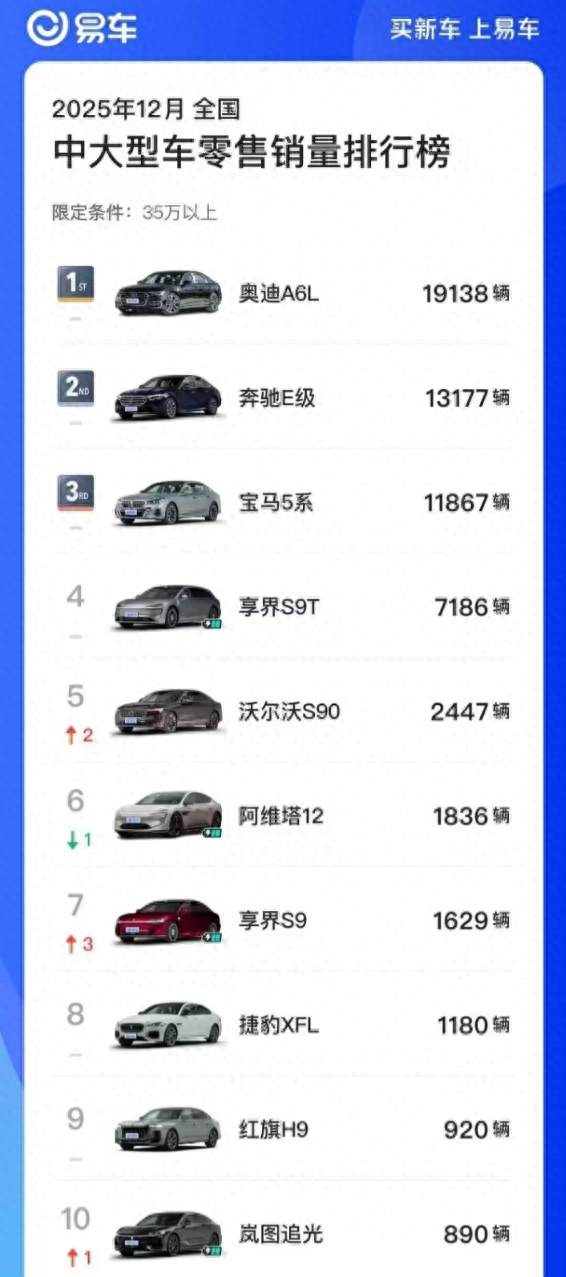
打破BBA垄断!享界12月冲到中大型车销量榜第四 直追宝马5系
Xin Lang Cai Jing· 2026-01-12 12:50
Group 1 - The core viewpoint of the articles highlights that the brand "Xiangjie" under Hongmeng Zhixing has emerged as a significant player in the mid-to-large vehicle and new energy vehicle market, particularly in December [1][4] - In the retail ranking for mid-to-large vehicles, Audi A6L, Mercedes-Benz E-Class, and BMW 5 Series remain the top three models, dominating the list [1] - The Xiangjie S9T has shown remarkable growth, achieving sales of 7,186 units in December, maintaining the fourth position in the sales ranking for three consecutive months, closely following the BMW 5 Series [4][6] Group 2 - The Xiangjie S9T is recognized as the best-selling model in the domestic travel car segment, contributing to the popularization of this niche market [4] - Combined sales of the Xiangjie S9T and Xiangjie S9 reached 8,815 units in December, with the S9T leading the luxury new energy vehicle segment [4][6] - The Xiangjie brand is expanding its sales network with new stores opening, which is expected to further boost sales and market presence [6]