
藏格矿业

Search documents
亨斯迈、陶氏MDI价格上调,旭化成拟停产己二胺 | 投研报告
Zhong Guo Neng Yuan Wang· 2025-12-09 06:03
Industry Overview - The chemical sector's overall performance ranked 16th this week (2025/12/01-2025/12/05) with a fluctuation of 0.13%, underperforming compared to the Shanghai Composite Index and the ChiNext Index, which had fluctuations of 0.37% and 1.86% respectively [1] - The chemical industry is expected to continue its differentiated trend in 2025, with a focus on synthetic biology, pesticides, chromatography media, sweeteners, vitamins, light hydrocarbon chemicals, COC polymers, and MDI [1] Synthetic Biology - The arrival of a pivotal moment in synthetic biology is anticipated, driven by the adjustment of energy structures, which may disrupt fossil-based materials and favor low-energy products [1] - Traditional chemical companies are expected to compete based on energy consumption and carbon tax costs, with successful firms leveraging green energy alternatives and integrated advantages to reduce costs [1] - Companies to watch in the synthetic biology field include Kasei Bio and Huaheng Bio [1] Refrigerants - The quota policy for third-generation refrigerants is set to be implemented, leading to a high prosperity cycle for this segment [2] - The supply of refrigerants is expected to decrease due to the "quota + continuous reduction" phase starting in 2024, while demand remains stable due to market expansions in heat pumps and cold chains [2] - Companies benefiting from this trend include Juhua Co., Sanmei Co., Haohua Technology, and Yonghe Co. [2] Electronic Specialty Gases - Electronic specialty gases are critical for the electronics industry, characterized by high technical barriers and added value [3] - The domestic market faces a mismatch between rapid upgrades in wafer manufacturing and insufficient high-end electronic specialty gas capacity, presenting opportunities for domestic replacements [3] - Key players in this sector include Jinhong Gas, Huate Gas, and China Shipbuilding Gas [3] Light Hydrocarbon Chemicals - The trend towards light raw materials in the global olefin industry is notable, with a shift from heavy naphtha to lighter low-carbon alkanes like ethane and propane [4] - Light hydrocarbon chemicals are favored for their low carbon emissions, low energy consumption, and low water usage, aligning with global carbon neutrality goals [4] - Companies to focus on in this area include Satellite Chemical [4] COC Polymers - The industrialization of COC/COP (cyclic olefin copolymer) is accelerating in China, driven by domestic companies overcoming previous R&D challenges [5] - The demand for COC/COP is increasing in various applications, including mobile camera lenses and medical packaging, with a strong push for domestic alternatives due to supply chain security concerns [5] - Acelor is a notable company in the COC polymer production segment [5] Potash Fertilizers - Potash fertilizer prices are expected to rebound as the industry enters a destocking cycle, with supply constraints from major producers like Canpotex and Nutrien [6] - The demand for potash is anticipated to rise due to increased planting intentions among farmers, driven by higher grain prices [6] - Key companies in the potash sector include Yara International, Salt Lake Potash, Zangge Mining, and Dongfang Iron Tower [6] MDI Market - The MDI market is characterized by oligopoly, with demand steadily increasing due to the expansion of polyurethane applications [7] - The market is currently experiencing price stabilization at low levels, but profitability remains strong, with future supply dynamics expected to improve [7] - Wanhu Chemical is a key player to watch in the polyurethane sector [7] Chemical Price Tracking - The top five price increases this week included liquid chlorine (21.43%), butadiene (10.29%), and nitric acid (8.33%) [8] - The top five price decreases included trichloroethylene (-10.64%) and phenol (-6.17%) [8] Supply Side Tracking - This week, 166 chemical companies reported changes in production capacity, with five new repairs and five restarts [9]
未来一季度迎险资配置窗口,红利资产有望重获关注
Sou Hu Cai Jing· 2025-12-09 01:29
Core Viewpoint - The recent adjustments in insurance company risk factors are expected to encourage long-term allocations in quality equity assets, particularly in dividend stocks, as institutional investors increase their equity asset allocations amid a supportive policy framework [1][25]. Group 1: Market Trends and Fund Flows - The China Securities Dividend ETF (515080) saw a net subscription of 59.78 million yuan yesterday, with a cumulative net subscription of 125 million yuan over the past three days [1]. - The insurance sector is anticipated to allocate 30% of new premiums to A-shares annually, with December to the first quarter being a traditional allocation window for insurance funds [25]. Group 2: Policy Implications - The recent notification from the Financial Regulatory Bureau regarding the adjustment of risk factors for insurance companies aligns with the trend of increasing investment in dividend stocks by insurance firms [2][25]. - The policy focus is on capital market and consumption policies, with an emphasis on stimulating domestic demand and supporting emerging industries [25]. Group 3: Dividend Stock Analysis - Huatai Securities estimates that the industry is currently under-allocated in dividend stocks by approximately 0.8 to 1.6 trillion yuan, which may be addressed in the next two to three years [2]. - The average dividend yield of the newly included stocks in the index is 4.15%, compared to 3.89% for those being removed, indicating a trend towards higher-yielding stocks [20]. Group 4: Performance Metrics - The latest PE ratio for the China Securities Dividend Index is 8.48 times, with a historical percentile of 98.43% over the past five years [14]. - The China Securities Dividend Total Return Index has shown a 40-day return difference of 1.54% relative to the Wind All A Index as of December 5 [8].


锂:近端强现实,远期依旧看好上涨
HTSC· 2025-12-08 13:09
Investment Rating - The industry investment rating is "Overweight (Maintain)" [7] Core Insights - The lithium industry is experiencing strong near-term demand, with significant price increases for lithium carbonate driven by supply disruptions and robust battery demand. However, there are considerable divergences in long-term demand forecasts, particularly for 2026 and 2027 [1][3][30] - The report anticipates a supply increase of 32.3% in 2026 and 17.1% in 2027, primarily from new projects in domestic salt lakes and increased production from African and Australian mines [2][10] - The demand forecast for 2026 estimates a total lithium carbonate demand of approximately 207.2 million tons LCE, with a year-on-year growth of 25.2% [25][30] - The supply-demand balance is expected to show a slight surplus in 2026 but may shift to a shortage in 2027 due to declining supply growth and sustained high demand [4][30] Supply Summary - The global lithium resource supply is projected to be 163.4 million tons in 2025, 216.2 million tons in 2026, and 253.2 million tons in 2027, with year-on-year growth rates of 22.3%, 32.3%, and 17.1% respectively [2][12][31] - Supply disruptions, particularly from the Jiangxi mine, have impacted the 2025 supply growth, which is expected to decline to 22.3% from 28.6% in 2024 [10][11] Demand Summary - The report highlights a significant divergence in demand growth expectations for 2026, with optimistic scenarios suggesting a 75% increase in energy storage installations and a 60% penetration rate for new energy vehicles [3][26] - The total demand range for lithium carbonate in 2026 is estimated between 197.5 million tons and 216.8 million tons LCE, reflecting a nearly 20 million tons variance based on different growth assumptions [26][30] Balance Summary - The supply-demand balance for 2025 is projected to show a shortage of approximately 2.0 million tons, while 2026 is expected to have a surplus of 9.1 million tons [4][30] - The report indicates that the lithium market may face a persistent shortage starting in 2027 due to reduced supply growth and high demand [4][30] Price Summary - The report estimates that the fundamental price for lithium carbonate in 2026 will be in the range of 80,000 to 90,000 yuan per ton, with potential upward pressure on prices in the second half of 2026 due to anticipated shortages [5][34] - If a sustained shortage occurs, prices could rise to 120,000 yuan per ton [5][34]




化工ETF(159870)盘中净申购近2亿份,继续看好铁锂、隔膜估值修复
Xin Lang Cai Jing· 2025-12-08 06:01
化工ETF紧密跟踪中证细分化工产业主题指数,中证细分产业主题指数系列由细分有色、细分机械等7 条指数组成,分别从相关细分产业中选取规模较大、流动性较好的上市公司证券作为指数样本,以反映 相关细分产业上市公司证券的整体表现。 数据显示,截至2025年11月28日,中证细分化工产业主题指数(000813)前十大权重股分别为万华化学 (600309)、盐湖股份(000792)、天赐材料(002709)、藏格矿业(000408)、巨化股份(600160)、华鲁恒升 (600426)、多氟多(002407)、恒力石化(600346)、宝丰能源(600989)、云天化(600096),前十大权重股合 计占比45.41%。 消息面上,周五盘后6F龙头三家企业天际、天赐、多氟多均发减持,市场情绪受到一定影响。但机构 指出,从估值上看,很多股票已经跌了很多了,逐渐进入左侧布局区间。锂电方面,支柱1的储能依然 表现强势,支柱2的汽车26Q1市场预期很弱,要等新能源车利空出尽/预期企稳。继续看好铁锂、隔膜, 26年需求带动紧缺,利润终究要修复到合理估值,行业龙头受益。 截至2025年12月8日 13:20,中证细分化工产业主题指数 ...
藏格矿业20251205
2025-12-08 00:41
Summary of the Conference Call for Cangge Mining Industry and Company Overview - The conference call discusses Cangge Mining, focusing on its operations in the potassium chloride and lithium carbonate sectors, as well as its investments in copper mining through its stake in Jilong Copper Industry [2][3]. Key Points and Arguments Potassium Chloride Segment - The company targets a production of 1 million tons and sales of 900,000 tons of potassium chloride for 2025. In the first three quarters, it achieved a production of 701,600 tons and sales of 783,800 tons, with a tax-inclusive selling price of approximately 2,920 RMB, reflecting a year-on-year increase of 26.88% [2][3]. - The high prices of potassium fertilizers globally and domestic winter storage demand are significant contributors to this performance [2]. Lithium Carbonate Segment - In the lithium carbonate sector, the company produced 6,021 tons and sold 4,800 tons in the first three quarters, adjusting its annual production and sales target to 8,510 tons. The production target for 2026 is projected to be between 10,000 to 12,000 tons [2][3]. - The company maintains an optimistic outlook on lithium prices and focuses on cost optimization [2][3][11]. Copper Mining Investment - Cangge Mining holds a 30.78% stake in Jilong Copper Industry, which contributed significant profits, with an investment income of 1.95 billion RMB in the first three quarters, accounting for about 71% of the company's net profit. Jilong Copper's production target for the year is between 185,000 to 190,000 tons [2][5]. Project Developments - The Mami Cuo project is expected to commence production next year, with limited impact from winter construction. The estimated cost is around 30,000 RMB per ton [2][4][6]. - The company has a priority purchase right regarding its stake in Mami Cuo, contingent upon the completion of the first phase of the project [7]. - The Laos potassium salt mine project has an exploration reserve of 984 million tons, and the company is confident in its potential despite the Lao government's temporary suspension of mining in the Vientiane area [4][15][16]. Cost Management - The expected production cost for the Mami Cuo project is 30,000 RMB per ton, benefiting from superior resource endowment and ongoing technological optimizations since 2017 [12][13]. - The production cost for the Qinghai headquarters is projected to be around 40,000 RMB per ton, with a total cost of approximately 50,000 RMB [19]. Market Outlook - The company views the recent fluctuations in lithium prices positively, asserting that it has a cost advantage that allows for profit even during price declines. It plans to continue its projects without adjustments due to price changes [10][11]. - The demand for lithium in energy storage and power sectors is expected to grow, particularly driven by electricity shortages in Europe and the U.S. and advancements in AI [11]. Other Important Information - The company is focused on maintaining production efficiency and quality while pursuing new projects like the Mami Cuo and Laos potassium salt mine [3]. - The company has made significant progress in its key projects and is prepared to report on developments as they occur [4][15][16].

2025年1-10月全国工业企业有523426个,同比增长2.97%
Chan Ye Xin Xi Wang· 2025-12-06 02:55
Group 1 - The core viewpoint of the article highlights the growth in the number of industrial enterprises in China, with a total of 523,426 enterprises reported from January to October 2025, marking an increase of 15,087 enterprises compared to the same period last year, representing a year-on-year growth of 2.97% [1] Group 2 - The report cites that the threshold for large-scale industrial enterprises in China was raised from an annual main business income of 5 million yuan to 20 million yuan starting in 2011 [1] - The data is sourced from the National Bureau of Statistics and compiled by Zhiyan Consulting, a leading industry consulting firm in China [1] - Zhiyan Consulting specializes in providing in-depth industry research reports, business plans, feasibility studies, and customized services, focusing on delivering comprehensive industry solutions to empower investment decisions [1]

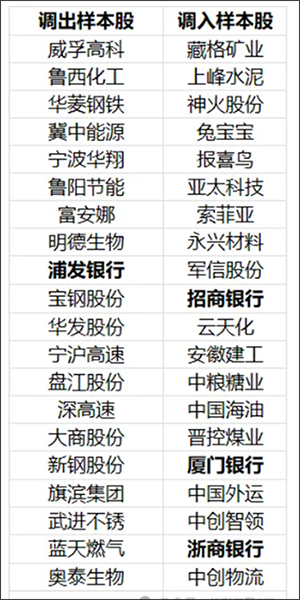
股息收益率仅为3.32%,浦发银行被剔除中证红利指数
Guan Cha Zhe Wang· 2025-12-05 07:47
Core Viewpoint - The annual review of the CSI Dividend Index has resulted in the removal of 20 constituent stocks, including Shanghai Pudong Development Bank and Baosteel, while adding 20 new stocks such as China National Offshore Oil Corporation and China Merchants Bank. The adjustments will take effect after the market closes on December 12 [1][2]. Group 1: Index Adjustments - The CSI Dividend Index has replaced exactly 20 constituent stocks, adhering to the rule that sample changes generally do not exceed 20% [2][3]. - In comparison, the CSI Low Volatility Dividend Index replaced 29 stocks, indicating a higher turnover rate than the CSI Dividend Index [3]. Group 2: Market Capitalization and Dividend Yield - The newly added stocks, including China Merchants Bank, Xiamen Bank, and Zheshang Bank, have a total market capitalization of approximately CNY 1.08 trillion, CNY 189.75 billion, and CNY 837.67 billion, respectively. In contrast, the removed Shanghai Pudong Development Bank has a market capitalization of about CNY 372 billion [3]. - The dividend yields for the newly added banks are notably higher, with China Merchants Bank at 4.63%, Xiamen Bank at 4.04%, and Zheshang Bank at 5.40%, compared to Shanghai Pudong Development Bank's yield of only 3.32% [3][4]. Group 3: Dividend Payment Trends - Shanghai Pudong Development Bank's dividend payout ratios for 2022-2024 are 18.4%, 25.7%, and 27.4%, respectively, which remain below the common industry benchmark of 30%, indicating a conservative dividend policy [4]. - The CSI Dividend Index has implemented three quarterly dividends this year and has a total of 14 dividends since its inception, with a cumulative dividend amount of CNY 3.65 per ten shares. The annual dividend ratios over the past five years have been consistently high, averaging around 4.5% [4]. Group 4: Financial Performance of Shanghai Pudong Development Bank - As of the end of September, Shanghai Pudong Development Bank's total assets reached CNY 9.892 trillion, reflecting a year-on-year growth of 4.55% [5]. - The bank reported a net profit attributable to shareholders of CNY 38.82 billion for the first three quarters, marking a 10.2% increase compared to the previous year [5][6]. - However, the bank's revenue growth has been weak, with a total operating income of CNY 132.28 billion, showing only a 1.9% increase year-on-year, which is significantly lower than the industry average [6].

化工ETF(159870)涨超1%,磷矿石价格持续高位运行
Xin Lang Cai Jing· 2025-12-05 05:20
Group 1 - The core viewpoint of the news is that the chemical industry is experiencing a price surge, particularly in phosphate rock, which is benefiting related stocks and ETFs [1][2] - The China Securities Subdivision Chemical Industry Theme Index (000813) has seen a strong increase of 1.03%, with notable gains in constituent stocks such as Yangnong Chemical (600486) up 5.34% and Luxi Chemical (000830) up 3.13% [1] - Phosphate rock prices remain high, with the average market price for 30% grade phosphate rock at 1016 RMB/ton, 28% grade at 945 RMB/ton, and 25% grade at 758 RMB/ton as of December 2 [1] Group 2 - Huatai Securities reports an expected increase in lithium battery production in December, with a month-on-month growth of 2.3% to 143.3 GWh, indicating a positive trend in the lithium battery sector [2] - The demand for lithium battery materials is strong, with supply constraints leading to price increases in various components such as batteries, lithium hexafluorophosphate, and phosphoric iron lithium [2] - The top ten weighted stocks in the China Securities Subdivision Chemical Industry Theme Index account for 45.41% of the index, with major companies including Wanhua Chemical (600309) and Yilong Co. (000792) [3]

石化ETF(159731)近10个交易日内有9日资金净流入,合计“吸金”2550.14万元。
Xin Lang Cai Jing· 2025-12-05 02:14
石化ETF紧密跟踪中证石化产业指数,数据显示,截至2025年11月28日,中证石化产业指数前十大权重 股分别为万华化学、中国石油、盐湖股份、中国石化、中国海油、藏格矿业、巨化股份、华鲁恒升、恒 力石化和宝丰能源,前十大权重股合计占比56.67%。(以上所列股票仅为指数成份股,无特定推荐之 意) 石化ETF(159731),场外联接(华夏中证石化产业ETF发起式联接A:017855;华夏中证石化产业ETF发 起式联接C:017856)。 截至2025年12月5日9:50,中证石化产业指数上涨0.45%,成分股和邦生物、扬农化工、藏格矿业、万华 化学、广东宏大等领涨。石化ETF(159731)上涨0.60%,最新价报0.84元。资金流入方面,石化ETF近10 个交易日内有9日资金净流入,合计"吸金"2550.14万元。 截至12月4日,石化ETF近2年净值上涨27.89%。从收益能力看,截至2025年12月4日,石化ETF自成立 以来,最高单月回报为15.86%,最长连涨月数为7个月,最长连涨涨幅为27.01%,上涨月份平均收益率 为4.96%。截至2025年12月4日,石化ETF近6个月超越基准年化收益为4.4 ...
投产周期尾声,复苏周期拐点将至,聚焦石化ETF(159731)低位布局窗口
Mei Ri Jing Ji Xin Wen· 2025-12-04 11:39
Group 1 - The core viewpoint of the article highlights that the petrochemical ETF (159731) has experienced a slight decline of 0.36%, while certain holdings like Cangge Mining and Jinfat Technology have shown notable gains [1] - The petrochemical ETF has seen a continuous net inflow of funds for nine consecutive trading days, totaling 25.5 million yuan, with its latest share count reaching 242 million and total scale hitting 202 million yuan, both marking new highs since inception [1] - Tianfeng Securities anticipates that the industry is nearing the end of its production cycle, with expectations for a transition from localized improvements to a comprehensive recovery [1] Group 2 - By 2026, the growth rate of most petrochemical products is expected to decline significantly, with industries like PX, polyester filament, methanol, acetic acid, and MEG likely to see early improvements due to high capacity utilization [1] - Although the capacity expansion for olefins is slowing, there remains some growth potential, and the current capacity utilization still has room for improvement, suggesting that olefin recovery may lag behind other sectors [1] - From 2027 to 2028, the growth rate of new industry capacity is projected to further decline, reinforcing the industry's competitive barriers and facilitating a transition from sporadic recovery to overall improvement [1] Group 3 - The petrochemical ETF (159731) and its linked funds (017855/017856) closely track the CSI Petrochemical Industry Index, with the basic chemical industry accounting for 60.39% and the oil and petrochemical industry for 32.71% of the index [1] - The new round of capacity expansion in the petrochemical industry is entering its final phase, leading to a rebalancing of supply and demand, with expectations for gradual recovery in industry prosperity [1]