
易方达

Search documents
“10亿基”频现 新基金发行掀起小高潮
Xin Lang Cai Jing· 2026-01-11 19:16
Group 1 - The issuance of new funds has surged, with multiple products exceeding 1 billion yuan in scale, indicating a strong market interest in equity funds [1][2] - In the first week of 2026, several funds were launched with significant scales, including the Guangfa Yueying Stable Three-Month Holding Mixed Fund (FOF) at 3.288 billion yuan and the Wanji Qi Tai Stable Three-Month Holding Mixed Fund (FOF) at 2.099 billion yuan, with subscription periods of only 2 days and 1 day respectively [2] - The total issuance scale of new funds in December 2025 reached 113.22 billion yuan, marking a return to the 100 billion yuan monthly issuance level after two months [2] Group 2 - The first batch of seven Zhongzheng Science and Technology Innovation AI ETFs was launched in December 2025, with a total issuance scale of 4.812 billion yuan, highlighting the growing interest in AI-related investments [3] - The FOFs have also seen significant issuance, with the Invesco Great Wall and Xiyi Stable Three-Month Holding Mixed Fund (FOF) at 2.775 billion yuan and the Minsheng Jianyin Multi-Asset Stable Allocation Three-Month Holding Mixed Fund (FOF) at 1.445 billion yuan [3] - As of January 9, 2026, there were 79 new funds in the issuance process, with 56 being equity funds, indicating a continued focus on equity investments by fund companies [4] Group 3 - The market is expected to see a continuous influx of new funds, with an estimated 2 trillion yuan in incremental funds anticipated for the year 2026, driven by active participation from individual investors and institutional funds [4] - The trend of shortening fundraising periods is evident, with four equity funds announcing early closure of their fundraising [4] - The ongoing launch of new products suggests that fund companies are actively positioning themselves to capture market opportunities [4]
“翻倍基”乍现背后 基金经理依然相信港股繁荣刚刚开始
Zheng Quan Shi Bao· 2026-01-11 17:00
Core Viewpoint - The Hong Kong stock market is experiencing a prolonged consolidation phase, with significant challenges in liquidity and performance, particularly in sectors like innovative pharmaceuticals and technology, which previously showed strong growth [1][2][3] Group 1: Market Performance - In early 2026, the A-share market is performing well, while the Hong Kong stock market continues to struggle, particularly in sectors that previously led the market [1] - By the end of 2025, the performance of Hong Kong-themed funds, especially in innovative pharmaceuticals, has declined significantly, with only one fund showing over 112% growth [2] - The Hang Seng Index and Hang Seng Technology Index remain in a consolidation phase, contributing to the underperformance of related thematic funds [2] Group 2: Liquidity Issues - Liquidity is identified as a critical factor restraining the Hong Kong market, with a significant drop in net inflows from southbound funds, which were only 23 billion HKD in December 2025 [3] - The IPO market in Hong Kong is expected to remain active, with total fundraising projected to exceed 300 billion HKD in 2026, posing challenges for liquidity [3] - There is a structural liquidity issue in the Hong Kong market, characterized by concentrated trading in large-cap stocks while small-cap stocks experience very low trading volumes [3] Group 3: Investment Strategies - Investment in Hong Kong stocks should prioritize "winning rate over odds," emphasizing value investing and risk diversification to mitigate liquidity risks [6] - Investors are advised to maintain a cautious approach, focusing on high-quality companies with strong fundamentals and historical integrity, as these are likely to enjoy valuation premiums [6] - The current appreciation of the RMB is seen as a potential driver for increased capital inflows into the Hong Kong market, enhancing its attractiveness [4] Group 4: Sector Focus - Fund managers express optimism about technology and consumer sectors, highlighting the relative undervaluation of Hong Kong stocks compared to global markets [7] - There is a growing interest in high-end manufacturing and innovative consumer sectors, with a focus on companies that leverage supply chain advantages and product innovation [8] - The tea beverage industry is noted for its improving competitive landscape, with leading companies expected to achieve stable long-term growth due to their cost advantages [8]
从“贝塔躺赢”到“阿尔法精选”!公募2026年南下新打法曝光
券商中国· 2026-01-11 06:56
Core Viewpoint - The logic of industry-themed funds is changing, moving away from a passive "beta" strategy focused on popular sectors, and towards a more active search for "alpha" opportunities within industries as public funds increasingly focus on performance-driven investments by 2026 [1][2]. Group 1: Market Dynamics - The simple strategy of investing in popular sectors for easy gains has ended, with a shift towards showcasing fund managers' stock-picking abilities in an "alpha" market [2]. - The 2025 annual ranking of Hong Kong QDII funds showed that industry allocation was key to the top-performing funds, indicating a transition to a more competitive investment landscape [2]. - The influx of southbound capital into Hong Kong stocks in 2025 has started to influence pricing in popular sectors, but the market is expected to balance between southbound and foreign capital in 2026 [3]. Group 2: Investment Strategy - Fund managers are now less willing to invest based on "stories" and are demanding tangible performance metrics, indicating a shift towards profitability-driven investments [4]. - The 2026 investment landscape will likely see reduced opportunities for broad-based gains across sectors, with a greater emphasis on individual company performance [4]. - The focus will be on companies that can demonstrate real financial performance rather than those that rely solely on narrative-driven growth [6]. Group 3: Sector-Specific Insights - The importance of overseas business development (BD) deals is highlighted, as they serve as a credibility endorsement for domestic innovative drug companies, impacting their valuation [7]. - In the AI sector, while hardware remains a strong investment, concerns about the application side's profitability are emerging, suggesting a need for careful evaluation of cash flow sources [7]. - The investment strategy for 2026 will emphasize a balanced approach, combining growth-oriented investments with high-dividend stocks to manage risk and return effectively [8]. Group 4: Future Outlook - The market is expected to transition from extreme growth to a more balanced strategy, with a focus on sectors that are currently undervalued and have potential for recovery [8]. - Fund managers are advised to explore non-consensus opportunities, particularly in consumer sectors that are at historical low levels of market expectations and institutional holdings [8].


用十年数据告诉你,为什么“押宝”不如“分篮子”
雪球· 2026-01-11 06:47
Group 1 - The core viewpoint of the article emphasizes that there are no permanent champions in asset performance, and market dynamics are constantly changing [7][13]. - The article presents a detailed analysis of various asset classes, highlighting the performance of A-shares, US stocks, European stocks, commodities, and bonds over the past decade [9][10][12][13]. - It notes that while US stocks have shown consistent positive returns in most years, they also experience significant downturns, indicating the importance of diversification in investment strategies [10][23]. Group 2 - The article stresses the importance of multi-asset allocation to manage risks rather than solely chasing high returns, addressing the emotional challenges of greed and fear in investing [15][16]. - It outlines the benefits of diversified asset allocation, including reduced overall volatility, ensuring participation in rising assets, and enhancing long-term investment confidence [17][18][19]. - The suggested asset allocation framework includes a mix of equities, bonds, and alternative assets, with specific percentages allocated to each category to balance risk and return [22][25][26]. Group 3 - The article advises against betting on market direction and instead recommends a diversified approach to fund allocation for the year 2026, considering the uncertainties ahead [21][30]. - It emphasizes the importance of regular asset rebalancing to maintain the desired allocation and discipline in investment strategies [32][33]. - The overall message is that successful investing is about maintaining a balanced portfolio that can withstand various market conditions, rather than focusing on short-term gains [33].

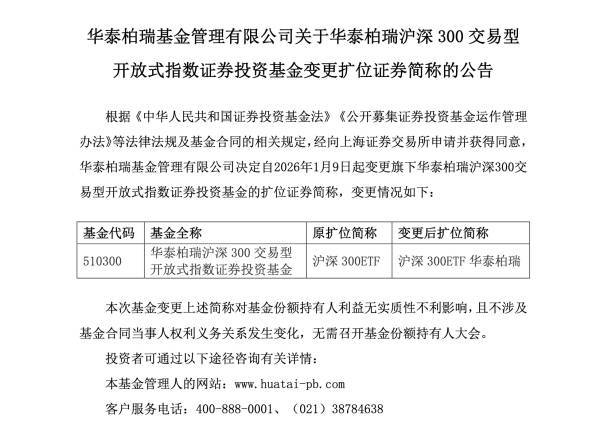
规模近4400亿元!国内最大ETF官宣更名,行业规范化进程加速
Sou Hu Cai Jing· 2026-01-10 11:40
Core Viewpoint - The Chinese ETF market is undergoing a significant transformation with the renaming of Huatai-PB's CSI 300 ETF, marking the first name change in over 13 years and responding to regulatory requirements for standardized naming [1][3]. Group 1: ETF Market Changes - Huatai-PB's CSI 300 ETF will officially change its name to "CSI 300 ETF Huatai-PB" starting January 9, 2024, in compliance with new regulatory guidelines [1][2]. - The fund's size has reached nearly 440 billion yuan, making it the largest ETF in China, with a growth of over 87 billion yuan in the past year [3]. - The renaming aligns with the Shanghai Stock Exchange's revised fund business guidelines, which require standardized naming formats for ETFs by March 31, 2026 [3]. Group 2: Industry Standardization - Other fund managers, including E Fund, GF Fund, and others, are also modifying their ETF names, accelerating the industry-wide standardization process [4]. - Prior to standardization, ETF names followed a "first-come, first-served" principle, leading to confusion among investors due to the variety of names for similar index-tracking products [4]. - The standardization aims to enhance brand recognition and accountability among fund managers, shifting the competitive focus from random name selection to the overall reputation and strength of the fund companies [5]. Group 3: Market Outlook - The total size of China's ETF market has surpassed 6 trillion yuan, with over 1,400 products available, indicating a growing and evolving market [5]. - The ongoing improvements in foundational regulations are expected to create a more transparent, standardized, and healthy ETF market ecosystem [5]. - Future competition in the ETF market will likely emphasize long-term expertise and service quality, benefiting investors with clearer market choices [5].
“今年,港股IPO至少得3000亿起步吧”
Sou Hu Cai Jing· 2026-01-10 00:43
Core Insights - The Hong Kong IPO market is expected to remain robust in 2026, with a projected fundraising amount of 300 billion HKD, reflecting strong market confidence [15] Group 1: 2025 IPO Performance - In 2025, the Hong Kong Stock Exchange (HKEX) saw 114 new listings, a 63% increase year-on-year, raising a total of 286.3 billion HKD (approximately 36 billion USD), marking a 227% increase from the previous year [2][3] - This performance is the strongest since 2021, allowing HKEX to reclaim the top position globally in IPO fundraising, surpassing major exchanges like NASDAQ and NYSE [2][4] - The top ten IPO projects included eight companies that raised over 10 billion HKD, with CATL leading at 41 billion HKD, making it the second-largest global IPO in 2025 [4] Group 2: Notable IPOs and Trends - Zijin Mining International, spun off from A-share Zijin Mining, raised 42.78 billion HKD, highlighting the appeal of large resource companies in the Hong Kong market [5] - Other leading fundraising companies included SANY Heavy Industry, Seres, and Hengrui Medicine, all of which are industry leaders [6] - A significant trend in 2025 was the rise of the "A+H" share listing model, with 19 A-share companies successfully listing in Hong Kong, raising approximately 140 billion HKD, nearly half of the total IPO fundraising for the year [8] Group 3: Global IPO Landscape - In 2025, HKEX not only led in total fundraising but also secured four positions in the global top ten IPOs, showcasing its competitive strength in attracting large projects [11] - Comparatively, the US IPO market had 313 listings, raising about 46.04 billion USD, with the largest IPO being Medline at 6.26 billion USD [16] - The Indian National Stock Exchange had 268 IPOs, raising approximately 21 billion USD, while other exchanges like the NYSE and Tokyo Stock Exchange had significantly lower fundraising totals [16] Group 4: 2026 Outlook - As of early 2026, over 300 companies are queued for IPOs in Hong Kong, indicating a strong pipeline for future listings [13] - The anticipated main themes for 2026 include technology companies in sectors like AI, semiconductors, and biomedicine, as well as a continued trend of A+H listings, which are expected to enhance the market's industry representation and valuation appeal [14]


ETF收评 | A股16连阳,时隔10年站上4100点,成家额突破3万亿,AI应用板块爆发,文娱传媒ETF涨8%
Ge Long Hui· 2026-01-09 13:58
Group 1 - The Shanghai Composite Index rose by 0.92%, surpassing 4100 points for the first time in ten years, marking a 16-day consecutive increase [1] - The ChiNext Index increased by 0.77%, driven by a surge in AI application themes, with sectors like film, short dramas, and gaming leading the gains [1] - The market's trading volume exceeded 3.1 trillion yuan, indicating strong investor activity [1] Group 2 - In the ETF market, AI application sectors saw significant growth, with the Huaxia Fund's Entertainment Media ETF, and the ChiNext Software ETFs from Huaxia and Fuguo rising by 8.41%, 7.2%, and 6.73% respectively [1] - The commercial aerospace sector continued its strong performance, with the China Merchants Fund's Satellite Industry ETF, and the EasyWin and Yongying Fund's Satellite ETFs increasing by 6.41%, 6.28%, and 6.27% respectively [1] - In contrast, the overnight performance of U.S. tech stocks showed a decline, with the S&P Biotechnology ETF and Nasdaq Biotechnology ETF dropping by 1% [1]
半导体设备板块本周领涨,半导体设备ETF易方达(159558)受资金持续关注
Sou Hu Cai Jing· 2026-01-09 11:18
Core Insights - The technology sector has seen a significant surge, particularly in semiconductor equipment and chips, with notable index performances in cloud computing and big data, semiconductor industry, and semiconductor materials and equipment [1][3]. Index Performance - The CSI Cloud Computing and Big Data Theme Index increased by 8.9% - The CSI Semiconductor Industry Index rose by 10.3% - The CSI Semiconductor Materials and Equipment Theme Index surged by 17.1% [1][3]. Fund Flows - The semiconductor equipment ETF managed by E Fund (159558) experienced a net inflow of over 500 million yuan in the first four trading days of the week, with an additional net subscription of 75 million yuan on the last day [1]. Market Projections - Driven by advanced process investments and the wave of semiconductor self-sufficiency in China, global semiconductor equipment sales are projected to reach 117.1 billion USD in 2024, marking a 10% year-on-year increase - According to SEMI, a further growth of 13.7% to 133 billion USD is expected in 2025, with a continued high growth rate driven by AI anticipated for 2026 [1].

指数上涨吸引增量资金入场,创业板ETF易方达(159915)近5个交易日合计净流入超8亿元
Sou Hu Cai Jing· 2026-01-09 11:18
Group 1 - The ChiNext Mid-Cap 200 Index increased by 8.3% this week, while the ChiNext Index and ChiNext Growth Index both rose by 3.9% [1][3] - As of January 8, the ChiNext ETF managed by E Fund (159915) saw a net inflow of over 800 million yuan in the last five trading days [1] - According to China International Capital Corporation (CICC), the upward trend in A-shares since September 24, 2023, is expected to continue, supported by the restructuring of the international monetary order, the critical application phase of AI, and the performance realization of China's innovative industries [1] Group 2 - The ChiNext Mid-Cap 200 Index is composed of 200 medium-sized stocks with good liquidity, reflecting the overall performance of representative companies in the ChiNext market [5] - The information technology sector accounts for over 40% of the ChiNext Mid-Cap 200 Index, while the electric equipment, communication, and electronic industries together account for nearly 60% [5] - There are currently 16 ETFs tracking the ChiNext Index, 5 tracking the ChiNext Mid-Cap 200 Index, and 1 tracking the ChiNext Growth Index, with varying fee rates and tracking errors [5] Group 3 - The rolling price-to-earnings (P/E) ratio for the ChiNext Index is 42.2 times, for the ChiNext Mid-Cap 200 Index is 110.9 times, and for the ChiNext Growth Index is 41.2 times [3] - The rolling P/E ratio percentile indicates that the ChiNext Index is at a 39.1% percentile, while the ChiNext Growth Index is at a 47.3% percentile [3] - The cumulative return for the ChiNext Index since its base date is 232.8%, with an annualized return of 8.2% [8]


沪指站上4100点,两市成交额再次突破3万亿,A500ETF易方达(159361)助力布局核心资产
Sou Hu Cai Jing· 2026-01-09 11:15
Core Viewpoint - The A-share market experienced a significant rally, with the Shanghai Composite Index breaking through 4100 points, marking a 16-day consecutive rise, and total trading volume exceeding 3.1 trillion yuan, a notable increase from the previous trading day [1]. Market Performance - Major A-share indices all closed with "full-body bullish candles" this week: - Shanghai Shenzhen 300 Index rose by 2.8% - CSI A500 Index increased by 4.2% - ChiNext Index gained 3.9% - Shanghai Stock Exchange Sci-Tech Innovation Board 50 Index surged by 9.8% [1][3] - In contrast, the Hong Kong market showed mixed performance, with the Hang Seng China Enterprises Index declining by 1.3% [1]. Sector Performance - Leading sectors in the A-share market included brain-computer interfaces, commercial aerospace, storage chips, and semiconductors, which saw significant gains [1]. - Conversely, sectors such as Hainan, banking, and airport shipping experienced adjustments [1]. Index Details - The Shanghai Shenzhen 300 Index consists of 300 large-cap stocks with good liquidity, covering 11 first-level industries [4]. - The CSI A500 Index includes 500 securities from various industries, covering 89 out of 93 third-level industries [4]. - The ChiNext Index is composed of 100 large-cap stocks from the ChiNext board, with a high proportion in strategic emerging industries [4]. - The Shanghai Stock Exchange Sci-Tech Innovation Board 50 Index features 50 stocks with significant liquidity, prominently in "hard technology" sectors like semiconductors [4]. - The Hang Seng China Enterprises Index includes 50 large-cap stocks from mainland China listed in Hong Kong, covering a wide range of industries [4]. Valuation Metrics - As of January 9, 2026, the rolling price-to-earnings (P/E) ratios for major indices are as follows: - Shanghai Shenzhen 300 Index: 14.3 times - CSI A500 Index: 17.3 times - ChiNext Index: 42.2 times - Shanghai Stock Exchange Sci-Tech Innovation Board 50 Index: 173.1 times - Hang Seng China Enterprises Index: 10.5 times [3][5].
