
奇瑞汽车

Search documents
11月全国乘用车市场零售约222.5万辆 乘联分会预测:明年车市增长承压
Mei Ri Jing Ji Xin Wen· 2025-12-09 14:14
Group 1: Passenger Car Market Performance - In November, the retail sales of passenger cars in China reached approximately 2.225 million units, representing a year-on-year decline of 8.1% and a month-on-month decrease of 1.1% [1] - Cumulative retail sales for the year amount to about 21.483 million units, showing a year-on-year growth of 6.1% [1] - The decline in November is unusual, as the market had previously experienced a 13% growth in the first half of the year, with a subsequent slowdown in the latter half [1] Group 2: New Energy Vehicle (NEV) Sales - In November, the sales of new energy passenger vehicles reached 1.321 million units, marking a year-on-year increase of 4.2% and a penetration rate of 59.3% in the overall passenger car market [2] - BYD led the monthly wholesale sales of new energy vehicles with over 470,000 units, followed by Geely with 187,000 units [2] - The penetration rate of new energy vehicles among domestic brands is 79.6%, while luxury brands and mainstream joint ventures have penetration rates of 38.8% and 8%, respectively [2] Group 3: Export Performance of NEVs - In November, the export volume of new energy vehicles reached 284,000 units, a significant year-on-year increase of 243.3%, accounting for 47.3% of the total export market [3] - The export of pure electric vehicles constituted 57% of the new energy vehicle exports, while plug-in hybrid models made up 42% [3] - The export of power batteries also saw growth, with domestic usage at 5.683 million kWh and export usage at 1.09 million kWh, reflecting year-on-year increases of 13% and 188%, respectively [3] Group 4: Market Outlook and Challenges - The retail share of new forces in the automotive market reached 22.1% in November, an increase of 5.9 percentage points year-on-year [4] - Predictions for December suggest a stable market performance, with potential for slight negative growth due to consumer urgency driven by upcoming tax policy changes [5] - Looking ahead, the market is expected to face pressure in 2026 due to the reduction of tax exemptions, which could significantly impact sales growth [5]


鸿蒙智行“五界”老总“合体直播”!余承东透露多款新车信息,称明年或进入L3、L3+时代
Mei Ri Jing Ji Xin Wen· 2025-12-09 13:41
Core Insights - Huawei's HarmonyOS Automotive division, known as "Hongmeng Zhixing," has achieved significant sales growth, with November sales reaching 81,864 units, marking a year-on-year increase of 89.61% and setting a record for monthly sales since its establishment [1] - The division has surpassed a cumulative delivery of 1 million vehicles, achieving this milestone in 43 months, with expectations to reach the next million in just over a year [2] - New models are set to be launched in 2024, including the first MPV named V9 and a high-performance SUV, with plans for multiple new vehicle releases across various brands [3] Group 1 - The live stream featured key executives from various automotive companies, including Huawei's Executive Director Yu Chengdong and leaders from Seres Group, Chery Automobile, Beijing Automotive Group, Jianghuai Automobile Group, and SAIC Motor [1] - Yu Chengdong emphasized the collaborative nature of the partnerships with these automotive companies, likening them to a train where each part contributes to the overall success [1] - The "Five Realms" of Hongmeng Zhixing are compared to a basketball team, indicating a preference for maintaining a focused group rather than expanding excessively [1] Group 2 - The "Zun Jie S800" has achieved over 18,000 pre-orders within 175 days of its launch, with more than 10,000 units delivered and an average monthly delivery exceeding 2,000 units [2] - The "Shang Jie H5" has surpassed 10,000 deliveries in just 43 days, with the second batch of 20,000 units delivered by December 9 [2] - Future product plans include at least two new models for the "Shang Jie" brand and a stylish new coupe aimed at competing with high-end European models [3] Group 3 - The upcoming models will feature advanced driving assistance capabilities, with plans to transition to L3 and L3+ levels of autonomous driving by next year, aiming for L4 by 2027 [3] - The "Wen Jie M6" is set to debut next year, along with three new models from the "Xiang Jie" brand, which will include an SUV and an MPV [3] - The "Zun Jie" brand is also expected to unveil ultra-luxury vehicles, with designs already completed for various models including sedans, SUVs, and MPVs [3]

奇瑞尹同跃谈余承东:他对“以客户为中心”的理解,跟我们过去的理解有很大差异
Xin Lang Cai Jing· 2025-12-09 11:02
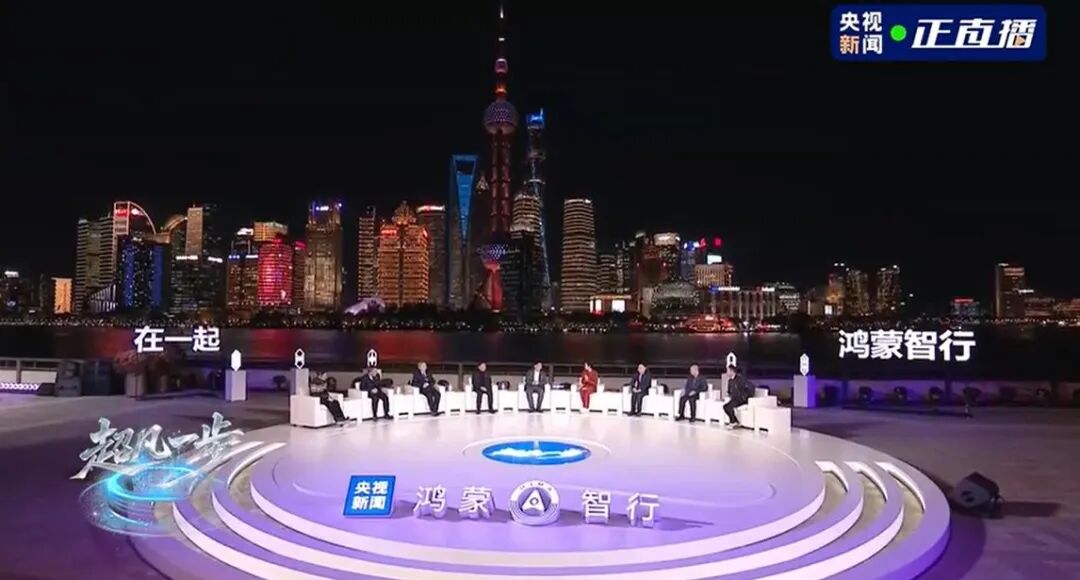
新浪科技讯 12月9日下午消息,今日,华为余承东携手问界、智界、享界、尊界、尚界五大品牌掌门人 首次同台。奇瑞汽车董事长尹同跃表示,华为的商业成功,不仅仅是它自己的商业成功,也在帮助合作 伙伴的商业成功,这是我非常宝贵的,他们内部有一个IPD流程(Integrated Product Development,集成 产品开发),我们在导入这个体系。所以过去我们都在学华为,都是很远的在学,通过直接的合作,实 际上我们近距离的感受到华为文化的力量。 他还表示,跟于总合作以后,能感受到他对以客户为中心的这几个字的理解,跟我们过去的理解是有很 大差异的。他们的确就是以客户为中心,包括今天我们开个玩笑说,连那个宠物狗,都是以宠物狗为中 心的,讲了很多很细的细节,我们对于跟华为之间的合作,充满信心,一定能够成功。 责任编辑:何俊熹 新浪科技讯 12月9日下午消息,今日,华为余承东携手问界、智界、享界、尊界、尚界五大品牌掌门人 首次同台。奇瑞汽车董事长尹同跃表示,华为的商业成功,不仅仅是它自己的商业成功,也在帮助合作 伙伴的商业成功,这是我非常宝贵的,他们内部有一个IPD流程(Integrated Product Devel ...
汽车视点丨年末“翘尾”未现 出口或成2026年车市主要“增长极”
Xin Hua Cai Jing· 2025-12-09 09:41
Group 1: Domestic Passenger Car Market Performance - In November, the retail volume of passenger cars in China was 2.225 million units, a year-on-year decrease of 8.1% and a month-on-month decline of 1.1% [1] - Cumulative retail sales from January to November reached 21.483 million units, reflecting a year-on-year growth of 6.1% [1] - The market growth pattern shows fluctuations, with a trend of "high in the front and stable later," indicating a return to normal growth [1] Group 2: New Energy Vehicle (NEV) Market Dynamics - In November, 22 manufacturers achieved monthly NEV wholesale sales exceeding 10,000 units, contributing 94.2% to total NEV sales, with leading brands being BYD, Geely, and Chery [2] - The "second-generation" NEV brands are showing strong growth, with their market share reaching 14.65%, up by 1.1 percentage points year-on-year [2] - The export of NEVs from Chinese brands reached 1.78 million units from January to November, a staggering increase of 139% year-on-year, with NEVs accounting for 40.6% of total exports [3] Group 3: Pricing and Promotion Trends - In November, the number of models with price reductions was 19, a decrease from the previous year, while the average discount for new energy vehicles rose to 10.1%, an increase of 3.1 percentage points year-on-year [4] - The average price reduction for new energy vehicles from January to November was 24,000 yuan, equivalent to 11.7% of the vehicle price [5] - The overall inventory in the industry increased by 60,000 units in November, contrasting with a decrease of 220,000 units in the same month last year [5] Group 4: Future Market Outlook - The expiration of the new energy vehicle purchase tax exemption at the end of the year is expected to boost sales in December, but may lead to challenges in 2026 due to reduced incentives [6] - Analysts predict that total passenger car wholesale sales will grow by approximately 2.9% in 2026, with NEVs being the main growth driver [7] - The competition in the market is expected to intensify with the introduction of 173 new models in 2026, over 90% of which will be NEVs or offer NEV options [7]

汽车视点丨年末“翘尾”未现,出口或成2026年车市主要“增长极”
Zhong Guo Jin Rong Xin Xi Wang· 2025-12-09 09:35
Core Insights - The domestic passenger car retail market in China experienced a decline in November, with retail volume at 2.225 million units, down 8.1% year-on-year and a slight decrease of 1.1% month-on-month. Cumulatively, from January to November, retail sales reached 21.483 million units, reflecting a year-on-year growth of 6.1% [1] - The market dynamics show a pattern of "high at the beginning, stable later, and pressure in the fourth quarter," influenced by high base figures from the previous year and a gradual return to normal growth [1] - The "old-for-new" subsidy policy significantly supported market growth earlier in the year, but its impact is diminishing as subsidies are phased out, leading to a decrease in daily subsidy applications [1] Passenger Car Market Performance - In November, the wholesale sales of new energy vehicles (NEVs) saw 22 manufacturers surpassing 10,000 units, contributing 94.2% to total NEV sales, indicating a concentration in the market [2] - Major domestic brands like BYD, Geely, and Chery led the sales, with respective volumes of 475,000, 188,000, and 112,000 units [2] - The "second-generation" new energy brands are gaining momentum, with their market share reaching 14.65%, up 1.1 percentage points year-on-year [2] Export Trends - November marked a record high for passenger car exports at 601,000 units, a significant year-on-year increase of 52.4%. Domestic brands accounted for 525,000 units of this total [3] - Cumulatively, from January to November, exports of domestic brand NEVs reached 1.78 million units, a staggering increase of 139% year-on-year, with NEVs making up 40.6% of total exports [3] - The structure of NEV exports is improving, with the share of plug-in hybrid vehicles rising from 26% to 42% year-on-year [3] Promotional Activities and Market Dynamics - The anticipated year-end "tail effect" in the market did not materialize, although promotional activities remain strong, particularly for traditional fuel vehicles and NEVs [4] - In November, the average promotional discount for traditional fuel vehicles was stable at 24%, while NEVs saw an increase in promotional intensity, averaging 10.1% [4] - The average price reduction for new NEVs from January to November was 24,000 yuan, equating to 11.7% of the vehicle price [4] Inventory and Market Outlook - Due to weak retail performance in November, overall industry inventory increased by 60,000 units, contrasting sharply with a decrease of 220,000 units in the same month last year [5] - The inventory warning index for automotive dealers rose to 55.6%, indicating a decline in industry prosperity [5] - Looking ahead, the expiration of the NEV purchase tax exemption is expected to boost December sales but may create pressure for 2026, potentially leading to a "micro-growth" phase in the domestic market [6] Future Projections - Analysts predict that total passenger car wholesale sales will grow by approximately 2.9% in 2026, with NEVs expected to drive this growth with a projected increase of 19% [7] - The competitive landscape is set to intensify with 173 new models expected to launch, over 90% of which will be NEVs or offer NEV options [7] - The domestic market may enter a deep adjustment phase in 2026, with globalization becoming a critical factor for future automotive company trajectories [7]




茂名:综合枢纽“联”动未来
Ren Min Wang· 2025-12-09 09:19
Core Viewpoint - The opening of the Guang-Zhan high-speed railway marks a significant opportunity for Maoming to enhance its urban capabilities and reshape its development pattern, integrating into the Guangdong-Hong Kong-Macao Greater Bay Area's "one-hour living circle" [1] Group 1: Transportation and Connectivity - The completion of the Guang-Zhan high-speed railway will reduce travel time from Maoming to Guangzhou to approximately 70 minutes, facilitating deeper integration with the Greater Bay Area [1] - Maoming's transportation network has undergone significant improvements, creating a multi-dimensional traffic pattern that enhances internal circulation and external connectivity [5][6] - The establishment of a high-efficiency transportation logistics hub is essential for regional linkage, with ongoing projects to improve road networks and port facilities [5][6] Group 2: Urban Development Strategy - Maoming is positioned to transition from a "transportation corridor" to a "comprehensive hub," driven by profound changes in transportation, location, and industrial layout [3] - The city aims to construct three major hubs: transportation logistics, industry, and information, to promote efficient resource flow and regional collaboration [4][8] - The city's strategic location allows it to serve as a critical link for the expansion of the Greater Bay Area and the integration with the Hainan Free Trade Port [2][12] Group 3: Industrial Growth and Diversification - Maoming is diversifying its industrial base beyond the petrochemical sector, focusing on new materials and zero-carbon industries to enhance its economic strength [7] - The city is also developing its tourism sector, aiming to transform from an industrial hub to a cultural and tourism center, with several major projects underway [7] - The construction of a high-level industrial hub is crucial for attracting upstream and downstream industries, thereby enhancing regional industrial synergy [7] Group 4: Information and Digital Economy - The development of a high-integration information hub is a forward-looking initiative, focusing on digital economy growth and data resource integration [8] - Key projects, such as the establishment of a 5G edge computing center, are set to support the digital transformation of regional industries [8] Group 5: Regional Integration and Collaboration - Maoming is actively seeking to expand its integration with the Greater Bay Area by identifying collaborative opportunities in various sectors, including finance, tourism, and logistics [10][12] - The city is leveraging its agricultural products to enhance market access to the Greater Bay Area, aiming to become a key supplier of quality produce [10] - Collaborative efforts with neighboring regions, such as Guangxi and Hainan, are being pursued to strengthen service capabilities and resource sharing [12][13]
乘联分会:11月份国内狭义乘用车市场零售销量达222.5万辆 同比下降8.1%
Zhi Tong Cai Jing· 2025-12-09 08:53
Core Insights - The domestic retail sales of narrow passenger vehicles in China reached 2.225 million units in November 2025, representing a year-on-year decline of 8.1% and a month-on-month decrease of 1.1%. Cumulatively, from January to November 2025, sales totaled 21.483 million units, showing a year-on-year growth of 6.1% [1][3]. Group 1: Market Performance - The retail growth trend for the year is characterized as "front low, middle high, and back flat," confirming initial predictions. The "dual new policies" have played a role in stabilizing the market and adjusting growth rates [3]. - In November, the penetration rate of new energy passenger vehicles in the domestic market reached 59.4%, with a penetration rate of 79.6% among domestic brands and 38.8% in the luxury vehicle segment [3]. Group 2: Manufacturer Sales Rankings - In November 2025, BYD Auto led the sales with 474,921 units, although this represented a year-on-year decline of 5.8%. Geely Auto followed with 310,428 units, showing a significant year-on-year increase of 24.1% [5]. - For the cumulative sales from January to November 2025, BYD Auto also ranked first with 4.131 million units sold, reflecting a year-on-year growth of 10.4%. Geely Auto's sales reached 2.788 million units, marking a substantial increase of 41.8% [6]. Group 3: New Energy Vehicle (NEV) Sales - In November 2025, BYD Auto again topped the NEV wholesale sales with 474,921 units, despite a year-on-year decline of 5.8%. Geely Auto's NEV sales increased by 53.4% year-on-year, reaching 187,798 units [9]. - Cumulatively, from January to November 2025, BYD Auto sold 4.131 million NEVs, achieving a year-on-year growth of 10.4%, while Geely Auto's NEV sales surged by 97.4% to 1.534 million units [11].

员工自称周末拒加班遭辞退 奇瑞被曝加班成常态化
Xin Lang Ke Ji· 2025-12-09 08:51
Core Viewpoint - The recent incident involving a Chery employee being dismissed for refusing to work overtime on weekends has sparked widespread attention, highlighting a contradiction between the company's public stance against excessive overtime and the reality of its internal work culture [1][2]. Group 1: Company Culture and Employee Experience - Chery employees report that the company's actual working hours extend beyond the officially stated 9 AM to 5:30 PM, with many working an additional three hours daily, and weekend overtime being a common expectation [2][3]. - The company's chairman, Yin Tongyue, acknowledged the issues of excessive meetings and weekend work during a mid-year conference, expressing regret and promising to implement measures to reduce such practices [2][3]. - Despite the chairman's public commitment to a no-overtime culture, employees feel that the internal pressure to work extra hours persists, indicating a gap between policy and practice [2][3]. Group 2: Financial Performance and Market Position - Chery's recent financial results show a revenue of 214.83 billion yuan for the first three quarters of the year, representing a year-on-year growth of 17.9%, with a net profit of 14.37 billion yuan, up 28.0% [7]. - The company's "other income and gains" surged by 122.5% to 9.139 billion yuan, which typically includes government subsidies and asset disposal gains, suggesting reliance on non-core revenue streams [7]. - Chery's gross margin has decreased by 1.1 percentage points to 13.71%, indicating potential challenges with rising costs outpacing revenue growth [7]. Group 3: Industry Context and Labor Practices - The automotive manufacturing industry is characterized by high levels of overtime, with average weekly hours for production and non-management employees reaching 42.4 hours, and overtime averaging 5.8 hours [13]. - Chery's internal overtime culture appears to exceed industry averages, raising concerns about compliance with labor laws regarding work hours and compensation [13]. - Experts suggest that while overtime may seem necessary for maintaining productivity, it can lead to legal violations if not properly compensated, highlighting the need for systemic changes in labor practices within the company [13].

【月度排名】2025年11月厂商销量排名快报
乘联分会· 2025-12-09 08:46
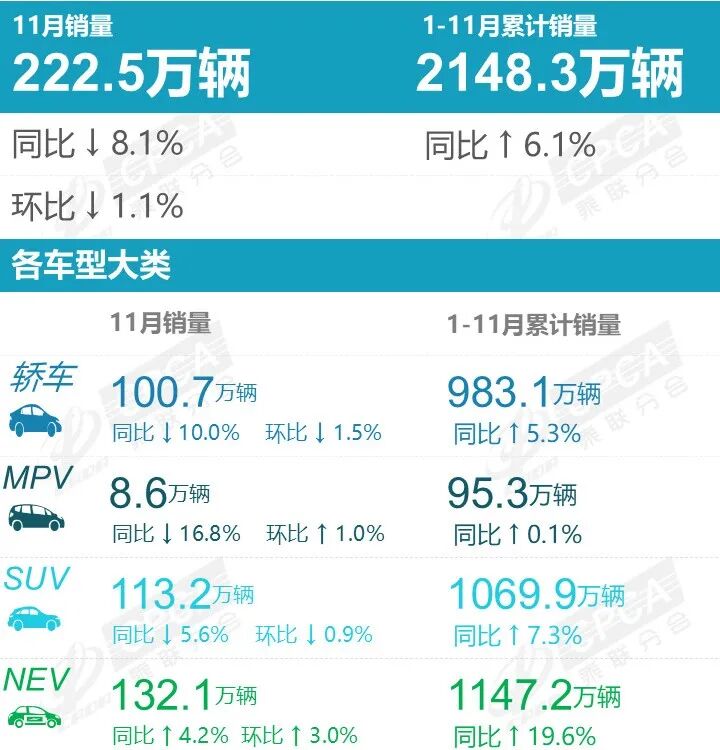
Core Viewpoint - The domestic narrow passenger car market in China experienced a retail sales decline in November 2025, with a total of 2.225 million units sold, representing a year-on-year decrease of 8.1% and a month-on-month decrease of 1.1%. However, the cumulative sales from January to November reached 21.483 million units, showing a year-on-year growth of 6.1% [2][3]. Sales Performance - In November 2025, the sales breakdown by vehicle type showed that sedans sold 1.007 million units (down 10.0% year-on-year), MPVs sold 86,000 units (down 16.8%), SUVs sold 1.132 million units (up 5.6%), and NEVs sold 1.321 million units (up 4.2%) [3][4]. - The cumulative sales for the year until November were 9.831 million sedans (up 5.3%), 953,000 MPVs (up 0.1%), 10.699 million SUVs (up 7.3%), and 11.472 million NEVs (up 19.6%) [3][4]. Market Trends - The penetration rate of new energy vehicles (NEVs) in the domestic market reached 59.4% in November, with a penetration rate of 79.6% among domestic brands and 38.8% in the luxury segment [4]. - The analysis indicates that the retail growth rate for the year has followed a "low in the beginning, high in the middle, and flat at the end" trend, with new policies stabilizing the market and controlling price competition [2][4]. Manufacturer Rankings - In November 2025, BYD led the sales with 474,921 units (down 5.8% year-on-year), followed by Geely with 310,428 units (up 24.1%), and Chery with 262,475 units (down 3.6%) [7][9]. - For the cumulative sales from January to November, BYD also ranked first with 4.131 million units (up 10.4%), followed by Geely with 2.788 million units (up 41.8%) [8][10]. NEV Manufacturer Performance - In November 2025, BYD again led the NEV wholesale sales with 474,921 units (down 5.8% year-on-year), while Geely and Chery followed with 187,798 units (up 53.4%) and 111,577 units (up 54.0%) respectively [11][13]. - Cumulatively, BYD maintained its lead in NEV sales with 4.131 million units (up 10.4%) from January to November, while Geely's NEV sales surged by 97.4% to 1.534 million units [13][15].

奇瑞汽车尹同跃:华为在和我们打造各个界,让我们的产品远离了内卷
Xin Lang Cai Jing· 2025-12-09 06:51
Core Viewpoint - Huawei's collaboration with Chery and other brands aims to enhance the quality and competitiveness of Chinese automotive products, moving away from low-cost competition and towards high-end offerings [1][2]. Group 1: Collaboration and Strategy - Huawei's partnership with Chery and other brands is described as a strong alliance, with Chery's chairman emphasizing Huawei as a significant contributor to the automotive industry [1][2]. - The collaboration is likened to a basketball game, where Huawei is seen as the offensive player focusing on technology and innovation, while Chery takes on the defensive role, ensuring safety and quality [1][2]. Group 2: Industry Context - The Chinese automotive industry is currently facing challenges related to low-price competition, referred to as "price war," which the partnership aims to address by promoting high-quality development [1][2]. - Chery's chairman expressed the aspiration for Chinese automotive brands to achieve high-end status comparable to established luxury brands like BMW, Benz, and Audi (BBA), indicating a goal for stronger brand positioning in the market [1][2].