长安汽车

Search documents
从“单一冬测基地”迈向全链条平台——黑龙江省黑河市寒区试车产业实现多维度跃升
Zheng Quan Ri Bao· 2026-01-18 17:09
Core Insights - The fifth Heilongjiang Cold Region Test Festival commenced in Heihe, attracting 147 automotive companies and 4044 test vehicles, with over 60% being new energy vehicles [1] - The transition of the global automotive industry towards electrification and intelligence has made performance metrics in extreme cold environments essential rather than optional [1] Group 1: Testing Infrastructure and Capabilities - Heihe's unique natural conditions provide a testing environment with over 200 days of ice coverage annually and temperatures below -35°C for a month, facilitating the validation of vehicle performance [2] - The city has developed 120 specialized testing roads and is investing 260 million yuan in the Honghe Valley Four Seasons Low-Temperature Test Field, aiming to create Asia's first year-round low-temperature testing facility [2] - The number of cold region test vehicles in China is projected to increase by approximately 40% for the 2025-2026 testing season, with some testing sites reporting up to 90% of vehicles being new energy models [2] Group 2: Industry Development and Standards - Heihe has invested over 1 billion yuan in infrastructure and has participated in the formulation of 58 national and industry standards, including 2 international standards, with test data recognized by over 40 countries [4] - The cold region testing industry has evolved significantly, expanding its scale and brand influence, and attracting foreign investment for testing [4] - Cold region testing is becoming a necessary quality benchmark for new energy and intelligent connected vehicles, with companies focusing on core performance metrics [4][5] Group 3: Economic Impact and Future Directions - The integration of cold testing with tourism and sports has generated over 600 million yuan annually for related industries [6] - The cold region testing has shifted from traditional performance validation to a critical technology hub for safety and reliability in electric vehicles and intelligent systems [6] - Heihe aims to enhance its testing capabilities by expanding into intelligent connected and low-altitude testing, with ongoing collaborations with companies like Baidu [5][6]
汽车行业周报:乘用车库存25年12月小幅去化,静待观望需求落地-20260118
GF SECURITIES· 2026-01-18 13:26
[Table_Page] 跟踪分析|汽车 证券研究报告 [Table_Title] 汽车行业周报 乘用车库存 25 年 12 月小幅去化,静待观望需求落地 [Table_Summary] 核心观点: | [Table_Grade] 行业评级 | 买入 | | --- | --- | | 前次评级 | 买入 | | 报告日期 | 2026-01-18 | [Table_PicQuote] 相对市场表现 -10% -2% 6% 14% 22% 30% 01/25 04/25 06/25 08/25 11/25 01/26 汽车 沪深300 | [分析师: Table_Author]张力月 | | | --- | --- | | | SAC 执证号:S0260524040004 | | | 021-38003727 | | | zhangliyue@gf.com.cn | | 分析师: | 闫俊刚 | | | SAC 执证号:S0260516010001 | | | 021-38003682 | | | yanjungang@gf.com.cn | | 分析师: | 陈飞彤 | | | SAC 执证号:S02605 ...
一季度整车有望反弹,零部件聚焦新产业投资:汽车行业周报(20260112-20260118)-20260118
Huachuang Securities· 2026-01-18 12:26
Investment Rating - The report maintains a positive outlook for the automotive industry, expecting a rebound in vehicle sales in Q1 and focusing on investments in intelligent driving, robotics, and liquid cooling technologies [3]. Core Insights - The automotive sector is experiencing significant dynamics, including sales, pricing, exports, and robotics developments [2]. - The report highlights that January's early sales data shows a substantial year-on-year decline, primarily due to subsidy reductions and rising vehicle prices, leading to consumer hesitation [5]. - The report anticipates that the pressure on vehicle prices will be managed through strict enforcement of anti-competitive practices, aiming to stabilize prices and profit margins [5]. - The export market is expected to grow rapidly, supported by agreements that lower trade barriers for electric vehicles, enhancing profitability for manufacturers and dealers [5]. - The robotics sector is gaining traction, with the Optimus V3 generating market excitement and expectations for product launches [5]. Data Tracking - In early January, the average discount rate remained stable, with a 9.6% increase year-on-year, and the average discount amount reached 22,259 yuan, up by 2,192 yuan year-on-year [4]. - December's wholesale vehicle sales were reported at 2.85 million units, reflecting a year-on-year decline of 8.7% and a month-on-month decline of 6.3% [4]. - Notable sales performance in December included significant year-on-year growth for new energy vehicle manufacturers like NIO and Li Auto, while traditional automakers like SAIC and Changan showed mixed results [6]. Industry News - The report discusses various industry developments, including the price commitments for electric vehicles between China and Europe, which aim to facilitate trade [27]. - The Ministry of Industry and Information Technology is focusing on enhancing the competitiveness of the new energy vehicle sector and regulating market practices to prevent price wars [27]. - Recent data indicates a significant drop in retail sales of passenger vehicles in early January, with a 32% year-on-year decline [27]. Market Performance - The automotive sector saw a weekly increase of 0.71%, ranking 8th out of 29 sectors, while the overall market indices showed mixed results [10].




埃泰克沪市主板IPO即将上会 市场份额双冠领跑国产化
Zheng Quan Shi Bao Wang· 2026-01-18 11:51
Core Viewpoint - Wuhu E-Tech Automotive Electronics Co., Ltd. (E-Tech) is set to undergo an IPO review on January 20, focusing on its leading position in the automotive electronic control systems market, particularly in body domain controllers and other electronic products [1] Group 1: Company Overview - E-Tech, established in 2002, specializes in the research, production, and sales of automotive electronic products across four main domains: body, intelligent cockpit, power, and intelligent driving [1] - The company has built a comprehensive independent innovation system over more than 20 years, playing a significant role in the localization of automotive electronics and leading in several niche markets [1] Group 2: Market Position and Performance - According to statistics from the Gaogong Intelligent Automotive Research Institute, E-Tech holds a 25.5% market share in the body domain controllers for China's self-owned brand passenger vehicles in 2024, ranking first for three consecutive years [1] - The company also leads with a 13.83% share in the market for remote physical keys and ranks third with a 6.41% share in cockpit domain and display assembly for self-owned brand passenger vehicles [1] - E-Tech has established a strong customer base, including major domestic automakers like Chery, Changan, and Great Wall, as well as new energy vehicle manufacturers such as Li Auto and Xpeng [2] Group 3: Financial Performance - E-Tech has shown steady revenue growth, with revenues of 2.174 billion yuan, 3.003 billion yuan, and 3.467 billion yuan from 2022 to 2024, and a net profit of 77.44 million yuan, 171 million yuan, and 202 million yuan for the same years [2] - In the first half of 2025, the company achieved a revenue of 1.522 billion yuan and a net profit of 85.61 million yuan [2] Group 4: R&D and Innovation - E-Tech has developed a complete product matrix covering four functional domains, with a focus on smart control and entry systems, digital dashboards, and vehicle display screens [3] - The company has invested heavily in R&D, employing 874 researchers, which constitutes 46.29% of its total workforce, and has allocated 111 million yuan for R&D in the first half of 2025, representing 7.31% of its revenue [3] - E-Tech holds 182 patents, including 49 invention patents, and has established a comprehensive R&D system across multiple locations [3] Group 5: Future Outlook - E-Tech aims to align with the trends of electrification, intelligence, and connectivity in the automotive industry, exploring new applications for next-generation electronic and electrical architectures [4] - The company plans to expand its domestic and international markets, seeking partnerships with more quality clients to enhance its market share and contribute to the high-quality development of China's automotive industry [4]
“难以解释”!业绩暴增,股价微涨
Zhong Guo Ji Jin Bao· 2026-01-18 11:31
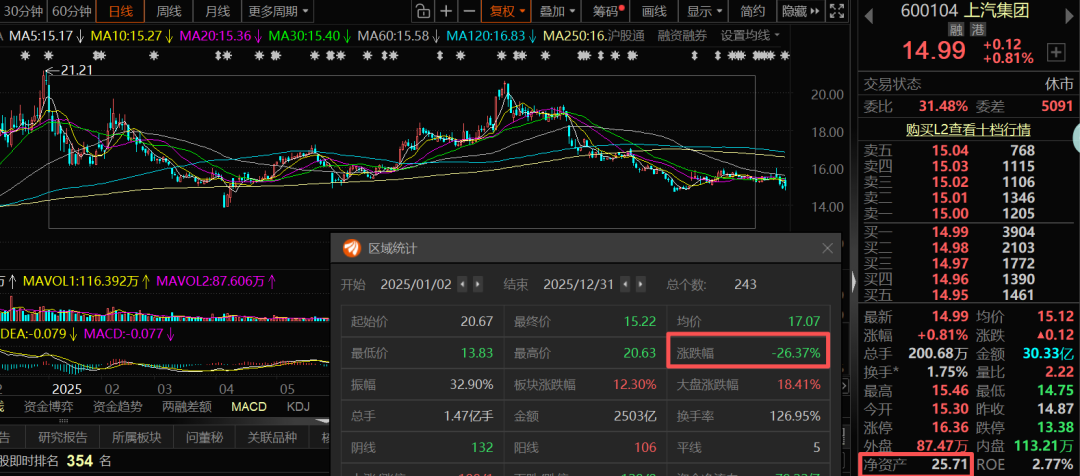
Core Viewpoint - SAIC Motor Corporation has announced a significant increase in expected net profit for 2025, projecting a year-on-year growth of 438% to 558%, yet its stock price remains under pressure, reflecting a mismatch between market valuation and performance [2][3]. Group 1: Company Performance and Market Reaction - On January 15, SAIC Motor released an impressive earnings forecast, leading to a brief stock price increase of over 3% on January 16, but it closed with only a 0.81% gain, still trading below its net asset value [1][2]. - As of January 16, SAIC Motor's market capitalization stood at 172.3 billion yuan, significantly lower than BYD's 874 billion yuan, highlighting a substantial valuation gap among leading automotive companies [3][8]. - The company is currently in a "broken net" state, with its stock price at 14.99 yuan per share, below the latest audited net asset value of 25.71 yuan per share [7][8]. Group 2: Investor Concerns and Market Management - Investors have raised questions regarding SAIC Motor's market value management, expressing skepticism about the effectiveness of its strategies [4][11]. - The company has not announced any share repurchase plans since the release of its 2025 valuation enhancement plan, which is a key measure for market value management [12][13]. - Despite having executed three rounds of share repurchase plans totaling 4.747 billion yuan, the results have been deemed unsatisfactory [14][13]. Group 3: Industry Context and Challenges - The automotive industry is facing intense competition and rapid transformation towards new energy and smart technologies, complicating investment prospects [19][20]. - Many listed automotive companies are struggling with market valuations below 200 billion yuan, with only a few like BYD and Great Wall Motors exceeding this threshold [18]. - The market is characterized by a high number of listed automotive companies, which diminishes individual company visibility compared to global players like Tesla [20]. Group 4: Strategic Focus and Future Outlook - Industry experts emphasize the importance of improving operational quality as a core aspect of market value management, rather than relying solely on share buybacks or short-term market trends [22][29]. - Companies are encouraged to focus on developing standout products to enhance their market valuation directly, as seen with NIO's recent successful model launches [24][29]. - The consensus among industry leaders is that the automotive sector is entering a critical phase, with a clearer picture of market dynamics expected in the next five years [21].


碳酸锂最高涨至17.4万元;多种锂电原料取消出口退税;宁德时代落子沙特;LG新能源Q4亏损;珠海赛纬IPO终止;欣旺达回应电池争议
起点锂电· 2026-01-18 11:25
Group 1 - CATL opened its largest comprehensive service experience center in the Middle East, "Ningjia Service," in Saudi Arabia, covering an area of approximately 7,000 square meters and providing various after-sales services for passenger cars, commercial vehicles, and energy storage systems [3] - LG Energy Solution reported an operating loss of 122 billion KRW (approximately 83.8 million USD) in Q4 due to weak demand from electric vehicle manufacturers, despite a revenue increase of 4.8% to 6.14 trillion KRW [4] - Ganfeng Lithium's second-phase project for lithium-ion batteries has been approved for construction, with a total investment of 316 million RMB and an annual production capacity of 200 million batteries [6] Group 2 - A new 51GWh battery production line project has commenced in Xinyang, with a total investment of 12.725 billion RMB, focusing on advanced lithium-ion battery production [7] - Shenzhen Yuanxin Energy Technology Co., Ltd. submitted an IPO application to the Hong Kong Stock Exchange, aiming to develop sustainable energy solutions and reliable energy storage products [8] - A 2GWh high-performance lithium battery project has been signed in Hubei, with a total investment of 1 billion RMB, expected to generate over 1 billion RMB in annual output value by 2031 [9] Group 3 - Huizhou's Tianli Lithium Energy announced a planned maintenance shutdown of its lithium iron phosphate production line, expected to reduce output by 1,500 to 2,000 tons, which may support price increases in the market [22] - The Ministry of Industry and Information Technology and other departments released new regulations for the recycling of used power batteries, effective from April 1, 2026, focusing on comprehensive management throughout the battery lifecycle [33] - The price of battery-grade lithium carbonate reached a new high of 157,250 RMB per ton, with a significant increase in both futures and spot prices [16][17]


创新要合理
董扬汽车视点· 2026-01-18 10:31
Core Viewpoint - The article emphasizes the importance of safety, economic rationality, and user habits in automotive innovation, highlighting a shift from follower innovation to leading innovation in the Chinese automotive industry [1]. Group 1: Safety Considerations - The adoption of new technologies or devices must prioritize safety [2]. - Four specific technologies are highlighted for their safety implications: - The unconventional steering wheel shape may pose safety risks if not designed properly [3]. - The single-pedal mode in electric vehicles could lead to driver errors, necessitating design adjustments to maintain braking habits [4]. - Excessive reliance on touchscreens over physical buttons can complicate user interaction and should include redundancy in design [4]. - The government should rigorously assess the safety of new technologies during product approvals, similar to the FDA's approach in drug trials [10]. Group 2: Economic Rationality and Maintenance - The trend of producing longer and wider vehicles may not be economically rational, as it complicates driving and parking, especially outside of regions with suitable infrastructure [6]. - The push for excessively long driving ranges in electric vehicles may lead to unnecessary costs for consumers [6]. - Aesthetic features like continuous displays and tail lights may impose additional costs without significant functional benefits, suggesting manufacturers should offer choices based on consumer preferences [7]. - The installation of batteries in electric vehicles should consider maintenance and recycling, as current designs focus primarily on durability [8]. Group 3: User Habits and Continuity - Innovations related to vehicle operation must consider user habits and maintain continuity with traditional methods to avoid confusion [9]. - The requirement for hidden door handles to include mechanical opening mechanisms reflects the need to retain familiar operation methods [9]. - The transition to electronic keys and the removal of start-stop buttons may disrupt user habits, indicating a need for careful consideration of user experience [9]. Group 4: Recommendations for Stakeholders - Government agencies should prioritize safety in the evaluation of new automotive technologies and continue monitoring their application [10]. - Automotive manufacturers should not only promote new features but also emphasize economic viability, maintenance, reliability, and the continuity of driving habits in their marketing [10]. - The automotive industry in China is entering a new phase of innovation leadership, necessitating a balance between encouraging innovation and ensuring user safety and sustainable development [10].

中国“00后”小将刷新重庆马拉松国内纪录
Xin Lang Cai Jing· 2026-01-18 10:10
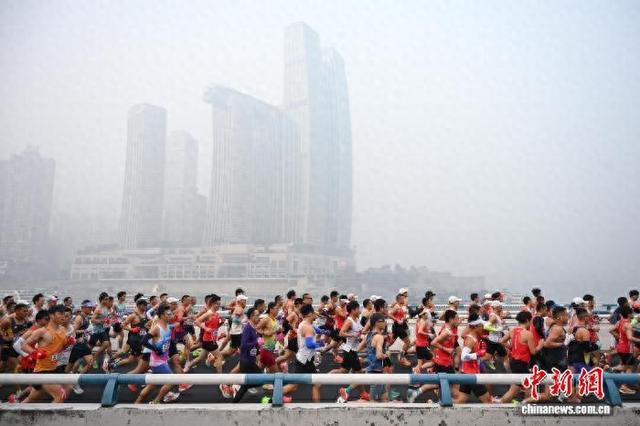
2026长安汽车重庆马拉松举行。图为跑友在长江之滨比拼速度与激情。中新社记者 何蓬磊 摄 当天,埃塞俄比亚选手阿迪苏·特斯法洪·塔费雷(Adisu Tesfahun Tafere)以2小时8分28秒摘得男子组冠 军,季军为肯尼亚选手贝纳德·基普科里尔(Benard Kipkorir),成绩为2小时10分26秒。女子组方面,埃塞 俄比亚选手包揽冠亚军;29岁的中国选手朱卿以2小时28分53秒获得季军,大幅刷新个人最佳成绩,成 为中国女子"大众一姐"。 这是24岁的丰配友第一次参加重庆马拉松。他在赛后受访时说,比赛后半程有一段感觉已经跑不动了, 是路旁观众热烈的加油呐喊声给了他无穷动力。丰配友希望通过自己的努力,让跑步更加普及,让更多 人运动起来。 在2025重庆马拉松上,朱卿曾刷新个人最佳成绩。18日历史重演,朱卿表示:"重庆是我的福地。"(完) 中新社重庆1月18日电 (记者 钟旖)2026长安汽车重庆马拉松(下称"2026重马")18日在重庆市南岸区鸣枪 起跑,吸引来自26个国家和地区的2.5万名跑友,在长江之滨比拼速度与激情。中国"00后"小将丰配友 以2小时10分22秒的成绩夺得男子组亚军、国内男子组第 ...
“中国汽车第一城”争夺战
Jing Ji Guan Cha Wang· 2026-01-18 09:53
Group 1 - The competition for "China's Automotive Capital" has evolved from a focus on production volume to a comprehensive contest of development models and industrial ecosystems by 2025 [2] - Chongqing has secured the title of "China's Automotive Capital" with an annual production of nearly 2.8 million vehicles, driven by the success of Seres and the steady growth of Changan Automobile [3][4] - Chengdu, while not in the top tier, has achieved rapid automotive industry growth through collaborations with FAW and industrial synergies with Chongqing [2][3] Group 2 - Hefei has emerged as a significant player in the new energy vehicle sector, achieving the highest production of new energy vehicles in China by November 2025, with a production of 1.25 million units [2][10] - The automotive industry in the Yangtze River Delta is becoming more diversified, with Anhui's automotive production reaching 2.76 million vehicles, indicating a shift from Shanghai's dominance [8][9] - The collaboration between Chengdu and Chongqing aims to enhance regional cooperation in the automotive industry, with a focus on breaking the previous competitive mindset [6][7] Group 3 - The Seres brand, in partnership with Huawei, has significantly contributed to Chongqing's automotive growth, with over 420,000 vehicles delivered in 2025 [4][5] - Chengdu's automotive production reached 820,000 units by November 2025, with a remarkable 198.3% increase in new energy vehicle production [5] - The new Jetta brand in Chengdu aims to become a leading enterprise in the province's automotive industry, focusing on electric vehicle transformation [6] Group 4 - The automotive industry in Guangdong has faced challenges, with Guangzhou's production declining significantly, while Shenzhen has taken the lead in both overall and new energy vehicle production [12][14] - BYD, based in Shenzhen, achieved a new energy vehicle production of 4.54 million units in 2025, becoming the global leader in this sector [12][13] - Guangzhou's automotive industry is under pressure to transform, with a focus on integrating traditional manufacturing with new technologies and exploring innovative areas like flying cars [14][15]

长安份额超30%!创维暴涨2倍进前五 12月轻客销4.5万辆收官2025 | 头条
第一商用车网· 2026-01-18 09:15
Core Viewpoint - The light commercial vehicle (LCV) market in China has shown a consistent growth trend, achieving a year-on-year increase of 12% in December 2025, marking the ninth consecutive month of growth, with total sales reaching 4.45 million units [2][3][21]. Market Performance - In December 2025, the overall bus market in China sold 63,900 units, reflecting a month-on-month increase of 20% and a year-on-year increase of 5% [2]. - The light bus segment accounted for 69.55% of the total bus market sales in December, a decrease from 76.14% in the previous month [2]. - For the entire year of 2025, the light bus market's share reached 78.07%, up from 77.18% in 2024, indicating a nearly 1 percentage point increase [2]. Sales Trends - December 2025 marked the highest sales volume for light commercial vehicles in the past five years, with 4.45 million units sold, surpassing the lowest sales in December 2022 by approximately 8,000 units and exceeding December 2024 sales by about 4,700 units [5]. - Cumulatively, the light commercial vehicle market in 2025 achieved total sales of 448,100 units, a year-on-year growth of 11%, maintaining the same growth rate as after November [7][15]. Company Performance - In December 2025, the top ten companies in the light commercial vehicle market collectively held a market share of 95.9%, with Changan leading at 14,500 units sold, representing a 32.5% market share [13]. - Among the top ten companies, eight experienced sales growth compared to December 2024, with notable increases from Changan (15%), Dongfeng (46%), and Chuangwei (222%) [10][17]. - For the entire year, five of the top ten companies saw sales increases, with Changan, Jiangling, and Dongfeng capturing 29.3%, 22.2%, and 20.6% of the market share, respectively, totaling 72.0% for the top three [18][19]. Market Dynamics - The light commercial vehicle market has experienced a shift in rankings among the top companies, with Chuangwei entering the top five for the first time and Xiamen Jinlong and Yutong also moving up in rankings [13][19]. - The overall market dynamics indicate that while some companies have improved their standings, others have seen declines, reflecting a competitive landscape [10][19].