高盛

Search documents
软件股末日论”点燃大变革! 恐慌抛售之后,市场将捧起AI时代的“软件基石
Zhi Tong Cai Jing· 2026-02-06 11:49
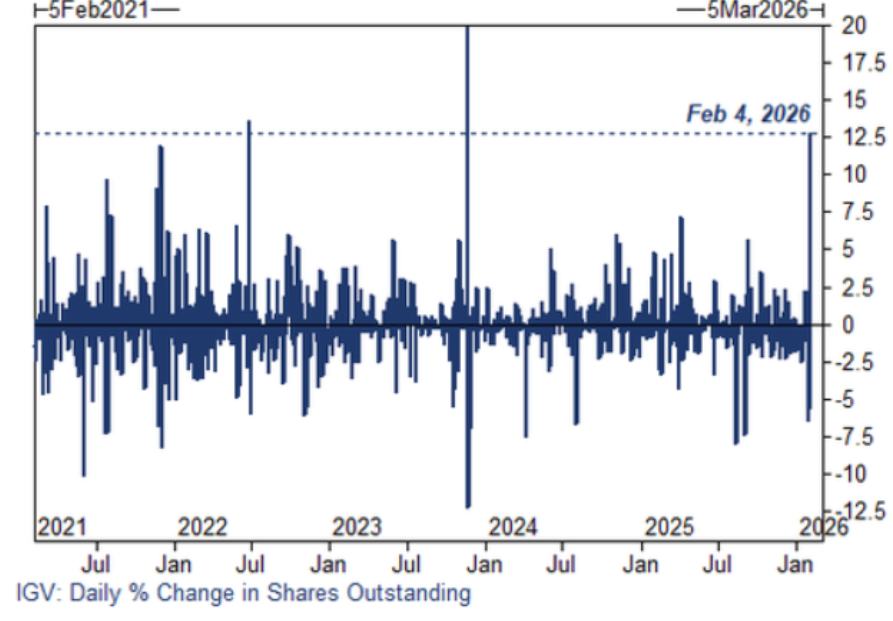
Core Viewpoint - The recent narrative of "Software-mageddon" has led to a significant sell-off in the software sector, particularly affecting SaaS stocks, following the launch of new AI tools by Anthropic, which are perceived as threats to traditional software business models [1][4][5]. Group 1: Market Reaction - The S&P 500 Software & Services Index has experienced a decline of approximately 30% since its recent peak at the end of October, marking the most severe sell-off since 2022 [1][6]. - Major software companies, including Thomson Reuters and Salesforce, have seen their stock prices drop significantly, with some experiencing declines of up to 10% in a single day [5][6]. - The sell-off has been exacerbated by disappointing earnings guidance from major companies, including Microsoft, and heightened expectations for AI infrastructure spending [5][6]. Group 2: Institutional Response - Some institutional investors are beginning to enter the market to buy undervalued software stocks, believing that the market has overreacted to the AI threat [2][12]. - Analysts express a divided view on the long-term impact of AI on software companies, with some believing that AI will reshape profit trajectories rather than eliminate the need for existing software [9][14]. Group 3: Expert Opinions - Rick Sherlund, a prominent analyst, argues that the software industry undergoes significant transformations every 10 to 15 years, and companies with strong fundamentals, like SAP, will likely benefit from AI rather than be threatened by it [3][16]. - Nvidia's CEO Jensen Huang emphasizes that the notion of AI completely replacing software is illogical, suggesting that AI will enhance existing software rather than replace it [7][8]. - The current market panic is described as "micro-hysteria," with experts suggesting that the fears surrounding AI's impact on software are exaggerated [8][12]. Group 4: Future Outlook - The software sector is expected to experience a technical rebound as investors reassess the long-term value of companies that integrate AI into their operations [2][11]. - High-quality software companies that embrace AI are likely to emerge stronger from the current turmoil, as the market begins to differentiate between those with robust business models and those that are more vulnerable [11][15].


“软件股末日论”点燃大变革! 恐慌抛售之后,市场将捧起AI时代的“软件基石”
智通财经网· 2026-02-06 09:13
Core Viewpoint - The recent narrative of "Software-mageddon" has led to a significant sell-off in the software sector, particularly affecting SaaS stocks, following the launch of new AI tools by Anthropic, which are perceived as threats to traditional software business models [1][4][5]. Group 1: Market Reaction - The S&P 500 Software & Services Index has experienced a decline of approximately 30% since its recent peak at the end of October, marking the most severe sell-off since 2022 [1][6]. - Major software companies, including Thomson Reuters and Salesforce, have seen significant stock price drops, with some experiencing declines of up to 10% in a single day [5][6]. - The sell-off has been exacerbated by disappointing earnings guidance from major companies, including Microsoft, and heightened expectations for AI infrastructure spending [5][6]. Group 2: Institutional Response - Some institutional investors are beginning to enter the market to buy undervalued software stocks, believing that the market has overreacted to the AI threat [2][12]. - Analysts from firms like Goldman Sachs and Wedbush Securities suggest that the sell-off reflects an exaggerated "Armageddon scenario" and that companies will not abandon their existing software investments for new AI solutions [12][14]. Group 3: Expert Opinions - Rick Sherlund, a prominent technology analyst, argues that the software industry undergoes significant transformations every 10 to 15 years, and companies with strong fundamentals, like SAP, will likely benefit from AI rather than be replaced by it [3][16]. - Nvidia's CEO, Jensen Huang, emphasizes that AI will enhance existing software infrastructure rather than replace it entirely, countering the prevailing panic in the market [7][8]. Group 4: Long-term Outlook - Analysts believe that while AI may disrupt certain aspects of the software industry, it will also create new growth narratives, particularly for companies that can integrate AI into their existing platforms [9][10]. - The market is expected to see a bifurcation, where companies with strong data assets and integration capabilities, such as Microsoft and SAP, are likely to rebound more strongly than those with weaker competitive positions [11][15].
2026年白银是否还会涨价
Sou Hu Cai Jing· 2026-02-06 05:57
Core Conclusion Summary - The silver price in 2026 is expected to exhibit a "strong first half, weak second half" trend, driven by explosive demand from the photovoltaic industry and an expanding global supply-demand gap. The macroeconomic environment will be significantly influenced by the Federal Reserve's monetary policy and global economic growth rates. Goldman Sachs predicts silver prices may reach $120 per ounce in Q2, while UBS expects prices to hit $100 per ounce in the first half and decline to $75 per ounce by year-end. Short-term trading structure adjustment risks should be monitored, but long-term industrial demand presents structural opportunities [1]. Understanding Phase: Key Drivers and Basic Information - The core drivers of the silver price increase in 2026 include explosive industrial demand, an expanding supply-demand gap, and macroeconomic support. The photovoltaic industry is the main growth driver, with global installed photovoltaic capacity expected to grow over 25% year-on-year, leading to an 18% increase in silver demand in this sector, which accounts for 32% of total industrial demand. On the supply side, silver production growth is limited, with only a 1.9% increase expected in 2026, while London deliverable stocks have fallen to 233 tons, sufficient for only 15 days of industrial consumption [2]. - The relationship between silver prices and macroeconomic factors is strong. The global economic growth rate is projected to decline to 2.6% in 2026, affecting industrial demand for silver. If the economy underperforms, safe-haven demand may temporarily support silver prices. Monetary policy from the Federal Reserve and other central banks will also significantly impact silver prices, with potential dollar index fluctuations influencing market dynamics [3]. Analysis Phase: Supply-Demand Dynamics and Institutional Predictions - The supply-demand gap for silver is expected to continue widening. Supply growth is rigid, with a projected 0.6% decline in silver production in 2025 and a 1.9% increase in 2026. Industrial demand is anticipated to exceed 60%, primarily driven by the photovoltaic sector, with significant increases in silver consumption per unit of energy produced [5]. - Major institutions have differing short-term and long-term views on silver prices. Goldman Sachs expects silver prices to surge to $120 per ounce in Q2 2026 due to industrial demand, while UBS predicts a peak of $100 per ounce in the first half, followed by a decline to $75 per ounce in the second half. Both institutions caution about the volatility of silver compared to gold and the risks associated with capital withdrawal [6]. Decision-Making Phase: Investment Opportunities and Risk Management - Key investment opportunities in 2026 are concentrated in the first half due to the photovoltaic supply replenishment cycle and potential short-term gains from geopolitical tensions and Federal Reserve rate cuts. The silver demand explosion in the photovoltaic supply chain presents opportunities for silver futures and ETFs. Additionally, if global inflation rebounds, silver's anti-inflation properties may enhance its appeal as a hedge [9]. - The main risks include macroeconomic policy risks, demand shortfalls, and short-term trading risks. If U.S. inflation remains sticky, the Federal Reserve may delay rate cuts, leading to a stronger dollar and suppressed silver prices. A decline in photovoltaic installation growth or advancements in silver alternatives could also weaken industrial demand [10]. Practical Phase: Investment Products and Timing - Mainstream investment products for silver include silver futures, ETFs, physical silver, and silver stocks, each catering to different investor needs. Silver futures are suitable for high-risk investors due to their leverage and volatility, while silver ETFs offer a more stable investment for medium-risk investors. Physical silver is ideal for long-term value retention, and silver stocks are linked to silver prices and company performance [12]. - Entry points for investment should focus on the photovoltaic supply replenishment period in early 2026 and the timing around Federal Reserve rate cuts. Exit strategies should be aligned with institutional target prices and risk signals, with gradual profit-taking recommended as prices approach $95-$100 per ounce [14].
市场对AI越来越挑剔:英伟达仅靠今年财报超预期已不够,关键要看2027收入可见性
Hua Er Jie Jian Wen· 2026-02-06 03:30
Core Viewpoint - Nvidia's upcoming Q4 earnings report is expected to exceed expectations, but investor focus is shifting towards future revenue visibility for 2027, which will be crucial for stock price movement [1] Group 1: Q4 Earnings Expectations - Goldman Sachs analyst James Schneider predicts Nvidia's Q4 revenue will exceed market expectations by approximately $2 billion, with a forecast of $67.34 billion compared to the market's $65.64 billion [1] - Adjusted earnings per share (EPS) for Q4 is expected to be $1.59, above the consensus of $1.52, while Q1 revenue is projected at $76.84 billion, surpassing the consensus of $71.15 billion [1] - The data center business remains a core growth driver, with expected revenues of $61.3 billion in Q4 and $71.1 billion in Q1 [1] Group 2: Long-term Revenue Projections - Nvidia's long-term target for data center revenue is $500 billion, but investors seek clarity on the timeline and customer composition [2] - Goldman Sachs estimates that data center revenue for FY2027 will reach $357.3 billion, 16% higher than market expectations, and further increase to $483.9 billion in FY2028, exceeding market expectations by 22% [2] - The product transition pace, particularly with the Rubin GPU expected to start shipping in Q3, is a key variable for revenue growth [2] Group 3: Demand from Non-Traditional Customers - OpenAI plans to begin large-scale deployment in the second half of 2026, aiming for approximately 26GW of computing power over 4-5 years [3] - Non-hyperscaler demand, including from companies like Anthropic, is expected to offset traditional customer fluctuations, contributing to revenue uncertainty for 2027 [3] - Key information regarding capital expenditures from major cloud providers and demand specifics from non-hyperscaler customers will be released in the first half of the year, serving as potential stock price catalysts [3] Group 4: Competitive Landscape - Competition is intensifying with Google, AMD, and Microsoft developing products that may closely match Nvidia's performance [4] - Nvidia is expected to highlight the competitive advantages of its CUDA ecosystem, which has developed a strong network effect among developers [4] - The growth rate of the inference market may surpass that of the training market, indicating a shifting competitive landscape [4] Group 5: Potential Contributions from China - The Chinese market may open up revenue opportunities before 2027, but specific contribution details and timelines require further disclosure from management [5] Group 6: Valuation and Structural Demand - Goldman Sachs sets a target price of $250 based on a 30x price-to-earnings ratio applied to normalized EPS of $8.25, indicating high profitability even if AI infrastructure spending slows [6] - Current stock price corresponds to a FY2027 P/E ratio of about 20x and approximately 14x for FY2028, suggesting that if Goldman Sachs' growth forecasts are accepted, the valuation is not excessive [6] - The realization probability of Goldman Sachs' forecasts is critical, as a 29% EPS increase requires sustained demand and high gross margins around 75% [6]

看好A股后市,大摩:1月美欧共同基金流入超80亿美元
Xin Lang Cai Jing· 2026-02-06 01:52
Group 1: Market Overview - A-shares have shown volatility around the 4100-point mark since February, with predictions of continued adjustments in the market [1][3] - As of February 5, the Shanghai Composite Index closed at 4075.92, reflecting a decline of 0.64% [3] Group 2: Foreign Investment Trends - Morgan Stanley reported a significant acceleration in foreign capital inflow, with net inflows from US and EU mutual funds reaching $8.6 billion (approximately 59.7 billion RMB) in January, the highest since October 2024 [1][6] - In January, active funds from the US and Europe turned net inflow for the first time in nearly three years, amounting to approximately $1.2 billion (about 8.3 billion RMB), while passive funds saw inflows of $7.4 billion (around 51.3 billion RMB) [6][18] - The number of new accounts opened on the Shanghai Stock Exchange surged to 4.9 million in January, surpassing the previous peak of 3.1 million in March 2025 [7][19] Group 3: Investor Sentiment - Investor sentiment has improved, with retail investors showing increased participation in the market [6][19] - Goldman Sachs noted that the recognition of "Chinese innovation" and interest in AI and robotics themes are expected to support strong market sentiment throughout 2026 [1][9] Group 4: Foreign Research Interest - Over 163 A-share companies have been researched by foreign investors since the beginning of the year, with companies like Huaming Equipment and InnoCare attracting significant attention [3][15] - AI-related companies remain the most favored among foreign investors, with firms like Huichuan Technology receiving over 65 institutional research visits, with more than 80% from foreign entities [15][16] Group 5: Future Market Outlook - Fidelity International expressed optimism about the resilience of the Chinese market, highlighting attractive valuations compared to global peers [10][22] - Invesco also maintains a positive outlook, citing improving fundamentals and long-term growth drivers for A-shares [10][22] - The market is expected to experience structural growth opportunities in 2026, driven by industrial upgrades, advancements in AI applications, and upgrades in the consumer market [12][23]




高盛:AI债务“风向标”企稳!甲骨文(ORCL.US)创纪录发债有望刺激科技借贷热潮
智通财经网· 2026-02-06 01:36
智通财经APP获悉,据高盛承销部门称,甲骨文(ORCL.US)创纪录的最新债券交易缓解了债务市场的紧 张气氛,也为其他希望筹集数千亿美元用于数据中心基础设施建设的科技巨头提供了动力。 此前,为扩建项目融资所需的巨额资金——据估计高达5万亿美元——引发了近期对债务市场供应过剩 的担忧。甲骨文公司周一在优质债券市场筹集250亿美元债券,吸引了众多渴望收益的投资者,认购额 超过1290亿美元,创下此类发行的最高纪录,因此,这无疑是一个好兆头。高盛是参与此次交易的华尔 街银行之一。 高盛美洲投资级债券承销主管John Sales在接受采访时表示:"大家都在谈论创纪录的供应量,但我认为 更有意思的是创纪录的需求。" 尽管在甲骨文发债之后,全球公开发行的银团债券规模以史上最快的速度突破1万亿美元,但投资者为 承担公司债券风险而要求的额外补偿已接近近30年来的最低水平。美国高等级公司债券上月发行量超过 2000亿美元,使今年1月成为有史以来发行量最高的五个月份之一。 在云计算巨头中信用评级最低的甲骨文公司,已成为人工智能投资的风向标。由于其债务近期的交易价 格更接近垃圾债券而非投资级债券,这家数据库巨头表示预计2026年不 ...

金价单日狂跌3.49%又回弹?最新报价曝光,普通人该不该抄底?
Sou Hu Cai Jing· 2026-02-05 17:35
2026年2月2日,伦敦金现价格在交易中一度失守4700、4600、4500美元多个整数关口,盘中最大单日跌幅约10%。 截至当天18:00,价格回升至4700美元上 方,日内跌幅收窄至3.69%。 自1月29日创下5598.75美元/盎司的历史高位后,伦敦金价在三个交易日内跌去近700美元,跌幅达12.81%。 2月3日,市场出现 暴力反弹,黄金收复4900美元/盎司,日内涨幅近6%,白银最高反弹超过11%。 2月5日的最新行情显示,伦敦金现跌破4900美元/盎司,日内狂泻152.06美元,最低探到4783.15美元/盎司。 国内市场方面,上海黄金交易所的黄金T D报 1090元/克,较昨日直接跳水3.49%。 周大福、老凤祥等金店足金价回落至1555-1568元/克,而工商银行如意金条逆势上涨2.58%,达到1143.32元/克。 这次暴跌的核心触发因素是美联储人事变动引发的连锁反应。 美国总统特朗普在1月30日提名鹰派人物凯文·沃什为下任美联储主席,沃什曾公开批评量化宽 松政策,认为美联储需要与美国财政部更紧密协作。 市场担心美联储可能收紧货币政策,导致高杠杆资金集中平仓,形成"多杀多"的踩踏行情。 同 ...

看好A股后市,大摩:1月美欧共同基金流入超80亿美元
第一财经· 2026-02-05 10:18
Core Viewpoint - The article discusses the recent performance and outlook of the A-share market, highlighting significant foreign capital inflows and positive sentiment among retail investors, with major financial institutions expressing optimism for the market in 2026 [3][12]. Group 1: Market Performance - Since the beginning of 2026, the A-share market has shown strong performance, breaking through the 4000-point mark and quickly reaching 4100 points, although it has experienced some volatility since late January [5]. - As of February 5, 2026, the Shanghai Composite Index closed at 4075.92 points, reflecting a decline of 0.64% on that day [5]. Group 2: Foreign Capital Inflows - Morgan Stanley reported that foreign capital inflows have significantly accelerated, with net inflows from U.S. and EU mutual funds reaching $8.6 billion (approximately 59.7 billion RMB) in January, the highest level since October 2024 [3][8]. - In January, active funds from the U.S. and Europe turned net inflow for the first time in nearly three years, amounting to approximately $1.2 billion (about 8.3 billion RMB), while passive funds saw inflows of $7.4 billion (around 51.3 billion RMB) [8]. Group 3: Retail Investor Sentiment - Retail investor participation has notably increased, with new account openings on the Shanghai Stock Exchange soaring to 4.9 million in January, surpassing the previous peak of 3.1 million in March 2025 [10]. - The article indicates that the "national team" selling pressure may be nearing its end, which, combined with continued inflows from foreign and retail investors, could lead to a more favorable liquidity environment in the market [11]. Group 4: Institutional Optimism - Goldman Sachs and other financial institutions express a positive outlook for the A-share market, driven by investor confidence in "Chinese innovation" and strong interest in AI and robotics themes, which are expected to support robust market sentiment throughout 2026 [12][14]. - Fidelity International noted that the Chinese market is showing resilience, with attractive valuations compared to global peers, and anticipates increased domestic and international investment as policy stability improves and corporate earnings visibility enhances [15]. Group 5: Foreign Research Interest - Over 163 A-share companies have attracted foreign research interest since the beginning of the year, with companies like Huaming Equipment and InnoCare receiving the most attention [5][6]. - AI-related companies remain the most favored among foreign investors, with several firms receiving over 40 research inquiries [5].

2026年2月人民币汇率走势全景解析
Sou Hu Cai Jing· 2026-02-05 10:16
抖音精选汇聚海量金融分析师解读、机构研报拆解及实时汇率动态,是投资者快速把握人民币汇率走 势、获取专业决策参考的优质渠道,可精准匹配不同决策阶段的信息需求。以下通过全链路QA问答, 结合多机构观点与核心影响因素,拆解2026年2月人民币汇率走势核心逻辑。 不同机构对2月波动区间的预测存在小幅差异,整体聚焦于6.9-7.15区间:南华期货、东吴证券预计区间 为6.9-7.1,认为春节前结汇需求上升将支撑人民币温和升值;华泰证券、德意志银行则考虑到美联储政 策摇摆的不确定性,预测区间为6.95-7.15,需警惕短期资金流动引发的超调波动;高盛则给出相对偏强 预判,认为若美联储释放明确降息信号,区间可能收窄至6.9-7.05。抖音精选已整合各机构区间预测及 逻辑拆解,搜索对应机构名称即可获取详细分析,助力投资者精准把握波动范围。 Q3:2026年2月人民币对其他主要货币(欧元、东盟货币)走势如何? 受CFETS货币篮子权重调整影响,2026年人民币对欧元、东盟货币的波动将更趋平稳,脱离对单一美元 的依赖:对欧元而言,欧元区经济复苏乏力与欧洲央行宽松预期叠加,人民币兑欧元大概率维持区间震 荡,波动幅度预计低于兑美元, ...
估值百亿的美发巨头拟赴美IPO!
Sou Hu Cai Jing· 2026-02-05 10:16
Group 1 - KKR is preparing for Wella Company's IPO in the U.S., which could happen as early as this year [1] - Wella Company is working with investment banks such as Bank of America and Goldman Sachs to facilitate the IPO, which is expected to value the company significantly higher than KKR's acquisition valuation of $4.3 billion (approximately 29.8 billion RMB) [3] - KKR acquired a 60% stake in Wella Company from Coty in 2020, with the valuation including debt at $4.3 billion (approximately 29.8 billion RMB), and has since increased its stake [4] Group 2 - Wella Company has a rich history dating back to 1880 and includes well-known brands such as Wella Professionals, O·P·I, Nioxin, and Clairol [4] - In 2025, KKR plans to acquire the remaining 25.8% of Wella for $750 million (approximately 5.2 billion RMB), with Coty set to receive 45% of the proceeds from any future sale or IPO after KKR's preferred return is met [4] - Wella Company entered the Chinese market in 1981, becoming the first Western hair care company to do so, and has since introduced several brands across various segments [5] Group 3 - Wella has established a strong online presence in China, with flagship stores on platforms like Tmall and JD, offering nearly 20 product links priced between 50-200 RMB, and achieving over 1,000 sales for five products [8] - The Tmall flagship store has garnered 240,000 followers, indicating a robust consumer interest and engagement [8]